Signal processing method, signal processing device, and signal processing program
a signal processing and signal processing technology, applied in the direction of frequency response correction, instruments, electrical transducers, etc., can solve the problems of increasing computational complexity, increasing computational complexity, and increasing the required memory size, so as to reduce computational complexity, accurate control of coefficient update, and high performance of removing echoes
- Summary
- Abstract
- Description
- Claims
- Application Information
AI Technical Summary
Benefits of technology
Problems solved by technology
Method used
Image

Examples
first embodiment
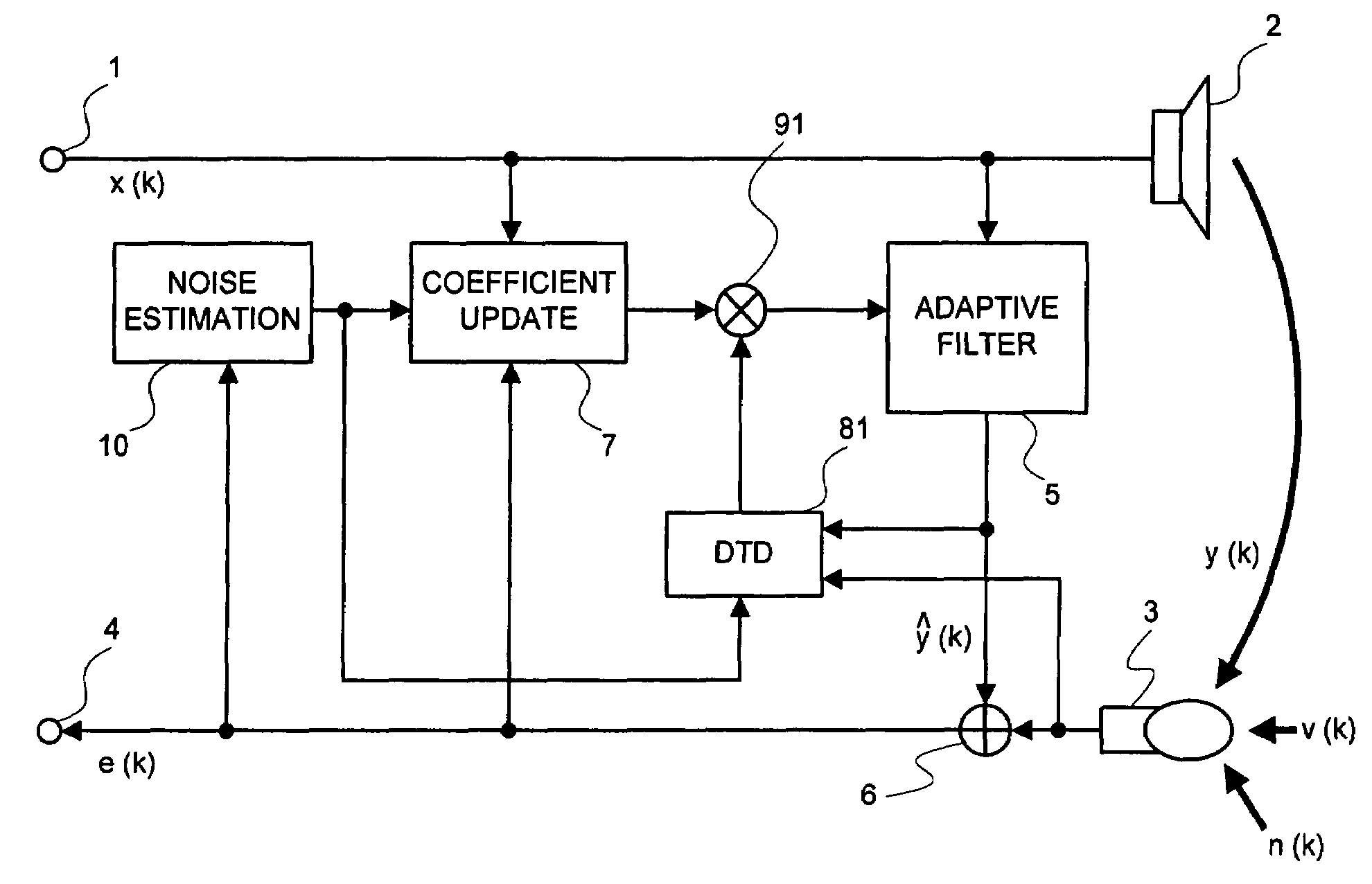
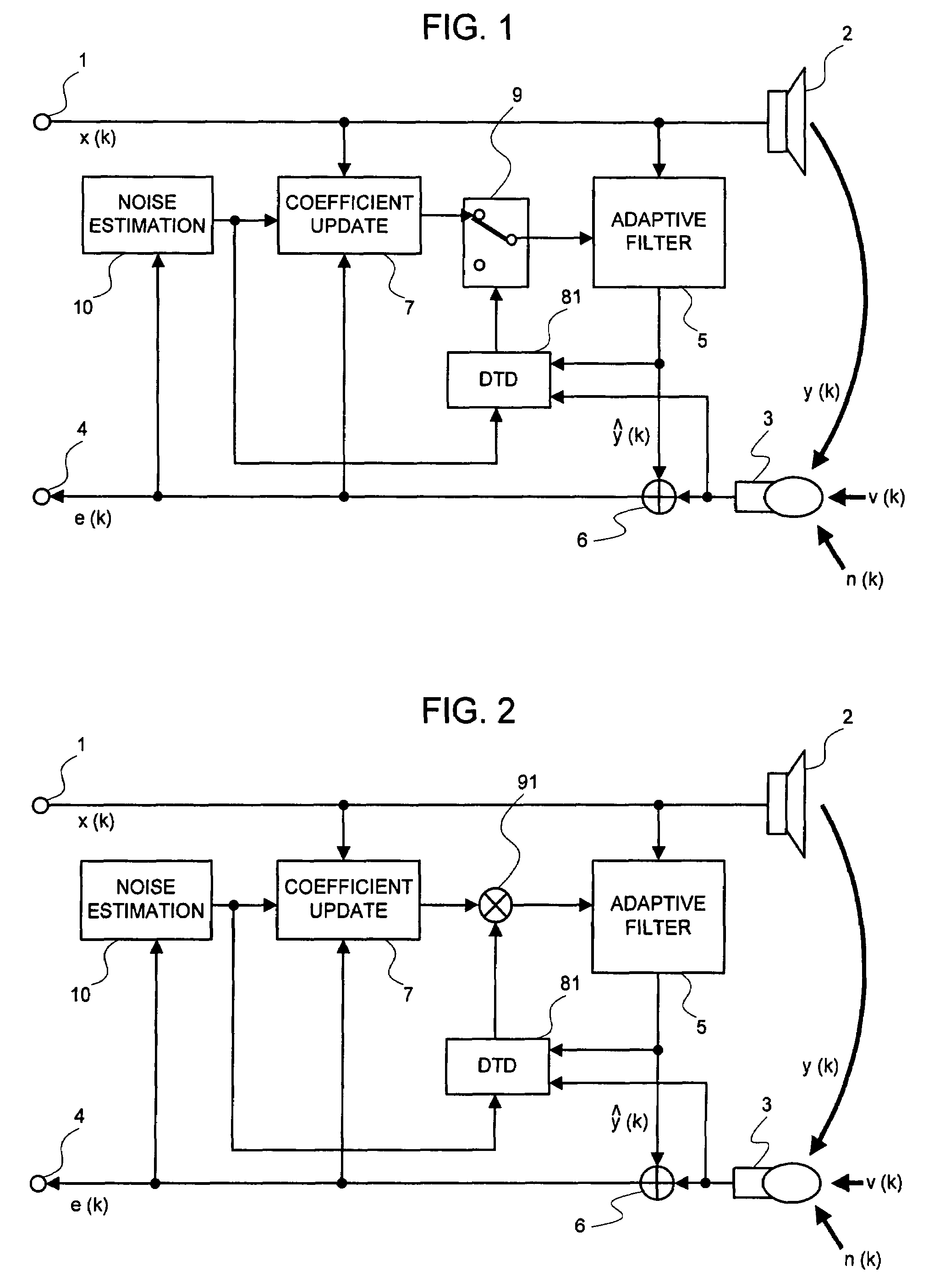
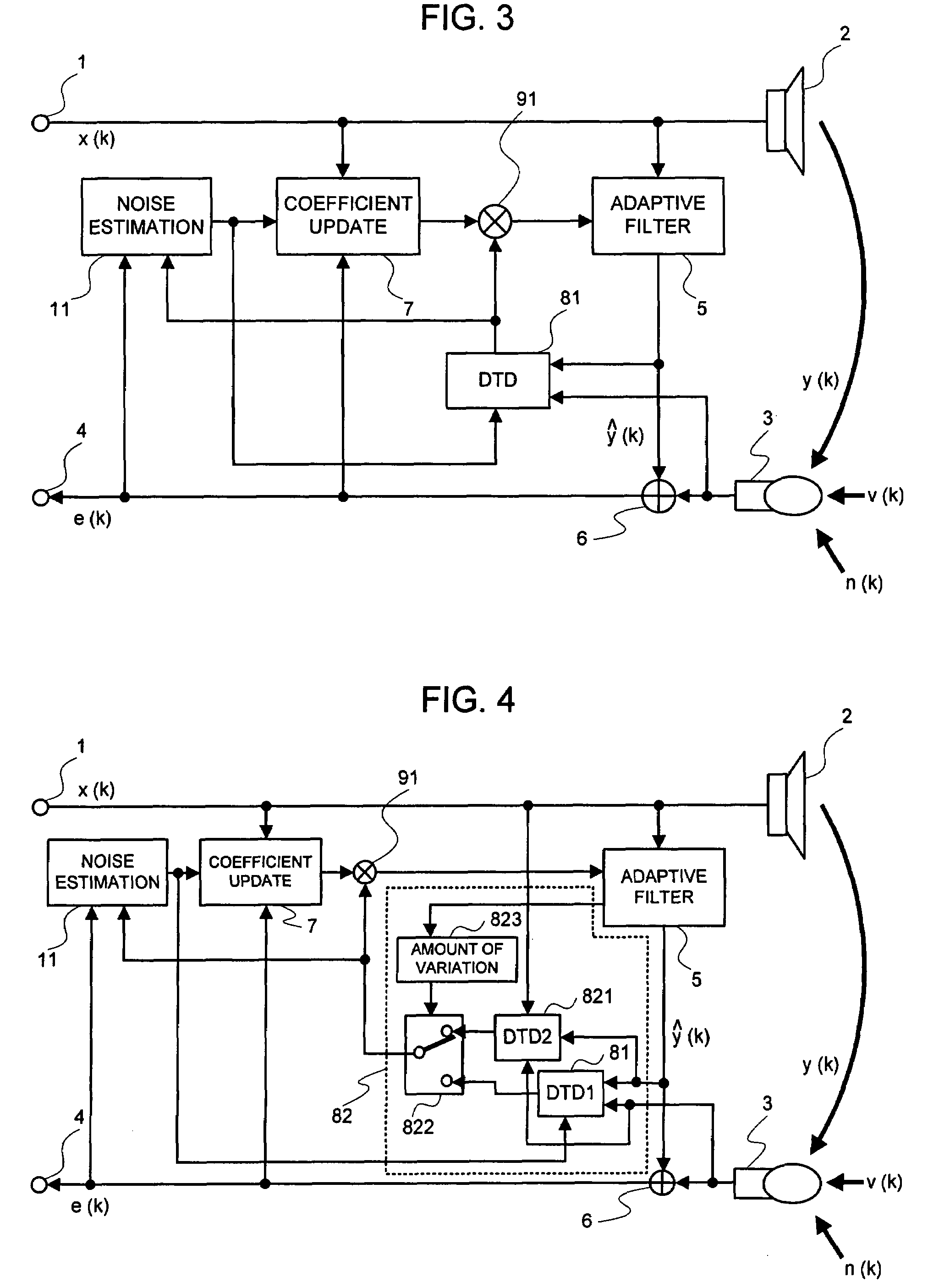
[0098]Referring to FIG. 1, the present invention includes an adaptive filter 5, a subtractor 6, a noise estimating circuit 10, a coefficient updating circuit 7, a switch 9, and a double-talk detecting circuit 81. The operation of the adaptive filter 5, subtractor 6, noise estimating circuit 10, coefficient updating circuit 7 and switch 9 has been described as the conventional technique with reference to FIG. 12. The noise estimating circuit 10 estimates a noise on receipt of an error. The double-talk detecting circuit 81 detects a double talk on receipt of a pseudo echo, a microphone signal, and an estimated noise.
embodiment 1
[0099
[0100]The double-talk detecting circuit 81 is supplied with a microphone signal m(k) and a pseudo echo y(k) hat. A procedure to detect a double talk using these signals will be given below:
[0101]Applying rxm=Rxxh to EQ. (9) gives EQ. (12):
[0102][Equation5]ξ=hTRxxhσm2.(12)
[0103]Using an approximation of EQ. (10), i.e., h W(k), and paying attention to the fact that E[hTX(k)]=E[y(k) hat], the following equation is obtained:
[0104][Equation6]ξ(k)=E[y^(k)2]σm2.(13)
In this equation, ξ is time-varying and therefore it is given as a function of k. The calculation of EQ. (13) consists of one multiplicative operation for a numerator in the radical sign, and one multiplicative operation for a denominator therein. In practice, σm2 is the average power of the microphone signal m(k), and is determined as:
[0105][Equation7]σm2(k)=∑j=0M-1m2(k-j).(14)
Since EQ. (14) is a moving average of m2(k), it can be calculated for a past value by an additive operation of m2(k) and a subtractive...
embodiment 2
[0125
[0126]In an embodiment 2, a time-varying threshold is applied to ξ(k). From EQ. (26), the value of ξ(k) in a double talk is approximately dependent upon a ratio between the power of a near-end signal and the power of an echo. Thus, if the power of a near-end signal and the power of an echo can be estimated, the value of ξ(k) in a double talk can be determined. The power of an echo can be sequentially determined by approximating it with the power of a pseudo echo. The power of a near-end signal can be calculated similarly to EQ. (21) as:
v2(k)hat=Ave[e2(k)]. (27)
The calculation of Ave[·] can be achieved using the moving average as given by EQ. (14) or (15), or a linear leaky integration represented by:
v2(k+1)hat=v2(k)hat+(1−δv)·e2(k), (28)
where δv is a time constant for averaging. For δv, adaptive control similar to that for δn may be used.
[0127]As can be clearly seen from EQ. (23), EQ. (28) is calculated to update v2(k) hat only when the residual echo and noise are substantial...
PUM
 Login to View More
 Abstract
Description
Claims
Application Information
 Login to View More
 - R&D
- Intellectual Property
- Life Sciences
- Materials
- Tech Scout
- Unparalleled Data Quality
- Higher Quality Content
- 60% Fewer Hallucinations
Browse by: Latest US Patents, China's latest patents, Technical Efficacy Thesaurus, Application Domain, Technology Topic, Popular Technical Reports.
© 2025 PatSnap. All rights reserved.Legal|Privacy policy|Modern Slavery Act Transparency Statement|Sitemap|About US| Contact US: help@patsnap.com