Check patentability & draft patents in minutes with Patsnap Eureka AI!

Method of transmitting video information over a wireless multi-path communication link and corresponding wireless station

a multi-path communication and wireless communication technology, applied in the field of wireless communication, can solve the problems of insufficient video transmission bandwidth, dynamic change in the quality of the wireless link, and inability to achieve the rate of current 802.11 wireless communication, and achieve the effect of optimizing the rendering quality of the video fram

Inactive Publication Date: 2015-06-30
CANON KK
View PDF4 Cites 0 Cited by
  • Summary
  • Abstract
  • Description
  • Claims
  • Application Information

AI Technical Summary

Benefits of technology

This approach optimizes bandwidth usage while maintaining high video quality by dynamically adapting to changing network conditions, ensuring robust transmission and improved rendering quality even with reduced bandwidth, without significant hardware or memory resource requirements.

Problems solved by technology

Such rate is not achievable in current 802.11 wireless communication systems using the 2.4 GHz and 5 GHz radio bands.
However, the 60 GHz millimeter wave technology is highly sensitive to perturbations (shadowing or interference) or fading phenomena making the quality of the wireless link dynamically change over time.
This results in the initial allocated link bandwidth being no longer sufficient for video transmission.
However, the spatial diversity requires duplicating the same information on a plurality of transmission paths, thus consuming communication network bandwidth and limiting the useful bandwidth allocated to the source data.
Therefore, using spatial diversity for conveying video stream between a wireless transmitting station (source device) and a wireless receiving station (destination device) would result in decreasing the video stream resolution so that it fits with the available link bandwidth, thereby reducing the quality of video rendering.
This is not suitable to optimize the use of the available link bandwidth over the multiple transmission paths, while keeping the best high quality video rendering.
Since more video components than necessary are then removed or dropped from the original video stream, the rendering of the video is severely decreased in quality.
Such a polyphase and quantization-based approach appears to be resource-demanding for the transmitting and receiving stations.

Method used

the structure of the environmentally friendly knitted fabric provided by the present invention; figure 2 Flow chart of the yarn wrapping machine for environmentally friendly knitted fabrics and storage devices; image 3 Is the parameter map of the yarn covering machine
View more

Image

Smart Image Click on the blue labels to locate them in the text.
Viewing Examples
Smart Image
  • Method of transmitting video information over a wireless multi-path communication link and corresponding wireless station
  • Method of transmitting video information over a wireless multi-path communication link and corresponding wireless station
  • Method of transmitting video information over a wireless multi-path communication link and corresponding wireless station

Examples

Experimental program
Comparison scheme
Effect test

first embodiment

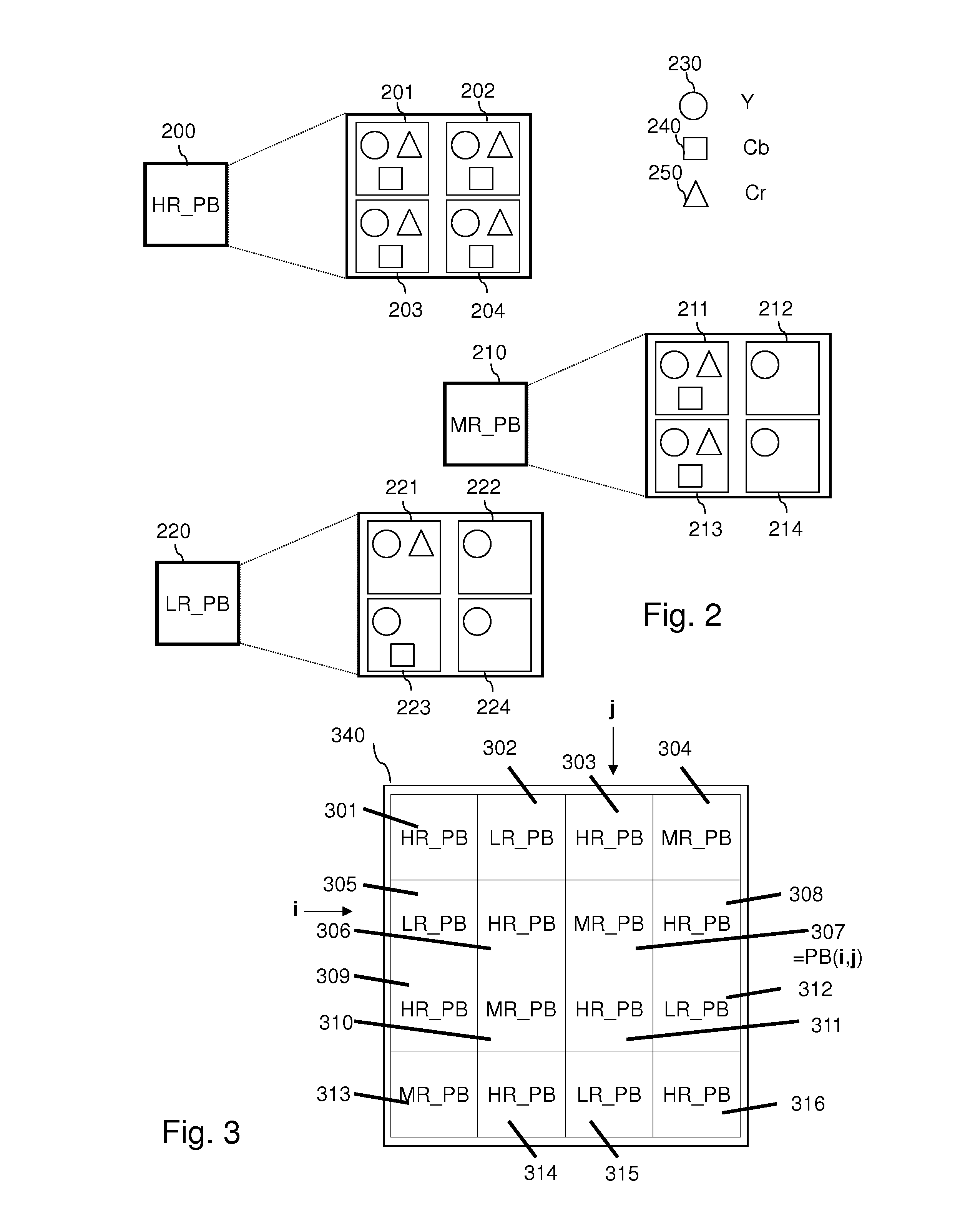
[0135]For the purposes of illustration of the present invention, the 4:4:4, 4:2:2 and 4:2:0 sub-sampling schemes are considered, corresponding to three resolutions: 4:4:4 resolution referred to as a “high resolution”, 4:2:2 resolution corresponding to a “medium resolution” and 4:2:0 resolution corresponding to a “low resolution”.

[0136]FIG. 2 illustrates a high resolution Pixel Block 200, a medium resolution Pixel Block 210 and a low resolution Pixel Block 220.

[0137]The high resolution Pixel Block 200 contains four pixels201, 202, 203 and 204. Each pixel is defined by three video components Y, Cb and Cr (4:4:4 sampling). A high resolution Pixel Block is then made of four luminance video components Y, four chroma video components Cb, and four chroma components Cr. Thus, the size of a high resolution Pixel Block 200 is 12 bytes. Such high resolution Pixel Block 200 is referenced HR_PB. The 4:4:4 scheme corresponds to the scheme of the uncompressed video frame provided by the applicatio...

second embodiment

[0257]the invention is now described with reference to FIG. 11, wherein the dropping operations drop enhancement part of the bits coding the pixel colour component, instead of the colour components themselves.

[0258]The same format of uncompressed video frame as above is used in this example, meaning that each pixel is made of three video components (e.g. Y, Cr and Cb), each coded over a fixed number of bits defining the various colour depths (e.g. 8 bits, 16 bits or 32 bits).

[0259]The conventional bit ordering defines a MSB (most significant bit) representing the highest order of bits and a LSB (least significant bit) representing the lowest order of bits. Between them, there are bits of intermediate orders.

[0260]The MSB is the most significant bit for the video rendering and the LSB the least significant one. If the MSB of a luma component is modified from 1 to 0, this modifies the luminance of the pixel by half the total range. For example, the corresponding pixel can switch from ...

the structure of the environmentally friendly knitted fabric provided by the present invention; figure 2 Flow chart of the yarn wrapping machine for environmentally friendly knitted fabrics and storage devices; image 3 Is the parameter map of the yarn covering machine
Login to View More

PUM

No PUM Login to View More

Abstract

The present invention a method of transmitting video information over a communication link made of several transmission paths between wireless transmitting and receiving stations. The method comprises, in the wireless transmitting station, obtaining an uncompressed video frame made of an array of pixel blocks, a pixel in the pixel blocks being represented by base pixel information and enhancement pixel information; generating at least one set of complementary pixel blocks from a given pixel block of the obtained uncompressed video frame, by applying different operations to said given pixel block for dropping different enhancement pixel information from that pixel block, so that the complementary pixel blocks comprise different enhancement pixel information and each comprises the base pixel information; and for each set, transmitting the complementary pixel blocks over respective different transmission paths to the wireless receiving station. This provides robustness of video transmission while keeping a high quality of video rendering.

Description

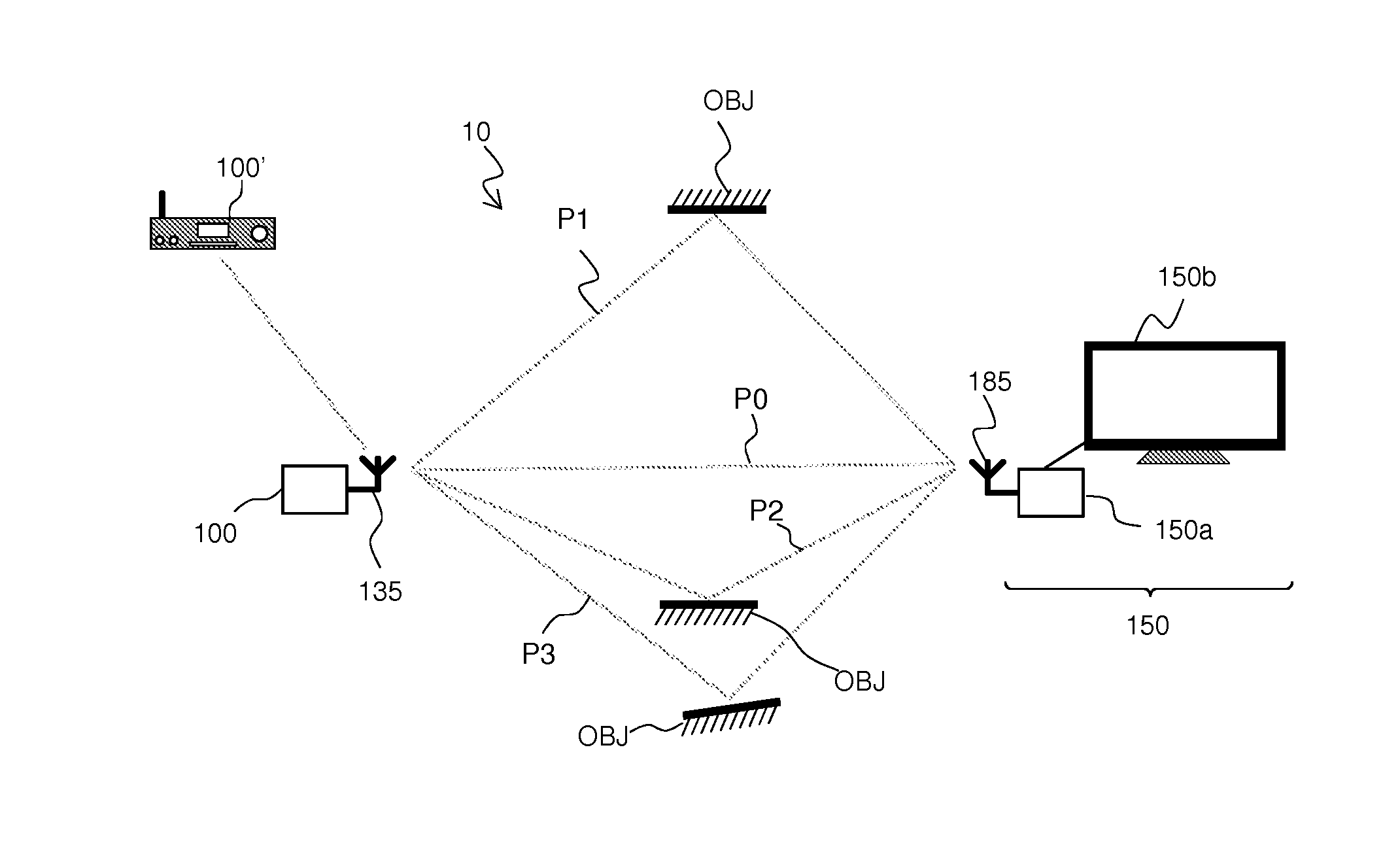
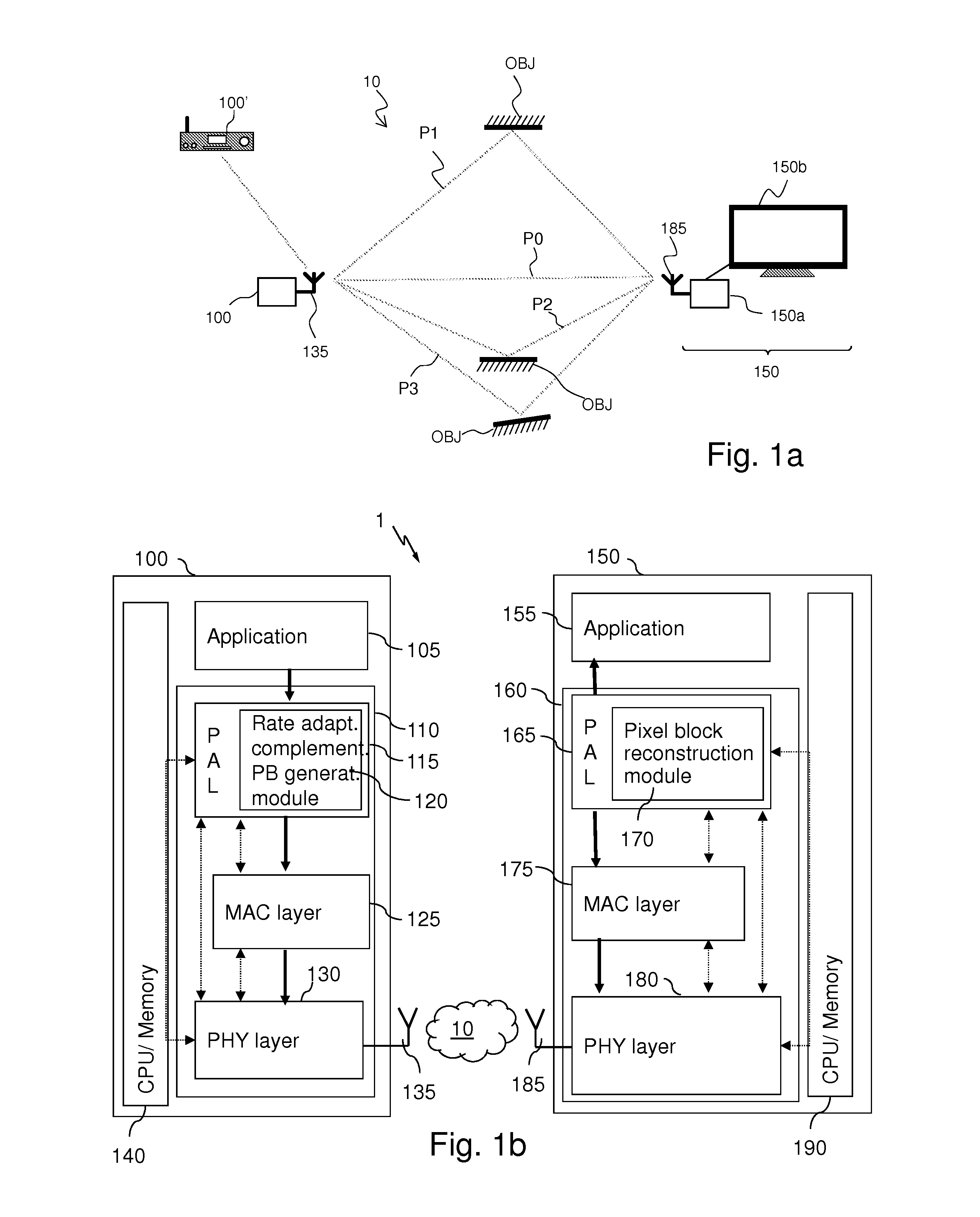
[0001]This application claims priority from GB patent application No. 11 21821.1 of Dec. 19, 2011 which is incorporated herein by reference.FIELD OF THE INVENTION[0002]The present invention relates in general to wireless communication, and in particular, to processing uncompressed video streams for wireless communication over multiple transmission paths.BACKGROUND OF THE INVENTION[0003]New recent multimedia applications, such as high-definition audio / video streaming, require wireless transmission of uncompressed video at high data rate of about several Gbps (Gigabits per second), with low latency.[0004]High definition (HD) video generally refers to a sequence of 60 Hz video frames with 1920 vertical lines and 1080 horizontal lines corresponding to 1920×1080 pixels of 24 bits. A video wireless communication system that supports such HD video requires a channel or communication link bandwidth of about 3 Gbps to support video data only.[0005]Such rate is not achievable in current 802.1...

Claims

the structure of the environmentally friendly knitted fabric provided by the present invention; figure 2 Flow chart of the yarn wrapping machine for environmentally friendly knitted fabrics and storage devices; image 3 Is the parameter map of the yarn covering machine
Login to View More

Application Information

Patent Timeline
no application Login to View More
Patent Type & Authority Patents(United States)
IPC IPC(8): H04N21/63H04N19/00H04N19/66
CPCH04N19/587H04N21/631H04N19/66H04N19/164H04N19/176H04N19/189H04N7/0155H04N7/12H04N21/43637H04N19/30
Inventor LAGRANGE, PASCALSEVIN, JULIEN
Owner CANON KK
Features
  • R&D
  • Intellectual Property
  • Life Sciences
  • Materials
  • Tech Scout
Why Patsnap Eureka
  • Unparalleled Data Quality
  • Higher Quality Content
  • 60% Fewer Hallucinations
Social media
Patsnap Eureka Blog
Learn More