Acidic gases permeated carboxyalkyl starch and alkaline starch extrudates and process for making the same
a technology of alkaline starch and carboxyalkyl starch, which is applied in the field of acidic gases permeating carboxyalkyl starch and alkaline starch extrudates and process for making the same, can solve the problems of increasing the vulnerability to energy pricing fluctuations, increasing the carbon footprint, and depleting non-renewable oil reserves
- Summary
- Abstract
- Description
- Claims
- Application Information
AI Technical Summary
Problems solved by technology
Method used
Image

Examples
example 1
Surface Treatment of Carboxyalkyl Starches by Acidic Gas Permeation
[0080]Ground and dirty CMS (320 Kg; 20-100 Mesh) was added into a 7000 liter double jacketed stainless steel reactor. The reactor was then evacuated to at 20 mm Hg. Nitrogen was injected to equilibrate with ambient pressure (760 mmHg). About 1725 liters of pre-heated solvent (MeOH / H2O, at 82.5% MeOH), at 55-60° C. was injected in the reactor. The slurry was agitated approximately at 100 rpm with a shaft equipped with 68 cm long propellers spaced from 30 cm from the reactor bottom. The mixture pH was adjusted by adding 2.1% (w / w HCl solution The HCl solution was typically prepared using 41.3 ml of HCl, 108.7 ml of tap water and 850 ml of methanol. Hydrochloric acid was added according to a kinetics illustrated in FIG. 3. As the data FIG. 3 was obtained with only 120 g of CMS (dry basis), 2373 times more HCl was used when the reaction was scaled to a larger pilot scale reaction vessel with the same results. Cleaning wa...
example 2
[0083]pH Adjusted and Surface Treated Carboxymethyl Starches by Acidic Gas Permeation
[0084]Carboxymethyl starch from the extruder (3980 kg) was loaded in the dextrinizer. The dextrinizer was kept under a 180 mm Hg vacuum with a gentle rotation agitation for 5 minutes. 4.54 kg of gaseous hydrogen chloride was added inside the dextrinizer at a rate of 0.45 kg / min. After adding the gaseous HCl portion, the product was kept under gentle agitation for 5 minutes and a vacuum of 180 mmHg was made. A sample of carboxymethyl starch particles was taken from the dextrinizer to determine its pH in 10% water suspension.
[0085]Another 4.54 kg of gaseous hydrogen chloride was added inside the dextrinizer at a rate of 0.45 kg / min. After adding the gaseous HCl portion, the product was kept under gentle agitation for 5 minutes and the 180 mmHg vacuum was made. A sample of carboxymethyl starch particles was taken from the dextrinizer to determine its pH in 10% water suspension. Another 4.54 kg of gaseo...
example 3
[0089]pH by Particle Size
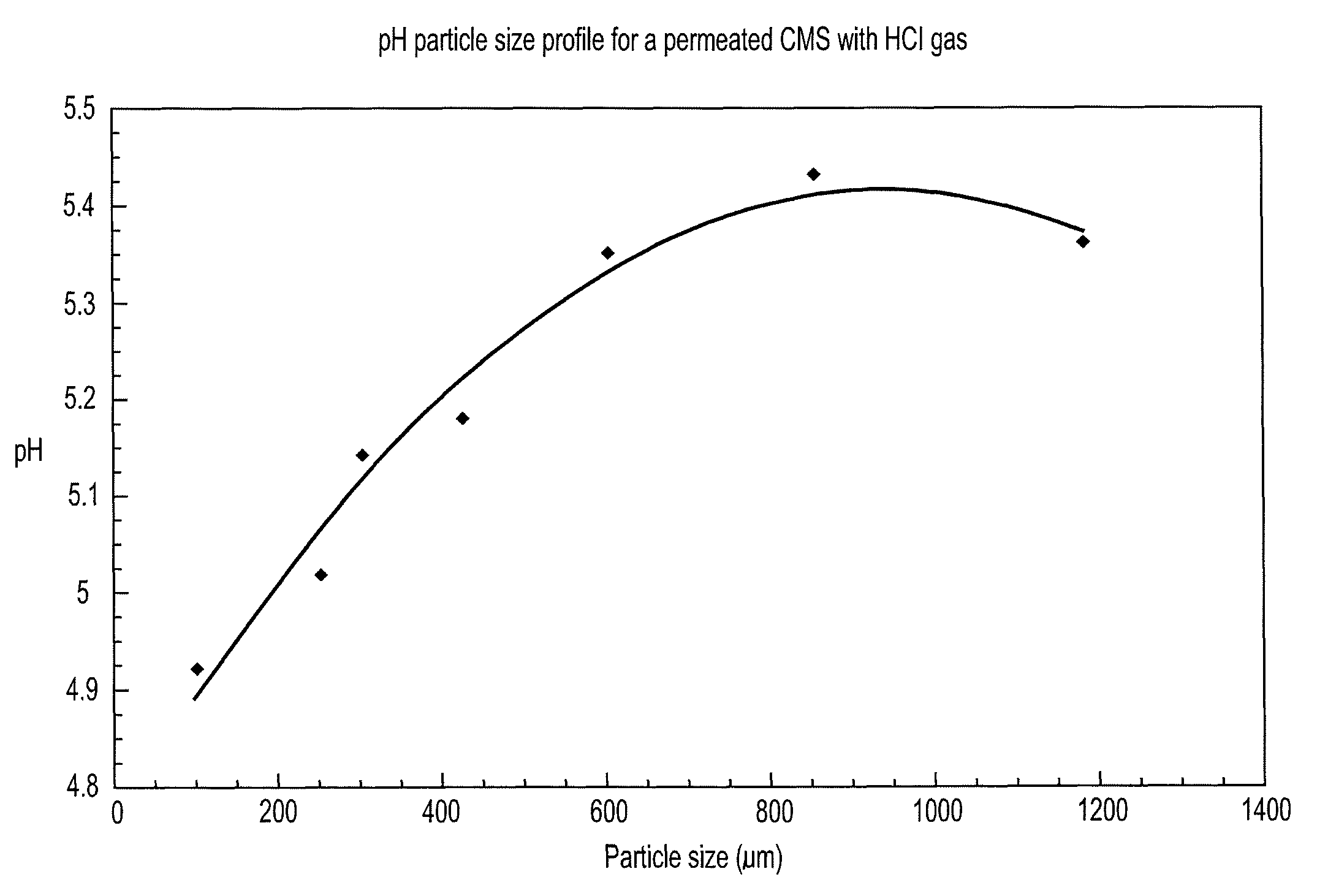
[0090]From the cleaned and ground mass of Example 2, 60 g was placed in a 500 ml polypropylene jar which could be closed with a septum equipped lid. A 150 ml polypropylene beaker was placed over the samples and filled with 10 g of NaCl. A syringe comprising 0.6 ml of concentrated sulphuric acid was injected over the NaCl beaker, generating hydrogen chloride. CMS particles were sieved on 1180 μm, 850 μm, 600 μm, 425 μm, 300 μm, 250 μm and 150 μm and the pH of these size fractionated particles is shown in FIG. 1.
PUM
| Property | Measurement | Unit |
|---|---|---|
| size | aaaaa | aaaaa |
| conductivity | aaaaa | aaaaa |
| temperature | aaaaa | aaaaa |
Abstract
Description
Claims
Application Information
 Login to View More
 - R&D
- Intellectual Property
- Life Sciences
- Materials
- Tech Scout
- Unparalleled Data Quality
- Higher Quality Content
- 60% Fewer Hallucinations
Browse by: Latest US Patents, China's latest patents, Technical Efficacy Thesaurus, Application Domain, Technology Topic, Popular Technical Reports.
© 2025 PatSnap. All rights reserved.Legal|Privacy policy|Modern Slavery Act Transparency Statement|Sitemap|About US| Contact US: help@patsnap.com