Supercharge Your Innovation With Domain-Expert AI Agents!

Dewatering machine and process

a technology of dewatering machine and process, which is applied in the direction of granular material drying, manufacturing tools, lighting and heating apparatus, etc., can solve the problems of unsatisfactory waste and difficult containment, and achieve the effect of reducing the number of dewatering and drying machines

Active Publication Date: 2016-04-19
NFM WELDING ENGINEERS
View PDF25 Cites 3 Cited by
  • Summary
  • Abstract
  • Description
  • Claims
  • Application Information

AI Technical Summary

Benefits of technology

The solution effectively reduces the escape of fines and volatility, achieving moisture reduction from up to 20% to less than 0.5% water by weight in polymers and up to 50% to less than 3% in elastomers using a single machine, thereby improving efficiency and safety while minimizing waste and energy consumption.

Problems solved by technology

In the prior art, during the dewatering process, many fines typically escape with the moisture that is being removed, and must either then be recycled using undesirable additional equipment and steps, or disposed of, which creates undesirable waste.
In addition, prior art dewatering processes typically employ more than one dewatering machine, each of which involves a cost investment to purchase, operate and maintain.
Moreover, the dewatering process often involves the escape of vapors and / or particles that may be volatile, and must be contained.
However, the design of certain prior art dewatering machines makes such containment difficult.

Method used

the structure of the environmentally friendly knitted fabric provided by the present invention; figure 2 Flow chart of the yarn wrapping machine for environmentally friendly knitted fabrics and storage devices; image 3 Is the parameter map of the yarn covering machine
View more

Image

Smart Image Click on the blue labels to locate them in the text.
Viewing Examples
Smart Image
  • Dewatering machine and process
  • Dewatering machine and process
  • Dewatering machine and process

Examples

Experimental program
Comparison scheme
Effect test

Embodiment Construction

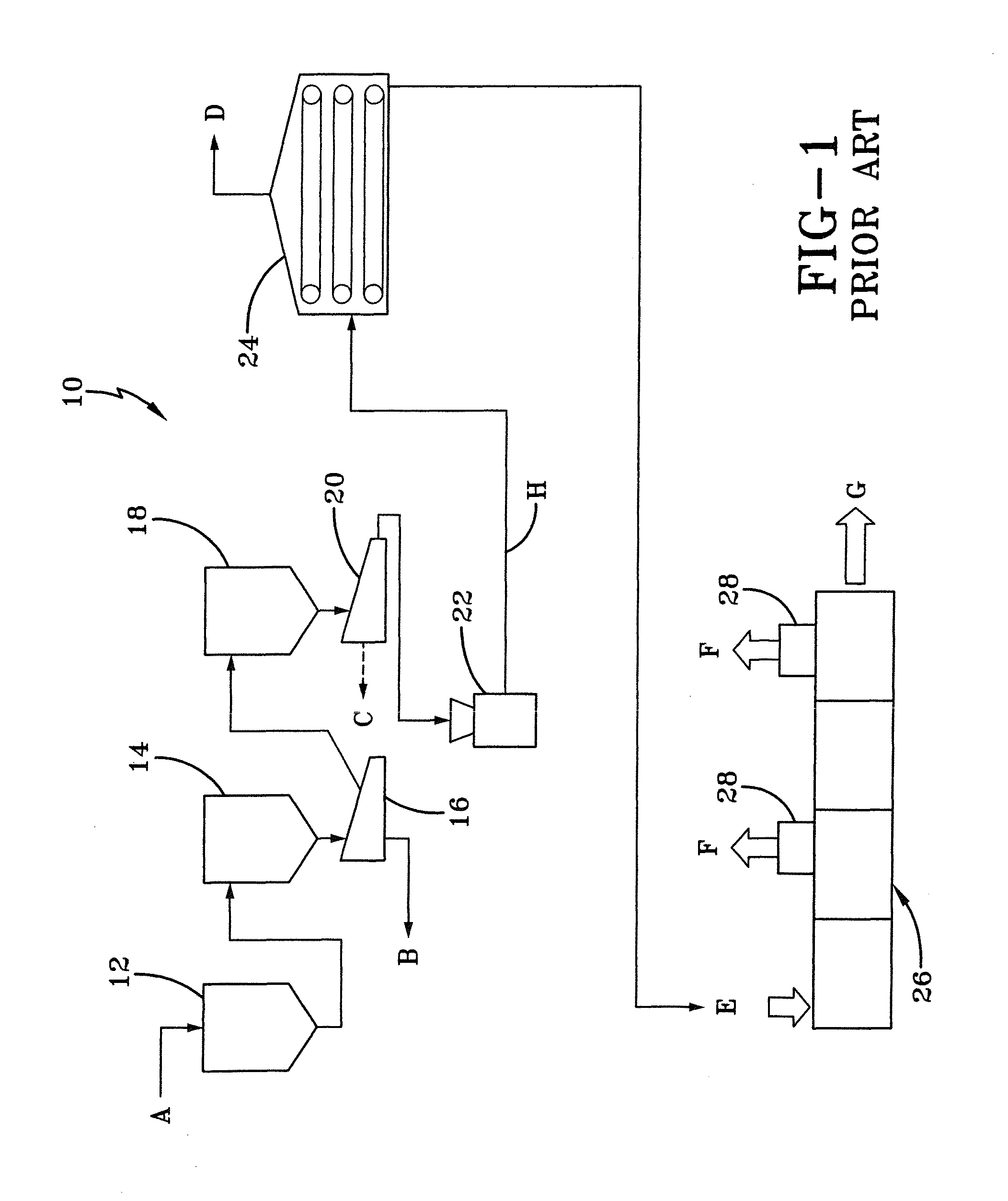
[0025]In order to better understand the improved dewatering machine and process of the present invention, a discussion of prior art dewatering machines and processes is in order. By way of example, reference herein is provided to the production of the copolymer acrylonitrile butadiene styrene, which is known in the art as ABS. ABS is a copolymer in which a styrene acrylonitrile (SAN) copolymer serves as a matrix for a butadiene styrene (BS) synthetic rubber filler, which is dispersed in the matrix. A method of producing ABS is emulsion polymerization with a graft copolymer, which is blended with SAN mass polymer. This method of ABS production is typically carried out in one of two ways: conventional coagulation or direct latex coagulation.

[0026]A conventional coagulation process is shown in FIG. 1 and is indicated generally at 10. In conventional coagulation process 10, stripped latex, indicated by A, is introduced into a blend tank 12 and is then transferred by pipe or other means ...

the structure of the environmentally friendly knitted fabric provided by the present invention; figure 2 Flow chart of the yarn wrapping machine for environmentally friendly knitted fabrics and storage devices; image 3 Is the parameter map of the yarn covering machine
Login to View More

PUM

No PUM Login to View More

Abstract

A dewatering machine for reducing moisture of a polymer or an elastomer includes a generally solid barrel and a pair of screws disposed in the barrel. At least a portion of the screws are intermeshing, and drive means are coupled to the screws. At least one mechanical filter is connected to the barrel. The machine includes means that enable particles of the polymer or the elastomer to fuse, which reduces the amount of fines that escape from the machine. In addition, the machine reduces the moisture of the polymer from up to about 20 percent water by weight to less than about 0.5 percent water by weight, and the moisture of the elastomer from up to about 50 percent water by weight to less than about 3.0 percent water by weight. A method of dewatering for reducing the moisture of a polymer or an elastomer is also provided.

Description

CROSS-REFERENCE TO RELATED APPLICATIONS[0001]This application claims the benefit of PCT Application Ser. No. PCT / US2012 / 037702, filed on May 14, 2012, which claims the benefit of U.S. Provisional Application Ser. No. 61 / 485,762, filed on May 13, 2011.BACKGROUND OF THE INVENTION[0002]1. Technical Field[0003]The invention relates to the art of dewatering and drying of polymers and elastomers. More particularly, the invention relates to the art of mechanical dewatering and drying machines that are used in the finishing of the formulation of certain polymers and elastomers. Still more particularly, the invention is directed to an improved dewatering and drying machine and accompanying process which reduce the escape of fine particles encountered in prior art dewatering and drying machines and processes, employs fewer machines than prior art dewatering and drying processes, and reduces the volatility of the dewatering process.[0004]2. Background Art[0005]In the formulation or production ...

Claims

the structure of the environmentally friendly knitted fabric provided by the present invention; figure 2 Flow chart of the yarn wrapping machine for environmentally friendly knitted fabrics and storage devices; image 3 Is the parameter map of the yarn covering machine
Login to View More

Application Information

Patent Timeline
no application Login to View More
Patent Type & Authority Patents(United States)
IPC IPC(8): C08J3/12B30B9/16B29C47/68B29C47/76B29C47/00F26B5/14B29C47/36B29C47/60F26B17/20B29C47/40B29C47/82B01D43/00B29C48/03B29C48/385B29C48/39B29C48/40B29C48/41B29C48/53B29C48/69B29C48/76B29C48/793B29K55/02
CPCF26B17/20B01D43/00B29C47/0009B29C47/366B29C47/369B29C47/402B29C47/6012B29C47/6018B29C47/68B29C47/762B29C47/763B29C47/767B29C47/82B29C47/822B29C47/825B30B9/16F26B5/14B29K2055/02F26B2200/08B29C48/793B29C48/03B29C48/39B29C48/53B29C48/69B29C48/83B29C48/385B29C48/402B29C48/762B29C48/763B29C48/767B29C48/832B29C48/834B29C48/41B29C48/40B30B9/12B29C48/76B29C48/505
Inventor TUCKER, CHRISTOPHER S.
Owner NFM WELDING ENGINEERS
Features
  • R&D
  • Intellectual Property
  • Life Sciences
  • Materials
  • Tech Scout
Why Patsnap Eureka
  • Unparalleled Data Quality
  • Higher Quality Content
  • 60% Fewer Hallucinations
Social media
Patsnap Eureka Blog
Learn More