Methods for inhibiting starvation of a cell
a cell and starvation technology, applied in the field of treatment or prevention of starvation in a cell, can solve the problems of reducing malfunctioning and death of cells, and affecting the quality of life, so as to improve the intracellular levels of glucose, lactate, pyruvate, and/or nadph, and improve the viability of cells
- Summary
- Abstract
- Description
- Claims
- Application Information
AI Technical Summary
Benefits of technology
Problems solved by technology
Method used
Image


Examples
example 1
Assessing Stimulation of the Insulin / mTOR Pathway and Resulting Effects on Cone Cell Death in a Mouse Model of Retinitis Pigmentosa
Material and Methods
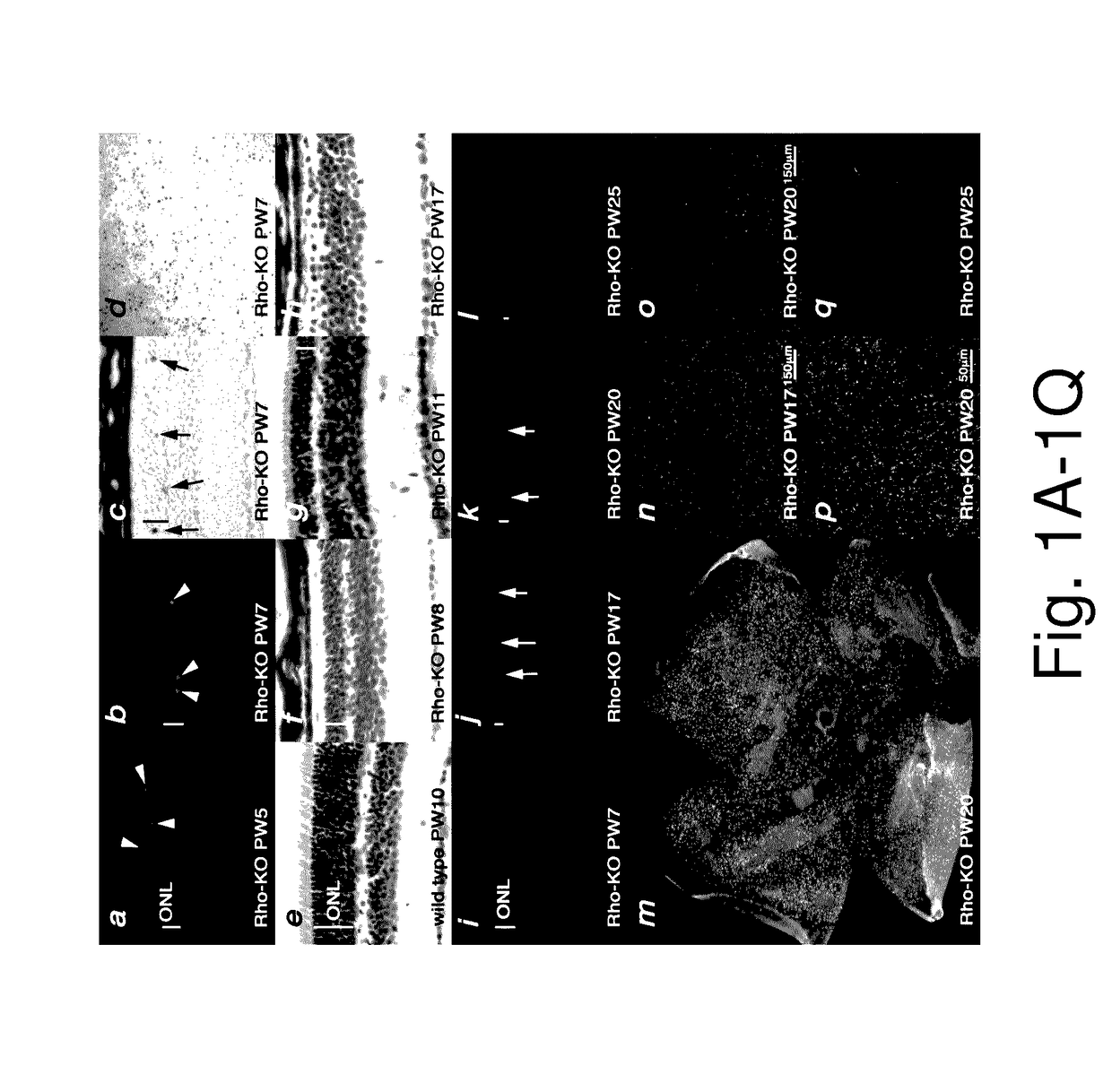
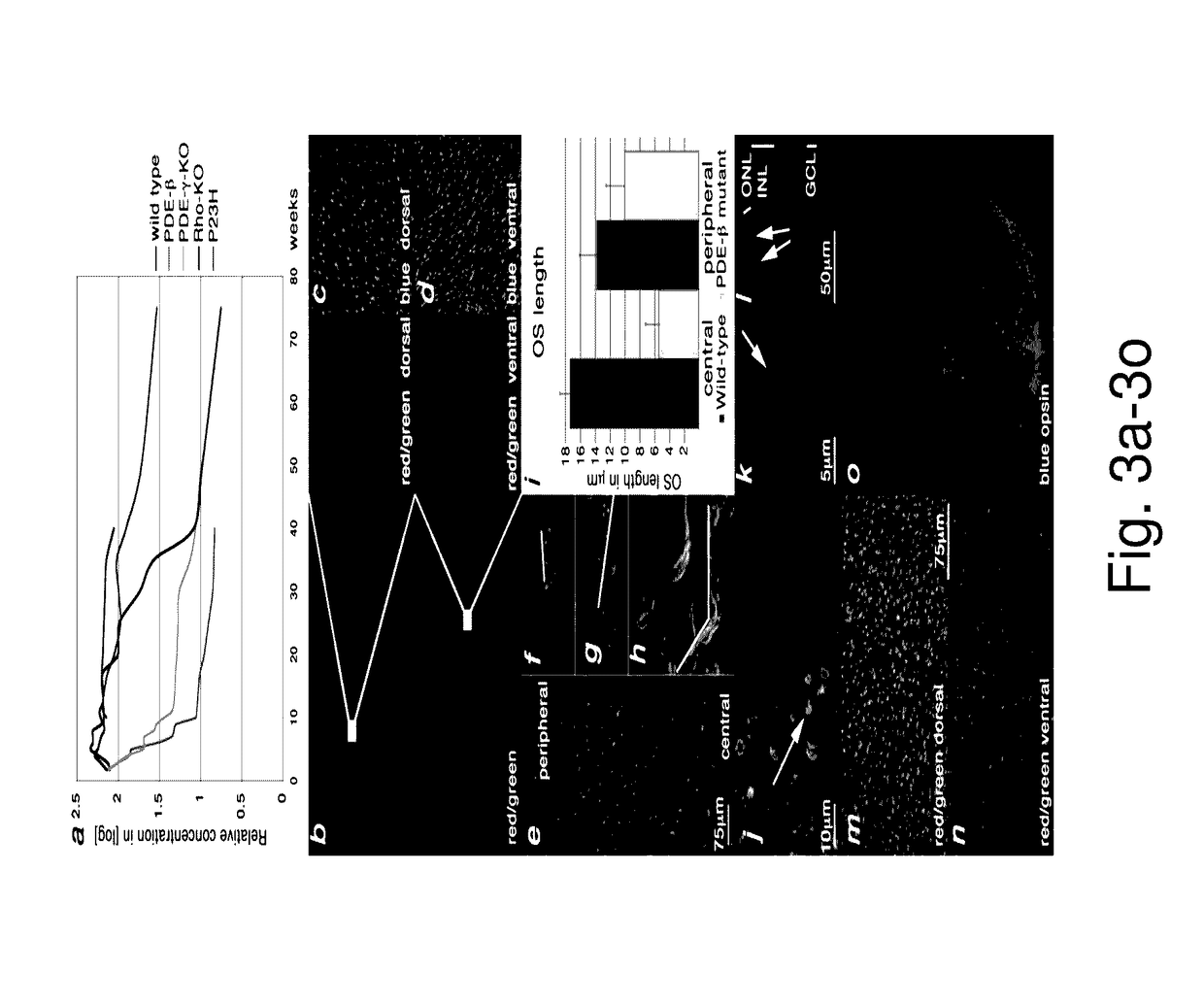
[0178]Animals: Wild type (wt) mice (C57B1 / 6N) and PDE-β− / − mice (referred as rd1 or FVB / N) were purchased from Taconic Farms. The PDE-β− / − mice have a mutation in the β-subunit of cGMP phosphodiesterase (Bowes, C. et al. (1990) Nature 347, 677-80) (PDE). The PDE-γknock-out (PDE-γ-KO) lacks the γ-subunit of PDE (Tsang, S. H. et al. (1996) Science 272, 1026-9). The rhodopsin knock-out (Rho-KO) lacks the rod-specific opsin gene (Tsang, S. H. et al. (1996) Science 272, 1026-9; Lem, J. et al. (1999) Proc Natl Acad Sci USA 96, 736-41). The P23H mouse has a proline-23 to histidine mutation in the rhodopsin gene (Naash, M. I., et al. (1993) Proc Natl Acad Sci USA 90, 5499-503). As this mouse carries a transgene the strain was always crossed back to C57B1 / 6N to ensure that none of the progeny would carry two alleles of the transgene. The trans...
example 2
Transfection of Cone Cells with Gluconeogenic Genes to Increase Cone Viability
[0199]Neurons can be compromised by genetic and environmental factors that lead to their malfunction and death. In the retina, specialized sensory neurons, the photoreceptors (rods and cones), as well as ganglion cells, the output neurons of the retina, are the neuronal cell types that malfunction and die, leading to partial or complete loss of vision. The reasons that retinal neurons die in a disease, Retinitis Pigmentosa, that leads to loss of vision have been investigated. In Retinitis Pigmentosa, mutation of a gene that is only expressed in rods leads to the death of the rods. Subsequently, cones also die. It has been discovered that cones suffer from a lack of activity in the mTOR pathway, and appear to be starving. Starvation in cones was indicated by the activation of the chaperone mediated autophagy pathway, whereby a cell digests selected proteins when under starvation conditions. Prior to autopha...
example 3
Transfection of Cone Cells with Gluconeogenic Genes to Increase Cone Viability
[0203]As described in Example 2, AAV vectors (2 / 5) were created to transmit the three gluconeogenesis genes, Pcx, Pck, and Fbp-1 (as a single vector comprising the three genes operably linked to the CMV promoter), and were used to produce glucose in transfected cells.
[0204]As described below, the three genes (Pcx, Pck, and Fbp-1) were separated into different AAV vectors operably linked to the cone-specific promoter, CAR, from the cone arrestin gene. In some cases, a gluconeogenesis gene was also operably linked to the marker gene, H2BGFP, a nuclear form of GFP, or mGFP, a membrane-bound form of GFP, to allow the tracking of infected cells. FIG. 30 depicts a map of the AAV2 / 5 vector comprising the CAR promoter, the gluconeogenesis gene, Pcx-1, and mGFP (the sequence of this vector is set forth in SEQ ID NO:12); FIG. 31 depicts a map of the AAV2 / 5 vector comprising the CAR promoter and the gluconeogenesis g...
PUM
| Property | Measurement | Unit |
|---|---|---|
| time | aaaaa | aaaaa |
| time | aaaaa | aaaaa |
| time | aaaaa | aaaaa |
Abstract
Description
Claims
Application Information
 Login to View More
 - R&D
- Intellectual Property
- Life Sciences
- Materials
- Tech Scout
- Unparalleled Data Quality
- Higher Quality Content
- 60% Fewer Hallucinations
Browse by: Latest US Patents, China's latest patents, Technical Efficacy Thesaurus, Application Domain, Technology Topic, Popular Technical Reports.
© 2025 PatSnap. All rights reserved.Legal|Privacy policy|Modern Slavery Act Transparency Statement|Sitemap|About US| Contact US: help@patsnap.com