Supercharge Your Innovation With Domain-Expert AI Agents!

Stabilized photo-alignment layer for liquid crystal

a liquid crystal and photo-alignment technology, applied in the field of liquid crystal (lc) photo-alignment layer, can solve the problems of mechanical damage, real challenge of photo-degradation, and not good for the yield of high-resolution displays, and achieve good and stable photo-alignment

Active Publication Date: 2017-10-17
NANO & ADVANCED MATERIALS INST
View PDF10 Cites 1 Cited by
  • Summary
  • Abstract
  • Description
  • Claims
  • Application Information

AI Technical Summary

Benefits of technology

The solution provides a stable and high-quality photo-alignment layer with improved anchoring energy, voltage holding ratio, and reduced residual DC charge, suitable for modern display devices and photonic applications, maintaining alignment stability under various exposures.

Problems solved by technology

The conventional alignment technique, i.e. rubbing, offers several mechanical damages and is not good for the yield of the high resolution displays.
However, the photo-degradation is the real challenge to deploy these systems for the real applications.
In the art, there has been research for providing such stable alignment layers, but other issues like residual DC charge, VHR and anchoring energy do not meet the criterion for acceptance.
However, these photo-alignment layers based on the reorientation process are not stable and can be destroyed by further exposure of light or thermal energy.
Furthermore, such azo dyes are highly sensitive to visible light, particularly the blue light, making the problem even more serious for display applications where such alignment layers are exposed to strong backlight all the time.
As early as 2003, it was proposed to add a reactive group, capable to be polymerized, to the dye molecule itself, but it results in poor anchoring energy.
However, these ideas led to long time and high cost of synthesis.
Furthermore, the alignment quality of LCs was ruined because of additional groups.
In spite of having a strong constraint on the layer thickness of LCP, it hardly can provide sufficient stabilization to the azo-dye photo alignment layer [12].
This approach provides good stability to the alignment layer but due to a complex molecular structure, the resultant optical quality is not good, particularly for the FLC.
This requirement for a large molecular tilt angle greatly limits the compounds and mixtures thereof which can be employed in such TIR devices.
Therefore, if the alignment layer is not stable, the easy axis rotates and causes distortion and local defect in the alignment, thus decreasing the contrast ratio of the FLC cell.
However, if the alignment layer is stable, the contrast ratio hardly has a significant impact due to such exposures.
The easy axis of the SD1 alignment layer was manipulated again with relatively worse alignment and thus the worse optical quality.
In addition to the photo-stability, temperature stability is also an important issue that is a big concern for manufacturers due to several high temperature fabrication processes in the manufacturing line.
The VHR is another important issue for active matrix LCDs.
In addition to all of these issues another most serious issue is image sticking in displays, which is related to the RDC of the alignment layer.
This becomes even more serious for any particular frame is displayed for a long time.
As expected, because of mixing, the RDC of the stabilized SD1 by the polymer network is an issue and has been found to be considerably larger than that of the pure SD1.

Method used

the structure of the environmentally friendly knitted fabric provided by the present invention; figure 2 Flow chart of the yarn wrapping machine for environmentally friendly knitted fabrics and storage devices; image 3 Is the parameter map of the yarn covering machine
View more

Image

Smart Image Click on the blue labels to locate them in the text.
Viewing Examples
Smart Image
  • Stabilized photo-alignment layer for liquid crystal
  • Stabilized photo-alignment layer for liquid crystal
  • Stabilized photo-alignment layer for liquid crystal

Examples

Experimental program
Comparison scheme
Effect test

Embodiment Construction

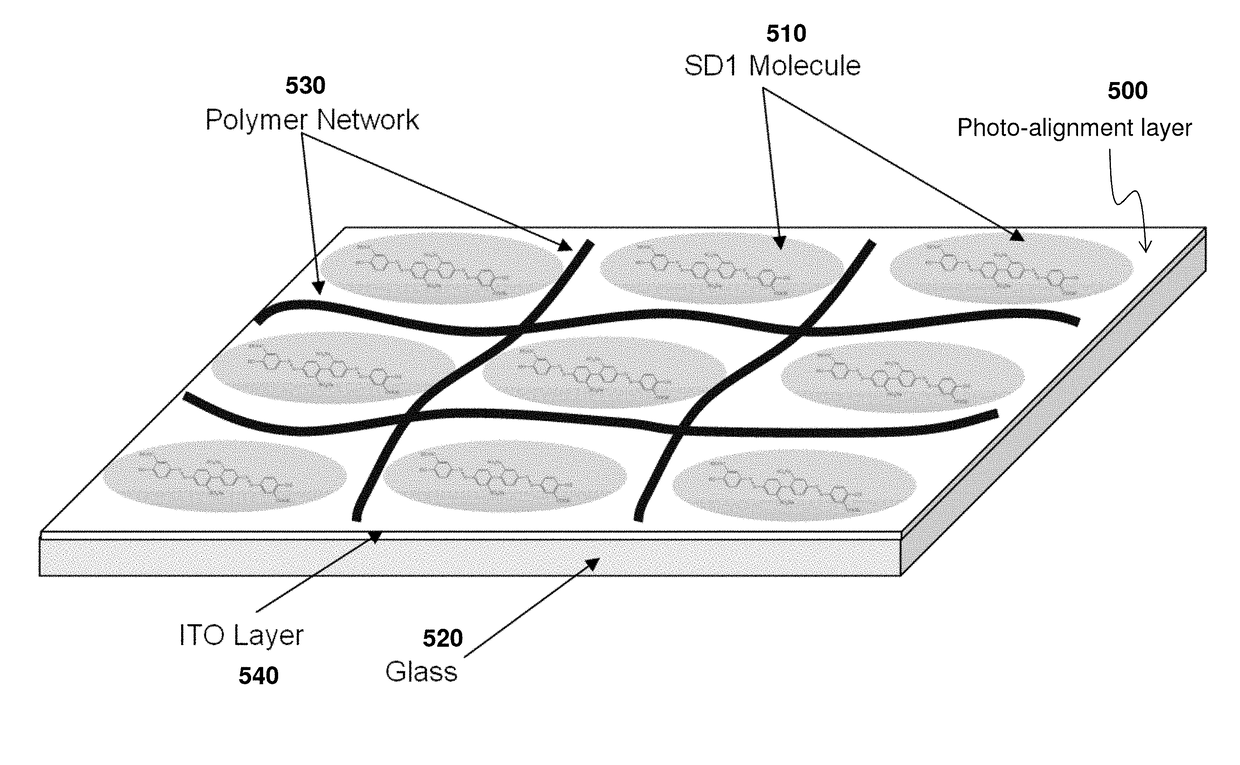
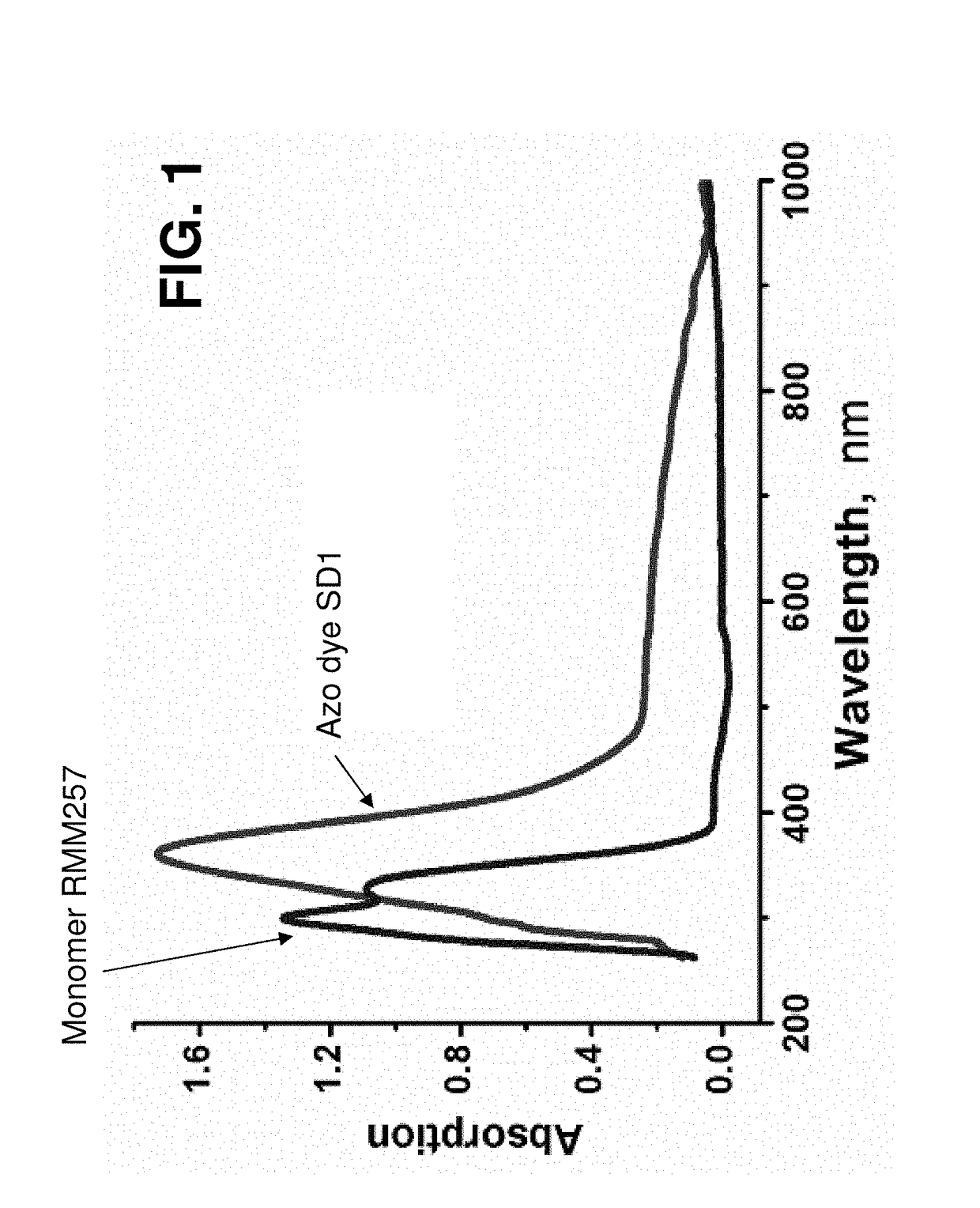
[0065]The present invention is developed based on the following observation. Recently, it has been observed that good control on the anchoring energy provides an opportunity to optimize optical characteristics of displays, particularly the ESHFFLC's [14-16]. Moreover, the anchoring energy of an azo-dye alignment layer is tunable by different irradiation doses [14, 15]. Therefore, to achieve a good optical quality, it is critically important to perform both processes, i.e. alignment and stabilization, separately. In simple words, it is preferred to have distinct absorption bands for the photo-alignment azo dye and the stabilizing material. Here, the stabilizing material is a monomer that forms a polymer in the stabilization process.

[0066]The proposition of using two separate processes for alignment and stabilization to achieve a good optical quality has been verified by an experiment detailed in Section A below. Section B provides the experimental results. With the optimal concentrat...

the structure of the environmentally friendly knitted fabric provided by the present invention; figure 2 Flow chart of the yarn wrapping machine for environmentally friendly knitted fabrics and storage devices; image 3 Is the parameter map of the yarn covering machine
Login to View More

PUM

PropertyMeasurementUnit
molecular tilt angleaaaaaaaaaa
thickaaaaaaaaaa
isotropic temperatureaaaaaaaaaa
Login to View More

Abstract

A liquid-crystal photo-alignment layer that is composed of polymer stabilized azo dyes is provided, where a polymer network is introduced in the photo-alignment layer for stabilization. The photo-alignment layer is realized based on a two-step irradiation to first achieve molecule alignment to form the photo-alignment layer and then stabilize this layer. To realize the photo-alignment layer, a pre-determined surface of the substrate is first coated with a film of mixture. The mixture comprises an azo dye and a monomer preferably mixed in an optimal concentration of 0.67 wt / wt. The azo dye and the monomer have light-absorption peaks at different wavelengths such that photo-alignment of the azo-dye molecules and stabilization of the photo-alignment layer by polymerization of the monomer are achievable by two separate exposures of light to the film.

Description

CROSS-REFERENCE TO RELATED APPLICATION[0001]This application claims the benefit of U.S. Provisional Application No. 61 / 958,358, filed Jul. 26, 2013, and the benefit of U.S. Provisional Application No. 61 / 969,838, filed Mar. 25, 2014. The disclosure of each of the aforementioned US provisional applications is incorporated by reference herein in its entirety.FIELD OF THE INVENTION[0002]The present invention generally relates to a liquid-crystal (LC) photo-alignment layer formed on a substrate. In particular, the present invention relates to forming the photo-alignment layer from a film of mixture comprising an azo dye and a monomer, whereby photo-alignment and layer stabilization are achievable by two separate exposures of light to the film.BACKGROUND[0003]There follows a list of references that are occasionally cited in the specification. Each of the disclosures of these references is incorporated by reference herein in its entirety.LIST OF REFERENCES[0004][1] V. G. Chigrinov, Liquid...

Claims

the structure of the environmentally friendly knitted fabric provided by the present invention; figure 2 Flow chart of the yarn wrapping machine for environmentally friendly knitted fabrics and storage devices; image 3 Is the parameter map of the yarn covering machine
Login to View More

Application Information

Patent Timeline
no application Login to View More
Patent Type & Authority Patents(United States)
IPC IPC(8): G02F1/1337C09B69/10
CPCG02F1/133711C09B69/106G02F1/133788G02F1/1337G02F1/133723C08J7/04C08J7/12C08J7/16C08K5/23
Inventor GUO, QISRIVASTAVA, ABHISHEK KUMARCHIGRINOV, VLADIMIR GRIGORIEVICHKWOK, HOI SING
Owner NANO & ADVANCED MATERIALS INST
Features
  • R&D
  • Intellectual Property
  • Life Sciences
  • Materials
  • Tech Scout
Why Patsnap Eureka
  • Unparalleled Data Quality
  • Higher Quality Content
  • 60% Fewer Hallucinations
Social media
Patsnap Eureka Blog
Learn More