Methods for identifying arthropod repellents based on modulation of specific ionotropic receptors, and compounds and compositions identified by such methods
a technology of specific ionotropic receptors and methods for identifying arthropods, which is applied in the field of arthropod repellents, can solve the problems of time and cost of development, and achieve the effects of increasing the activity of an ir40a receptor, increasing the activity of an ir93a receptor, and decreasing the activity of an ir40a receptor
- Summary
- Abstract
- Description
- Claims
- Application Information
AI Technical Summary
Benefits of technology
Problems solved by technology
Method used
Image

Examples
example 1
Involvement of Ir40a Neurons in DEET Avoidance
[0223]This Example demonstrates the involvement of the Ir40a+ Olfactory Sensory Neurons (OSNs) in DEET repellency.
Materials and Methods
[0224]Drosophila Olfactory Avoidance Assay for DEET:
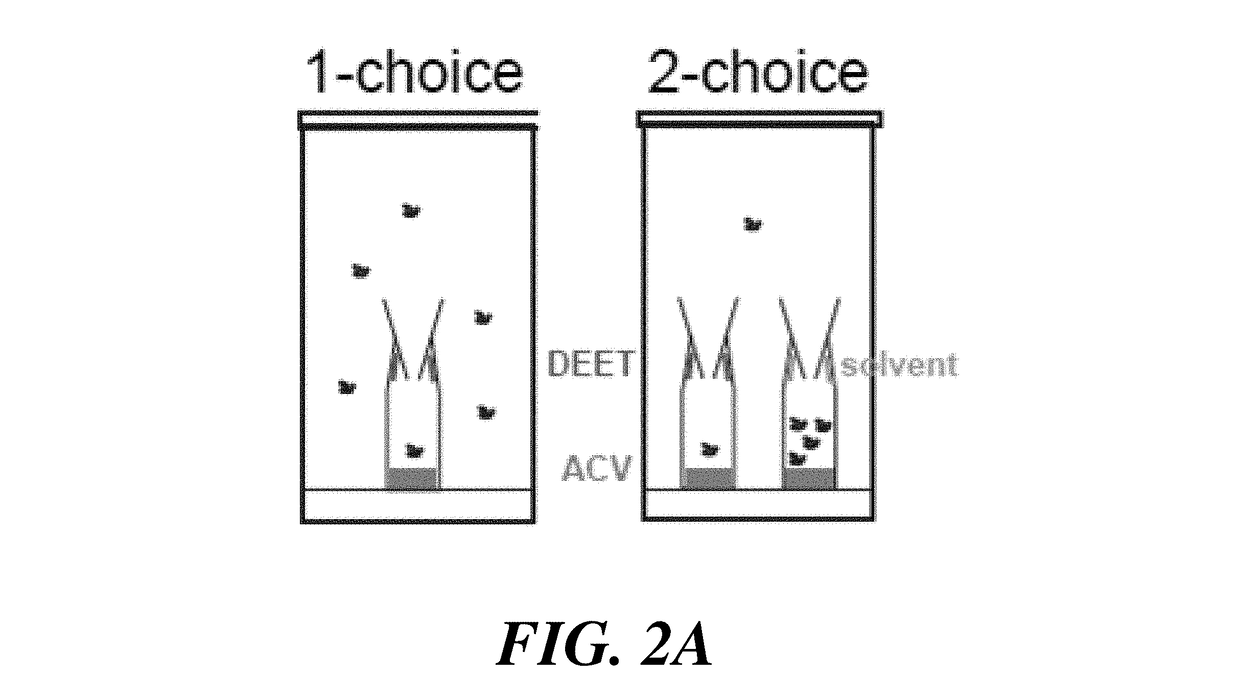
[0225]For each trial, three- to six-day old flies (10 males and 10 females) were starved for 18 hours. Flies were transferred to a cylindrical 38.1 mm D×84.1 mm H chamber containing two traps each fashioned from an upturned 1.5 ml microcentrifuge tube with 2 mm removed from the tapered end. A pipette tip (1000 μl), was cut 2.5 cm from narrow end and 0.5 cm from top and inserted into the bottom of the inverted microcentrifuge tube. A 15 mm×16 mm #1 Whatmann filter paper was inserted in between the pipette tip and tip of microcentrifuge tube in a manner that entering flies cannot make physical contact with it. With reference to FIG. 2A, for the 1-choice test, a 50 μl sample of test odorant (50% DEET in DMSO) was applied to filter paper and 125 μl of 10% ap...
example 2
Involvement of Ir40a in DEET Avoidance
[0228]This Example also demonstrates the involvement of the Ir40a receptor for DEET avoidance. Behavior assays (according to the protocol in Example 1) using mutant flies were performed. While no reported mutants or transposon insertion lines were available for Ir40a, two lines from the Drosophila Genome Reference Panel (DGRP) were identified that contain missense point mutations in Ir40a, which were confirmed by sequencing the appropriate portion of Ir40a in both lines (FIG. 2D). A common wild-type strain (Canton-S) of D. melanogaster showed a robust and reproducible avoidance response to volatile DEET in a 2-choice trap assay lured by 10% apple cider vinegar (ACV). This strong olfactory avoidance to DEET was observed to be nearly abolished in the two DGRP lines that contain mutations in Ir40a (FIG. 2D). The two DGRP lines were observed to exhibit strong attraction to the 10% ACV lure in control 2-choice trap experiments, suggesting that they a...
example 3
Behavior Experiments in Synaptic Activity Silenced Flies
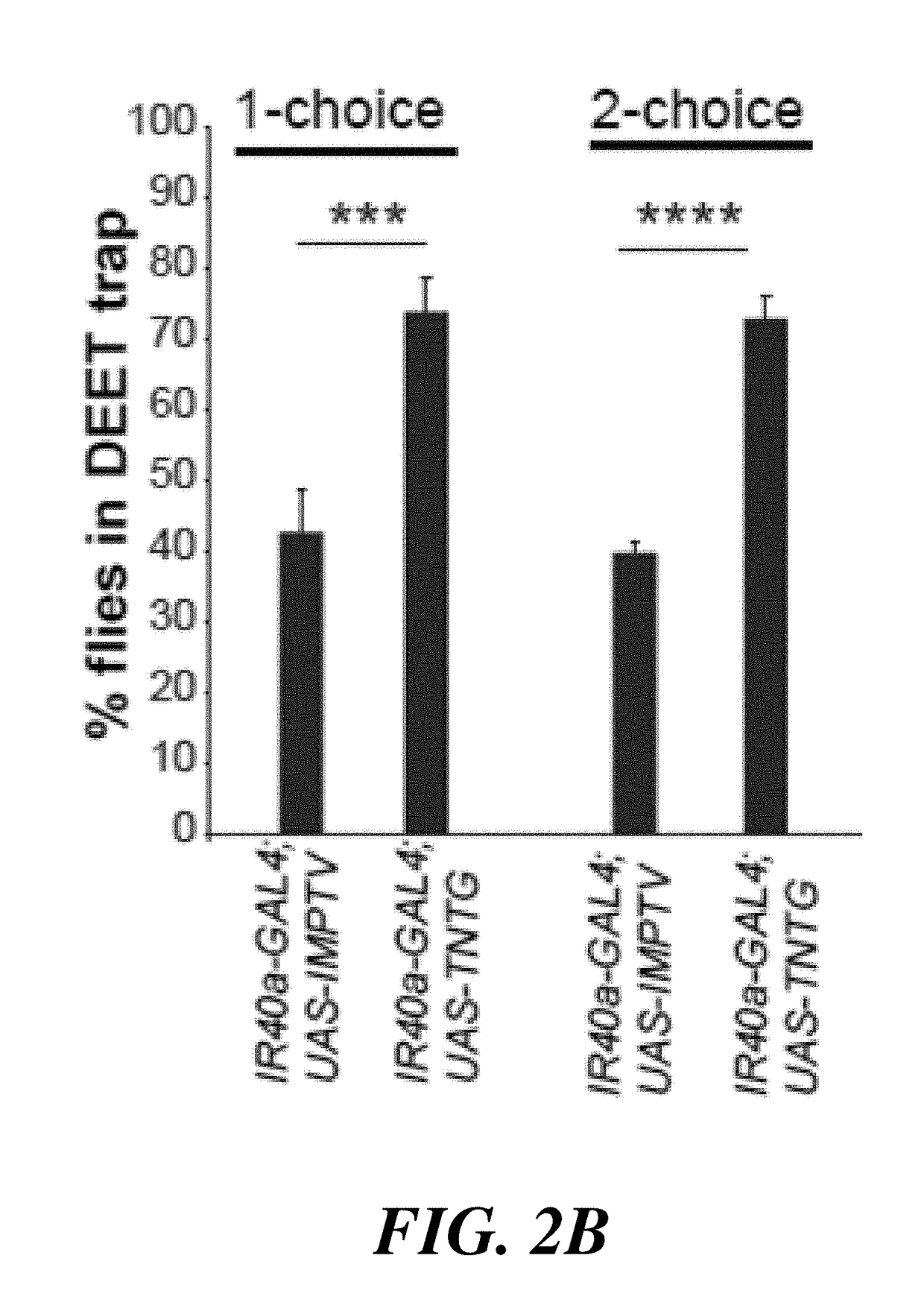
[0229]In order to investigate the involvement of the Ir40a+ neurons in mediating avoidance to newly discovered repellents, behavior experiments in synaptic activity silenced flies were performed as before (FIG. 2B). A majority of control flies expressing a non-functional version of tetanus toxin (IMPTV) avoided volatile repellents in both a 1-choice and 2-choice trap assay lured by 10% apple cider vinegar (ACV). As seen in FIGS. 4A and 4B, avoidance was observed to be substantially decreased in Ir40a neuron-TNTG flies, demonstrating that these neurons were involved in repellency to the newly identified repellents. These results demonstrate that Ir40a+ neurons can be used in identifying new natural DEET substitutes.
PUM
 Login to View More
 Abstract
Description
Claims
Application Information
 Login to View More
 - R&D
- Intellectual Property
- Life Sciences
- Materials
- Tech Scout
- Unparalleled Data Quality
- Higher Quality Content
- 60% Fewer Hallucinations
Browse by: Latest US Patents, China's latest patents, Technical Efficacy Thesaurus, Application Domain, Technology Topic, Popular Technical Reports.
© 2025 PatSnap. All rights reserved.Legal|Privacy policy|Modern Slavery Act Transparency Statement|Sitemap|About US| Contact US: help@patsnap.com