Check patentability & draft patents in minutes with Patsnap Eureka AI!

Radio sensing device and radar system

a radio sensing device and radar technology, applied in the direction of measuring devices, using reradiation, instruments, etc., can solve the problems of unfavorable safety, increased costs, and unnecessary addition of new hardware, so as to reduce the probability of wave interference, increase all costs, and minimize the effect of radio interference with adjacent similar devices

Active Publication Date: 2018-03-13
U SHIN LTD
View PDF3 Cites 1 Cited by
  • Summary
  • Abstract
  • Description
  • Claims
  • Application Information

AI Technical Summary

Benefits of technology

[0028]According to one or more embodiments of the present invention, a new concept “direction hopping” is newly introduced to make it possible to advantageously decrease the probability of occurrence of wave interference by only changing software controls without adding new hardware. More specifically, so-called “frequency hopping” is a communication scheme that performs communication while changing radio frequencies at random. In contrast to this, the “direction hopping” according to one or more embodiments of the present invention perform radar searching while changing scanning directions of radio beams at random. In this manner, the probability of causing the beam directions of two adjacent radio sensing devices to continuously face to each other two or more times by chance can be reduced.
[0029]According to one or more embodiments of the present invention, in a radio sensing device such as a CTA radio sensing device which operates beam directions in a sector shape or a spherical-shell shape, the probability of occurrence of radio interference with an adjacent similar device can be advantageously minimized without increasing all costs.

Problems solved by technology

However, a large number of vehicles in each of which 24-GHz-band SRRs of many types are mounted come into a city to disadvantageously cause radio interference between radio sensing devices of the vehicles.
However, even for avoidance of radio interference, addition of new hardware undesirably increases costs.
For this reason, a wasted time for which an antenna is not scanned is generated to cause the fear of deteriorating the safety.
It is known that, in a quasi-extremely-high frequency band such as a 24-GHz band, radio interference easily occurs when two antennas come close to each other or face each other.

Method used

the structure of the environmentally friendly knitted fabric provided by the present invention; figure 2 Flow chart of the yarn wrapping machine for environmentally friendly knitted fabrics and storage devices; image 3 Is the parameter map of the yarn covering machine
View more

Image

Smart Image Click on the blue labels to locate them in the text.
Viewing Examples
Smart Image
  • Radio sensing device and radar system
  • Radio sensing device and radar system
  • Radio sensing device and radar system

Examples

Experimental program
Comparison scheme
Effect test

first embodiment

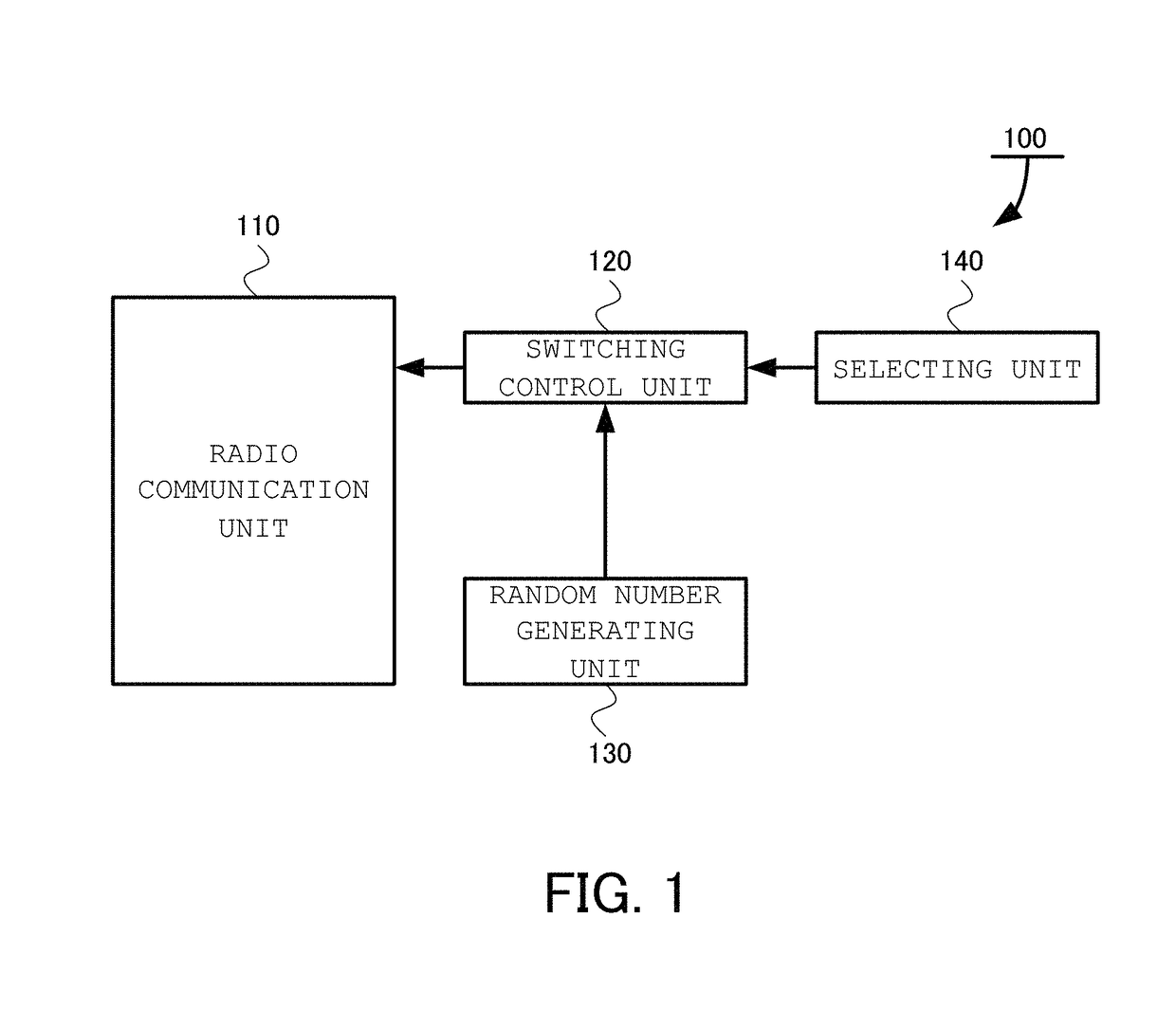
[0045]A first embodiment of the present invention will be described below with reference to FIGS. 1 to 4.

[0046]In this embodiment, two vehicles will be exemplified.

[0047]As shown in FIG. 3A, in the past, antennas are switched in a fixed order. In the drawing, reference symbols and numerals “T”, “Trand”, and “1, 2, 3, or 4” understandably represent a measurement cycle, a time required for making a circle of random numbers, and a selected measurement antenna, respectively. In the embodiment, the measurement cycle “T” is not changed. Measurement antennas are switched as shown in FIG. 3B when Trand=T, and are switched as shown in FIG. 3C when Trand=2T.

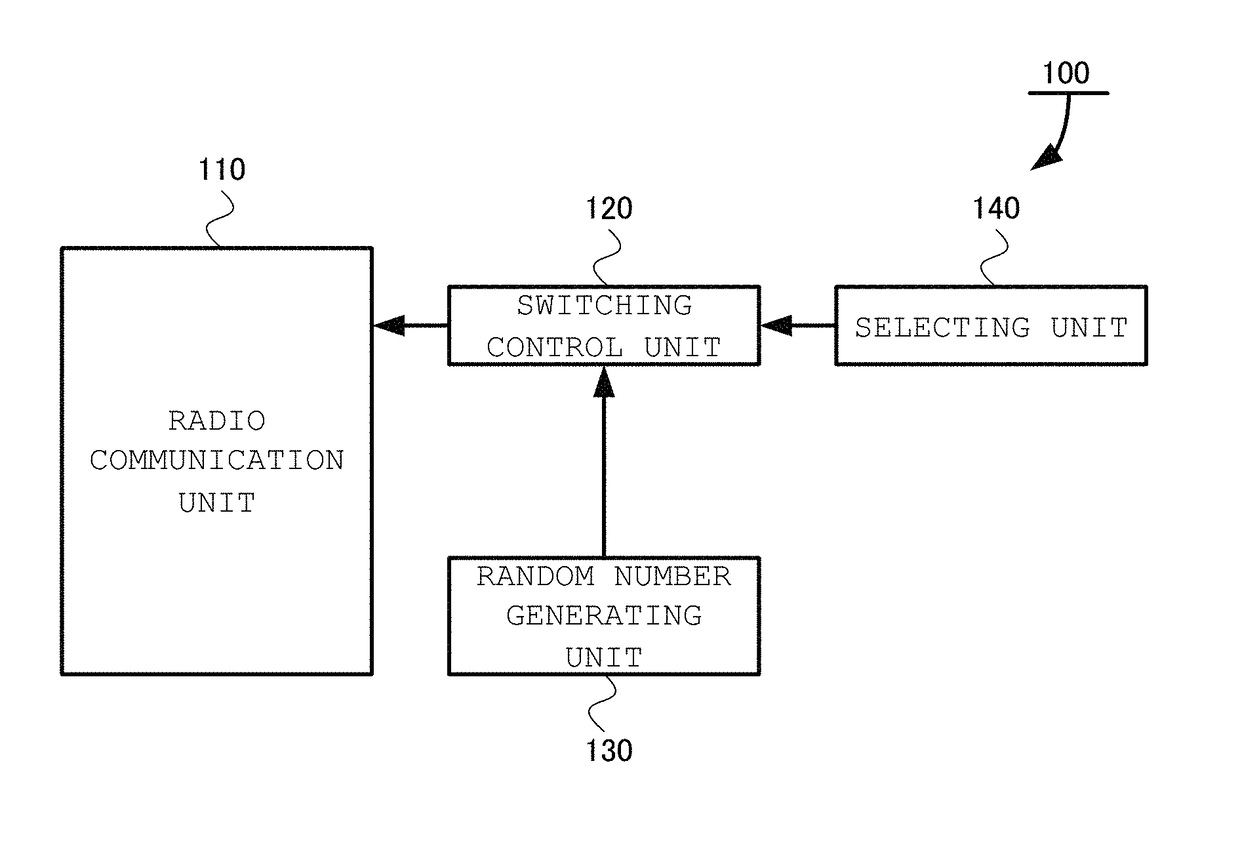
[0048]A radio sensing device 100 according to the present invention, as shown in FIG. 1, includes a radio communication unit 110, a switching control unit 120, a random number generating unit 130, and a selecting unit 140.

[0049]The radio communication unit 110 is a unit to transmit and receive radio waves by using a plurality of antennas. ...

second embodiment

[0059]A second embodiment of the present invention will be described below with reference to FIG. 5 and FIG. 6.

[0060]In the first embodiment, a scanning order of beam directions is the effect of the embodiment, and a unit for scanning the beam directions is not limited to a specific unit. In FIG. 4, a so-called switch changeover scheme which selects a plurality of antennas such that the antennas are arranged in a circular shape or a spherical-shell shape is described. However, as the unit for scanning beam directions, a mechanical scanning scheme or the like known as another unit may be used. More specifically, as shown in FIG. 6, an entire antenna may be physically turned in predetermined directions (for example, by a stepping motor, a gear, and the like) to change the directions.

[0061]On the other hand, in the electronic scanning scheme, a feeding phase to each of unit antennas constituting an array antenna is finely adjusted to scan a combined beam direction of the entire array a...

third embodiment

[0065]A third embodiment of the present invention will be described below with reference to FIG. 8.

[0066]In the first and second embodiments, an issue of radio interference between two radio sensing devices independently mounted on two vehicles, respectively, is pointed out. However, as shown in FIG. 8, the risk of occurrence of radio interference may be caused even between two radio sensing devices mounted on the same vehicle. For example, as shown in FIG. 8, the risk is caused when a radio wave radiated from a rearmost antenna of the radio sensing device at a rear left corner (342) is reflected by a nearby wall and strikes a rearmost antenna of the radio sensing device at a rear right corner (341). At this time, the risk of occurrence of radio interference in a domain (236) in the drawing is present.

[0067]In this case, in the embodiment, as shown in FIG. 8, a switch control circuit (223) is shared by radio sensing devices at two adjacent corners, different random numbers are inten...

the structure of the environmentally friendly knitted fabric provided by the present invention; figure 2 Flow chart of the yarn wrapping machine for environmentally friendly knitted fabrics and storage devices; image 3 Is the parameter map of the yarn covering machine
Login to View More

PUM

No PUM Login to View More

Abstract

A radio sensing device includes N antennas, N being a natural number which is one or more, a switching control unit that sequentially switches the antennas and scans radio waves in some directions or all directions in a circular shape or a spherical-shell shape, and a random number generating unit that generates random numbers. The switching control unit performs an operation of switching selecting orders of the N antennas on the basis of the generated random numbers within a time which is M (M; positive integer) times a unit time required to sequentially scan each of all the N antennas once.

Description

BACKGROUND[0001]Field of the Invention[0002]The present invention relates to a radio sensing device and a radar system and, more particularly, to a radio sensing device and a radar system which perform wide-angle monitoring by using a plurality of short-range radar sensors which have been rapidly popularized in recent years to avoid the risks of vehicle-to-vehicle collision, vehicle-to-person collision, vehicle-to-railcar collision, and the like.[0003]It is an object of the present invention to minimize the probability of radio interference in radio sensing devices which scan beam directions in a circular shape or a spherical-shell shape. For this reason, the invention cannot only be applied to a CTA (Cross Traffic Alert) radio sensing device but also be widely applied to a radio sensing device having the same scanning function as described above or a similar radio sensing device.[0004]Description of Related Art[0005]In recent years, an obstacle radar has been rapidly popularized. I...

Claims

the structure of the environmentally friendly knitted fabric provided by the present invention; figure 2 Flow chart of the yarn wrapping machine for environmentally friendly knitted fabrics and storage devices; image 3 Is the parameter map of the yarn covering machine
Login to View More

Application Information

Patent Timeline
no application Login to View More
Patent Type & Authority Patents(United States)
IPC IPC(8): G01S13/93G01S7/02G01S13/931
CPCG01S13/931G01S7/023G01S2013/9378G01S2013/9375G01S2013/93272G01S2013/93271G01S7/0235G01S7/0236
Inventor AMANO, YOSHIHISA
Owner U SHIN LTD
Features
  • R&D
  • Intellectual Property
  • Life Sciences
  • Materials
  • Tech Scout
Why Patsnap Eureka
  • Unparalleled Data Quality
  • Higher Quality Content
  • 60% Fewer Hallucinations
Social media
Patsnap Eureka Blog
Learn More