

Advanced Elastomers for Improved Progressive Cavity Pump Compatibility
APR 2, 202610 MIN READ
Generate Your Research Report Instantly with AI Agent
PatSnap Eureka helps you evaluate technical feasibility & market potential.
Advanced Elastomer Development Background and Objectives
Progressive cavity pumps (PCPs) have emerged as critical components in various industrial applications, particularly in oil and gas extraction, wastewater treatment, and chemical processing. These positive displacement pumps rely on the precise interaction between a helical rotor and an elastomeric stator to create sealed cavities that transport fluids efficiently. The elastomeric stator, typically manufactured from synthetic rubber compounds, represents the most vulnerable component in the system due to its direct contact with pumped media and mechanical stress from rotor rotation.
The evolution of PCP technology has been closely tied to advancements in elastomer science. Early PCP systems, developed in the 1930s, utilized basic rubber formulations that provided limited chemical resistance and operational lifespan. As industrial applications expanded into more demanding environments, including high-temperature oil wells, corrosive chemical processes, and abrasive slurries, the limitations of conventional elastomers became increasingly apparent. Premature stator failure due to swelling, hardening, cracking, or chemical degradation resulted in costly downtime and frequent maintenance requirements.
Contemporary industrial demands have intensified the need for advanced elastomer solutions. Modern oil extraction operations frequently encounter temperatures exceeding 150°C, aggressive chemical environments containing hydrogen sulfide and carbon dioxide, and high differential pressures. Similarly, chemical processing applications require elastomers that maintain dimensional stability and sealing integrity when exposed to solvents, acids, and other reactive substances. Traditional elastomer formulations often fail to meet these stringent requirements, leading to reduced pump efficiency and increased operational costs.
The primary objective of advanced elastomer development for PCP applications centers on creating materials that demonstrate superior chemical compatibility across diverse fluid types while maintaining mechanical integrity under extreme operating conditions. This involves developing elastomer compounds with enhanced resistance to swelling in hydrocarbon environments, improved thermal stability at elevated temperatures, and superior abrasion resistance for handling particulate-laden fluids.
Secondary objectives include optimizing the elastomer's mechanical properties to ensure proper interference fit with the rotor while accommodating thermal expansion and contraction cycles. The material must exhibit consistent hardness and compression set resistance throughout its service life to maintain effective sealing and prevent premature wear. Additionally, the elastomer should demonstrate predictable aging characteristics, allowing for reliable service life estimation and maintenance scheduling.
Research efforts also focus on developing elastomers with improved processability and manufacturing consistency. This includes formulations that can be reliably molded into complex stator geometries while maintaining uniform properties throughout the component. The development of quality control methodologies and accelerated testing protocols represents another crucial objective, enabling rapid evaluation of new formulations and prediction of long-term performance in specific applications.
The evolution of PCP technology has been closely tied to advancements in elastomer science. Early PCP systems, developed in the 1930s, utilized basic rubber formulations that provided limited chemical resistance and operational lifespan. As industrial applications expanded into more demanding environments, including high-temperature oil wells, corrosive chemical processes, and abrasive slurries, the limitations of conventional elastomers became increasingly apparent. Premature stator failure due to swelling, hardening, cracking, or chemical degradation resulted in costly downtime and frequent maintenance requirements.
Contemporary industrial demands have intensified the need for advanced elastomer solutions. Modern oil extraction operations frequently encounter temperatures exceeding 150°C, aggressive chemical environments containing hydrogen sulfide and carbon dioxide, and high differential pressures. Similarly, chemical processing applications require elastomers that maintain dimensional stability and sealing integrity when exposed to solvents, acids, and other reactive substances. Traditional elastomer formulations often fail to meet these stringent requirements, leading to reduced pump efficiency and increased operational costs.
The primary objective of advanced elastomer development for PCP applications centers on creating materials that demonstrate superior chemical compatibility across diverse fluid types while maintaining mechanical integrity under extreme operating conditions. This involves developing elastomer compounds with enhanced resistance to swelling in hydrocarbon environments, improved thermal stability at elevated temperatures, and superior abrasion resistance for handling particulate-laden fluids.
Secondary objectives include optimizing the elastomer's mechanical properties to ensure proper interference fit with the rotor while accommodating thermal expansion and contraction cycles. The material must exhibit consistent hardness and compression set resistance throughout its service life to maintain effective sealing and prevent premature wear. Additionally, the elastomer should demonstrate predictable aging characteristics, allowing for reliable service life estimation and maintenance scheduling.
Research efforts also focus on developing elastomers with improved processability and manufacturing consistency. This includes formulations that can be reliably molded into complex stator geometries while maintaining uniform properties throughout the component. The development of quality control methodologies and accelerated testing protocols represents another crucial objective, enabling rapid evaluation of new formulations and prediction of long-term performance in specific applications.
Market Demand for Enhanced PCP Performance Solutions
The global progressive cavity pump market is experiencing significant growth driven by increasing demand across multiple industrial sectors. Oil and gas operations, particularly unconventional extraction methods, require enhanced pumping solutions capable of handling abrasive fluids, high temperatures, and corrosive environments. The artificial lift market segment alone represents a substantial portion of PCP applications, where improved elastomer performance directly translates to reduced operational costs and extended equipment lifecycles.
Water and wastewater treatment facilities increasingly rely on PCPs for handling viscous sludges and chemically aggressive media. Municipal treatment plants and industrial facilities demand pumps with superior chemical resistance and longer service intervals to minimize maintenance disruptions. The growing emphasis on environmental compliance and operational efficiency creates substantial market pressure for advanced elastomer solutions that can withstand harsh chemical environments while maintaining consistent performance.
Food and beverage processing industries present another significant market segment requiring specialized elastomer formulations. These applications demand materials that meet stringent FDA regulations while providing excellent resistance to cleaning chemicals and temperature variations. The trend toward more complex food processing operations and stricter hygiene standards drives demand for elastomers with enhanced durability and contamination resistance.
Mining and mineral processing operations represent a rapidly expanding market for enhanced PCP solutions. These applications involve highly abrasive slurries containing suspended solids that quickly degrade conventional elastomer materials. The increasing complexity of ore processing and the need for continuous operation in remote locations create strong demand for elastomers with superior abrasion resistance and extended service life.
The pharmaceutical and chemical processing sectors require elastomers capable of handling aggressive solvents, acids, and bases while maintaining material integrity. Regulatory requirements for product purity and process validation drive demand for advanced materials with documented chemical compatibility and consistent performance characteristics.
Market drivers include rising operational costs associated with frequent elastomer replacement, increasing downtime penalties in critical applications, and growing environmental regulations requiring more reliable containment systems. The shift toward predictive maintenance strategies and Industry 4.0 implementations further emphasizes the need for elastomers with predictable degradation patterns and extended service intervals.
Regional demand varies significantly, with North American shale operations, Middle Eastern oil production, and Asian industrial expansion representing key growth markets. Each region presents unique environmental challenges and regulatory requirements that influence elastomer specification and performance criteria.
Water and wastewater treatment facilities increasingly rely on PCPs for handling viscous sludges and chemically aggressive media. Municipal treatment plants and industrial facilities demand pumps with superior chemical resistance and longer service intervals to minimize maintenance disruptions. The growing emphasis on environmental compliance and operational efficiency creates substantial market pressure for advanced elastomer solutions that can withstand harsh chemical environments while maintaining consistent performance.
Food and beverage processing industries present another significant market segment requiring specialized elastomer formulations. These applications demand materials that meet stringent FDA regulations while providing excellent resistance to cleaning chemicals and temperature variations. The trend toward more complex food processing operations and stricter hygiene standards drives demand for elastomers with enhanced durability and contamination resistance.
Mining and mineral processing operations represent a rapidly expanding market for enhanced PCP solutions. These applications involve highly abrasive slurries containing suspended solids that quickly degrade conventional elastomer materials. The increasing complexity of ore processing and the need for continuous operation in remote locations create strong demand for elastomers with superior abrasion resistance and extended service life.
The pharmaceutical and chemical processing sectors require elastomers capable of handling aggressive solvents, acids, and bases while maintaining material integrity. Regulatory requirements for product purity and process validation drive demand for advanced materials with documented chemical compatibility and consistent performance characteristics.
Market drivers include rising operational costs associated with frequent elastomer replacement, increasing downtime penalties in critical applications, and growing environmental regulations requiring more reliable containment systems. The shift toward predictive maintenance strategies and Industry 4.0 implementations further emphasizes the need for elastomers with predictable degradation patterns and extended service intervals.
Regional demand varies significantly, with North American shale operations, Middle Eastern oil production, and Asian industrial expansion representing key growth markets. Each region presents unique environmental challenges and regulatory requirements that influence elastomer specification and performance criteria.
Current Elastomer Limitations in Progressive Cavity Pumps
Progressive cavity pumps (PCPs) rely heavily on elastomeric stators to create the necessary sealing interface with the metallic rotor, yet current elastomer materials face significant performance limitations that restrict pump efficiency and operational lifespan. The primary challenge stems from the demanding operating conditions these elastomers must endure, including extreme temperatures, aggressive chemical environments, and high mechanical stress cycles.
Temperature resistance represents one of the most critical limitations in current elastomer formulations. Standard nitrile rubber (NBR) and fluoroelastomer compounds typically degrade rapidly when exposed to temperatures exceeding 150°C, which are common in geothermal applications and deep oil wells. This thermal degradation manifests as hardening, cracking, and loss of elastic properties, leading to compromised sealing performance and increased wear rates.
Chemical compatibility issues further compound the performance challenges. Existing elastomers often exhibit poor resistance to hydrogen sulfide, carbon dioxide, and various hydrocarbon solvents commonly encountered in oil and gas operations. Swelling, softening, and chemical degradation occur when these materials interact with aggressive fluids, resulting in dimensional changes that disrupt the critical interference fit between stator and rotor.
Mechanical durability limitations significantly impact pump reliability and maintenance intervals. Current elastomer compounds suffer from fatigue failure under cyclic loading conditions, particularly when subjected to the continuous compression and relaxation cycles inherent in PCP operation. Abrasive wear from particulate-laden fluids accelerates material loss, while tear propagation from surface defects leads to catastrophic failure modes.
The interference fit requirements in PCPs create additional constraints for elastomer performance. Maintaining optimal compression levels while accommodating thermal expansion and chemical swelling requires precise material property control that current formulations struggle to achieve consistently. Compression set resistance, a critical parameter for long-term sealing effectiveness, remains inadequate in many existing elastomer systems, particularly under elevated temperature conditions.
Manufacturing and processing limitations also restrict the development of advanced elastomer solutions. Current vulcanization systems and additive packages often compromise one performance attribute while attempting to enhance another, creating trade-offs that limit overall system optimization. The challenge of achieving uniform crosslink density and additive distribution in complex stator geometries further complicates the development of high-performance elastomer compounds.
Temperature resistance represents one of the most critical limitations in current elastomer formulations. Standard nitrile rubber (NBR) and fluoroelastomer compounds typically degrade rapidly when exposed to temperatures exceeding 150°C, which are common in geothermal applications and deep oil wells. This thermal degradation manifests as hardening, cracking, and loss of elastic properties, leading to compromised sealing performance and increased wear rates.
Chemical compatibility issues further compound the performance challenges. Existing elastomers often exhibit poor resistance to hydrogen sulfide, carbon dioxide, and various hydrocarbon solvents commonly encountered in oil and gas operations. Swelling, softening, and chemical degradation occur when these materials interact with aggressive fluids, resulting in dimensional changes that disrupt the critical interference fit between stator and rotor.
Mechanical durability limitations significantly impact pump reliability and maintenance intervals. Current elastomer compounds suffer from fatigue failure under cyclic loading conditions, particularly when subjected to the continuous compression and relaxation cycles inherent in PCP operation. Abrasive wear from particulate-laden fluids accelerates material loss, while tear propagation from surface defects leads to catastrophic failure modes.
The interference fit requirements in PCPs create additional constraints for elastomer performance. Maintaining optimal compression levels while accommodating thermal expansion and chemical swelling requires precise material property control that current formulations struggle to achieve consistently. Compression set resistance, a critical parameter for long-term sealing effectiveness, remains inadequate in many existing elastomer systems, particularly under elevated temperature conditions.
Manufacturing and processing limitations also restrict the development of advanced elastomer solutions. Current vulcanization systems and additive packages often compromise one performance attribute while attempting to enhance another, creating trade-offs that limit overall system optimization. The challenge of achieving uniform crosslink density and additive distribution in complex stator geometries further complicates the development of high-performance elastomer compounds.
Existing Elastomer Solutions for PCP Compatibility
01 Polymer blend compatibility through compatibilizers
Advanced elastomer compatibility can be achieved through the use of compatibilizers that improve the interfacial adhesion between different polymer phases. These compatibilizers act as bridging agents between immiscible polymers, enhancing the mechanical properties and stability of the blend. The compatibilizers can be block copolymers, grafted polymers, or reactive additives that create chemical bonds at the interface between different elastomer phases.- Polymer blend compatibility through compatibilizers: Advanced elastomer compatibility can be achieved through the use of compatibilizers that improve the interfacial adhesion between different polymer phases. These compatibilizers act as bridging agents between immiscible polymers, enhancing the mechanical properties and stability of the blend. The compatibilizers can be block copolymers, grafted polymers, or reactive additives that create chemical bonds at the interface between different elastomer phases.
- Thermoplastic elastomer compatibility systems: Thermoplastic elastomers can be formulated with enhanced compatibility by selecting appropriate base polymers and processing conditions. The compatibility is improved through controlled morphology development, where the elastomeric phase is dispersed in a thermoplastic matrix. This approach allows for better processability while maintaining elastomeric properties, and can involve the use of specific ratios of hard and soft segments to optimize phase compatibility.
- Cross-linking systems for elastomer compatibility: Advanced cross-linking systems can enhance the compatibility of elastomer blends by creating chemical bonds between different polymer chains. These systems utilize peroxides, sulfur-based compounds, or radiation-induced cross-linking to improve the integration of different elastomeric components. The cross-linking process helps to stabilize the morphology and prevent phase separation, resulting in improved mechanical properties and durability.
- Nanocomposite reinforcement for elastomer compatibility: The incorporation of nanofillers and reinforcing agents can significantly improve the compatibility and performance of advanced elastomer systems. These nanocomposites utilize materials such as silica, carbon nanotubes, or clay particles that are dispersed throughout the elastomer matrix. The nanofillers enhance interfacial interactions and provide reinforcement, leading to improved mechanical properties, thermal stability, and compatibility between different elastomer phases.
- Functional additives for elastomer blend optimization: Functional additives including plasticizers, processing aids, and stabilizers play a crucial role in optimizing elastomer compatibility. These additives modify the viscosity, improve processing characteristics, and enhance the long-term stability of elastomer blends. The selection of appropriate additives can reduce the interfacial tension between incompatible phases and promote better dispersion of components, resulting in homogeneous blends with superior performance characteristics.
02 Thermoplastic elastomer compatibility systems
Thermoplastic elastomers can be formulated with enhanced compatibility by controlling the morphology and phase structure of the material. This involves optimizing the ratio of hard and soft segments, selecting appropriate base polymers, and incorporating additives that promote phase mixing. The resulting materials exhibit improved processability, mechanical strength, and elastic recovery while maintaining compatibility with various substrates and processing conditions.Expand Specific Solutions03 Cross-linking systems for elastomer compatibility
Cross-linking agents and vulcanization systems can be tailored to improve the compatibility of elastomers with other materials. By selecting appropriate cross-linking chemistry, cure systems, and accelerators, the elastomer network can be optimized to achieve better adhesion to substrates, improved resistance to chemicals and oils, and enhanced thermal stability. Dynamic cross-linking techniques can also be employed to create thermoplastic vulcanizates with superior compatibility characteristics.Expand Specific Solutions04 Functional additives for enhanced elastomer compatibility
The incorporation of functional additives such as plasticizers, processing aids, and surface modifiers can significantly improve elastomer compatibility with various materials and environments. These additives can reduce viscosity, improve dispersion of fillers, enhance adhesion to polar and non-polar substrates, and provide resistance to degradation. The selection of additives depends on the specific elastomer type and the intended application requirements.Expand Specific Solutions05 Nanocomposite approaches for elastomer compatibility
Nanofillers and nanostructured materials can be incorporated into elastomer matrices to enhance compatibility and performance characteristics. The use of nanoclays, carbon nanotubes, graphene, or silica nanoparticles can improve mechanical properties, barrier properties, and thermal stability while maintaining or enhancing compatibility with other system components. Surface modification of nanofillers is often employed to ensure proper dispersion and interfacial adhesion within the elastomer matrix.Expand Specific Solutions
Key Players in Elastomer and PCP Manufacturing Industry
The advanced elastomers for progressive cavity pump compatibility market represents a mature industrial sector experiencing steady growth driven by increasing demand from oil and gas, wastewater treatment, and chemical processing industries. The market demonstrates significant scale with established players spanning multiple geographic regions and technological specializations. Technology maturity varies across segments, with companies like Seepex GmbH leading in specialized progressive cavity pump systems, while major oilfield service providers including Halliburton Energy Services, NOV Inc., and Schlumberger Technologies leverage extensive R&D capabilities for advanced elastomer solutions. Material science leaders such as Henkel AG and ExxonMobil Chemical Patents contribute sophisticated polymer technologies, while precision manufacturers like ARTEMIS Kautschuk- und Kunststoff-Technik and USD Formteiltechnik provide specialized component fabrication. The competitive landscape reflects a consolidating industry where established players maintain strong positions through proprietary formulations, extensive distribution networks, and integrated service offerings, creating substantial barriers for new entrants while driving continuous innovation in elastomer performance and durability.
NOV, Inc.
Technical Solution: NOV has developed specialized elastomer compounds for progressive cavity pump stators, incorporating advanced polymer blends with enhanced abrasion resistance and improved compatibility with various pumped media. Their elastomer technology features optimized Shore hardness profiles and specialized additive systems that provide superior performance in handling abrasive fluids, viscous materials, and chemically aggressive substances. The company's elastomer formulations utilize proprietary cross-linking chemistry to achieve excellent compression set resistance and dimensional stability while maintaining flexibility and sealing effectiveness throughout extended operational cycles in demanding industrial applications.
Strengths: Comprehensive understanding of oilfield equipment requirements with strong engineering support and global service network. Weaknesses: Limited focus on non-oilfield applications may restrict market penetration in other industrial sectors.
ExxonMobil Chemical Patents, Inc.
Technical Solution: ExxonMobil has developed advanced synthetic elastomer technologies based on proprietary hydrogenated nitrile butadiene rubber (HNBR) and fluoroelastomer formulations for progressive cavity pump applications. Their elastomer systems feature enhanced molecular architecture with controlled polymer chain distribution and specialized additive packages that provide superior resistance to aggressive chemicals, high temperatures, and mechanical wear. The technology incorporates advanced cross-linking systems that maintain elasticity and sealing performance across wide temperature ranges while offering excellent compatibility with petroleum-based fluids and synthetic lubricants commonly used in progressive cavity pump systems.
Strengths: World-class polymer chemistry expertise with extensive R&D capabilities and global supply chain infrastructure. Weaknesses: Higher material costs compared to conventional elastomer solutions may limit adoption in cost-sensitive applications.
Core Innovations in Advanced Elastomer Technologies
Adjustable interference progressive cavity pump/motor for predictive wear
PatentInactiveUS20160208798A1
Innovation
- The design incorporates a hyperboloidal configuration with a rotor and stator featuring an elastomeric coating and a tapered rotor, allowing for adjustable interference fit to accommodate thermal expansion and wear, using specialized fluoropolymers and filler materials to reduce friction and wear rates, and enabling manual or automatic adjustment to optimize performance across varying conditions.


Progressive cavity pump/motor
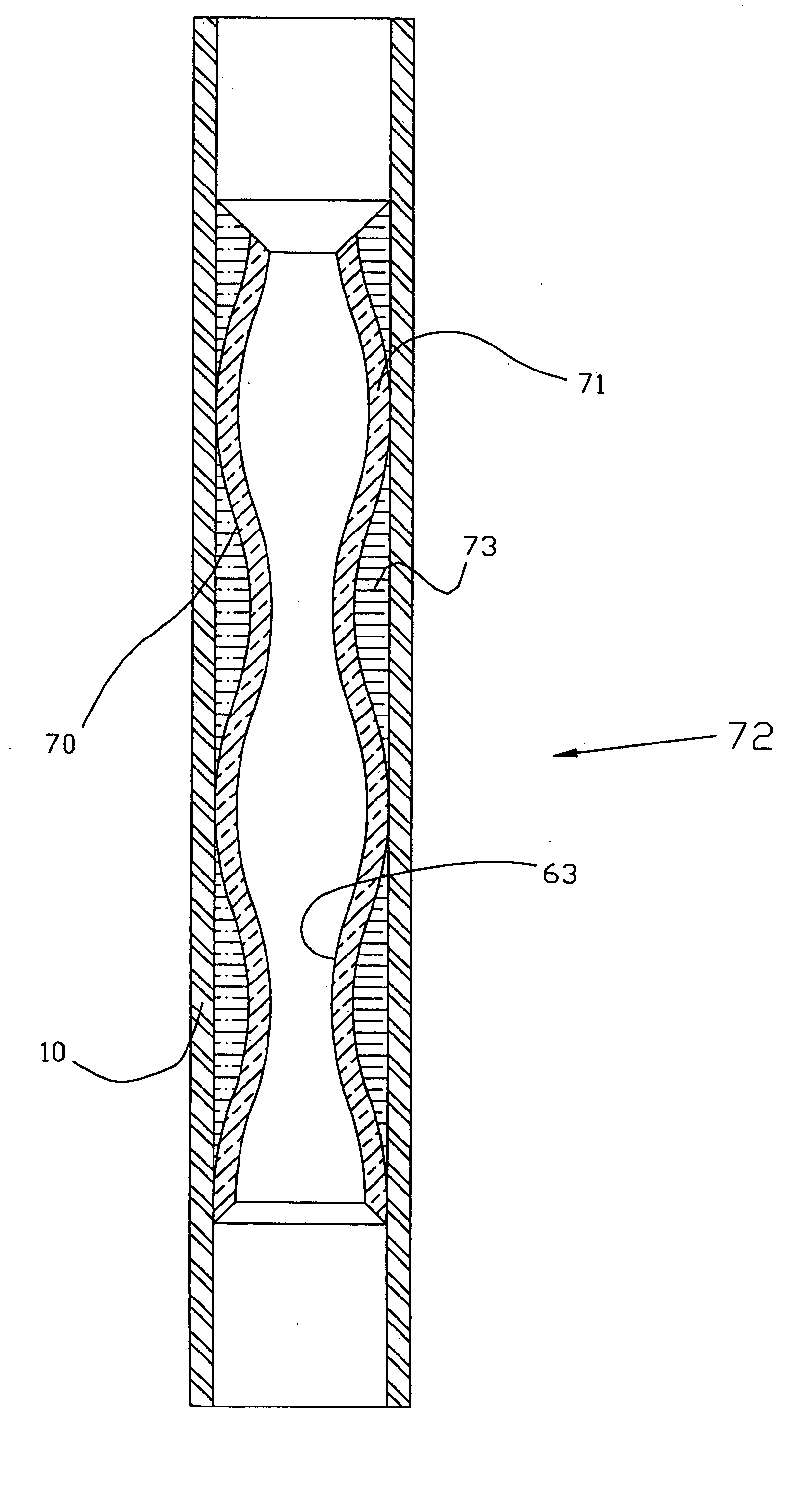
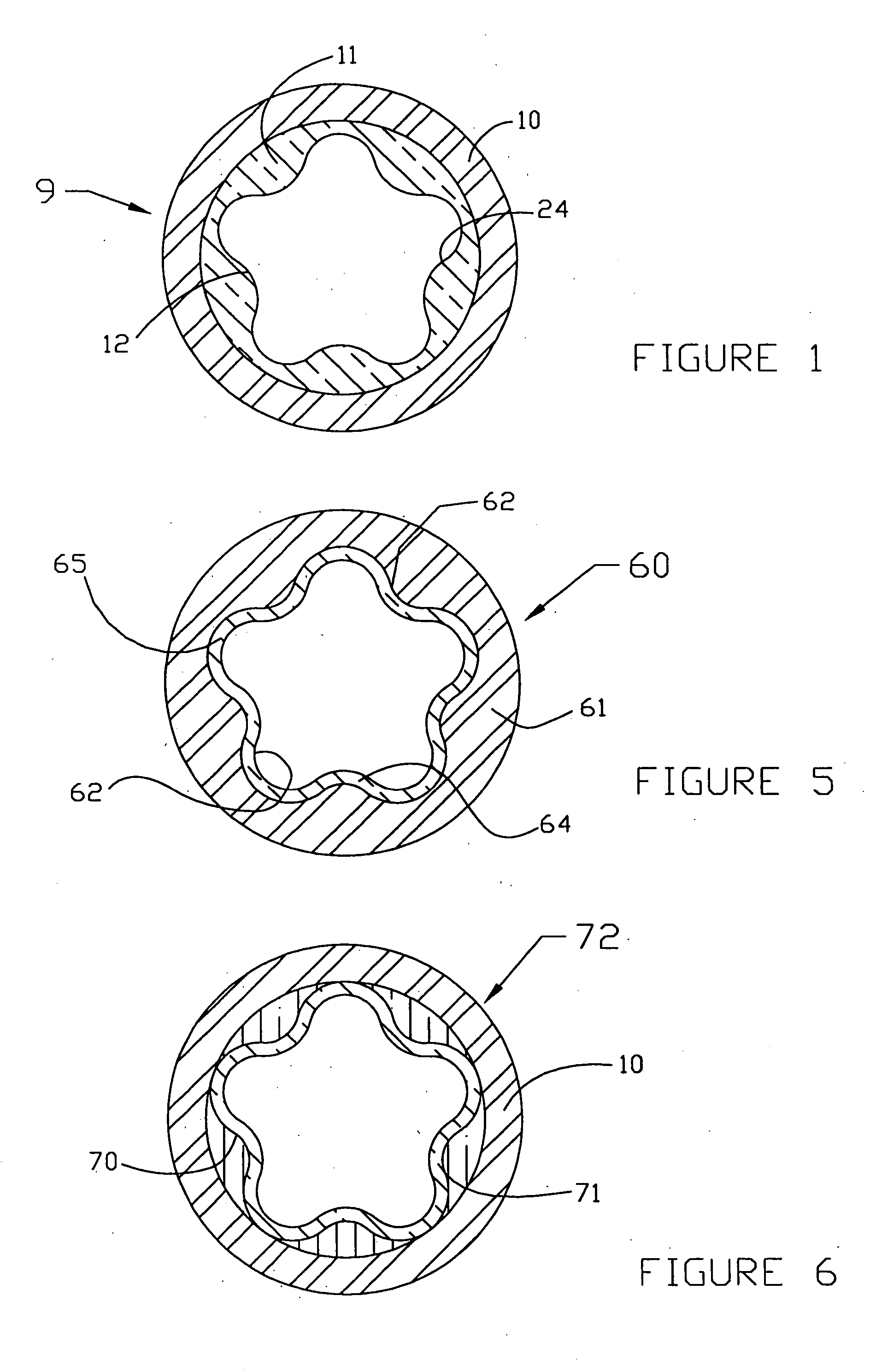
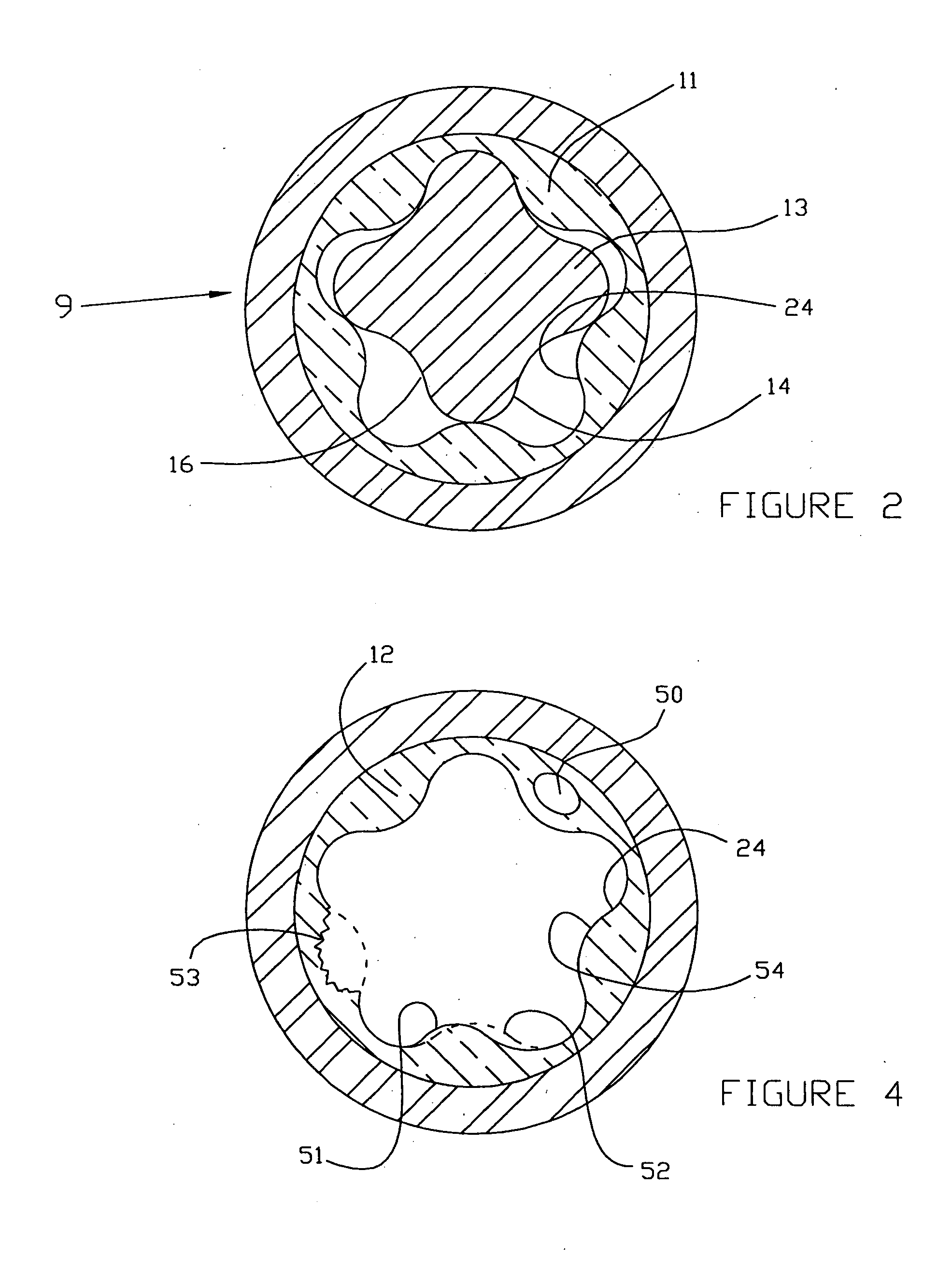
PatentInactiveUS20050118040A1
Innovation
- A stator design featuring a substantially uniform elastomer layer on the interior profile, with optional variations in thickness and reinforcement, to enhance mechanical strength and heat conduction, and an integral elastomeric layer formed on the interior profile of a cylindrical housing or tube, which can include a profiled reinforcement member or a cast-in inner stator member.

Environmental Impact Assessment of Elastomer Materials
The environmental impact assessment of elastomer materials used in progressive cavity pumps represents a critical evaluation framework that encompasses the entire lifecycle of these specialized polymeric compounds. This assessment methodology examines environmental implications from raw material extraction through manufacturing processes, operational deployment, and end-of-life disposal or recycling scenarios.
Raw material sourcing for advanced elastomers typically involves petroleum-based feedstocks, synthetic rubber compounds, and various chemical additives that enhance performance characteristics. The extraction and processing of these materials generate significant carbon footprints, with synthetic rubber production contributing approximately 3.5 to 4.2 kg CO2 equivalent per kilogram of finished material. Additionally, the manufacturing processes often require energy-intensive vulcanization procedures and chemical cross-linking agents that may pose environmental concerns.
Manufacturing phase environmental impacts include volatile organic compound emissions, energy consumption for high-temperature processing, and waste generation from quality control procedures. Advanced elastomer production facilities must comply with stringent air quality regulations, particularly regarding benzene, toluene, and other aromatic hydrocarbon emissions. Water usage for cooling and cleaning processes also represents a significant environmental consideration, especially in regions with water scarcity concerns.
Operational environmental performance of elastomer materials in progressive cavity pumps demonstrates both positive and negative aspects. Enhanced durability and chemical resistance of advanced elastomers reduce replacement frequency, thereby minimizing waste generation and maintenance-related environmental impacts. However, potential leaching of chemical additives, plasticizers, or degradation products into pumped fluids may create contamination risks, particularly in food processing or pharmaceutical applications.
End-of-life management presents substantial challenges for elastomer materials due to their cross-linked molecular structure, which complicates recycling processes. Traditional disposal methods include incineration for energy recovery or landfill disposal, both carrying environmental implications. Emerging devulcanization technologies and chemical recycling approaches offer promising alternatives, though commercial viability remains limited.
Regulatory frameworks governing elastomer environmental impact continue evolving, with REACH regulations in Europe and similar initiatives globally imposing stricter requirements for chemical registration, evaluation, and authorization. These regulations particularly focus on substances of very high concern, including certain accelerators, antioxidants, and flame retardants commonly used in elastomer formulations.
Life cycle assessment methodologies provide quantitative frameworks for evaluating environmental impacts, typically revealing that raw material production and end-of-life management represent the most significant environmental burden phases. Advanced elastomer formulations incorporating bio-based feedstocks or recycled content demonstrate reduced environmental impacts, though performance trade-offs may limit their applicability in demanding progressive cavity pump applications.
Raw material sourcing for advanced elastomers typically involves petroleum-based feedstocks, synthetic rubber compounds, and various chemical additives that enhance performance characteristics. The extraction and processing of these materials generate significant carbon footprints, with synthetic rubber production contributing approximately 3.5 to 4.2 kg CO2 equivalent per kilogram of finished material. Additionally, the manufacturing processes often require energy-intensive vulcanization procedures and chemical cross-linking agents that may pose environmental concerns.
Manufacturing phase environmental impacts include volatile organic compound emissions, energy consumption for high-temperature processing, and waste generation from quality control procedures. Advanced elastomer production facilities must comply with stringent air quality regulations, particularly regarding benzene, toluene, and other aromatic hydrocarbon emissions. Water usage for cooling and cleaning processes also represents a significant environmental consideration, especially in regions with water scarcity concerns.
Operational environmental performance of elastomer materials in progressive cavity pumps demonstrates both positive and negative aspects. Enhanced durability and chemical resistance of advanced elastomers reduce replacement frequency, thereby minimizing waste generation and maintenance-related environmental impacts. However, potential leaching of chemical additives, plasticizers, or degradation products into pumped fluids may create contamination risks, particularly in food processing or pharmaceutical applications.
End-of-life management presents substantial challenges for elastomer materials due to their cross-linked molecular structure, which complicates recycling processes. Traditional disposal methods include incineration for energy recovery or landfill disposal, both carrying environmental implications. Emerging devulcanization technologies and chemical recycling approaches offer promising alternatives, though commercial viability remains limited.
Regulatory frameworks governing elastomer environmental impact continue evolving, with REACH regulations in Europe and similar initiatives globally imposing stricter requirements for chemical registration, evaluation, and authorization. These regulations particularly focus on substances of very high concern, including certain accelerators, antioxidants, and flame retardants commonly used in elastomer formulations.
Life cycle assessment methodologies provide quantitative frameworks for evaluating environmental impacts, typically revealing that raw material production and end-of-life management represent the most significant environmental burden phases. Advanced elastomer formulations incorporating bio-based feedstocks or recycled content demonstrate reduced environmental impacts, though performance trade-offs may limit their applicability in demanding progressive cavity pump applications.
Quality Standards and Testing Protocols for PCP Elastomers
The establishment of comprehensive quality standards for PCP elastomers represents a critical foundation for ensuring reliable pump performance across diverse operational environments. Current industry standards primarily reference ASTM D2000 and ISO 1629 classifications, which provide baseline material specifications but lack the specificity required for progressive cavity pump applications. Enhanced standards must address the unique mechanical stresses, chemical exposures, and thermal cycling conditions inherent to PCP operations, particularly in demanding applications such as heavy oil extraction and abrasive fluid handling.
Mechanical property testing protocols form the cornerstone of elastomer qualification, encompassing tensile strength, elongation at break, tear resistance, and compression set measurements. Advanced testing methodologies now incorporate dynamic mechanical analysis (DMA) to evaluate viscoelastic behavior under oscillatory loading conditions that simulate actual pump operation. Fatigue testing protocols have evolved to include multi-axial stress conditions, reflecting the complex deformation patterns experienced by stator elastomers during rotor rotation and fluid pressure variations.
Chemical compatibility assessment requires standardized exposure testing protocols that replicate field conditions with greater accuracy. Immersion testing in representative production fluids, including crude oil, brine, and chemical additives, must be conducted at elevated temperatures and pressures to accelerate aging effects. The development of accelerated aging protocols using Arrhenius modeling enables prediction of long-term performance from shorter-term laboratory tests, significantly reducing qualification timelines while maintaining reliability standards.
Temperature performance evaluation has become increasingly sophisticated, incorporating thermal shock testing and extended high-temperature exposure protocols. Testing standards now specify temperature cycling procedures that simulate startup and shutdown conditions, as these thermal transients often represent the most severe stress conditions for elastomer materials. Low-temperature brittleness testing ensures material flexibility is maintained across the full operational temperature range.
Abrasion resistance testing protocols have been refined to better represent the erosive conditions encountered in sand-laden production fluids. Standardized test methods now incorporate realistic particle size distributions and flow velocities, providing more accurate predictions of field performance. Surface analysis techniques, including profilometry and microscopy, enable quantitative assessment of wear patterns and degradation mechanisms.
Quality control protocols extend beyond material testing to encompass manufacturing process validation and dimensional accuracy verification. Statistical process control methods ensure consistent elastomer properties across production batches, while advanced inspection techniques verify geometric conformance to design specifications. These comprehensive testing frameworks provide the foundation for reliable elastomer selection and performance prediction in progressive cavity pump applications.
Mechanical property testing protocols form the cornerstone of elastomer qualification, encompassing tensile strength, elongation at break, tear resistance, and compression set measurements. Advanced testing methodologies now incorporate dynamic mechanical analysis (DMA) to evaluate viscoelastic behavior under oscillatory loading conditions that simulate actual pump operation. Fatigue testing protocols have evolved to include multi-axial stress conditions, reflecting the complex deformation patterns experienced by stator elastomers during rotor rotation and fluid pressure variations.
Chemical compatibility assessment requires standardized exposure testing protocols that replicate field conditions with greater accuracy. Immersion testing in representative production fluids, including crude oil, brine, and chemical additives, must be conducted at elevated temperatures and pressures to accelerate aging effects. The development of accelerated aging protocols using Arrhenius modeling enables prediction of long-term performance from shorter-term laboratory tests, significantly reducing qualification timelines while maintaining reliability standards.
Temperature performance evaluation has become increasingly sophisticated, incorporating thermal shock testing and extended high-temperature exposure protocols. Testing standards now specify temperature cycling procedures that simulate startup and shutdown conditions, as these thermal transients often represent the most severe stress conditions for elastomer materials. Low-temperature brittleness testing ensures material flexibility is maintained across the full operational temperature range.
Abrasion resistance testing protocols have been refined to better represent the erosive conditions encountered in sand-laden production fluids. Standardized test methods now incorporate realistic particle size distributions and flow velocities, providing more accurate predictions of field performance. Surface analysis techniques, including profilometry and microscopy, enable quantitative assessment of wear patterns and degradation mechanisms.
Quality control protocols extend beyond material testing to encompass manufacturing process validation and dimensional accuracy verification. Statistical process control methods ensure consistent elastomer properties across production batches, while advanced inspection techniques verify geometric conformance to design specifications. These comprehensive testing frameworks provide the foundation for reliable elastomer selection and performance prediction in progressive cavity pump applications.
Unlock deeper insights with PatSnap Eureka Quick Research — get a full tech report to explore trends and direct your research. Try now!
Generate Your Research Report Instantly with AI Agent
Supercharge your innovation with PatSnap Eureka AI Agent Platform!