AI Graphics for Dynamic Weather Simulations
MAR 30, 20269 MIN READ
Generate Your Research Report Instantly with AI Agent
Patsnap Eureka helps you evaluate technical feasibility & market potential.
AI Graphics Weather Simulation Background and Objectives
The convergence of artificial intelligence and computer graphics has opened unprecedented opportunities for revolutionizing weather simulation technologies. Traditional weather visualization systems have long relied on static models and predetermined animation sequences, limiting their ability to represent the complex, dynamic nature of atmospheric phenomena. The emergence of AI-driven graphics processing represents a paradigm shift, enabling real-time generation of highly realistic weather patterns that adapt continuously to changing meteorological conditions.
Weather simulation technology has evolved significantly since the early computational models of the 1960s. Initial systems focused primarily on numerical weather prediction, with limited visual representation capabilities. The introduction of computer graphics in the 1980s brought basic visualization tools, while the 1990s saw the development of more sophisticated rendering techniques. The 2000s marked the integration of real-time processing capabilities, and the 2010s introduced machine learning algorithms for pattern recognition and prediction enhancement.
Current technological trends indicate a strong movement toward intelligent, adaptive simulation systems. Deep learning architectures, particularly generative adversarial networks and transformer models, are increasingly being applied to weather data processing and visualization. These AI systems can learn from vast datasets of historical weather patterns, satellite imagery, and sensor data to generate highly accurate visual representations of atmospheric conditions.
The primary objective of AI graphics for dynamic weather simulations is to create immersive, scientifically accurate visual environments that respond in real-time to meteorological data inputs. This technology aims to bridge the gap between raw numerical weather data and intuitive visual understanding, making complex atmospheric phenomena accessible to both scientific researchers and general audiences.
Key technical goals include achieving photorealistic rendering of cloud formations, precipitation patterns, and atmospheric lighting effects while maintaining computational efficiency for real-time applications. The system must demonstrate capability to seamlessly transition between different weather states, accurately represent micro-climate variations, and integrate multiple data sources including satellite feeds, ground-based sensors, and predictive models.
Furthermore, the technology seeks to enable predictive visualization capabilities, where AI algorithms can generate probable future weather scenarios based on current conditions and historical patterns. This predictive aspect extends beyond traditional forecasting by providing visual representations of uncertainty ranges and alternative weather development pathways, supporting enhanced decision-making in weather-sensitive industries such as aviation, agriculture, and emergency management.
Weather simulation technology has evolved significantly since the early computational models of the 1960s. Initial systems focused primarily on numerical weather prediction, with limited visual representation capabilities. The introduction of computer graphics in the 1980s brought basic visualization tools, while the 1990s saw the development of more sophisticated rendering techniques. The 2000s marked the integration of real-time processing capabilities, and the 2010s introduced machine learning algorithms for pattern recognition and prediction enhancement.
Current technological trends indicate a strong movement toward intelligent, adaptive simulation systems. Deep learning architectures, particularly generative adversarial networks and transformer models, are increasingly being applied to weather data processing and visualization. These AI systems can learn from vast datasets of historical weather patterns, satellite imagery, and sensor data to generate highly accurate visual representations of atmospheric conditions.
The primary objective of AI graphics for dynamic weather simulations is to create immersive, scientifically accurate visual environments that respond in real-time to meteorological data inputs. This technology aims to bridge the gap between raw numerical weather data and intuitive visual understanding, making complex atmospheric phenomena accessible to both scientific researchers and general audiences.
Key technical goals include achieving photorealistic rendering of cloud formations, precipitation patterns, and atmospheric lighting effects while maintaining computational efficiency for real-time applications. The system must demonstrate capability to seamlessly transition between different weather states, accurately represent micro-climate variations, and integrate multiple data sources including satellite feeds, ground-based sensors, and predictive models.
Furthermore, the technology seeks to enable predictive visualization capabilities, where AI algorithms can generate probable future weather scenarios based on current conditions and historical patterns. This predictive aspect extends beyond traditional forecasting by providing visual representations of uncertainty ranges and alternative weather development pathways, supporting enhanced decision-making in weather-sensitive industries such as aviation, agriculture, and emergency management.
Market Demand for Dynamic Weather Visualization Systems
The global demand for dynamic weather visualization systems has experienced substantial growth across multiple sectors, driven by increasing requirements for accurate, real-time weather representation in critical applications. Aviation industry represents one of the largest market segments, where airlines, airports, and air traffic control systems require sophisticated weather visualization tools for flight planning, route optimization, and safety management. The complexity of modern aviation operations necessitates advanced graphical representations of weather patterns, turbulence zones, and atmospheric conditions that can be updated in real-time.
Broadcasting and media industries constitute another significant demand driver, as weather forecasting services seek more engaging and accurate visual presentations for television, digital platforms, and mobile applications. Modern audiences expect high-quality, interactive weather graphics that can demonstrate complex meteorological phenomena through intuitive visual interfaces. This has created substantial market pressure for advanced AI-powered graphics solutions that can automatically generate compelling weather visualizations.
Emergency management and disaster response organizations represent a rapidly expanding market segment for dynamic weather visualization systems. Government agencies, emergency services, and disaster preparedness organizations require sophisticated tools to visualize severe weather events, predict impact zones, and coordinate response efforts. The increasing frequency and intensity of extreme weather events globally has amplified demand for these specialized visualization capabilities.
The gaming and entertainment industry has emerged as an unexpected but significant market driver, with video game developers, film studios, and virtual reality applications requiring realistic weather simulation graphics. These applications demand highly detailed, computationally efficient weather visualization systems that can operate in real-time interactive environments while maintaining visual fidelity.
Maritime and offshore industries also contribute substantial demand, requiring weather visualization systems for vessel navigation, offshore operations, and port management. The complexity of marine weather patterns and the critical safety implications have driven adoption of advanced visualization technologies in these sectors.
Research institutions, universities, and climate modeling organizations represent a specialized but important market segment, requiring sophisticated visualization tools for scientific analysis, climate research, and educational purposes. These applications often demand the highest levels of accuracy and detail in weather representation, driving innovation in AI graphics technologies for weather simulation applications.
Broadcasting and media industries constitute another significant demand driver, as weather forecasting services seek more engaging and accurate visual presentations for television, digital platforms, and mobile applications. Modern audiences expect high-quality, interactive weather graphics that can demonstrate complex meteorological phenomena through intuitive visual interfaces. This has created substantial market pressure for advanced AI-powered graphics solutions that can automatically generate compelling weather visualizations.
Emergency management and disaster response organizations represent a rapidly expanding market segment for dynamic weather visualization systems. Government agencies, emergency services, and disaster preparedness organizations require sophisticated tools to visualize severe weather events, predict impact zones, and coordinate response efforts. The increasing frequency and intensity of extreme weather events globally has amplified demand for these specialized visualization capabilities.
The gaming and entertainment industry has emerged as an unexpected but significant market driver, with video game developers, film studios, and virtual reality applications requiring realistic weather simulation graphics. These applications demand highly detailed, computationally efficient weather visualization systems that can operate in real-time interactive environments while maintaining visual fidelity.
Maritime and offshore industries also contribute substantial demand, requiring weather visualization systems for vessel navigation, offshore operations, and port management. The complexity of marine weather patterns and the critical safety implications have driven adoption of advanced visualization technologies in these sectors.
Research institutions, universities, and climate modeling organizations represent a specialized but important market segment, requiring sophisticated visualization tools for scientific analysis, climate research, and educational purposes. These applications often demand the highest levels of accuracy and detail in weather representation, driving innovation in AI graphics technologies for weather simulation applications.
Current AI Graphics Weather Rendering Challenges
Real-time weather rendering in AI graphics systems faces significant computational complexity challenges. Current neural networks struggle to process the massive datasets required for accurate atmospheric modeling while maintaining interactive frame rates. The computational overhead of simulating particle systems for rain, snow, and fog effects often exceeds available GPU memory bandwidth, creating bottlenecks that compromise visual fidelity.
Temporal consistency represents another critical challenge in dynamic weather simulations. Existing AI models frequently produce flickering artifacts and discontinuous transitions between weather states. The lack of robust temporal coherence mechanisms results in unrealistic weather pattern evolution, where cloud formations appear and disappear abruptly rather than following natural atmospheric dynamics.
Physical accuracy constraints pose substantial difficulties for current AI graphics approaches. Most machine learning models prioritize visual plausibility over meteorological correctness, leading to weather simulations that appear convincing but violate fundamental atmospheric physics principles. The challenge lies in balancing computational efficiency with scientifically accurate representations of pressure systems, temperature gradients, and moisture distribution.
Multi-scale rendering complexity creates additional technical hurdles. Weather phenomena occur across vastly different spatial and temporal scales, from microscopic water droplets to continental weather systems spanning thousands of kilometers. Current AI architectures struggle to simultaneously capture fine-grained particle interactions and large-scale atmospheric circulation patterns within unified rendering frameworks.
Data integration challenges significantly impact weather simulation quality. Real-time weather rendering requires seamless integration of meteorological data, satellite imagery, and ground-based sensor information. Current systems often suffer from data latency issues and inconsistent formatting across different sources, resulting in delayed or inaccurate weather representations.
Performance optimization remains a persistent challenge across different hardware configurations. AI graphics systems must adapt to varying computational resources while maintaining consistent visual quality. The lack of efficient model compression techniques and hardware-specific optimizations limits deployment scalability, particularly for mobile and embedded applications requiring real-time weather visualization capabilities.
Temporal consistency represents another critical challenge in dynamic weather simulations. Existing AI models frequently produce flickering artifacts and discontinuous transitions between weather states. The lack of robust temporal coherence mechanisms results in unrealistic weather pattern evolution, where cloud formations appear and disappear abruptly rather than following natural atmospheric dynamics.
Physical accuracy constraints pose substantial difficulties for current AI graphics approaches. Most machine learning models prioritize visual plausibility over meteorological correctness, leading to weather simulations that appear convincing but violate fundamental atmospheric physics principles. The challenge lies in balancing computational efficiency with scientifically accurate representations of pressure systems, temperature gradients, and moisture distribution.
Multi-scale rendering complexity creates additional technical hurdles. Weather phenomena occur across vastly different spatial and temporal scales, from microscopic water droplets to continental weather systems spanning thousands of kilometers. Current AI architectures struggle to simultaneously capture fine-grained particle interactions and large-scale atmospheric circulation patterns within unified rendering frameworks.
Data integration challenges significantly impact weather simulation quality. Real-time weather rendering requires seamless integration of meteorological data, satellite imagery, and ground-based sensor information. Current systems often suffer from data latency issues and inconsistent formatting across different sources, resulting in delayed or inaccurate weather representations.
Performance optimization remains a persistent challenge across different hardware configurations. AI graphics systems must adapt to varying computational resources while maintaining consistent visual quality. The lack of efficient model compression techniques and hardware-specific optimizations limits deployment scalability, particularly for mobile and embedded applications requiring real-time weather visualization capabilities.
Existing AI Weather Simulation Solutions
01 AI-based graphics rendering and processing techniques
Advanced artificial intelligence algorithms are employed to enhance graphics rendering capabilities, including real-time processing, image quality improvement, and computational efficiency optimization. These techniques utilize machine learning models to accelerate rendering pipelines, reduce computational overhead, and generate high-quality visual outputs. The methods encompass neural network-based rendering, deep learning for texture synthesis, and AI-driven optimization of graphics processing workflows.- AI-based graphics rendering and processing techniques: Advanced artificial intelligence algorithms are employed to enhance graphics rendering capabilities, including real-time processing, image quality improvement, and computational efficiency optimization. These techniques utilize machine learning models to accelerate rendering pipelines, reduce computational overhead, and generate high-quality visual outputs. The methods encompass neural network-based rendering, deep learning for texture synthesis, and AI-driven optimization of graphics processing workflows.
- Neural network architectures for graphics generation: Specialized neural network structures are designed specifically for generating and manipulating graphical content. These architectures include generative adversarial networks, convolutional neural networks, and transformer-based models that can create, modify, and enhance visual elements. The systems enable automated content creation, style transfer, and intelligent image synthesis through trained models that understand visual patterns and artistic principles.
- Hardware acceleration for AI graphics processing: Dedicated hardware components and processing units are developed to accelerate artificial intelligence operations in graphics applications. These include specialized processors, memory architectures, and integrated circuits optimized for parallel processing of graphics-related AI workloads. The hardware solutions provide enhanced performance for real-time graphics generation, reduced power consumption, and improved throughput for complex visual computing tasks.
- AI-driven graphics optimization and compression: Intelligent algorithms are applied to optimize graphics data representation and reduce storage requirements while maintaining visual quality. These methods utilize machine learning to identify redundancies, predict optimal compression parameters, and adaptively adjust quality settings based on content characteristics. The techniques enable efficient transmission, storage, and processing of graphics data across various platforms and applications.
- Interactive AI graphics systems and user interfaces: Integrated systems combine artificial intelligence capabilities with user interaction mechanisms to enable intuitive graphics creation and manipulation. These platforms provide intelligent assistance for design tasks, automated suggestion systems, and adaptive interfaces that respond to user behavior and preferences. The solutions facilitate creative workflows by leveraging AI to understand user intent and provide context-aware graphics tools.
02 Neural network architectures for graphics generation
Specialized neural network structures are designed specifically for generating and manipulating graphical content. These architectures include generative adversarial networks, convolutional neural networks, and transformer-based models that can create, modify, and enhance visual elements. The systems enable automated content creation, style transfer, and intelligent image synthesis through trained models that understand visual patterns and artistic principles.Expand Specific Solutions03 Hardware acceleration for AI graphics processing
Dedicated hardware components and architectures are developed to accelerate artificial intelligence operations in graphics applications. These solutions include specialized processors, memory configurations, and system architectures optimized for parallel processing of graphics-related AI workloads. The hardware implementations provide improved performance, reduced latency, and enhanced power efficiency for real-time graphics applications requiring intensive computational resources.Expand Specific Solutions04 AI-driven graphics user interface and interaction systems
Intelligent systems are created to facilitate user interaction with graphics applications through artificial intelligence. These systems incorporate natural language processing, gesture recognition, and predictive interfaces that adapt to user behavior. The technologies enable intuitive control mechanisms, automated workflow optimization, and context-aware assistance for graphics creation and manipulation tasks, improving user experience and productivity.Expand Specific Solutions05 Machine learning models for graphics quality enhancement
Sophisticated machine learning approaches are applied to improve various aspects of graphics quality, including resolution upscaling, noise reduction, color correction, and artifact removal. These models are trained on large datasets to learn optimal enhancement strategies and can be applied in real-time or post-processing scenarios. The techniques enable transformation of lower-quality graphics into higher-fidelity outputs while preserving important visual details and characteristics.Expand Specific Solutions
Key Players in AI Weather Graphics Industry
The AI graphics for dynamic weather simulations market is in a rapidly evolving growth stage, driven by increasing demand for real-time weather visualization across automotive, aerospace, and meteorological sectors. The market demonstrates significant scale potential with diverse applications spanning from autonomous vehicle systems to climate research. Technology maturity varies considerably among key players: established tech giants like Microsoft Technology Licensing, Samsung Electronics, and Huawei Cloud Computing lead in AI infrastructure and cloud computing capabilities, while specialized companies such as Vaisala Oyj and Pelmorex Corp. bring deep meteorological expertise. Chinese satellite technology firms including Chang Guang Satellite Technology and Tianjin Yunyao Aerospace Technology are advancing satellite-based weather data collection, complemented by automotive leaders like Hyundai Motor and Kia Corp. integrating weather simulations into vehicle systems. Research institutions like Nanjing University and National University of Defense Technology contribute foundational AI research, creating a competitive landscape where traditional weather companies, tech giants, and emerging satellite specialists converge to develop increasingly sophisticated real-time weather simulation capabilities.
Huawei Cloud Computing Technology Co. Ltd.
Technical Solution: Huawei Cloud leverages advanced AI algorithms and GPU acceleration to deliver real-time dynamic weather simulation graphics. Their solution integrates machine learning models with high-performance computing infrastructure to generate photorealistic weather visualizations including cloud formations, precipitation patterns, and atmospheric effects. The platform utilizes distributed computing architecture to process massive meteorological datasets and render complex weather phenomena with sub-second latency. Their AI graphics engine employs neural networks for predictive weather modeling and combines it with advanced rendering techniques to create immersive weather simulations for various applications including autonomous driving, aviation, and smart city planning.
Strengths: Strong cloud infrastructure and AI capabilities, comprehensive ecosystem integration. Weaknesses: Limited specialized weather simulation experience compared to dedicated meteorological companies.
Samsung Electronics Co., Ltd.
Technical Solution: Samsung develops AI-powered graphics processing solutions for dynamic weather simulations through their advanced semiconductor and display technologies. Their approach combines custom AI chips with high-resolution display systems to render real-time weather graphics. The company's solution utilizes machine learning algorithms optimized for mobile and embedded systems, enabling weather visualization on various devices from smartphones to large-scale displays. Their graphics processing units are specifically designed to handle the computational complexity of fluid dynamics simulations required for accurate weather rendering, incorporating neural network acceleration for enhanced performance in meteorological applications.
Strengths: Advanced semiconductor technology and display expertise, strong mobile device integration. Weaknesses: Less focus on enterprise-level meteorological solutions, primarily consumer-oriented approach.
Core AI Algorithms for Dynamic Weather Rendering
System and method for providing weather effects in images
PatentPendingCN120147490A
Innovation
- By using artificial intelligence models to predict three-dimensional space in a 2D picture, combined with weather texture images to simulate weather effects in images in real time, allowing the device to simulate weather effects with less computing resources.


Dynamic weather simulation
PatentInactiveUS7077749B1
Innovation
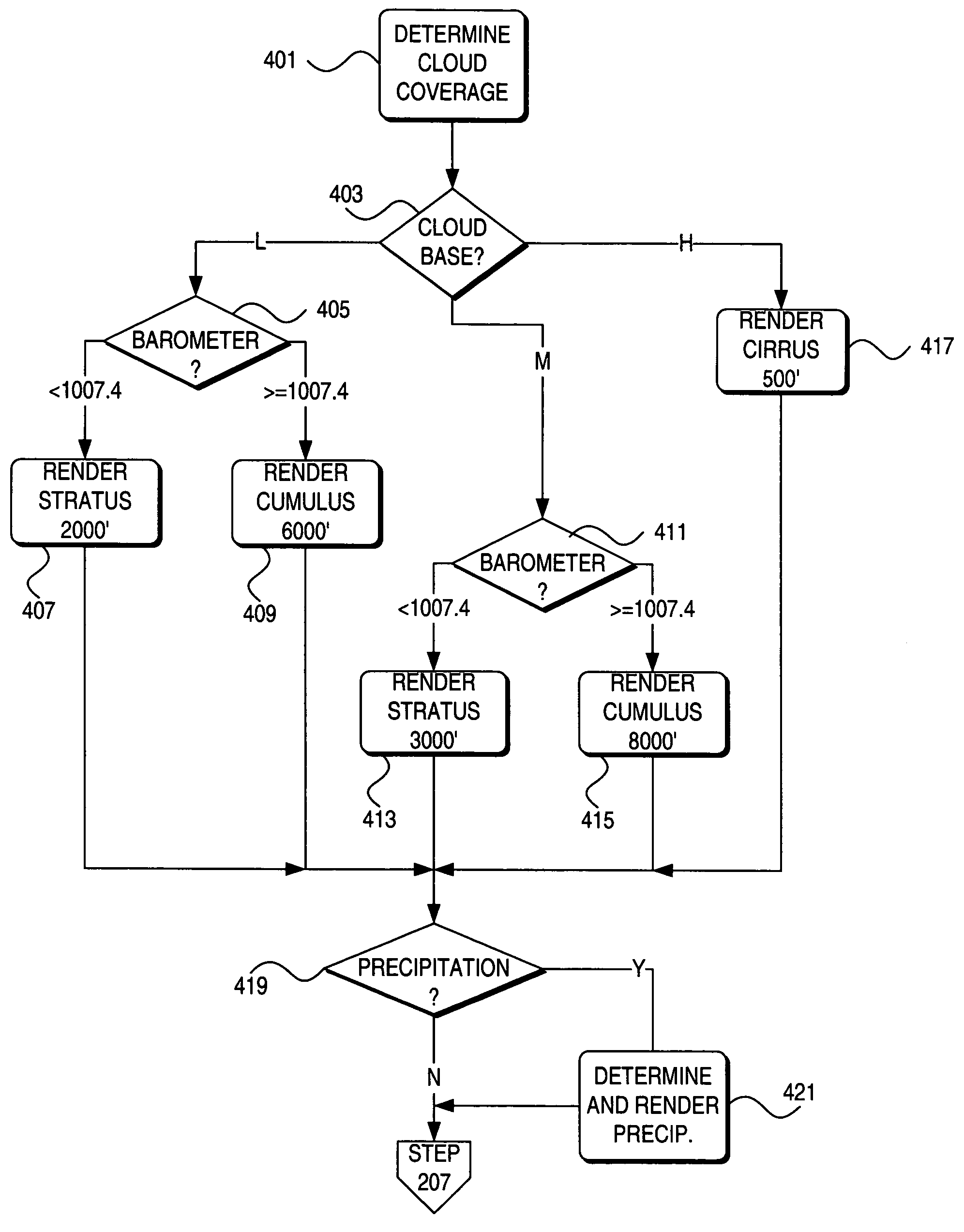
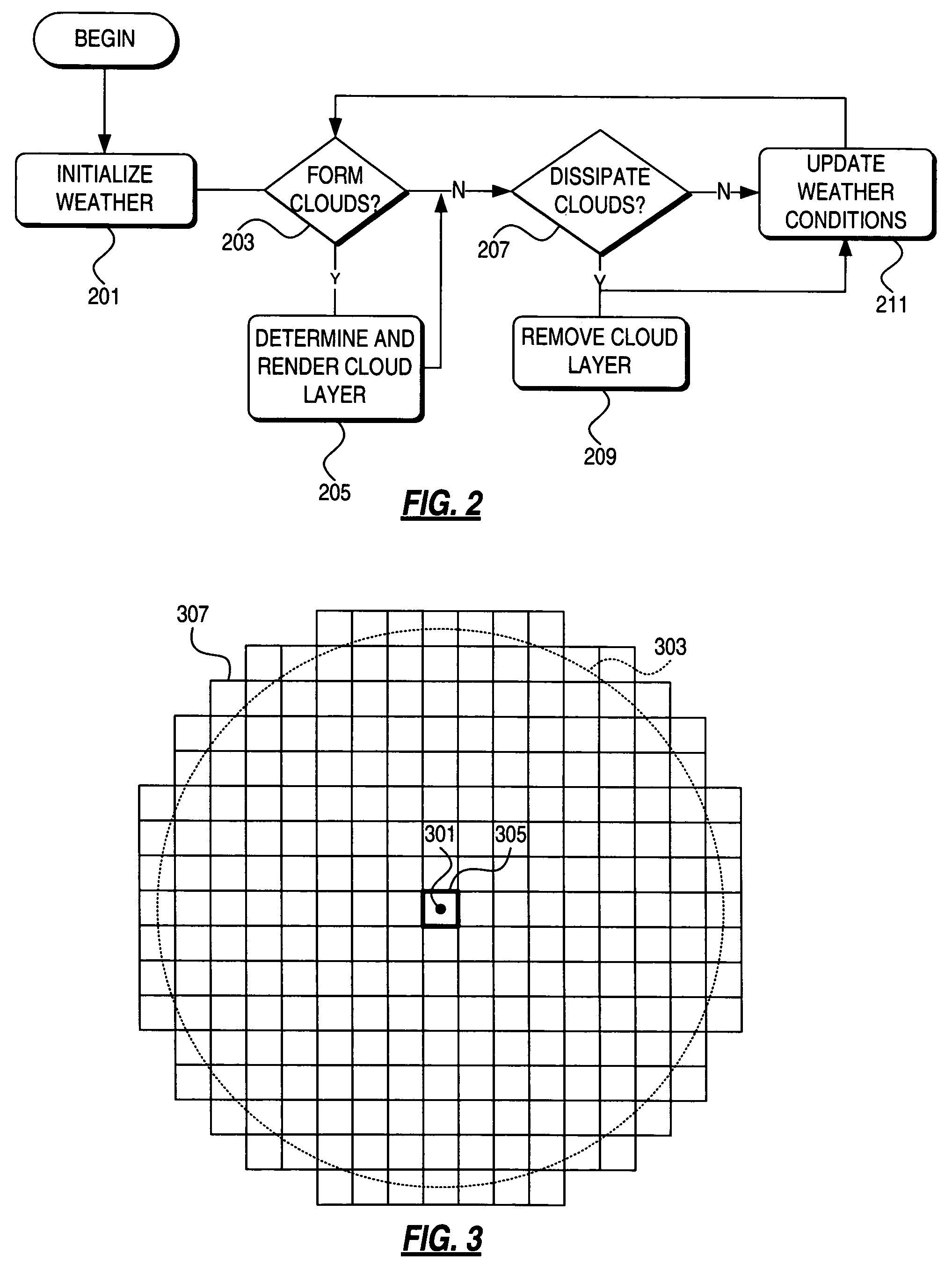
- A weather simulation manager that dynamically simulates weather by receiving and altering meteorological conditions, such as temperature and dew point, to render clouds and precipitation, and independently simulates weather for multiple areas visible from the user's position, using a geographic grid to manage resource allocation and ensure realistic, varied weather conditions without overburdening the system.

Real-time Performance Optimization Strategies
Real-time performance optimization in AI-driven dynamic weather simulations requires sophisticated computational strategies to balance visual fidelity with processing efficiency. The primary challenge lies in managing the computational overhead of machine learning models while maintaining interactive frame rates essential for real-time applications such as flight simulators, gaming environments, and meteorological visualization systems.
Level-of-detail (LOD) algorithms represent a fundamental optimization approach, dynamically adjusting simulation complexity based on viewing distance and importance. Weather phenomena closer to the observer receive full computational resources, while distant elements utilize simplified models or pre-computed approximations. This hierarchical approach can reduce computational load by 40-60% without significant visual quality degradation.
Temporal coherence optimization leverages frame-to-frame consistency in weather patterns. Rather than recalculating entire weather systems each frame, algorithms track incremental changes and update only modified regions. This technique proves particularly effective for slowly evolving phenomena like cloud formation and precipitation patterns, achieving performance improvements of 30-50% in typical scenarios.
GPU-accelerated parallel processing forms the backbone of modern real-time weather simulation optimization. Compute shaders enable massive parallelization of particle systems, fluid dynamics calculations, and neural network inference. Advanced implementations utilize asynchronous compute queues to overlap weather simulation with rendering operations, maximizing hardware utilization efficiency.
Adaptive quality scaling dynamically adjusts simulation parameters based on system performance metrics. When frame rates drop below target thresholds, the system automatically reduces particle counts, simplifies physics calculations, or switches to lower-fidelity approximation models. This ensures consistent user experience across varying hardware configurations and computational loads.
Memory bandwidth optimization through data structure reorganization and compression techniques significantly impacts performance. Structure-of-arrays layouts improve cache coherency for vectorized operations, while specialized compression algorithms for weather data can reduce memory footprint by 70% while maintaining acceptable accuracy levels for real-time applications.
Level-of-detail (LOD) algorithms represent a fundamental optimization approach, dynamically adjusting simulation complexity based on viewing distance and importance. Weather phenomena closer to the observer receive full computational resources, while distant elements utilize simplified models or pre-computed approximations. This hierarchical approach can reduce computational load by 40-60% without significant visual quality degradation.
Temporal coherence optimization leverages frame-to-frame consistency in weather patterns. Rather than recalculating entire weather systems each frame, algorithms track incremental changes and update only modified regions. This technique proves particularly effective for slowly evolving phenomena like cloud formation and precipitation patterns, achieving performance improvements of 30-50% in typical scenarios.
GPU-accelerated parallel processing forms the backbone of modern real-time weather simulation optimization. Compute shaders enable massive parallelization of particle systems, fluid dynamics calculations, and neural network inference. Advanced implementations utilize asynchronous compute queues to overlap weather simulation with rendering operations, maximizing hardware utilization efficiency.
Adaptive quality scaling dynamically adjusts simulation parameters based on system performance metrics. When frame rates drop below target thresholds, the system automatically reduces particle counts, simplifies physics calculations, or switches to lower-fidelity approximation models. This ensures consistent user experience across varying hardware configurations and computational loads.
Memory bandwidth optimization through data structure reorganization and compression techniques significantly impacts performance. Structure-of-arrays layouts improve cache coherency for vectorized operations, while specialized compression algorithms for weather data can reduce memory footprint by 70% while maintaining acceptable accuracy levels for real-time applications.
Cross-Platform Weather Graphics Integration
Cross-platform weather graphics integration represents a critical technical challenge in developing AI-driven dynamic weather simulation systems. The complexity arises from the need to maintain consistent visual fidelity and performance across diverse hardware architectures, operating systems, and rendering pipelines while delivering real-time weather visualization capabilities.
Modern weather simulation applications must operate seamlessly across desktop environments running Windows, macOS, and Linux, mobile platforms including iOS and Android, web browsers supporting WebGL and WebGPU standards, and emerging platforms such as augmented reality headsets and automotive infotainment systems. Each platform presents unique constraints regarding computational resources, memory management, and graphics API compatibility.
The integration challenge extends beyond mere compatibility to encompass performance optimization across varying hardware capabilities. High-end workstations may leverage dedicated GPUs with substantial VRAM for complex particle systems and volumetric rendering, while mobile devices require efficient algorithms that balance visual quality with battery consumption and thermal management.
Graphics API abstraction layers have emerged as essential components for cross-platform weather graphics integration. Modern solutions typically implement unified rendering backends that translate high-level graphics commands to platform-specific APIs such as DirectX 12, Vulkan, Metal, and OpenGL ES. This abstraction enables developers to maintain a single codebase while optimizing for platform-specific performance characteristics.
Data synchronization presents another significant integration challenge, particularly for real-time weather simulations that require consistent meteorological data across all platforms. Cloud-based data distribution systems must account for varying network conditions, offline capabilities, and data compression requirements specific to each platform's bandwidth limitations.
Shader compatibility remains a persistent technical hurdle, as different platforms support varying shader languages and feature sets. Cross-compilation tools and shader abstraction frameworks have become indispensable for maintaining consistent visual effects across platforms while leveraging platform-specific optimizations where available.
The emergence of progressive web applications and cloud gaming services has introduced additional complexity, requiring weather graphics systems to operate efficiently in bandwidth-constrained environments while maintaining interactive performance standards expected by users across all deployment scenarios.
Modern weather simulation applications must operate seamlessly across desktop environments running Windows, macOS, and Linux, mobile platforms including iOS and Android, web browsers supporting WebGL and WebGPU standards, and emerging platforms such as augmented reality headsets and automotive infotainment systems. Each platform presents unique constraints regarding computational resources, memory management, and graphics API compatibility.
The integration challenge extends beyond mere compatibility to encompass performance optimization across varying hardware capabilities. High-end workstations may leverage dedicated GPUs with substantial VRAM for complex particle systems and volumetric rendering, while mobile devices require efficient algorithms that balance visual quality with battery consumption and thermal management.
Graphics API abstraction layers have emerged as essential components for cross-platform weather graphics integration. Modern solutions typically implement unified rendering backends that translate high-level graphics commands to platform-specific APIs such as DirectX 12, Vulkan, Metal, and OpenGL ES. This abstraction enables developers to maintain a single codebase while optimizing for platform-specific performance characteristics.
Data synchronization presents another significant integration challenge, particularly for real-time weather simulations that require consistent meteorological data across all platforms. Cloud-based data distribution systems must account for varying network conditions, offline capabilities, and data compression requirements specific to each platform's bandwidth limitations.
Shader compatibility remains a persistent technical hurdle, as different platforms support varying shader languages and feature sets. Cross-compilation tools and shader abstraction frameworks have become indispensable for maintaining consistent visual effects across platforms while leveraging platform-specific optimizations where available.
The emergence of progressive web applications and cloud gaming services has introduced additional complexity, requiring weather graphics systems to operate efficiently in bandwidth-constrained environments while maintaining interactive performance standards expected by users across all deployment scenarios.
Unlock deeper insights with Patsnap Eureka Quick Research — get a full tech report to explore trends and direct your research. Try now!
Generate Your Research Report Instantly with AI Agent
Supercharge your innovation with Patsnap Eureka AI Agent Platform!