
Analyzing Electrolyte Penetration at Micron Level in Pouch Cell Stacking
MAY 28, 202610 MIN READ
Generate Your Research Report Instantly with AI Agent
Patsnap Eureka helps you evaluate technical feasibility & market potential.
Electrolyte Penetration Background and Technical Objectives
Electrolyte penetration in lithium-ion battery systems has emerged as a critical factor determining cell performance, safety, and longevity. The phenomenon involves the infiltration of liquid electrolyte into the porous electrode structures and separator materials, establishing ionic pathways essential for electrochemical reactions. In pouch cell configurations, this process becomes particularly complex due to the multi-layered stacking architecture and the flexible packaging format that introduces unique mechanical and thermal dynamics.
The historical development of electrolyte penetration analysis began with basic wetting studies in the 1990s, focusing primarily on macroscopic observations. Early research concentrated on understanding bulk electrolyte distribution patterns and their correlation with cell capacity. However, as battery technology advanced toward higher energy densities and faster charging capabilities, the limitations of macro-level analysis became apparent, necessitating investigation at the microscopic scale.
The transition to micron-level analysis represents a paradigm shift in battery research methodology. At this scale, researchers can observe individual pore filling mechanisms, interfacial phenomena between electrolyte and active materials, and localized concentration gradients that significantly impact cell behavior. This microscopic perspective reveals heterogeneous penetration patterns that are invisible at larger scales but critically influence overall cell performance.
Contemporary challenges in electrolyte penetration analysis stem from the inherent complexity of pouch cell stacking geometries. Unlike cylindrical or prismatic cells with uniform structures, pouch cells feature multiple electrode layers with varying porosity distributions, creating intricate three-dimensional penetration pathways. The flexible nature of pouch packaging introduces additional variables, as mechanical deformation during operation can alter pore structures and electrolyte flow patterns.
The primary technical objective centers on developing comprehensive analytical methodologies capable of quantifying electrolyte penetration dynamics at the micron scale within operational pouch cell environments. This encompasses real-time monitoring of penetration rates, mapping spatial distribution patterns, and correlating microscopic observations with macroscopic cell performance metrics. Advanced imaging techniques, coupled with computational modeling approaches, aim to establish predictive frameworks for optimizing electrolyte formulations and cell designs.
Secondary objectives include establishing standardized measurement protocols for micron-level penetration analysis, developing non-destructive characterization methods suitable for commercial applications, and creating design guidelines for enhanced electrolyte utilization efficiency. These goals collectively support the broader industry objective of achieving superior battery performance through fundamental understanding of electrolyte behavior at the microscopic scale.
The historical development of electrolyte penetration analysis began with basic wetting studies in the 1990s, focusing primarily on macroscopic observations. Early research concentrated on understanding bulk electrolyte distribution patterns and their correlation with cell capacity. However, as battery technology advanced toward higher energy densities and faster charging capabilities, the limitations of macro-level analysis became apparent, necessitating investigation at the microscopic scale.
The transition to micron-level analysis represents a paradigm shift in battery research methodology. At this scale, researchers can observe individual pore filling mechanisms, interfacial phenomena between electrolyte and active materials, and localized concentration gradients that significantly impact cell behavior. This microscopic perspective reveals heterogeneous penetration patterns that are invisible at larger scales but critically influence overall cell performance.
Contemporary challenges in electrolyte penetration analysis stem from the inherent complexity of pouch cell stacking geometries. Unlike cylindrical or prismatic cells with uniform structures, pouch cells feature multiple electrode layers with varying porosity distributions, creating intricate three-dimensional penetration pathways. The flexible nature of pouch packaging introduces additional variables, as mechanical deformation during operation can alter pore structures and electrolyte flow patterns.
The primary technical objective centers on developing comprehensive analytical methodologies capable of quantifying electrolyte penetration dynamics at the micron scale within operational pouch cell environments. This encompasses real-time monitoring of penetration rates, mapping spatial distribution patterns, and correlating microscopic observations with macroscopic cell performance metrics. Advanced imaging techniques, coupled with computational modeling approaches, aim to establish predictive frameworks for optimizing electrolyte formulations and cell designs.
Secondary objectives include establishing standardized measurement protocols for micron-level penetration analysis, developing non-destructive characterization methods suitable for commercial applications, and creating design guidelines for enhanced electrolyte utilization efficiency. These goals collectively support the broader industry objective of achieving superior battery performance through fundamental understanding of electrolyte behavior at the microscopic scale.
Market Demand for Advanced Pouch Cell Analysis
The global lithium-ion battery market is experiencing unprecedented growth, driven by the rapid expansion of electric vehicles, energy storage systems, and portable electronics. This surge has intensified the demand for advanced battery analysis technologies, particularly for pouch cell configurations that offer superior energy density and design flexibility compared to cylindrical or prismatic formats.
Pouch cells have gained significant traction in automotive applications due to their lightweight construction and efficient space utilization. However, their complex multi-layer architecture presents unique challenges in quality control and performance optimization. The stacking process, where multiple electrode layers are assembled with separators and electrolyte, requires precise monitoring to ensure uniform electrolyte distribution and prevent defects that could compromise battery safety and longevity.
The automotive industry's transition toward electrification has created substantial market pressure for enhanced battery manufacturing quality assurance. Electric vehicle manufacturers demand batteries with consistent performance characteristics, extended cycle life, and robust safety profiles. These requirements have elevated the importance of micron-level analysis capabilities that can detect subtle variations in electrolyte penetration patterns during the manufacturing process.
Energy storage system applications further amplify this demand, as grid-scale installations require batteries with predictable degradation patterns and minimal performance variation across large battery arrays. The ability to analyze electrolyte penetration at the microscopic level enables manufacturers to identify potential failure modes before they manifest in field applications, reducing warranty costs and improving system reliability.
Current market dynamics reveal a significant gap between existing analysis capabilities and industry requirements. Traditional inspection methods often lack the resolution and speed necessary for comprehensive quality assessment in high-volume manufacturing environments. This limitation has created opportunities for advanced analytical solutions that can provide real-time, non-destructive evaluation of electrolyte distribution patterns.
The semiconductor and electronics industries have also contributed to market demand growth, as portable devices require increasingly compact and efficient power sources. Pouch cells used in smartphones, tablets, and wearable devices must meet stringent thickness tolerances and performance specifications, necessitating precise control over electrolyte penetration during assembly.
Manufacturing cost pressures have intensified the need for early defect detection capabilities. The ability to identify electrolyte penetration anomalies during the stacking process, rather than after cell completion, can significantly reduce material waste and production costs. This economic driver has accelerated adoption of advanced analysis technologies across the battery manufacturing ecosystem.
Regulatory requirements for battery safety and performance documentation have further strengthened market demand for comprehensive analysis capabilities. Manufacturers must demonstrate thorough understanding of their production processes and product characteristics to meet increasingly stringent certification standards in automotive and energy storage applications.
Pouch cells have gained significant traction in automotive applications due to their lightweight construction and efficient space utilization. However, their complex multi-layer architecture presents unique challenges in quality control and performance optimization. The stacking process, where multiple electrode layers are assembled with separators and electrolyte, requires precise monitoring to ensure uniform electrolyte distribution and prevent defects that could compromise battery safety and longevity.
The automotive industry's transition toward electrification has created substantial market pressure for enhanced battery manufacturing quality assurance. Electric vehicle manufacturers demand batteries with consistent performance characteristics, extended cycle life, and robust safety profiles. These requirements have elevated the importance of micron-level analysis capabilities that can detect subtle variations in electrolyte penetration patterns during the manufacturing process.
Energy storage system applications further amplify this demand, as grid-scale installations require batteries with predictable degradation patterns and minimal performance variation across large battery arrays. The ability to analyze electrolyte penetration at the microscopic level enables manufacturers to identify potential failure modes before they manifest in field applications, reducing warranty costs and improving system reliability.
Current market dynamics reveal a significant gap between existing analysis capabilities and industry requirements. Traditional inspection methods often lack the resolution and speed necessary for comprehensive quality assessment in high-volume manufacturing environments. This limitation has created opportunities for advanced analytical solutions that can provide real-time, non-destructive evaluation of electrolyte distribution patterns.
The semiconductor and electronics industries have also contributed to market demand growth, as portable devices require increasingly compact and efficient power sources. Pouch cells used in smartphones, tablets, and wearable devices must meet stringent thickness tolerances and performance specifications, necessitating precise control over electrolyte penetration during assembly.
Manufacturing cost pressures have intensified the need for early defect detection capabilities. The ability to identify electrolyte penetration anomalies during the stacking process, rather than after cell completion, can significantly reduce material waste and production costs. This economic driver has accelerated adoption of advanced analysis technologies across the battery manufacturing ecosystem.
Regulatory requirements for battery safety and performance documentation have further strengthened market demand for comprehensive analysis capabilities. Manufacturers must demonstrate thorough understanding of their production processes and product characteristics to meet increasingly stringent certification standards in automotive and energy storage applications.
Current State of Micron-Level Electrolyte Analysis
The current landscape of micron-level electrolyte analysis in pouch cell stacking represents a rapidly evolving field driven by the increasing demand for high-performance lithium-ion batteries. Traditional characterization methods have primarily relied on macroscopic measurements that provide limited insight into the microscale heterogeneities within battery systems. However, recent technological advances have enabled researchers to probe electrolyte distribution and penetration at unprecedented spatial resolutions.
X-ray computed tomography (CT) has emerged as one of the leading non-destructive techniques for visualizing electrolyte penetration in three dimensions. Synchrotron-based X-ray imaging systems can achieve sub-micron resolution, allowing researchers to track electrolyte wetting dynamics in real-time during cell assembly and operation. These systems utilize phase contrast imaging to distinguish between different materials based on their refractive indices, providing clear visualization of electrolyte-electrode interfaces.
Neutron imaging represents another powerful approach for electrolyte analysis, particularly advantageous due to hydrogen's high neutron scattering cross-section. This technique enables direct observation of liquid electrolyte distribution within assembled cells without requiring contrast agents. Recent developments in neutron detector technology have pushed spatial resolution capabilities below 10 micrometers, making it increasingly viable for detailed pouch cell analysis.
Advanced electron microscopy techniques, including cryo-electron microscopy and environmental scanning electron microscopy, have been adapted for electrolyte characterization. These methods allow direct observation of electrolyte-electrode interfaces at nanometer scales, though sample preparation requirements can introduce artifacts that complicate interpretation of results.
Optical coherence tomography (OCT) has gained attention as a complementary technique offering real-time monitoring capabilities. While spatial resolution is typically limited to several micrometers, OCT provides valuable insights into dynamic wetting processes and can be integrated into manufacturing environments for quality control applications.
Despite these technological advances, significant challenges persist in achieving comprehensive micron-level electrolyte analysis. Sample preparation artifacts, beam damage effects, and the need for specialized facilities limit widespread adoption of many advanced techniques. Additionally, correlating static imaging results with dynamic battery performance remains an ongoing challenge that requires continued methodological development.
Current research efforts focus on developing multi-modal imaging approaches that combine complementary techniques to provide more complete characterization. Integration of machine learning algorithms for automated image analysis and pattern recognition is also accelerating data processing capabilities, enabling more systematic studies of electrolyte penetration phenomena across different cell designs and operating conditions.
X-ray computed tomography (CT) has emerged as one of the leading non-destructive techniques for visualizing electrolyte penetration in three dimensions. Synchrotron-based X-ray imaging systems can achieve sub-micron resolution, allowing researchers to track electrolyte wetting dynamics in real-time during cell assembly and operation. These systems utilize phase contrast imaging to distinguish between different materials based on their refractive indices, providing clear visualization of electrolyte-electrode interfaces.
Neutron imaging represents another powerful approach for electrolyte analysis, particularly advantageous due to hydrogen's high neutron scattering cross-section. This technique enables direct observation of liquid electrolyte distribution within assembled cells without requiring contrast agents. Recent developments in neutron detector technology have pushed spatial resolution capabilities below 10 micrometers, making it increasingly viable for detailed pouch cell analysis.
Advanced electron microscopy techniques, including cryo-electron microscopy and environmental scanning electron microscopy, have been adapted for electrolyte characterization. These methods allow direct observation of electrolyte-electrode interfaces at nanometer scales, though sample preparation requirements can introduce artifacts that complicate interpretation of results.
Optical coherence tomography (OCT) has gained attention as a complementary technique offering real-time monitoring capabilities. While spatial resolution is typically limited to several micrometers, OCT provides valuable insights into dynamic wetting processes and can be integrated into manufacturing environments for quality control applications.
Despite these technological advances, significant challenges persist in achieving comprehensive micron-level electrolyte analysis. Sample preparation artifacts, beam damage effects, and the need for specialized facilities limit widespread adoption of many advanced techniques. Additionally, correlating static imaging results with dynamic battery performance remains an ongoing challenge that requires continued methodological development.
Current research efforts focus on developing multi-modal imaging approaches that combine complementary techniques to provide more complete characterization. Integration of machine learning algorithms for automated image analysis and pattern recognition is also accelerating data processing capabilities, enabling more systematic studies of electrolyte penetration phenomena across different cell designs and operating conditions.
Existing Micron-Level Electrolyte Detection Solutions
01 Electrolyte membrane materials and compositions
Development of specialized membrane materials designed to control electrolyte penetration through the use of specific polymeric compositions, ceramic materials, and composite structures. These materials are engineered to provide selective permeability while maintaining structural integrity and chemical stability in various electrolyte environments.- Electrolyte membrane materials and compositions: Development of specialized membrane materials and electrolyte compositions designed to control and optimize penetration characteristics. These materials focus on ionic conductivity, selectivity, and barrier properties to manage electrolyte transport through various substrates and interfaces.
- Battery separator technology for electrolyte management: Advanced separator technologies that regulate electrolyte penetration in battery systems. These solutions involve porous structures, coating technologies, and material engineering to achieve optimal electrolyte distribution while preventing unwanted migration or leakage.
- Surface treatment and coating methods: Surface modification techniques and coating applications that control electrolyte penetration behavior. These methods involve chemical treatments, physical modifications, and protective layers to enhance or restrict electrolyte interaction with substrate materials.
- Electrochemical cell design and structure: Innovative cell architectures and structural designs that optimize electrolyte penetration patterns for improved performance. These approaches focus on geometric configurations, flow channels, and internal structures to enhance electrolyte distribution and utilization efficiency.
- Testing and measurement techniques for penetration analysis: Methods and apparatus for evaluating, measuring, and characterizing electrolyte penetration behavior. These techniques include analytical procedures, testing equipment, and measurement protocols to assess penetration depth, rate, and uniformity in various applications.
02 Barrier coating technologies for electrolyte resistance
Application of protective coating systems and surface treatments to prevent or control electrolyte penetration into substrates. These technologies involve the development of thin film barriers, surface modification techniques, and multi-layer coating systems that provide enhanced resistance to ionic transport.Expand Specific Solutions03 Porous structure design for controlled electrolyte transport
Engineering of porous materials and structures to achieve controlled electrolyte penetration rates and pathways. This includes the optimization of pore size distribution, porosity levels, and interconnected pore networks to facilitate desired electrolyte transport characteristics while preventing unwanted penetration.Expand Specific Solutions04 Electrolyte penetration testing and measurement methods
Development of analytical techniques and testing protocols for evaluating electrolyte penetration behavior in various materials and systems. These methods include standardized testing procedures, measurement apparatus, and characterization techniques to assess penetration rates, depth, and mechanisms.Expand Specific Solutions05 Battery and electrochemical cell electrolyte management
Strategies for managing electrolyte penetration in battery systems and electrochemical devices to optimize performance and prevent degradation. This includes separator design, electrolyte formulation, and cell architecture modifications to control electrolyte distribution and minimize unwanted penetration effects.Expand Specific Solutions
Key Players in Battery Analysis and Pouch Cell Technology
The electrolyte penetration analysis at micron level in pouch cell stacking represents a rapidly evolving segment within the mature lithium-ion battery industry, currently valued at over $50 billion globally. The competitive landscape is dominated by established Asian manufacturers including LG Energy Solution, LG Chem, and Panasonic Holdings, who possess advanced manufacturing capabilities and significant R&D investments. Chinese players like Svolt Energy Technology, Microvast, and Tianjin Gateway Power are aggressively expanding market share through cost-effective solutions and technological innovation. Technology maturity varies significantly, with leading companies like LG Chem and Panasonic demonstrating sophisticated electrolyte penetration control technologies, while emerging players focus on process optimization and automation solutions, supported by specialized equipment providers like Project Engineering & Contracting NV and research institutions.
LG Energy Solution Ltd.
Technical Solution: LG Energy Solution has developed advanced electrolyte penetration analysis technologies for pouch cell manufacturing, utilizing high-resolution X-ray computed tomography and scanning electron microscopy to examine electrolyte distribution at the micron level. Their approach combines real-time monitoring systems with post-mortem analysis to track electrolyte wetting behavior during the formation process. The company employs specialized electrolyte formulations with enhanced wetting agents and optimized viscosity profiles to improve penetration uniformity across stacked electrode layers. Their quality control systems include automated optical inspection and impedance spectroscopy to detect electrolyte distribution anomalies during production.
Strengths: Market-leading production scale and extensive R&D resources for advanced characterization techniques. Weaknesses: High capital investment requirements for sophisticated analysis equipment and longer development cycles for new electrolyte formulations.
GM Global Technology Operations LLC
Technical Solution: GM has developed electrolyte penetration analysis capabilities focused on automotive pouch cell applications, utilizing advanced microscopy techniques and electrochemical characterization methods. Their approach emphasizes understanding electrolyte wetting behavior under various temperature and pressure conditions relevant to automotive environments. The company employs specialized test protocols including accelerated aging studies to evaluate long-term electrolyte distribution stability. GM's methodology incorporates computational fluid dynamics modeling to predict electrolyte flow patterns and optimize cell design parameters. Their analysis systems include automated image analysis software for quantifying penetration depth and uniformity across large electrode areas in pouch cell configurations.
Strengths: Strong automotive application focus with robust testing protocols for real-world conditions. Weaknesses: Limited to automotive-specific requirements which may not translate to other applications, and dependency on supplier partnerships for advanced materials.
Core Innovations in Electrolyte Penetration Measurement
Electrolyte Infiltration Method and Apparatus for Pouch Cell, and Electrolyte Injection Machine
PatentPendingUS20240339740A1
Innovation
- An electrolyte infiltration method involving a series of vacuum pressure cycles within a closed environment to facilitate expansion and contraction of the cell, accelerating electrolyte infiltration by creating a pressure difference that enhances electrolyte penetration to the middle electrode sheet, combined with an infiltration apparatus utilizing splint cylinders and a lifting mechanism for precise control.
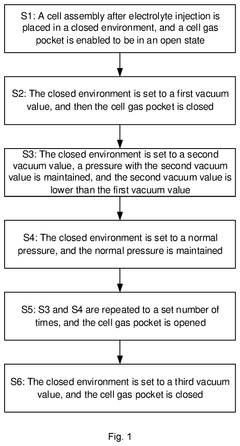
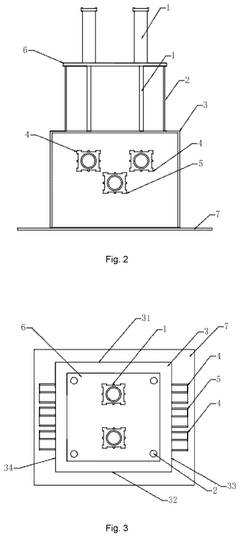
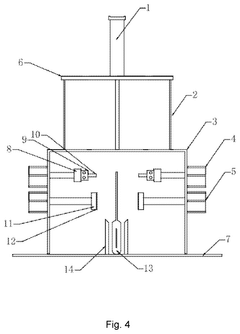
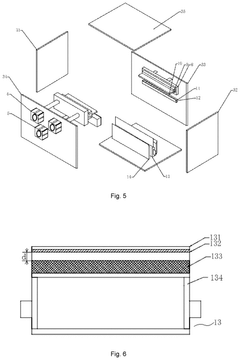
Method for producing an electrode/separator stack including filling with an electrolyte for use in an electrochemical energy storage cell
PatentWO2012072220A1
Innovation
- A method that involves creating small gaps between adjacent sheets to facilitate even electrolyte penetration, followed by bending the stack to maximize gap width, allowing for easy filling and distribution of the electrolyte, and then returning the stack to its original shape for stable and efficient electrolyte distribution.


Safety Standards for Battery Electrolyte Analysis
The analysis of electrolyte penetration at micron level in pouch cell stacking requires adherence to comprehensive safety standards that govern both analytical procedures and operational protocols. Current international standards primarily focus on IEC 62133 series for secondary lithium batteries, which establishes fundamental safety requirements for electrolyte handling and analysis. These standards mandate specific containment protocols when conducting microscopic analysis of electrolyte distribution within cell structures.
Laboratory safety protocols for micron-level electrolyte analysis must incorporate specialized ventilation systems capable of handling volatile organic compounds commonly found in lithium-ion electrolytes. The standards require fume extraction rates of minimum 100 linear feet per minute at the hood face, with emergency backup systems to prevent exposure during power failures. Personnel protective equipment specifications include chemical-resistant gloves rated for organic solvents, full-face respirators with organic vapor cartridges, and anti-static laboratory coats to prevent ignition risks.
Sample preparation safety standards emphasize controlled atmosphere environments to prevent electrolyte degradation and minimize exposure risks. The protocols mandate inert gas purging systems, typically using high-purity argon or nitrogen, to maintain oxygen levels below 10 ppm during sample handling. Temperature control requirements specify maintaining ambient conditions between 18-25°C to prevent thermal decomposition of electrolyte components during microscopic examination.
Analytical equipment safety standards require specialized grounding protocols for electron microscopy systems used in micron-level analysis. The standards mandate isolation transformers and dedicated electrical circuits to prevent electromagnetic interference that could compromise both safety systems and analytical accuracy. Emergency shutdown procedures must be accessible within 10 seconds from any operator position, with automatic sample isolation capabilities.
Waste management protocols for electrolyte analysis follow hazardous material classification under UN3480 regulations. Contaminated materials require segregated collection in approved containers with secondary containment systems. The standards specify neutralization procedures for electrolyte residues before disposal, typically involving controlled reaction with appropriate buffering agents to achieve pH levels between 6-8 before entering standard hazardous waste streams.
Documentation requirements mandate comprehensive chain-of-custody protocols for all samples undergoing micron-level analysis. Safety data sheets must be readily accessible for all electrolyte formulations, with specific attention to thermal runaway characteristics and gas evolution profiles. Regular safety audits are required quarterly to ensure continued compliance with evolving battery safety standards and analytical best practices.
Laboratory safety protocols for micron-level electrolyte analysis must incorporate specialized ventilation systems capable of handling volatile organic compounds commonly found in lithium-ion electrolytes. The standards require fume extraction rates of minimum 100 linear feet per minute at the hood face, with emergency backup systems to prevent exposure during power failures. Personnel protective equipment specifications include chemical-resistant gloves rated for organic solvents, full-face respirators with organic vapor cartridges, and anti-static laboratory coats to prevent ignition risks.
Sample preparation safety standards emphasize controlled atmosphere environments to prevent electrolyte degradation and minimize exposure risks. The protocols mandate inert gas purging systems, typically using high-purity argon or nitrogen, to maintain oxygen levels below 10 ppm during sample handling. Temperature control requirements specify maintaining ambient conditions between 18-25°C to prevent thermal decomposition of electrolyte components during microscopic examination.
Analytical equipment safety standards require specialized grounding protocols for electron microscopy systems used in micron-level analysis. The standards mandate isolation transformers and dedicated electrical circuits to prevent electromagnetic interference that could compromise both safety systems and analytical accuracy. Emergency shutdown procedures must be accessible within 10 seconds from any operator position, with automatic sample isolation capabilities.
Waste management protocols for electrolyte analysis follow hazardous material classification under UN3480 regulations. Contaminated materials require segregated collection in approved containers with secondary containment systems. The standards specify neutralization procedures for electrolyte residues before disposal, typically involving controlled reaction with appropriate buffering agents to achieve pH levels between 6-8 before entering standard hazardous waste streams.
Documentation requirements mandate comprehensive chain-of-custody protocols for all samples undergoing micron-level analysis. Safety data sheets must be readily accessible for all electrolyte formulations, with specific attention to thermal runaway characteristics and gas evolution profiles. Regular safety audits are required quarterly to ensure continued compliance with evolving battery safety standards and analytical best practices.
Environmental Impact of Electrolyte Leakage Detection
Electrolyte leakage in pouch cell batteries poses significant environmental challenges that extend beyond immediate safety concerns. When electrolyte penetration occurs at the micron level within cell stacking structures, the potential for environmental contamination increases substantially due to the gradual but persistent nature of such microscopic breaches.
The primary environmental concern stems from the chemical composition of lithium-ion battery electrolytes, which typically contain lithium salts such as lithium hexafluorophosphate (LiPF6) dissolved in organic carbonate solvents. These compounds can persist in soil and groundwater systems for extended periods, potentially affecting local ecosystems. The fluorinated components are particularly problematic as they resist natural biodegradation processes and can accumulate in environmental matrices.
Micron-level electrolyte penetration creates unique detection challenges that amplify environmental risks. Unlike catastrophic failures that trigger immediate containment responses, microscopic leakage often goes undetected until significant quantities have been released. This delayed detection allows contaminants to migrate through soil layers and potentially reach groundwater sources, expanding the geographic scope of environmental impact.
Advanced detection methodologies for micron-level penetration must consider environmental monitoring protocols alongside technical performance metrics. Real-time detection systems that can identify trace electrolyte components in surrounding environments become crucial for preventing widespread contamination. These systems should incorporate both chemical sensors for direct electrolyte detection and indirect monitoring approaches that track environmental indicators such as pH changes or conductivity variations in nearby soil or water samples.
The environmental impact assessment framework for electrolyte leakage detection should encompass both acute and chronic exposure scenarios. Acute impacts may include immediate soil chemistry alterations and potential harm to local flora, while chronic effects could involve long-term groundwater contamination and bioaccumulation in food chains. Detection systems must therefore be calibrated to identify leakage levels well below those that would cause immediate environmental damage.
Regulatory compliance considerations further complicate the environmental impact landscape. Detection thresholds must align with increasingly stringent environmental protection standards while maintaining practical feasibility for industrial implementation. This balance requires sophisticated detection technologies capable of identifying electrolyte penetration at concentrations measured in parts per billion rather than traditional parts per million scales.
The primary environmental concern stems from the chemical composition of lithium-ion battery electrolytes, which typically contain lithium salts such as lithium hexafluorophosphate (LiPF6) dissolved in organic carbonate solvents. These compounds can persist in soil and groundwater systems for extended periods, potentially affecting local ecosystems. The fluorinated components are particularly problematic as they resist natural biodegradation processes and can accumulate in environmental matrices.
Micron-level electrolyte penetration creates unique detection challenges that amplify environmental risks. Unlike catastrophic failures that trigger immediate containment responses, microscopic leakage often goes undetected until significant quantities have been released. This delayed detection allows contaminants to migrate through soil layers and potentially reach groundwater sources, expanding the geographic scope of environmental impact.
Advanced detection methodologies for micron-level penetration must consider environmental monitoring protocols alongside technical performance metrics. Real-time detection systems that can identify trace electrolyte components in surrounding environments become crucial for preventing widespread contamination. These systems should incorporate both chemical sensors for direct electrolyte detection and indirect monitoring approaches that track environmental indicators such as pH changes or conductivity variations in nearby soil or water samples.
The environmental impact assessment framework for electrolyte leakage detection should encompass both acute and chronic exposure scenarios. Acute impacts may include immediate soil chemistry alterations and potential harm to local flora, while chronic effects could involve long-term groundwater contamination and bioaccumulation in food chains. Detection systems must therefore be calibrated to identify leakage levels well below those that would cause immediate environmental damage.
Regulatory compliance considerations further complicate the environmental impact landscape. Detection thresholds must align with increasingly stringent environmental protection standards while maintaining practical feasibility for industrial implementation. This balance requires sophisticated detection technologies capable of identifying electrolyte penetration at concentrations measured in parts per billion rather than traditional parts per million scales.
Unlock deeper insights with Patsnap Eureka Quick Research — get a full tech report to explore trends and direct your research. Try now!
Generate Your Research Report Instantly with AI Agent
Supercharge your innovation with Patsnap Eureka AI Agent Platform!