
Analyzing Microinverter Reliability: Heat Dissipation Techniques
MAY 19, 20269 MIN READ
Generate Your Research Report Instantly with AI Agent
Patsnap Eureka helps you evaluate technical feasibility & market potential.
Microinverter Heat Management Background and Objectives
Microinverters have emerged as a critical component in distributed photovoltaic systems, converting DC power from individual solar panels to AC power at the panel level. Unlike traditional string inverters, microinverters operate under harsh environmental conditions while maintaining high power density requirements, making thermal management a paramount concern for system reliability and longevity.
The evolution of microinverter technology has been driven by the demand for improved energy harvest, enhanced system monitoring capabilities, and reduced installation complexity. Early microinverter designs faced significant challenges related to power electronics miniaturization and heat dissipation, as the compact form factor required for panel-level installation created inherent thermal constraints that directly impacted device performance and lifespan.
Historical development patterns reveal that microinverter reliability issues have consistently centered around thermal stress-induced failures. Power semiconductor devices, magnetic components, and electrolytic capacitors within microinverters are particularly susceptible to elevated operating temperatures, which accelerate aging mechanisms and reduce mean time between failures. Industry data indicates that every 10°C increase in operating temperature can halve the expected lifespan of critical electronic components.
The primary objective of advanced heat dissipation techniques in microinverter design is to maintain junction temperatures of power semiconductors below critical thresholds while maximizing power conversion efficiency. This involves developing innovative thermal management solutions that can effectively transfer heat from high-power-density components to the ambient environment through the limited surface area available in microinverter enclosures.
Contemporary thermal management strategies aim to achieve several key performance targets: maintaining semiconductor junction temperatures below 125°C under peak operating conditions, ensuring enclosure surface temperatures remain within safe limits for installation personnel, and minimizing thermal cycling effects that contribute to solder joint fatigue and component degradation. These objectives must be balanced against cost constraints, manufacturing scalability, and long-term reliability requirements spanning 20-25 year operational lifetimes typical of solar installations.
The evolution of microinverter technology has been driven by the demand for improved energy harvest, enhanced system monitoring capabilities, and reduced installation complexity. Early microinverter designs faced significant challenges related to power electronics miniaturization and heat dissipation, as the compact form factor required for panel-level installation created inherent thermal constraints that directly impacted device performance and lifespan.
Historical development patterns reveal that microinverter reliability issues have consistently centered around thermal stress-induced failures. Power semiconductor devices, magnetic components, and electrolytic capacitors within microinverters are particularly susceptible to elevated operating temperatures, which accelerate aging mechanisms and reduce mean time between failures. Industry data indicates that every 10°C increase in operating temperature can halve the expected lifespan of critical electronic components.
The primary objective of advanced heat dissipation techniques in microinverter design is to maintain junction temperatures of power semiconductors below critical thresholds while maximizing power conversion efficiency. This involves developing innovative thermal management solutions that can effectively transfer heat from high-power-density components to the ambient environment through the limited surface area available in microinverter enclosures.
Contemporary thermal management strategies aim to achieve several key performance targets: maintaining semiconductor junction temperatures below 125°C under peak operating conditions, ensuring enclosure surface temperatures remain within safe limits for installation personnel, and minimizing thermal cycling effects that contribute to solder joint fatigue and component degradation. These objectives must be balanced against cost constraints, manufacturing scalability, and long-term reliability requirements spanning 20-25 year operational lifetimes typical of solar installations.
Market Demand for Reliable Solar Microinverter Systems
The global solar energy market has experienced unprecedented growth, driving substantial demand for reliable microinverter systems that can withstand harsh environmental conditions while maintaining optimal performance. Solar installations worldwide increasingly favor microinverter technology over traditional string inverters due to their superior module-level power optimization, enhanced safety features, and improved system monitoring capabilities.
Residential solar installations represent the primary market segment for microinverters, where homeowners prioritize long-term reliability and minimal maintenance requirements. The distributed nature of residential installations makes system accessibility challenging, creating strong market pressure for microinverters with extended operational lifespans and reduced failure rates. Heat-related failures constitute a significant concern for end users, as thermal stress directly impacts component longevity and system performance.
Commercial and industrial solar deployments also demonstrate growing preference for microinverter solutions, particularly in applications where partial shading or complex roof configurations limit string inverter effectiveness. These market segments demand robust thermal management solutions to ensure consistent energy production and minimize operational disruptions that could affect business operations.
The increasing adoption of solar-plus-storage systems further amplifies reliability requirements, as microinverters must integrate seamlessly with battery management systems while maintaining thermal stability under varying load conditions. Market research indicates that thermal-related failures account for a substantial portion of microinverter warranty claims, driving manufacturers to prioritize advanced heat dissipation technologies.
Emerging markets in Asia-Pacific and Latin America present significant growth opportunities, where extreme climate conditions and limited maintenance infrastructure create heightened demand for thermally robust microinverter designs. These regions often experience elevated ambient temperatures and high humidity levels, making effective heat dissipation critical for market acceptance.
The competitive landscape increasingly rewards manufacturers who can demonstrate superior thermal performance through innovative heat dissipation techniques, advanced materials, and optimized enclosure designs. Market differentiation now heavily depends on proven reliability metrics and extended warranty offerings, with thermal management capabilities serving as key purchasing criteria for installers and system integrators.
Residential solar installations represent the primary market segment for microinverters, where homeowners prioritize long-term reliability and minimal maintenance requirements. The distributed nature of residential installations makes system accessibility challenging, creating strong market pressure for microinverters with extended operational lifespans and reduced failure rates. Heat-related failures constitute a significant concern for end users, as thermal stress directly impacts component longevity and system performance.
Commercial and industrial solar deployments also demonstrate growing preference for microinverter solutions, particularly in applications where partial shading or complex roof configurations limit string inverter effectiveness. These market segments demand robust thermal management solutions to ensure consistent energy production and minimize operational disruptions that could affect business operations.
The increasing adoption of solar-plus-storage systems further amplifies reliability requirements, as microinverters must integrate seamlessly with battery management systems while maintaining thermal stability under varying load conditions. Market research indicates that thermal-related failures account for a substantial portion of microinverter warranty claims, driving manufacturers to prioritize advanced heat dissipation technologies.
Emerging markets in Asia-Pacific and Latin America present significant growth opportunities, where extreme climate conditions and limited maintenance infrastructure create heightened demand for thermally robust microinverter designs. These regions often experience elevated ambient temperatures and high humidity levels, making effective heat dissipation critical for market acceptance.
The competitive landscape increasingly rewards manufacturers who can demonstrate superior thermal performance through innovative heat dissipation techniques, advanced materials, and optimized enclosure designs. Market differentiation now heavily depends on proven reliability metrics and extended warranty offerings, with thermal management capabilities serving as key purchasing criteria for installers and system integrators.
Current Thermal Challenges in Microinverter Design
Microinverter thermal management faces unprecedented challenges as power density requirements continue to escalate while device footprints shrink. Modern microinverters must handle power levels ranging from 250W to 400W within increasingly compact enclosures, creating thermal flux densities that approach the limits of conventional cooling methods. The semiconductor components, particularly power MOSFETs and switching controllers, generate substantial heat during DC-to-AC conversion processes, with junction temperatures potentially exceeding 150°C under peak operating conditions.
The confined installation environment of microinverters exacerbates thermal challenges significantly. Mounted directly beneath solar panels, these devices experience ambient temperatures that can reach 85°C in direct sunlight, while simultaneously being exposed to limited airflow and restricted convective cooling opportunities. The enclosed mounting configuration creates a thermal trap effect, where heat accumulation becomes self-reinforcing and can lead to cascading thermal failures across multiple system components.
Power semiconductor thermal cycling represents another critical challenge in microinverter design. The continuous switching operations, typically occurring at frequencies between 16kHz and 100kHz, create rapid temperature fluctuations that induce thermal stress in solder joints, wire bonds, and semiconductor die attachments. These thermal cycles, combined with diurnal temperature variations, accelerate material fatigue and can reduce device lifespan by up to 40% compared to steady-state thermal conditions.
Component density optimization conflicts directly with thermal management requirements in current microinverter architectures. The industry push toward higher power-to-volume ratios necessitates tighter component placement, which reduces thermal isolation between heat-generating elements and creates hotspot formation. Critical components such as electrolytic capacitors, which are particularly temperature-sensitive, often experience accelerated degradation when positioned near high-heat semiconductor devices due to space constraints.
Electromagnetic interference considerations further complicate thermal design strategies. Traditional heat dissipation methods, including metal heat sinks and thermal interface materials, can interfere with EMI shielding requirements and create unintended electromagnetic coupling paths. This constraint limits the application of conventional thermal management solutions and necessitates innovative approaches that simultaneously address both thermal and electromagnetic compatibility requirements.
The reliability implications of inadequate thermal management extend beyond individual component failures to system-level performance degradation. Elevated operating temperatures reduce power conversion efficiency, increase leakage currents, and accelerate electrolytic capacitor aging, ultimately compromising the 25-year operational lifespan expected in photovoltaic applications.
The confined installation environment of microinverters exacerbates thermal challenges significantly. Mounted directly beneath solar panels, these devices experience ambient temperatures that can reach 85°C in direct sunlight, while simultaneously being exposed to limited airflow and restricted convective cooling opportunities. The enclosed mounting configuration creates a thermal trap effect, where heat accumulation becomes self-reinforcing and can lead to cascading thermal failures across multiple system components.
Power semiconductor thermal cycling represents another critical challenge in microinverter design. The continuous switching operations, typically occurring at frequencies between 16kHz and 100kHz, create rapid temperature fluctuations that induce thermal stress in solder joints, wire bonds, and semiconductor die attachments. These thermal cycles, combined with diurnal temperature variations, accelerate material fatigue and can reduce device lifespan by up to 40% compared to steady-state thermal conditions.
Component density optimization conflicts directly with thermal management requirements in current microinverter architectures. The industry push toward higher power-to-volume ratios necessitates tighter component placement, which reduces thermal isolation between heat-generating elements and creates hotspot formation. Critical components such as electrolytic capacitors, which are particularly temperature-sensitive, often experience accelerated degradation when positioned near high-heat semiconductor devices due to space constraints.
Electromagnetic interference considerations further complicate thermal design strategies. Traditional heat dissipation methods, including metal heat sinks and thermal interface materials, can interfere with EMI shielding requirements and create unintended electromagnetic coupling paths. This constraint limits the application of conventional thermal management solutions and necessitates innovative approaches that simultaneously address both thermal and electromagnetic compatibility requirements.
The reliability implications of inadequate thermal management extend beyond individual component failures to system-level performance degradation. Elevated operating temperatures reduce power conversion efficiency, increase leakage currents, and accelerate electrolytic capacitor aging, ultimately compromising the 25-year operational lifespan expected in photovoltaic applications.
Existing Heat Dissipation Solutions for Microinverters
01 Thermal management and heat dissipation systems
Effective thermal management is crucial for microinverter reliability, involving advanced heat dissipation techniques, thermal interface materials, and cooling systems to maintain optimal operating temperatures. These solutions help prevent thermal stress and extend component lifespan by managing heat generated during power conversion processes.- Thermal management and heat dissipation systems: Effective thermal management is crucial for microinverter reliability, involving advanced heat dissipation techniques, thermal interface materials, and cooling systems to prevent overheating and extend component lifespan. These systems help maintain optimal operating temperatures and reduce thermal stress on critical components.
- Power conversion circuit protection and fault detection: Implementation of robust protection circuits and fault detection mechanisms to safeguard microinverters from electrical anomalies, overcurrent conditions, and voltage fluctuations. These systems include monitoring circuits, protective relays, and automatic shutdown mechanisms to prevent damage and ensure safe operation.
- Component durability and material selection: Selection of high-quality components and materials designed to withstand environmental stresses, including temperature cycling, humidity, and UV exposure. This involves using robust capacitors, semiconductors, and encapsulation materials that maintain performance over extended periods in outdoor installations.
- Communication and monitoring systems: Integration of advanced communication protocols and monitoring systems that enable real-time performance tracking, remote diagnostics, and predictive maintenance capabilities. These systems help identify potential issues before they lead to failures and optimize overall system reliability.
- Environmental protection and enclosure design: Development of weatherproof enclosures and environmental protection systems that shield internal components from moisture, dust, corrosive elements, and mechanical stress. These designs ensure long-term reliability in various climatic conditions and installation environments.
02 Power electronics protection and fault detection
Implementation of comprehensive protection circuits and fault detection mechanisms to safeguard microinverters from electrical anomalies such as overvoltage, overcurrent, and ground faults. These systems include advanced monitoring capabilities and automatic shutdown features to prevent damage and ensure safe operation under various conditions.Expand Specific Solutions03 Communication and monitoring systems
Integration of robust communication protocols and real-time monitoring systems that enable remote diagnostics, performance tracking, and predictive maintenance. These systems provide continuous health assessment and early warning capabilities to identify potential reliability issues before they lead to system failures.Expand Specific Solutions04 Environmental protection and enclosure design
Development of weatherproof enclosures and environmental protection measures to shield microinverters from moisture, dust, temperature extremes, and other harsh outdoor conditions. These designs incorporate advanced sealing technologies and corrosion-resistant materials to ensure long-term durability in various climatic conditions.Expand Specific Solutions05 Power conversion efficiency and component optimization
Enhancement of power conversion circuits and optimization of electronic components to improve overall system efficiency and reduce stress on critical components. This includes advanced switching techniques, improved magnetic components, and optimized control algorithms that contribute to increased reliability and extended operational life.Expand Specific Solutions
Key Players in Microinverter and Thermal Management
The microinverter reliability market, particularly focusing on heat dissipation techniques, represents a rapidly evolving sector within the broader renewable energy industry. The market is currently in a growth phase, driven by increasing solar adoption and demand for enhanced system reliability. Market size continues expanding as distributed solar installations proliferate globally, creating substantial opportunities for thermal management innovations. Technology maturity varies significantly across market participants, with established semiconductor giants like Intel Corp., Texas Instruments, and Infineon Technologies leading advanced thermal solutions development. Energy-focused companies including Huawei Digital Power Technologies and Goodwe Technologies are integrating sophisticated heat dissipation methods into their inverter designs. Meanwhile, specialized thermal management providers such as Asia Vital Components and Long Victory Instruments are developing targeted cooling solutions. Research institutions like Industrial Technology Research Institute and Peking University contribute fundamental thermal engineering advances, while component manufacturers including Murata Manufacturing and Renesas Electronics provide essential heat-resistant materials and control systems for next-generation microinverter reliability enhancement.
Huawei Digital Power Technologies Co., Ltd.
Technical Solution: Huawei Digital Power has developed advanced thermal management solutions for microinverters, incorporating intelligent heat dissipation algorithms and multi-layer thermal interface materials. Their approach utilizes dynamic thermal monitoring with real-time temperature sensing across critical components, enabling adaptive power derating to prevent overheating. The company implements advanced aluminum heat sink designs with optimized fin structures and thermal pads with high thermal conductivity materials. Their microinverter systems feature distributed thermal management architecture that balances heat generation across multiple switching elements, significantly improving overall system reliability and extending operational lifespan under various environmental conditions.
Strengths: Comprehensive thermal management system with intelligent monitoring capabilities, proven track record in power electronics thermal solutions. Weaknesses: Higher complexity may increase manufacturing costs and potential points of failure.
Renesas Electronics Corp.
Technical Solution: Renesas Electronics has developed integrated thermal management solutions for microinverters that combine advanced power semiconductor technologies with intelligent thermal control systems. Their approach utilizes smart power modules with embedded thermal sensors and real-time thermal monitoring capabilities. The company's solutions feature optimized package designs with enhanced thermal performance through advanced substrate materials and thermal via technologies. Renesas implements predictive thermal management algorithms that dynamically adjust switching frequencies and power levels based on thermal conditions. Their microinverter solutions incorporate multi-layer thermal interface materials and advanced heat spreading techniques, achieving thermal resistance reductions of up to 35% while maintaining high power density and efficiency ratings above 95%.
Strengths: Integrated thermal monitoring with smart power modules, excellent power density and efficiency performance. Weaknesses: May require specialized design expertise for optimal implementation, potentially higher integration complexity.
Core Thermal Management Patents and Innovations
Top-mounted heat dissipation photovoltaic inverter device
PatentPendingEP4465783A1
Innovation
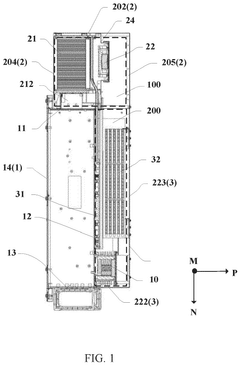
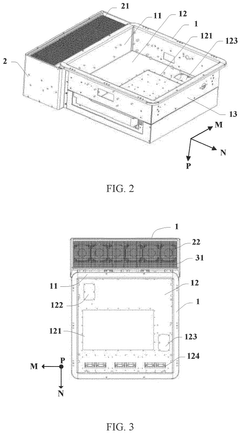
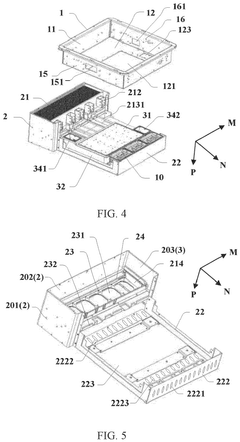
- A top-mounted heat dissipation photovoltaic inverter device with a modular design incorporating a top-installed heat dissipation assembly featuring a condenser and fan assembly, and a back-mounted heat dissipation assembly with an evaporator and air-cooled heat sink, arranged in a compact L-shaped configuration to enhance heat dissipation efficiency and maintainability.

Heat dissipating apparatus having micro-structure layer and method of fabricating the same
PatentInactiveUS7578338B2
Innovation
- A heat dissipating apparatus with a micro-structure layer formed by injection molding or printing on highly conductive substrates, creating a capillary structure that enhances heat conduction and uses a working fluid for efficient liquid-gas phase transition, allowing for precise control of dimensions and high thermal conductivity.


Grid Integration Standards for Microinverter Systems
Grid integration standards for microinverter systems represent a critical framework that ensures reliable operation while addressing thermal management challenges inherent in distributed photovoltaic installations. These standards establish comprehensive requirements for electrical performance, safety protocols, and operational parameters that directly influence heat dissipation effectiveness in microinverter designs.
The IEEE 1547 standard series forms the foundation for microinverter grid integration, defining interconnection requirements that impact thermal performance through operational voltage ranges, frequency response characteristics, and power quality specifications. These parameters directly affect component stress levels and subsequent heat generation patterns within microinverter circuits.
UL 1741 certification requirements establish safety benchmarks that incorporate thermal protection mechanisms, mandating specific temperature derating curves and thermal shutdown protocols. The standard requires microinverters to maintain stable operation across ambient temperature ranges from -40°C to +85°C, necessitating robust heat dissipation strategies to prevent performance degradation or premature failure.
International standards such as IEC 62109 provide additional thermal management guidelines, specifying insulation coordination requirements and environmental testing protocols that validate heat dissipation effectiveness under various climatic conditions. These standards mandate thermal cycling tests that simulate real-world temperature fluctuations, ensuring long-term reliability of grid-connected microinverter systems.
Grid code compliance requirements vary by region but consistently emphasize power quality maintenance under thermal stress conditions. European standards EN 50438 and German VDE-AR-N 4105 establish specific harmonic distortion limits and reactive power capabilities that must be sustained even during elevated operating temperatures, driving innovation in thermal management solutions.
Recent updates to grid integration standards increasingly focus on rapid shutdown capabilities and arc fault detection, both of which introduce additional thermal considerations. These safety features require sophisticated control circuits that generate supplementary heat, necessitating enhanced cooling strategies to maintain overall system reliability while meeting stringent grid interconnection requirements.
The IEEE 1547 standard series forms the foundation for microinverter grid integration, defining interconnection requirements that impact thermal performance through operational voltage ranges, frequency response characteristics, and power quality specifications. These parameters directly affect component stress levels and subsequent heat generation patterns within microinverter circuits.
UL 1741 certification requirements establish safety benchmarks that incorporate thermal protection mechanisms, mandating specific temperature derating curves and thermal shutdown protocols. The standard requires microinverters to maintain stable operation across ambient temperature ranges from -40°C to +85°C, necessitating robust heat dissipation strategies to prevent performance degradation or premature failure.
International standards such as IEC 62109 provide additional thermal management guidelines, specifying insulation coordination requirements and environmental testing protocols that validate heat dissipation effectiveness under various climatic conditions. These standards mandate thermal cycling tests that simulate real-world temperature fluctuations, ensuring long-term reliability of grid-connected microinverter systems.
Grid code compliance requirements vary by region but consistently emphasize power quality maintenance under thermal stress conditions. European standards EN 50438 and German VDE-AR-N 4105 establish specific harmonic distortion limits and reactive power capabilities that must be sustained even during elevated operating temperatures, driving innovation in thermal management solutions.
Recent updates to grid integration standards increasingly focus on rapid shutdown capabilities and arc fault detection, both of which introduce additional thermal considerations. These safety features require sophisticated control circuits that generate supplementary heat, necessitating enhanced cooling strategies to maintain overall system reliability while meeting stringent grid interconnection requirements.
Environmental Impact of Microinverter Thermal Design
The thermal design of microinverters presents significant environmental implications that extend beyond immediate performance considerations. As these devices operate continuously in outdoor environments, their heat dissipation strategies directly influence both ecological footprint and sustainability metrics throughout their operational lifecycle.
Traditional heat dissipation approaches in microinverters often rely on aluminum heat sinks and forced air cooling systems, which contribute to material resource consumption and manufacturing emissions. The aluminum extraction and processing required for heat sink production generates substantial carbon dioxide emissions, with each kilogram of aluminum producing approximately 11.5 kg of CO2 equivalent during primary production. Additionally, the surface treatments and anodizing processes used to enhance thermal conductivity introduce chemical waste streams that require careful environmental management.
Passive thermal management strategies demonstrate considerably lower environmental impact compared to active cooling solutions. Natural convection designs eliminate the need for fans or pumps, reducing both energy consumption and electronic waste generation. These systems typically achieve 15-20% lower lifetime carbon footprints while maintaining adequate thermal performance for most installation scenarios.
The geographic deployment environment significantly affects thermal design environmental impact. Microinverters installed in high-temperature regions require more robust cooling solutions, potentially increasing material usage by 25-30%. Conversely, installations in moderate climates can utilize simplified thermal designs with reduced environmental burden.
Advanced thermal interface materials present both opportunities and challenges for environmental sustainability. While graphene-enhanced thermal pads offer superior heat transfer coefficients, their production processes currently involve energy-intensive synthesis methods. However, bio-based thermal compounds derived from plant materials show promising environmental profiles with comparable thermal performance.
End-of-life considerations reveal that thermal design choices significantly impact recyclability. Modular heat sink designs facilitate material separation during recycling, while integrated thermal solutions often complicate material recovery processes. The selection of thermally conductive adhesives and interface materials particularly influences recycling efficiency, with silicone-based compounds generally offering better separation characteristics than epoxy alternatives.
Emerging thermal design approaches incorporating phase change materials and vapor chamber technologies demonstrate potential for reduced environmental impact through improved efficiency and material optimization, though comprehensive lifecycle assessments remain necessary to validate these benefits.
Traditional heat dissipation approaches in microinverters often rely on aluminum heat sinks and forced air cooling systems, which contribute to material resource consumption and manufacturing emissions. The aluminum extraction and processing required for heat sink production generates substantial carbon dioxide emissions, with each kilogram of aluminum producing approximately 11.5 kg of CO2 equivalent during primary production. Additionally, the surface treatments and anodizing processes used to enhance thermal conductivity introduce chemical waste streams that require careful environmental management.
Passive thermal management strategies demonstrate considerably lower environmental impact compared to active cooling solutions. Natural convection designs eliminate the need for fans or pumps, reducing both energy consumption and electronic waste generation. These systems typically achieve 15-20% lower lifetime carbon footprints while maintaining adequate thermal performance for most installation scenarios.
The geographic deployment environment significantly affects thermal design environmental impact. Microinverters installed in high-temperature regions require more robust cooling solutions, potentially increasing material usage by 25-30%. Conversely, installations in moderate climates can utilize simplified thermal designs with reduced environmental burden.
Advanced thermal interface materials present both opportunities and challenges for environmental sustainability. While graphene-enhanced thermal pads offer superior heat transfer coefficients, their production processes currently involve energy-intensive synthesis methods. However, bio-based thermal compounds derived from plant materials show promising environmental profiles with comparable thermal performance.
End-of-life considerations reveal that thermal design choices significantly impact recyclability. Modular heat sink designs facilitate material separation during recycling, while integrated thermal solutions often complicate material recovery processes. The selection of thermally conductive adhesives and interface materials particularly influences recycling efficiency, with silicone-based compounds generally offering better separation characteristics than epoxy alternatives.
Emerging thermal design approaches incorporating phase change materials and vapor chamber technologies demonstrate potential for reduced environmental impact through improved efficiency and material optimization, though comprehensive lifecycle assessments remain necessary to validate these benefits.
Unlock deeper insights with Patsnap Eureka Quick Research — get a full tech report to explore trends and direct your research. Try now!
Generate Your Research Report Instantly with AI Agent
Supercharge your innovation with Patsnap Eureka AI Agent Platform!