

Assess Microfiber's Ability to Capture Microplastics
FEB 27, 20269 MIN READ
Generate Your Research Report Instantly with AI Agent
PatSnap Eureka helps you evaluate technical feasibility & market potential.
Microfiber Filtration Technology Background and Objectives
Microplastic pollution has emerged as one of the most pressing environmental challenges of the 21st century, with particles smaller than 5mm infiltrating marine ecosystems, food chains, and even human bodies. The proliferation of synthetic textiles has significantly contributed to this crisis, as washing machines release millions of microfibers into wastewater systems with each cycle. Traditional wastewater treatment facilities demonstrate limited effectiveness in capturing these microscopic particles, allowing substantial quantities to reach natural water bodies.
The development of microfiber filtration technology represents a critical intervention point in addressing this environmental challenge. Unlike conventional filtration methods designed for larger particles, microfiber capture requires specialized approaches capable of intercepting particles ranging from 1 to 5000 micrometers while maintaining practical flow rates and operational efficiency. This technology domain encompasses various filtration mechanisms, including physical sieving, electrostatic attraction, and surface adhesion principles.
Current research initiatives focus on developing filtration solutions that can be integrated into existing washing machine systems, external filtration devices, and industrial wastewater treatment processes. The technology must balance multiple performance criteria including capture efficiency, durability, maintenance requirements, and cost-effectiveness. Advanced materials science plays a crucial role, with innovations in membrane technology, nanofiber structures, and smart materials offering promising pathways for enhanced performance.
The primary objective of microfiber filtration technology development centers on achieving capture efficiencies exceeding 90% for particles across the full microfiber size spectrum. Secondary objectives include minimizing system pressure drops, extending filter lifespan, and developing sustainable disposal or recycling methods for captured materials. Long-term goals encompass creating self-cleaning filtration systems and integrating real-time monitoring capabilities.
Regulatory pressures are intensifying globally, with several jurisdictions considering mandatory microfiber filtration requirements for new washing machines. This regulatory landscape creates both opportunities and challenges for technology developers, necessitating solutions that meet diverse performance standards while remaining commercially viable. The technology's success will ultimately be measured by its ability to significantly reduce microfiber emissions at scale while maintaining user acceptance and economic feasibility.
The development of microfiber filtration technology represents a critical intervention point in addressing this environmental challenge. Unlike conventional filtration methods designed for larger particles, microfiber capture requires specialized approaches capable of intercepting particles ranging from 1 to 5000 micrometers while maintaining practical flow rates and operational efficiency. This technology domain encompasses various filtration mechanisms, including physical sieving, electrostatic attraction, and surface adhesion principles.
Current research initiatives focus on developing filtration solutions that can be integrated into existing washing machine systems, external filtration devices, and industrial wastewater treatment processes. The technology must balance multiple performance criteria including capture efficiency, durability, maintenance requirements, and cost-effectiveness. Advanced materials science plays a crucial role, with innovations in membrane technology, nanofiber structures, and smart materials offering promising pathways for enhanced performance.
The primary objective of microfiber filtration technology development centers on achieving capture efficiencies exceeding 90% for particles across the full microfiber size spectrum. Secondary objectives include minimizing system pressure drops, extending filter lifespan, and developing sustainable disposal or recycling methods for captured materials. Long-term goals encompass creating self-cleaning filtration systems and integrating real-time monitoring capabilities.
Regulatory pressures are intensifying globally, with several jurisdictions considering mandatory microfiber filtration requirements for new washing machines. This regulatory landscape creates both opportunities and challenges for technology developers, necessitating solutions that meet diverse performance standards while remaining commercially viable. The technology's success will ultimately be measured by its ability to significantly reduce microfiber emissions at scale while maintaining user acceptance and economic feasibility.
Market Demand for Microplastic Removal Solutions
The global microplastic pollution crisis has created an urgent and expanding market demand for effective removal solutions across multiple sectors. Microplastics, defined as plastic particles smaller than 5mm, have been detected in drinking water systems, marine environments, food chains, and even human tissues, driving regulatory pressure and consumer awareness that translate into substantial market opportunities for innovative filtration technologies.
Municipal water treatment facilities represent the largest market segment, as governments worldwide implement stricter regulations on microplastic contamination in drinking water supplies. The European Union's revised Drinking Water Directive and similar regulations in other regions mandate monitoring and reduction of microplastic levels, creating mandatory demand for advanced filtration systems capable of capturing particles in the micrometer range.
Industrial wastewater treatment constitutes another significant market driver, particularly in textile manufacturing where synthetic fiber shedding contributes substantially to microplastic pollution. Fashion brands and textile manufacturers face increasing pressure from environmental regulations and corporate sustainability commitments, generating demand for specialized filtration solutions that can effectively capture microfibers before discharge.
The marine and aquaculture industries present emerging market opportunities as microplastic contamination threatens seafood safety and ecosystem health. Port authorities, shipping companies, and aquaculture operations increasingly seek technologies to prevent microplastic accumulation in marine environments, driven by both regulatory compliance and operational sustainability goals.
Consumer-facing applications represent a rapidly growing market segment, with household water filtration systems incorporating microplastic removal capabilities gaining traction among environmentally conscious consumers. The bottled water industry also seeks advanced filtration technologies to ensure product purity and meet evolving quality standards.
Market growth is further accelerated by the lack of standardized, cost-effective solutions for microplastic removal at scale. Current technologies often struggle with the size range, diverse chemical compositions, and varying shapes of microplastic particles, creating opportunities for innovative approaches like microfiber-based capture systems that can address these technical challenges while meeting economic viability requirements across different application sectors.
Municipal water treatment facilities represent the largest market segment, as governments worldwide implement stricter regulations on microplastic contamination in drinking water supplies. The European Union's revised Drinking Water Directive and similar regulations in other regions mandate monitoring and reduction of microplastic levels, creating mandatory demand for advanced filtration systems capable of capturing particles in the micrometer range.
Industrial wastewater treatment constitutes another significant market driver, particularly in textile manufacturing where synthetic fiber shedding contributes substantially to microplastic pollution. Fashion brands and textile manufacturers face increasing pressure from environmental regulations and corporate sustainability commitments, generating demand for specialized filtration solutions that can effectively capture microfibers before discharge.
The marine and aquaculture industries present emerging market opportunities as microplastic contamination threatens seafood safety and ecosystem health. Port authorities, shipping companies, and aquaculture operations increasingly seek technologies to prevent microplastic accumulation in marine environments, driven by both regulatory compliance and operational sustainability goals.
Consumer-facing applications represent a rapidly growing market segment, with household water filtration systems incorporating microplastic removal capabilities gaining traction among environmentally conscious consumers. The bottled water industry also seeks advanced filtration technologies to ensure product purity and meet evolving quality standards.
Market growth is further accelerated by the lack of standardized, cost-effective solutions for microplastic removal at scale. Current technologies often struggle with the size range, diverse chemical compositions, and varying shapes of microplastic particles, creating opportunities for innovative approaches like microfiber-based capture systems that can address these technical challenges while meeting economic viability requirements across different application sectors.
Current State of Microfiber-Based Filtration Systems
Microfiber-based filtration systems have emerged as a promising technology for microplastic capture, leveraging the unique properties of synthetic and natural microfibers to create effective filtration media. Current commercial systems primarily utilize electrospun nanofibers, melt-blown microfibers, and modified cellulose fibers as the core filtration components. These systems are deployed across various applications including wastewater treatment plants, washing machine filters, and industrial water processing facilities.
The most prevalent microfiber filtration technologies currently in operation include depth filtration systems using polypropylene microfibers, surface filtration membranes incorporating polyamide nanofibers, and hybrid systems combining multiple fiber types. Electrospinning technology has enabled the production of ultrafine fibers with diameters ranging from 50 nanometers to 5 micrometers, creating high surface area filtration media capable of capturing particles significantly smaller than the fiber diameter through various capture mechanisms.
Commercial implementations demonstrate varying degrees of effectiveness in microplastic removal. Municipal wastewater treatment facilities equipped with tertiary microfiber filtration systems report removal efficiencies between 85-95% for particles larger than 10 micrometers. However, performance drops significantly for submicron particles, with capture rates falling to 60-75% for particles in the 1-5 micrometer range. Industrial applications show higher efficiency rates due to controlled operating conditions and optimized fiber configurations.
Current system architectures predominantly feature multi-stage filtration designs incorporating progressively finer microfiber media. Primary stages utilize coarser microfibers for bulk particle removal, while secondary and tertiary stages employ nanofiber membranes for fine particle capture. Advanced systems integrate electrostatic charging of fibers to enhance particle attraction and retention, particularly effective for capturing charged microplastic particles commonly found in synthetic textile wash water.
Manufacturing scalability remains a critical factor influencing widespread adoption. Established production methods including melt-blowing, solution spinning, and electrospinning have achieved commercial scale for standard applications, though specialized microplastic capture systems require customized fiber properties and configurations. Current production costs range from $15-50 per square meter for high-performance microfiber filtration media, depending on fiber specifications and surface treatments.
Operational challenges in existing systems include fiber degradation under continuous use, fouling from organic matter, and maintenance requirements for sustained performance. Most commercial systems require periodic backwashing or media replacement every 3-6 months, with associated operational costs impacting overall system economics. Integration with existing water treatment infrastructure presents additional complexity, often requiring significant modifications to accommodate microfiber filtration modules.
The most prevalent microfiber filtration technologies currently in operation include depth filtration systems using polypropylene microfibers, surface filtration membranes incorporating polyamide nanofibers, and hybrid systems combining multiple fiber types. Electrospinning technology has enabled the production of ultrafine fibers with diameters ranging from 50 nanometers to 5 micrometers, creating high surface area filtration media capable of capturing particles significantly smaller than the fiber diameter through various capture mechanisms.
Commercial implementations demonstrate varying degrees of effectiveness in microplastic removal. Municipal wastewater treatment facilities equipped with tertiary microfiber filtration systems report removal efficiencies between 85-95% for particles larger than 10 micrometers. However, performance drops significantly for submicron particles, with capture rates falling to 60-75% for particles in the 1-5 micrometer range. Industrial applications show higher efficiency rates due to controlled operating conditions and optimized fiber configurations.
Current system architectures predominantly feature multi-stage filtration designs incorporating progressively finer microfiber media. Primary stages utilize coarser microfibers for bulk particle removal, while secondary and tertiary stages employ nanofiber membranes for fine particle capture. Advanced systems integrate electrostatic charging of fibers to enhance particle attraction and retention, particularly effective for capturing charged microplastic particles commonly found in synthetic textile wash water.
Manufacturing scalability remains a critical factor influencing widespread adoption. Established production methods including melt-blowing, solution spinning, and electrospinning have achieved commercial scale for standard applications, though specialized microplastic capture systems require customized fiber properties and configurations. Current production costs range from $15-50 per square meter for high-performance microfiber filtration media, depending on fiber specifications and surface treatments.
Operational challenges in existing systems include fiber degradation under continuous use, fouling from organic matter, and maintenance requirements for sustained performance. Most commercial systems require periodic backwashing or media replacement every 3-6 months, with associated operational costs impacting overall system economics. Integration with existing water treatment infrastructure presents additional complexity, often requiring significant modifications to accommodate microfiber filtration modules.
Existing Microfiber Solutions for Microplastic Capture
01 Microfiber filtration systems in washing machines
Specialized filtration systems can be integrated into washing machines to capture microfibers released during laundry cycles. These systems typically employ fine mesh filters or multi-stage filtration mechanisms that trap synthetic microfibers before they enter wastewater systems. The filters are designed to be removable and cleanable, allowing for regular maintenance and optimal performance in preventing microfiber pollution.- Filtration structures with enhanced microfiber capture: Specialized filtration structures designed with specific pore sizes, mesh configurations, or layered arrangements to effectively trap and retain microfibers during washing or filtration processes. These structures may incorporate multiple filtration layers with varying densities or utilize three-dimensional network designs to maximize capture efficiency while maintaining adequate flow rates.
- Surface modification and coating technologies for microfiber adhesion: Technologies involving surface treatments or coatings applied to filtration media or capture devices to enhance microfiber adhesion and retention. These modifications may include chemical treatments, plasma treatments, or application of adhesive layers that increase the affinity between microfibers and the capture surface, preventing release back into water systems.
- Electrostatic or magnetic capture mechanisms: Systems utilizing electrostatic charges or magnetic properties to attract and capture microfibers. These mechanisms may involve charged filtration media, electromagnetic fields, or materials with inherent electrostatic properties that enhance microfiber capture through non-mechanical means, providing efficient separation without relying solely on physical barriers.
- Washing machine integrated microfiber capture devices: Devices specifically designed for integration into washing machines or laundry systems to capture microfibers at the source during washing cycles. These may include filter cartridges, trap assemblies, or specialized drum designs that collect shed microfibers before they enter wastewater systems, with features for easy maintenance and cleaning.
- Testing and measurement methods for microfiber capture efficiency: Standardized methods and apparatus for evaluating the effectiveness of microfiber capture technologies. These include testing protocols, measurement devices, and analytical techniques to quantify capture rates, particle size distribution, and long-term performance of filtration or capture systems under various operating conditions.
02 Textile materials with reduced microfiber shedding
Development of textile materials and fabrics that inherently shed fewer microfibers during use and washing. This involves modifying fiber structures, using specific yarn constructions, or applying surface treatments that enhance fiber cohesion. These materials are engineered to maintain their integrity during mechanical stress, thereby reducing the release of microfibers into the environment.Expand Specific Solutions03 Microfiber capture bags and accessories
Portable capture devices such as specialized laundry bags or ball-shaped accessories that can be added to washing loads to trap microfibers. These products use fine mesh materials or innovative surface textures to attract and retain loose microfibers during the wash cycle. They provide a cost-effective solution for existing washing machines without requiring permanent modifications.Expand Specific Solutions04 Advanced filtration media and materials
Development of specialized filtration media with enhanced microfiber capture capabilities, including nanofiber membranes, electrostatically charged materials, and multi-layered composite structures. These materials are designed with specific pore sizes and surface properties optimized for trapping microfibers of various dimensions while maintaining adequate water flow rates. The filtration media can be incorporated into various applications including water treatment systems and appliance filters.Expand Specific Solutions05 Wastewater treatment systems for microfiber removal
Industrial and municipal wastewater treatment technologies specifically designed to capture microfibers from effluent streams. These systems employ advanced separation techniques such as membrane filtration, sedimentation, or flotation processes to remove microfibers before water discharge. The technologies can be integrated into existing treatment facilities or implemented as standalone units for targeted microfiber pollution control.Expand Specific Solutions
Key Players in Microfiber Filtration Industry
The microfiber technology for microplastic capture represents an emerging market in early development stages, driven by increasing environmental regulations and growing awareness of plastic pollution. The market remains relatively small but shows significant growth potential as governments worldwide implement stricter microplastic monitoring and removal requirements. Technology maturity varies considerably across the competitive landscape, with established filtration companies like Donaldson Co., Inc. and 3M Innovative Properties Co. leveraging their existing expertise to adapt microfiber solutions for microplastic applications. Material science leaders including Toray Industries, Kuraray Co., and Mitsubishi Heavy Industries bring advanced fiber manufacturing capabilities, while research institutions such as Northwestern University, University of Washington, and Donghua University contribute fundamental innovations in fiber design and capture mechanisms. Specialized environmental technology companies like Xeros Ltd. and Langmiao Environmental Protection Technology focus on novel approaches, though most solutions remain in prototype or pilot phases, indicating the technology requires further development before widespread commercial deployment.
Donaldson Co., Inc.
Technical Solution: Donaldson has developed advanced microfiber filtration systems specifically designed for microplastic capture in industrial and municipal water treatment applications. Their proprietary Ultra-Web nanofiber technology creates a three-dimensional fiber matrix with sub-micron pore structures that effectively trap microplastic particles as small as 0.1 micrometers. The company's filtration media combines electrospun nanofibers with conventional support layers, achieving filtration efficiency rates exceeding 99.5% for microplastics while maintaining low pressure drop characteristics. Their systems incorporate pulse-jet cleaning mechanisms to extend filter life and reduce maintenance costs in continuous operation environments.
Strengths: Proven industrial-scale deployment, high filtration efficiency, self-cleaning capability. Weaknesses: Higher initial capital costs, requires specialized maintenance expertise.
3M Innovative Properties Co.
Technical Solution: 3M has developed innovative microfiber-based filtration solutions utilizing their proprietary melt-blown and electrospinning technologies for microplastic removal from water systems. Their approach combines multiple fiber diameter ranges within a single filter medium, creating a gradient density structure that captures microplastics through both surface filtration and depth loading mechanisms. The company's Nextera filtration media incorporates charged fibers that enhance particle attraction and retention, achieving removal efficiencies above 98% for particles ranging from 1-100 micrometers. Their modular design allows for scalable implementation across various water treatment facilities, from residential to industrial applications.
Strengths: Established manufacturing infrastructure, multi-mechanism filtration approach, scalable solutions. Weaknesses: Limited effectiveness for nano-scale plastics, periodic replacement requirements.
Core Patents in Microfiber Microplastic Filtration
A method of capturing and analysing microplastic particles from aqueous medium
PatentPendingUS20220212164A1
Innovation
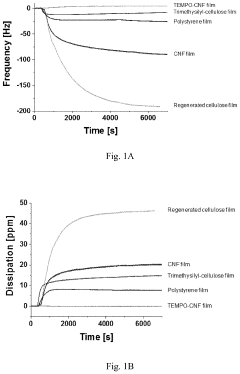
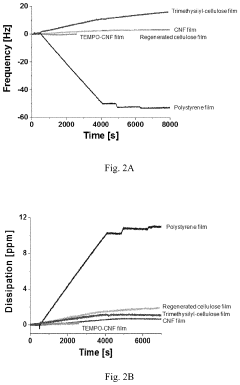
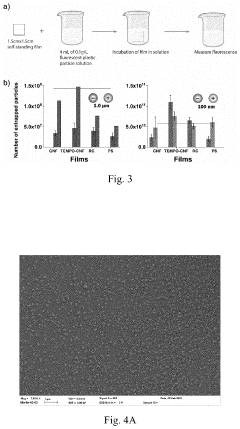
- Nanoscaled lignocellulosic structures, such as cellulose nanofibrils and nanocrystalline cellulose, are used to capture microplastic and nanoplastic particles due to their hydrophilic and hygroscopic properties, which create capillary forces and enhance cohesion with the particles, allowing for efficient attachment and release.
Method and textile used for collecting microplastics from water
PatentPendingUS20230337772A1
Innovation
- A textile with three distinct layers - an inner water-resistant layer, a middle high-pile layer for attraction, and an exterior mesh layer for capture - designed to passively collect microplastic debris as it is worn or used in water, utilizing ultrasonic welding for construction to enhance efficiency and reduce production time.


Environmental Regulations for Microplastic Control
The regulatory landscape for microplastic control has evolved significantly in recent years, driven by mounting scientific evidence of environmental and health impacts. The European Union has emerged as a frontrunner in establishing comprehensive frameworks, with the Single-Use Plastics Directive (2019) and the proposed restrictions on intentionally added microplastics under REACH regulation. These regulations specifically target synthetic textile fibers released during washing processes, creating direct implications for microfiber capture technologies.
In the United States, regulatory approaches vary by state, with California leading through the Microfiber Pollution Prevention Act, which mandates disclosure requirements for synthetic textiles and encourages the development of filtration technologies. Federal agencies including the EPA and NOAA have initiated research programs to establish standardized testing methods for microplastic detection and quantification, though comprehensive federal legislation remains pending.
The International Maritime Organization has implemented regulations addressing plastic pollution from ships, while several countries including France, Canada, and Australia have introduced or are developing national strategies for microplastic reduction. These regulatory frameworks increasingly recognize the role of source control technologies, particularly microfiber capture systems for washing machines, as essential components of pollution prevention strategies.
Emerging regulations focus on establishing performance standards for capture efficiency, typically requiring removal rates exceeding 80-90% of released microfibers. Compliance testing protocols are being standardized through organizations like ASTM International and ISO, creating uniform assessment criteria for microfiber capture technologies. These standards directly influence the technical requirements for filtration systems, driving innovation in capture mechanisms and efficiency optimization.
The regulatory trend indicates a shift toward mandatory installation of microfiber capture devices in commercial and potentially residential washing machines within the next decade. This regulatory momentum creates both compliance pressures and market opportunities for effective microplastic capture technologies, establishing clear performance benchmarks that guide technological development priorities.
In the United States, regulatory approaches vary by state, with California leading through the Microfiber Pollution Prevention Act, which mandates disclosure requirements for synthetic textiles and encourages the development of filtration technologies. Federal agencies including the EPA and NOAA have initiated research programs to establish standardized testing methods for microplastic detection and quantification, though comprehensive federal legislation remains pending.
The International Maritime Organization has implemented regulations addressing plastic pollution from ships, while several countries including France, Canada, and Australia have introduced or are developing national strategies for microplastic reduction. These regulatory frameworks increasingly recognize the role of source control technologies, particularly microfiber capture systems for washing machines, as essential components of pollution prevention strategies.
Emerging regulations focus on establishing performance standards for capture efficiency, typically requiring removal rates exceeding 80-90% of released microfibers. Compliance testing protocols are being standardized through organizations like ASTM International and ISO, creating uniform assessment criteria for microfiber capture technologies. These standards directly influence the technical requirements for filtration systems, driving innovation in capture mechanisms and efficiency optimization.
The regulatory trend indicates a shift toward mandatory installation of microfiber capture devices in commercial and potentially residential washing machines within the next decade. This regulatory momentum creates both compliance pressures and market opportunities for effective microplastic capture technologies, establishing clear performance benchmarks that guide technological development priorities.
Sustainability Assessment of Microfiber Technologies
The sustainability assessment of microfiber technologies for microplastic capture encompasses multiple environmental, economic, and social dimensions that must be carefully evaluated to determine their long-term viability. This comprehensive evaluation framework considers the entire lifecycle impact of these technologies, from material sourcing and manufacturing to deployment, operation, and end-of-life management.
Environmental sustainability represents the primary concern in assessing microfiber capture technologies. The production of synthetic microfibers often relies on petroleum-based polymers, contributing to carbon emissions and resource depletion. However, emerging bio-based alternatives derived from cellulose, chitosan, and other renewable materials offer promising pathways toward reduced environmental impact. The energy consumption during manufacturing and processing phases must be weighed against the environmental benefits achieved through microplastic removal from aquatic systems.
Operational sustainability focuses on the long-term effectiveness and resource requirements of microfiber deployment systems. Key considerations include the durability of microfiber materials under various environmental conditions, their resistance to fouling and degradation, and the frequency of replacement or regeneration required. The energy demands for pumping water through microfiber filtration systems and the associated carbon footprint significantly influence overall sustainability metrics.
Economic viability plays a crucial role in determining the scalability and widespread adoption of microfiber technologies. Cost-effectiveness analyses must consider initial capital investments, operational expenses, maintenance requirements, and the economic value of recovered microplastics. The development of circular economy models, where captured microplastics are recycled into new products, enhances economic sustainability while reducing waste streams.
Social sustainability aspects encompass the broader implications of microfiber technology deployment on communities and ecosystems. This includes assessing potential impacts on marine life, fishing industries, and coastal communities that depend on clean water resources. The accessibility and affordability of these technologies for developing regions, where microplastic pollution is often most severe, represents a critical equity consideration.
Life cycle assessment methodologies provide quantitative frameworks for evaluating the net environmental benefits of microfiber technologies. These assessments compare the environmental costs of technology production and operation against the benefits of microplastic removal, considering factors such as greenhouse gas emissions, water usage, and ecosystem impact reduction. The temporal aspects of sustainability must also be considered, as the long-term accumulation of microfibers themselves could potentially create new environmental challenges if not properly managed through biodegradable materials or effective recovery systems.
Environmental sustainability represents the primary concern in assessing microfiber capture technologies. The production of synthetic microfibers often relies on petroleum-based polymers, contributing to carbon emissions and resource depletion. However, emerging bio-based alternatives derived from cellulose, chitosan, and other renewable materials offer promising pathways toward reduced environmental impact. The energy consumption during manufacturing and processing phases must be weighed against the environmental benefits achieved through microplastic removal from aquatic systems.
Operational sustainability focuses on the long-term effectiveness and resource requirements of microfiber deployment systems. Key considerations include the durability of microfiber materials under various environmental conditions, their resistance to fouling and degradation, and the frequency of replacement or regeneration required. The energy demands for pumping water through microfiber filtration systems and the associated carbon footprint significantly influence overall sustainability metrics.
Economic viability plays a crucial role in determining the scalability and widespread adoption of microfiber technologies. Cost-effectiveness analyses must consider initial capital investments, operational expenses, maintenance requirements, and the economic value of recovered microplastics. The development of circular economy models, where captured microplastics are recycled into new products, enhances economic sustainability while reducing waste streams.
Social sustainability aspects encompass the broader implications of microfiber technology deployment on communities and ecosystems. This includes assessing potential impacts on marine life, fishing industries, and coastal communities that depend on clean water resources. The accessibility and affordability of these technologies for developing regions, where microplastic pollution is often most severe, represents a critical equity consideration.
Life cycle assessment methodologies provide quantitative frameworks for evaluating the net environmental benefits of microfiber technologies. These assessments compare the environmental costs of technology production and operation against the benefits of microplastic removal, considering factors such as greenhouse gas emissions, water usage, and ecosystem impact reduction. The temporal aspects of sustainability must also be considered, as the long-term accumulation of microfibers themselves could potentially create new environmental challenges if not properly managed through biodegradable materials or effective recovery systems.
Unlock deeper insights with PatSnap Eureka Quick Research — get a full tech report to explore trends and direct your research. Try now!
Generate Your Research Report Instantly with AI Agent
Supercharge your innovation with PatSnap Eureka AI Agent Platform!