

Assessing CFRP Integration into Multimaterial Systems
SEP 17, 20259 MIN READ
Generate Your Research Report Instantly with AI Agent
PatSnap Eureka helps you evaluate technical feasibility & market potential.
CFRP Technology Background and Integration Objectives
Carbon Fiber Reinforced Polymers (CFRP) have evolved significantly since their initial development in the 1960s for aerospace applications. The technology originated from the need for materials with superior strength-to-weight ratios compared to traditional metals. Over subsequent decades, manufacturing processes have advanced from manual layup techniques to automated processes including filament winding, pultrusion, and resin transfer molding, dramatically improving production efficiency and material consistency.
The evolution of CFRP technology has been characterized by continuous improvements in fiber properties, matrix systems, and interfacial bonding. Early carbon fibers offered tensile strengths around 1,500 MPa, while modern variants can exceed 7,000 MPa. Similarly, matrix systems have progressed from basic epoxies to specialized formulations with enhanced thermal stability, chemical resistance, and processing characteristics.
Current technological trends in CFRP development focus on cost reduction, recyclability, and integration capabilities. The industry is moving toward out-of-autoclave processing, thermoplastic matrices, and continuous manufacturing methods to address the historically high production costs. Simultaneously, research into fiber surface treatments and novel sizing agents aims to enhance interfacial properties for improved multimaterial integration.
The primary objective of CFRP integration into multimaterial systems is to achieve optimal performance through strategic material placement. This approach leverages the exceptional specific strength and stiffness of CFRP while mitigating its limitations through complementary materials. Key integration goals include developing reliable joining technologies, preventing galvanic corrosion between carbon fibers and metals, and creating predictive models for long-term performance of hybrid structures.
Another critical objective is establishing design methodologies that account for the anisotropic nature of CFRP when combined with isotropic materials. This includes developing specialized finite element analysis techniques and material models that accurately predict stress distributions at material interfaces. The integration must also address thermal expansion mismatches, which can lead to residual stresses and potential structural failure.
From a manufacturing perspective, integration objectives include developing compatible processing windows for different materials and creating efficient assembly sequences. This requires innovations in adhesive bonding, mechanical fastening, and co-curing techniques that maintain structural integrity while minimizing weight penalties. Additionally, non-destructive testing methods must be adapted to evaluate the quality of multimaterial interfaces.
The long-term technological trajectory aims toward fully integrated design-to-manufacturing workflows for multimaterial systems, with digital twins enabling virtual testing and optimization before physical production. This evolution will require advances in multiscale modeling, interface science, and adaptive manufacturing technologies to realize the full potential of CFRP in next-generation multimaterial applications.
The evolution of CFRP technology has been characterized by continuous improvements in fiber properties, matrix systems, and interfacial bonding. Early carbon fibers offered tensile strengths around 1,500 MPa, while modern variants can exceed 7,000 MPa. Similarly, matrix systems have progressed from basic epoxies to specialized formulations with enhanced thermal stability, chemical resistance, and processing characteristics.
Current technological trends in CFRP development focus on cost reduction, recyclability, and integration capabilities. The industry is moving toward out-of-autoclave processing, thermoplastic matrices, and continuous manufacturing methods to address the historically high production costs. Simultaneously, research into fiber surface treatments and novel sizing agents aims to enhance interfacial properties for improved multimaterial integration.
The primary objective of CFRP integration into multimaterial systems is to achieve optimal performance through strategic material placement. This approach leverages the exceptional specific strength and stiffness of CFRP while mitigating its limitations through complementary materials. Key integration goals include developing reliable joining technologies, preventing galvanic corrosion between carbon fibers and metals, and creating predictive models for long-term performance of hybrid structures.
Another critical objective is establishing design methodologies that account for the anisotropic nature of CFRP when combined with isotropic materials. This includes developing specialized finite element analysis techniques and material models that accurately predict stress distributions at material interfaces. The integration must also address thermal expansion mismatches, which can lead to residual stresses and potential structural failure.
From a manufacturing perspective, integration objectives include developing compatible processing windows for different materials and creating efficient assembly sequences. This requires innovations in adhesive bonding, mechanical fastening, and co-curing techniques that maintain structural integrity while minimizing weight penalties. Additionally, non-destructive testing methods must be adapted to evaluate the quality of multimaterial interfaces.
The long-term technological trajectory aims toward fully integrated design-to-manufacturing workflows for multimaterial systems, with digital twins enabling virtual testing and optimization before physical production. This evolution will require advances in multiscale modeling, interface science, and adaptive manufacturing technologies to realize the full potential of CFRP in next-generation multimaterial applications.
Market Analysis for CFRP in Multimaterial Applications
The global Carbon Fiber Reinforced Polymer (CFRP) market has demonstrated robust growth, reaching approximately $31.5 billion in 2022 and projected to expand at a CAGR of 10.8% through 2030. This growth is primarily driven by increasing demand across automotive, aerospace, wind energy, and construction sectors, where multimaterial systems are becoming increasingly prevalent.
In the automotive industry, CFRP integration into multimaterial structures has gained significant traction as manufacturers strive to meet stringent emission standards and fuel efficiency requirements. The market for automotive CFRP applications alone was valued at $5.4 billion in 2022, with luxury and high-performance vehicle segments showing the highest adoption rates. BMW's i-series and Audi's space frame technology represent successful commercial implementations of CFRP in multimaterial automotive designs.
The aerospace sector remains the most mature market for CFRP multimaterial applications, accounting for approximately 36% of the total CFRP market. Boeing's 787 Dreamliner and Airbus A350 XWB, with their extensive use of CFRP in combination with traditional aerospace materials, have established new benchmarks for commercial aircraft design. The defense aerospace segment is following suit, with CFRP-metal hybrid structures increasingly featured in next-generation military aircraft.
Wind energy represents the fastest-growing application segment for CFRP in multimaterial systems, with a CAGR of 13.2%. Larger turbine blades necessitate the integration of CFRP with glass fibers and core materials to achieve optimal performance characteristics. This sector's growth is particularly pronounced in Europe and Asia-Pacific regions, where renewable energy investments continue to accelerate.
Regional analysis reveals that North America and Europe currently dominate the CFRP multimaterial market, collectively accounting for over 60% of global demand. However, Asia-Pacific is emerging as the fastest-growing region, with China, Japan, and South Korea making substantial investments in manufacturing capabilities and end-use applications.
Market challenges include the persistent high cost of carbon fiber production, with raw material costs representing 50-70% of final CFRP component prices. Additionally, technical challenges in joining dissimilar materials and ensuring long-term durability of interfaces remain significant barriers to wider adoption in cost-sensitive applications.
Supply chain analysis indicates increasing vertical integration among major players, with companies like Toray Industries, Hexcel Corporation, and Teijin Limited expanding their capabilities from raw material production to finished component manufacturing. This trend is reshaping competitive dynamics and enabling more sophisticated multimaterial solutions.
Customer demand patterns show growing interest in CFRP-metal hybrid structures that combine the lightweight properties of composites with the ductility and damage tolerance of metals. This hybrid approach is expected to represent the largest growth segment within the broader CFRP market over the next five years.
In the automotive industry, CFRP integration into multimaterial structures has gained significant traction as manufacturers strive to meet stringent emission standards and fuel efficiency requirements. The market for automotive CFRP applications alone was valued at $5.4 billion in 2022, with luxury and high-performance vehicle segments showing the highest adoption rates. BMW's i-series and Audi's space frame technology represent successful commercial implementations of CFRP in multimaterial automotive designs.
The aerospace sector remains the most mature market for CFRP multimaterial applications, accounting for approximately 36% of the total CFRP market. Boeing's 787 Dreamliner and Airbus A350 XWB, with their extensive use of CFRP in combination with traditional aerospace materials, have established new benchmarks for commercial aircraft design. The defense aerospace segment is following suit, with CFRP-metal hybrid structures increasingly featured in next-generation military aircraft.
Wind energy represents the fastest-growing application segment for CFRP in multimaterial systems, with a CAGR of 13.2%. Larger turbine blades necessitate the integration of CFRP with glass fibers and core materials to achieve optimal performance characteristics. This sector's growth is particularly pronounced in Europe and Asia-Pacific regions, where renewable energy investments continue to accelerate.
Regional analysis reveals that North America and Europe currently dominate the CFRP multimaterial market, collectively accounting for over 60% of global demand. However, Asia-Pacific is emerging as the fastest-growing region, with China, Japan, and South Korea making substantial investments in manufacturing capabilities and end-use applications.
Market challenges include the persistent high cost of carbon fiber production, with raw material costs representing 50-70% of final CFRP component prices. Additionally, technical challenges in joining dissimilar materials and ensuring long-term durability of interfaces remain significant barriers to wider adoption in cost-sensitive applications.
Supply chain analysis indicates increasing vertical integration among major players, with companies like Toray Industries, Hexcel Corporation, and Teijin Limited expanding their capabilities from raw material production to finished component manufacturing. This trend is reshaping competitive dynamics and enabling more sophisticated multimaterial solutions.
Customer demand patterns show growing interest in CFRP-metal hybrid structures that combine the lightweight properties of composites with the ductility and damage tolerance of metals. This hybrid approach is expected to represent the largest growth segment within the broader CFRP market over the next five years.
Current Challenges in CFRP-Multimaterial Systems
The integration of Carbon Fiber Reinforced Polymers (CFRP) into multimaterial systems presents significant technical challenges despite their exceptional strength-to-weight ratio and corrosion resistance. One of the primary obstacles is the fundamental incompatibility between CFRP and traditional materials like metals and thermoplastics, which manifests in different thermal expansion coefficients, creating internal stresses during temperature fluctuations that can lead to delamination and structural failure.
Joining technologies represent another major hurdle in CFRP-multimaterial integration. Conventional methods such as mechanical fastening damage carbon fibers and create stress concentration points, while adhesive bonding faces durability concerns under extreme environmental conditions. Welding techniques, effective for thermoplastic-metal joints, remain largely ineffective for thermoset-based CFRP composites due to their non-meltable nature.
Galvanic corrosion emerges as a critical issue when CFRP contacts metals, particularly aluminum and steel. The carbon fibers act as cathodes in the presence of moisture, accelerating corrosion of the adjacent metal components and compromising structural integrity. Current mitigation strategies using barrier materials add weight and complexity, contradicting the lightweight benefits of CFRP implementation.
Manufacturing scalability presents significant challenges for mass production industries like automotive and aerospace. The lengthy cure cycles of thermoset-based CFRP systems are incompatible with high-volume production lines. Additionally, the complex geometries required for multimaterial structures often necessitate specialized tooling and processing equipment, substantially increasing production costs.
Quality control and non-destructive testing (NDT) of CFRP-multimaterial interfaces remain problematic. Conventional NDT methods like ultrasonic testing encounter difficulties at material boundaries due to acoustic impedance mismatches, while X-ray techniques struggle to detect subtle interface defects. This creates uncertainty in quality assurance processes critical for safety-critical applications.
End-of-life considerations pose increasing challenges as sustainability regulations tighten globally. The heterogeneous nature of CFRP-multimaterial systems makes recycling extremely difficult, with current technologies unable to efficiently separate and recover the constituent materials. This limitation contradicts circular economy principles and creates potential regulatory compliance issues for manufacturers.
Cost factors continue to impede widespread adoption, with raw CFRP materials costing 5-20 times more than conventional metals. The specialized processing equipment, extended production cycles, and skilled labor requirements further elevate manufacturing expenses, making economic justification difficult outside premium applications where performance benefits clearly outweigh cost considerations.
Joining technologies represent another major hurdle in CFRP-multimaterial integration. Conventional methods such as mechanical fastening damage carbon fibers and create stress concentration points, while adhesive bonding faces durability concerns under extreme environmental conditions. Welding techniques, effective for thermoplastic-metal joints, remain largely ineffective for thermoset-based CFRP composites due to their non-meltable nature.
Galvanic corrosion emerges as a critical issue when CFRP contacts metals, particularly aluminum and steel. The carbon fibers act as cathodes in the presence of moisture, accelerating corrosion of the adjacent metal components and compromising structural integrity. Current mitigation strategies using barrier materials add weight and complexity, contradicting the lightweight benefits of CFRP implementation.
Manufacturing scalability presents significant challenges for mass production industries like automotive and aerospace. The lengthy cure cycles of thermoset-based CFRP systems are incompatible with high-volume production lines. Additionally, the complex geometries required for multimaterial structures often necessitate specialized tooling and processing equipment, substantially increasing production costs.
Quality control and non-destructive testing (NDT) of CFRP-multimaterial interfaces remain problematic. Conventional NDT methods like ultrasonic testing encounter difficulties at material boundaries due to acoustic impedance mismatches, while X-ray techniques struggle to detect subtle interface defects. This creates uncertainty in quality assurance processes critical for safety-critical applications.
End-of-life considerations pose increasing challenges as sustainability regulations tighten globally. The heterogeneous nature of CFRP-multimaterial systems makes recycling extremely difficult, with current technologies unable to efficiently separate and recover the constituent materials. This limitation contradicts circular economy principles and creates potential regulatory compliance issues for manufacturers.
Cost factors continue to impede widespread adoption, with raw CFRP materials costing 5-20 times more than conventional metals. The specialized processing equipment, extended production cycles, and skilled labor requirements further elevate manufacturing expenses, making economic justification difficult outside premium applications where performance benefits clearly outweigh cost considerations.
Existing CFRP-Multimaterial Joining Solutions
01 Manufacturing methods for CFRP components
Various manufacturing techniques are employed to produce carbon fiber reinforced polymer components, including molding processes, layup techniques, and curing methods. These processes ensure optimal fiber orientation and resin distribution, resulting in high-strength lightweight structures. Advanced manufacturing methods help minimize defects and ensure consistent quality in CFRP parts for various applications.- Manufacturing methods for CFRP components: Various manufacturing techniques are employed to produce Carbon Fiber Reinforced Polymer components with optimal structural integrity. These methods include automated fiber placement, resin transfer molding, and compression molding processes that ensure precise fiber orientation and resin distribution. Advanced manufacturing approaches help minimize voids, enhance interlaminar strength, and improve overall mechanical properties of the composite structures.
- Integration of CFRP in automotive applications: Carbon Fiber Reinforced Polymers are increasingly being integrated into automotive structures to reduce vehicle weight while maintaining or improving structural performance. Applications include chassis components, body panels, and structural reinforcements that contribute to improved fuel efficiency and reduced emissions. The integration involves specialized joining techniques to connect CFRP parts with traditional metallic components while addressing challenges related to galvanic corrosion and differential thermal expansion.
- CFRP joining and bonding technologies: Specialized techniques have been developed for joining CFRP components to other materials, including adhesive bonding, mechanical fastening, and hybrid joining methods. These technologies address the unique challenges of connecting composites to metals or other composites while maintaining structural integrity. Advanced surface preparation methods and specialized adhesives enhance bond strength, while innovative mechanical fastening systems minimize stress concentrations and prevent delamination.
- CFRP reinforcement structures and designs: Innovative structural designs optimize the performance of CFRP components through strategic fiber orientation, layup sequences, and reinforcement patterns. These designs include integrated stiffeners, sandwich structures, and hybrid material systems that enhance load-bearing capacity while minimizing weight. Computational modeling and simulation techniques help predict structural behavior and optimize designs for specific loading conditions and performance requirements.
- CFRP applications in aerospace and wind energy: Carbon Fiber Reinforced Polymers are extensively used in aerospace structures and wind energy systems due to their exceptional strength-to-weight ratio and fatigue resistance. In aerospace, applications include fuselage sections, wing components, and control surfaces that reduce aircraft weight and improve fuel efficiency. For wind energy, CFRP is used in turbine blades to increase length and efficiency while reducing weight and maintenance requirements. These applications involve specialized design considerations to address the unique environmental and loading conditions in each industry.
02 Integration of CFRP in automotive structures
Carbon fiber reinforced polymers are increasingly integrated into automotive structures to reduce vehicle weight while maintaining structural integrity. CFRP components are strategically incorporated into chassis, body panels, and structural elements to enhance fuel efficiency and performance. The integration involves specialized joining techniques to connect CFRP parts with traditional automotive materials while addressing challenges related to thermal expansion and galvanic corrosion.Expand Specific Solutions03 CFRP joining and fastening technologies
Specialized joining methods are developed for connecting CFRP components to other materials or to themselves. These include adhesive bonding, mechanical fastening systems, and hybrid joining techniques that accommodate the unique properties of carbon fiber composites. Advanced fastening technologies address challenges such as stress concentration, delamination prevention, and maintaining structural integrity at connection points.Expand Specific Solutions04 CFRP reinforcement in construction applications
Carbon fiber reinforced polymers are utilized in construction and civil engineering to strengthen existing structures or create new lightweight building components. CFRP reinforcement systems provide high tensile strength for concrete structures, bridges, and architectural elements. These applications leverage the corrosion resistance and high strength-to-weight ratio of CFRP materials to extend service life and improve structural performance in demanding environments.Expand Specific Solutions05 CFRP in aerospace and specialized applications
Carbon fiber reinforced polymers are extensively used in aerospace components and other specialized applications requiring exceptional strength-to-weight ratios. CFRP materials are engineered for aircraft structures, spacecraft components, and high-performance equipment where weight reduction is critical. These applications involve specialized design considerations to address thermal cycling, impact resistance, and long-term durability under extreme operating conditions.Expand Specific Solutions
Key Industry Players in CFRP Multimaterial Development
The CFRP integration into multimaterial systems market is currently in a growth phase, characterized by increasing adoption across automotive, aerospace, and industrial sectors. The global market size is estimated to exceed $25 billion, with projected annual growth of 8-10% through 2030. Leading aerospace players like Boeing, Airbus, and RTX are driving high-end applications, while automotive manufacturers including BMW, Toyota, and Honda are expanding CFRP usage in premium vehicles. Technical maturity varies significantly across sectors, with aerospace applications being most advanced. Material suppliers Toray Industries, Mitsubishi Kasei, and Toho Tenax dominate raw material production, while research institutions like Xi'an Jiaotong University and University of Bristol are advancing fundamental technologies for improved multimaterial interfaces and cost-effective manufacturing processes.
The Boeing Co.
Technical Solution: Boeing has pioneered advanced CFRP integration techniques for aerospace applications, particularly in their 787 Dreamliner which features approximately 50% composite materials by weight. Their proprietary technology involves automated fiber placement (AFP) systems that precisely lay carbon fiber prepreg materials onto complex tooling surfaces. Boeing has developed specialized joining methods for CFRP-metal interfaces using titanium transition fittings and advanced surface preparation techniques to mitigate galvanic corrosion. Their multimaterial systems incorporate lightning strike protection through embedded copper mesh networks within the CFRP layers. Boeing's approach includes proprietary resin systems optimized for mechanical performance and environmental resistance, with specialized curing cycles that minimize residual stresses at material interfaces.
Strengths: Industry-leading expertise in large-scale CFRP integration; proprietary joining technologies; extensive real-world performance data. Weaknesses: High implementation costs; complex certification requirements; specialized repair procedures needed for maintenance.
Bayerische Motoren Werke AG
Technical Solution: BMW has developed a comprehensive CFRP integration strategy for automotive applications, most notably in their "Carbon Core" technology used in the 7-Series and i-Series vehicles. Their approach combines CFRP with aluminum and high-strength steel in a purpose-designed multimaterial architecture. BMW utilizes Resin Transfer Molding (RTM) processes optimized for higher volume production compared to aerospace applications. Their patented joining technologies include structural adhesives with specific formulations for different material interfaces, combined with mechanical fastening where appropriate. BMW has pioneered automated manufacturing processes for CFRP components, including robotic handling systems and laser-guided cutting. Their multimaterial design philosophy focuses on placing CFRP specifically in areas where its properties provide maximum structural benefit while managing costs through strategic material placement.
Strengths: Production-scale implementation of CFRP in multimaterial systems; automated manufacturing processes; weight optimization expertise. Weaknesses: Higher production costs compared to conventional materials; complex end-of-life recycling challenges; limited repairability in certain structural applications.
Critical Patents and Research in CFRP Integration
Bond Inspection System and Method
PatentActiveUS20160320350A1
Innovation
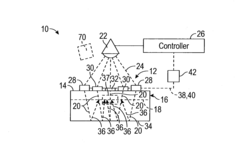
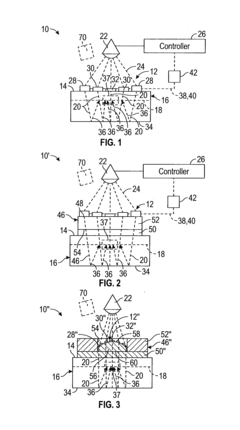
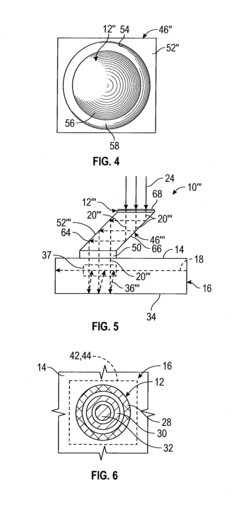
- A compact bond inspection system using a reactive material that creates compression waves when activated by a lower-energy source, such as a 10 joule laser, positioned in a predetermined pattern to generate tension waves that reflect and combine simultaneously at the bondline, reducing the need for high-power equipment and enabling on-site inspections.
Integrated system and method for in-situ 3-axis scanning and detecting defects in object under static and cyclic testing
PatentActiveUS20200182758A1
Innovation
- An integrated system for in-situ 3-axis scanning using a servo-controlled test system and eddy current sensor, allowing for synchronized 3D scanning of CFRP composites before, during, and after mechanical testing without removing the composite from the test system, utilizing a probe assembly with a XYZ gantry system and operator console for automated control.


Sustainability Impact of CFRP in Multimaterial Structures
The integration of Carbon Fiber Reinforced Polymers (CFRP) into multimaterial systems presents significant sustainability implications that warrant thorough examination. Life cycle assessment (LCA) studies indicate that while CFRP production is energy-intensive, requiring approximately 286-342 MJ/kg compared to 170-214 MJ/kg for aluminum, the operational phase benefits often outweigh manufacturing impacts in transportation applications.
CFRP incorporation enables substantial weight reduction—typically 50-70% compared to steel structures—leading to improved fuel efficiency in automotive and aerospace applications. For passenger vehicles, each 10% weight reduction translates to approximately 6-8% fuel economy improvement, with corresponding reductions in lifetime greenhouse gas emissions.
However, end-of-life management remains problematic. Current recycling technologies for CFRP recover only 30-40% of the original fiber properties, compared to nearly 95% for metals like aluminum. Pyrolysis and solvolysis methods show promise but remain energy-intensive and commercially limited. The cross-linked thermoset matrices commonly used in CFRP present particular challenges for material separation and recovery.
Environmental impact assessments reveal that CFRP-integrated multimaterial structures can reduce overall carbon footprint by 20-35% during operational phases, but manufacturing emissions are 2-3 times higher than conventional materials. This creates a "carbon payback period" ranging from 2-8 years depending on application intensity and usage patterns.
Water consumption and toxicity metrics also present concerns. CFRP production requires 120-200 liters of water per kilogram, significantly higher than steel production (70-90 liters/kg). Additionally, the use of solvents, hardeners, and release agents in manufacturing processes introduces potential ecotoxicity risks that require careful management.
From a circular economy perspective, design strategies are emerging to enhance CFRP sustainability in multimaterial systems. These include the development of thermoplastic matrices for improved recyclability, modular designs facilitating disassembly, and bio-based carbon fiber precursors that could reduce manufacturing energy requirements by up to 40%.
Regulatory frameworks increasingly influence CFRP adoption, with the European Union's End-of-Life Vehicle Directive requiring 95% recoverability by weight, presenting challenges for CFRP-intensive designs. Meanwhile, carbon pricing mechanisms are gradually improving the economic case for lightweight CFRP solutions despite their higher initial production emissions.
CFRP incorporation enables substantial weight reduction—typically 50-70% compared to steel structures—leading to improved fuel efficiency in automotive and aerospace applications. For passenger vehicles, each 10% weight reduction translates to approximately 6-8% fuel economy improvement, with corresponding reductions in lifetime greenhouse gas emissions.
However, end-of-life management remains problematic. Current recycling technologies for CFRP recover only 30-40% of the original fiber properties, compared to nearly 95% for metals like aluminum. Pyrolysis and solvolysis methods show promise but remain energy-intensive and commercially limited. The cross-linked thermoset matrices commonly used in CFRP present particular challenges for material separation and recovery.
Environmental impact assessments reveal that CFRP-integrated multimaterial structures can reduce overall carbon footprint by 20-35% during operational phases, but manufacturing emissions are 2-3 times higher than conventional materials. This creates a "carbon payback period" ranging from 2-8 years depending on application intensity and usage patterns.
Water consumption and toxicity metrics also present concerns. CFRP production requires 120-200 liters of water per kilogram, significantly higher than steel production (70-90 liters/kg). Additionally, the use of solvents, hardeners, and release agents in manufacturing processes introduces potential ecotoxicity risks that require careful management.
From a circular economy perspective, design strategies are emerging to enhance CFRP sustainability in multimaterial systems. These include the development of thermoplastic matrices for improved recyclability, modular designs facilitating disassembly, and bio-based carbon fiber precursors that could reduce manufacturing energy requirements by up to 40%.
Regulatory frameworks increasingly influence CFRP adoption, with the European Union's End-of-Life Vehicle Directive requiring 95% recoverability by weight, presenting challenges for CFRP-intensive designs. Meanwhile, carbon pricing mechanisms are gradually improving the economic case for lightweight CFRP solutions despite their higher initial production emissions.
Lifecycle Assessment and Recyclability Considerations
The lifecycle assessment of Carbon Fiber Reinforced Polymers (CFRP) in multimaterial systems reveals significant environmental considerations throughout their production, use, and end-of-life phases. Manufacturing CFRP components typically consumes 5-10 times more energy than conventional materials, primarily due to energy-intensive carbon fiber production processes which require temperatures exceeding 1000°C during precursor oxidation and carbonization stages.
When integrated into multimaterial systems, CFRP creates complex environmental trade-offs. While the lightweight properties of CFRP can reduce operational energy consumption in transportation applications—potentially saving 20-30% of fuel in automotive and aerospace sectors over the product lifespan—these benefits must be weighed against the higher initial environmental footprint of production.
End-of-life management presents particularly challenging obstacles for CFRP in multimaterial systems. The thermoset matrices commonly used in CFRP cannot be simply melted and reformed like thermoplastics, creating significant recyclability barriers. Current recycling rates for CFRP remain below 15% globally, substantially lower than rates for conventional materials like aluminum (approximately 75%) and steel (over 85%).
Several recycling technologies are emerging to address these challenges. Mechanical recycling processes can recover short fibers with 30-50% retention of original mechanical properties, suitable for non-structural applications. Pyrolysis and solvolysis show greater promise, potentially recovering fibers with up to 90% of original tensile strength, though commercial-scale implementation remains limited.
Design for disassembly represents a critical strategy for improving CFRP recyclability in multimaterial systems. Innovations include reversible adhesives, mechanical fastening systems designed for easy separation, and material identification technologies to facilitate sorting. These approaches can reduce the energy required for recycling by 40-60% compared to conventional joining methods.
Recent regulatory developments are accelerating focus on CFRP lifecycle management. The European Union's End-of-Life Vehicle Directive and similar regulations in Asia and North America are establishing increasingly stringent recyclability requirements, with targets of 85-95% recyclability for vehicles. These regulations are driving research into bio-based matrices and thermoplastic composites that offer improved recyclability while maintaining performance characteristics.
Comprehensive lifecycle assessment tools specifically adapted for CFRP in multimaterial systems are being developed to better quantify environmental impacts and guide design decisions. These tools incorporate factors such as fiber orientation, resin systems, and joining technologies to provide more accurate environmental impact projections across the entire product lifecycle.
When integrated into multimaterial systems, CFRP creates complex environmental trade-offs. While the lightweight properties of CFRP can reduce operational energy consumption in transportation applications—potentially saving 20-30% of fuel in automotive and aerospace sectors over the product lifespan—these benefits must be weighed against the higher initial environmental footprint of production.
End-of-life management presents particularly challenging obstacles for CFRP in multimaterial systems. The thermoset matrices commonly used in CFRP cannot be simply melted and reformed like thermoplastics, creating significant recyclability barriers. Current recycling rates for CFRP remain below 15% globally, substantially lower than rates for conventional materials like aluminum (approximately 75%) and steel (over 85%).
Several recycling technologies are emerging to address these challenges. Mechanical recycling processes can recover short fibers with 30-50% retention of original mechanical properties, suitable for non-structural applications. Pyrolysis and solvolysis show greater promise, potentially recovering fibers with up to 90% of original tensile strength, though commercial-scale implementation remains limited.
Design for disassembly represents a critical strategy for improving CFRP recyclability in multimaterial systems. Innovations include reversible adhesives, mechanical fastening systems designed for easy separation, and material identification technologies to facilitate sorting. These approaches can reduce the energy required for recycling by 40-60% compared to conventional joining methods.
Recent regulatory developments are accelerating focus on CFRP lifecycle management. The European Union's End-of-Life Vehicle Directive and similar regulations in Asia and North America are establishing increasingly stringent recyclability requirements, with targets of 85-95% recyclability for vehicles. These regulations are driving research into bio-based matrices and thermoplastic composites that offer improved recyclability while maintaining performance characteristics.
Comprehensive lifecycle assessment tools specifically adapted for CFRP in multimaterial systems are being developed to better quantify environmental impacts and guide design decisions. These tools incorporate factors such as fiber orientation, resin systems, and joining technologies to provide more accurate environmental impact projections across the entire product lifecycle.
Unlock deeper insights with PatSnap Eureka Quick Research — get a full tech report to explore trends and direct your research. Try now!
Generate Your Research Report Instantly with AI Agent
Supercharge your innovation with PatSnap Eureka AI Agent Platform!