
Battery Management System for Defense Applications: Optimization
MAR 20, 20269 MIN READ
Generate Your Research Report Instantly with AI Agent
Patsnap Eureka helps you evaluate technical feasibility & market potential.
Defense Battery Management System Background and Objectives
Battery management systems in defense applications have evolved from basic monitoring circuits to sophisticated, mission-critical platforms that ensure operational readiness across diverse military environments. The historical development traces back to early military electronics in the 1960s, where simple voltage regulators protected radio equipment. As defense systems became increasingly electronic-dependent, the complexity of power management grew exponentially, particularly with the introduction of portable communication systems, night vision equipment, and advanced weaponry requiring reliable energy sources.
The evolution accelerated dramatically during the digital revolution of the 1990s and 2000s, when military platforms began integrating complex sensor arrays, computing systems, and networked communications. This transformation demanded battery management solutions capable of handling multiple cell chemistries, extreme temperature variations, and electromagnetic interference while maintaining operational security. Modern defense BMS technology represents a convergence of advanced materials science, real-time computing, and military-grade reliability standards.
Current technological trends indicate a shift toward intelligent, adaptive battery management architectures that leverage artificial intelligence and machine learning algorithms. These systems can predict battery degradation patterns, optimize charging cycles based on mission profiles, and provide predictive maintenance capabilities. The integration of solid-state battery technologies and advanced lithium-ion chemistries has further expanded the performance envelope, enabling longer mission durations and reduced logistical footprints.
The primary technical objectives center on achieving optimal energy density while maintaining safety and reliability under extreme conditions. Defense BMS must operate effectively across temperature ranges from -40°C to +85°C, withstand shock and vibration loads exceeding commercial standards, and provide fail-safe operation during electromagnetic pulse events. Additionally, these systems must support rapid charging capabilities for time-critical missions while preventing thermal runaway and ensuring long-term cell health.
Strategic objectives encompass reducing total cost of ownership through extended battery lifecycles, minimizing maintenance requirements in forward-deployed environments, and enhancing mission effectiveness through improved power availability predictions. The integration of cybersecurity features has become paramount, requiring encrypted communication protocols and tamper-resistant hardware designs to prevent adversarial interference with critical power systems.
The evolution accelerated dramatically during the digital revolution of the 1990s and 2000s, when military platforms began integrating complex sensor arrays, computing systems, and networked communications. This transformation demanded battery management solutions capable of handling multiple cell chemistries, extreme temperature variations, and electromagnetic interference while maintaining operational security. Modern defense BMS technology represents a convergence of advanced materials science, real-time computing, and military-grade reliability standards.
Current technological trends indicate a shift toward intelligent, adaptive battery management architectures that leverage artificial intelligence and machine learning algorithms. These systems can predict battery degradation patterns, optimize charging cycles based on mission profiles, and provide predictive maintenance capabilities. The integration of solid-state battery technologies and advanced lithium-ion chemistries has further expanded the performance envelope, enabling longer mission durations and reduced logistical footprints.
The primary technical objectives center on achieving optimal energy density while maintaining safety and reliability under extreme conditions. Defense BMS must operate effectively across temperature ranges from -40°C to +85°C, withstand shock and vibration loads exceeding commercial standards, and provide fail-safe operation during electromagnetic pulse events. Additionally, these systems must support rapid charging capabilities for time-critical missions while preventing thermal runaway and ensuring long-term cell health.
Strategic objectives encompass reducing total cost of ownership through extended battery lifecycles, minimizing maintenance requirements in forward-deployed environments, and enhancing mission effectiveness through improved power availability predictions. The integration of cybersecurity features has become paramount, requiring encrypted communication protocols and tamper-resistant hardware designs to prevent adversarial interference with critical power systems.
Military Battery System Market Demand Analysis
The global military battery systems market is experiencing unprecedented growth driven by the increasing electrification of defense platforms and the rising demand for portable power solutions in modern warfare scenarios. Defense organizations worldwide are prioritizing energy independence and operational efficiency, creating substantial demand for advanced battery management systems that can optimize performance under extreme conditions.
Military applications require battery systems that can operate reliably in harsh environments including extreme temperatures, high vibration, electromagnetic interference, and potential combat damage. These demanding operational requirements have created a specialized market segment where performance, reliability, and safety take precedence over cost considerations. The need for extended mission duration and reduced logistical footprint has intensified the focus on battery optimization technologies.
The proliferation of electronic warfare systems, unmanned platforms, and soldier-worn devices has significantly expanded the addressable market for military battery solutions. Modern military operations increasingly depend on sophisticated electronic systems for communication, navigation, surveillance, and weapon systems, all requiring reliable and optimized power management. This trend has created diverse market segments ranging from small tactical devices to large-scale vehicle and stationary applications.
Emerging threats and evolving warfare tactics have accelerated the adoption of autonomous systems and remote-operated platforms, further driving demand for advanced battery management solutions. Military forces are investing heavily in unmanned aerial vehicles, ground robots, and maritime autonomous systems, all requiring sophisticated power management capabilities to maximize operational effectiveness and mission success rates.
The market demand is also influenced by the growing emphasis on silent operations and reduced thermal signatures, where optimized battery systems play a crucial role in maintaining stealth capabilities. Traditional diesel generators and combustion engines are increasingly being replaced or supplemented by battery systems in forward operating bases and mobile command centers.
Regional defense spending patterns and geopolitical tensions significantly impact market demand dynamics. Nations investing in military modernization programs are prioritizing advanced power systems as force multipliers, recognizing that superior energy management capabilities can provide tactical advantages in various operational scenarios.
The integration of artificial intelligence and machine learning technologies into military systems has created additional demand for intelligent battery management solutions capable of predictive maintenance and adaptive optimization based on mission profiles and environmental conditions.
Military applications require battery systems that can operate reliably in harsh environments including extreme temperatures, high vibration, electromagnetic interference, and potential combat damage. These demanding operational requirements have created a specialized market segment where performance, reliability, and safety take precedence over cost considerations. The need for extended mission duration and reduced logistical footprint has intensified the focus on battery optimization technologies.
The proliferation of electronic warfare systems, unmanned platforms, and soldier-worn devices has significantly expanded the addressable market for military battery solutions. Modern military operations increasingly depend on sophisticated electronic systems for communication, navigation, surveillance, and weapon systems, all requiring reliable and optimized power management. This trend has created diverse market segments ranging from small tactical devices to large-scale vehicle and stationary applications.
Emerging threats and evolving warfare tactics have accelerated the adoption of autonomous systems and remote-operated platforms, further driving demand for advanced battery management solutions. Military forces are investing heavily in unmanned aerial vehicles, ground robots, and maritime autonomous systems, all requiring sophisticated power management capabilities to maximize operational effectiveness and mission success rates.
The market demand is also influenced by the growing emphasis on silent operations and reduced thermal signatures, where optimized battery systems play a crucial role in maintaining stealth capabilities. Traditional diesel generators and combustion engines are increasingly being replaced or supplemented by battery systems in forward operating bases and mobile command centers.
Regional defense spending patterns and geopolitical tensions significantly impact market demand dynamics. Nations investing in military modernization programs are prioritizing advanced power systems as force multipliers, recognizing that superior energy management capabilities can provide tactical advantages in various operational scenarios.
The integration of artificial intelligence and machine learning technologies into military systems has created additional demand for intelligent battery management solutions capable of predictive maintenance and adaptive optimization based on mission profiles and environmental conditions.
Current BMS Challenges in Defense Applications
Defense applications impose extraordinary demands on battery management systems that far exceed civilian requirements. Military equipment must operate reliably in extreme environmental conditions, including temperature ranges from -40°C to +85°C, high humidity, salt spray exposure, and intense vibration during transport and combat operations. These harsh conditions create significant challenges for BMS components, particularly sensors and control circuits that must maintain accuracy and functionality under severe stress.
Power density and energy efficiency represent critical bottlenecks in defense BMS applications. Military platforms require maximum operational endurance while minimizing weight and volume constraints. Current lithium-ion technologies struggle to meet the simultaneous demands for high energy density, rapid charging capabilities, and extended cycle life required for mission-critical equipment. The challenge intensifies when considering the need for silent operation modes that eliminate electromagnetic signatures detectable by enemy surveillance systems.
Safety and reliability concerns in defense applications extend beyond typical commercial standards. Military BMS must prevent thermal runaway events that could compromise mission success or personnel safety. The systems must also withstand ballistic impacts, electromagnetic pulse attacks, and chemical exposure while maintaining operational integrity. Current protection mechanisms often add significant weight and complexity, creating trade-offs between safety and performance optimization.
Interoperability challenges plague defense BMS implementations across different military platforms and allied forces. Existing systems often utilize proprietary communication protocols and incompatible charging interfaces, limiting operational flexibility and logistical efficiency. The lack of standardized BMS architectures complicates maintenance, training, and equipment sharing between different military units and international partners.
Real-time monitoring and predictive maintenance capabilities remain insufficient in current defense BMS solutions. Military operations demand precise state-of-charge estimation, remaining useful life prediction, and fault detection capabilities that can operate autonomously without external connectivity. Current algorithms struggle with accuracy under dynamic load conditions and extended storage periods common in military applications.
Cybersecurity vulnerabilities present emerging challenges as defense BMS systems become increasingly connected and sophisticated. The integration of wireless monitoring capabilities and remote diagnostics creates potential attack vectors that adversaries could exploit to compromise mission effectiveness. Current security implementations often conflict with operational requirements for rapid deployment and field maintenance accessibility.
Power density and energy efficiency represent critical bottlenecks in defense BMS applications. Military platforms require maximum operational endurance while minimizing weight and volume constraints. Current lithium-ion technologies struggle to meet the simultaneous demands for high energy density, rapid charging capabilities, and extended cycle life required for mission-critical equipment. The challenge intensifies when considering the need for silent operation modes that eliminate electromagnetic signatures detectable by enemy surveillance systems.
Safety and reliability concerns in defense applications extend beyond typical commercial standards. Military BMS must prevent thermal runaway events that could compromise mission success or personnel safety. The systems must also withstand ballistic impacts, electromagnetic pulse attacks, and chemical exposure while maintaining operational integrity. Current protection mechanisms often add significant weight and complexity, creating trade-offs between safety and performance optimization.
Interoperability challenges plague defense BMS implementations across different military platforms and allied forces. Existing systems often utilize proprietary communication protocols and incompatible charging interfaces, limiting operational flexibility and logistical efficiency. The lack of standardized BMS architectures complicates maintenance, training, and equipment sharing between different military units and international partners.
Real-time monitoring and predictive maintenance capabilities remain insufficient in current defense BMS solutions. Military operations demand precise state-of-charge estimation, remaining useful life prediction, and fault detection capabilities that can operate autonomously without external connectivity. Current algorithms struggle with accuracy under dynamic load conditions and extended storage periods common in military applications.
Cybersecurity vulnerabilities present emerging challenges as defense BMS systems become increasingly connected and sophisticated. The integration of wireless monitoring capabilities and remote diagnostics creates potential attack vectors that adversaries could exploit to compromise mission effectiveness. Current security implementations often conflict with operational requirements for rapid deployment and field maintenance accessibility.
Existing Military BMS Optimization Solutions
01 Battery state monitoring and estimation
Battery management systems incorporate methods for monitoring and estimating battery states including state of charge (SOC), state of health (SOH), and remaining useful life. These systems utilize various algorithms and sensor data to accurately determine battery conditions in real-time. Advanced estimation techniques help predict battery performance and degradation patterns, enabling proactive maintenance and optimal battery utilization.- Battery state monitoring and estimation techniques: Battery management systems employ various methods to monitor and estimate critical battery parameters such as state of charge (SOC), state of health (SOH), and remaining useful life. These techniques utilize voltage, current, and temperature measurements combined with algorithms including Kalman filtering, coulomb counting, and machine learning approaches to provide accurate real-time assessment of battery conditions. Advanced estimation methods help optimize battery performance and prevent over-discharge or overcharge conditions.
- Cell balancing and equalization systems: Battery management systems incorporate cell balancing mechanisms to ensure uniform charge distribution across individual cells in a battery pack. These systems employ passive or active balancing techniques to equalize voltage differences between cells, extending battery lifespan and improving overall pack performance. Balancing circuits can redistribute energy from higher-charged cells to lower-charged cells or dissipate excess energy to maintain cell uniformity.
- Thermal management and temperature control: Effective thermal management is critical for battery safety and performance. Battery management systems integrate temperature sensing and control mechanisms to monitor cell temperatures and activate cooling or heating systems as needed. These systems prevent thermal runaway, optimize operating temperature ranges, and ensure safe battery operation under various environmental conditions. Temperature control strategies may include liquid cooling, air cooling, or phase change materials.
- Communication protocols and data management: Battery management systems utilize standardized communication protocols to exchange data with external systems and enable remote monitoring. These systems implement interfaces such as CAN bus, RS485, or wireless protocols to transmit battery status information, diagnostic data, and control commands. Data management capabilities include logging historical performance data, cloud connectivity, and integration with vehicle or energy storage system controllers for coordinated operation.
- Safety protection and fault diagnosis: Battery management systems incorporate multiple safety features to protect against hazardous conditions including overvoltage, undervoltage, overcurrent, short circuits, and thermal events. These systems employ real-time monitoring, predictive algorithms, and fail-safe mechanisms to detect abnormal conditions and trigger protective actions such as disconnecting loads or activating emergency shutdown procedures. Fault diagnosis capabilities enable early detection of cell degradation, internal shorts, and other failure modes.
02 Battery cell balancing and equalization
Cell balancing techniques are implemented to ensure uniform charge distribution across battery cells in a pack. These methods include passive balancing using resistors and active balancing using energy transfer circuits. Proper balancing extends battery life, improves performance, and prevents individual cell degradation. The systems monitor voltage differences between cells and apply corrective measures to maintain balance.Expand Specific Solutions03 Thermal management and temperature control
Thermal management systems regulate battery temperature to maintain optimal operating conditions and prevent thermal runaway. These systems employ cooling and heating mechanisms, temperature sensors, and control algorithms to manage heat dissipation and distribution. Effective thermal management ensures battery safety, longevity, and consistent performance across varying environmental conditions.Expand Specific Solutions04 Battery safety protection and fault detection
Safety protection mechanisms monitor critical parameters such as voltage, current, and temperature to detect abnormal conditions and potential faults. The systems implement multiple protection layers including overcurrent protection, overvoltage protection, and short circuit detection. Fault diagnosis algorithms identify degradation patterns and failure modes, triggering appropriate safety responses to prevent hazardous situations.Expand Specific Solutions05 Communication and data management
Battery management systems integrate communication interfaces and protocols for data exchange with external systems and controllers. These systems collect, process, and transmit battery performance data for monitoring and analysis. Cloud connectivity and data logging capabilities enable remote diagnostics, predictive maintenance, and fleet management. Standardized communication protocols ensure interoperability with vehicle systems and charging infrastructure.Expand Specific Solutions
Key Players in Defense BMS Industry
The Battery Management System (BMS) for defense applications represents a rapidly evolving market driven by increasing electrification of military platforms and stringent safety requirements. The industry is in a growth phase with significant market expansion expected as defense contractors prioritize energy efficiency and operational reliability. Technology maturity varies considerably across players, with established giants like Robert Bosch GmbH, LG Energy Solution Ltd., and Samsung SDI Co., Ltd. leading in advanced lithium-ion management systems, while specialized firms like Zitara Technologies focus on AI-driven optimization solutions. Traditional defense contractors including The Boeing Co. and automotive leaders such as Toyota Motor Engineering leverage their systems integration expertise, while emerging players like Beijing Haibo Sichuang Technology and Flash Battery Srl contribute innovative approaches to military-grade battery management, creating a competitive landscape characterized by both technological sophistication and diverse specialization levels.
Robert Bosch GmbH
Technical Solution: Bosch develops advanced Battery Management Systems specifically designed for defense applications, featuring multi-layered safety architecture with redundant monitoring circuits and fail-safe mechanisms. Their BMS solutions incorporate predictive analytics algorithms that can forecast battery degradation patterns under extreme operational conditions typical in military environments. The system includes thermal management optimization with active cooling control, state-of-charge estimation accuracy within 2% even under high-stress scenarios, and electromagnetic interference shielding to meet military standards. Bosch's defense BMS also features secure communication protocols and tamper-resistant hardware design to prevent unauthorized access or manipulation during critical missions.
Strengths: Proven reliability in automotive applications, extensive experience in harsh environment solutions, strong R&D capabilities. Weaknesses: Higher cost compared to commercial solutions, complex integration requirements for legacy defense systems.
LG Energy Solution Ltd.
Technical Solution: LG Energy Solution provides comprehensive Battery Management Systems optimized for defense applications, focusing on high-energy density battery packs with advanced safety monitoring. Their BMS architecture incorporates machine learning algorithms for real-time battery health assessment and predictive maintenance scheduling, crucial for mission-critical defense operations. The system features modular design allowing scalability from small portable devices to large vehicle applications, with built-in cybersecurity features including encrypted data transmission and secure boot processes. LG's defense BMS includes advanced thermal runaway prevention mechanisms, voltage balancing optimization across multiple cell configurations, and ruggedized components rated for extreme temperature ranges from -40°C to +85°C typical in military deployments.
Strengths: Leading battery technology expertise, strong manufacturing capabilities, proven track record in energy storage systems. Weaknesses: Limited defense-specific experience compared to traditional defense contractors, potential supply chain vulnerabilities.
Core BMS Optimization Patents for Defense Use
Method and apparatus for optimizing battery management system
PatentActiveUS12012014B2
Innovation
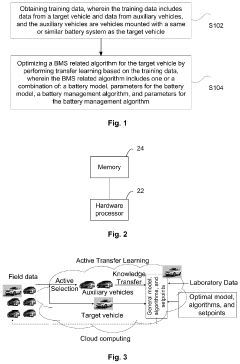
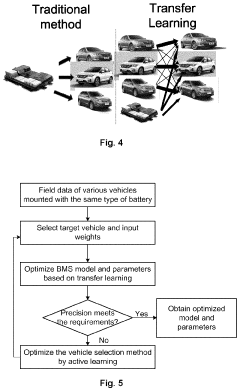
- The method employs transfer learning using training data from target and auxiliary vehicles with similar battery systems, optimizing algorithms through cloud computing and connected vehicle technology to adapt to individual driving and charging patterns, enabling the battery management system to learn from past usage and adapt to novel situations.
Battery management system and method for determining an internal state of a battery
PatentWO2025163218A1
Innovation
- A battery management system that synchronizes current and power limits using an equivalent circuit model, temperature sensors, and calibration information to determine optimal charge and discharge limits, incorporating PI or PID controllers for precise control.


Defense Industry Standards and Compliance Requirements
Defense applications of battery management systems operate within a highly regulated environment where compliance with stringent standards is paramount for operational success and safety. The primary governing framework includes MIL-STD-810 for environmental engineering considerations, which establishes rigorous testing protocols for temperature extremes, vibration, shock, and humidity exposure that defense BMS must withstand in combat and field conditions.
MIL-STD-461 electromagnetic compatibility requirements ensure that battery management systems do not interfere with critical communication and navigation equipment while maintaining immunity to electromagnetic pulses and radio frequency interference. This standard is particularly crucial for BMS optimization as it directly impacts system architecture decisions regarding shielding, filtering, and circuit design approaches.
The Department of Defense Architecture Framework (DoDAF) mandates comprehensive system documentation and interoperability requirements that influence BMS design specifications. Compliance necessitates detailed operational views, system views, and technical standards views that demonstrate how the battery management system integrates with broader defense platforms and mission-critical systems.
ITAR (International Traffic in Arms Regulations) compliance significantly impacts the development and deployment of defense BMS technologies, restricting the sharing of technical data and requiring careful consideration of supply chain security. This regulation affects component selection, manufacturing processes, and technology transfer protocols, often necessitating domestic sourcing of critical components and limiting international collaboration opportunities.
Cybersecurity compliance follows NIST Cybersecurity Framework and DoD Instruction 8500.01, requiring robust authentication mechanisms, encrypted communications, and secure boot processes within BMS architectures. These requirements directly influence optimization strategies by adding computational overhead and security validation processes that must be balanced against performance objectives.
Quality assurance standards including AS9100 and ISO 9001 establish manufacturing and testing protocols that ensure consistent performance and reliability. Defense contractors must demonstrate compliance through extensive documentation, traceability systems, and rigorous testing procedures that validate BMS performance under specified operational parameters and environmental conditions.
MIL-STD-461 electromagnetic compatibility requirements ensure that battery management systems do not interfere with critical communication and navigation equipment while maintaining immunity to electromagnetic pulses and radio frequency interference. This standard is particularly crucial for BMS optimization as it directly impacts system architecture decisions regarding shielding, filtering, and circuit design approaches.
The Department of Defense Architecture Framework (DoDAF) mandates comprehensive system documentation and interoperability requirements that influence BMS design specifications. Compliance necessitates detailed operational views, system views, and technical standards views that demonstrate how the battery management system integrates with broader defense platforms and mission-critical systems.
ITAR (International Traffic in Arms Regulations) compliance significantly impacts the development and deployment of defense BMS technologies, restricting the sharing of technical data and requiring careful consideration of supply chain security. This regulation affects component selection, manufacturing processes, and technology transfer protocols, often necessitating domestic sourcing of critical components and limiting international collaboration opportunities.
Cybersecurity compliance follows NIST Cybersecurity Framework and DoD Instruction 8500.01, requiring robust authentication mechanisms, encrypted communications, and secure boot processes within BMS architectures. These requirements directly influence optimization strategies by adding computational overhead and security validation processes that must be balanced against performance objectives.
Quality assurance standards including AS9100 and ISO 9001 establish manufacturing and testing protocols that ensure consistent performance and reliability. Defense contractors must demonstrate compliance through extensive documentation, traceability systems, and rigorous testing procedures that validate BMS performance under specified operational parameters and environmental conditions.
Security and Reliability Considerations in Military BMS
Security considerations in military Battery Management Systems represent a critical intersection of cybersecurity and operational integrity. Modern defense BMS architectures must implement multi-layered security protocols to protect against sophisticated cyber threats, including advanced persistent threats and state-sponsored attacks. The integration of encryption algorithms, secure boot processes, and hardware security modules becomes essential to safeguard sensitive operational data and prevent unauthorized system access.
Authentication mechanisms within military BMS require robust implementation of cryptographic protocols and digital certificates. Multi-factor authentication systems ensure that only authorized personnel can access critical battery management functions, while role-based access controls limit operational capabilities based on clearance levels. These security frameworks must operate seamlessly without compromising system responsiveness during critical mission phases.
Reliability in defense applications demands fault-tolerant architectures that maintain operational continuity under extreme conditions. Military BMS must incorporate redundant communication pathways, backup power management protocols, and fail-safe mechanisms that ensure mission-critical systems remain operational even when primary components experience failures. Environmental hardening against electromagnetic interference, temperature extremes, and physical shock further enhances system reliability.
Data integrity protection requires continuous monitoring and validation of sensor inputs, communication channels, and control algorithms. Advanced anomaly detection systems can identify potential security breaches or system malfunctions before they compromise mission effectiveness. Real-time diagnostics and predictive maintenance capabilities enable proactive identification of potential failure points.
The implementation of secure communication protocols between BMS components and external systems necessitates careful consideration of latency requirements and bandwidth limitations in tactical environments. Encrypted data transmission must balance security requirements with operational speed, ensuring that critical battery status information reaches command systems without delay while maintaining protection against interception or manipulation.
Authentication mechanisms within military BMS require robust implementation of cryptographic protocols and digital certificates. Multi-factor authentication systems ensure that only authorized personnel can access critical battery management functions, while role-based access controls limit operational capabilities based on clearance levels. These security frameworks must operate seamlessly without compromising system responsiveness during critical mission phases.
Reliability in defense applications demands fault-tolerant architectures that maintain operational continuity under extreme conditions. Military BMS must incorporate redundant communication pathways, backup power management protocols, and fail-safe mechanisms that ensure mission-critical systems remain operational even when primary components experience failures. Environmental hardening against electromagnetic interference, temperature extremes, and physical shock further enhances system reliability.
Data integrity protection requires continuous monitoring and validation of sensor inputs, communication channels, and control algorithms. Advanced anomaly detection systems can identify potential security breaches or system malfunctions before they compromise mission effectiveness. Real-time diagnostics and predictive maintenance capabilities enable proactive identification of potential failure points.
The implementation of secure communication protocols between BMS components and external systems necessitates careful consideration of latency requirements and bandwidth limitations in tactical environments. Encrypted data transmission must balance security requirements with operational speed, ensuring that critical battery status information reaches command systems without delay while maintaining protection against interception or manipulation.
Unlock deeper insights with Patsnap Eureka Quick Research — get a full tech report to explore trends and direct your research. Try now!
Generate Your Research Report Instantly with AI Agent
Supercharge your innovation with Patsnap Eureka AI Agent Platform!