Battery Management System for Remote Operations: Performance
MAR 20, 20269 MIN READ
Generate Your Research Report Instantly with AI Agent
Patsnap Eureka helps you evaluate technical feasibility & market potential.
Remote BMS Performance Challenges and Goals
Remote Battery Management Systems (BMS) have evolved significantly since their initial deployment in the early 2000s, transitioning from basic monitoring solutions to sophisticated, AI-driven performance optimization platforms. The technology emerged from the growing need to manage distributed energy storage systems across vast geographical areas, particularly in renewable energy installations, telecommunications infrastructure, and electric vehicle charging networks. Early systems relied on simple voltage and temperature monitoring, but modern remote BMS solutions now incorporate advanced algorithms for predictive maintenance, real-time performance optimization, and autonomous decision-making capabilities.
The evolution of remote BMS technology has been driven by the convergence of IoT connectivity, edge computing, and advanced battery chemistry understanding. Initial systems faced significant limitations in data transmission bandwidth and processing power, restricting their ability to perform complex analytics. However, the advent of 5G networks, low-power wide-area network (LPWAN) technologies, and edge computing has transformed the landscape, enabling real-time monitoring and control of battery systems across multiple locations simultaneously.
Current technological objectives focus on achieving sub-second response times for critical safety interventions while maintaining continuous connectivity even in challenging environmental conditions. The industry is pursuing enhanced predictive accuracy for battery degradation patterns, with targets of 95% accuracy in remaining useful life predictions. Advanced thermal management through intelligent cooling system integration represents another critical goal, aiming to extend battery lifespan by 20-30% through optimized temperature control strategies.
Performance standardization across diverse battery chemistries and operating environments remains a primary challenge. Remote BMS systems must adapt to lithium-ion, lithium iron phosphate, and emerging solid-state battery technologies while maintaining consistent performance metrics. The integration of machine learning algorithms for anomaly detection and performance optimization requires substantial computational resources at the edge, driving the need for more efficient processing architectures.
Energy efficiency optimization represents a fundamental objective, with systems targeting less than 1% parasitic power consumption relative to total battery capacity. This efficiency requirement becomes critical in remote installations where every watt of consumed power directly impacts system economics and operational sustainability.
The evolution of remote BMS technology has been driven by the convergence of IoT connectivity, edge computing, and advanced battery chemistry understanding. Initial systems faced significant limitations in data transmission bandwidth and processing power, restricting their ability to perform complex analytics. However, the advent of 5G networks, low-power wide-area network (LPWAN) technologies, and edge computing has transformed the landscape, enabling real-time monitoring and control of battery systems across multiple locations simultaneously.
Current technological objectives focus on achieving sub-second response times for critical safety interventions while maintaining continuous connectivity even in challenging environmental conditions. The industry is pursuing enhanced predictive accuracy for battery degradation patterns, with targets of 95% accuracy in remaining useful life predictions. Advanced thermal management through intelligent cooling system integration represents another critical goal, aiming to extend battery lifespan by 20-30% through optimized temperature control strategies.
Performance standardization across diverse battery chemistries and operating environments remains a primary challenge. Remote BMS systems must adapt to lithium-ion, lithium iron phosphate, and emerging solid-state battery technologies while maintaining consistent performance metrics. The integration of machine learning algorithms for anomaly detection and performance optimization requires substantial computational resources at the edge, driving the need for more efficient processing architectures.
Energy efficiency optimization represents a fundamental objective, with systems targeting less than 1% parasitic power consumption relative to total battery capacity. This efficiency requirement becomes critical in remote installations where every watt of consumed power directly impacts system economics and operational sustainability.
Market Demand for Remote Operation Battery Systems
The global market for remote operation battery systems is experiencing unprecedented growth driven by the rapid expansion of unmanned systems across multiple industries. Autonomous vehicles, drones, remote monitoring equipment, and IoT devices deployed in harsh or inaccessible environments require sophisticated battery management solutions that can operate reliably without human intervention for extended periods.
Industrial automation represents one of the largest demand drivers, particularly in sectors such as oil and gas, mining, and renewable energy. Remote monitoring stations, pipeline inspection systems, and offshore wind farm maintenance equipment require battery systems capable of operating autonomously in extreme weather conditions while maintaining consistent performance metrics. The increasing deployment of smart grid infrastructure further amplifies this demand, as utilities seek reliable energy storage solutions for remote substations and grid monitoring equipment.
The defense and aerospace sectors constitute another significant market segment, with military drones, satellite systems, and remote surveillance equipment requiring advanced battery management capabilities. These applications demand systems that can maintain optimal performance across wide temperature ranges while providing real-time health monitoring and predictive maintenance capabilities to prevent mission-critical failures.
Agricultural technology adoption is creating substantial new market opportunities, with precision farming equipment, autonomous tractors, and remote soil monitoring systems requiring robust battery management solutions. These systems must operate reliably across seasonal variations while providing extended operational periods between maintenance cycles.
The telecommunications industry drives considerable demand through the deployment of remote cell towers, emergency communication systems, and rural broadband infrastructure. These installations require battery systems capable of providing backup power while maintaining performance monitoring capabilities across distributed networks.
Market growth is further accelerated by regulatory requirements for environmental monitoring equipment, particularly in remote locations where traditional power infrastructure is unavailable. Air quality sensors, weather monitoring stations, and wildlife tracking systems require battery management solutions that can operate autonomously while providing reliable data transmission capabilities.
The convergence of artificial intelligence and edge computing technologies is creating new market segments, with remote processing units and distributed computing nodes requiring sophisticated power management systems. These applications demand battery solutions that can optimize performance based on computational workloads while maintaining system reliability in unmanned environments.
Industrial automation represents one of the largest demand drivers, particularly in sectors such as oil and gas, mining, and renewable energy. Remote monitoring stations, pipeline inspection systems, and offshore wind farm maintenance equipment require battery systems capable of operating autonomously in extreme weather conditions while maintaining consistent performance metrics. The increasing deployment of smart grid infrastructure further amplifies this demand, as utilities seek reliable energy storage solutions for remote substations and grid monitoring equipment.
The defense and aerospace sectors constitute another significant market segment, with military drones, satellite systems, and remote surveillance equipment requiring advanced battery management capabilities. These applications demand systems that can maintain optimal performance across wide temperature ranges while providing real-time health monitoring and predictive maintenance capabilities to prevent mission-critical failures.
Agricultural technology adoption is creating substantial new market opportunities, with precision farming equipment, autonomous tractors, and remote soil monitoring systems requiring robust battery management solutions. These systems must operate reliably across seasonal variations while providing extended operational periods between maintenance cycles.
The telecommunications industry drives considerable demand through the deployment of remote cell towers, emergency communication systems, and rural broadband infrastructure. These installations require battery systems capable of providing backup power while maintaining performance monitoring capabilities across distributed networks.
Market growth is further accelerated by regulatory requirements for environmental monitoring equipment, particularly in remote locations where traditional power infrastructure is unavailable. Air quality sensors, weather monitoring stations, and wildlife tracking systems require battery management solutions that can operate autonomously while providing reliable data transmission capabilities.
The convergence of artificial intelligence and edge computing technologies is creating new market segments, with remote processing units and distributed computing nodes requiring sophisticated power management systems. These applications demand battery solutions that can optimize performance based on computational workloads while maintaining system reliability in unmanned environments.
Current BMS Performance Limitations in Remote Environments
Battery Management Systems deployed in remote environments face significant performance constraints that fundamentally limit their operational effectiveness. The primary challenge stems from extreme temperature variations, where systems must operate across temperature ranges from -40°C to +85°C. These conditions severely impact battery chemistry performance, reducing capacity by up to 50% in extreme cold and accelerating degradation rates in high-temperature scenarios. Current BMS architectures struggle to maintain accurate state-of-charge estimations under such thermal stress, leading to premature system shutdowns or unsafe operating conditions.
Communication reliability represents another critical limitation in remote BMS deployments. Traditional systems rely heavily on continuous connectivity for monitoring and control functions, yet remote locations often experience intermittent or completely absent network coverage. This connectivity gap creates blind spots in system monitoring, preventing real-time diagnostics and remote troubleshooting capabilities. When communication failures occur, many BMS units default to conservative operating modes, significantly reducing system performance and energy availability.
Power consumption inefficiencies plague current BMS designs in remote applications. The systems themselves consume substantial standby power, typically ranging from 50-200mW continuously, which becomes problematic during extended periods of low energy generation. This parasitic load can drain battery reserves during critical periods, particularly in solar or wind-powered installations where energy generation may be intermittent for days or weeks.
Sensor accuracy degradation under harsh environmental conditions presents ongoing challenges. Voltage, current, and temperature sensors experience drift and calibration issues when exposed to humidity, dust, vibration, and electromagnetic interference common in remote locations. These measurement inaccuracies compound over time, leading to increasingly unreliable battery state estimations and suboptimal charging strategies.
Maintenance accessibility constraints significantly impact BMS performance sustainability. Remote installations often require specialized personnel and equipment for servicing, making routine calibration and component replacement costly and infrequent. This limitation forces systems to operate with degraded components longer than optimal, progressively reducing overall system reliability and performance.
Current BMS algorithms also demonstrate inadequate adaptation to varying load profiles typical in remote applications. Many systems are optimized for predictable, grid-connected scenarios rather than the highly variable and unpredictable energy demands characteristic of remote operations, resulting in suboptimal energy management and reduced battery lifespan.
Communication reliability represents another critical limitation in remote BMS deployments. Traditional systems rely heavily on continuous connectivity for monitoring and control functions, yet remote locations often experience intermittent or completely absent network coverage. This connectivity gap creates blind spots in system monitoring, preventing real-time diagnostics and remote troubleshooting capabilities. When communication failures occur, many BMS units default to conservative operating modes, significantly reducing system performance and energy availability.
Power consumption inefficiencies plague current BMS designs in remote applications. The systems themselves consume substantial standby power, typically ranging from 50-200mW continuously, which becomes problematic during extended periods of low energy generation. This parasitic load can drain battery reserves during critical periods, particularly in solar or wind-powered installations where energy generation may be intermittent for days or weeks.
Sensor accuracy degradation under harsh environmental conditions presents ongoing challenges. Voltage, current, and temperature sensors experience drift and calibration issues when exposed to humidity, dust, vibration, and electromagnetic interference common in remote locations. These measurement inaccuracies compound over time, leading to increasingly unreliable battery state estimations and suboptimal charging strategies.
Maintenance accessibility constraints significantly impact BMS performance sustainability. Remote installations often require specialized personnel and equipment for servicing, making routine calibration and component replacement costly and infrequent. This limitation forces systems to operate with degraded components longer than optimal, progressively reducing overall system reliability and performance.
Current BMS algorithms also demonstrate inadequate adaptation to varying load profiles typical in remote applications. Many systems are optimized for predictable, grid-connected scenarios rather than the highly variable and unpredictable energy demands characteristic of remote operations, resulting in suboptimal energy management and reduced battery lifespan.
Existing Remote BMS Performance Optimization Solutions
01 State of Charge (SOC) and State of Health (SOH) estimation methods
Battery management systems employ various algorithms and techniques to accurately estimate the state of charge and state of health of battery cells. These estimation methods utilize voltage, current, and temperature measurements combined with mathematical models to predict remaining capacity and battery degradation. Advanced estimation techniques include Kalman filtering, neural networks, and coulomb counting methods to improve accuracy and reliability of battery performance monitoring.- State of Charge (SOC) and State of Health (SOH) estimation methods: Battery management systems employ various algorithms and techniques to accurately estimate the state of charge and state of health of battery cells. These estimation methods utilize voltage, current, and temperature measurements combined with mathematical models to predict remaining capacity and battery degradation. Advanced estimation techniques include Kalman filtering, neural networks, and coulomb counting methods to improve accuracy and reliability of battery performance monitoring.
- Cell balancing and equalization techniques: To optimize battery pack performance and extend lifespan, battery management systems implement cell balancing strategies that equalize the charge levels across individual cells. These techniques include passive balancing using resistive dissipation and active balancing that transfers energy between cells. Effective balancing prevents overcharging or over-discharging of individual cells, thereby improving overall pack efficiency and safety.
- Thermal management and temperature monitoring: Battery management systems incorporate thermal monitoring and control mechanisms to maintain optimal operating temperatures. Temperature sensors distributed throughout the battery pack provide real-time data for thermal management algorithms. These systems can trigger cooling or heating mechanisms to prevent thermal runaway, reduce degradation, and maintain performance across various environmental conditions.
- Communication protocols and data management: Modern battery management systems utilize standardized communication protocols to interface with vehicle control units and external systems. These protocols enable real-time data transmission of battery parameters, diagnostic information, and performance metrics. Data management capabilities include logging, cloud connectivity, and predictive analytics to support maintenance scheduling and performance optimization.
- Safety protection and fault detection mechanisms: Battery management systems implement multiple layers of safety protection including overvoltage, undervoltage, overcurrent, and short circuit detection. Advanced fault detection algorithms monitor abnormal behavior patterns and can isolate problematic cells or modules. These protective mechanisms include hardware interlocks, software safeguards, and emergency shutdown procedures to prevent hazardous conditions and ensure safe operation under all circumstances.
02 Cell balancing and equalization techniques
Battery management systems implement cell balancing strategies to ensure uniform charge distribution across all cells in a battery pack. These techniques include passive balancing using resistive dissipation and active balancing using energy transfer methods. Proper cell balancing extends battery life, improves overall pack performance, and prevents individual cell over-charging or under-charging conditions that could lead to safety issues or reduced capacity.Expand Specific Solutions03 Thermal management and temperature monitoring
Effective thermal management is critical for battery performance and safety. Battery management systems incorporate temperature sensors and control algorithms to monitor and regulate battery temperature within optimal operating ranges. These systems may control cooling or heating mechanisms to prevent thermal runaway, reduce degradation, and maintain consistent performance across varying environmental conditions.Expand Specific Solutions04 Communication protocols and data management
Battery management systems utilize various communication protocols to exchange data with external systems and enable remote monitoring. These systems implement standardized interfaces for data transmission, logging, and analysis of battery parameters. Advanced data management capabilities include cloud connectivity, diagnostic reporting, and integration with vehicle control units or energy management systems for optimized performance.Expand Specific Solutions05 Safety protection and fault detection mechanisms
Battery management systems incorporate multiple layers of safety protection to detect and respond to abnormal conditions. These mechanisms monitor for over-voltage, under-voltage, over-current, and short-circuit conditions. Fault detection algorithms identify cell failures, connection issues, and other anomalies to trigger protective actions such as disconnecting the battery or limiting power output to prevent damage or hazardous situations.Expand Specific Solutions
Key Players in Remote BMS and Energy Storage Industry
The battery management system for remote operations market is experiencing rapid growth driven by increasing demand for autonomous vehicles, drones, and IoT devices requiring reliable power management in challenging environments. The industry is transitioning from early adoption to mainstream deployment, with market expansion fueled by electric vehicle proliferation and renewable energy storage needs. Technology maturity varies significantly across market segments, with established players like Panasonic, LG Energy Solution, Samsung SDI, and Contemporary Amperex Technology leading in advanced lithium-ion battery management, while companies such as Qualcomm and Bosch contribute sophisticated semiconductor solutions and automotive-grade systems. Emerging specialists like ACCURE Battery Intelligence and SK On are developing next-generation predictive analytics and high-density battery technologies, indicating the market's evolution toward intelligent, AI-driven battery management solutions for enhanced remote operational performance and reliability.
Panasonic Intellectual Property Management Co. Ltd.
Technical Solution: Panasonic has developed comprehensive BMS solutions leveraging their extensive experience in battery technology, particularly focusing on remote monitoring and control systems. Their BMS architecture features distributed processing capabilities with edge computing nodes that can operate independently even when communication links are compromised. The system incorporates advanced electrochemical impedance spectroscopy (EIS) for real-time battery health assessment and includes proprietary balancing algorithms that optimize energy distribution across cell groups. For remote operations, Panasonic's BMS supports multiple communication protocols including LoRaWAN for long-range, low-power applications, and includes ruggedized hardware designed for harsh environmental conditions. The system can manage battery systems ranging from 5kWh to 1MWh and features automatic load shedding capabilities to preserve critical functions during power shortages. Their BMS also includes cybersecurity features with encrypted data transmission and secure authentication protocols.
Strengths: Robust hardware design for harsh environments, multiple communication protocol support, strong cybersecurity features, proven reliability. Weaknesses: Higher initial investment costs, limited customization options for specialized applications.
Hitachi Ltd.
Technical Solution: Hitachi has developed enterprise-grade BMS solutions focusing on industrial remote operations with emphasis on reliability and long-term performance. Their system incorporates advanced digital twin technology that creates virtual models of battery systems for predictive simulation and optimization. The BMS features Hitachi's proprietary adaptive control algorithms that automatically adjust charging and discharging parameters based on real-time performance data and environmental conditions. For remote operations, the system includes redundant communication systems with satellite backup, GPS synchronization for distributed systems, and advanced encryption for secure data transmission. The BMS can handle large-scale battery installations from 100kWh to 10MWh and includes sophisticated load forecasting capabilities that optimize energy storage and distribution. Hitachi's solution also incorporates renewable energy integration features, automatically managing power flow from solar, wind, and grid sources. The system includes comprehensive diagnostic tools and remote troubleshooting capabilities that can resolve 80% of issues without on-site intervention.
Strengths: Excellent scalability for large installations, sophisticated load forecasting, strong renewable energy integration, comprehensive remote diagnostics. Weaknesses: Higher complexity requiring specialized expertise, longer implementation timelines for large-scale deployments.
Core Innovations in Remote Battery Monitoring Systems
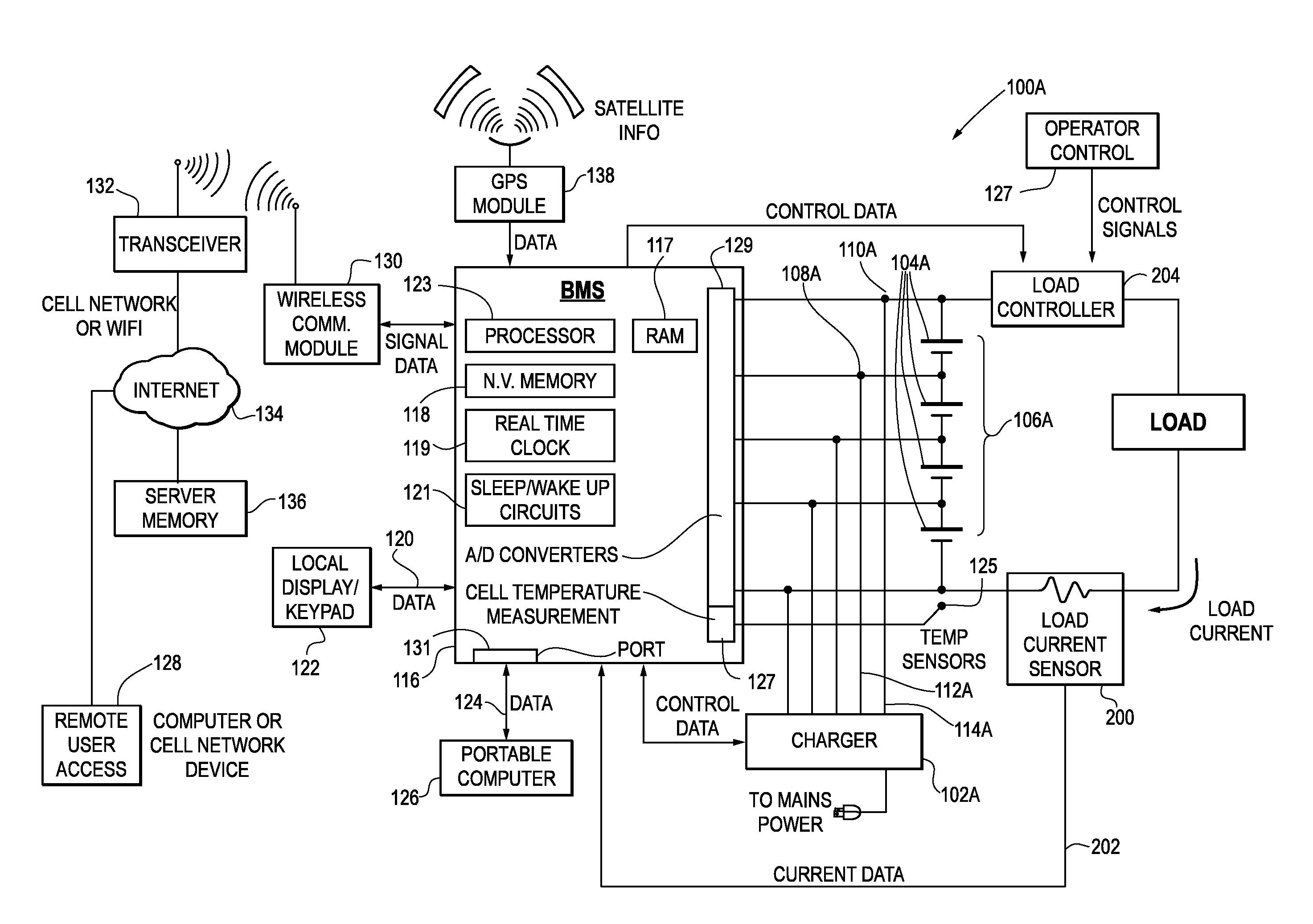
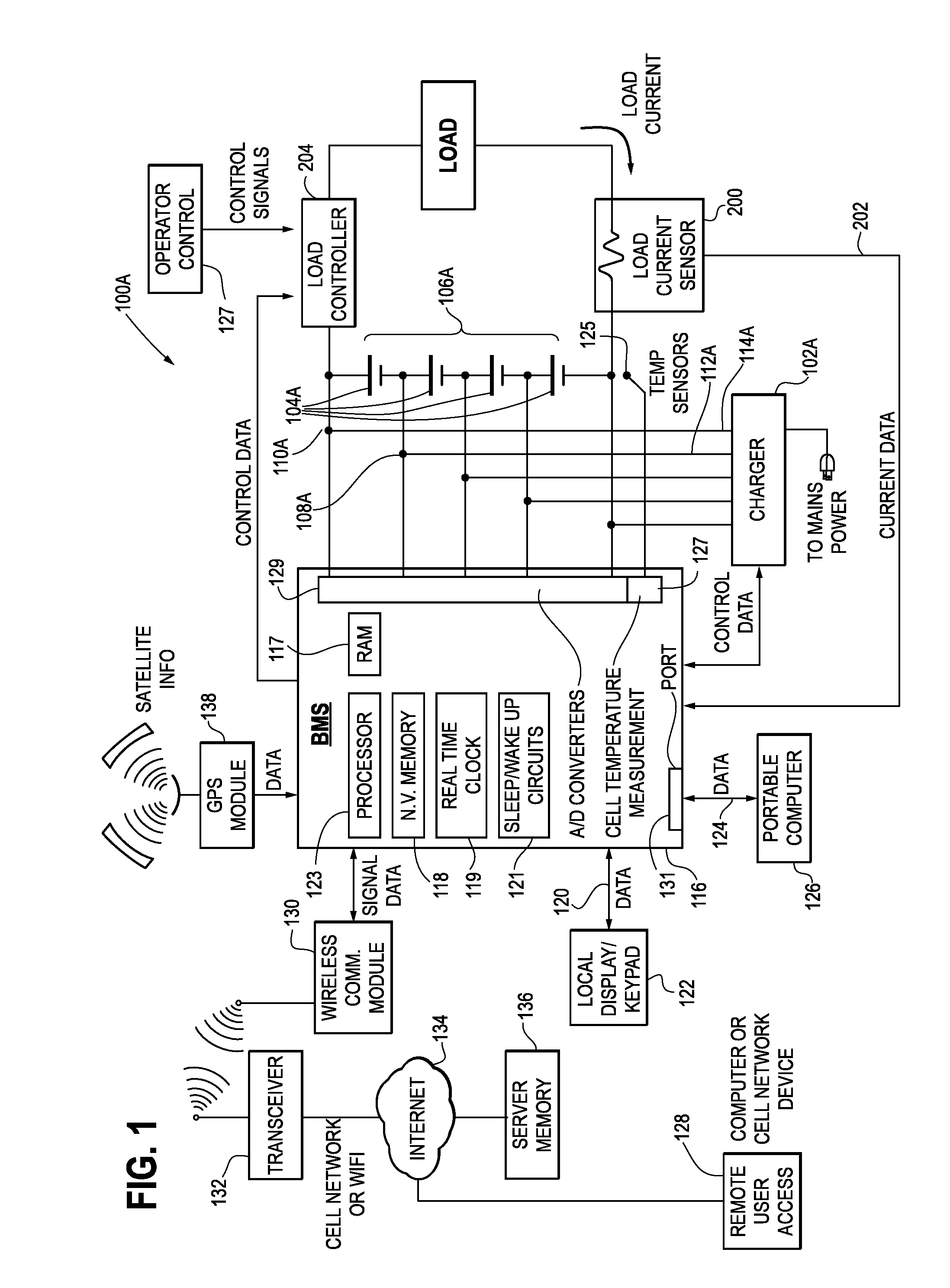
Intelligent battery management system and method
PatentInactiveUS20110248678A1
Innovation
- An intelligent battery management system (BMS) that automates the collection and analysis of performance data from individual cells, using wireless communication to transmit data to a central server, and incorporates features like load control, temperature monitoring, GPS tracking, and remote operation to optimize battery performance and extend battery life.
Patent
Innovation
- Integration of remote monitoring capabilities with real-time battery performance analytics to enable predictive maintenance and fault detection in distributed energy systems.
- Implementation of adaptive load balancing algorithms that dynamically adjust battery discharge patterns based on remote operational demands and environmental conditions.
- Development of edge computing capabilities within the BMS to process critical data locally and reduce dependency on cloud connectivity for time-sensitive operations.
Environmental Impact Assessment for Remote Battery Systems
The environmental implications of remote battery management systems present a complex landscape of challenges and opportunities that require comprehensive assessment across multiple dimensions. Remote battery installations, particularly those deployed in isolated geographical locations, create unique environmental considerations that differ significantly from conventional grid-connected systems.
Battery manufacturing processes contribute substantially to the overall environmental footprint, with lithium-ion systems requiring extensive mining operations for raw materials including lithium, cobalt, and rare earth elements. The extraction processes often occur in environmentally sensitive regions, potentially disrupting local ecosystems and water resources. Transportation of battery components to remote locations further amplifies carbon emissions, especially when installations require helicopter or specialized vehicle access.
Operational environmental impacts vary significantly based on deployment context and system design. Remote battery systems typically operate in pristine natural environments where any contamination risk carries heightened consequences. Thermal management requirements in extreme climates necessitate additional energy consumption, potentially reducing overall system efficiency and increasing indirect environmental costs.
End-of-life considerations present particular challenges for remote installations. Battery disposal and recycling logistics become exponentially more complex when systems are located hundreds of kilometers from processing facilities. The lack of established reverse logistics networks for remote locations often results in extended operational lifespans beyond optimal performance parameters, potentially leading to increased failure rates and environmental risks.
However, remote battery systems also demonstrate significant positive environmental impacts through enabling renewable energy integration in previously inaccessible locations. These installations facilitate the displacement of diesel generators and other fossil fuel-dependent power sources, creating substantial long-term carbon reduction benefits that often outweigh initial manufacturing and deployment impacts.
Climate resilience factors must be evaluated comprehensively, as remote battery systems face exposure to extreme weather events, temperature fluctuations, and natural disasters. System degradation under harsh environmental conditions can accelerate replacement cycles, multiplying environmental impacts while simultaneously reducing the effective service life of installations.
Battery manufacturing processes contribute substantially to the overall environmental footprint, with lithium-ion systems requiring extensive mining operations for raw materials including lithium, cobalt, and rare earth elements. The extraction processes often occur in environmentally sensitive regions, potentially disrupting local ecosystems and water resources. Transportation of battery components to remote locations further amplifies carbon emissions, especially when installations require helicopter or specialized vehicle access.
Operational environmental impacts vary significantly based on deployment context and system design. Remote battery systems typically operate in pristine natural environments where any contamination risk carries heightened consequences. Thermal management requirements in extreme climates necessitate additional energy consumption, potentially reducing overall system efficiency and increasing indirect environmental costs.
End-of-life considerations present particular challenges for remote installations. Battery disposal and recycling logistics become exponentially more complex when systems are located hundreds of kilometers from processing facilities. The lack of established reverse logistics networks for remote locations often results in extended operational lifespans beyond optimal performance parameters, potentially leading to increased failure rates and environmental risks.
However, remote battery systems also demonstrate significant positive environmental impacts through enabling renewable energy integration in previously inaccessible locations. These installations facilitate the displacement of diesel generators and other fossil fuel-dependent power sources, creating substantial long-term carbon reduction benefits that often outweigh initial manufacturing and deployment impacts.
Climate resilience factors must be evaluated comprehensively, as remote battery systems face exposure to extreme weather events, temperature fluctuations, and natural disasters. System degradation under harsh environmental conditions can accelerate replacement cycles, multiplying environmental impacts while simultaneously reducing the effective service life of installations.
Safety Standards and Regulations for Remote BMS Operations
Remote Battery Management System operations are governed by a comprehensive framework of safety standards and regulations that ensure reliable performance across diverse operational environments. The regulatory landscape encompasses international standards such as IEC 62619 for lithium-ion battery safety, UN 38.3 for transportation requirements, and ISO 26262 for functional safety in automotive applications. These standards establish fundamental safety parameters including thermal management protocols, electrical isolation requirements, and fail-safe mechanisms that are particularly critical for remote operations where immediate human intervention may not be feasible.
Functional safety requirements for remote BMS operations mandate redundant monitoring systems and autonomous emergency response capabilities. IEC 61508 provides the foundational framework for safety-related systems, requiring Safety Integrity Level (SIL) ratings that correspond to the criticality of the application. Remote BMS implementations typically require SIL 2 or SIL 3 certification, necessitating dual-channel monitoring, independent safety processors, and deterministic communication protocols. These requirements ensure that system failures can be detected and mitigated without compromising operational safety or personnel protection.
Communication security regulations have become increasingly stringent as remote BMS systems integrate with broader IoT ecosystems. Cybersecurity frameworks such as IEC 62443 mandate encrypted data transmission, secure authentication protocols, and intrusion detection capabilities. Remote operations must comply with data protection regulations including GDPR for European deployments and various national cybersecurity directives. These regulations require implementation of end-to-end encryption, regular security audits, and incident response procedures specifically tailored for remote monitoring scenarios.
Environmental and operational safety standards address the unique challenges of remote BMS deployment across various climatic and geographical conditions. Military and aerospace applications follow MIL-STD-810 for environmental testing, while marine applications must comply with DNV GL standards for offshore operations. These regulations specify temperature cycling requirements, vibration resistance, electromagnetic compatibility, and ingress protection ratings that ensure consistent performance across extreme operational environments.
Certification processes for remote BMS systems require extensive documentation of safety analysis, including Failure Mode and Effects Analysis (FMEA), Hazard Analysis and Risk Assessment (HARA), and comprehensive testing protocols. Regulatory bodies such as UL, TÜV, and CSA mandate third-party verification of safety systems, with particular emphasis on remote diagnostic capabilities and autonomous safety responses that maintain operational integrity without direct human oversight.
Functional safety requirements for remote BMS operations mandate redundant monitoring systems and autonomous emergency response capabilities. IEC 61508 provides the foundational framework for safety-related systems, requiring Safety Integrity Level (SIL) ratings that correspond to the criticality of the application. Remote BMS implementations typically require SIL 2 or SIL 3 certification, necessitating dual-channel monitoring, independent safety processors, and deterministic communication protocols. These requirements ensure that system failures can be detected and mitigated without compromising operational safety or personnel protection.
Communication security regulations have become increasingly stringent as remote BMS systems integrate with broader IoT ecosystems. Cybersecurity frameworks such as IEC 62443 mandate encrypted data transmission, secure authentication protocols, and intrusion detection capabilities. Remote operations must comply with data protection regulations including GDPR for European deployments and various national cybersecurity directives. These regulations require implementation of end-to-end encryption, regular security audits, and incident response procedures specifically tailored for remote monitoring scenarios.
Environmental and operational safety standards address the unique challenges of remote BMS deployment across various climatic and geographical conditions. Military and aerospace applications follow MIL-STD-810 for environmental testing, while marine applications must comply with DNV GL standards for offshore operations. These regulations specify temperature cycling requirements, vibration resistance, electromagnetic compatibility, and ingress protection ratings that ensure consistent performance across extreme operational environments.
Certification processes for remote BMS systems require extensive documentation of safety analysis, including Failure Mode and Effects Analysis (FMEA), Hazard Analysis and Risk Assessment (HARA), and comprehensive testing protocols. Regulatory bodies such as UL, TÜV, and CSA mandate third-party verification of safety systems, with particular emphasis on remote diagnostic capabilities and autonomous safety responses that maintain operational integrity without direct human oversight.
Unlock deeper insights with Patsnap Eureka Quick Research — get a full tech report to explore trends and direct your research. Try now!
Generate Your Research Report Instantly with AI Agent
Supercharge your innovation with Patsnap Eureka AI Agent Platform!