Battery Management System vs Microgrid Integration: Achievements
MAR 20, 20269 MIN READ
Generate Your Research Report Instantly with AI Agent
Patsnap Eureka helps you evaluate technical feasibility & market potential.
BMS-Microgrid Integration Background and Objectives
The integration of Battery Management Systems (BMS) with microgrids represents a critical technological convergence that addresses the growing demand for distributed energy resources and grid resilience. This integration has evolved from isolated battery monitoring systems to sophisticated energy orchestration platforms that enable seamless coordination between energy storage, renewable generation, and grid operations.
Historically, BMS technology emerged in the 1990s primarily for electric vehicle applications, focusing on cell-level monitoring and protection. Concurrently, microgrid concepts developed from the need for localized power generation and distribution systems. The convergence of these technologies gained momentum in the 2010s as renewable energy penetration increased and grid modernization initiatives accelerated globally.
The technological evolution has been driven by several key factors including the declining costs of lithium-ion batteries, advancement in power electronics, and the proliferation of Internet of Things (IoT) connectivity. Early BMS implementations were limited to basic voltage and temperature monitoring, while modern systems incorporate predictive analytics, machine learning algorithms, and real-time optimization capabilities.
Current market dynamics reflect a shift toward decentralized energy systems, with microgrids projected to reach a global market value exceeding $47 billion by 2030. This growth is fueled by increasing frequency of extreme weather events, aging grid infrastructure, and regulatory support for clean energy transitions. The integration challenges have evolved from simple battery protection to complex multi-objective optimization problems involving energy arbitrage, peak shaving, and grid services provision.
The primary technical objectives of BMS-microgrid integration encompass several critical areas. Energy optimization represents a fundamental goal, requiring sophisticated algorithms to balance state-of-charge management with economic dispatch decisions. Grid stability support through frequency regulation and voltage control has become increasingly important as traditional synchronous generators are displaced by inverter-based resources.
Safety and reliability objectives remain paramount, with modern integrated systems required to maintain battery health while ensuring continuous power supply to critical loads. This involves advanced thermal management, fault detection, and graceful degradation strategies that preserve system functionality under adverse conditions.
Interoperability standards such as IEEE 2030.7 and IEC 61850 have emerged as key technical targets, enabling seamless communication between BMS components and microgrid controllers. These standards facilitate vendor-neutral implementations and support the scalability requirements of modern distributed energy systems.
Historically, BMS technology emerged in the 1990s primarily for electric vehicle applications, focusing on cell-level monitoring and protection. Concurrently, microgrid concepts developed from the need for localized power generation and distribution systems. The convergence of these technologies gained momentum in the 2010s as renewable energy penetration increased and grid modernization initiatives accelerated globally.
The technological evolution has been driven by several key factors including the declining costs of lithium-ion batteries, advancement in power electronics, and the proliferation of Internet of Things (IoT) connectivity. Early BMS implementations were limited to basic voltage and temperature monitoring, while modern systems incorporate predictive analytics, machine learning algorithms, and real-time optimization capabilities.
Current market dynamics reflect a shift toward decentralized energy systems, with microgrids projected to reach a global market value exceeding $47 billion by 2030. This growth is fueled by increasing frequency of extreme weather events, aging grid infrastructure, and regulatory support for clean energy transitions. The integration challenges have evolved from simple battery protection to complex multi-objective optimization problems involving energy arbitrage, peak shaving, and grid services provision.
The primary technical objectives of BMS-microgrid integration encompass several critical areas. Energy optimization represents a fundamental goal, requiring sophisticated algorithms to balance state-of-charge management with economic dispatch decisions. Grid stability support through frequency regulation and voltage control has become increasingly important as traditional synchronous generators are displaced by inverter-based resources.
Safety and reliability objectives remain paramount, with modern integrated systems required to maintain battery health while ensuring continuous power supply to critical loads. This involves advanced thermal management, fault detection, and graceful degradation strategies that preserve system functionality under adverse conditions.
Interoperability standards such as IEEE 2030.7 and IEC 61850 have emerged as key technical targets, enabling seamless communication between BMS components and microgrid controllers. These standards facilitate vendor-neutral implementations and support the scalability requirements of modern distributed energy systems.
Market Demand for Smart Grid Energy Storage Solutions
The global smart grid energy storage market is experiencing unprecedented growth driven by the urgent need for grid modernization and renewable energy integration. Traditional power grids face increasing challenges from distributed energy resources, intermittent renewable generation, and growing electricity demand, creating substantial market opportunities for advanced energy storage solutions integrated with sophisticated battery management systems.
Utility companies worldwide are investing heavily in grid-scale energy storage projects to enhance grid stability and reliability. The integration of battery management systems with microgrid infrastructure has become a critical requirement for utilities seeking to manage peak demand, provide frequency regulation services, and ensure seamless operation during grid disturbances. This demand is particularly pronounced in regions with high renewable energy penetration where grid balancing becomes increasingly complex.
Commercial and industrial sectors represent another significant demand driver for smart grid energy storage solutions. Large-scale facilities are seeking energy management systems that can optimize electricity costs through peak shaving, demand response participation, and backup power capabilities. The ability of integrated battery management systems to provide real-time monitoring, predictive maintenance, and automated control functions has made these solutions increasingly attractive to commercial customers.
Residential markets are also contributing to growing demand, particularly in areas with time-of-use electricity pricing and net metering policies. Homeowners are increasingly interested in energy storage systems that can maximize solar energy utilization, provide backup power during outages, and participate in virtual power plant programs. The integration of smart battery management with home energy management systems has created new market segments focused on distributed energy resources.
Regulatory frameworks and government incentives are significantly shaping market demand patterns. Many jurisdictions have implemented energy storage mandates, renewable portfolio standards, and grid modernization initiatives that directly drive demand for integrated battery management and microgrid solutions. These policy drivers are creating sustained market growth across multiple geographic regions.
The emergence of electric vehicle charging infrastructure is creating additional demand for smart grid energy storage solutions. Fast-charging stations require sophisticated energy management capabilities to minimize grid impact while providing reliable charging services. Battery management systems integrated with microgrid infrastructure enable optimal load balancing and grid support services at charging locations.
Market demand is also being influenced by the declining costs of battery technologies and the increasing sophistication of energy management software platforms. As total system costs decrease and performance capabilities improve, market adoption accelerates across all customer segments, creating a positive feedback loop that drives continued innovation and market expansion.
Utility companies worldwide are investing heavily in grid-scale energy storage projects to enhance grid stability and reliability. The integration of battery management systems with microgrid infrastructure has become a critical requirement for utilities seeking to manage peak demand, provide frequency regulation services, and ensure seamless operation during grid disturbances. This demand is particularly pronounced in regions with high renewable energy penetration where grid balancing becomes increasingly complex.
Commercial and industrial sectors represent another significant demand driver for smart grid energy storage solutions. Large-scale facilities are seeking energy management systems that can optimize electricity costs through peak shaving, demand response participation, and backup power capabilities. The ability of integrated battery management systems to provide real-time monitoring, predictive maintenance, and automated control functions has made these solutions increasingly attractive to commercial customers.
Residential markets are also contributing to growing demand, particularly in areas with time-of-use electricity pricing and net metering policies. Homeowners are increasingly interested in energy storage systems that can maximize solar energy utilization, provide backup power during outages, and participate in virtual power plant programs. The integration of smart battery management with home energy management systems has created new market segments focused on distributed energy resources.
Regulatory frameworks and government incentives are significantly shaping market demand patterns. Many jurisdictions have implemented energy storage mandates, renewable portfolio standards, and grid modernization initiatives that directly drive demand for integrated battery management and microgrid solutions. These policy drivers are creating sustained market growth across multiple geographic regions.
The emergence of electric vehicle charging infrastructure is creating additional demand for smart grid energy storage solutions. Fast-charging stations require sophisticated energy management capabilities to minimize grid impact while providing reliable charging services. Battery management systems integrated with microgrid infrastructure enable optimal load balancing and grid support services at charging locations.
Market demand is also being influenced by the declining costs of battery technologies and the increasing sophistication of energy management software platforms. As total system costs decrease and performance capabilities improve, market adoption accelerates across all customer segments, creating a positive feedback loop that drives continued innovation and market expansion.
Current BMS-Microgrid Integration Status and Challenges
The integration of Battery Management Systems (BMS) with microgrids has reached a significant maturity level, with numerous successful deployments across residential, commercial, and utility-scale applications. Current BMS technologies demonstrate sophisticated capabilities in monitoring cell voltages, temperatures, and state-of-charge parameters while seamlessly communicating with microgrid controllers through standardized protocols such as Modbus, CAN bus, and emerging IEC 61850 standards.
Modern BMS-microgrid integration architectures typically employ hierarchical control structures where the BMS operates at the device level, managing individual battery cells and modules, while higher-level energy management systems coordinate multiple distributed energy resources. This multi-layered approach has proven effective in optimizing energy storage utilization, with reported round-trip efficiencies exceeding 90% in well-designed systems.
Despite these achievements, several critical challenges persist in current implementations. Interoperability remains a primary concern, as different BMS manufacturers often utilize proprietary communication protocols that complicate integration with diverse microgrid components. The lack of universal standards creates compatibility issues, particularly in retrofit applications where existing infrastructure must accommodate new battery technologies.
Cybersecurity vulnerabilities represent another significant challenge, as increased connectivity exposes BMS-microgrid systems to potential cyber threats. Current security measures often rely on basic encryption and access controls, which may prove insufficient against sophisticated attacks targeting critical energy infrastructure.
Scalability limitations also constrain current solutions, particularly in dynamic microgrid environments where battery capacity requirements fluctuate based on renewable energy generation patterns and load demands. Many existing BMS architectures struggle to efficiently manage heterogeneous battery chemistries and aging profiles within the same microgrid, leading to suboptimal performance and reduced system lifespan.
Real-time optimization capabilities remain constrained by computational limitations in current BMS hardware, preventing the implementation of advanced algorithms for predictive maintenance and adaptive control strategies that could significantly enhance overall system performance and reliability.
Modern BMS-microgrid integration architectures typically employ hierarchical control structures where the BMS operates at the device level, managing individual battery cells and modules, while higher-level energy management systems coordinate multiple distributed energy resources. This multi-layered approach has proven effective in optimizing energy storage utilization, with reported round-trip efficiencies exceeding 90% in well-designed systems.
Despite these achievements, several critical challenges persist in current implementations. Interoperability remains a primary concern, as different BMS manufacturers often utilize proprietary communication protocols that complicate integration with diverse microgrid components. The lack of universal standards creates compatibility issues, particularly in retrofit applications where existing infrastructure must accommodate new battery technologies.
Cybersecurity vulnerabilities represent another significant challenge, as increased connectivity exposes BMS-microgrid systems to potential cyber threats. Current security measures often rely on basic encryption and access controls, which may prove insufficient against sophisticated attacks targeting critical energy infrastructure.
Scalability limitations also constrain current solutions, particularly in dynamic microgrid environments where battery capacity requirements fluctuate based on renewable energy generation patterns and load demands. Many existing BMS architectures struggle to efficiently manage heterogeneous battery chemistries and aging profiles within the same microgrid, leading to suboptimal performance and reduced system lifespan.
Real-time optimization capabilities remain constrained by computational limitations in current BMS hardware, preventing the implementation of advanced algorithms for predictive maintenance and adaptive control strategies that could significantly enhance overall system performance and reliability.
Existing BMS-Microgrid Integration Solutions
01 Battery state monitoring and estimation techniques
Battery management systems employ various methods to monitor and estimate critical battery parameters such as state of charge (SOC), state of health (SOH), and remaining useful life. These techniques utilize voltage, current, and temperature measurements combined with algorithms including Kalman filtering, coulomb counting, and machine learning approaches to provide accurate real-time assessment of battery conditions. Advanced estimation methods help optimize battery performance and prevent over-discharge or overcharge conditions.- Battery state monitoring and estimation: Battery management systems incorporate advanced algorithms and sensors to monitor and estimate critical battery parameters such as state of charge (SOC), state of health (SOH), and remaining useful life. These systems utilize voltage, current, and temperature measurements combined with computational models to provide accurate real-time assessments of battery conditions. The monitoring capabilities enable predictive maintenance and optimize battery performance throughout its lifecycle.
- Cell balancing and equalization techniques: Advanced cell balancing methods are implemented to ensure uniform charge distribution across individual cells within battery packs. These techniques include both passive and active balancing approaches that redistribute energy among cells to prevent overcharging or undercharging of specific cells. Effective balancing extends battery life, improves overall pack performance, and enhances safety by maintaining cells within optimal operating ranges.
- Thermal management and temperature control: Integrated thermal management systems regulate battery temperature through active cooling or heating mechanisms to maintain optimal operating conditions. These systems employ temperature sensors, cooling channels, heat exchangers, and control algorithms to prevent thermal runaway and degradation. Proper thermal management ensures consistent performance across varying environmental conditions and extends battery lifespan by preventing temperature-related stress.
- Communication protocols and data management: Battery management systems utilize standardized communication interfaces and protocols to exchange data with external systems and enable remote monitoring. These systems implement secure data transmission, cloud connectivity, and diagnostic capabilities for real-time performance tracking. The communication architecture supports integration with vehicle control units, charging infrastructure, and fleet management platforms while ensuring data integrity and cybersecurity.
- Safety protection and fault detection: Comprehensive safety mechanisms are integrated to detect and respond to abnormal conditions such as overcurrent, overvoltage, short circuits, and thermal events. These protection systems employ multiple redundant sensors, fail-safe circuits, and emergency shutdown procedures to prevent hazardous situations. Advanced fault detection algorithms identify early warning signs of battery degradation or malfunction, triggering appropriate protective actions to ensure user safety and prevent catastrophic failures.
02 Cell balancing and equalization systems
Battery management systems incorporate cell balancing mechanisms to ensure uniform charge distribution across individual cells in a battery pack. These systems can employ passive balancing using resistive dissipation or active balancing that transfers energy between cells. Proper balancing extends battery life, improves capacity utilization, and prevents premature degradation of weaker cells. The balancing circuits can be implemented at various levels including module-level and pack-level configurations.Expand Specific Solutions03 Thermal management and temperature control
Effective thermal management is critical for battery safety and performance. Battery management systems integrate temperature sensing and control mechanisms to maintain optimal operating temperatures. These systems may include active cooling or heating elements, thermal modeling algorithms, and safety protocols that adjust charging rates or disconnect loads when temperature thresholds are exceeded. Proper thermal management prevents thermal runaway and extends battery cycle life.Expand Specific Solutions04 Communication protocols and data management
Modern battery management systems feature sophisticated communication interfaces that enable data exchange with external systems and cloud platforms. These systems support various protocols for transmitting battery status information, diagnostic data, and operational parameters. The communication architecture facilitates remote monitoring, predictive maintenance, and integration with vehicle control units or energy management systems. Data logging and analytics capabilities provide insights for performance optimization.Expand Specific Solutions05 Safety protection and fault detection mechanisms
Battery management systems incorporate multiple layers of safety protection to prevent hazardous conditions. These include overvoltage and undervoltage protection, overcurrent detection, short circuit prevention, and isolation monitoring. Advanced fault detection algorithms identify abnormal cell behavior, internal resistance changes, and potential failure modes. When faults are detected, the system can trigger protective actions such as disconnecting contactors, reducing power output, or activating emergency shutdown procedures.Expand Specific Solutions
Major Players in BMS and Microgrid Technology Sector
The battery management system and microgrid integration sector represents a rapidly evolving market in the growth phase, driven by increasing demand for renewable energy storage and grid modernization. The market demonstrates significant scale with established players like Tesla, BYD, Contemporary Amperex Technology (CATL), and Samsung SDI leading battery technology development, while companies such as ABB, Schneider Electric, and State Grid Corp. of China advance grid integration solutions. Technology maturity varies across segments, with battery management systems reaching commercial maturity through innovations from Tesla, EVE Energy, and FranklinWH Energy Storage, while advanced microgrid integration remains in development phases. Research institutions including Indian Institutes of Technology, University of California, and Nanyang Technological University contribute foundational research, while emerging players like Hygge Energy and Maxout Renewables drive specialized applications, creating a competitive landscape characterized by both technological sophistication and market consolidation opportunities.
Samsung SDI Co., Ltd.
Technical Solution: Samsung SDI has developed sophisticated BMS technology integrated with microgrid systems, focusing on high-performance lithium-ion battery solutions for energy storage applications. Their BMS features advanced cell balancing algorithms, precise state estimation, and robust safety mechanisms designed for grid-scale deployments. The system incorporates Samsung's proprietary battery chemistry optimization with intelligent thermal management and predictive analytics capabilities. Their microgrid integration platform supports seamless communication with power conversion systems, renewable energy sources, and grid management infrastructure, enabling efficient energy arbitrage and grid stabilization services through advanced control algorithms and real-time monitoring systems.
Strengths: Advanced battery chemistry expertise, strong R&D capabilities, proven reliability in large-scale deployments. Weaknesses: Limited market presence in residential microgrid segment, higher complexity in system integration.
Contemporary Amperex Technology Co., Ltd.
Technical Solution: CATL has developed comprehensive BMS solutions specifically designed for microgrid applications, featuring advanced cell monitoring, thermal management, and safety protection systems. Their BMS incorporates cloud-based analytics and AI-driven optimization algorithms that enable seamless integration with renewable energy sources and grid infrastructure. The system supports multiple communication protocols including CAN, Modbus, and Ethernet for enhanced interoperability with various microgrid components. CATL's BMS architecture includes advanced fault detection and isolation capabilities, ensuring system stability during grid disturbances while maintaining optimal energy storage performance across different operating conditions.
Strengths: Cost-effective solutions, strong manufacturing capabilities, extensive global partnerships. Weaknesses: Limited software ecosystem compared to Tesla, relatively newer in microgrid integration market.
Core BMS Technologies for Microgrid Applications
Battery energy storage system and microgrid controller
PatentActiveUS20210351590A1
Innovation
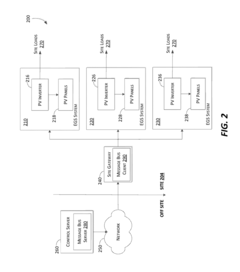
- A control algorithm using a Kalman Filter design for model-based state reconstruction is implemented to track the stored energy level of BESS, incorporating real-time feedback measurements and handling intermittent errors, ensuring seamless operation during sensor or communication faults.


Control system for maintaining preferred battery levels in a microgrid
PatentActiveUS20170288413A1
Innovation
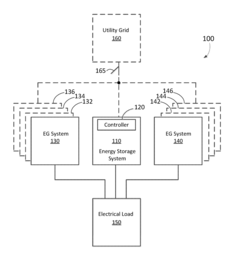
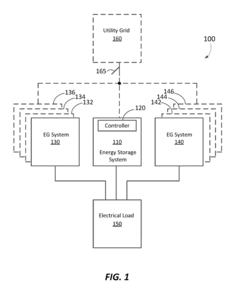
- A microgrid system with an energy storage system and a controller that monitors and controls the state-of-energy, adjusting power generation based on load demand and setting target charge and discharge values to maintain the energy storage system within desired levels, utilizing multiple operational states and hysteresis bands to manage transitions and prevent frequent switching.
Grid Code Compliance and Energy Storage Standards
Grid code compliance represents a fundamental requirement for battery management systems operating within microgrid environments, establishing the technical and operational standards that ensure safe, reliable, and efficient integration with existing electrical infrastructure. These regulatory frameworks define specific parameters for voltage regulation, frequency response, power quality, and fault protection that battery systems must adhere to when interfacing with utility grids or operating in islanded microgrid configurations.
The evolution of energy storage standards has been driven by the increasing penetration of distributed energy resources and the growing complexity of modern power systems. International standards such as IEEE 1547, IEC 61850, and UL 1973 provide comprehensive guidelines for interconnection requirements, communication protocols, and safety certifications that battery management systems must satisfy. These standards address critical aspects including anti-islanding protection, voltage and frequency ride-through capabilities, and reactive power support functions.
Battery management systems must demonstrate compliance with grid codes through rigorous testing and certification processes that validate their ability to maintain system stability during various operating conditions. Key compliance areas include harmonic distortion limits, power factor requirements, and response times for grid support functions. The integration of advanced control algorithms enables battery systems to provide ancillary services such as frequency regulation, voltage support, and peak shaving while maintaining adherence to established grid codes.
Energy storage standards continue to evolve in response to technological advancements and changing grid requirements, with recent updates focusing on cybersecurity protocols, interoperability standards, and enhanced safety measures. The development of smart grid technologies has necessitated more sophisticated communication standards that enable real-time coordination between battery management systems and grid operators, ensuring optimal performance while maintaining regulatory compliance.
The harmonization of international standards remains an ongoing challenge, as different regions maintain varying requirements for grid interconnection and energy storage deployment. Battery management systems designed for global markets must accommodate multiple regulatory frameworks while maintaining cost-effectiveness and technical performance, driving innovation in adaptive control systems and modular hardware architectures that can be configured to meet diverse compliance requirements across different jurisdictions.
The evolution of energy storage standards has been driven by the increasing penetration of distributed energy resources and the growing complexity of modern power systems. International standards such as IEEE 1547, IEC 61850, and UL 1973 provide comprehensive guidelines for interconnection requirements, communication protocols, and safety certifications that battery management systems must satisfy. These standards address critical aspects including anti-islanding protection, voltage and frequency ride-through capabilities, and reactive power support functions.
Battery management systems must demonstrate compliance with grid codes through rigorous testing and certification processes that validate their ability to maintain system stability during various operating conditions. Key compliance areas include harmonic distortion limits, power factor requirements, and response times for grid support functions. The integration of advanced control algorithms enables battery systems to provide ancillary services such as frequency regulation, voltage support, and peak shaving while maintaining adherence to established grid codes.
Energy storage standards continue to evolve in response to technological advancements and changing grid requirements, with recent updates focusing on cybersecurity protocols, interoperability standards, and enhanced safety measures. The development of smart grid technologies has necessitated more sophisticated communication standards that enable real-time coordination between battery management systems and grid operators, ensuring optimal performance while maintaining regulatory compliance.
The harmonization of international standards remains an ongoing challenge, as different regions maintain varying requirements for grid interconnection and energy storage deployment. Battery management systems designed for global markets must accommodate multiple regulatory frameworks while maintaining cost-effectiveness and technical performance, driving innovation in adaptive control systems and modular hardware architectures that can be configured to meet diverse compliance requirements across different jurisdictions.
Cybersecurity Framework for Connected Energy Systems
The integration of battery management systems with microgrids has created unprecedented cybersecurity challenges that demand comprehensive protection frameworks. As energy storage systems become increasingly connected to distributed grid networks, the attack surface expands exponentially, requiring sophisticated security architectures that can protect both individual battery assets and the broader microgrid infrastructure.
Modern cybersecurity frameworks for connected energy systems must address multi-layered vulnerabilities spanning from device-level battery controllers to grid-wide communication protocols. The framework architecture typically incorporates network segmentation strategies that isolate critical battery management functions from external communications while maintaining operational visibility. Advanced encryption protocols ensure secure data transmission between battery systems and microgrid control centers, preventing unauthorized access to sensitive operational parameters and state-of-charge information.
Identity and access management represents a cornerstone of effective cybersecurity implementation in battery-microgrid ecosystems. The framework establishes role-based authentication mechanisms that restrict system access based on operational necessity, ensuring that battery management commands originate only from verified sources. Multi-factor authentication protocols add additional security layers, particularly for remote monitoring and control operations that are increasingly common in distributed energy deployments.
Real-time threat detection capabilities form another critical component of the cybersecurity framework. Machine learning algorithms continuously monitor communication patterns between battery systems and microgrid components, identifying anomalous behaviors that may indicate cyber intrusions or system compromises. These detection systems must operate with minimal latency to prevent disruption of time-sensitive battery management operations while maintaining grid stability.
The framework also addresses incident response protocols specifically tailored to energy system requirements. Automated isolation procedures can disconnect compromised battery systems from the microgrid network while preserving essential safety functions. Recovery mechanisms ensure rapid restoration of secure communications once threats are neutralized, minimizing operational downtime and maintaining energy supply reliability.
Compliance integration ensures that cybersecurity measures align with evolving regulatory requirements for critical energy infrastructure. The framework incorporates standardized security controls that meet industry specifications while providing flexibility for customization based on specific deployment scenarios and risk profiles inherent to different microgrid configurations.
Modern cybersecurity frameworks for connected energy systems must address multi-layered vulnerabilities spanning from device-level battery controllers to grid-wide communication protocols. The framework architecture typically incorporates network segmentation strategies that isolate critical battery management functions from external communications while maintaining operational visibility. Advanced encryption protocols ensure secure data transmission between battery systems and microgrid control centers, preventing unauthorized access to sensitive operational parameters and state-of-charge information.
Identity and access management represents a cornerstone of effective cybersecurity implementation in battery-microgrid ecosystems. The framework establishes role-based authentication mechanisms that restrict system access based on operational necessity, ensuring that battery management commands originate only from verified sources. Multi-factor authentication protocols add additional security layers, particularly for remote monitoring and control operations that are increasingly common in distributed energy deployments.
Real-time threat detection capabilities form another critical component of the cybersecurity framework. Machine learning algorithms continuously monitor communication patterns between battery systems and microgrid components, identifying anomalous behaviors that may indicate cyber intrusions or system compromises. These detection systems must operate with minimal latency to prevent disruption of time-sensitive battery management operations while maintaining grid stability.
The framework also addresses incident response protocols specifically tailored to energy system requirements. Automated isolation procedures can disconnect compromised battery systems from the microgrid network while preserving essential safety functions. Recovery mechanisms ensure rapid restoration of secure communications once threats are neutralized, minimizing operational downtime and maintaining energy supply reliability.
Compliance integration ensures that cybersecurity measures align with evolving regulatory requirements for critical energy infrastructure. The framework incorporates standardized security controls that meet industry specifications while providing flexibility for customization based on specific deployment scenarios and risk profiles inherent to different microgrid configurations.
Unlock deeper insights with Patsnap Eureka Quick Research — get a full tech report to explore trends and direct your research. Try now!
Generate Your Research Report Instantly with AI Agent
Supercharge your innovation with Patsnap Eureka AI Agent Platform!