
Battery Swelling vs Capacity: Identifying the Optimal Threshold
MAY 26, 20269 MIN READ
Generate Your Research Report Instantly with AI Agent
Patsnap Eureka helps you evaluate technical feasibility & market potential.
Battery Swelling Technology Background and Capacity Goals
Battery swelling represents one of the most critical safety and performance challenges in modern lithium-ion battery technology. This phenomenon occurs when electrochemical reactions within battery cells generate gases, causing physical expansion that can compromise both structural integrity and operational efficiency. The relationship between swelling and capacity degradation has emerged as a fundamental concern for manufacturers seeking to optimize battery performance while maintaining safety standards.
The evolution of battery technology has consistently focused on maximizing energy density while minimizing physical constraints. Early lithium-ion batteries in the 1990s exhibited significant swelling issues due to primitive electrolyte formulations and inadequate cell design. As technology progressed through the 2000s, manufacturers developed sophisticated separator materials and electrolyte additives to mitigate gas generation, yet swelling remained an inherent characteristic of battery operation.
Contemporary battery systems face increasing demands for higher capacity and longer operational lifespans, particularly in electric vehicles and energy storage applications. The challenge lies in determining the optimal threshold where acceptable swelling levels intersect with maximum capacity utilization. This balance point varies significantly across different battery chemistries, with lithium iron phosphate cells typically exhibiting lower swelling rates compared to high-energy nickel-cobalt-aluminum variants.
Current technological objectives center on establishing predictive models that can accurately forecast swelling behavior throughout battery lifecycle stages. Advanced monitoring systems now incorporate pressure sensors and dimensional measurement tools to track real-time swelling progression. These developments enable manufacturers to set precise operational parameters that maximize capacity while preventing dangerous expansion levels.
The primary goal involves developing standardized threshold metrics that account for various operational conditions, including temperature fluctuations, charging rates, and depth of discharge cycles. Research initiatives focus on creating adaptive algorithms that can dynamically adjust capacity limits based on measured swelling rates, ensuring optimal performance without compromising safety margins.
Future technological targets emphasize the development of next-generation battery architectures that inherently minimize swelling through innovative cell designs and advanced materials. These include solid-state electrolytes, flexible packaging solutions, and intelligent battery management systems capable of real-time threshold optimization based on individual cell characteristics and operational history.
The evolution of battery technology has consistently focused on maximizing energy density while minimizing physical constraints. Early lithium-ion batteries in the 1990s exhibited significant swelling issues due to primitive electrolyte formulations and inadequate cell design. As technology progressed through the 2000s, manufacturers developed sophisticated separator materials and electrolyte additives to mitigate gas generation, yet swelling remained an inherent characteristic of battery operation.
Contemporary battery systems face increasing demands for higher capacity and longer operational lifespans, particularly in electric vehicles and energy storage applications. The challenge lies in determining the optimal threshold where acceptable swelling levels intersect with maximum capacity utilization. This balance point varies significantly across different battery chemistries, with lithium iron phosphate cells typically exhibiting lower swelling rates compared to high-energy nickel-cobalt-aluminum variants.
Current technological objectives center on establishing predictive models that can accurately forecast swelling behavior throughout battery lifecycle stages. Advanced monitoring systems now incorporate pressure sensors and dimensional measurement tools to track real-time swelling progression. These developments enable manufacturers to set precise operational parameters that maximize capacity while preventing dangerous expansion levels.
The primary goal involves developing standardized threshold metrics that account for various operational conditions, including temperature fluctuations, charging rates, and depth of discharge cycles. Research initiatives focus on creating adaptive algorithms that can dynamically adjust capacity limits based on measured swelling rates, ensuring optimal performance without compromising safety margins.
Future technological targets emphasize the development of next-generation battery architectures that inherently minimize swelling through innovative cell designs and advanced materials. These include solid-state electrolytes, flexible packaging solutions, and intelligent battery management systems capable of real-time threshold optimization based on individual cell characteristics and operational history.
Market Demand for Swelling-Resistant Battery Solutions
The global battery market is experiencing unprecedented demand for swelling-resistant solutions as manufacturers grapple with the critical balance between energy density and structural integrity. Consumer electronics manufacturers face mounting pressure to deliver devices with extended battery life while maintaining slim form factors, creating a substantial market opportunity for batteries that can optimize the capacity-swelling threshold relationship.
Electric vehicle manufacturers represent the largest segment driving demand for swelling-resistant battery technologies. The automotive industry requires battery packs that maintain consistent performance over extended lifecycles while minimizing dimensional changes that could compromise vehicle safety systems. Fleet operators and consumers increasingly prioritize battery longevity and reliability, making swelling resistance a key differentiator in purchasing decisions.
The consumer electronics sector demonstrates strong demand patterns for batteries that can maximize capacity without compromising device aesthetics or functionality. Smartphone and laptop manufacturers face intense competition to deliver thinner devices with longer battery life, necessitating advanced battery solutions that can operate at optimal capacity thresholds without significant dimensional expansion. Premium device segments show particular willingness to adopt higher-cost swelling-resistant technologies.
Energy storage system deployments for renewable energy applications create substantial demand for large-format batteries with predictable swelling characteristics. Grid-scale installations require batteries that maintain structural integrity over decades of operation, with swelling behavior that can be accurately predicted and accommodated in system designs. The growing renewable energy sector amplifies this demand as storage capacity requirements continue expanding globally.
Industrial and aerospace applications represent specialized but high-value market segments requiring batteries with stringent swelling control specifications. These sectors demand batteries that can operate within precise dimensional tolerances while maximizing energy density, often justifying premium pricing for advanced swelling-resistant technologies. Medical device applications similarly require batteries with predictable expansion characteristics to ensure device reliability and patient safety.
Emerging markets in developing regions show increasing demand for reliable battery solutions as electrification accelerates. These markets particularly value batteries that maintain performance characteristics over extended periods without requiring frequent replacement, making swelling resistance an important factor in total cost of ownership calculations.
Electric vehicle manufacturers represent the largest segment driving demand for swelling-resistant battery technologies. The automotive industry requires battery packs that maintain consistent performance over extended lifecycles while minimizing dimensional changes that could compromise vehicle safety systems. Fleet operators and consumers increasingly prioritize battery longevity and reliability, making swelling resistance a key differentiator in purchasing decisions.
The consumer electronics sector demonstrates strong demand patterns for batteries that can maximize capacity without compromising device aesthetics or functionality. Smartphone and laptop manufacturers face intense competition to deliver thinner devices with longer battery life, necessitating advanced battery solutions that can operate at optimal capacity thresholds without significant dimensional expansion. Premium device segments show particular willingness to adopt higher-cost swelling-resistant technologies.
Energy storage system deployments for renewable energy applications create substantial demand for large-format batteries with predictable swelling characteristics. Grid-scale installations require batteries that maintain structural integrity over decades of operation, with swelling behavior that can be accurately predicted and accommodated in system designs. The growing renewable energy sector amplifies this demand as storage capacity requirements continue expanding globally.
Industrial and aerospace applications represent specialized but high-value market segments requiring batteries with stringent swelling control specifications. These sectors demand batteries that can operate within precise dimensional tolerances while maximizing energy density, often justifying premium pricing for advanced swelling-resistant technologies. Medical device applications similarly require batteries with predictable expansion characteristics to ensure device reliability and patient safety.
Emerging markets in developing regions show increasing demand for reliable battery solutions as electrification accelerates. These markets particularly value batteries that maintain performance characteristics over extended periods without requiring frequent replacement, making swelling resistance an important factor in total cost of ownership calculations.
Current Battery Swelling Challenges and Technical Barriers
Battery swelling represents one of the most critical safety and performance challenges in modern lithium-ion battery technology. This phenomenon occurs when electrolyte decomposition and gas generation cause physical expansion of battery cells, creating a complex trade-off between maintaining battery capacity and ensuring operational safety. The challenge intensifies as manufacturers push for higher energy densities while attempting to minimize the risk of thermal runaway and mechanical failure.
The primary technical barrier lies in the electrochemical processes that drive swelling behavior. During charge-discharge cycles, lithium plating on the anode surface and electrolyte oxidation at elevated voltages generate gaseous byproducts including hydrogen, carbon monoxide, and various organic compounds. These gases accumulate within the sealed cell structure, creating internal pressure that manifests as visible swelling. The rate and extent of gas generation correlate directly with operating conditions such as temperature, charge rate, and depth of discharge.
Temperature management presents another significant technical hurdle. Elevated temperatures accelerate electrolyte decomposition reactions, leading to increased gas generation and accelerated swelling rates. However, the relationship between temperature and capacity retention creates a paradox where optimal capacity performance often occurs at temperatures that exacerbate swelling issues. This thermal sensitivity becomes particularly problematic in applications requiring high power density or operation in extreme environmental conditions.
Mechanical stress distribution within battery packs compounds the swelling challenge. As individual cells expand, they create uneven pressure distribution across the pack assembly, potentially leading to cell deformation, separator damage, and electrical contact issues. The mechanical constraints imposed by pack housing can either mitigate or exacerbate swelling effects, depending on the design approach and materials selection.
Current measurement and monitoring technologies face significant limitations in real-time swelling detection. Traditional thickness gauges and pressure sensors provide limited spatial resolution and cannot capture the dynamic nature of swelling behavior during operational cycles. Advanced techniques such as acoustic emission monitoring and impedance spectroscopy show promise but require sophisticated signal processing and interpretation algorithms that are not yet mature for commercial deployment.
The establishment of optimal swelling thresholds remains technically challenging due to the multifactorial nature of the problem. Swelling rates vary significantly based on cell chemistry, manufacturing quality, operating history, and environmental conditions. Developing universal threshold criteria requires extensive statistical analysis across diverse operating scenarios and battery configurations, making standardization efforts complex and time-intensive.
The primary technical barrier lies in the electrochemical processes that drive swelling behavior. During charge-discharge cycles, lithium plating on the anode surface and electrolyte oxidation at elevated voltages generate gaseous byproducts including hydrogen, carbon monoxide, and various organic compounds. These gases accumulate within the sealed cell structure, creating internal pressure that manifests as visible swelling. The rate and extent of gas generation correlate directly with operating conditions such as temperature, charge rate, and depth of discharge.
Temperature management presents another significant technical hurdle. Elevated temperatures accelerate electrolyte decomposition reactions, leading to increased gas generation and accelerated swelling rates. However, the relationship between temperature and capacity retention creates a paradox where optimal capacity performance often occurs at temperatures that exacerbate swelling issues. This thermal sensitivity becomes particularly problematic in applications requiring high power density or operation in extreme environmental conditions.
Mechanical stress distribution within battery packs compounds the swelling challenge. As individual cells expand, they create uneven pressure distribution across the pack assembly, potentially leading to cell deformation, separator damage, and electrical contact issues. The mechanical constraints imposed by pack housing can either mitigate or exacerbate swelling effects, depending on the design approach and materials selection.
Current measurement and monitoring technologies face significant limitations in real-time swelling detection. Traditional thickness gauges and pressure sensors provide limited spatial resolution and cannot capture the dynamic nature of swelling behavior during operational cycles. Advanced techniques such as acoustic emission monitoring and impedance spectroscopy show promise but require sophisticated signal processing and interpretation algorithms that are not yet mature for commercial deployment.
The establishment of optimal swelling thresholds remains technically challenging due to the multifactorial nature of the problem. Swelling rates vary significantly based on cell chemistry, manufacturing quality, operating history, and environmental conditions. Developing universal threshold criteria requires extensive statistical analysis across diverse operating scenarios and battery configurations, making standardization efforts complex and time-intensive.
Current Battery Swelling Detection and Mitigation Methods
01 Battery swelling prevention through structural design
Battery swelling can be mitigated through improved structural design of battery cells and housings. This includes the use of reinforced casings, pressure-resistant materials, and optimized cell geometry to accommodate volume changes during charge-discharge cycles. Advanced housing designs incorporate flexible elements and expansion chambers to manage internal pressure buildup while maintaining structural integrity.- Battery swelling prevention through structural design: Battery swelling can be mitigated through improved structural design of battery cells and housings. This includes the use of reinforced casings, pressure-resistant materials, and optimized cell geometry to accommodate volume expansion during charge-discharge cycles. Advanced housing designs incorporate flexible elements and expansion chambers to manage internal pressure buildup while maintaining structural integrity.
- Electrolyte composition optimization for swelling control: The formulation of electrolyte compositions plays a crucial role in controlling battery swelling and maintaining capacity. Specialized additives and stabilizers can be incorporated to reduce gas generation and minimize volume expansion. These formulations help maintain electrolyte stability under various operating conditions while preserving ionic conductivity and overall battery performance.
- Capacity retention through electrode material enhancement: Advanced electrode materials and coatings are developed to maintain battery capacity while reducing swelling tendencies. These materials exhibit improved structural stability during lithium insertion and extraction processes. Surface treatments and composite structures help minimize mechanical stress and volume changes that contribute to both capacity fade and physical expansion.
- Thermal management systems for swelling mitigation: Effective thermal management is essential for controlling battery swelling and preserving capacity. Advanced cooling systems, heat dissipation structures, and temperature monitoring technologies help maintain optimal operating temperatures. These systems prevent thermal runaway conditions that can lead to excessive gas generation and subsequent swelling while maintaining electrochemical performance.
- Battery management systems for capacity and swelling monitoring: Sophisticated battery management systems incorporate sensors and algorithms to monitor both capacity degradation and physical expansion. These systems provide real-time assessment of battery health, predict swelling behavior, and implement protective measures to prevent damage. Advanced monitoring techniques enable early detection of abnormal conditions and optimize charging protocols to minimize both capacity loss and swelling.
02 Electrolyte composition optimization for swelling control
The formulation of electrolytes plays a crucial role in controlling battery swelling and maintaining capacity. Optimized electrolyte compositions reduce gas generation and minimize volume expansion during battery operation. Special additives and stabilizers are incorporated to prevent decomposition reactions that lead to swelling while preserving ionic conductivity and overall battery performance.Expand Specific Solutions03 Electrode material engineering for capacity retention
Advanced electrode materials and their engineering are essential for maintaining battery capacity while minimizing swelling. This involves the development of stable active materials, optimized particle sizes, and improved binder systems that can withstand volume changes during cycling. Surface treatments and coating technologies are employed to enhance electrode stability and prevent degradation that leads to capacity loss and swelling.Expand Specific Solutions04 Thermal management systems for swelling mitigation
Effective thermal management is critical for preventing battery swelling and capacity degradation. Advanced cooling systems, heat dissipation structures, and temperature monitoring technologies help maintain optimal operating conditions. Thermal interface materials and heat spreaders are integrated to ensure uniform temperature distribution and prevent localized heating that can cause swelling and capacity loss.Expand Specific Solutions05 Battery management and monitoring systems
Sophisticated battery management systems incorporate real-time monitoring of swelling and capacity parameters. These systems use sensors to detect early signs of swelling, pressure changes, and capacity degradation. Advanced algorithms control charging profiles, voltage limits, and current flow to prevent conditions that lead to swelling while optimizing capacity utilization and extending battery life.Expand Specific Solutions
Key Players in Battery Swelling Management Industry
The battery swelling versus capacity optimization challenge represents a rapidly evolving segment within the broader battery technology industry, currently in a growth phase driven by increasing electrification demands across automotive and consumer electronics sectors. The market demonstrates significant scale with major players like LG Energy Solution, Samsung SDI, CATL, and SK On leading battery manufacturing, while automotive giants Toyota, Mercedes-Benz, and Stellantis drive application-side innovation. Technology maturity varies considerably across the competitive landscape, with established companies like Apple, Samsung Electronics, and LG Chem leveraging advanced battery management systems, while specialized firms such as Qnovo focus on intelligent software solutions for battery optimization. The convergence of traditional automotive manufacturers with battery specialists and technology companies creates a dynamic ecosystem where identifying optimal swelling thresholds becomes critical for balancing performance, safety, and longevity across diverse applications.
LG Energy Solution Ltd.
Technical Solution: LG Energy Solution has developed advanced battery management systems that incorporate real-time swelling detection algorithms using pressure sensors and strain gauges integrated within battery packs. Their technology employs machine learning models to predict optimal capacity thresholds by analyzing the correlation between cell expansion rates and remaining useful life. The system continuously monitors dimensional changes at the cell level and adjusts charging parameters to maintain swelling within acceptable limits while maximizing energy density. Their approach includes temperature compensation algorithms and multi-point measurement systems to ensure accurate swelling detection across different operating conditions and battery chemistries including NCM and LFP technologies.
Strengths: Industry-leading expertise in battery chemistry and extensive real-world data from automotive applications. Weaknesses: High implementation costs and complexity in integration with existing battery systems.
Samsung Electronics Co., Ltd.
Technical Solution: Samsung has implemented sophisticated battery health monitoring systems that utilize multi-sensor arrays to detect early signs of battery swelling while optimizing capacity utilization. Their proprietary algorithm analyzes the relationship between mechanical stress, electrochemical impedance, and capacity fade to establish dynamic threshold parameters. The system employs pressure-sensitive films and accelerometers to measure micro-deformations in real-time, correlating these measurements with battery state-of-charge and temperature profiles. Samsung's approach includes predictive analytics that can forecast swelling progression up to 6 months in advance, enabling proactive capacity management strategies that balance performance with safety margins across their mobile device and energy storage portfolios.
Strengths: Strong integration capabilities across consumer electronics and robust data analytics platform. Weaknesses: Limited focus on automotive applications and proprietary solutions may lack industry standardization.
Core Patents in Battery Swelling Threshold Technologies
State Of Battery Health Estimation Based On Swelling Characteristics
PatentActiveUS20210197691A1
Innovation
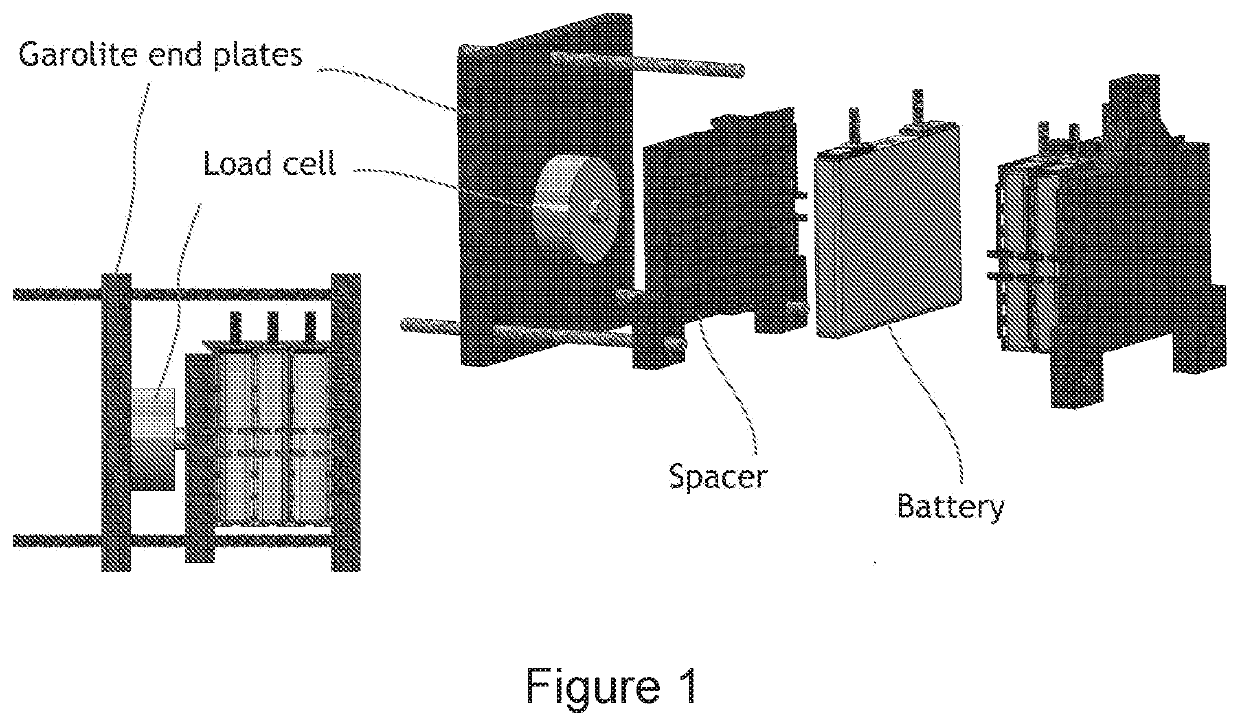
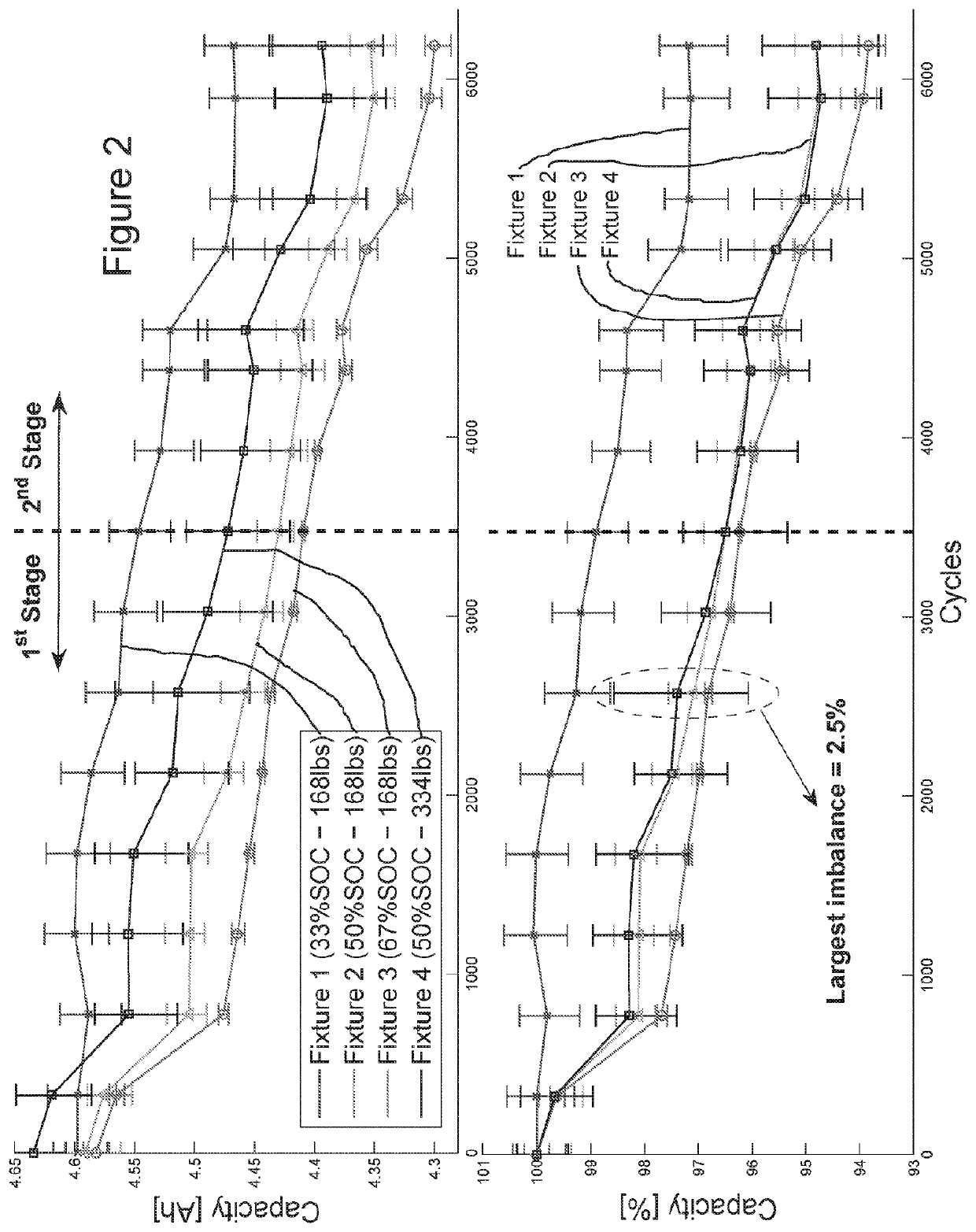
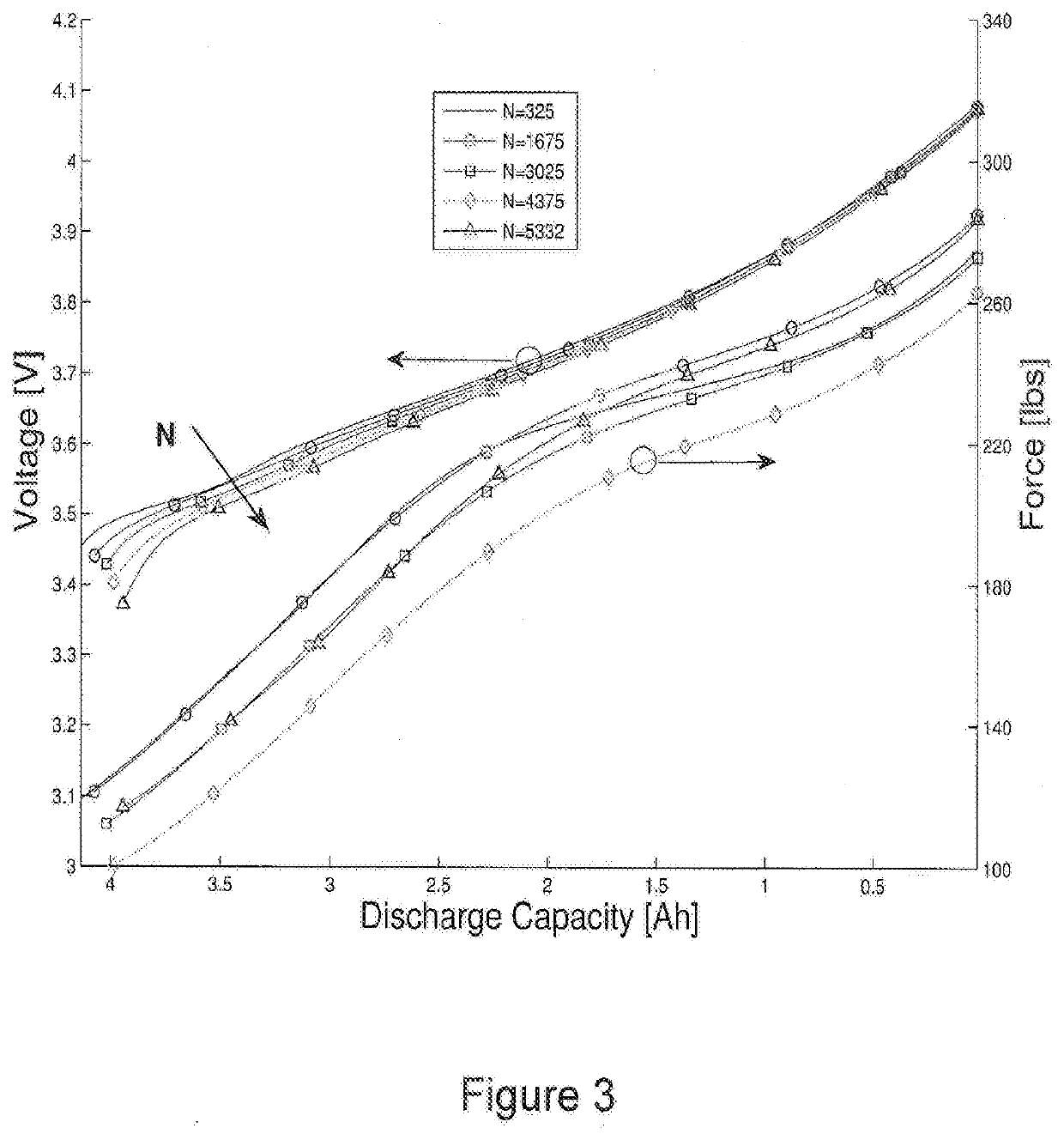
- The method employs force measurements to derive incremental capacity curves, which are less noisy and allow for SOH estimation at higher SOC ranges, enabling more frequent monitoring and improved accuracy by using a battery management system (BMS) that incorporates a pressure sensor to measure swelling-induced force changes.

Circuitry and techniques for determining swelling of a battery/cell and adaptive charging circuitry and techniques based thereon
PatentActiveUS20180149462A1
Innovation
- The development of methods and systems to estimate battery swelling based on capacity fade and state of health, using relationships derived from charge cycles, and adaptive charging techniques that adjust charging sequences to mitigate swelling, including the use of inductive or capacitive sensors to measure displacement and correlate with capacity fade or state of health.


Safety Standards for Battery Swelling Management
Battery swelling management has become a critical safety concern as lithium-ion batteries are increasingly deployed across diverse applications from consumer electronics to electric vehicles. Current safety standards primarily focus on establishing comprehensive frameworks that address both preventive measures and responsive protocols when swelling occurs beyond acceptable thresholds.
The International Electrotechnical Commission (IEC) 62133 series provides fundamental safety requirements for portable sealed secondary cells and batteries. These standards mandate specific testing protocols for mechanical abuse, including crush and impact tests that can induce swelling. The standard requires manufacturers to demonstrate that batteries maintain structural integrity and do not exhibit dangerous failure modes when subjected to controlled deformation scenarios.
UL 2054 and UL 1642 standards specifically address household and commercial battery applications, establishing rigorous testing procedures for abnormal charging conditions that commonly lead to swelling. These standards require batteries to undergo overcharge testing at 150% of rated capacity while monitoring for gas generation, electrolyte leakage, and dimensional changes. The acceptance criteria explicitly limit allowable swelling to prevent case rupture and thermal runaway initiation.
Automotive applications follow ISO 12405 standards, which establish more stringent requirements due to higher energy densities and safety-critical applications. These standards mandate continuous monitoring systems capable of detecting early-stage swelling through pressure sensors and dimensional measurement systems. The framework requires immediate system shutdown when swelling exceeds predetermined thresholds, typically defined as 10-15% volumetric expansion depending on cell chemistry and packaging design.
Recent developments in safety standards emphasize predictive monitoring approaches rather than purely reactive measures. The emerging IEC 63056 standard introduces requirements for battery management systems to incorporate swelling prediction algorithms based on electrochemical impedance spectroscopy and gas pressure monitoring. This proactive approach enables intervention before critical swelling thresholds are reached.
Regulatory bodies are increasingly focusing on establishing unified global standards for swelling management, particularly as battery technologies advance toward higher energy densities. The collaboration between IEC, ISO, and national standards organizations aims to create harmonized testing protocols that account for various failure mechanisms leading to swelling, including lithium plating, electrolyte decomposition, and separator degradation.
The International Electrotechnical Commission (IEC) 62133 series provides fundamental safety requirements for portable sealed secondary cells and batteries. These standards mandate specific testing protocols for mechanical abuse, including crush and impact tests that can induce swelling. The standard requires manufacturers to demonstrate that batteries maintain structural integrity and do not exhibit dangerous failure modes when subjected to controlled deformation scenarios.
UL 2054 and UL 1642 standards specifically address household and commercial battery applications, establishing rigorous testing procedures for abnormal charging conditions that commonly lead to swelling. These standards require batteries to undergo overcharge testing at 150% of rated capacity while monitoring for gas generation, electrolyte leakage, and dimensional changes. The acceptance criteria explicitly limit allowable swelling to prevent case rupture and thermal runaway initiation.
Automotive applications follow ISO 12405 standards, which establish more stringent requirements due to higher energy densities and safety-critical applications. These standards mandate continuous monitoring systems capable of detecting early-stage swelling through pressure sensors and dimensional measurement systems. The framework requires immediate system shutdown when swelling exceeds predetermined thresholds, typically defined as 10-15% volumetric expansion depending on cell chemistry and packaging design.
Recent developments in safety standards emphasize predictive monitoring approaches rather than purely reactive measures. The emerging IEC 63056 standard introduces requirements for battery management systems to incorporate swelling prediction algorithms based on electrochemical impedance spectroscopy and gas pressure monitoring. This proactive approach enables intervention before critical swelling thresholds are reached.
Regulatory bodies are increasingly focusing on establishing unified global standards for swelling management, particularly as battery technologies advance toward higher energy densities. The collaboration between IEC, ISO, and national standards organizations aims to create harmonized testing protocols that account for various failure mechanisms leading to swelling, including lithium plating, electrolyte decomposition, and separator degradation.
Environmental Impact of Battery Swelling Solutions
The environmental implications of battery swelling solutions represent a critical consideration in sustainable energy storage development. As the industry seeks to balance performance optimization with ecological responsibility, various mitigation strategies present distinct environmental footprints that require comprehensive assessment.
Traditional battery swelling prevention methods often rely on chemical additives and enhanced electrolyte formulations. These approaches typically introduce synthetic compounds that may pose disposal challenges at end-of-life. The manufacturing processes for advanced electrolyte systems frequently involve energy-intensive purification steps and specialized chemical synthesis, contributing to increased carbon emissions during production phases.
Mechanical solutions, including improved cell casing designs and pressure management systems, generally demonstrate more favorable environmental profiles. These approaches primarily utilize recyclable materials such as aluminum alloys and engineered plastics, which can be recovered through established recycling infrastructure. However, the precision manufacturing required for advanced mechanical components often demands higher energy consumption during production.
Thermal management solutions present mixed environmental impacts depending on implementation approaches. Active cooling systems incorporating refrigerants may introduce potential greenhouse gas concerns, while passive thermal management through advanced materials typically offers more sustainable alternatives. Phase-change materials and thermally conductive composites, while requiring specialized manufacturing processes, often provide long-term environmental benefits through improved battery longevity.
The lifecycle environmental assessment reveals that swelling prevention strategies significantly influence overall battery sustainability. Solutions that extend battery operational life effectively reduce the frequency of replacement cycles, thereby minimizing cumulative environmental impact despite potentially higher initial production costs. This relationship becomes particularly relevant when considering the resource-intensive nature of battery manufacturing, including lithium extraction and processing.
Emerging bio-based approaches to swelling mitigation show promising environmental potential. Research into organic electrolyte additives derived from renewable sources and biodegradable separator materials suggests pathways toward more sustainable solutions. These innovations, while still in development phases, could substantially reduce the environmental burden associated with battery swelling management while maintaining performance standards necessary for commercial applications.
Traditional battery swelling prevention methods often rely on chemical additives and enhanced electrolyte formulations. These approaches typically introduce synthetic compounds that may pose disposal challenges at end-of-life. The manufacturing processes for advanced electrolyte systems frequently involve energy-intensive purification steps and specialized chemical synthesis, contributing to increased carbon emissions during production phases.
Mechanical solutions, including improved cell casing designs and pressure management systems, generally demonstrate more favorable environmental profiles. These approaches primarily utilize recyclable materials such as aluminum alloys and engineered plastics, which can be recovered through established recycling infrastructure. However, the precision manufacturing required for advanced mechanical components often demands higher energy consumption during production.
Thermal management solutions present mixed environmental impacts depending on implementation approaches. Active cooling systems incorporating refrigerants may introduce potential greenhouse gas concerns, while passive thermal management through advanced materials typically offers more sustainable alternatives. Phase-change materials and thermally conductive composites, while requiring specialized manufacturing processes, often provide long-term environmental benefits through improved battery longevity.
The lifecycle environmental assessment reveals that swelling prevention strategies significantly influence overall battery sustainability. Solutions that extend battery operational life effectively reduce the frequency of replacement cycles, thereby minimizing cumulative environmental impact despite potentially higher initial production costs. This relationship becomes particularly relevant when considering the resource-intensive nature of battery manufacturing, including lithium extraction and processing.
Emerging bio-based approaches to swelling mitigation show promising environmental potential. Research into organic electrolyte additives derived from renewable sources and biodegradable separator materials suggests pathways toward more sustainable solutions. These innovations, while still in development phases, could substantially reduce the environmental burden associated with battery swelling management while maintaining performance standards necessary for commercial applications.
Unlock deeper insights with Patsnap Eureka Quick Research — get a full tech report to explore trends and direct your research. Try now!
Generate Your Research Report Instantly with AI Agent
Supercharge your innovation with Patsnap Eureka AI Agent Platform!