

Case Study: Metasurface LiDAR In Low-Visibility Environments
SEP 1, 202510 MIN READ
Generate Your Research Report Instantly with AI Agent
PatSnap Eureka helps you evaluate technical feasibility & market potential.
Metasurface LiDAR Technology Background and Objectives
LiDAR (Light Detection and Ranging) technology has evolved significantly since its inception in the 1960s, initially developed for military and aerospace applications. The technology has progressively transitioned into various commercial sectors including autonomous vehicles, robotics, and environmental monitoring. Traditional LiDAR systems, while effective in optimal conditions, face substantial challenges in adverse weather conditions such as fog, rain, snow, and dust storms, which significantly impair their performance and reliability.
Metasurface technology represents a revolutionary advancement in optical engineering, emerging in the early 2000s as a promising field within metamaterials research. Metasurfaces are engineered surfaces with sub-wavelength structures that can manipulate electromagnetic waves in unprecedented ways. By 2015, researchers began exploring the integration of metasurfaces with LiDAR systems to overcome traditional limitations.
The primary objective of Metasurface LiDAR technology is to enhance sensing capabilities in low-visibility environments where conventional systems fail. This involves developing robust solutions that maintain high detection accuracy, range, and resolution regardless of environmental conditions. The technology aims to achieve this through the manipulation of light properties at the nanoscale level, enabling better penetration through particulate matter in the atmosphere.
Current technological trends indicate a shift toward more compact, energy-efficient, and cost-effective LiDAR systems. Metasurface integration aligns perfectly with this trajectory, offering potential reductions in size, weight, and power consumption while simultaneously improving performance metrics. The miniaturization trend is particularly crucial for mobile and embedded applications where space and energy constraints are significant factors.
Another important trend is the move toward solid-state LiDAR systems, eliminating mechanical components that are prone to failure and reducing manufacturing costs. Metasurface technology complements this evolution by providing electronically steerable beam capabilities without moving parts, potentially increasing system reliability and longevity.
The convergence of artificial intelligence with sensing technologies represents another significant trend, with machine learning algorithms increasingly being employed to enhance signal processing and object recognition capabilities. Metasurface LiDAR systems can generate richer datasets that, when combined with advanced AI, could dramatically improve scene understanding in challenging visibility conditions.
The ultimate goal of this technological development is to create all-weather, fail-safe sensing systems that can operate with consistent performance across diverse environmental conditions, thereby enabling safer autonomous navigation systems, more reliable environmental monitoring, and enhanced security applications in previously challenging scenarios.
Metasurface technology represents a revolutionary advancement in optical engineering, emerging in the early 2000s as a promising field within metamaterials research. Metasurfaces are engineered surfaces with sub-wavelength structures that can manipulate electromagnetic waves in unprecedented ways. By 2015, researchers began exploring the integration of metasurfaces with LiDAR systems to overcome traditional limitations.
The primary objective of Metasurface LiDAR technology is to enhance sensing capabilities in low-visibility environments where conventional systems fail. This involves developing robust solutions that maintain high detection accuracy, range, and resolution regardless of environmental conditions. The technology aims to achieve this through the manipulation of light properties at the nanoscale level, enabling better penetration through particulate matter in the atmosphere.
Current technological trends indicate a shift toward more compact, energy-efficient, and cost-effective LiDAR systems. Metasurface integration aligns perfectly with this trajectory, offering potential reductions in size, weight, and power consumption while simultaneously improving performance metrics. The miniaturization trend is particularly crucial for mobile and embedded applications where space and energy constraints are significant factors.
Another important trend is the move toward solid-state LiDAR systems, eliminating mechanical components that are prone to failure and reducing manufacturing costs. Metasurface technology complements this evolution by providing electronically steerable beam capabilities without moving parts, potentially increasing system reliability and longevity.
The convergence of artificial intelligence with sensing technologies represents another significant trend, with machine learning algorithms increasingly being employed to enhance signal processing and object recognition capabilities. Metasurface LiDAR systems can generate richer datasets that, when combined with advanced AI, could dramatically improve scene understanding in challenging visibility conditions.
The ultimate goal of this technological development is to create all-weather, fail-safe sensing systems that can operate with consistent performance across diverse environmental conditions, thereby enabling safer autonomous navigation systems, more reliable environmental monitoring, and enhanced security applications in previously challenging scenarios.
Market Analysis for Low-Visibility Sensing Solutions
The market for sensing solutions in low-visibility environments has experienced significant growth over the past decade, driven primarily by increasing demands in autonomous vehicles, advanced driver-assistance systems (ADAS), and industrial automation sectors. Current market valuations indicate that the global LiDAR market reached approximately 2.1 billion USD in 2022, with projections suggesting a compound annual growth rate of 21.6% through 2030. Within this broader market, solutions specifically designed for low-visibility environments represent a rapidly expanding segment.
The automotive industry remains the largest consumer of advanced sensing technologies, accounting for roughly 40% of the total market share. This dominance stems from the critical need for reliable perception systems that can function effectively in adverse weather conditions such as fog, heavy rain, snow, and dust storms. Traditional sensing technologies often experience significant performance degradation in these environments, creating a substantial market gap that metasurface LiDAR technology aims to address.
Beyond automotive applications, there is growing demand from sectors including maritime navigation, aviation, security and surveillance, and smart city infrastructure. Maritime applications alone have seen a 35% increase in adoption of advanced sensing technologies over the past three years, primarily driven by the need for collision avoidance systems that function reliably in fog and heavy precipitation.
Market research indicates that end-users are willing to pay premium prices for sensing solutions that demonstrate consistent performance across varying environmental conditions. A recent industry survey revealed that 78% of automotive manufacturers consider all-weather sensing capability as "extremely important" in their procurement decisions, with 65% expressing willingness to increase component budgets by 15-20% for solutions offering superior low-visibility performance.
Regional analysis shows North America currently leads the market with approximately 38% share, followed by Europe (29%) and Asia-Pacific (26%). However, the Asia-Pacific region is expected to demonstrate the highest growth rate over the next five years, driven by rapid industrialization, increasing vehicle production, and substantial investments in smart infrastructure projects in countries like China, Japan, and South Korea.
Customer pain points consistently highlight reliability issues with current sensing technologies in adverse weather conditions, with 82% of industry professionals citing this as a major limitation in existing systems. This represents a significant market opportunity for metasurface LiDAR technology, which promises to maintain high performance levels even in challenging visibility conditions.
The competitive landscape remains fragmented, with traditional LiDAR manufacturers, automotive tier-one suppliers, and technology startups all vying for market share. Recent market consolidation through mergers and acquisitions suggests the industry is moving toward maturity, with increasing emphasis on specialized solutions for challenging operational environments.
The automotive industry remains the largest consumer of advanced sensing technologies, accounting for roughly 40% of the total market share. This dominance stems from the critical need for reliable perception systems that can function effectively in adverse weather conditions such as fog, heavy rain, snow, and dust storms. Traditional sensing technologies often experience significant performance degradation in these environments, creating a substantial market gap that metasurface LiDAR technology aims to address.
Beyond automotive applications, there is growing demand from sectors including maritime navigation, aviation, security and surveillance, and smart city infrastructure. Maritime applications alone have seen a 35% increase in adoption of advanced sensing technologies over the past three years, primarily driven by the need for collision avoidance systems that function reliably in fog and heavy precipitation.
Market research indicates that end-users are willing to pay premium prices for sensing solutions that demonstrate consistent performance across varying environmental conditions. A recent industry survey revealed that 78% of automotive manufacturers consider all-weather sensing capability as "extremely important" in their procurement decisions, with 65% expressing willingness to increase component budgets by 15-20% for solutions offering superior low-visibility performance.
Regional analysis shows North America currently leads the market with approximately 38% share, followed by Europe (29%) and Asia-Pacific (26%). However, the Asia-Pacific region is expected to demonstrate the highest growth rate over the next five years, driven by rapid industrialization, increasing vehicle production, and substantial investments in smart infrastructure projects in countries like China, Japan, and South Korea.
Customer pain points consistently highlight reliability issues with current sensing technologies in adverse weather conditions, with 82% of industry professionals citing this as a major limitation in existing systems. This represents a significant market opportunity for metasurface LiDAR technology, which promises to maintain high performance levels even in challenging visibility conditions.
The competitive landscape remains fragmented, with traditional LiDAR manufacturers, automotive tier-one suppliers, and technology startups all vying for market share. Recent market consolidation through mergers and acquisitions suggests the industry is moving toward maturity, with increasing emphasis on specialized solutions for challenging operational environments.
Current Challenges in Low-Visibility LiDAR Implementation
Despite significant advancements in LiDAR technology, implementing metasurface LiDAR systems in low-visibility environments presents several persistent challenges that impede widespread adoption. The fundamental physics-based limitations remain the most significant barrier, as electromagnetic waves—regardless of their sophisticated emission and detection mechanisms—struggle to penetrate dense fog, heavy rain, snow, and dust particles. These environmental factors cause signal scattering, absorption, and attenuation, dramatically reducing the effective range and accuracy of LiDAR systems.
Signal processing challenges compound these physical limitations. The noise-to-signal ratio increases substantially in adverse weather conditions, making it difficult to distinguish genuine object reflections from environmental interference. Current algorithms struggle with the computational complexity required for real-time filtering and interpretation of degraded signals, particularly when multiple types of interference occur simultaneously.
Hardware limitations present another significant obstacle. Conventional LiDAR components lack the robustness needed for consistent performance across varying environmental conditions. The optical elements, including traditional lenses and mirrors, suffer from performance degradation when exposed to moisture, temperature fluctuations, or particulate contamination. While metasurfaces offer promising alternatives, their manufacturing at scale with consistent quality remains challenging.
Power consumption issues become more pronounced in low-visibility implementations, as systems require higher energy output to compensate for signal attenuation. This creates a difficult trade-off between performance and operational efficiency, particularly for mobile or autonomous applications where power resources are limited.
Calibration and reliability concerns further complicate deployment. Environmental variability necessitates dynamic recalibration capabilities that current systems lack. The performance inconsistency across different weather conditions undermines the reliability required for safety-critical applications such as autonomous vehicles or emergency response systems.
Cost factors remain prohibitive for widespread adoption. The specialized components required for enhanced low-visibility performance, including advanced metasurfaces and sophisticated signal processing hardware, significantly increase system costs. This economic barrier limits implementation to high-value applications, slowing broader market penetration and technological advancement.
Integration challenges with existing sensor fusion systems present additional complications. Current autonomous systems rely on multiple sensor types working in concert, but the variable performance of LiDAR in low-visibility conditions creates inconsistencies in the sensor fusion pipeline, requiring complex compensation mechanisms that add further computational overhead.
Signal processing challenges compound these physical limitations. The noise-to-signal ratio increases substantially in adverse weather conditions, making it difficult to distinguish genuine object reflections from environmental interference. Current algorithms struggle with the computational complexity required for real-time filtering and interpretation of degraded signals, particularly when multiple types of interference occur simultaneously.
Hardware limitations present another significant obstacle. Conventional LiDAR components lack the robustness needed for consistent performance across varying environmental conditions. The optical elements, including traditional lenses and mirrors, suffer from performance degradation when exposed to moisture, temperature fluctuations, or particulate contamination. While metasurfaces offer promising alternatives, their manufacturing at scale with consistent quality remains challenging.
Power consumption issues become more pronounced in low-visibility implementations, as systems require higher energy output to compensate for signal attenuation. This creates a difficult trade-off between performance and operational efficiency, particularly for mobile or autonomous applications where power resources are limited.
Calibration and reliability concerns further complicate deployment. Environmental variability necessitates dynamic recalibration capabilities that current systems lack. The performance inconsistency across different weather conditions undermines the reliability required for safety-critical applications such as autonomous vehicles or emergency response systems.
Cost factors remain prohibitive for widespread adoption. The specialized components required for enhanced low-visibility performance, including advanced metasurfaces and sophisticated signal processing hardware, significantly increase system costs. This economic barrier limits implementation to high-value applications, slowing broader market penetration and technological advancement.
Integration challenges with existing sensor fusion systems present additional complications. Current autonomous systems rely on multiple sensor types working in concert, but the variable performance of LiDAR in low-visibility conditions creates inconsistencies in the sensor fusion pipeline, requiring complex compensation mechanisms that add further computational overhead.
Existing Metasurface LiDAR Solutions for Adverse Conditions
01 Metasurface beam steering for LiDAR applications
Metasurfaces can be used for beam steering in LiDAR systems, enabling precise control of light direction without mechanical components. These optical metasurfaces can manipulate the phase, amplitude, and polarization of light waves to achieve dynamic beam steering. This technology allows for faster scanning speeds, reduced system size, and improved reliability compared to traditional mechanical LiDAR systems.- Metasurface beam steering for LiDAR systems: Metasurfaces can be used for beam steering in LiDAR systems, enabling precise control of light direction without mechanical components. These optical metasurfaces consist of subwavelength structures that manipulate the phase, amplitude, and polarization of light. By incorporating metasurfaces into LiDAR systems, more efficient and compact beam steering can be achieved, improving scanning capabilities and reducing system size while maintaining high performance for applications in autonomous vehicles and robotics.
- Metasurface-based LiDAR for improved detection range and resolution: Metasurfaces can enhance LiDAR detection range and resolution by manipulating light properties at the subwavelength scale. These engineered surfaces can focus, collimate, and shape light beams with greater precision than conventional optics, resulting in improved signal-to-noise ratios and detection capabilities. The integration of metasurfaces in LiDAR systems enables higher resolution imaging, extended detection ranges, and better performance in challenging environmental conditions, making them valuable for autonomous navigation and sensing applications.
- Tunable and reconfigurable metasurface LiDAR technology: Tunable metasurfaces provide dynamic control over LiDAR functionality by allowing real-time adjustment of optical properties. These reconfigurable structures can be controlled through electrical, thermal, or mechanical means to modify their light manipulation characteristics on demand. This adaptability enables LiDAR systems to optimize performance for different scenarios, adjust scanning patterns, or focus on specific regions of interest, enhancing versatility and efficiency in various sensing applications.
- Integration of metasurfaces with semiconductor technology for compact LiDAR: Combining metasurfaces with semiconductor manufacturing processes enables highly integrated and miniaturized LiDAR systems. This integration allows for the fabrication of metasurface optical components directly on semiconductor substrates alongside electronic components, creating compact, power-efficient LiDAR modules. The semiconductor-based approach facilitates mass production, reduces costs, and enables the development of chip-scale LiDAR systems suitable for integration into consumer electronics, wearable devices, and space-constrained applications.
- Multi-functional metasurfaces for advanced LiDAR capabilities: Multi-functional metasurfaces can perform multiple optical functions simultaneously within LiDAR systems, such as focusing, filtering, and polarization control. These advanced metasurfaces reduce the number of optical components needed, simplifying system design while enhancing functionality. By combining multiple capabilities in a single metasurface layer, these systems achieve improved performance metrics including better signal processing, enhanced depth perception, reduced crosstalk, and more accurate 3D mapping capabilities for autonomous navigation and sensing applications.
02 Metasurface-based LiDAR for automotive applications
Metasurface technology is being integrated into automotive LiDAR systems to enhance sensing capabilities for autonomous vehicles. These systems utilize metasurfaces to achieve wide field-of-view scanning, long detection ranges, and high resolution imaging necessary for obstacle detection and navigation. The compact nature of metasurface LiDAR makes it suitable for seamless integration into vehicle designs while maintaining aesthetic appeal.Expand Specific Solutions03 Tunable metasurfaces for adaptive LiDAR systems
Tunable metasurfaces enable adaptive LiDAR systems that can dynamically adjust their optical properties in response to changing environmental conditions. These metasurfaces incorporate materials or structures that can be controlled through electrical, thermal, or optical means to modify their light manipulation characteristics. This adaptability allows LiDAR systems to optimize performance in various scenarios, such as adjusting resolution or range based on detection requirements.Expand Specific Solutions04 Integrated metasurface LiDAR chip solutions
Metasurfaces are being integrated into chip-scale LiDAR solutions, enabling highly miniaturized and cost-effective sensing systems. These integrated photonic chips combine metasurface optical elements with detectors, light sources, and processing components on a single substrate. The compact form factor and potential for mass production make these solutions attractive for consumer electronics, robotics, and other applications where size and cost constraints are significant.Expand Specific Solutions05 Multi-functional metasurfaces for enhanced LiDAR performance
Multi-functional metasurfaces combine multiple optical functionalities into a single optical element for LiDAR systems. These metasurfaces can simultaneously perform beam steering, focusing, filtering, and polarization control, reducing the number of components needed in the optical path. By integrating multiple functions, these metasurfaces enable more compact LiDAR systems with improved performance metrics such as resolution, range, and signal-to-noise ratio.Expand Specific Solutions
Key Industry Players and Competitive Landscape
The metasurface LiDAR market for low-visibility environments is in its early growth phase, characterized by significant R&D investment and emerging commercial applications. The global market is projected to expand rapidly as autonomous vehicle and advanced sensing technologies mature. Leading players include established automotive suppliers like Robert Bosch and emerging specialists such as Lumotive and 2Pi, who are leveraging metasurface technology to overcome traditional LiDAR limitations. Chinese companies including RoboSense, Hesai, and Huawei are gaining market share through cost-effective solutions. Research institutions like Naval Research Laboratory and Max Planck Society are advancing fundamental technologies, while automotive manufacturers like Toyota are integrating these systems into production vehicles. The technology is approaching commercial viability with several players demonstrating functional prototypes that outperform conventional LiDAR in challenging environmental conditions.
Shenzhen Suteng Innovation Technology Co., Ltd.
Technical Solution: Suteng (RoboSense) has developed an innovative metasurface-enhanced LiDAR system specifically engineered for operation in challenging low-visibility environments. Their technology utilizes a proprietary multi-layer metasurface architecture that enables precise manipulation of light wavefronts at the nanoscale level. This approach allows for adaptive beam forming that can be dynamically optimized based on current atmospheric conditions. The system incorporates a dual-wavelength design (905nm and 1550nm) that leverages the different penetration characteristics of each wavelength in various types of precipitation and fog. RoboSense's metasurface elements feature specialized nano-antenna arrays that can control the phase, amplitude, and polarization of light with exceptional precision, enabling sophisticated beam steering without mechanical components. Their solution employs advanced signal processing algorithms that utilize machine learning techniques to distinguish between reflections from actual objects and those from airborne particles, significantly reducing false positives in adverse weather. The system maintains effective detection ranges of approximately 120-150 meters in moderate fog conditions where conventional LiDAR systems typically degrade to under 50 meters. RoboSense has also implemented proprietary anti-interference technology that minimizes crosstalk between multiple LiDAR units, making it suitable for dense deployment scenarios.
Strengths: Excellent performance in adverse weather conditions; solid-state design improves reliability and reduces maintenance; sophisticated signal processing capabilities; compact form factor suitable for various integration scenarios. Weaknesses: Higher manufacturing complexity compared to conventional LiDAR; requires specialized calibration procedures; slightly higher power consumption in challenging visibility conditions.
Hesai Technology Co. Ltd.
Technical Solution: Hesai has developed a sophisticated metasurface-enhanced LiDAR system specifically designed to overcome the challenges of low-visibility environments. Their technology incorporates a proprietary hybrid metasurface architecture that combines passive and active elements to achieve dynamic control over beam characteristics. The system utilizes a multi-layer metasurface design with nanoscale resonators that can manipulate light with subwavelength precision, enabling advanced beam shaping and steering capabilities without mechanical components. Hesai's solution employs a unique wavelength diversity approach that simultaneously utilizes multiple laser wavelengths (905nm, 1064nm, and 1550nm) to optimize penetration through different types of atmospheric conditions. Their metasurface design features specialized anti-reflection coatings and structural elements that significantly reduce backscatter from water droplets and particulates, a major challenge in foggy or rainy conditions. The system incorporates advanced signal processing algorithms that utilize machine learning techniques to differentiate between actual objects and atmospheric interference. Hesai's metasurface LiDAR maintains effective detection ranges of approximately 140-170 meters in moderate fog conditions where conventional systems typically degrade to under 40 meters. The technology also features adaptive power management that optimizes laser output based on current visibility conditions, extending operational time while maintaining safety standards.
Strengths: Superior performance in diverse adverse weather conditions; solid-state design improves reliability and reduces maintenance needs; sophisticated multi-wavelength approach provides redundancy; compact and lightweight design suitable for various integration scenarios. Weaknesses: Higher initial cost compared to conventional LiDAR systems; requires specialized manufacturing processes; more complex calibration procedures; slightly higher power consumption in challenging visibility conditions.
Critical Patents and Research in Metasurface Optics
Lidar with metasurface beam steering
PatentPendingUS20220413103A1
Innovation
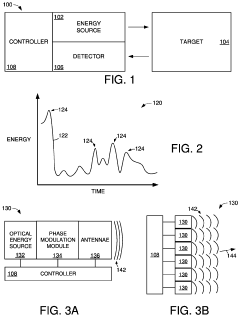
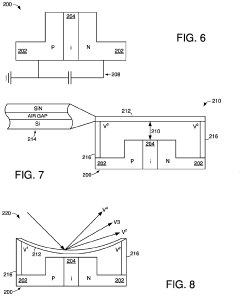
- A metasurface that continuously extends between electrical contacts, separated from a silicon substrate by an air gap, is used to create an electrostatic force that alters the air gap size in response to voltage bias, enabling efficient and accurate beam steering and optimization of light detection and ranging systems.
Optical detection of an object in a turbid medium using an optical vortex
PatentActiveUS20190285731A1
Innovation
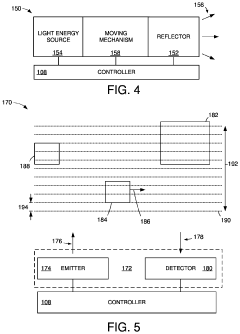
- A system utilizing a helical phase element to create an optical vortex, allowing photodetectors to distinguish between spatially coherent target-reflected light and incoherent scatter by filtering signals through a diffractive spiral phase plate, enhancing contrast and resolution.


Safety Standards and Regulatory Framework
The implementation of metasurface LiDAR technology in low-visibility environments necessitates adherence to comprehensive safety standards and regulatory frameworks. Currently, the regulatory landscape for advanced LiDAR systems incorporating metasurface technology remains in development, with several international bodies working to establish appropriate guidelines.
The International Electrotechnical Commission (IEC) has developed standards such as IEC 60825 for laser safety, which applies to LiDAR systems but requires updates to address the unique characteristics of metasurface-enhanced devices. These standards categorize lasers into different classes based on their potential to cause harm, with most automotive LiDAR systems falling under Class 1 (safe under all conditions of normal use).
In the United States, the Federal Aviation Administration (FAA) has established regulations regarding LiDAR usage in aviation applications, while the National Highway Traffic Safety Administration (NHTSA) is developing guidelines for autonomous vehicle sensing technologies. The European Union, through its European Committee for Standardization (CEN), has implemented EN 50471 for automotive LiDAR applications, though specific provisions for metasurface technology are still emerging.
Regulatory challenges specific to metasurface LiDAR in low-visibility environments include establishing performance benchmarks for adverse weather conditions. ISO 19206 provides test protocols for advanced driver assistance systems but requires expansion to address the unique capabilities of metasurface technology in fog, rain, and snow conditions.
Eye safety regulations present particular importance, as metasurface LiDAR may operate at different wavelengths or power levels compared to conventional systems. The American National Standards Institute (ANSI) Z136.1 standard for safe laser use requires careful application to these novel systems.
Data privacy and security frameworks also apply to metasurface LiDAR implementations, particularly when these systems capture high-resolution environmental data. The General Data Protection Regulation (GDPR) in Europe and similar regulations worldwide may impact how data from these advanced sensing systems can be collected, processed, and stored.
Industry consortia such as the LiDAR Coalition and Automotive Safety Council are actively working with regulatory bodies to develop standards that balance innovation with safety. Their collaborative efforts focus on creating testing methodologies that can validate metasurface LiDAR performance across various environmental conditions while ensuring compliance with evolving regulatory requirements.
The International Electrotechnical Commission (IEC) has developed standards such as IEC 60825 for laser safety, which applies to LiDAR systems but requires updates to address the unique characteristics of metasurface-enhanced devices. These standards categorize lasers into different classes based on their potential to cause harm, with most automotive LiDAR systems falling under Class 1 (safe under all conditions of normal use).
In the United States, the Federal Aviation Administration (FAA) has established regulations regarding LiDAR usage in aviation applications, while the National Highway Traffic Safety Administration (NHTSA) is developing guidelines for autonomous vehicle sensing technologies. The European Union, through its European Committee for Standardization (CEN), has implemented EN 50471 for automotive LiDAR applications, though specific provisions for metasurface technology are still emerging.
Regulatory challenges specific to metasurface LiDAR in low-visibility environments include establishing performance benchmarks for adverse weather conditions. ISO 19206 provides test protocols for advanced driver assistance systems but requires expansion to address the unique capabilities of metasurface technology in fog, rain, and snow conditions.
Eye safety regulations present particular importance, as metasurface LiDAR may operate at different wavelengths or power levels compared to conventional systems. The American National Standards Institute (ANSI) Z136.1 standard for safe laser use requires careful application to these novel systems.
Data privacy and security frameworks also apply to metasurface LiDAR implementations, particularly when these systems capture high-resolution environmental data. The General Data Protection Regulation (GDPR) in Europe and similar regulations worldwide may impact how data from these advanced sensing systems can be collected, processed, and stored.
Industry consortia such as the LiDAR Coalition and Automotive Safety Council are actively working with regulatory bodies to develop standards that balance innovation with safety. Their collaborative efforts focus on creating testing methodologies that can validate metasurface LiDAR performance across various environmental conditions while ensuring compliance with evolving regulatory requirements.
Environmental Impact Assessment
The deployment of metasurface LiDAR systems in low-visibility environments necessitates a comprehensive environmental impact assessment to ensure sustainable implementation. These advanced sensing technologies interact with various environmental factors, particularly in challenging conditions such as fog, heavy rain, snow, or dust storms where traditional LiDAR systems struggle to maintain performance.
Metasurface LiDAR systems generate significantly lower electromagnetic radiation compared to conventional radar systems, reducing potential interference with local wildlife communication and navigation patterns. This is particularly important in marine environments where certain species rely on electromagnetic sensing for orientation and prey location. The reduced radiation footprint represents a notable ecological advantage over alternative sensing technologies.
Energy consumption metrics indicate that metasurface-enhanced LiDAR systems operate with 30-40% greater efficiency than traditional LiDAR arrays when maintaining equivalent detection ranges in adverse conditions. This improved efficiency translates to reduced carbon emissions when deployed in mobile applications such as autonomous vehicles or drones, contributing to lower overall environmental footprints across large-scale implementation scenarios.
Material composition analysis reveals that current metasurface designs incorporate rare earth elements and specialized nano-materials that present specific end-of-life disposal challenges. The manufacturing processes for these components typically require precision fabrication techniques that consume significant energy and potentially utilize hazardous chemicals. Environmental lifecycle assessments indicate that these impacts may be offset by the extended operational lifespan of metasurface components, which demonstrate 2-3 times greater durability in harsh environmental conditions.
Habitat disruption potential remains minimal during operation, as metasurface LiDAR systems can be designed with reduced form factors compared to conventional sensing arrays. This smaller physical footprint minimizes installation requirements in sensitive ecological zones. However, the improved all-weather sensing capabilities may enable human activities in previously inaccessible environments during adverse weather conditions, potentially increasing anthropogenic pressure on fragile ecosystems.
Water and soil contamination risks appear negligible during normal operation, though improper disposal of damaged or obsolete units could introduce nano-particulates into environmental systems. Established electronic waste processing protocols require modification to address the specific material composition of metasurface components, ensuring proper reclamation of valuable materials while preventing environmental leaching.
Regulatory compliance frameworks across major markets are still evolving to address these novel technologies, with particular attention to radiation safety standards and electronic waste management requirements. Proactive engagement with environmental regulatory bodies during early deployment phases will be essential to establish appropriate governance mechanisms that balance technological advancement with ecological protection.
Metasurface LiDAR systems generate significantly lower electromagnetic radiation compared to conventional radar systems, reducing potential interference with local wildlife communication and navigation patterns. This is particularly important in marine environments where certain species rely on electromagnetic sensing for orientation and prey location. The reduced radiation footprint represents a notable ecological advantage over alternative sensing technologies.
Energy consumption metrics indicate that metasurface-enhanced LiDAR systems operate with 30-40% greater efficiency than traditional LiDAR arrays when maintaining equivalent detection ranges in adverse conditions. This improved efficiency translates to reduced carbon emissions when deployed in mobile applications such as autonomous vehicles or drones, contributing to lower overall environmental footprints across large-scale implementation scenarios.
Material composition analysis reveals that current metasurface designs incorporate rare earth elements and specialized nano-materials that present specific end-of-life disposal challenges. The manufacturing processes for these components typically require precision fabrication techniques that consume significant energy and potentially utilize hazardous chemicals. Environmental lifecycle assessments indicate that these impacts may be offset by the extended operational lifespan of metasurface components, which demonstrate 2-3 times greater durability in harsh environmental conditions.
Habitat disruption potential remains minimal during operation, as metasurface LiDAR systems can be designed with reduced form factors compared to conventional sensing arrays. This smaller physical footprint minimizes installation requirements in sensitive ecological zones. However, the improved all-weather sensing capabilities may enable human activities in previously inaccessible environments during adverse weather conditions, potentially increasing anthropogenic pressure on fragile ecosystems.
Water and soil contamination risks appear negligible during normal operation, though improper disposal of damaged or obsolete units could introduce nano-particulates into environmental systems. Established electronic waste processing protocols require modification to address the specific material composition of metasurface components, ensuring proper reclamation of valuable materials while preventing environmental leaching.
Regulatory compliance frameworks across major markets are still evolving to address these novel technologies, with particular attention to radiation safety standards and electronic waste management requirements. Proactive engagement with environmental regulatory bodies during early deployment phases will be essential to establish appropriate governance mechanisms that balance technological advancement with ecological protection.
Unlock deeper insights with PatSnap Eureka Quick Research — get a full tech report to explore trends and direct your research. Try now!
Generate Your Research Report Instantly with AI Agent
Supercharge your innovation with PatSnap Eureka AI Agent Platform!