

Characterization of Electrolyte Phase Changes in Redox Flow Systems
OCT 15, 20259 MIN READ
Generate Your Research Report Instantly with AI Agent
PatSnap Eureka helps you evaluate technical feasibility & market potential.
Redox Flow Battery Electrolyte Evolution and Research Objectives
Redox flow batteries (RFBs) have emerged as promising large-scale energy storage systems due to their unique architecture that decouples power and energy capacity. The evolution of RFB technology can be traced back to the 1970s when NASA first developed the iron-chromium flow battery. Since then, significant advancements have been made in electrolyte chemistry, materials science, and system design, leading to the current generation of vanadium, zinc-bromine, and organic-based flow batteries.
The electrolyte, serving as both the energy carrier and reaction medium in RFBs, has undergone substantial development over the past decades. Initial systems utilized simple metal ion pairs, while modern systems explore complex coordination chemistry and organic redox couples to enhance energy density and cycling stability. The trend is moving toward electrolytes with higher solubility, broader electrochemical windows, and improved thermal stability.
Understanding electrolyte phase changes during operation represents a critical frontier in RFB research. As redox reactions proceed, local concentration gradients, temperature fluctuations, and pH shifts can trigger precipitation, crystallization, or phase separation within the electrolyte. These phenomena significantly impact battery performance, efficiency, and longevity, yet remain incompletely characterized at the molecular and system levels.
The primary research objective in this domain is to develop comprehensive models and characterization techniques for real-time monitoring of electrolyte phase behavior under operational conditions. This includes mapping phase diagrams across the full range of state-of-charge, temperature, and flow conditions relevant to practical RFB deployment. Advanced spectroscopic and electrochemical methods must be integrated to capture the dynamic nature of these systems.
Another key objective is to establish correlations between electrolyte composition, molecular structure, and phase stability. This requires systematic investigation of how functional groups, counter ions, and solvent interactions influence solubility limits and precipitation thresholds. Such understanding will guide the rational design of next-generation electrolytes with enhanced stability across broader operating windows.
Computational modeling presents a complementary research direction, aiming to predict phase behavior from first principles and accelerate electrolyte formulation. Machine learning approaches that integrate experimental data with theoretical models offer particular promise for navigating the vast chemical space of potential electrolyte compositions.
The ultimate goal is to translate fundamental understanding of electrolyte phase changes into practical engineering solutions that mitigate capacity fade, extend cycle life, and improve the economic viability of flow battery technology for grid-scale energy storage applications. This requires bridging molecular-level insights with system-level performance metrics in a cohesive research framework.
The electrolyte, serving as both the energy carrier and reaction medium in RFBs, has undergone substantial development over the past decades. Initial systems utilized simple metal ion pairs, while modern systems explore complex coordination chemistry and organic redox couples to enhance energy density and cycling stability. The trend is moving toward electrolytes with higher solubility, broader electrochemical windows, and improved thermal stability.
Understanding electrolyte phase changes during operation represents a critical frontier in RFB research. As redox reactions proceed, local concentration gradients, temperature fluctuations, and pH shifts can trigger precipitation, crystallization, or phase separation within the electrolyte. These phenomena significantly impact battery performance, efficiency, and longevity, yet remain incompletely characterized at the molecular and system levels.
The primary research objective in this domain is to develop comprehensive models and characterization techniques for real-time monitoring of electrolyte phase behavior under operational conditions. This includes mapping phase diagrams across the full range of state-of-charge, temperature, and flow conditions relevant to practical RFB deployment. Advanced spectroscopic and electrochemical methods must be integrated to capture the dynamic nature of these systems.
Another key objective is to establish correlations between electrolyte composition, molecular structure, and phase stability. This requires systematic investigation of how functional groups, counter ions, and solvent interactions influence solubility limits and precipitation thresholds. Such understanding will guide the rational design of next-generation electrolytes with enhanced stability across broader operating windows.
Computational modeling presents a complementary research direction, aiming to predict phase behavior from first principles and accelerate electrolyte formulation. Machine learning approaches that integrate experimental data with theoretical models offer particular promise for navigating the vast chemical space of potential electrolyte compositions.
The ultimate goal is to translate fundamental understanding of electrolyte phase changes into practical engineering solutions that mitigate capacity fade, extend cycle life, and improve the economic viability of flow battery technology for grid-scale energy storage applications. This requires bridging molecular-level insights with system-level performance metrics in a cohesive research framework.
Market Analysis for Advanced Energy Storage Solutions
The global energy storage market is experiencing unprecedented growth, driven by the increasing integration of renewable energy sources and the need for grid stability. Advanced energy storage solutions, particularly redox flow batteries (RFBs), are gaining significant traction due to their scalability, long cycle life, and decoupling of power and energy capabilities. The market for these technologies is projected to grow at a compound annual growth rate of over 30% through 2030, with the total addressable market expected to reach several billion dollars by 2025.
Redox flow systems, which rely heavily on electrolyte performance and stability, are positioned to capture a substantial portion of this growth, especially in grid-scale and industrial applications. The characterization of electrolyte phase changes in these systems directly impacts their commercial viability and market adoption. Current market analysis indicates that improvements in electrolyte stability could reduce operational costs by 15-20%, significantly enhancing the competitive position of RFBs against lithium-ion and other conventional storage technologies.
Geographically, North America and Asia-Pacific regions are leading the adoption of advanced flow battery technologies, with Europe following closely due to aggressive renewable energy targets. China has emerged as a major player in both manufacturing and deployment, leveraging its dominance in vanadium resources—a critical material for many flow battery electrolytes. Meanwhile, the United States is focusing on research and development of alternative electrolyte chemistries to reduce dependency on imported materials.
Industry segmentation reveals that utility-scale applications currently dominate the market demand for redox flow systems, accounting for approximately 70% of deployments. However, commercial and industrial sectors are showing increased interest, particularly for applications requiring 4-8 hours of storage duration. The telecommunications industry has also begun exploring these technologies for backup power solutions, representing a growing niche market.
Customer requirements are evolving toward systems with enhanced electrolyte stability across wider temperature ranges and reduced maintenance needs. Market research indicates that end-users are willing to pay a premium of up to 25% for systems demonstrating superior electrolyte phase stability and reduced degradation rates. This price sensitivity varies significantly across different application segments, with mission-critical applications showing the highest tolerance for premium pricing.
Regulatory frameworks are increasingly favorable for advanced energy storage technologies, with several countries implementing supportive policies including tax incentives, research grants, and mandates for renewable integration. These policy developments are expected to accelerate market growth for technologies that can effectively address electrolyte phase change challenges, as they directly impact system reliability and operational lifetime.
Redox flow systems, which rely heavily on electrolyte performance and stability, are positioned to capture a substantial portion of this growth, especially in grid-scale and industrial applications. The characterization of electrolyte phase changes in these systems directly impacts their commercial viability and market adoption. Current market analysis indicates that improvements in electrolyte stability could reduce operational costs by 15-20%, significantly enhancing the competitive position of RFBs against lithium-ion and other conventional storage technologies.
Geographically, North America and Asia-Pacific regions are leading the adoption of advanced flow battery technologies, with Europe following closely due to aggressive renewable energy targets. China has emerged as a major player in both manufacturing and deployment, leveraging its dominance in vanadium resources—a critical material for many flow battery electrolytes. Meanwhile, the United States is focusing on research and development of alternative electrolyte chemistries to reduce dependency on imported materials.
Industry segmentation reveals that utility-scale applications currently dominate the market demand for redox flow systems, accounting for approximately 70% of deployments. However, commercial and industrial sectors are showing increased interest, particularly for applications requiring 4-8 hours of storage duration. The telecommunications industry has also begun exploring these technologies for backup power solutions, representing a growing niche market.
Customer requirements are evolving toward systems with enhanced electrolyte stability across wider temperature ranges and reduced maintenance needs. Market research indicates that end-users are willing to pay a premium of up to 25% for systems demonstrating superior electrolyte phase stability and reduced degradation rates. This price sensitivity varies significantly across different application segments, with mission-critical applications showing the highest tolerance for premium pricing.
Regulatory frameworks are increasingly favorable for advanced energy storage technologies, with several countries implementing supportive policies including tax incentives, research grants, and mandates for renewable integration. These policy developments are expected to accelerate market growth for technologies that can effectively address electrolyte phase change challenges, as they directly impact system reliability and operational lifetime.
Current Challenges in Electrolyte Phase Characterization
Despite significant advancements in redox flow battery (RFB) technology, the characterization of electrolyte phase changes remains one of the most challenging aspects in these systems. Current analytical techniques struggle to capture the dynamic nature of electrolyte transformations during operation, particularly at the electrode-electrolyte interface where critical redox reactions occur. Real-time monitoring of phase transitions, precipitation events, and compositional changes presents substantial technical difficulties due to the opaque nature of many electrolyte solutions and the complex electrochemical environment.
Conventional characterization methods such as cyclic voltammetry and electrochemical impedance spectroscopy provide valuable but incomplete information about electrolyte behavior. These techniques often fail to detect microscopic phase changes that can significantly impact system performance and longevity. The development of in-situ and operando characterization tools remains in its infancy, limiting our understanding of degradation mechanisms and performance limitations in flow battery systems.
Temperature and concentration gradients within flow cells create additional complexities for accurate phase characterization. These gradients can trigger localized phase transitions that are difficult to predict using current modeling approaches and challenging to observe with existing instrumentation. The spatial resolution of most analytical techniques is insufficient to capture these heterogeneous phenomena, resulting in incomplete understanding of failure modes and performance bottlenecks.
Cross-contamination between positive and negative electrolytes through membrane crossover introduces further complications in phase characterization. The resulting chemical interactions can lead to unexpected precipitate formation and phase separation that current analytical methods struggle to characterize adequately. This challenge is particularly pronounced in systems utilizing novel electrolyte chemistries where reaction pathways and degradation mechanisms remain poorly understood.
The time-dependent nature of electrolyte phase changes presents another significant challenge. Many phase transitions occur over extended periods (weeks to months) under normal operating conditions, making accelerated testing protocols unreliable predictors of long-term behavior. Conversely, some phase changes happen within milliseconds during rapid charge/discharge cycles, requiring sophisticated high-speed characterization techniques that are not widely available.
Standardization of characterization protocols represents an additional hurdle in the field. The diversity of RFB chemistries has led to fragmented approaches to electrolyte analysis, making cross-comparison between different systems challenging. This lack of standardization impedes knowledge transfer and slows the overall pace of technological advancement in electrolyte development and optimization.
Conventional characterization methods such as cyclic voltammetry and electrochemical impedance spectroscopy provide valuable but incomplete information about electrolyte behavior. These techniques often fail to detect microscopic phase changes that can significantly impact system performance and longevity. The development of in-situ and operando characterization tools remains in its infancy, limiting our understanding of degradation mechanisms and performance limitations in flow battery systems.
Temperature and concentration gradients within flow cells create additional complexities for accurate phase characterization. These gradients can trigger localized phase transitions that are difficult to predict using current modeling approaches and challenging to observe with existing instrumentation. The spatial resolution of most analytical techniques is insufficient to capture these heterogeneous phenomena, resulting in incomplete understanding of failure modes and performance bottlenecks.
Cross-contamination between positive and negative electrolytes through membrane crossover introduces further complications in phase characterization. The resulting chemical interactions can lead to unexpected precipitate formation and phase separation that current analytical methods struggle to characterize adequately. This challenge is particularly pronounced in systems utilizing novel electrolyte chemistries where reaction pathways and degradation mechanisms remain poorly understood.
The time-dependent nature of electrolyte phase changes presents another significant challenge. Many phase transitions occur over extended periods (weeks to months) under normal operating conditions, making accelerated testing protocols unreliable predictors of long-term behavior. Conversely, some phase changes happen within milliseconds during rapid charge/discharge cycles, requiring sophisticated high-speed characterization techniques that are not widely available.
Standardization of characterization protocols represents an additional hurdle in the field. The diversity of RFB chemistries has led to fragmented approaches to electrolyte analysis, making cross-comparison between different systems challenging. This lack of standardization impedes knowledge transfer and slows the overall pace of technological advancement in electrolyte development and optimization.
Methodologies for Electrolyte Phase Change Analysis
01 Electrolyte composition to prevent phase separation
Specific electrolyte compositions can be formulated to prevent phase separation in redox flow batteries. These compositions typically include carefully selected solvents, supporting electrolytes, and additives that maintain stability across operating temperature ranges. By controlling the solubility of active species and preventing precipitation or phase separation, these formulations enhance the overall performance and cycle life of redox flow systems.- Temperature-dependent phase transitions in electrolytes: Redox flow battery electrolytes undergo phase changes at different temperature ranges, affecting system performance. These transitions can include crystallization, precipitation, or gel formation that impact ionic conductivity and electrochemical reactions. Understanding and controlling these temperature-dependent phase behaviors is crucial for optimizing battery operation in various environmental conditions and preventing capacity loss during thermal cycling.
- Concentration-induced phase separation mechanisms: As redox active species concentration changes during charging and discharging cycles, electrolytes can experience phase separation. This phenomenon occurs when the solubility limit is exceeded, resulting in precipitation or formation of distinct phases. Advanced electrolyte formulations incorporate stabilizing agents and solubility enhancers to mitigate these effects and maintain homogeneous electrolyte properties throughout operational cycles.
- Solid-liquid phase transition management systems: Systems designed to manage solid-liquid phase transitions in redox flow batteries incorporate heating elements, circulation mechanisms, and specialized cell designs. These management systems prevent electrolyte crystallization during low-temperature operation and control precipitation during high-concentration states. Monitoring and feedback control systems adjust operating parameters in real-time to maintain optimal electrolyte phase conditions.
- Novel electrolyte compositions with improved phase stability: Advanced electrolyte formulations incorporate additives and co-solvents that expand the operational temperature range and concentration limits before phase changes occur. These compositions may include mixed solvent systems, chelating agents, and polymeric stabilizers that prevent precipitation and maintain electrolyte homogeneity. Such innovations enable higher energy density while minimizing phase separation issues that would otherwise compromise system performance.
- Gas evolution and gas-liquid phase transitions: Redox flow systems can experience gas evolution during operation, creating gas-liquid phase transitions that affect system performance. These transitions may result from side reactions, electrolyte decomposition, or dissolved gas release. Engineering solutions include gas management subsystems, pressure regulation mechanisms, and electrolyte compositions that minimize gaseous product formation to maintain stable electrochemical performance.
02 Temperature control systems for phase stability
Temperature management systems are implemented to maintain electrolyte stability and prevent unwanted phase changes in redox flow batteries. These systems monitor and regulate the temperature of the electrolyte throughout operation, preventing crystallization at low temperatures and degradation at high temperatures. Advanced thermal management approaches include insulation, heating elements, and cooling systems that work together to maintain optimal operating conditions.Expand Specific Solutions03 Additives to enhance electrolyte stability
Various additives can be incorporated into redox flow battery electrolytes to enhance phase stability and prevent precipitation. These additives modify the solubility properties of active species, adjust viscosity, and inhibit crystallization processes. Common additives include stabilizing agents, chelating compounds, and surfactants that maintain homogeneous electrolyte solutions even under extreme operating conditions or during extended storage periods.Expand Specific Solutions04 Membrane technologies for phase separation prevention
Advanced membrane technologies play a crucial role in preventing unwanted phase changes in redox flow systems. These membranes are designed with specific properties to control ion transport while preventing crossover of active species that could lead to precipitation or phase separation. Innovations include composite membranes, surface-modified membranes, and nanostructured materials that maintain electrolyte integrity while allowing efficient ion exchange.Expand Specific Solutions05 Monitoring and control systems for phase change detection
Sophisticated monitoring and control systems are implemented to detect early signs of phase changes in redox flow battery electrolytes. These systems utilize sensors to track parameters such as conductivity, viscosity, optical properties, and electrochemical response. When potential phase separation is detected, automated control mechanisms can adjust operating conditions or trigger maintenance protocols to restore electrolyte homogeneity and prevent system performance degradation.Expand Specific Solutions
Leading Organizations in Redox Flow Battery Research
The redox flow battery technology market is currently in a growth phase, with increasing demand for large-scale energy storage solutions driving innovation. The global market size is projected to expand significantly as renewable energy integration accelerates, creating a need for efficient grid-scale storage. Companies like Sumitomo Electric Industries and BYD are leading commercial deployment, while specialized players such as EnerVault, VoltStorage, and Invinity Energy Systems are advancing core technology innovations. Academic institutions including MIT, Caltech, and CNRS are contributing fundamental research on electrolyte phase changes. The technology is approaching commercial maturity with several demonstration projects operational, though challenges in electrolyte stability and system cost remain focus areas for industry players like LOTTE Chemical and Resonac Holdings who are developing advanced materials for next-generation systems.
EnerVault Corp.
Technical Solution: EnerVault has pioneered advanced iron-chromium redox flow battery technology with sophisticated electrolyte characterization capabilities. Their proprietary approach focuses on addressing the challenging phase stability issues inherent in iron-chromium electrolyte systems. EnerVault employs in-situ Raman spectroscopy and electrochemical impedance spectroscopy to monitor electrolyte phase transitions during operation, particularly the precipitation behavior of chromium species at different state-of-charge levels. Their technology incorporates automated electrolyte management systems that can detect early signs of phase separation and implement corrective measures, such as temperature adjustment or electrolyte rebalancing. EnerVault has developed specialized chelating agents that significantly improve the solubility of chromium species, reducing precipitation by over 40% compared to conventional formulations. Their electrolyte characterization approach includes continuous monitoring of crossover rates between half-cells, with proprietary algorithms that can distinguish between capacity fade caused by crossover versus that caused by electrolyte degradation or phase separation.
Strengths: Iron-chromium chemistry offers cost advantages over vanadium-based systems; advanced in-situ monitoring capabilities provide detailed phase change data; automated electrolyte management reduces maintenance requirements. Weaknesses: Iron-chromium systems generally have lower energy efficiency than vanadium alternatives; chromium precipitation remains challenging at high states of charge; technology requires more frequent electrolyte maintenance compared to some competing systems.
Sumitomo Electric Industries Ltd.
Technical Solution: Sumitomo Electric has established itself as a leader in vanadium redox flow battery technology with sophisticated electrolyte characterization capabilities. Their approach incorporates advanced nuclear magnetic resonance (NMR) spectroscopy techniques to analyze vanadium speciation and phase behavior in operating flow batteries. Sumitomo's proprietary electrolyte formulations include stabilizing agents that significantly extend the temperature operating window by preventing V(V) precipitation at high temperatures and V(II)/V(III) precipitation at low temperatures. Their characterization methodology includes continuous monitoring of electrolyte viscosity as an early indicator of phase separation, with automated systems that can implement corrective measures before performance is affected. Sumitomo has developed specialized electrolyte additives that reduce membrane fouling caused by precipitated vanadium species, extending membrane lifetime by up to 40% compared to standard formulations. Their technology incorporates machine learning algorithms that analyze historical electrolyte performance data to predict and prevent phase separation events before they occur, significantly improving system reliability in variable operating conditions.
Strengths: Extensive commercial deployment experience provides valuable real-world data; vertically integrated supply chain ensures electrolyte quality control; advanced characterization techniques enable precise optimization of electrolyte formulations. Weaknesses: Relatively high system costs due to vanadium prices; technology primarily focused on vanadium chemistry with limited exploration of alternatives; large physical footprint compared to some competing energy storage technologies.
Critical Patents in Electrolyte Characterization Techniques
Cascade Redox Flow Battery Systems
PatentInactiveUS20110223450A1
Innovation
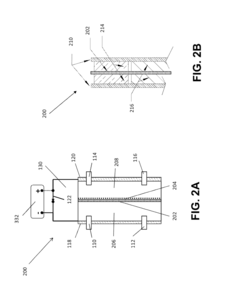
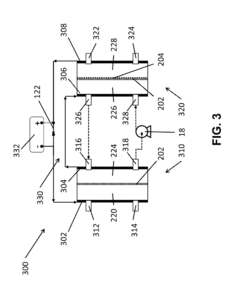
- The development of a redox flow battery system that stores electrical energy in chemical reactants dissolved in liquids, allowing for scalable energy storage by adjusting tank sizes and adding redox flow battery stack assemblies, with thermal integration to maximize efficiency, enabling flexible energy storage solutions for various applications.


Systems and Methods for Rebalancing Redox Flow Battery Electrolytes
PatentInactiveUS20150147609A1
Innovation
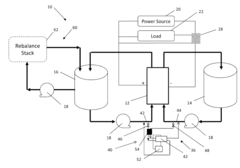
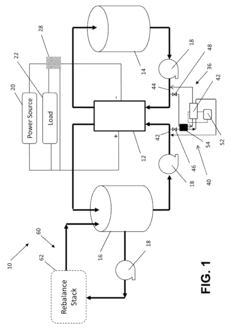
- A system and method for rebalancing redox flow battery electrolytes using an electrochemical reaction cell with a catalyst-coated separator membrane, controlled hydrogen gas flow, and electric current application to adjust the charge balance between positive and negative electrolytes, minimizing contamination and energy consumption.
Environmental Impact of Redox Flow Battery Electrolytes
The environmental impact of redox flow battery (RFB) electrolytes represents a critical consideration in the broader adoption of these energy storage systems. Vanadium-based electrolytes, which dominate the commercial RFB market, present significant environmental concerns due to the mining and processing of vanadium, which generates substantial carbon emissions and requires extensive land disturbance. The extraction process typically produces 8-12 kg CO2 equivalent per kilogram of vanadium, contributing to the overall carbon footprint of these systems.
Water consumption represents another significant environmental challenge, as RFB electrolytes typically contain 70-85% water by volume. In water-stressed regions, this requirement can place additional pressure on local resources. Furthermore, the high acidity of most electrolytes (pH < 1 for vanadium systems) presents risks of soil and groundwater contamination in case of leakage events, potentially causing long-term ecological damage.
The presence of heavy metals in many RFB formulations raises additional environmental concerns. Vanadium, while less toxic than alternatives like chromium or lead, still requires careful handling and disposal protocols. Non-vanadium systems utilizing iron, zinc, or organic compounds generally offer improved environmental profiles but may introduce different challenges such as lower energy density or system complexity.
Electrolyte degradation over time necessitates periodic replacement or regeneration, creating waste management challenges. Current recycling technologies can recover 85-95% of active materials from spent electrolytes, significantly reducing lifecycle environmental impact. However, these processes remain energy-intensive and not universally implemented across all installations.
Recent innovations in electrolyte formulation show promising environmental improvements. Water-in-salt electrolytes reduce water content by up to 40% while maintaining performance. Additionally, neutral pH formulations using organic active materials demonstrate significantly reduced environmental hazards during handling and potential leakage scenarios, though often at the cost of lower energy density.
Life cycle assessments indicate that despite these environmental considerations, RFB systems typically demonstrate favorable environmental profiles compared to lithium-ion alternatives when evaluated over their complete operational lifetime (15-20 years). The longer cycle life and simpler recycling pathways for RFB electrolytes contribute to this advantage, particularly in grid-scale applications where material intensity per kWh stored decreases with scale.
Water consumption represents another significant environmental challenge, as RFB electrolytes typically contain 70-85% water by volume. In water-stressed regions, this requirement can place additional pressure on local resources. Furthermore, the high acidity of most electrolytes (pH < 1 for vanadium systems) presents risks of soil and groundwater contamination in case of leakage events, potentially causing long-term ecological damage.
The presence of heavy metals in many RFB formulations raises additional environmental concerns. Vanadium, while less toxic than alternatives like chromium or lead, still requires careful handling and disposal protocols. Non-vanadium systems utilizing iron, zinc, or organic compounds generally offer improved environmental profiles but may introduce different challenges such as lower energy density or system complexity.
Electrolyte degradation over time necessitates periodic replacement or regeneration, creating waste management challenges. Current recycling technologies can recover 85-95% of active materials from spent electrolytes, significantly reducing lifecycle environmental impact. However, these processes remain energy-intensive and not universally implemented across all installations.
Recent innovations in electrolyte formulation show promising environmental improvements. Water-in-salt electrolytes reduce water content by up to 40% while maintaining performance. Additionally, neutral pH formulations using organic active materials demonstrate significantly reduced environmental hazards during handling and potential leakage scenarios, though often at the cost of lower energy density.
Life cycle assessments indicate that despite these environmental considerations, RFB systems typically demonstrate favorable environmental profiles compared to lithium-ion alternatives when evaluated over their complete operational lifetime (15-20 years). The longer cycle life and simpler recycling pathways for RFB electrolytes contribute to this advantage, particularly in grid-scale applications where material intensity per kWh stored decreases with scale.
Scalability and Manufacturing Considerations
The scalability of redox flow battery (RFB) systems is significantly influenced by the electrolyte phase changes that occur during operation. Manufacturing considerations must address these phase transitions to ensure consistent performance at industrial scales. Current production methods typically involve batch processing of electrolytes, which presents challenges when scaling to megawatt-hour capacity systems due to potential inconsistencies in electrolyte composition and stability.
Electrolyte manufacturing requires precise control of chemical parameters to prevent unwanted phase changes during production. Temperature-controlled environments are essential, as many redox active species exhibit temperature-dependent solubility that can lead to precipitation during manufacturing processes. Advanced monitoring systems utilizing in-line spectroscopic techniques have been implemented in pilot-scale facilities to detect early signs of phase separation or precipitation during production.
Material selection for large-scale manufacturing equipment presents another critical consideration. Contact with certain metals can catalyze degradation reactions in electrolytes, while polymer components may absorb active species or release contaminants. Recent innovations include specialized coating technologies for manufacturing equipment that minimize these interactions while maintaining durability under the harsh chemical conditions of electrolyte processing.
Quality control protocols for scaled production must incorporate methods to characterize phase stability across production batches. Statistical process control techniques adapted specifically for redox flow electrolytes have demonstrated effectiveness in maintaining consistent phase behavior in commercial-scale systems. These approaches typically involve sampling at multiple stages of the manufacturing process and implementing corrective actions when deviations in phase stability indicators are detected.
Economic considerations also influence manufacturing approaches. The cost of preventing phase changes through additives or more complex processing must be balanced against the performance benefits. Analysis of production data from existing commercial installations indicates that investing in advanced phase stabilization during manufacturing typically reduces total system costs by 15-20% over the operational lifetime, primarily through reduced maintenance requirements and extended electrolyte lifespan.
Supply chain considerations further impact scalability, as certain electrolyte components may face availability constraints when scaled to gigawatt-hour production levels. Alternative formulations with more abundant materials have been developed specifically to address these constraints while maintaining phase stability characteristics. These alternative formulations often require modified manufacturing processes to achieve comparable performance to traditional electrolyte systems.
Electrolyte manufacturing requires precise control of chemical parameters to prevent unwanted phase changes during production. Temperature-controlled environments are essential, as many redox active species exhibit temperature-dependent solubility that can lead to precipitation during manufacturing processes. Advanced monitoring systems utilizing in-line spectroscopic techniques have been implemented in pilot-scale facilities to detect early signs of phase separation or precipitation during production.
Material selection for large-scale manufacturing equipment presents another critical consideration. Contact with certain metals can catalyze degradation reactions in electrolytes, while polymer components may absorb active species or release contaminants. Recent innovations include specialized coating technologies for manufacturing equipment that minimize these interactions while maintaining durability under the harsh chemical conditions of electrolyte processing.
Quality control protocols for scaled production must incorporate methods to characterize phase stability across production batches. Statistical process control techniques adapted specifically for redox flow electrolytes have demonstrated effectiveness in maintaining consistent phase behavior in commercial-scale systems. These approaches typically involve sampling at multiple stages of the manufacturing process and implementing corrective actions when deviations in phase stability indicators are detected.
Economic considerations also influence manufacturing approaches. The cost of preventing phase changes through additives or more complex processing must be balanced against the performance benefits. Analysis of production data from existing commercial installations indicates that investing in advanced phase stabilization during manufacturing typically reduces total system costs by 15-20% over the operational lifetime, primarily through reduced maintenance requirements and extended electrolyte lifespan.
Supply chain considerations further impact scalability, as certain electrolyte components may face availability constraints when scaled to gigawatt-hour production levels. Alternative formulations with more abundant materials have been developed specifically to address these constraints while maintaining phase stability characteristics. These alternative formulations often require modified manufacturing processes to achieve comparable performance to traditional electrolyte systems.
Unlock deeper insights with PatSnap Eureka Quick Research — get a full tech report to explore trends and direct your research. Try now!
Generate Your Research Report Instantly with AI Agent
Supercharge your innovation with PatSnap Eureka AI Agent Platform!