
Comparing CRT vs OLED Display Durability
MAR 2, 20269 MIN READ
Generate Your Research Report Instantly with AI Agent
Patsnap Eureka helps you evaluate technical feasibility & market potential.
CRT vs OLED Display Technology Background and Durability Goals
Display technology has undergone remarkable evolution since the mid-20th century, with Cathode Ray Tube (CRT) and Organic Light-Emitting Diode (OLED) technologies representing two distinct eras of innovation. CRT technology dominated the display landscape for over five decades, from the 1940s through the early 2000s, establishing itself as the cornerstone of television broadcasting, computer monitors, and professional display applications. This technology relied on electron beam manipulation to excite phosphor coatings, creating visible light through controlled bombardment of the screen surface.
The emergence of OLED technology in the late 1980s, with commercial viability achieved in the 2000s, marked a paradigmatic shift toward solid-state display solutions. Unlike CRT's vacuum tube architecture, OLED displays utilize organic compounds that emit light when electrical current is applied, eliminating the need for backlighting systems and enabling unprecedented form factor flexibility.
The technological evolution trajectory reveals distinct phases of development priorities. Early CRT advancement focused on phosphor chemistry optimization, electron gun precision enhancement, and convergence accuracy improvements. Manufacturing processes matured to achieve consistent quality across large-scale production, with durability becoming a natural byproduct of robust mechanical construction and proven material science.
OLED development has progressed through multiple generations, addressing initial limitations in blue emitter longevity, moisture sensitivity, and manufacturing yield rates. Contemporary OLED research emphasizes material engineering for extended operational lifespans, encapsulation technologies for environmental protection, and compensation algorithms for uniform aging characteristics.
Durability objectives for both technologies reflect their respective operational contexts and market expectations. CRT durability goals traditionally centered on achieving 20,000 to 50,000 hours of operational life with minimal performance degradation, focusing on phosphor burn-in resistance, electron gun stability, and high-voltage component reliability. The technology's inherent robustness stemmed from its mature manufacturing processes and well-understood failure mechanisms.
Modern OLED durability targets aim for comparable or superior longevity while addressing unique challenges inherent to organic materials. Primary objectives include achieving uniform pixel degradation across the display surface, maintaining color accuracy throughout the operational lifespan, and preventing catastrophic failure modes such as dark spot formation or delamination. Advanced OLED implementations target 100,000-hour operational lifespans under controlled conditions, with sophisticated pixel-level compensation systems to maintain visual consistency.
The convergence of these durability goals reflects evolving consumer expectations and application requirements, where display longevity directly impacts total cost of ownership and user satisfaction across diverse deployment scenarios.
The emergence of OLED technology in the late 1980s, with commercial viability achieved in the 2000s, marked a paradigmatic shift toward solid-state display solutions. Unlike CRT's vacuum tube architecture, OLED displays utilize organic compounds that emit light when electrical current is applied, eliminating the need for backlighting systems and enabling unprecedented form factor flexibility.
The technological evolution trajectory reveals distinct phases of development priorities. Early CRT advancement focused on phosphor chemistry optimization, electron gun precision enhancement, and convergence accuracy improvements. Manufacturing processes matured to achieve consistent quality across large-scale production, with durability becoming a natural byproduct of robust mechanical construction and proven material science.
OLED development has progressed through multiple generations, addressing initial limitations in blue emitter longevity, moisture sensitivity, and manufacturing yield rates. Contemporary OLED research emphasizes material engineering for extended operational lifespans, encapsulation technologies for environmental protection, and compensation algorithms for uniform aging characteristics.
Durability objectives for both technologies reflect their respective operational contexts and market expectations. CRT durability goals traditionally centered on achieving 20,000 to 50,000 hours of operational life with minimal performance degradation, focusing on phosphor burn-in resistance, electron gun stability, and high-voltage component reliability. The technology's inherent robustness stemmed from its mature manufacturing processes and well-understood failure mechanisms.
Modern OLED durability targets aim for comparable or superior longevity while addressing unique challenges inherent to organic materials. Primary objectives include achieving uniform pixel degradation across the display surface, maintaining color accuracy throughout the operational lifespan, and preventing catastrophic failure modes such as dark spot formation or delamination. Advanced OLED implementations target 100,000-hour operational lifespans under controlled conditions, with sophisticated pixel-level compensation systems to maintain visual consistency.
The convergence of these durability goals reflects evolving consumer expectations and application requirements, where display longevity directly impacts total cost of ownership and user satisfaction across diverse deployment scenarios.
Market Demand Analysis for Durable Display Technologies
The global display market is experiencing unprecedented demand for durable display technologies, driven by evolving consumer expectations and diverse application requirements. Traditional CRT displays, despite their declining market presence, continue to serve specialized industrial and professional applications where durability remains paramount. These legacy systems maintain relevance in environments requiring resistance to electromagnetic interference and extreme operating conditions.
OLED technology has emerged as a transformative force in the display industry, capturing significant market share across consumer electronics, automotive displays, and emerging applications. The technology's superior color reproduction, energy efficiency, and form factor flexibility have created substantial demand across multiple sectors. However, durability concerns, particularly regarding organic material degradation and burn-in susceptibility, continue to influence purchasing decisions in mission-critical applications.
Consumer electronics represent the largest market segment driving demand for durable display solutions. Smartphones, tablets, and television manufacturers increasingly prioritize display longevity as a key differentiator, responding to consumer demands for devices with extended operational lifespans. The automotive industry has become a critical growth driver, requiring displays that withstand temperature extremes, vibration, and prolonged exposure to varying environmental conditions.
Industrial and commercial applications present distinct durability requirements that influence technology selection. Medical equipment, aerospace systems, and manufacturing control interfaces demand displays capable of continuous operation over extended periods without performance degradation. These sectors often prioritize proven reliability over cutting-edge features, creating sustained demand for established technologies alongside selective adoption of newer solutions.
The healthcare sector represents an emerging high-value market segment where display durability directly impacts patient safety and operational efficiency. Medical imaging systems, patient monitoring equipment, and surgical displays require exceptional reliability and consistent performance over multi-year operational cycles. This sector's stringent regulatory requirements and risk-averse procurement practices create unique market dynamics favoring thoroughly validated display technologies.
Gaming and entertainment applications have generated substantial demand for displays balancing durability with performance characteristics. Professional gaming, digital signage, and broadcast applications require displays capable of sustained high-performance operation while maintaining color accuracy and brightness consistency over extended periods.
OLED technology has emerged as a transformative force in the display industry, capturing significant market share across consumer electronics, automotive displays, and emerging applications. The technology's superior color reproduction, energy efficiency, and form factor flexibility have created substantial demand across multiple sectors. However, durability concerns, particularly regarding organic material degradation and burn-in susceptibility, continue to influence purchasing decisions in mission-critical applications.
Consumer electronics represent the largest market segment driving demand for durable display solutions. Smartphones, tablets, and television manufacturers increasingly prioritize display longevity as a key differentiator, responding to consumer demands for devices with extended operational lifespans. The automotive industry has become a critical growth driver, requiring displays that withstand temperature extremes, vibration, and prolonged exposure to varying environmental conditions.
Industrial and commercial applications present distinct durability requirements that influence technology selection. Medical equipment, aerospace systems, and manufacturing control interfaces demand displays capable of continuous operation over extended periods without performance degradation. These sectors often prioritize proven reliability over cutting-edge features, creating sustained demand for established technologies alongside selective adoption of newer solutions.
The healthcare sector represents an emerging high-value market segment where display durability directly impacts patient safety and operational efficiency. Medical imaging systems, patient monitoring equipment, and surgical displays require exceptional reliability and consistent performance over multi-year operational cycles. This sector's stringent regulatory requirements and risk-averse procurement practices create unique market dynamics favoring thoroughly validated display technologies.
Gaming and entertainment applications have generated substantial demand for displays balancing durability with performance characteristics. Professional gaming, digital signage, and broadcast applications require displays capable of sustained high-performance operation while maintaining color accuracy and brightness consistency over extended periods.
Current Durability Status and Challenges of CRT vs OLED
CRT displays demonstrate exceptional longevity with operational lifespans typically ranging from 15 to 30 years under normal usage conditions. The phosphor coating degradation occurs gradually, with brightness reduction of approximately 50% after 20,000 to 30,000 hours of operation. However, CRT technology faces significant challenges including susceptibility to magnetic interference, screen burn-in from static images, and geometric distortion over time. The bulky cathode ray tube structure also presents mechanical vulnerability to impact damage.
OLED displays currently exhibit more limited durability compared to CRT technology, with typical lifespans of 8 to 15 years depending on usage patterns and environmental conditions. The organic compounds in OLED panels are particularly vulnerable to moisture and oxygen exposure, leading to accelerated degradation. Blue OLED subpixels demonstrate the shortest lifespan, typically degrading 2-3 times faster than red and green subpixels, resulting in color shift and reduced overall display quality over time.
Burn-in remains a critical challenge for both technologies, though manifesting differently. CRT displays experience permanent phosphor damage from prolonged static image display, while OLED panels suffer from uneven pixel degradation creating persistent ghost images. OLED burn-in occurs more rapidly, often becoming noticeable within 1,000 to 5,000 hours of displaying static content, compared to CRT displays which may require 10,000+ hours for similar effects.
Temperature sensitivity presents another significant durability concern, particularly for OLED technology. Operating temperatures above 40°C can accelerate organic material degradation by up to 50%, while CRT displays maintain relatively stable performance across broader temperature ranges. Manufacturing defects in OLED panels, including dead pixels and uneven luminance, tend to manifest earlier in the product lifecycle compared to CRT displays.
Power cycling stress affects both technologies differently. CRT displays experience thermal stress during warm-up periods, potentially leading to component failure in high-voltage circuits. OLED displays face degradation from repeated current fluctuations during power transitions, though modern power management systems have significantly mitigated these issues. Current industry efforts focus on developing more stable organic compounds and improved encapsulation techniques to enhance OLED durability while maintaining the inherent advantages over legacy CRT technology.
OLED displays currently exhibit more limited durability compared to CRT technology, with typical lifespans of 8 to 15 years depending on usage patterns and environmental conditions. The organic compounds in OLED panels are particularly vulnerable to moisture and oxygen exposure, leading to accelerated degradation. Blue OLED subpixels demonstrate the shortest lifespan, typically degrading 2-3 times faster than red and green subpixels, resulting in color shift and reduced overall display quality over time.
Burn-in remains a critical challenge for both technologies, though manifesting differently. CRT displays experience permanent phosphor damage from prolonged static image display, while OLED panels suffer from uneven pixel degradation creating persistent ghost images. OLED burn-in occurs more rapidly, often becoming noticeable within 1,000 to 5,000 hours of displaying static content, compared to CRT displays which may require 10,000+ hours for similar effects.
Temperature sensitivity presents another significant durability concern, particularly for OLED technology. Operating temperatures above 40°C can accelerate organic material degradation by up to 50%, while CRT displays maintain relatively stable performance across broader temperature ranges. Manufacturing defects in OLED panels, including dead pixels and uneven luminance, tend to manifest earlier in the product lifecycle compared to CRT displays.
Power cycling stress affects both technologies differently. CRT displays experience thermal stress during warm-up periods, potentially leading to component failure in high-voltage circuits. OLED displays face degradation from repeated current fluctuations during power transitions, though modern power management systems have significantly mitigated these issues. Current industry efforts focus on developing more stable organic compounds and improved encapsulation techniques to enhance OLED durability while maintaining the inherent advantages over legacy CRT technology.
Current Durability Enhancement Solutions for Displays
01 OLED encapsulation and moisture barrier technologies
Advanced encapsulation techniques are critical for improving OLED display durability by preventing moisture and oxygen ingress, which are primary causes of OLED degradation. Multi-layer barrier films, thin-film encapsulation, and getter materials are employed to extend the operational lifetime of OLED displays. These protective structures significantly enhance resistance to environmental factors that would otherwise compromise display performance and longevity.- OLED encapsulation and moisture barrier technologies: Advanced encapsulation techniques are critical for improving OLED display durability by preventing moisture and oxygen ingress, which are primary causes of OLED degradation. Multi-layer barrier films, thin-film encapsulation, and getter materials are employed to extend the operational lifetime of OLED displays. These protective layers help maintain display performance and prevent dark spot formation and luminance decay over extended periods.
- OLED organic material stability and degradation resistance: The intrinsic stability of organic light-emitting materials directly impacts OLED display longevity. Research focuses on developing more stable host materials, dopants, and charge transport layers that resist photochemical and thermal degradation. Material engineering approaches include molecular design for enhanced stability, use of thermally activated delayed fluorescence materials, and optimization of layer structures to reduce degradation mechanisms and extend display lifespan.
- Display driving and compensation circuits for lifetime extension: Advanced driving schemes and compensation circuits are implemented to mitigate OLED degradation effects and maintain uniform display quality over time. These include pixel compensation algorithms that adjust for threshold voltage shifts and mobility changes in driving transistors, as well as adaptive brightness control systems. Such technologies help counteract the natural aging of OLED materials and ensure consistent display performance throughout the product lifetime.
- Substrate and backplane technologies for display robustness: The choice of substrate materials and backplane architectures significantly influences display durability. Flexible substrates with enhanced mechanical properties, low-temperature polysilicon and oxide semiconductor thin-film transistor backplanes, and improved adhesion layers contribute to better resistance against mechanical stress, thermal cycling, and environmental factors. These structural improvements enhance overall display reliability and resistance to physical damage.
- Comparative testing methodologies for display lifetime assessment: Standardized accelerated aging tests and reliability assessment protocols are essential for comparing the durability of different display technologies. These methodologies include elevated temperature and humidity stress tests, continuous operation lifetime measurements, and optical degradation monitoring. Testing frameworks enable objective comparison of CRT and OLED technologies regarding their operational stability, failure modes, and expected service life under various environmental conditions.
02 OLED organic material stability and degradation resistance
The inherent stability of organic light-emitting materials directly impacts OLED display durability. Research focuses on developing organic compounds with improved thermal stability, resistance to photochemical degradation, and extended operational lifetimes. Material engineering approaches include molecular structure optimization and the use of host-dopant systems that minimize degradation pathways and maintain luminous efficiency over extended periods.Expand Specific Solutions03 Display panel structural reinforcement and mechanical durability
Structural design improvements enhance the mechanical durability of both CRT and OLED displays through reinforced substrates, impact-resistant layers, and flexible display architectures. For OLED technology, flexible and foldable display configurations require specialized substrate materials and protective layers that maintain durability under repeated mechanical stress. These innovations address physical damage resistance and extend the usable lifetime under various operating conditions.Expand Specific Solutions04 Driving circuitry and compensation techniques for display longevity
Advanced driving circuits and compensation algorithms mitigate display degradation by adjusting for non-uniform aging of display elements. Pixel compensation schemes detect and correct for brightness variations and color shifts that occur over time. These techniques are particularly important for OLED displays where organic material degradation is non-uniform, ensuring consistent image quality and extending effective display lifetime through intelligent control systems.Expand Specific Solutions05 Thermal management systems for display durability enhancement
Effective thermal management is essential for maintaining display durability by controlling operating temperatures that accelerate material degradation. Heat dissipation structures, thermal interface materials, and active cooling systems prevent excessive temperature buildup in display panels. Proper thermal design extends component lifetime by reducing thermal stress on organic materials in OLEDs and electronic components in both CRT and OLED technologies.Expand Specific Solutions
Major Display Manufacturers and Durability Leaders
The CRT vs OLED display durability comparison represents a mature market transitioning from legacy to advanced technologies. The industry has evolved from CRT's dominance in the 20th century to OLED's current growth phase, with the global display market exceeding $150 billion annually. Technology maturity varies significantly between segments: CRT technology is fully mature but declining, while OLED represents cutting-edge innovation with ongoing durability improvements. Key players like Samsung Display, LG Display, and BOE Technology Group lead OLED development, while companies such as Japan Display and Innolux Corp. bridge traditional LCD and emerging OLED technologies. Chinese manufacturers including TCL China Star Optoelectronics and Wuhan Tianma Microelectronics are rapidly advancing OLED capabilities, intensifying global competition and driving technological convergence toward superior durability solutions.
Samsung Display Co., Ltd.
Technical Solution: Samsung Display has developed advanced OLED technology with enhanced durability through improved organic materials and encapsulation techniques. Their OLED panels feature extended lifespan of over 100,000 hours and reduced burn-in susceptibility through pixel shifting algorithms and compensation circuits. The company has invested heavily in quantum dot OLED (QD-OLED) technology, which combines quantum dot color conversion with OLED's self-emissive properties to achieve better color accuracy and longer operational life. Their manufacturing process includes advanced thin-film encapsulation (TFE) technology that provides superior moisture and oxygen barrier properties, significantly improving panel longevity compared to traditional OLED displays.
Strengths: Leading OLED technology with superior color reproduction and contrast ratios, advanced encapsulation techniques for improved durability. Weaknesses: Higher manufacturing costs compared to LCD alternatives, potential for organic material degradation over extended use periods.
BOE Technology Group Co., Ltd.
Technical Solution: BOE has developed comprehensive display durability solutions covering both LCD and OLED technologies. Their approach focuses on advanced backlight systems for LCD displays using quantum dot enhancement films and mini-LED backlighting to achieve better brightness uniformity and extended operational life exceeding 50,000 hours. For OLED technology, BOE implements proprietary compensation algorithms and uses high-stability organic materials to reduce pixel degradation. The company has pioneered flexible OLED displays with enhanced mechanical durability through innovative substrate materials and optimized layer structures. Their manufacturing facilities incorporate advanced quality control systems to ensure consistent panel performance and longevity across different environmental conditions.
Strengths: Cost-effective manufacturing processes, strong focus on flexible display durability, comprehensive LCD and OLED portfolio. Weaknesses: Technology gap compared to leading Korean manufacturers, limited presence in premium display segments.
Core Patents in CRT and OLED Durability Technologies
Organic light-emitting diode display device
PatentActiveUS20080007159A1
Innovation
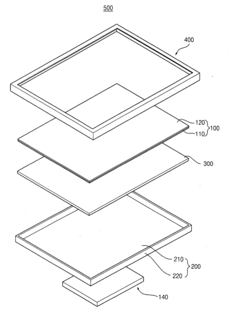
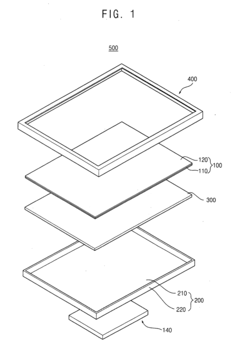
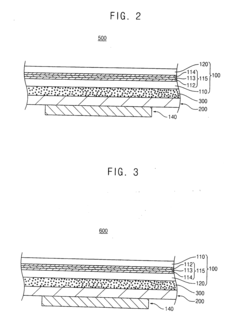
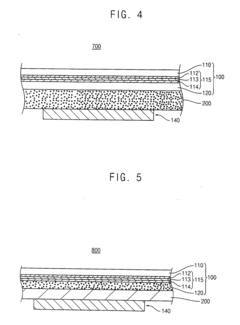
- Incorporating a heat insulating member made of porous polymer between the display panel and the driving circuit part, or between the display panel and the receiving container, to prevent heat generated by the driving circuit from reaching the light-emitting layer, thereby maintaining a lower temperature and reducing degradation.
Organic light emitting diode display
PatentActiveUS20190305254A1
Innovation
- The implementation of an OLED display with a capping layer made of inorganic materials having a high refractive index, combined with a thin film encapsulation layer and a low refractive layer, which are alternately stacked to enhance light extraction and efficiency, along with a resonant auxiliary layer to adjust light characteristics.


Environmental Impact Assessment of Display Lifecycles
The environmental impact assessment of display lifecycles reveals significant differences between CRT and OLED technologies across multiple sustainability dimensions. Manufacturing processes for CRT displays require substantial energy consumption and utilize hazardous materials including lead-based glass, phosphor coatings, and heavy metals. The production of a typical CRT monitor generates approximately 300-400 kg of CO2 equivalent emissions, primarily due to the energy-intensive glass tube manufacturing process and the mining of rare earth elements for phosphor compounds.
OLED displays present a contrasting environmental profile during manufacturing. While the production process involves sophisticated organic compound synthesis and requires cleanroom environments, the overall material footprint is considerably smaller. OLED manufacturing generates approximately 150-200 kg of CO2 equivalent emissions per unit, representing a 40-50% reduction compared to CRT production. However, OLED manufacturing relies on indium tin oxide and other rare materials, creating supply chain sustainability concerns.
Operational energy consumption patterns differ substantially between these technologies. CRT displays typically consume 80-150 watts during operation, with energy consumption remaining constant regardless of displayed content. This continuous high power draw results in significant lifetime carbon emissions, particularly in regions dependent on fossil fuel-based electricity generation. The electron beam scanning mechanism inherently requires substantial power for cathode heating and electromagnetic deflection systems.
OLED displays demonstrate superior operational efficiency, consuming 30-60 watts under typical usage conditions. The self-emissive nature of OLED pixels enables dynamic power scaling based on content brightness, with dark scenes consuming minimal energy. This adaptive power consumption characteristic can reduce operational emissions by 60-70% compared to CRT displays over equivalent usage periods.
End-of-life disposal considerations present distinct challenges for each technology. CRT displays contain approximately 2-4 kg of lead per unit, requiring specialized recycling processes to prevent soil and groundwater contamination. The glass tube recycling infrastructure has declined significantly, leading to increased disposal costs and environmental risks. Conversely, OLED displays contain fewer hazardous materials but present challenges in organic compound degradation and rare metal recovery.
Lifecycle carbon footprint analysis indicates OLED displays achieve environmental payback within 2-3 years of operation compared to equivalent CRT systems, primarily through reduced operational energy consumption and manufacturing emissions.
OLED displays present a contrasting environmental profile during manufacturing. While the production process involves sophisticated organic compound synthesis and requires cleanroom environments, the overall material footprint is considerably smaller. OLED manufacturing generates approximately 150-200 kg of CO2 equivalent emissions per unit, representing a 40-50% reduction compared to CRT production. However, OLED manufacturing relies on indium tin oxide and other rare materials, creating supply chain sustainability concerns.
Operational energy consumption patterns differ substantially between these technologies. CRT displays typically consume 80-150 watts during operation, with energy consumption remaining constant regardless of displayed content. This continuous high power draw results in significant lifetime carbon emissions, particularly in regions dependent on fossil fuel-based electricity generation. The electron beam scanning mechanism inherently requires substantial power for cathode heating and electromagnetic deflection systems.
OLED displays demonstrate superior operational efficiency, consuming 30-60 watts under typical usage conditions. The self-emissive nature of OLED pixels enables dynamic power scaling based on content brightness, with dark scenes consuming minimal energy. This adaptive power consumption characteristic can reduce operational emissions by 60-70% compared to CRT displays over equivalent usage periods.
End-of-life disposal considerations present distinct challenges for each technology. CRT displays contain approximately 2-4 kg of lead per unit, requiring specialized recycling processes to prevent soil and groundwater contamination. The glass tube recycling infrastructure has declined significantly, leading to increased disposal costs and environmental risks. Conversely, OLED displays contain fewer hazardous materials but present challenges in organic compound degradation and rare metal recovery.
Lifecycle carbon footprint analysis indicates OLED displays achieve environmental payback within 2-3 years of operation compared to equivalent CRT systems, primarily through reduced operational energy consumption and manufacturing emissions.
Cost-Benefit Analysis of Display Durability Investments
The economic evaluation of display durability investments requires a comprehensive assessment of both immediate capital expenditures and long-term operational benefits. When comparing CRT and OLED technologies, organizations must consider the substantial differences in initial procurement costs, with OLED displays typically commanding premium pricing due to advanced manufacturing processes and superior performance characteristics. However, this higher upfront investment often translates into significant operational savings over the display lifecycle.
Total cost of ownership analysis reveals that OLED displays, despite higher initial costs, frequently deliver superior economic value through reduced maintenance requirements and extended operational lifespans. CRT displays, while offering lower entry costs, incur substantial ongoing expenses related to power consumption, frequent component replacements, and specialized maintenance expertise. The energy efficiency advantage of OLED technology can result in 60-70% reduction in operational power costs compared to equivalent CRT installations.
Durability-related cost factors extend beyond direct hardware expenses to encompass productivity impacts and business continuity considerations. OLED displays demonstrate superior resistance to environmental stressors, reducing unplanned downtime and associated revenue losses. The modular nature of OLED technology enables targeted repairs rather than complete system replacements, further optimizing maintenance budgets and minimizing operational disruptions.
Return on investment calculations must incorporate the extended service life potential of OLED displays, which can operate effectively for 15-20 years under normal conditions compared to 8-12 years for CRT systems. This longevity advantage, combined with consistent performance degradation patterns, enables more predictable capital planning and reduces the frequency of technology refresh cycles.
Risk mitigation represents another critical economic consideration, as OLED displays offer greater resilience against obsolescence and supply chain disruptions. The widespread adoption of OLED technology ensures continued component availability and technical support, while CRT systems face increasing challenges related to discontinued parts and diminishing expertise pools, potentially leading to unexpected replacement costs and operational vulnerabilities.
Total cost of ownership analysis reveals that OLED displays, despite higher initial costs, frequently deliver superior economic value through reduced maintenance requirements and extended operational lifespans. CRT displays, while offering lower entry costs, incur substantial ongoing expenses related to power consumption, frequent component replacements, and specialized maintenance expertise. The energy efficiency advantage of OLED technology can result in 60-70% reduction in operational power costs compared to equivalent CRT installations.
Durability-related cost factors extend beyond direct hardware expenses to encompass productivity impacts and business continuity considerations. OLED displays demonstrate superior resistance to environmental stressors, reducing unplanned downtime and associated revenue losses. The modular nature of OLED technology enables targeted repairs rather than complete system replacements, further optimizing maintenance budgets and minimizing operational disruptions.
Return on investment calculations must incorporate the extended service life potential of OLED displays, which can operate effectively for 15-20 years under normal conditions compared to 8-12 years for CRT systems. This longevity advantage, combined with consistent performance degradation patterns, enables more predictable capital planning and reduces the frequency of technology refresh cycles.
Risk mitigation represents another critical economic consideration, as OLED displays offer greater resilience against obsolescence and supply chain disruptions. The widespread adoption of OLED technology ensures continued component availability and technical support, while CRT systems face increasing challenges related to discontinued parts and diminishing expertise pools, potentially leading to unexpected replacement costs and operational vulnerabilities.
Unlock deeper insights with Patsnap Eureka Quick Research — get a full tech report to explore trends and direct your research. Try now!
Generate Your Research Report Instantly with AI Agent
Supercharge your innovation with Patsnap Eureka AI Agent Platform!