Comparing Hydrogen Compression vs Storage: Cost Analysis
APR 7, 20269 MIN READ
Generate Your Research Report Instantly with AI Agent
PatSnap Eureka helps you evaluate technical feasibility & market potential.
Hydrogen Compression and Storage Technology Background and Goals
Hydrogen has emerged as a critical component in the global transition toward sustainable energy systems, driven by its potential to decarbonize hard-to-abate sectors including heavy industry, long-haul transportation, and power generation. The technology encompasses two fundamental processes: compression for transportation and distribution, and storage for maintaining hydrogen availability across temporal and spatial scales. These processes represent significant cost centers that directly impact hydrogen's commercial viability and widespread adoption.
The evolution of hydrogen compression technology traces back to early industrial applications in the 20th century, initially serving petrochemical and ammonia production sectors. Modern compression systems have evolved from simple reciprocating compressors to sophisticated multi-stage systems incorporating advanced materials and control technologies. Parallel developments in storage solutions have progressed from basic pressure vessels to complex underground cavern systems and emerging solid-state storage materials.
Current market dynamics reflect growing recognition of hydrogen's role in achieving net-zero emissions targets. Government policies worldwide, including the European Green Deal and various national hydrogen strategies, have established ambitious deployment targets driving technological advancement. The International Energy Agency projects hydrogen demand could reach 520 million tonnes by 2070, necessitating massive infrastructure investments in both compression and storage capabilities.
The primary technical objectives center on achieving cost parity with conventional energy carriers while maintaining safety and efficiency standards. Compression technology aims to reduce specific energy consumption below 2.5 kWh per kilogram of hydrogen while achieving compression ratios exceeding 300:1 for efficient transportation. Storage solutions target cost reductions to below $100 per kilogram of hydrogen capacity for large-scale applications, with cycle efficiency improvements and extended operational lifespans.
Economic optimization represents the overarching goal, requiring comprehensive analysis of capital expenditure, operational costs, and system integration expenses. The technology development trajectory focuses on minimizing the total cost of ownership while ensuring scalability for industrial deployment. This necessitates breakthrough innovations in materials science, system design, and operational methodologies to achieve commercially viable hydrogen infrastructure supporting the global energy transition.
The evolution of hydrogen compression technology traces back to early industrial applications in the 20th century, initially serving petrochemical and ammonia production sectors. Modern compression systems have evolved from simple reciprocating compressors to sophisticated multi-stage systems incorporating advanced materials and control technologies. Parallel developments in storage solutions have progressed from basic pressure vessels to complex underground cavern systems and emerging solid-state storage materials.
Current market dynamics reflect growing recognition of hydrogen's role in achieving net-zero emissions targets. Government policies worldwide, including the European Green Deal and various national hydrogen strategies, have established ambitious deployment targets driving technological advancement. The International Energy Agency projects hydrogen demand could reach 520 million tonnes by 2070, necessitating massive infrastructure investments in both compression and storage capabilities.
The primary technical objectives center on achieving cost parity with conventional energy carriers while maintaining safety and efficiency standards. Compression technology aims to reduce specific energy consumption below 2.5 kWh per kilogram of hydrogen while achieving compression ratios exceeding 300:1 for efficient transportation. Storage solutions target cost reductions to below $100 per kilogram of hydrogen capacity for large-scale applications, with cycle efficiency improvements and extended operational lifespans.
Economic optimization represents the overarching goal, requiring comprehensive analysis of capital expenditure, operational costs, and system integration expenses. The technology development trajectory focuses on minimizing the total cost of ownership while ensuring scalability for industrial deployment. This necessitates breakthrough innovations in materials science, system design, and operational methodologies to achieve commercially viable hydrogen infrastructure supporting the global energy transition.
Market Demand Analysis for Hydrogen Infrastructure Solutions
The global hydrogen infrastructure market is experiencing unprecedented growth driven by accelerating decarbonization commitments across multiple sectors. Industrial applications represent the largest current demand segment, with steel production, chemical manufacturing, and oil refining industries seeking cost-effective hydrogen solutions to reduce carbon emissions. These sectors require reliable compression and storage systems to maintain continuous operations while meeting increasingly stringent environmental regulations.
Transportation sector demand is rapidly expanding, particularly for heavy-duty vehicles, maritime shipping, and aviation applications where battery solutions face limitations. Fleet operators are evaluating total cost of ownership models that heavily depend on efficient compression and storage infrastructure. The economics of hydrogen refueling stations directly correlate with the optimization balance between compression energy costs and storage capacity investments.
Power generation and grid balancing applications are emerging as significant demand drivers, especially in regions with high renewable energy penetration. Utilities require large-scale storage solutions to manage seasonal energy variations, creating substantial market opportunities for advanced storage technologies. The cost-effectiveness of different storage approaches becomes critical for project viability in competitive electricity markets.
Regional demand patterns vary significantly based on policy frameworks and industrial structures. European markets emphasize distributed hydrogen networks requiring efficient compression systems for pipeline transport. Asian markets, particularly Japan and South Korea, focus on large-scale import terminals demanding high-capacity storage solutions. North American markets show growing interest in industrial clusters where shared infrastructure can optimize both compression and storage investments.
The residential and commercial heating sector represents an emerging demand category, particularly in regions phasing out natural gas. These applications require cost-optimized solutions that balance initial infrastructure investments with operational efficiency. Market adoption rates depend heavily on achieving cost parity with conventional energy sources through improved compression and storage economics.
Supply chain considerations significantly influence infrastructure demand patterns. Hydrogen production facilities require on-site storage and compression capabilities, while distribution networks need strategically located compression stations. The optimal configuration depends on production scales, transport distances, and end-user requirements, creating diverse market segments with varying cost sensitivity profiles.
Transportation sector demand is rapidly expanding, particularly for heavy-duty vehicles, maritime shipping, and aviation applications where battery solutions face limitations. Fleet operators are evaluating total cost of ownership models that heavily depend on efficient compression and storage infrastructure. The economics of hydrogen refueling stations directly correlate with the optimization balance between compression energy costs and storage capacity investments.
Power generation and grid balancing applications are emerging as significant demand drivers, especially in regions with high renewable energy penetration. Utilities require large-scale storage solutions to manage seasonal energy variations, creating substantial market opportunities for advanced storage technologies. The cost-effectiveness of different storage approaches becomes critical for project viability in competitive electricity markets.
Regional demand patterns vary significantly based on policy frameworks and industrial structures. European markets emphasize distributed hydrogen networks requiring efficient compression systems for pipeline transport. Asian markets, particularly Japan and South Korea, focus on large-scale import terminals demanding high-capacity storage solutions. North American markets show growing interest in industrial clusters where shared infrastructure can optimize both compression and storage investments.
The residential and commercial heating sector represents an emerging demand category, particularly in regions phasing out natural gas. These applications require cost-optimized solutions that balance initial infrastructure investments with operational efficiency. Market adoption rates depend heavily on achieving cost parity with conventional energy sources through improved compression and storage economics.
Supply chain considerations significantly influence infrastructure demand patterns. Hydrogen production facilities require on-site storage and compression capabilities, while distribution networks need strategically located compression stations. The optimal configuration depends on production scales, transport distances, and end-user requirements, creating diverse market segments with varying cost sensitivity profiles.
Current State and Challenges in Hydrogen Compression vs Storage
The hydrogen industry currently faces significant disparities in technological maturity between compression and storage solutions. Hydrogen compression technology has achieved commercial viability across multiple pressure ranges, with mechanical compressors dominating industrial applications at pressures up to 700 bar. However, achieving ultra-high pressures above 700 bar for automotive applications remains technically challenging and economically prohibitive for widespread deployment.
Storage technologies present a more fragmented landscape with varying degrees of commercial readiness. Compressed gas storage in high-pressure vessels represents the most mature approach, widely implemented in industrial settings. Conversely, liquid hydrogen storage requires cryogenic temperatures of -253°C, demanding sophisticated insulation systems and continuous energy input to maintain storage conditions. Solid-state storage using metal hydrides and chemical storage methods remain largely in developmental phases, with limited commercial applications due to technical constraints.
Cost structures reveal fundamental challenges across both domains. Compression systems face escalating energy consumption costs as pressure requirements increase, with compressor efficiency declining significantly at higher pressures. Capital expenditure for high-pressure compression equipment grows exponentially, particularly for systems exceeding 350 bar. Maintenance costs further compound operational expenses, as high-pressure components experience accelerated wear and require frequent replacement.
Storage cost challenges vary significantly by technology type. High-pressure vessel storage incurs substantial material costs due to specialized carbon fiber composites required for safe operation. Liquid hydrogen storage systems demand continuous energy input for refrigeration, creating ongoing operational expenses that can exceed initial capital investments over system lifetime. Underground storage solutions, while potentially cost-effective for large-scale applications, face geological constraints and regulatory uncertainties that limit deployment options.
Geographic distribution of technological capabilities reveals concentrated expertise in developed markets. European nations lead in high-pressure compression technology development, while Japan dominates liquid hydrogen storage research. North American markets focus primarily on large-scale compressed gas storage applications. This geographic concentration creates supply chain vulnerabilities and limits technology transfer to emerging markets.
Integration challenges between compression and storage systems create additional complexity. Pressure matching requirements between compression output and storage input pressures often necessitate intermediate pressure regulation, introducing efficiency losses and additional equipment costs. Temperature management during compression processes affects storage system performance, particularly for cryogenic applications where heat integration becomes critical for overall system efficiency.
Regulatory frameworks remain inconsistent globally, creating uncertainty for technology deployment and cost optimization strategies. Safety standards vary significantly between regions, affecting equipment specifications and associated costs. Environmental regulations increasingly influence technology selection, with lifecycle carbon footprint considerations becoming decisive factors in system design and implementation decisions.
Storage technologies present a more fragmented landscape with varying degrees of commercial readiness. Compressed gas storage in high-pressure vessels represents the most mature approach, widely implemented in industrial settings. Conversely, liquid hydrogen storage requires cryogenic temperatures of -253°C, demanding sophisticated insulation systems and continuous energy input to maintain storage conditions. Solid-state storage using metal hydrides and chemical storage methods remain largely in developmental phases, with limited commercial applications due to technical constraints.
Cost structures reveal fundamental challenges across both domains. Compression systems face escalating energy consumption costs as pressure requirements increase, with compressor efficiency declining significantly at higher pressures. Capital expenditure for high-pressure compression equipment grows exponentially, particularly for systems exceeding 350 bar. Maintenance costs further compound operational expenses, as high-pressure components experience accelerated wear and require frequent replacement.
Storage cost challenges vary significantly by technology type. High-pressure vessel storage incurs substantial material costs due to specialized carbon fiber composites required for safe operation. Liquid hydrogen storage systems demand continuous energy input for refrigeration, creating ongoing operational expenses that can exceed initial capital investments over system lifetime. Underground storage solutions, while potentially cost-effective for large-scale applications, face geological constraints and regulatory uncertainties that limit deployment options.
Geographic distribution of technological capabilities reveals concentrated expertise in developed markets. European nations lead in high-pressure compression technology development, while Japan dominates liquid hydrogen storage research. North American markets focus primarily on large-scale compressed gas storage applications. This geographic concentration creates supply chain vulnerabilities and limits technology transfer to emerging markets.
Integration challenges between compression and storage systems create additional complexity. Pressure matching requirements between compression output and storage input pressures often necessitate intermediate pressure regulation, introducing efficiency losses and additional equipment costs. Temperature management during compression processes affects storage system performance, particularly for cryogenic applications where heat integration becomes critical for overall system efficiency.
Regulatory frameworks remain inconsistent globally, creating uncertainty for technology deployment and cost optimization strategies. Safety standards vary significantly between regions, affecting equipment specifications and associated costs. Environmental regulations increasingly influence technology selection, with lifecycle carbon footprint considerations becoming decisive factors in system design and implementation decisions.
Current Technical Solutions for Hydrogen Compression and Storage
01 Hydrogen production cost reduction through electrolysis optimization
Methods and systems for reducing hydrogen production costs focus on optimizing electrolysis processes, including improving electrode materials, enhancing energy efficiency, and utilizing renewable energy sources. Advanced electrolysis technologies such as proton exchange membrane (PEM) and alkaline electrolysis are employed to minimize energy consumption and operational costs. Process parameter optimization and system integration strategies further contribute to cost reduction in hydrogen generation.- Hydrogen production cost reduction through electrolysis optimization: Methods and systems for reducing hydrogen production costs focus on optimizing electrolysis processes, including improving electrode materials, enhancing energy efficiency, and utilizing renewable energy sources. Advanced electrolysis technologies such as proton exchange membrane (PEM) and alkaline electrolysis are employed to minimize energy consumption and operational costs. Process parameter optimization and system integration strategies further contribute to cost reduction in hydrogen generation.
- Cost-effective hydrogen storage and transportation solutions: Technologies for reducing hydrogen storage and transportation costs include development of advanced storage materials, compression systems, and liquefaction methods. Innovations in hydrogen carriers, container designs, and distribution infrastructure help minimize logistics expenses. Methods for improving storage density and reducing energy requirements during compression or liquefaction processes are key factors in overall cost reduction.
- Hydrogen production from alternative feedstocks and waste materials: Cost reduction strategies involve utilizing alternative feedstocks such as biomass, industrial waste, or byproducts for hydrogen production. These methods include gasification, reforming, and biological processes that convert low-cost or waste materials into hydrogen. Such approaches reduce raw material costs and provide environmental benefits through waste utilization and circular economy principles.
- Integration of hydrogen production with industrial processes: Cost optimization through integration of hydrogen production facilities with existing industrial processes enables waste heat recovery, byproduct utilization, and shared infrastructure. Co-location strategies with refineries, chemical plants, or power generation facilities reduce capital and operational expenses. System integration approaches maximize energy efficiency and minimize overall production costs through synergistic operations.
- Advanced catalysts and materials for cost-effective hydrogen production: Development of novel catalysts and materials reduces hydrogen production costs by improving reaction efficiency, lowering operating temperatures, and extending equipment lifespan. Non-precious metal catalysts, nanostructured materials, and composite catalysts offer cost advantages while maintaining high performance. Material innovations in reactors, membranes, and separation systems contribute to overall cost reduction in hydrogen production systems.
02 Cost-effective hydrogen storage and transportation solutions
Technologies for reducing hydrogen storage and transportation costs include development of advanced storage materials, compression systems, and liquefaction methods. Innovations in hydrogen carrier systems, such as metal hydrides and chemical hydrogen storage compounds, enable more economical handling and distribution. Infrastructure designs that minimize energy losses during storage and optimize logistics contribute to overall cost reduction in the hydrogen supply chain.Expand Specific Solutions03 Industrial-scale hydrogen production from renewable sources
Large-scale hydrogen production methods utilizing renewable energy sources such as solar, wind, and biomass aim to reduce production costs while maintaining sustainability. Integration of renewable energy systems with hydrogen production facilities, including photovoltaic-electrolysis coupling and wind-powered hydrogen generation, provides cost-effective alternatives to conventional production methods. Process intensification and economies of scale in industrial hydrogen plants further decrease unit production costs.Expand Specific Solutions04 Hydrogen production cost analysis and economic modeling
Comprehensive cost analysis frameworks and economic models for hydrogen production evaluate various factors including capital expenditure, operational expenses, energy inputs, and lifecycle costs. These analytical tools assess the economic viability of different hydrogen production pathways and identify cost optimization opportunities. Market analysis and cost projection models help stakeholders make informed decisions regarding hydrogen technology investments and deployment strategies.Expand Specific Solutions05 Catalyst and material innovations for cost reduction
Development of novel catalysts and materials for hydrogen production and processing aims to reduce costs through improved efficiency and durability. Non-precious metal catalysts, advanced membrane materials, and optimized reactor designs lower material costs while maintaining or enhancing performance. Innovations in catalyst synthesis methods and material engineering enable mass production at reduced costs, making hydrogen technologies more economically competitive.Expand Specific Solutions
Key Players in Hydrogen Compression and Storage Industry
The hydrogen compression and storage market represents a rapidly evolving sector within the broader hydrogen economy, currently in its growth phase as industries transition toward decarbonization. The market demonstrates substantial expansion potential, driven by increasing demand for clean energy solutions across automotive, industrial, and power generation applications. Technology maturity varies significantly across different approaches, with established players like General Electric Company and Johnson Matthey Plc leveraging decades of industrial experience in catalysts and energy systems. Emerging specialized companies such as H2Go Power Ltd., Hydrogenious LOHC Technologies GmbH, and Hydrexia Pty Ltd. are pioneering innovative storage solutions including liquid organic hydrogen carriers and solid-state systems. Chinese manufacturers like CIMC Enric are scaling production capabilities, while research institutions including Zhejiang University and Oxford University Innovation drive fundamental breakthroughs. The competitive landscape reflects a mix of mature industrial giants and agile startups, indicating a market transitioning from early adoption to commercial viability with diverse technological pathways competing for dominance.
China International Marine Containers (Group) Co., Ltd.
Technical Solution: CIMC Group has developed comprehensive hydrogen compression and storage solutions focusing on cost optimization through economies of scale and integrated manufacturing. Their approach combines multi-stage compression systems with Type III and Type IV composite pressure vessels for storage at 350-700 bar. The company's cost analysis shows that compression accounts for 15-20% of total hydrogen delivery costs, while storage vessel costs range from $500-800 per kg of hydrogen capacity. CIMC's integrated approach reduces costs by manufacturing both compression equipment and storage tanks in-house, achieving 20-30% cost savings compared to separate procurement. Their modular compression stations can handle 200-2000 kg/day capacity with energy consumption of 2.5-3.5 kWh per kg of hydrogen compressed to 350 bar. The company focuses on standardization and mass production to drive down unit costs for both compression and storage components.
Advantages: Integrated manufacturing reduces costs, proven compression technology, scalable solutions, strong supply chain. Disadvantages: High capital investment for compression infrastructure, energy intensive process, limited to conventional pressure storage.
Johnson Matthey Plc
Technical Solution: Johnson Matthey focuses on catalyst-based solutions for hydrogen compression and alternative storage methods, particularly metal hydride storage systems that eliminate the need for high-pressure compression. Their metal hydride technology stores hydrogen at low pressures (1-10 bar) and moderate temperatures (80-120°C), reducing compression energy requirements by 90% compared to 700 bar pressure storage. The cost analysis shows metal hydride systems have higher initial material costs ($1,500-2,500 per kg H2 capacity) but eliminate ongoing compression energy costs of $1-2 per kg hydrogen. JM's advanced catalyst materials enable faster hydrogen absorption/desorption kinetics, improving system efficiency and reducing heating/cooling energy requirements. Their integrated approach combines compression optimization with storage solutions, targeting applications where energy costs outweigh capital costs over the system lifetime. The technology is particularly cost-effective for stationary storage applications with frequent cycling requirements.
Advantages: Eliminates high-pressure compression needs, safe low-pressure operation, no storage losses, suitable for frequent cycling. Disadvantages: High material costs, requires heating for hydrogen release, lower gravimetric density, temperature management complexity.
Core Cost Analysis Methods for Hydrogen Infrastructure
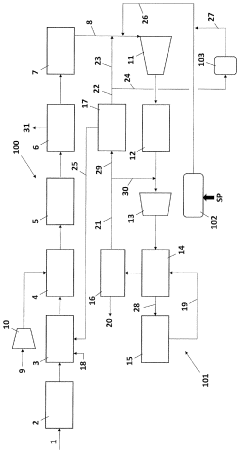
Process for ammonia synthesis using green hydrogen
PatentPendingUS20240158247A1
Innovation
- A hybrid process that integrates conventional hydrogen from reforming with green hydrogen produced from renewable sources, utilizing recovered hydrogen from the ammonia synthesis loop to maintain high pressure and reduce compression needs, allowing for direct storage and increased renewable energy contribution.
Hydrogen compression, storage, and dispensing
PatentPendingAU2022416184A1
Innovation
- A high-pressure gas storage system that utilizes a liquid sump tank and separation system to control pressure by partially filling or draining the storage vessel with liquid, allowing for partial saturation of the gas and reducing saturation through a separation system, thereby increasing the usable volume and reducing maintenance costs.


Policy and Regulatory Framework for Hydrogen Infrastructure
The regulatory landscape for hydrogen infrastructure development varies significantly across global markets, with governments increasingly recognizing the strategic importance of hydrogen in achieving carbon neutrality goals. The European Union has established the most comprehensive framework through its Hydrogen Strategy for a Climate-Neutral Europe, setting ambitious targets for electrolyzer capacity and renewable hydrogen production by 2030. This regulatory foundation directly impacts cost structures for both compression and storage technologies by establishing technical standards, safety protocols, and investment incentives.
Safety regulations represent a critical component of the policy framework, particularly affecting compression system design and storage facility requirements. International standards such as ISO 14687 for hydrogen fuel quality and IEC 62282 for fuel cell technologies establish baseline requirements that influence equipment costs. National fire codes and pressure vessel regulations, including ASME Section VIII in the United States and EN 13458 in Europe, mandate specific design criteria for high-pressure storage systems, directly impacting capital expenditure calculations for storage infrastructure.
Financial incentives and support mechanisms significantly alter the economic comparison between compression and storage solutions. Tax credits, such as the Production Tax Credit for clean hydrogen in the United States, can reduce operational costs by up to 30%. Grant programs like Germany's National Innovation Programme for Hydrogen and Fuel Cell Technology provide capital cost offsets that particularly benefit high-investment storage projects. These policy instruments create regional variations in cost competitiveness between compression-focused and storage-intensive approaches.
Permitting and approval processes introduce additional cost considerations that vary by jurisdiction and technology choice. Compressed hydrogen facilities typically face streamlined approval processes due to established industrial gas handling precedents, while large-scale storage projects may encounter extended environmental review periods. Local zoning regulations and community acceptance policies can significantly impact project timelines and associated financing costs, particularly for underground storage facilities requiring geological assessments and long-term monitoring commitments.
Emerging carbon pricing mechanisms and renewable energy mandates are reshaping the economic fundamentals of hydrogen infrastructure investments. Carbon border adjustment mechanisms and domestic carbon pricing create cost advantages for low-carbon hydrogen production, influencing the optimal balance between compression efficiency and storage capacity in system design decisions.
Safety regulations represent a critical component of the policy framework, particularly affecting compression system design and storage facility requirements. International standards such as ISO 14687 for hydrogen fuel quality and IEC 62282 for fuel cell technologies establish baseline requirements that influence equipment costs. National fire codes and pressure vessel regulations, including ASME Section VIII in the United States and EN 13458 in Europe, mandate specific design criteria for high-pressure storage systems, directly impacting capital expenditure calculations for storage infrastructure.
Financial incentives and support mechanisms significantly alter the economic comparison between compression and storage solutions. Tax credits, such as the Production Tax Credit for clean hydrogen in the United States, can reduce operational costs by up to 30%. Grant programs like Germany's National Innovation Programme for Hydrogen and Fuel Cell Technology provide capital cost offsets that particularly benefit high-investment storage projects. These policy instruments create regional variations in cost competitiveness between compression-focused and storage-intensive approaches.
Permitting and approval processes introduce additional cost considerations that vary by jurisdiction and technology choice. Compressed hydrogen facilities typically face streamlined approval processes due to established industrial gas handling precedents, while large-scale storage projects may encounter extended environmental review periods. Local zoning regulations and community acceptance policies can significantly impact project timelines and associated financing costs, particularly for underground storage facilities requiring geological assessments and long-term monitoring commitments.
Emerging carbon pricing mechanisms and renewable energy mandates are reshaping the economic fundamentals of hydrogen infrastructure investments. Carbon border adjustment mechanisms and domestic carbon pricing create cost advantages for low-carbon hydrogen production, influencing the optimal balance between compression efficiency and storage capacity in system design decisions.
Safety Standards and Risk Assessment in Hydrogen Systems
Safety standards and risk assessment frameworks for hydrogen systems have evolved significantly as the technology transitions from laboratory applications to commercial deployment. The inherent properties of hydrogen, including its wide flammability range, low ignition energy, and high diffusivity, necessitate comprehensive safety protocols that address both compression and storage operations. Current international standards such as ISO 14687, SAE J2719, and IEC 62282 provide foundational guidelines, while regional regulations like NFPA 2 in North America and EN 17127 in Europe establish specific requirements for hydrogen infrastructure.
Risk assessment methodologies for hydrogen compression systems focus primarily on mechanical failure modes, including compressor seal degradation, pipeline integrity under cyclic loading, and potential hydrogen embrittlement of metallic components. Quantitative risk analysis typically employs fault tree analysis and hazard identification studies to evaluate failure probabilities, with particular attention to high-pressure scenarios exceeding 700 bar. The assessment framework considers both immediate risks such as fire and explosion hazards, and long-term degradation mechanisms that could compromise system reliability.
Storage system risk evaluation encompasses different challenges depending on the storage method employed. High-pressure gaseous storage requires assessment of vessel integrity, pressure relief system functionality, and containment structure adequacy. Liquid hydrogen storage introduces cryogenic-specific risks including thermal cycling effects, vacuum loss scenarios, and boil-off gas management. Underground storage systems demand geological stability analysis and groundwater contamination prevention measures.
Comparative risk profiles between compression and storage systems reveal distinct safety considerations that influence overall system design and operational protocols. Compression systems typically present higher dynamic risks due to moving components and pressure fluctuations, while storage systems involve more static but potentially catastrophic failure modes. The integration of advanced monitoring technologies, including hydrogen leak detection systems and predictive maintenance algorithms, has become essential for maintaining acceptable risk levels across both operational domains.
Regulatory compliance frameworks increasingly emphasize performance-based standards rather than prescriptive requirements, allowing for innovative safety solutions while maintaining rigorous protection levels. This evolution supports the development of hybrid systems that optimize both compression and storage components while ensuring comprehensive risk mitigation throughout the hydrogen value chain.
Risk assessment methodologies for hydrogen compression systems focus primarily on mechanical failure modes, including compressor seal degradation, pipeline integrity under cyclic loading, and potential hydrogen embrittlement of metallic components. Quantitative risk analysis typically employs fault tree analysis and hazard identification studies to evaluate failure probabilities, with particular attention to high-pressure scenarios exceeding 700 bar. The assessment framework considers both immediate risks such as fire and explosion hazards, and long-term degradation mechanisms that could compromise system reliability.
Storage system risk evaluation encompasses different challenges depending on the storage method employed. High-pressure gaseous storage requires assessment of vessel integrity, pressure relief system functionality, and containment structure adequacy. Liquid hydrogen storage introduces cryogenic-specific risks including thermal cycling effects, vacuum loss scenarios, and boil-off gas management. Underground storage systems demand geological stability analysis and groundwater contamination prevention measures.
Comparative risk profiles between compression and storage systems reveal distinct safety considerations that influence overall system design and operational protocols. Compression systems typically present higher dynamic risks due to moving components and pressure fluctuations, while storage systems involve more static but potentially catastrophic failure modes. The integration of advanced monitoring technologies, including hydrogen leak detection systems and predictive maintenance algorithms, has become essential for maintaining acceptable risk levels across both operational domains.
Regulatory compliance frameworks increasingly emphasize performance-based standards rather than prescriptive requirements, allowing for innovative safety solutions while maintaining rigorous protection levels. This evolution supports the development of hybrid systems that optimize both compression and storage components while ensuring comprehensive risk mitigation throughout the hydrogen value chain.
Unlock deeper insights with PatSnap Eureka Quick Research — get a full tech report to explore trends and direct your research. Try now!
Generate Your Research Report Instantly with AI Agent
Supercharge your innovation with PatSnap Eureka AI Agent Platform!