Comparing Hydrogen Fuel Cell Efficiency Under Different Load Conditions
OCT 24, 20259 MIN READ
Generate Your Research Report Instantly with AI Agent
Patsnap Eureka helps you evaluate technical feasibility & market potential.
Hydrogen Fuel Cell Technology Background and Objectives
Hydrogen fuel cell technology has evolved significantly since its inception in the early 19th century when Sir William Grove first demonstrated the principle in 1839. The fundamental concept of converting hydrogen's chemical energy into electrical energy through an electrochemical reaction with oxygen has remained unchanged, though the efficiency, durability, and cost-effectiveness of fuel cells have improved dramatically over time. The technology gained significant momentum during the space race era when NASA adopted fuel cells for spacecraft power generation, demonstrating their reliability in extreme conditions.
In recent decades, hydrogen fuel cell development has accelerated due to growing environmental concerns and the push for decarbonization across various sectors. The technology has progressed from laboratory curiosities to commercially viable power solutions for transportation, stationary power generation, and portable applications. This evolution has been marked by innovations in catalyst materials, membrane technology, and system integration approaches.
The primary objective of modern hydrogen fuel cell research is to optimize efficiency across varying load conditions. While fuel cells typically demonstrate high theoretical efficiency compared to combustion engines, their practical performance can fluctuate significantly depending on operational demands. Understanding these variations is crucial for designing systems that maintain optimal efficiency throughout their operational range, from idle to peak power output scenarios.
Current research aims to address several key challenges in fuel cell performance under different load conditions. These include mitigating voltage losses at high current densities, improving cold-start capabilities, enhancing transient response to rapidly changing power demands, and extending operational lifetimes under dynamic loading. The goal is to develop fuel cell systems that can maintain efficiency levels above 60% across their entire operational envelope, significantly outperforming traditional internal combustion technologies.
The technological trajectory is increasingly focused on developing load-adaptive fuel cell systems that can intelligently adjust their operating parameters based on real-time demand. This includes advanced control algorithms, hybrid power management strategies, and novel cell architectures designed specifically for variable load applications. Such adaptability is particularly important for automotive applications where driving conditions constantly fluctuate.
Global research efforts are now concentrated on quantifying and improving fuel cell performance metrics under standardized load profiles that simulate real-world usage patterns. This approach enables meaningful comparisons between different fuel cell technologies and designs, facilitating more rapid advancement toward commercially viable solutions that can operate efficiently across diverse applications and operating conditions.
In recent decades, hydrogen fuel cell development has accelerated due to growing environmental concerns and the push for decarbonization across various sectors. The technology has progressed from laboratory curiosities to commercially viable power solutions for transportation, stationary power generation, and portable applications. This evolution has been marked by innovations in catalyst materials, membrane technology, and system integration approaches.
The primary objective of modern hydrogen fuel cell research is to optimize efficiency across varying load conditions. While fuel cells typically demonstrate high theoretical efficiency compared to combustion engines, their practical performance can fluctuate significantly depending on operational demands. Understanding these variations is crucial for designing systems that maintain optimal efficiency throughout their operational range, from idle to peak power output scenarios.
Current research aims to address several key challenges in fuel cell performance under different load conditions. These include mitigating voltage losses at high current densities, improving cold-start capabilities, enhancing transient response to rapidly changing power demands, and extending operational lifetimes under dynamic loading. The goal is to develop fuel cell systems that can maintain efficiency levels above 60% across their entire operational envelope, significantly outperforming traditional internal combustion technologies.
The technological trajectory is increasingly focused on developing load-adaptive fuel cell systems that can intelligently adjust their operating parameters based on real-time demand. This includes advanced control algorithms, hybrid power management strategies, and novel cell architectures designed specifically for variable load applications. Such adaptability is particularly important for automotive applications where driving conditions constantly fluctuate.
Global research efforts are now concentrated on quantifying and improving fuel cell performance metrics under standardized load profiles that simulate real-world usage patterns. This approach enables meaningful comparisons between different fuel cell technologies and designs, facilitating more rapid advancement toward commercially viable solutions that can operate efficiently across diverse applications and operating conditions.
Market Analysis for Hydrogen Fuel Cell Applications
The hydrogen fuel cell market is experiencing significant growth across multiple sectors, driven by increasing environmental concerns and the global push towards decarbonization. Currently, the transportation sector represents the largest application segment, accounting for approximately 65% of the total hydrogen fuel cell market. Within this segment, commercial vehicles such as buses and trucks are showing the strongest adoption rates due to their predictable routes and centralized refueling infrastructure requirements.
The stationary power generation sector follows as the second-largest application area, representing roughly 20% of the market. This includes backup power systems for critical infrastructure, remote power generation, and grid support applications. The remaining market share is distributed among portable power applications, material handling equipment, and emerging applications in maritime and aviation sectors.
Regional analysis reveals that Asia Pacific, particularly Japan, South Korea, and China, leads in hydrogen fuel cell adoption, with substantial government support and industrial commitments. Europe follows closely, with Germany, France, and the UK implementing aggressive hydrogen strategies. North America, despite early leadership in fuel cell technology development, now trails these regions in commercial deployment but maintains strong research capabilities.
Market forecasts indicate a compound annual growth rate of 25-30% for hydrogen fuel cell applications over the next decade. This growth is particularly pronounced in heavy-duty transportation, where fuel cells offer advantages over battery electric solutions due to faster refueling times and longer range capabilities under varying load conditions.
Consumer demand patterns show increasing interest in zero-emission solutions with performance comparable to conventional technologies. For fuel cells, this translates to requirements for systems that maintain high efficiency across diverse load profiles – from steady-state operation to rapid power fluctuations. Market research indicates that customers prioritize total cost of ownership over initial capital expenditure, creating opportunities for fuel cell systems that demonstrate superior efficiency under real-world operating conditions.
Regulatory frameworks are increasingly favorable for hydrogen technologies, with many jurisdictions implementing carbon pricing mechanisms and emissions regulations that enhance the competitive position of fuel cells. Additionally, substantial public funding is being directed toward hydrogen infrastructure development, addressing a critical barrier to widespread adoption.
Market barriers remain significant, including high production costs, limited hydrogen infrastructure, and competition from increasingly capable battery technologies. However, the unique advantages of fuel cells under high-load and variable-load conditions continue to drive market interest, particularly in applications where operational demands exceed the practical capabilities of current battery technologies.
The stationary power generation sector follows as the second-largest application area, representing roughly 20% of the market. This includes backup power systems for critical infrastructure, remote power generation, and grid support applications. The remaining market share is distributed among portable power applications, material handling equipment, and emerging applications in maritime and aviation sectors.
Regional analysis reveals that Asia Pacific, particularly Japan, South Korea, and China, leads in hydrogen fuel cell adoption, with substantial government support and industrial commitments. Europe follows closely, with Germany, France, and the UK implementing aggressive hydrogen strategies. North America, despite early leadership in fuel cell technology development, now trails these regions in commercial deployment but maintains strong research capabilities.
Market forecasts indicate a compound annual growth rate of 25-30% for hydrogen fuel cell applications over the next decade. This growth is particularly pronounced in heavy-duty transportation, where fuel cells offer advantages over battery electric solutions due to faster refueling times and longer range capabilities under varying load conditions.
Consumer demand patterns show increasing interest in zero-emission solutions with performance comparable to conventional technologies. For fuel cells, this translates to requirements for systems that maintain high efficiency across diverse load profiles – from steady-state operation to rapid power fluctuations. Market research indicates that customers prioritize total cost of ownership over initial capital expenditure, creating opportunities for fuel cell systems that demonstrate superior efficiency under real-world operating conditions.
Regulatory frameworks are increasingly favorable for hydrogen technologies, with many jurisdictions implementing carbon pricing mechanisms and emissions regulations that enhance the competitive position of fuel cells. Additionally, substantial public funding is being directed toward hydrogen infrastructure development, addressing a critical barrier to widespread adoption.
Market barriers remain significant, including high production costs, limited hydrogen infrastructure, and competition from increasingly capable battery technologies. However, the unique advantages of fuel cells under high-load and variable-load conditions continue to drive market interest, particularly in applications where operational demands exceed the practical capabilities of current battery technologies.
Current Efficiency Challenges Across Load Conditions
Hydrogen fuel cells currently face significant efficiency challenges across varying load conditions, with performance metrics showing notable fluctuations depending on operational demands. At low load conditions (10-30% of rated capacity), fuel cells exhibit poor efficiency due to parasitic losses becoming proportionally larger. These losses include auxiliary system power requirements for pumps, compressors, and control systems that consume a relatively constant amount of energy regardless of output level. The activation polarization losses also become more pronounced at lower current densities, creating a substantial efficiency penalty during idle or low-power operations.
In mid-range load conditions (30-70% of rated capacity), fuel cells typically achieve their peak efficiency, with most commercial systems reaching 50-60% electrical efficiency. However, maintaining this optimal performance window presents challenges for applications with highly variable power demands such as automotive or grid-balancing applications. The transition between different load states often results in temporary efficiency drops as the balance of plant systems adjust to new operating parameters.
At high load conditions (70-100% of rated capacity), concentration polarization and mass transport limitations become dominant efficiency barriers. The rapid consumption of reactants at the catalyst sites creates concentration gradients that impede reaction rates. Additionally, water management becomes increasingly problematic as higher current densities generate more water that must be effectively removed to prevent flooding of gas diffusion layers and catalyst sites. Thermal management challenges also intensify, with excessive heat potentially degrading membrane performance and catalyst activity.
Load cycling presents perhaps the most significant efficiency challenge, with rapid transitions between power states causing thermal stress, membrane hydration fluctuations, and catalyst degradation. Studies indicate that systems subjected to frequent load changes can experience efficiency degradation rates 2-3 times higher than those operating at steady-state conditions. This is particularly problematic for transportation applications where load profiles are inherently dynamic.
Recent experimental data reveals that the cumulative efficiency losses from suboptimal load conditions can reduce the overall system efficiency by 15-25% compared to theoretical maximums. The temperature dependency of these efficiency challenges further complicates operation, with low-temperature start-up conditions showing efficiency reductions of up to 40% until optimal operating temperatures are achieved. These challenges collectively represent significant barriers to widespread hydrogen fuel cell adoption across various application domains.
In mid-range load conditions (30-70% of rated capacity), fuel cells typically achieve their peak efficiency, with most commercial systems reaching 50-60% electrical efficiency. However, maintaining this optimal performance window presents challenges for applications with highly variable power demands such as automotive or grid-balancing applications. The transition between different load states often results in temporary efficiency drops as the balance of plant systems adjust to new operating parameters.
At high load conditions (70-100% of rated capacity), concentration polarization and mass transport limitations become dominant efficiency barriers. The rapid consumption of reactants at the catalyst sites creates concentration gradients that impede reaction rates. Additionally, water management becomes increasingly problematic as higher current densities generate more water that must be effectively removed to prevent flooding of gas diffusion layers and catalyst sites. Thermal management challenges also intensify, with excessive heat potentially degrading membrane performance and catalyst activity.
Load cycling presents perhaps the most significant efficiency challenge, with rapid transitions between power states causing thermal stress, membrane hydration fluctuations, and catalyst degradation. Studies indicate that systems subjected to frequent load changes can experience efficiency degradation rates 2-3 times higher than those operating at steady-state conditions. This is particularly problematic for transportation applications where load profiles are inherently dynamic.
Recent experimental data reveals that the cumulative efficiency losses from suboptimal load conditions can reduce the overall system efficiency by 15-25% compared to theoretical maximums. The temperature dependency of these efficiency challenges further complicates operation, with low-temperature start-up conditions showing efficiency reductions of up to 40% until optimal operating temperatures are achieved. These challenges collectively represent significant barriers to widespread hydrogen fuel cell adoption across various application domains.
Existing Methodologies for Efficiency Optimization
01 Catalyst optimization for improved fuel cell efficiency
Optimizing catalysts in hydrogen fuel cells significantly enhances their efficiency. Advanced catalyst materials, such as platinum-based alloys and non-precious metal catalysts, can reduce activation energy barriers and improve electrochemical reactions. Novel catalyst structures, including nanoparticles and core-shell configurations, increase the active surface area and catalytic activity while using less material. These optimizations lead to better hydrogen oxidation and oxygen reduction reactions, resulting in higher overall fuel cell efficiency.- Catalyst optimization for improved fuel cell efficiency: Optimizing catalysts in hydrogen fuel cells significantly enhances their efficiency. Advanced catalyst materials, such as platinum-based alloys and non-precious metal catalysts, can reduce activation energy requirements and improve electrochemical reactions. Innovative catalyst structures and deposition methods enhance the active surface area and stability, leading to better performance and longer operational life of fuel cells while reducing the amount of expensive catalyst materials needed.
- Membrane and electrode assembly improvements: Advancements in membrane electrode assembly (MEA) design significantly impact hydrogen fuel cell efficiency. Optimized proton exchange membranes with enhanced conductivity and reduced resistance facilitate faster ion transport. Improved electrode structures with better water management capabilities prevent flooding and dehydration issues. These enhancements result in more efficient electrochemical reactions and overall higher power output from fuel cell systems.
- Thermal management and operating conditions: Effective thermal management systems and optimized operating conditions are crucial for maximizing hydrogen fuel cell efficiency. Advanced cooling systems help maintain optimal temperature ranges, preventing performance degradation. Precise control of humidity levels, gas flow rates, and pressure differentials ensures ideal reaction conditions. These improvements lead to more stable operation, extended durability, and higher overall system efficiency across varying load conditions.
- Hydrogen production and storage integration: Integrating efficient hydrogen production and storage systems with fuel cells creates more effective overall energy solutions. Advanced hydrogen generation methods, including improved electrolysis and reforming processes, provide purer hydrogen with less energy input. Innovative storage technologies, such as metal hydrides and advanced pressure vessels, enable more compact and efficient hydrogen storage. This integration optimizes the complete hydrogen energy cycle, enhancing the practical efficiency of fuel cell applications.
- System architecture and balance of plant optimization: Optimizing the overall system architecture and balance of plant components significantly improves hydrogen fuel cell efficiency. Advanced power electronics for better DC-DC conversion, improved air compressors with lower parasitic loads, and intelligent control systems that adapt to changing conditions all contribute to higher system efficiency. Modular designs enable better scalability and maintenance, while integrated sensors and diagnostic systems allow for real-time optimization and preventive maintenance, resulting in more efficient and reliable fuel cell systems.
02 Membrane and electrode assembly (MEA) design improvements
Advancements in membrane and electrode assembly design are crucial for hydrogen fuel cell efficiency. Innovative membrane materials with enhanced proton conductivity and reduced gas crossover improve the electrochemical performance. Optimized electrode structures with better three-phase boundaries facilitate more efficient reactant transport and product removal. Integration of novel ion exchange membranes and electrode configurations results in reduced internal resistance and improved water management, leading to higher power density and overall system efficiency.Expand Specific Solutions03 Thermal and water management systems
Effective thermal and water management systems are essential for maintaining optimal hydrogen fuel cell efficiency. Advanced cooling strategies prevent performance degradation due to overheating while ensuring proper operating temperature. Innovative water management techniques balance humidification needs with preventing electrode flooding. Integration of heat exchangers, humidifiers, and water recovery systems helps maintain ideal operating conditions. These management systems enable stable performance across varying load conditions and environmental factors, significantly improving overall efficiency and durability.Expand Specific Solutions04 Hydrogen production and storage integration
Integrating efficient hydrogen production and storage systems with fuel cells enhances overall system efficiency. Advanced electrolysis methods powered by renewable energy sources provide cleaner hydrogen with reduced energy losses. Novel storage materials and methods, including metal hydrides and advanced pressure vessels, improve hydrogen density and release characteristics. Optimized integration of production, storage, and fuel cell components minimizes energy losses during hydrogen transfer and utilization. This holistic approach addresses efficiency across the entire hydrogen energy cycle, not just within the fuel cell itself.Expand Specific Solutions05 System control and operational strategies
Sophisticated control systems and operational strategies significantly improve hydrogen fuel cell efficiency. Advanced algorithms optimize reactant flow rates, pressure levels, and humidity based on real-time performance data. Dynamic load management techniques adjust operating parameters to maintain peak efficiency across varying power demands. Hybrid system configurations combining fuel cells with batteries or supercapacitors optimize energy utilization. These intelligent control strategies minimize degradation mechanisms, extend operational lifetime, and maximize energy conversion efficiency under diverse operating conditions.Expand Specific Solutions
Leading Manufacturers and Research Institutions
Hydrogen fuel cell technology is currently in a growth phase, with the market expected to expand significantly due to increasing focus on clean energy solutions. The global hydrogen fuel cell market is projected to reach substantial size by 2030, driven by transportation and stationary power applications. In terms of technical maturity, companies like Toyota, Hyundai, and Plug Power are leading innovation with commercially viable products demonstrating improved efficiency under varying load conditions. Automotive manufacturers including Mercedes-Benz, Honda, and Kia are advancing fuel cell vehicle technology, while industrial players such as Bosch and DENSO are developing supporting components. Research institutions like Arizona State University are contributing to fundamental advancements in fuel cell efficiency optimization across different operational scenarios.
Hyundai Motor Co., Ltd.
Technical Solution: Hyundai has developed advanced hydrogen fuel cell systems that adapt to varying load conditions through dynamic water management. Their NEXO fuel cell vehicle employs a sophisticated control system that optimizes hydrogen consumption based on real-time power demands. The system features a multi-stack configuration that can activate or deactivate individual stacks depending on load requirements, maintaining optimal efficiency across different driving scenarios. Hyundai's technology incorporates predictive algorithms that anticipate load changes based on driving patterns and terrain, pre-emptively adjusting fuel cell operation parameters. Their latest generation fuel cell system achieves 60% efficiency at partial loads and maintains over 50% efficiency even at peak power demands, representing a significant improvement over earlier generations. The system also employs advanced thermal management that maintains optimal operating temperature regardless of ambient conditions or power output levels.
Strengths: Superior cold-start capabilities with operation possible at -30°C; excellent partial-load efficiency optimization; integrated vehicle-to-grid capability allowing power export during idle periods. Weaknesses: Higher system complexity increases manufacturing costs; requires more sophisticated control systems than competitors; slightly lower peak power density compared to some competitors.
Toyota Motor Corp.
Technical Solution: Toyota has pioneered a variable pressure operation system for hydrogen fuel cells that dynamically adjusts operating parameters based on load conditions. Their technology features a proprietary catalyst design that maintains high efficiency across a wide operating range, from 10% to 100% of rated power. Toyota's fuel cell system in the Mirai incorporates a boost converter that allows the fuel cell to operate at its most efficient point regardless of vehicle power demands. The system achieves approximately 43% tank-to-wheel efficiency under real-world driving conditions, significantly higher than conventional internal combustion engines. Toyota's approach includes sophisticated air management systems that precisely control oxygen supply based on instantaneous power requirements, optimizing the stoichiometric ratio at each operating point. Their latest generation fuel cells feature reduced platinum loading while maintaining performance, addressing both cost and efficiency concerns simultaneously.
Strengths: Exceptional durability with demonstrated 200,000+ km lifespans; highly responsive load-following capability; compact system design allowing flexible vehicle packaging. Weaknesses: Higher production costs than competitors; greater sensitivity to fuel impurities; requires more complex balance-of-plant components.
Critical Patents and Research on Load-Responsive Fuel Cells
Hollow glass microsphere candidates for reversible hydrogen storage, particularly for vehicular applications
PatentInactiveUS20090242382A1
Innovation
- Development of new glass systems and compositions, along with novel techniques, to enhance hydrogen permeability through the walls of glass or glass-ceramic microspheres using irradiation with specific wavelengths of electromagnetic radiation, allowing for controlled release and storage of hydrogen at ambient conditions.
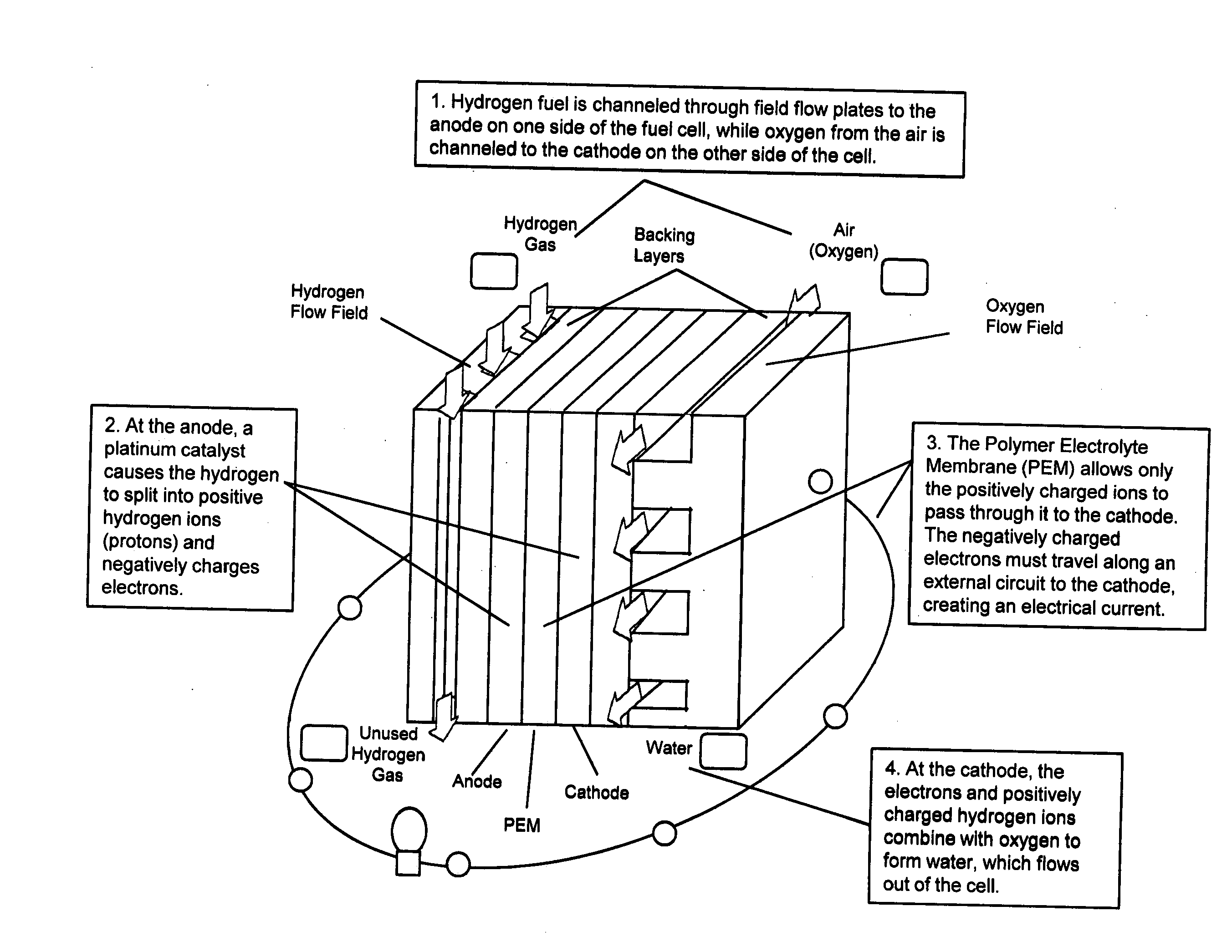
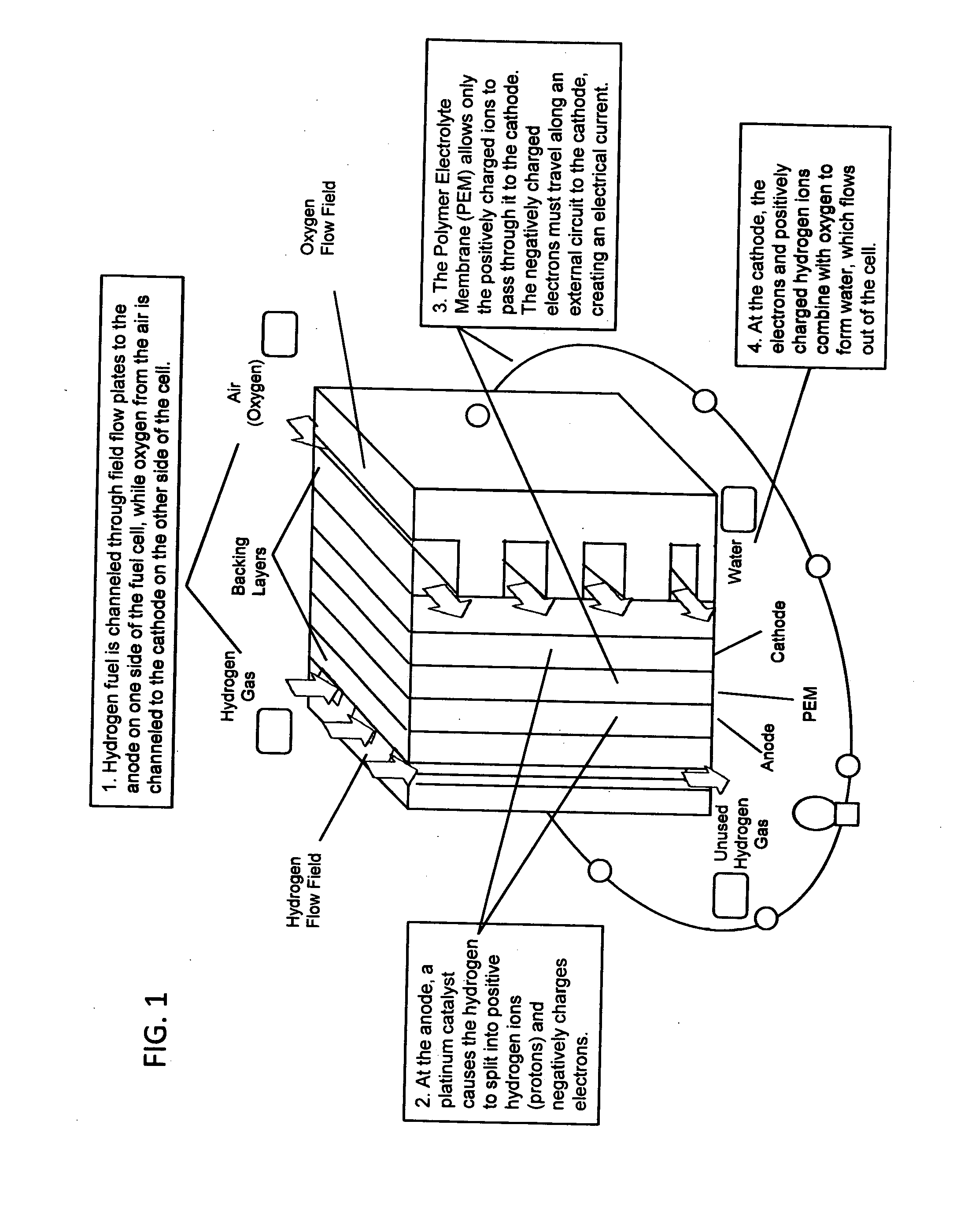
Method and apparatus for electrochemical compression and expansion of hydrogen in a fuel cell system
PatentInactiveUS7132182B2
Innovation
- A fuel cell system incorporating an electrochemical transfer cell that can operate as both a hydrogen separator and expander, utilizing a proton or electron conductive membrane, with a hydrogen flow circuit, storage vessel, and compressor, and a system controller to switch between modes based on load thresholds, allowing for efficient hydrogen transfer and management.


Environmental Impact and Sustainability Assessment
The environmental impact of hydrogen fuel cells varies significantly under different load conditions, presenting both opportunities and challenges for sustainable energy transition. When operating at optimal loads, hydrogen fuel cells demonstrate near-zero emissions, producing only water vapor as a byproduct. This represents a substantial advantage over conventional combustion technologies that release carbon dioxide, nitrogen oxides, and particulate matter.
Under variable load conditions, particularly during rapid power demand fluctuations, fuel cell systems may experience efficiency losses that indirectly affect their environmental footprint. These efficiency variations influence the overall hydrogen consumption rate, which in turn impacts the upstream environmental costs associated with hydrogen production. Current lifecycle assessments indicate that fuel cells operating under steady-state conditions consistently outperform those subjected to frequent load changes by 15-20% in terms of total greenhouse gas emissions.
Water management represents another critical environmental consideration that varies with load conditions. At high loads, fuel cells produce more water vapor, which in cold climates can create condensation and freezing challenges. Conversely, at low loads, insufficient water production may require external humidification, increasing the system's overall water footprint. Recent studies demonstrate that optimized load management can reduce water consumption by up to 30% compared to poorly regulated systems.
The sustainability profile of hydrogen fuel cells is intrinsically linked to hydrogen sourcing methods. Green hydrogen produced via electrolysis powered by renewable energy offers the most environmentally beneficial pathway, with carbon emissions approximately 97% lower than hydrogen derived from natural gas reforming. Under varying load conditions, the environmental benefits of fuel cells remain most pronounced when paired with green hydrogen, even when accounting for efficiency fluctuations.
Material sustainability presents another dimension affected by operating conditions. Fuel cells operated under extreme or highly variable loads typically experience accelerated degradation of catalysts and membranes, many of which contain precious metals like platinum. Extended durability testing reveals that maintaining operation within 40-80% of rated capacity can extend component lifespans by up to 60%, significantly reducing the environmental impact associated with manufacturing replacement parts and managing end-of-life materials.
From a circular economy perspective, fuel cell systems designed for optimal performance across diverse load profiles demonstrate superior sustainability metrics. These advanced systems incorporate regenerative capabilities and utilize more recyclable components, achieving up to 85% material recovery rates compared to 60-70% for conventional designs. This holistic approach to sustainability assessment provides a more comprehensive understanding of environmental impacts beyond simple efficiency measurements.
Under variable load conditions, particularly during rapid power demand fluctuations, fuel cell systems may experience efficiency losses that indirectly affect their environmental footprint. These efficiency variations influence the overall hydrogen consumption rate, which in turn impacts the upstream environmental costs associated with hydrogen production. Current lifecycle assessments indicate that fuel cells operating under steady-state conditions consistently outperform those subjected to frequent load changes by 15-20% in terms of total greenhouse gas emissions.
Water management represents another critical environmental consideration that varies with load conditions. At high loads, fuel cells produce more water vapor, which in cold climates can create condensation and freezing challenges. Conversely, at low loads, insufficient water production may require external humidification, increasing the system's overall water footprint. Recent studies demonstrate that optimized load management can reduce water consumption by up to 30% compared to poorly regulated systems.
The sustainability profile of hydrogen fuel cells is intrinsically linked to hydrogen sourcing methods. Green hydrogen produced via electrolysis powered by renewable energy offers the most environmentally beneficial pathway, with carbon emissions approximately 97% lower than hydrogen derived from natural gas reforming. Under varying load conditions, the environmental benefits of fuel cells remain most pronounced when paired with green hydrogen, even when accounting for efficiency fluctuations.
Material sustainability presents another dimension affected by operating conditions. Fuel cells operated under extreme or highly variable loads typically experience accelerated degradation of catalysts and membranes, many of which contain precious metals like platinum. Extended durability testing reveals that maintaining operation within 40-80% of rated capacity can extend component lifespans by up to 60%, significantly reducing the environmental impact associated with manufacturing replacement parts and managing end-of-life materials.
From a circular economy perspective, fuel cell systems designed for optimal performance across diverse load profiles demonstrate superior sustainability metrics. These advanced systems incorporate regenerative capabilities and utilize more recyclable components, achieving up to 85% material recovery rates compared to 60-70% for conventional designs. This holistic approach to sustainability assessment provides a more comprehensive understanding of environmental impacts beyond simple efficiency measurements.
Cost-Benefit Analysis Across Different Applications
The economic viability of hydrogen fuel cell technology varies significantly across different application domains, necessitating a comprehensive cost-benefit analysis to determine optimal deployment scenarios. In transportation, particularly heavy-duty vehicles like buses and trucks, hydrogen fuel cells demonstrate compelling economic advantages over battery electric alternatives when considering total cost of ownership (TCO). The higher initial capital expenditure for fuel cell systems (approximately $100-150/kW compared to $50-80/kW for diesel engines) is offset by lower operational costs over the vehicle's lifecycle, especially in high-utilization scenarios where rapid refueling capabilities translate to increased uptime.
For stationary power applications, the cost-benefit equation shifts considerably. In grid-scale energy storage, hydrogen fuel cells face stiff competition from lithium-ion batteries, which currently offer lower levelized cost of energy (LCOE) in most short-duration storage scenarios. However, for long-duration storage (>24 hours), hydrogen systems begin to demonstrate economic advantages, with costs estimated at $0.15-0.30/kWh compared to $0.25-0.50/kWh for battery solutions at similar durations.
Industrial applications present perhaps the most favorable cost-benefit scenario for hydrogen fuel cells under varying load conditions. In manufacturing facilities with fluctuating power demands, fuel cells operating at partial loads maintain relatively high efficiency (55-60% at 50% load) compared to conventional generators, which experience significant efficiency drops at similar partial loads. This characteristic enables cost savings of 15-25% in energy-intensive industries when accounting for demand charges and peak shaving capabilities.
Maritime and aviation sectors demonstrate promising but still developing cost-benefit profiles. For maritime applications, hydrogen fuel cells become economically viable primarily on short-range vessels where the weight advantages and operational flexibility outweigh infrastructure limitations. Current analyses indicate potential operational cost reductions of 20-30% compared to conventional marine propulsion systems, though this advantage is highly dependent on hydrogen production and distribution costs.
The residential and commercial building sector presents the most challenging cost-benefit scenario for hydrogen fuel cells under variable loads. Current micro-CHP (Combined Heat and Power) systems based on hydrogen technology show payback periods of 8-12 years in most markets, significantly longer than alternative technologies. However, in regions with high electricity costs and supportive regulatory frameworks, this can improve to 5-7 years, particularly when systems are optimized for load-following capabilities that maximize efficiency during partial load operations.
For stationary power applications, the cost-benefit equation shifts considerably. In grid-scale energy storage, hydrogen fuel cells face stiff competition from lithium-ion batteries, which currently offer lower levelized cost of energy (LCOE) in most short-duration storage scenarios. However, for long-duration storage (>24 hours), hydrogen systems begin to demonstrate economic advantages, with costs estimated at $0.15-0.30/kWh compared to $0.25-0.50/kWh for battery solutions at similar durations.
Industrial applications present perhaps the most favorable cost-benefit scenario for hydrogen fuel cells under varying load conditions. In manufacturing facilities with fluctuating power demands, fuel cells operating at partial loads maintain relatively high efficiency (55-60% at 50% load) compared to conventional generators, which experience significant efficiency drops at similar partial loads. This characteristic enables cost savings of 15-25% in energy-intensive industries when accounting for demand charges and peak shaving capabilities.
Maritime and aviation sectors demonstrate promising but still developing cost-benefit profiles. For maritime applications, hydrogen fuel cells become economically viable primarily on short-range vessels where the weight advantages and operational flexibility outweigh infrastructure limitations. Current analyses indicate potential operational cost reductions of 20-30% compared to conventional marine propulsion systems, though this advantage is highly dependent on hydrogen production and distribution costs.
The residential and commercial building sector presents the most challenging cost-benefit scenario for hydrogen fuel cells under variable loads. Current micro-CHP (Combined Heat and Power) systems based on hydrogen technology show payback periods of 8-12 years in most markets, significantly longer than alternative technologies. However, in regions with high electricity costs and supportive regulatory frameworks, this can improve to 5-7 years, particularly when systems are optimized for load-following capabilities that maximize efficiency during partial load operations.
Unlock deeper insights with Patsnap Eureka Quick Research — get a full tech report to explore trends and direct your research. Try now!
Generate Your Research Report Instantly with AI Agent
Supercharge your innovation with Patsnap Eureka AI Agent Platform!