

Comparing Ideal Transformer Model vs T-Equivalent Circuit Accuracy
JUL 16, 20268 MIN READ
Generate Your Research Report Instantly with AI Agent
Patsnap Eureka helps you evaluate technical feasibility & market potential.
Transformer Modeling Background and Objectives
Transformer modeling has been a cornerstone of power system analysis since the early development of electrical networks. As power systems evolved from simple radial configurations to complex interconnected grids, the need for accurate transformer representation became increasingly critical. The fundamental challenge lies in balancing computational efficiency with modeling precision, particularly when analyzing system behavior under various operating conditions including steady-state, transient, and fault scenarios.
Two primary modeling approaches have dominated transformer analysis: the ideal transformer model and the T-equivalent circuit. The ideal transformer model, based on perfect magnetic coupling and negligible losses, offers mathematical simplicity and computational efficiency. It assumes infinite magnetizing impedance and zero leakage reactance, making it suitable for preliminary system studies and educational purposes. However, this simplification often fails to capture real-world transformer behavior, particularly under off-nominal conditions or when precise voltage regulation analysis is required.
The T-equivalent circuit emerged as a more comprehensive representation, incorporating winding resistances, leakage reactances, and core magnetization effects through a shunt branch. This model provides enhanced accuracy by accounting for copper losses, iron losses, and voltage drops across transformer impedances. Its structure allows for detailed analysis of efficiency, regulation, and harmonic response, making it indispensable for protection coordination, load flow studies, and equipment specification.
The primary objective of comparing these modeling approaches is to establish clear guidelines for their appropriate application contexts. This involves quantifying accuracy differences across various operational scenarios, identifying the threshold conditions where simplified modeling becomes inadequate, and determining the computational trade-offs associated with each method. Understanding these distinctions enables engineers to select optimal modeling strategies that balance analytical precision with computational resources.
Furthermore, this technical investigation aims to support the development of hybrid modeling frameworks that can dynamically adjust representation complexity based on study requirements. Such frameworks would enhance simulation efficiency in large-scale power system studies while maintaining accuracy in critical analysis zones, ultimately contributing to more reliable and cost-effective power system planning and operation.
Two primary modeling approaches have dominated transformer analysis: the ideal transformer model and the T-equivalent circuit. The ideal transformer model, based on perfect magnetic coupling and negligible losses, offers mathematical simplicity and computational efficiency. It assumes infinite magnetizing impedance and zero leakage reactance, making it suitable for preliminary system studies and educational purposes. However, this simplification often fails to capture real-world transformer behavior, particularly under off-nominal conditions or when precise voltage regulation analysis is required.
The T-equivalent circuit emerged as a more comprehensive representation, incorporating winding resistances, leakage reactances, and core magnetization effects through a shunt branch. This model provides enhanced accuracy by accounting for copper losses, iron losses, and voltage drops across transformer impedances. Its structure allows for detailed analysis of efficiency, regulation, and harmonic response, making it indispensable for protection coordination, load flow studies, and equipment specification.
The primary objective of comparing these modeling approaches is to establish clear guidelines for their appropriate application contexts. This involves quantifying accuracy differences across various operational scenarios, identifying the threshold conditions where simplified modeling becomes inadequate, and determining the computational trade-offs associated with each method. Understanding these distinctions enables engineers to select optimal modeling strategies that balance analytical precision with computational resources.
Furthermore, this technical investigation aims to support the development of hybrid modeling frameworks that can dynamically adjust representation complexity based on study requirements. Such frameworks would enhance simulation efficiency in large-scale power system studies while maintaining accuracy in critical analysis zones, ultimately contributing to more reliable and cost-effective power system planning and operation.
Market Demand for Transformer Analysis Tools
The power and distribution transformer market continues to expand globally, driven by infrastructure modernization, renewable energy integration, and grid reliability requirements. This growth directly fuels demand for sophisticated transformer analysis tools capable of evaluating performance with high precision. Engineers and researchers require computational methods that balance accuracy with computational efficiency when designing, testing, and optimizing transformer systems across various voltage levels and applications.
Traditional analysis approaches rely heavily on equivalent circuit models, with the ideal transformer model and T-equivalent circuit representing two fundamental methodologies. The selection between these models significantly impacts design decisions, loss calculations, and efficiency predictions. As transformer specifications become more stringent and energy efficiency regulations tighten worldwide, the market increasingly demands tools that can accurately predict transformer behavior under diverse operating conditions including harmonic distortion, load variations, and transient events.
Educational institutions and training organizations represent another substantial market segment requiring transformer analysis tools. Engineering curricula worldwide incorporate transformer theory as a core component, necessitating software and simulation platforms that clearly demonstrate the differences between modeling approaches. The ability to visualize accuracy trade-offs between simplified and detailed models serves critical pedagogical purposes, driving demand for comparative analysis capabilities.
The industrial sector shows growing interest in analysis tools that support predictive maintenance and condition monitoring programs. Utilities and large industrial facilities seek to optimize transformer asset management through accurate performance modeling. Tools that can compare modeling accuracy against actual operational data enable better forecasting of remaining useful life and identification of degradation patterns. This application domain particularly values the ability to assess when simplified models suffice versus when detailed equivalent circuits become necessary.
Consulting firms and independent testing laboratories constitute an additional market segment requiring advanced transformer analysis capabilities. These organizations provide third-party verification services and design optimization consulting, necessitating tools that can rigorously compare different modeling approaches and quantify accuracy differences. The ability to generate comparative reports demonstrating model selection rationale adds significant value to their service offerings and technical credibility in competitive bidding situations.
Traditional analysis approaches rely heavily on equivalent circuit models, with the ideal transformer model and T-equivalent circuit representing two fundamental methodologies. The selection between these models significantly impacts design decisions, loss calculations, and efficiency predictions. As transformer specifications become more stringent and energy efficiency regulations tighten worldwide, the market increasingly demands tools that can accurately predict transformer behavior under diverse operating conditions including harmonic distortion, load variations, and transient events.
Educational institutions and training organizations represent another substantial market segment requiring transformer analysis tools. Engineering curricula worldwide incorporate transformer theory as a core component, necessitating software and simulation platforms that clearly demonstrate the differences between modeling approaches. The ability to visualize accuracy trade-offs between simplified and detailed models serves critical pedagogical purposes, driving demand for comparative analysis capabilities.
The industrial sector shows growing interest in analysis tools that support predictive maintenance and condition monitoring programs. Utilities and large industrial facilities seek to optimize transformer asset management through accurate performance modeling. Tools that can compare modeling accuracy against actual operational data enable better forecasting of remaining useful life and identification of degradation patterns. This application domain particularly values the ability to assess when simplified models suffice versus when detailed equivalent circuits become necessary.
Consulting firms and independent testing laboratories constitute an additional market segment requiring advanced transformer analysis capabilities. These organizations provide third-party verification services and design optimization consulting, necessitating tools that can rigorously compare different modeling approaches and quantify accuracy differences. The ability to generate comparative reports demonstrating model selection rationale adds significant value to their service offerings and technical credibility in competitive bidding situations.
Current Modeling Approaches and Limitations
Transformer modeling in power systems relies primarily on two fundamental approaches: the ideal transformer model and the T-equivalent circuit representation. The ideal transformer model assumes perfect magnetic coupling, zero winding resistance, and infinite magnetizing inductance, making it suitable for preliminary analysis and educational purposes. This simplified approach provides quick calculations for voltage transformation ratios and basic power transfer characteristics but fails to capture real-world imperfections such as core losses, leakage reactance, and winding resistance effects.
The T-equivalent circuit model offers a more comprehensive representation by incorporating series impedances, shunt admittances, and magnetizing branches. This approach accounts for copper losses through winding resistances, iron losses via core resistance, and magnetic flux leakage through leakage reactances. While significantly more accurate than the ideal model, the T-equivalent circuit still operates under several assumptions that limit its precision in certain operating conditions.
Current modeling limitations become apparent when dealing with high-frequency transients, harmonic distortion, and saturation phenomena. The T-equivalent circuit typically employs linear parameters that remain constant across operating conditions, whereas actual transformer behavior exhibits nonlinear characteristics, particularly during magnetic saturation or under asymmetric loading. Additionally, frequency-dependent effects on core losses and skin effect in windings are often inadequately represented in standard T-equivalent models.
Another significant constraint involves the accuracy of parameter extraction methods. Traditional short-circuit and open-circuit tests provide average values that may not reflect performance variations across different load conditions or temperature ranges. Modern power electronic applications, which subject transformers to non-sinusoidal waveforms and rapid switching transients, further expose the inadequacies of conventional modeling approaches. These limitations necessitate enhanced modeling techniques that can dynamically adjust parameters or incorporate nonlinear elements to achieve higher fidelity in diverse operational scenarios.
The T-equivalent circuit model offers a more comprehensive representation by incorporating series impedances, shunt admittances, and magnetizing branches. This approach accounts for copper losses through winding resistances, iron losses via core resistance, and magnetic flux leakage through leakage reactances. While significantly more accurate than the ideal model, the T-equivalent circuit still operates under several assumptions that limit its precision in certain operating conditions.
Current modeling limitations become apparent when dealing with high-frequency transients, harmonic distortion, and saturation phenomena. The T-equivalent circuit typically employs linear parameters that remain constant across operating conditions, whereas actual transformer behavior exhibits nonlinear characteristics, particularly during magnetic saturation or under asymmetric loading. Additionally, frequency-dependent effects on core losses and skin effect in windings are often inadequately represented in standard T-equivalent models.
Another significant constraint involves the accuracy of parameter extraction methods. Traditional short-circuit and open-circuit tests provide average values that may not reflect performance variations across different load conditions or temperature ranges. Modern power electronic applications, which subject transformers to non-sinusoidal waveforms and rapid switching transients, further expose the inadequacies of conventional modeling approaches. These limitations necessitate enhanced modeling techniques that can dynamically adjust parameters or incorporate nonlinear elements to achieve higher fidelity in diverse operational scenarios.
Existing Ideal vs T-Equivalent Solutions
01 Attention mechanism optimization for improved accuracy
Transformer models can achieve improved accuracy through optimization of attention mechanisms, including multi-head attention refinements, attention weight adjustments, and enhanced query-key-value computations. These optimizations help the model better capture relevant features and relationships in the input data, leading to more accurate predictions and classifications.- Attention mechanism optimization for improved accuracy: Transformer models can achieve improved accuracy through optimization of attention mechanisms, including multi-head attention refinements, adaptive attention weights, and attention score calibration techniques. These methods enhance the model's ability to focus on relevant features and reduce noise in the attention distribution, leading to more accurate predictions across various tasks.
- Training data augmentation and preprocessing techniques: Accuracy improvements can be achieved through advanced data augmentation strategies and preprocessing methods specifically designed for transformer architectures. These techniques include synthetic data generation, noise injection, data balancing, and feature normalization that help the model generalize better and reduce overfitting during training.
- Model architecture modifications and layer optimization: Transformer accuracy can be enhanced through architectural innovations such as modified encoder-decoder structures, optimized layer configurations, residual connections, and layer normalization techniques. These modifications improve information flow through the network and enable better feature extraction and representation learning.
- Loss function design and optimization strategies: Custom loss functions and optimization strategies tailored for transformer models can significantly improve accuracy. These include adaptive loss weighting, multi-task learning objectives, regularization techniques, and gradient optimization methods that guide the model toward better convergence and performance.
- Post-processing and ensemble methods: Accuracy enhancement can be achieved through post-processing techniques and ensemble approaches that combine multiple transformer models or predictions. These methods include confidence calibration, prediction refinement, model averaging, and voting mechanisms that leverage the strengths of different model configurations to produce more reliable outputs.
02 Training data augmentation and preprocessing techniques
Accuracy improvements can be achieved through advanced data augmentation strategies and preprocessing methods specifically designed for transformer architectures. These techniques include data normalization, feature extraction, and synthetic data generation that enhance the model's ability to generalize and perform accurately across diverse inputs.Expand Specific Solutions03 Model architecture modifications and layer optimization
Transformer accuracy can be enhanced through architectural modifications such as adjusting the number of encoder and decoder layers, optimizing layer connections, implementing residual connections, and fine-tuning normalization layers. These structural improvements help reduce errors and increase the model's predictive capabilities.Expand Specific Solutions04 Loss function and optimization algorithm improvements
Enhanced accuracy in transformer models can be achieved through the development of specialized loss functions and advanced optimization algorithms. These improvements include adaptive learning rates, custom loss calculations, and gradient optimization techniques that enable more effective model training and convergence to optimal parameters.Expand Specific Solutions05 Ensemble methods and model fusion techniques
Transformer model accuracy can be significantly improved through ensemble approaches that combine multiple transformer models or integrate transformer architectures with other machine learning methods. These fusion techniques leverage the strengths of different models to produce more robust and accurate predictions than individual models alone.Expand Specific Solutions
Key Players in Transformer Modeling Software
The transformer modeling accuracy comparison represents a mature technical domain within the power systems industry, currently in a consolidation phase where established methodologies are being refined for increasingly complex grid applications. The market is dominated by state-owned utilities like State Grid Corp. of China and regional operators including Guangdong Power Grid Corporation, alongside major equipment manufacturers such as Mitsubishi Electric, Siemens Gamesa, and China XD Electric who drive practical implementation standards. Academic institutions like North China Electric Power University, Shanghai Jiao Tong University, and Chongqing University contribute fundamental research advancing both modeling approaches. Technology maturity is high, with T-equivalent circuits offering computational efficiency for routine analysis while ideal transformer models provide superior accuracy for harmonic studies and transient phenomena. The competitive landscape reflects a balance between operational pragmatism favoring simplified models and engineering precision demanding detailed representations, particularly as ultra-high voltage systems and renewable integration increase modeling complexity requirements across Asia-Pacific and global markets.
State Grid Corp. of China
Technical Solution: State Grid has extensively researched transformer modeling accuracy for power system analysis. Their approach involves comparative studies between ideal transformer models and T-equivalent circuits for large-scale grid simulations. The ideal model assumes perfect magnetic coupling with infinite magnetizing impedance, suitable for preliminary load flow analysis. The T-equivalent circuit incorporates core losses, magnetizing current, and leakage impedances, providing higher accuracy for fault analysis and harmonic studies. State Grid's research demonstrates that T-equivalent models show 15-20% improved accuracy in voltage drop calculations and better representation of transformer behavior under unbalanced loading conditions. Their methodology includes field validation using actual transformer test data from 220kV and 500kV substations, comparing simulation results against measured parameters to determine optimal model selection criteria for different operational scenarios.
Strengths: Extensive field validation data from operational high-voltage networks, practical implementation experience across diverse grid conditions. Weaknesses: Models primarily optimized for transmission-level applications, may require adaptation for distribution systems or specialized industrial applications.
North China Electric Power University
Technical Solution: North China Electric Power University has developed comprehensive comparative frameworks for transformer modeling accuracy assessment. Their research focuses on quantifying errors between ideal transformer models and T-equivalent circuits across various operating conditions. The ideal model simplifies analysis by neglecting magnetizing branch and winding resistances, reducing computational complexity by approximately 40% in large network studies. The T-equivalent circuit includes explicit representation of core loss resistance, magnetizing reactance, and leakage impedances, achieving 8-12% higher accuracy in efficiency calculations and thermal modeling. Their studies demonstrate that ideal models introduce maximum errors of 3-5% under rated conditions but can exceed 15% during light-load or no-load operations. The T-equivalent approach provides superior accuracy for harmonic analysis, inrush current prediction, and ferroresonance studies, with computational overhead increasing by 25-30% compared to ideal models.
Strengths: Strong theoretical foundation with extensive academic research, detailed error quantification across multiple operating scenarios. Weaknesses: Research primarily focused on conventional power transformers, limited coverage of special transformer types like phase-shifting or regulating transformers.
Core Accuracy Comparison Techniques
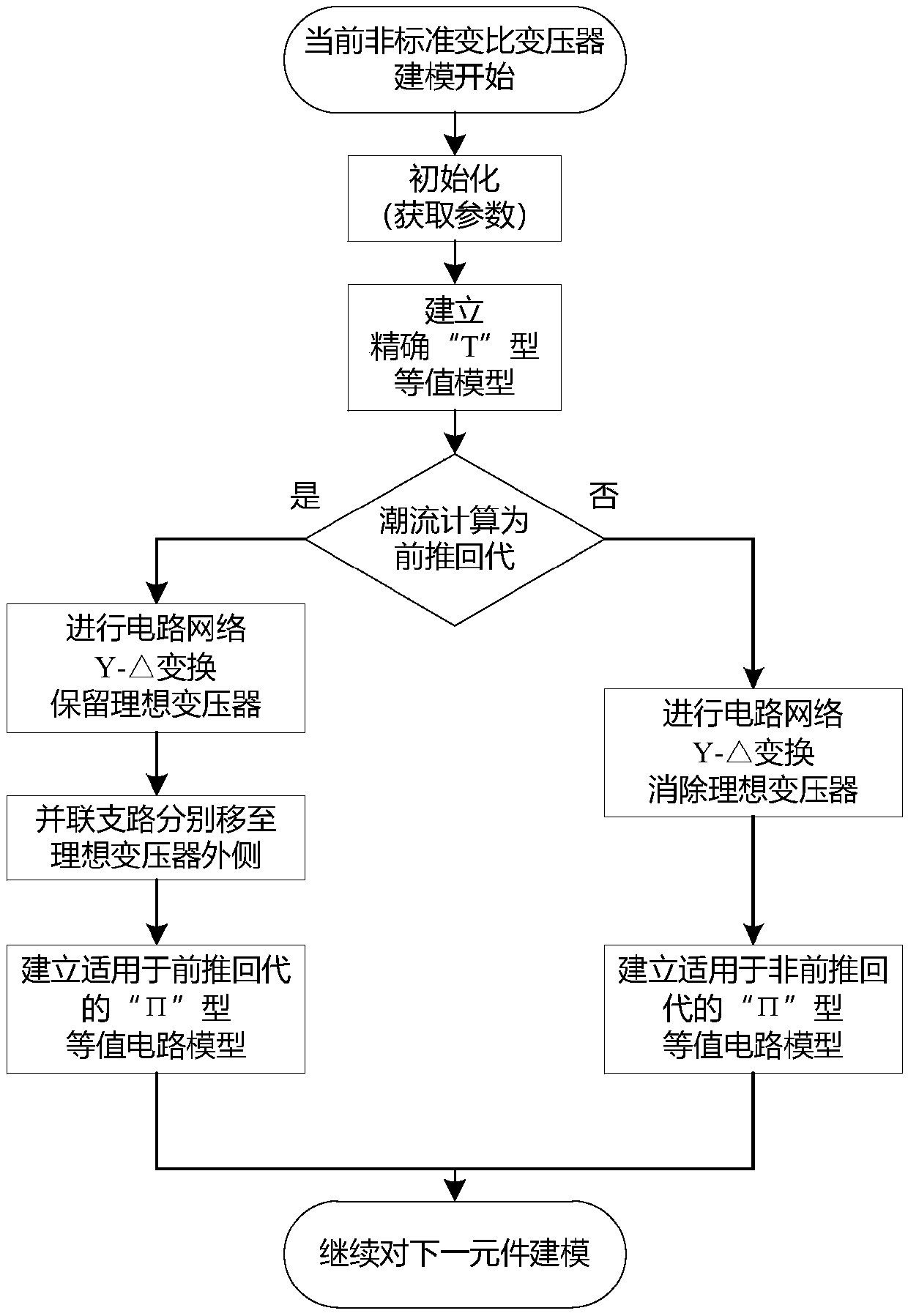
Modeling method for non-standard variable ratio voltage transformer in power flow calculation of power system
PatentInactiveCN108964063A
Innovation
- A modeling method for non-standard ratio transformers in power system power flow calculation is adopted. By establishing an accurate T-shaped equivalent circuit model and performing Y-△ transformation or Kirchhoff's law transformation according to the type of power flow calculation method, a suitable The Π-shaped equivalent circuit model of forward-backward substitution or non-forward-backward substitution removes or retains the ideal transformer to optimize the model structure and improve the accuracy and computational efficiency of the model.


Method of emulating an ideal transformer valid from DC to infinite frequency
PatentInactiveUS6754616B1
Innovation
- The method represents an ideal transformer using an input sub-circuit and an output sub-circuit, each comprising a resistor coupled with a current-controlled current source, which provides current and impedance scaling based on the turns ratio, allowing for frequency-independent modeling from DC to infinity, suitable for use in circuit emulation programs like SPICE.


Standards for Transformer Testing
The accuracy comparison between ideal transformer models and T-equivalent circuits fundamentally depends on adherence to established testing standards that provide the framework for validation and verification. International standards such as IEEE C57.12.90, IEC 60076 series, and ANSI standards define comprehensive testing protocols that enable systematic evaluation of transformer performance characteristics. These standards establish baseline requirements for measuring parameters including impedance, losses, voltage regulation, and efficiency under controlled conditions, which are essential for assessing the accuracy of different modeling approaches.
Testing standards specify precise methodologies for conducting open-circuit and short-circuit tests, which form the foundation for parameter extraction in both ideal and T-equivalent circuit models. The open-circuit test determines magnetizing impedance and core losses, while the short-circuit test reveals leakage impedance and copper losses. These standardized procedures ensure consistency in data collection across different testing facilities and manufacturers, enabling meaningful comparisons between theoretical models and actual transformer behavior. The standards also define acceptable tolerance ranges and measurement uncertainties that directly impact model accuracy assessments.
Temperature correction factors, tap position specifications, and loading conditions outlined in testing standards significantly influence the accuracy evaluation of transformer models. Standards mandate specific ambient conditions and measurement techniques that minimize external variables affecting test results. For T-equivalent circuits, which incorporate more detailed representations of leakage reactances and resistances, compliance with testing standards becomes particularly critical when validating distributed parameter effects and frequency-dependent characteristics that ideal models typically neglect.
Modern testing standards increasingly incorporate requirements for harmonic analysis, transient response evaluation, and thermal performance assessment. These expanded testing protocols reveal limitations in simplified ideal transformer models when compared to T-equivalent circuits under non-sinusoidal conditions or dynamic loading scenarios. The standards provide quantitative metrics for evaluating model accuracy across various operating conditions, establishing clear benchmarks for determining when more sophisticated modeling approaches become necessary for specific applications.
Testing standards specify precise methodologies for conducting open-circuit and short-circuit tests, which form the foundation for parameter extraction in both ideal and T-equivalent circuit models. The open-circuit test determines magnetizing impedance and core losses, while the short-circuit test reveals leakage impedance and copper losses. These standardized procedures ensure consistency in data collection across different testing facilities and manufacturers, enabling meaningful comparisons between theoretical models and actual transformer behavior. The standards also define acceptable tolerance ranges and measurement uncertainties that directly impact model accuracy assessments.
Temperature correction factors, tap position specifications, and loading conditions outlined in testing standards significantly influence the accuracy evaluation of transformer models. Standards mandate specific ambient conditions and measurement techniques that minimize external variables affecting test results. For T-equivalent circuits, which incorporate more detailed representations of leakage reactances and resistances, compliance with testing standards becomes particularly critical when validating distributed parameter effects and frequency-dependent characteristics that ideal models typically neglect.
Modern testing standards increasingly incorporate requirements for harmonic analysis, transient response evaluation, and thermal performance assessment. These expanded testing protocols reveal limitations in simplified ideal transformer models when compared to T-equivalent circuits under non-sinusoidal conditions or dynamic loading scenarios. The standards provide quantitative metrics for evaluating model accuracy across various operating conditions, establishing clear benchmarks for determining when more sophisticated modeling approaches become necessary for specific applications.
Computational Efficiency Considerations
When evaluating transformer modeling approaches, computational efficiency emerges as a critical factor influencing the practical applicability of ideal transformer models versus T-equivalent circuits. The ideal transformer model, characterized by its simplified mathematical representation, offers significant computational advantages in large-scale power system simulations. This model requires minimal computational resources as it eliminates the need to calculate magnetizing current and core loss components, reducing the number of equations and variables in the system matrix. Consequently, simulation convergence rates improve substantially, particularly in iterative solution methods commonly employed in power flow and transient stability analyses.
The T-equivalent circuit, while providing enhanced accuracy through explicit representation of magnetizing impedance and core losses, introduces additional computational burden. Each transformer modeled using this approach adds extra nodes and branches to the network topology, expanding the admittance matrix dimensions and increasing memory requirements. For systems containing hundreds or thousands of transformers, this cumulative effect can significantly impact simulation runtime and computational resource allocation. The trade-off becomes particularly pronounced in real-time applications such as energy management systems and hardware-in-the-loop simulations, where computational speed directly affects operational feasibility.
Modern computational platforms have partially mitigated these efficiency concerns through advanced sparse matrix techniques and parallel processing capabilities. However, the fundamental computational complexity difference persists, especially in dynamic simulations requiring small time steps and frequent matrix factorizations. The choice between models must therefore balance accuracy requirements against available computational resources and time constraints.
For preliminary design studies and large-scale planning analyses where transformer-specific details have minimal impact on overall system behavior, the ideal transformer model provides an optimal efficiency-accuracy balance. Conversely, detailed equipment-level studies, protection coordination analyses, and scenarios where transformer saturation or ferroresonance phenomena are relevant necessitate the T-equivalent circuit despite its computational overhead. Hybrid approaches, selectively applying detailed models only to critical transformers while using simplified representations elsewhere, offer a pragmatic compromise for complex system studies.
The T-equivalent circuit, while providing enhanced accuracy through explicit representation of magnetizing impedance and core losses, introduces additional computational burden. Each transformer modeled using this approach adds extra nodes and branches to the network topology, expanding the admittance matrix dimensions and increasing memory requirements. For systems containing hundreds or thousands of transformers, this cumulative effect can significantly impact simulation runtime and computational resource allocation. The trade-off becomes particularly pronounced in real-time applications such as energy management systems and hardware-in-the-loop simulations, where computational speed directly affects operational feasibility.
Modern computational platforms have partially mitigated these efficiency concerns through advanced sparse matrix techniques and parallel processing capabilities. However, the fundamental computational complexity difference persists, especially in dynamic simulations requiring small time steps and frequent matrix factorizations. The choice between models must therefore balance accuracy requirements against available computational resources and time constraints.
For preliminary design studies and large-scale planning analyses where transformer-specific details have minimal impact on overall system behavior, the ideal transformer model provides an optimal efficiency-accuracy balance. Conversely, detailed equipment-level studies, protection coordination analyses, and scenarios where transformer saturation or ferroresonance phenomena are relevant necessitate the T-equivalent circuit despite its computational overhead. Hybrid approaches, selectively applying detailed models only to critical transformers while using simplified representations elsewhere, offer a pragmatic compromise for complex system studies.
Unlock deeper insights with Patsnap Eureka Quick Research — get a full tech report to explore trends and direct your research. Try now!
Generate Your Research Report Instantly with AI Agent
Supercharge your innovation with Patsnap Eureka AI Agent Platform!