

Comparing Optical Phased Arrays to Radar for Navigation
APR 29, 20268 MIN READ
Generate Your Research Report Instantly with AI Agent
PatSnap Eureka helps you evaluate technical feasibility & market potential.
OPA vs Radar Navigation Background and Objectives
Navigation systems have undergone significant evolution from early celestial navigation methods to modern satellite-based positioning systems. Traditional radar-based navigation emerged in the mid-20th century, providing reliable distance and bearing measurements through radio frequency electromagnetic waves. However, the increasing demand for higher precision, reduced size, weight, and power consumption has driven the exploration of alternative technologies.
Optical Phased Arrays represent an emerging paradigm in navigation technology, leveraging coherent light manipulation through electronically controlled phase shifters. Unlike conventional radar systems that operate in the radio frequency spectrum, OPAs utilize optical wavelengths to achieve beam steering and target detection capabilities. This fundamental difference in operating principles opens new possibilities for navigation applications while presenting unique technical challenges.
The evolution of navigation technology has been characterized by continuous improvements in accuracy, miniaturization, and integration capabilities. Early radar systems required substantial infrastructure and power consumption, limiting their deployment in mobile platforms. Modern phased array radars have addressed many of these limitations through solid-state electronics and advanced signal processing, yet they still face constraints related to antenna size requirements and electromagnetic interference susceptibility.
Current navigation objectives emphasize the need for systems that can operate effectively in contested environments where GPS signals may be unavailable or compromised. This requirement has intensified interest in alternative positioning technologies that can provide autonomous navigation capabilities without relying on external reference signals. Both radar and optical systems offer potential solutions, but with distinctly different operational characteristics and implementation challenges.
The primary objective of comparing OPAs to radar for navigation applications centers on evaluating their relative performance across multiple dimensions including accuracy, range capability, environmental resilience, and integration complexity. Understanding these trade-offs is essential for determining optimal application scenarios and guiding future development investments in navigation technology advancement.
Optical Phased Arrays represent an emerging paradigm in navigation technology, leveraging coherent light manipulation through electronically controlled phase shifters. Unlike conventional radar systems that operate in the radio frequency spectrum, OPAs utilize optical wavelengths to achieve beam steering and target detection capabilities. This fundamental difference in operating principles opens new possibilities for navigation applications while presenting unique technical challenges.
The evolution of navigation technology has been characterized by continuous improvements in accuracy, miniaturization, and integration capabilities. Early radar systems required substantial infrastructure and power consumption, limiting their deployment in mobile platforms. Modern phased array radars have addressed many of these limitations through solid-state electronics and advanced signal processing, yet they still face constraints related to antenna size requirements and electromagnetic interference susceptibility.
Current navigation objectives emphasize the need for systems that can operate effectively in contested environments where GPS signals may be unavailable or compromised. This requirement has intensified interest in alternative positioning technologies that can provide autonomous navigation capabilities without relying on external reference signals. Both radar and optical systems offer potential solutions, but with distinctly different operational characteristics and implementation challenges.
The primary objective of comparing OPAs to radar for navigation applications centers on evaluating their relative performance across multiple dimensions including accuracy, range capability, environmental resilience, and integration complexity. Understanding these trade-offs is essential for determining optimal application scenarios and guiding future development investments in navigation technology advancement.
Market Demand for Advanced Navigation Technologies
The global navigation technology market is experiencing unprecedented growth driven by the convergence of autonomous systems, precision agriculture, and next-generation defense applications. Traditional radar-based navigation systems, while reliable, face increasing limitations in environments requiring ultra-high precision and stealth capabilities. This has created substantial market opportunities for advanced optical navigation technologies, particularly optical phased arrays, which offer superior resolution and reduced electromagnetic signatures.
Autonomous vehicle manufacturers represent one of the most significant demand drivers for advanced navigation technologies. Current radar systems struggle with precise object detection in complex urban environments, creating market pressure for solutions that can provide centimeter-level accuracy. Optical phased arrays address these limitations by offering enhanced spatial resolution and the ability to simultaneously perform navigation and high-resolution imaging functions.
The aerospace and defense sectors demonstrate particularly strong demand for navigation systems that can operate effectively in contested electromagnetic environments. Military applications require navigation solutions that minimize detectability while maintaining operational effectiveness. Optical phased arrays meet these requirements by operating in spectral regions that are less congested and more difficult to jam compared to traditional radar frequencies.
Commercial maritime and aviation industries are increasingly seeking navigation technologies that can provide redundant positioning capabilities independent of GPS systems. The vulnerability of satellite-based navigation to interference and spoofing has created market demand for alternative technologies. Optical navigation systems offer inherent resistance to electronic warfare tactics while providing complementary positioning data.
Emerging applications in robotics and industrial automation are driving demand for compact, high-precision navigation systems. Manufacturing environments require navigation solutions that can operate reliably in the presence of metallic structures and electromagnetic interference. Optical phased arrays provide advantages in these scenarios through their immunity to electromagnetic disturbances and ability to integrate with existing optical sensor networks.
The market demand is further amplified by regulatory pressures requiring backup navigation systems in critical applications. Safety-critical industries are mandating redundant navigation capabilities, creating opportunities for optical navigation technologies to serve as complementary systems to existing radar-based solutions.
Autonomous vehicle manufacturers represent one of the most significant demand drivers for advanced navigation technologies. Current radar systems struggle with precise object detection in complex urban environments, creating market pressure for solutions that can provide centimeter-level accuracy. Optical phased arrays address these limitations by offering enhanced spatial resolution and the ability to simultaneously perform navigation and high-resolution imaging functions.
The aerospace and defense sectors demonstrate particularly strong demand for navigation systems that can operate effectively in contested electromagnetic environments. Military applications require navigation solutions that minimize detectability while maintaining operational effectiveness. Optical phased arrays meet these requirements by operating in spectral regions that are less congested and more difficult to jam compared to traditional radar frequencies.
Commercial maritime and aviation industries are increasingly seeking navigation technologies that can provide redundant positioning capabilities independent of GPS systems. The vulnerability of satellite-based navigation to interference and spoofing has created market demand for alternative technologies. Optical navigation systems offer inherent resistance to electronic warfare tactics while providing complementary positioning data.
Emerging applications in robotics and industrial automation are driving demand for compact, high-precision navigation systems. Manufacturing environments require navigation solutions that can operate reliably in the presence of metallic structures and electromagnetic interference. Optical phased arrays provide advantages in these scenarios through their immunity to electromagnetic disturbances and ability to integrate with existing optical sensor networks.
The market demand is further amplified by regulatory pressures requiring backup navigation systems in critical applications. Safety-critical industries are mandating redundant navigation capabilities, creating opportunities for optical navigation technologies to serve as complementary systems to existing radar-based solutions.
Current State of OPA and Radar Navigation Systems
Optical Phased Arrays (OPAs) represent an emerging technology in navigation systems, leveraging coherent light manipulation through electronically controlled phase shifters to achieve precise beam steering without mechanical components. Current OPA implementations primarily utilize silicon photonics platforms, operating in near-infrared wavelengths between 1.3-1.55 micrometers. Leading research institutions and companies have demonstrated OPA systems capable of achieving beam steering ranges up to 180 degrees with angular resolutions approaching 0.1 degrees.
The technology faces significant challenges in power efficiency and environmental robustness. Current OPA prototypes typically consume 10-50 watts for moderate aperture sizes, substantially higher than comparable radar systems. Temperature sensitivity remains a critical limitation, with phase drift occurring across operational temperature ranges, requiring sophisticated calibration algorithms and thermal management systems.
Radar navigation systems have reached technological maturity across multiple frequency bands, from L-band (1-2 GHz) to millimeter-wave frequencies exceeding 77 GHz. Modern radar implementations incorporate advanced signal processing techniques including synthetic aperture radar (SAR), multiple-input multiple-output (MIMO) configurations, and adaptive beamforming. Commercial automotive radar systems demonstrate centimeter-level accuracy at ranges exceeding 200 meters, while consuming less than 5 watts of power.
Contemporary radar systems excel in adverse weather conditions, maintaining performance through fog, rain, and snow that would severely degrade optical systems. Digital beamforming techniques enable simultaneous multi-target tracking with angular resolutions better than 1 degree. Advanced radar processors integrate machine learning algorithms for improved target classification and false alarm reduction.
The integration landscape shows radar systems dominating current navigation applications due to proven reliability and cost-effectiveness. However, OPA technology demonstrates superior angular resolution potential and immunity to electromagnetic interference. Current development trajectories indicate OPA systems require breakthrough advances in power efficiency and environmental stability before achieving widespread deployment in navigation applications.
The technology faces significant challenges in power efficiency and environmental robustness. Current OPA prototypes typically consume 10-50 watts for moderate aperture sizes, substantially higher than comparable radar systems. Temperature sensitivity remains a critical limitation, with phase drift occurring across operational temperature ranges, requiring sophisticated calibration algorithms and thermal management systems.
Radar navigation systems have reached technological maturity across multiple frequency bands, from L-band (1-2 GHz) to millimeter-wave frequencies exceeding 77 GHz. Modern radar implementations incorporate advanced signal processing techniques including synthetic aperture radar (SAR), multiple-input multiple-output (MIMO) configurations, and adaptive beamforming. Commercial automotive radar systems demonstrate centimeter-level accuracy at ranges exceeding 200 meters, while consuming less than 5 watts of power.
Contemporary radar systems excel in adverse weather conditions, maintaining performance through fog, rain, and snow that would severely degrade optical systems. Digital beamforming techniques enable simultaneous multi-target tracking with angular resolutions better than 1 degree. Advanced radar processors integrate machine learning algorithms for improved target classification and false alarm reduction.
The integration landscape shows radar systems dominating current navigation applications due to proven reliability and cost-effectiveness. However, OPA technology demonstrates superior angular resolution potential and immunity to electromagnetic interference. Current development trajectories indicate OPA systems require breakthrough advances in power efficiency and environmental stability before achieving widespread deployment in navigation applications.
Existing OPA and Radar Navigation Solutions
01 Optical phased array beam steering and control systems
Advanced beam steering mechanisms that enable precise directional control of optical signals through electronic phase manipulation. These systems utilize multiple optical elements arranged in arrays to achieve rapid and accurate beam positioning without mechanical movement, providing enhanced reliability and response times for navigation applications.- Optical phased array beam steering and control systems: Advanced beam steering mechanisms that enable precise directional control of optical signals through phased array configurations. These systems utilize electronic control of phase relationships between array elements to achieve rapid and accurate beam positioning for navigation applications. The technology enables dynamic beam shaping and steering without mechanical movement, providing enhanced reliability and response speed for navigation systems.
- Integrated optical navigation sensor arrays: Comprehensive sensor integration approaches that combine multiple optical phased array elements into unified navigation systems. These configurations provide enhanced spatial awareness and positioning accuracy through coordinated operation of multiple optical elements. The integration enables simultaneous multi-directional sensing and improved signal processing capabilities for complex navigation scenarios.
- Signal processing and calibration methods for optical arrays: Sophisticated algorithms and calibration techniques designed to optimize the performance of optical phased arrays in navigation applications. These methods address phase alignment, signal correction, and adaptive compensation for environmental factors. The processing techniques ensure consistent performance across varying operational conditions and maintain navigation accuracy over extended periods.
- Compact optical phased array architectures: Miniaturized design approaches that enable integration of optical phased arrays into space-constrained navigation systems. These architectures focus on reducing size and weight while maintaining performance characteristics essential for navigation applications. The compact designs facilitate deployment in mobile platforms and embedded navigation systems where space and power consumption are critical factors.
- Multi-dimensional optical scanning and positioning: Advanced scanning methodologies that enable comprehensive spatial coverage and precise positioning through optical phased array systems. These techniques provide multi-axis scanning capabilities and enhanced resolution for navigation and positioning applications. The scanning systems support both continuous and discrete positioning modes, enabling versatile navigation solutions for various operational requirements.
02 Integrated photonic navigation architectures
Comprehensive photonic integration approaches that combine optical phased arrays with navigation processing units on single chip platforms. These architectures enable miniaturized navigation systems with reduced power consumption and improved performance through monolithic integration of optical and electronic components.Expand Specific Solutions03 Phase calibration and error correction methods
Sophisticated calibration techniques designed to maintain phase coherence across array elements and compensate for manufacturing variations and environmental effects. These methods ensure optimal array performance through real-time phase monitoring and adaptive correction algorithms that maintain navigation accuracy over varying operational conditions.Expand Specific Solutions04 Multi-dimensional scanning and tracking capabilities
Advanced scanning methodologies that enable simultaneous multi-axis beam control for comprehensive spatial coverage and target tracking. These capabilities support dynamic navigation scenarios through rapid beam repositioning and continuous target acquisition across wide angular ranges.Expand Specific Solutions05 Signal processing and navigation algorithms
Specialized computational approaches for processing optical phased array signals and extracting navigation information. These algorithms incorporate advanced filtering, correlation, and positioning techniques optimized for optical array data to provide accurate real-time navigation solutions with enhanced noise immunity and signal clarity.Expand Specific Solutions
Key Players in OPA and Radar Navigation Industry
The optical phased array (OPA) versus radar navigation technology landscape represents an emerging sector transitioning from research to early commercialization phases. The market remains nascent with significant growth potential as autonomous systems demand advanced sensing capabilities. Technology maturity varies considerably across players, with leading research institutions like MIT, Caltech, and Columbia University driving fundamental innovations in silicon photonics and beam steering algorithms. Industrial leaders including Lockheed Martin, Raytheon, and Bosch are advancing practical implementations, while specialized companies like LeoLabs and RoboSense focus on specific applications in space tracking and autonomous vehicles respectively. Chinese institutions such as Shanghai Jiao Tong University and UESTC contribute substantial research momentum. The competitive landscape shows a clear divide between academic research excellence and industrial scaling capabilities, with technology readiness levels spanning from laboratory prototypes to pilot deployments across different applications.
California Institute of Technology
Technical Solution: Caltech has pioneered research in optical phased arrays for navigation applications, developing novel architectures that combine silicon photonics with advanced control algorithms. Their research focuses on large-scale optical phased arrays with thousands of elements, enabling unprecedented beam steering capabilities for navigation purposes. Caltech's approach utilizes machine learning algorithms to optimize beam patterns and compensate for manufacturing variations in optical antenna arrays. The institution has demonstrated OPA systems capable of simultaneous multi-beam operation, allowing for concurrent ranging measurements to multiple targets. Their technology incorporates novel calibration techniques that maintain beam quality over temperature variations and component aging. Caltech's research has shown significant improvements in power efficiency compared to mechanical scanning systems, with their OPA designs achieving over 10% wall-plug efficiency while maintaining diffraction-limited beam quality for precision navigation applications.
Strengths: Cutting-edge research capabilities, innovative algorithms for beam optimization, large-scale array demonstrations, strong academic-industry partnerships. Weaknesses: Early-stage technology readiness, limited commercial manufacturing experience, requires significant additional development for practical deployment.
Massachusetts Institute of Technology
Technical Solution: MIT has developed advanced optical phased array (OPA) systems for navigation applications, focusing on solid-state LiDAR technology that eliminates mechanical scanning components. Their OPA approach uses silicon photonics to create electronically steerable beams with microsecond-level beam steering capabilities. The technology integrates thousands of optical antennas on a single chip, enabling precise distance and velocity measurements for navigation. MIT's research demonstrates OPA systems achieving centimeter-level accuracy in ranging applications, with the ability to simultaneously track multiple targets. Their approach leverages coherent detection methods to improve signal-to-noise ratios compared to traditional radar systems, particularly effective in adverse weather conditions where optical wavelengths can provide superior resolution.
Strengths: Superior angular resolution due to shorter wavelengths, compact solid-state design, high precision ranging capabilities. Weaknesses: Limited range compared to radar systems, susceptible to atmospheric conditions like fog and rain, higher power consumption for long-range applications.
Core Innovations in OPA Navigation Technologies
Phased Array Antenna with Isotropic and Non-Isotropic Radiating and Omnidirectional and Non-Omnidirectional Receiving Elements
PatentActiveUS20230112587A1
Innovation
- Implementing a combination of isotropic and non-isotropic radiating elements, where isotropic elements cover non-remote fields and non-isotropic elements, with focused beams, cover remote fields, effectively redirecting excess power to increase the antenna's maximum detection range without increasing element count or power per element.
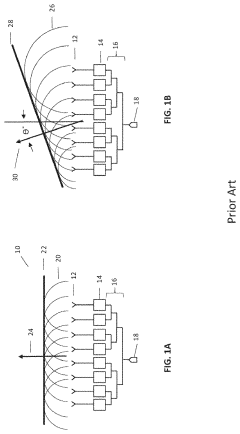
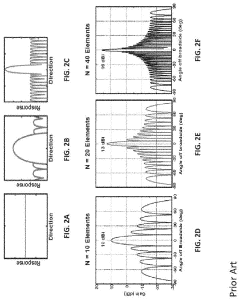
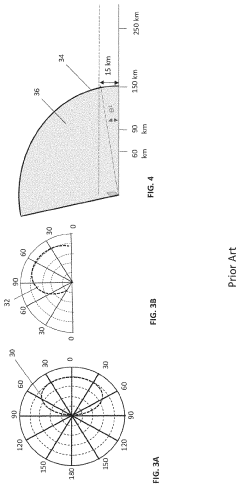
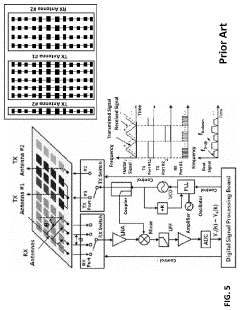
Integrated optical phased array
PatentWO2023275285A1
Innovation
- The integrated optical phased array employs a phase shifter array, waveguide array, and a plane emitting surface, such as a plate or slab grating, to achieve a 180-degree FOV and low beam divergence. This configuration minimizes crosstalk by using a short waveguide array with a half-wavelength pitch and incorporates a beam expander to reduce beam divergence without increasing the number of channels.


Safety Standards for Navigation System Technologies
Safety standards for navigation system technologies represent a critical framework governing the deployment and operation of both optical phased arrays and radar-based navigation systems. The International Civil Aviation Organization (ICAO) and International Maritime Organization (IMO) have established comprehensive safety requirements that directly impact the comparative evaluation of these technologies. These standards encompass performance criteria, reliability thresholds, and operational safety margins that must be met before any navigation technology can be certified for commercial or critical applications.
For radar-based navigation systems, established safety standards have evolved over decades of operational experience. The Required Navigation Performance (RNP) specifications define precise accuracy, integrity, availability, and continuity requirements that radar systems must consistently achieve. These mature standards benefit from extensive real-world validation and well-understood failure modes, providing clear certification pathways for radar implementations.
Optical phased array navigation systems face more complex safety certification challenges due to their relative novelty in navigation applications. Current safety frameworks require adaptation to address unique characteristics of optical systems, including atmospheric interference susceptibility, laser safety considerations, and novel failure modes not present in traditional radar systems. The Federal Aviation Administration and European Union Aviation Safety Agency are developing supplementary guidelines specifically addressing optical navigation technologies.
Environmental safety standards present distinct considerations for each technology. Radar systems must comply with electromagnetic compatibility requirements and radio frequency exposure limits, while optical phased arrays must meet laser safety classifications and optical radiation exposure standards. These divergent safety domains require specialized expertise and testing protocols, influencing system design and operational procedures.
Redundancy and backup system requirements under current safety standards favor radar technology due to its established integration with existing navigation infrastructure. However, emerging standards are beginning to recognize the potential for optical phased arrays to serve as complementary or alternative navigation sources, provided they meet equivalent safety performance metrics and demonstrate sufficient reliability under adverse conditions.
For radar-based navigation systems, established safety standards have evolved over decades of operational experience. The Required Navigation Performance (RNP) specifications define precise accuracy, integrity, availability, and continuity requirements that radar systems must consistently achieve. These mature standards benefit from extensive real-world validation and well-understood failure modes, providing clear certification pathways for radar implementations.
Optical phased array navigation systems face more complex safety certification challenges due to their relative novelty in navigation applications. Current safety frameworks require adaptation to address unique characteristics of optical systems, including atmospheric interference susceptibility, laser safety considerations, and novel failure modes not present in traditional radar systems. The Federal Aviation Administration and European Union Aviation Safety Agency are developing supplementary guidelines specifically addressing optical navigation technologies.
Environmental safety standards present distinct considerations for each technology. Radar systems must comply with electromagnetic compatibility requirements and radio frequency exposure limits, while optical phased arrays must meet laser safety classifications and optical radiation exposure standards. These divergent safety domains require specialized expertise and testing protocols, influencing system design and operational procedures.
Redundancy and backup system requirements under current safety standards favor radar technology due to its established integration with existing navigation infrastructure. However, emerging standards are beginning to recognize the potential for optical phased arrays to serve as complementary or alternative navigation sources, provided they meet equivalent safety performance metrics and demonstrate sufficient reliability under adverse conditions.
Environmental Impact of Navigation Technologies
The environmental implications of navigation technologies represent a critical consideration in the evaluation of optical phased arrays versus radar systems. Both technologies present distinct environmental footprints that extend beyond their operational performance characteristics, encompassing energy consumption patterns, electromagnetic emissions, and lifecycle sustainability factors.
Optical phased arrays demonstrate significantly lower electromagnetic interference profiles compared to traditional radar systems. While radar operates through active emission of radio frequency signals that can potentially interfere with wildlife migration patterns and sensitive electronic equipment, optical systems primarily utilize infrared or near-infrared wavelengths with minimal environmental disruption. This characteristic makes optical phased arrays particularly suitable for deployment in ecologically sensitive areas where electromagnetic pollution must be minimized.
Energy efficiency represents another crucial environmental differentiator between these technologies. Optical phased arrays typically require substantially less power for operation, particularly in passive detection modes where they rely on ambient or reflected light sources. Radar systems, conversely, demand continuous high-power transmission for effective range detection and tracking capabilities. This power differential translates directly into reduced carbon footprint and lower operational environmental impact for optical systems.
The manufacturing and disposal phases of these technologies also present contrasting environmental considerations. Optical phased arrays utilize semiconductor materials and precision optical components that, while requiring energy-intensive fabrication processes, generally contain fewer rare earth elements compared to high-power radar transmitters. However, the precision manufacturing requirements for optical components may involve specialized chemical processes with their own environmental implications.
Radar systems present challenges related to their electromagnetic spectrum utilization, potentially contributing to radio frequency pollution in increasingly crowded spectral environments. The proliferation of radar-based navigation systems raises concerns about cumulative electromagnetic exposure and interference with natural biological processes that rely on electromagnetic sensitivity.
Long-term sustainability considerations favor optical technologies due to their potential for integration with renewable energy sources and reduced infrastructure requirements. The compact nature of optical phased arrays enables deployment scenarios with minimal environmental disruption, while radar installations often require substantial supporting infrastructure and clear electromagnetic corridors that may impact local ecosystems and land use patterns.
Optical phased arrays demonstrate significantly lower electromagnetic interference profiles compared to traditional radar systems. While radar operates through active emission of radio frequency signals that can potentially interfere with wildlife migration patterns and sensitive electronic equipment, optical systems primarily utilize infrared or near-infrared wavelengths with minimal environmental disruption. This characteristic makes optical phased arrays particularly suitable for deployment in ecologically sensitive areas where electromagnetic pollution must be minimized.
Energy efficiency represents another crucial environmental differentiator between these technologies. Optical phased arrays typically require substantially less power for operation, particularly in passive detection modes where they rely on ambient or reflected light sources. Radar systems, conversely, demand continuous high-power transmission for effective range detection and tracking capabilities. This power differential translates directly into reduced carbon footprint and lower operational environmental impact for optical systems.
The manufacturing and disposal phases of these technologies also present contrasting environmental considerations. Optical phased arrays utilize semiconductor materials and precision optical components that, while requiring energy-intensive fabrication processes, generally contain fewer rare earth elements compared to high-power radar transmitters. However, the precision manufacturing requirements for optical components may involve specialized chemical processes with their own environmental implications.
Radar systems present challenges related to their electromagnetic spectrum utilization, potentially contributing to radio frequency pollution in increasingly crowded spectral environments. The proliferation of radar-based navigation systems raises concerns about cumulative electromagnetic exposure and interference with natural biological processes that rely on electromagnetic sensitivity.
Long-term sustainability considerations favor optical technologies due to their potential for integration with renewable energy sources and reduced infrastructure requirements. The compact nature of optical phased arrays enables deployment scenarios with minimal environmental disruption, while radar installations often require substantial supporting infrastructure and clear electromagnetic corridors that may impact local ecosystems and land use patterns.
Unlock deeper insights with PatSnap Eureka Quick Research — get a full tech report to explore trends and direct your research. Try now!
Generate Your Research Report Instantly with AI Agent
Supercharge your innovation with PatSnap Eureka AI Agent Platform!