1D pMUT array vs 2D pMUT array: Which Enables 3D beamforming?
MAY 5, 20269 MIN READ
Generate Your Research Report Instantly with AI Agent
PatSnap Eureka helps you evaluate technical feasibility & market potential.
pMUT Array Technology Background and 3D Beamforming Goals
Piezoelectric Micromachined Ultrasonic Transducers (pMUTs) represent a revolutionary advancement in ultrasonic sensing technology, emerging from the convergence of MEMS fabrication techniques and piezoelectric materials science. These devices leverage the piezoelectric effect to convert electrical signals into mechanical vibrations and vice versa, enabling precise ultrasonic wave generation and detection at microscale dimensions. The technology has evolved significantly since its inception in the early 2000s, transitioning from simple single-element designs to sophisticated array configurations.
The fundamental architecture of pMUT arrays involves multiple transducer elements arranged in either one-dimensional (1D) or two-dimensional (2D) configurations. 1D pMUT arrays feature elements aligned along a single axis, typically offering simplified control electronics and manufacturing processes. In contrast, 2D pMUT arrays distribute elements across a planar surface in matrix formations, providing enhanced spatial control capabilities but requiring more complex addressing schemes and fabrication methodologies.
Historical development of pMUT technology has been driven by the limitations of traditional bulk piezoelectric transducers, particularly in applications requiring miniaturization, low power consumption, and integration with semiconductor processing. Early implementations focused on single-frequency operation and basic imaging applications, but technological maturation has enabled broadband operation and advanced signal processing capabilities.
The evolution toward array configurations emerged from the recognition that multiple transducer elements could provide superior beam control, improved signal-to-noise ratios, and enhanced spatial resolution compared to single-element devices. This progression paralleled developments in digital signal processing and beamforming algorithms, creating synergistic opportunities for advanced ultrasonic applications.
Three-dimensional beamforming represents the pinnacle of ultrasonic array technology, enabling precise control of acoustic energy in all spatial dimensions. The primary objective involves achieving dynamic focusing capabilities that can electronically steer and shape ultrasonic beams without mechanical movement. This capability is essential for applications requiring real-time adaptive focusing, multi-zone operation, and complex beam patterns.
The technical goals for 3D beamforming with pMUT arrays encompass several critical performance metrics. Spatial resolution enhancement aims to achieve sub-wavelength focusing precision, while temporal control seeks to enable rapid beam steering with microsecond response times. Additionally, the technology targets improved penetration depth and reduced side-lobe levels compared to conventional ultrasonic systems.
Current research directions focus on optimizing array geometries, developing advanced beamforming algorithms, and integrating artificial intelligence for adaptive beam control. The ultimate vision involves creating intelligent ultrasonic systems capable of autonomous operation across diverse application domains, from medical diagnostics to industrial sensing and autonomous vehicle navigation.
The fundamental architecture of pMUT arrays involves multiple transducer elements arranged in either one-dimensional (1D) or two-dimensional (2D) configurations. 1D pMUT arrays feature elements aligned along a single axis, typically offering simplified control electronics and manufacturing processes. In contrast, 2D pMUT arrays distribute elements across a planar surface in matrix formations, providing enhanced spatial control capabilities but requiring more complex addressing schemes and fabrication methodologies.
Historical development of pMUT technology has been driven by the limitations of traditional bulk piezoelectric transducers, particularly in applications requiring miniaturization, low power consumption, and integration with semiconductor processing. Early implementations focused on single-frequency operation and basic imaging applications, but technological maturation has enabled broadband operation and advanced signal processing capabilities.
The evolution toward array configurations emerged from the recognition that multiple transducer elements could provide superior beam control, improved signal-to-noise ratios, and enhanced spatial resolution compared to single-element devices. This progression paralleled developments in digital signal processing and beamforming algorithms, creating synergistic opportunities for advanced ultrasonic applications.
Three-dimensional beamforming represents the pinnacle of ultrasonic array technology, enabling precise control of acoustic energy in all spatial dimensions. The primary objective involves achieving dynamic focusing capabilities that can electronically steer and shape ultrasonic beams without mechanical movement. This capability is essential for applications requiring real-time adaptive focusing, multi-zone operation, and complex beam patterns.
The technical goals for 3D beamforming with pMUT arrays encompass several critical performance metrics. Spatial resolution enhancement aims to achieve sub-wavelength focusing precision, while temporal control seeks to enable rapid beam steering with microsecond response times. Additionally, the technology targets improved penetration depth and reduced side-lobe levels compared to conventional ultrasonic systems.
Current research directions focus on optimizing array geometries, developing advanced beamforming algorithms, and integrating artificial intelligence for adaptive beam control. The ultimate vision involves creating intelligent ultrasonic systems capable of autonomous operation across diverse application domains, from medical diagnostics to industrial sensing and autonomous vehicle navigation.
Market Demand for Advanced pMUT Array Solutions
The global ultrasound imaging market is experiencing unprecedented growth driven by increasing demand for non-invasive diagnostic solutions and real-time imaging capabilities. Healthcare providers worldwide are seeking advanced ultrasound technologies that can deliver superior image quality, enhanced diagnostic accuracy, and improved patient outcomes. This growing demand has created substantial market opportunities for next-generation ultrasound transducer technologies, particularly advanced pMUT array solutions.
Medical imaging applications represent the largest market segment for advanced pMUT arrays, with hospitals and diagnostic centers actively upgrading their ultrasound equipment to support three-dimensional imaging capabilities. The shift from traditional 2D imaging to volumetric 3D imaging has become a critical requirement in cardiology, obstetrics, and interventional procedures. Healthcare institutions are increasingly prioritizing ultrasound systems that can provide comprehensive spatial information through advanced beamforming techniques.
The automotive industry has emerged as a significant growth driver for pMUT array technologies, particularly in autonomous vehicle development and advanced driver assistance systems. Vehicle manufacturers are integrating sophisticated ultrasonic sensing solutions for object detection, parking assistance, and collision avoidance systems. The demand for high-resolution spatial mapping and accurate distance measurement in automotive applications has accelerated the adoption of advanced pMUT array configurations.
Industrial non-destructive testing markets are experiencing substantial growth in demand for advanced ultrasonic inspection solutions. Manufacturing industries require precise flaw detection, material characterization, and structural integrity assessment capabilities. The ability to perform three-dimensional defect mapping and volumetric inspection has become increasingly important for quality assurance and safety compliance across aerospace, energy, and manufacturing sectors.
Consumer electronics applications are driving demand for miniaturized yet high-performance pMUT array solutions. The integration of ultrasonic sensing capabilities in smartphones, wearable devices, and smart home systems has created new market opportunities. Manufacturers are seeking compact pMUT array solutions that can enable gesture recognition, proximity sensing, and biometric authentication while maintaining low power consumption and cost-effectiveness.
The market demand is increasingly focused on pMUT array solutions that can enable flexible beamforming architectures, supporting both focused beam patterns and wide-field imaging modes. End users across various industries are seeking versatile ultrasonic systems that can adapt to different application requirements while maintaining consistent performance and reliability standards.
Medical imaging applications represent the largest market segment for advanced pMUT arrays, with hospitals and diagnostic centers actively upgrading their ultrasound equipment to support three-dimensional imaging capabilities. The shift from traditional 2D imaging to volumetric 3D imaging has become a critical requirement in cardiology, obstetrics, and interventional procedures. Healthcare institutions are increasingly prioritizing ultrasound systems that can provide comprehensive spatial information through advanced beamforming techniques.
The automotive industry has emerged as a significant growth driver for pMUT array technologies, particularly in autonomous vehicle development and advanced driver assistance systems. Vehicle manufacturers are integrating sophisticated ultrasonic sensing solutions for object detection, parking assistance, and collision avoidance systems. The demand for high-resolution spatial mapping and accurate distance measurement in automotive applications has accelerated the adoption of advanced pMUT array configurations.
Industrial non-destructive testing markets are experiencing substantial growth in demand for advanced ultrasonic inspection solutions. Manufacturing industries require precise flaw detection, material characterization, and structural integrity assessment capabilities. The ability to perform three-dimensional defect mapping and volumetric inspection has become increasingly important for quality assurance and safety compliance across aerospace, energy, and manufacturing sectors.
Consumer electronics applications are driving demand for miniaturized yet high-performance pMUT array solutions. The integration of ultrasonic sensing capabilities in smartphones, wearable devices, and smart home systems has created new market opportunities. Manufacturers are seeking compact pMUT array solutions that can enable gesture recognition, proximity sensing, and biometric authentication while maintaining low power consumption and cost-effectiveness.
The market demand is increasingly focused on pMUT array solutions that can enable flexible beamforming architectures, supporting both focused beam patterns and wide-field imaging modes. End users across various industries are seeking versatile ultrasonic systems that can adapt to different application requirements while maintaining consistent performance and reliability standards.
Current State and Challenges of 1D vs 2D pMUT Arrays
The current landscape of piezoelectric micromachined ultrasonic transducers (pMUTs) reveals significant disparities between 1D and 2D array configurations, particularly in their capability to enable effective 3D beamforming. Contemporary 1D pMUT arrays demonstrate mature fabrication processes and established manufacturing protocols, with several commercial implementations achieving reliable performance in medical imaging and industrial sensing applications. These linear arrays typically operate with element pitches ranging from 100 to 300 micrometers and demonstrate consistent acoustic performance across frequencies from 1 to 20 MHz.
In contrast, 2D pMUT arrays represent an emerging technology with substantially more complex design requirements and manufacturing challenges. Current 2D implementations face significant constraints in element density, with most existing prototypes limited to relatively sparse arrays due to interconnection complexity and crosstalk management issues. The fabrication yield for 2D arrays remains considerably lower than their 1D counterparts, primarily due to the exponential increase in electrical connections and the associated packaging challenges.
Signal processing capabilities present another critical differentiation point. Existing 1D arrays rely on mechanical or electronic steering in the elevation plane, limiting their 3D beamforming precision to predetermined focal zones. Current commercial systems compensate through acoustic lensing or multi-element focusing techniques, but these approaches inherently restrict dynamic beam steering capabilities and limit the achievable beam quality in three-dimensional space.
The primary technical challenges facing 2D pMUT arrays include thermal management, where the increased element density creates significant heat dissipation issues that can affect piezoelectric performance and long-term reliability. Crosstalk between adjacent elements remains a persistent problem, with current isolation techniques proving insufficient for high-density configurations. Additionally, the complexity of driving electronics scales quadratically with array dimensions, creating substantial challenges in system integration and cost management.
Manufacturing consistency represents another significant hurdle, as 2D arrays require precise control over thousands of individual elements simultaneously. Current fabrication techniques struggle to maintain uniform piezoelectric properties across large 2D arrays, resulting in amplitude and phase variations that degrade beamforming performance. The packaging and interconnection technologies for 2D arrays remain largely experimental, with most implementations limited to research prototypes rather than commercially viable products.
Despite these challenges, recent advances in MEMS fabrication and 3D packaging technologies are beginning to address some fundamental limitations, suggesting potential pathways toward more practical 2D pMUT array implementations for advanced 3D beamforming applications.
In contrast, 2D pMUT arrays represent an emerging technology with substantially more complex design requirements and manufacturing challenges. Current 2D implementations face significant constraints in element density, with most existing prototypes limited to relatively sparse arrays due to interconnection complexity and crosstalk management issues. The fabrication yield for 2D arrays remains considerably lower than their 1D counterparts, primarily due to the exponential increase in electrical connections and the associated packaging challenges.
Signal processing capabilities present another critical differentiation point. Existing 1D arrays rely on mechanical or electronic steering in the elevation plane, limiting their 3D beamforming precision to predetermined focal zones. Current commercial systems compensate through acoustic lensing or multi-element focusing techniques, but these approaches inherently restrict dynamic beam steering capabilities and limit the achievable beam quality in three-dimensional space.
The primary technical challenges facing 2D pMUT arrays include thermal management, where the increased element density creates significant heat dissipation issues that can affect piezoelectric performance and long-term reliability. Crosstalk between adjacent elements remains a persistent problem, with current isolation techniques proving insufficient for high-density configurations. Additionally, the complexity of driving electronics scales quadratically with array dimensions, creating substantial challenges in system integration and cost management.
Manufacturing consistency represents another significant hurdle, as 2D arrays require precise control over thousands of individual elements simultaneously. Current fabrication techniques struggle to maintain uniform piezoelectric properties across large 2D arrays, resulting in amplitude and phase variations that degrade beamforming performance. The packaging and interconnection technologies for 2D arrays remain largely experimental, with most implementations limited to research prototypes rather than commercially viable products.
Despite these challenges, recent advances in MEMS fabrication and 3D packaging technologies are beginning to address some fundamental limitations, suggesting potential pathways toward more practical 2D pMUT array implementations for advanced 3D beamforming applications.
Existing 1D and 2D pMUT Array Implementation Solutions
01 Array configuration and element arrangement for 3D beamforming
Techniques for optimizing the physical arrangement and configuration of piezoelectric micromachined ultrasonic transducer elements in arrays to enable effective three-dimensional beamforming. This includes methods for determining optimal spacing, positioning, and geometric layouts of transducer elements to achieve desired beam patterns and directional control in three-dimensional space.- Array configuration and element arrangement for 3D beamforming: Techniques for optimizing the physical arrangement and configuration of piezoelectric micromachined ultrasonic transducer elements in arrays to enable effective three-dimensional beamforming. This includes methods for determining optimal spacing, positioning, and geometric layouts of transducer elements to achieve desired beam patterns and directional control in three-dimensional space.
- Signal processing algorithms for 3D beam steering: Advanced signal processing methods and algorithms specifically designed for controlling and steering ultrasonic beams in three-dimensional space using arrays. These techniques involve complex mathematical computations for phase delays, amplitude weighting, and timing control to achieve precise beam direction and focus in multiple dimensions simultaneously.
- Multi-dimensional focusing and imaging techniques: Methods for achieving precise focusing capabilities and enhanced imaging resolution through three-dimensional beamforming approaches. These techniques enable improved depth perception, volumetric imaging, and enhanced signal-to-noise ratios by utilizing sophisticated focusing algorithms and multi-dimensional signal processing.
- Real-time beamforming control systems: Systems and methods for implementing real-time control and adjustment of beamforming parameters in three-dimensional applications. These approaches involve dynamic adaptation of beam characteristics, automated calibration procedures, and responsive control mechanisms that can adjust beamforming parameters based on real-time feedback and environmental conditions.
- Hardware implementation and circuit design: Specialized hardware architectures and circuit designs optimized for three-dimensional beamforming applications. This includes integrated circuit solutions, driver electronics, and hardware acceleration techniques that enable efficient implementation of complex beamforming algorithms while maintaining low power consumption and high performance.
02 Signal processing algorithms for 3D beam steering
Advanced signal processing methods and algorithms specifically designed for controlling and steering ultrasonic beams in three dimensions using arrays. These techniques involve complex mathematical computations for phase and amplitude control of individual array elements to achieve precise beam direction and focus in volumetric space.Expand Specific Solutions03 Delay and phase control mechanisms
Systems and methods for implementing precise timing delays and phase adjustments across array elements to enable coherent beamforming in three-dimensional applications. These mechanisms ensure proper synchronization and phase relationships between transducer elements for optimal beam formation and steering capabilities.Expand Specific Solutions04 Multi-dimensional imaging and focusing techniques
Methodologies for achieving enhanced imaging resolution and dynamic focusing capabilities in three-dimensional space through advanced beamforming techniques. These approaches enable improved image quality, depth perception, and volumetric reconstruction by optimizing the focusing characteristics of ultrasonic arrays.Expand Specific Solutions05 Hardware implementation and control systems
Electronic control systems and hardware architectures specifically designed for implementing three-dimensional beamforming with arrays. This includes driver circuits, control interfaces, and integrated systems that manage the complex timing and signal requirements necessary for effective volumetric beamforming operations.Expand Specific Solutions
Key Players in pMUT and Ultrasonic Transducer Industry
The pMUT array technology for 3D beamforming is in a rapidly evolving growth stage, driven by increasing demand for advanced ultrasound imaging and miniaturized medical devices. The market shows significant expansion potential, particularly in portable ultrasound systems and point-of-care diagnostics. Technology maturity varies considerably across players, with established medical imaging giants like Siemens Medical Solutions, Koninklijke Philips, and Samsung Electronics leading in commercial deployment and system integration. Emerging companies such as Exo Imaging focus on innovative handheld platforms, while research institutions including Duke University, KU Leuven, and Fraunhofer-Gesellschaft drive fundamental advances in pMUT design and beamforming algorithms. Semiconductor leaders like Intel and Qualcomm contribute processing capabilities, while specialized firms like BK Medical and foundries such as Xiver Mems advance manufacturing techniques. The competitive landscape reflects a transition from research-phase innovations to commercial viability.
Exo Imaging, Inc.
Technical Solution: Exo Imaging specializes in portable ultrasound systems using advanced pMUT array technology specifically designed for 3D beamforming applications. Their proprietary approach focuses on optimizing both 1D linear arrays and 2D matrix arrays to achieve superior image quality in handheld devices. The company's technology emphasizes low-power consumption and compact form factors while maintaining high sensitivity and broad bandwidth characteristics. Their beamforming implementation utilizes sophisticated algorithms that account for the unique acoustic properties of pMUT transducers, including frequency-dependent directivity patterns and thermal stability considerations. The system architecture integrates custom ASIC designs to handle the complex signal processing requirements of multi-dimensional array configurations.
Strengths: Specialized focus on portable ultrasound applications, innovative low-power designs, compact system integration. Weaknesses: Limited market presence compared to established players, potential scalability challenges for high-volume production.
Siemens Medical Solutions USA, Inc.
Technical Solution: Siemens has developed comprehensive pMUT array solutions for advanced medical imaging applications, with particular emphasis on comparing 1D and 2D configurations for optimal 3D beamforming performance. Their technology platform incorporates sophisticated transducer designs with optimized acoustic coupling and advanced materials engineering to enhance sensitivity and bandwidth. The company's approach to 2D pMUT arrays features innovative interconnection schemes and integrated electronics that minimize parasitic effects while maximizing signal-to-noise ratios. Their beamforming algorithms are specifically tailored to address the unique characteristics of pMUT technology, including compensation for manufacturing variations and temperature-dependent performance changes. The system architecture supports real-time 3D imaging with advanced processing capabilities.
Strengths: Strong research and development capabilities, extensive clinical validation experience, comprehensive system integration expertise. Weaknesses: Focus primarily on high-end medical applications, potentially higher costs for broader market adoption.
Core Innovations in 3D Beamforming with pMUT Arrays
PMUT array employing integrated MEMS switches
PatentWO2014126724A1
Innovation
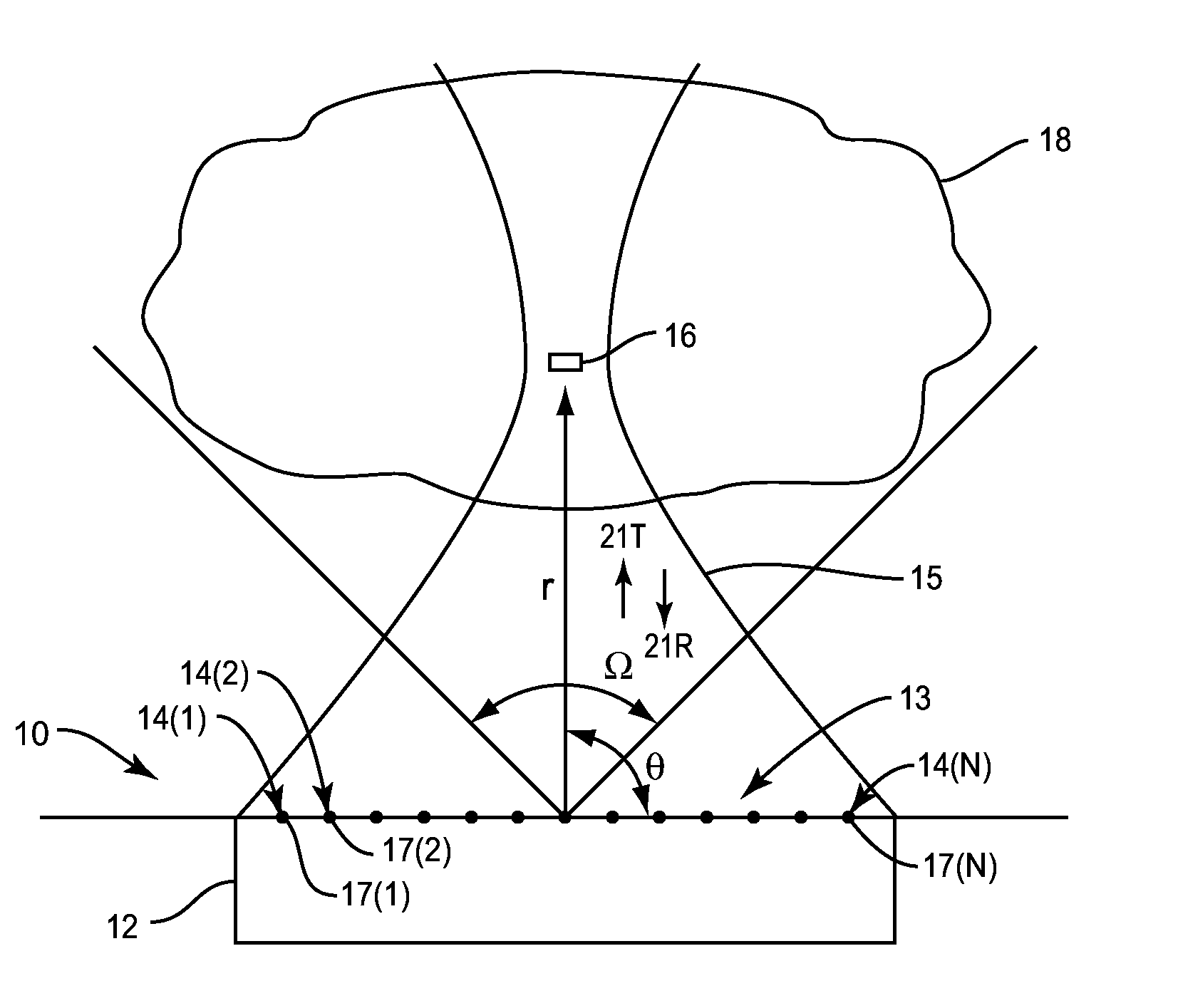
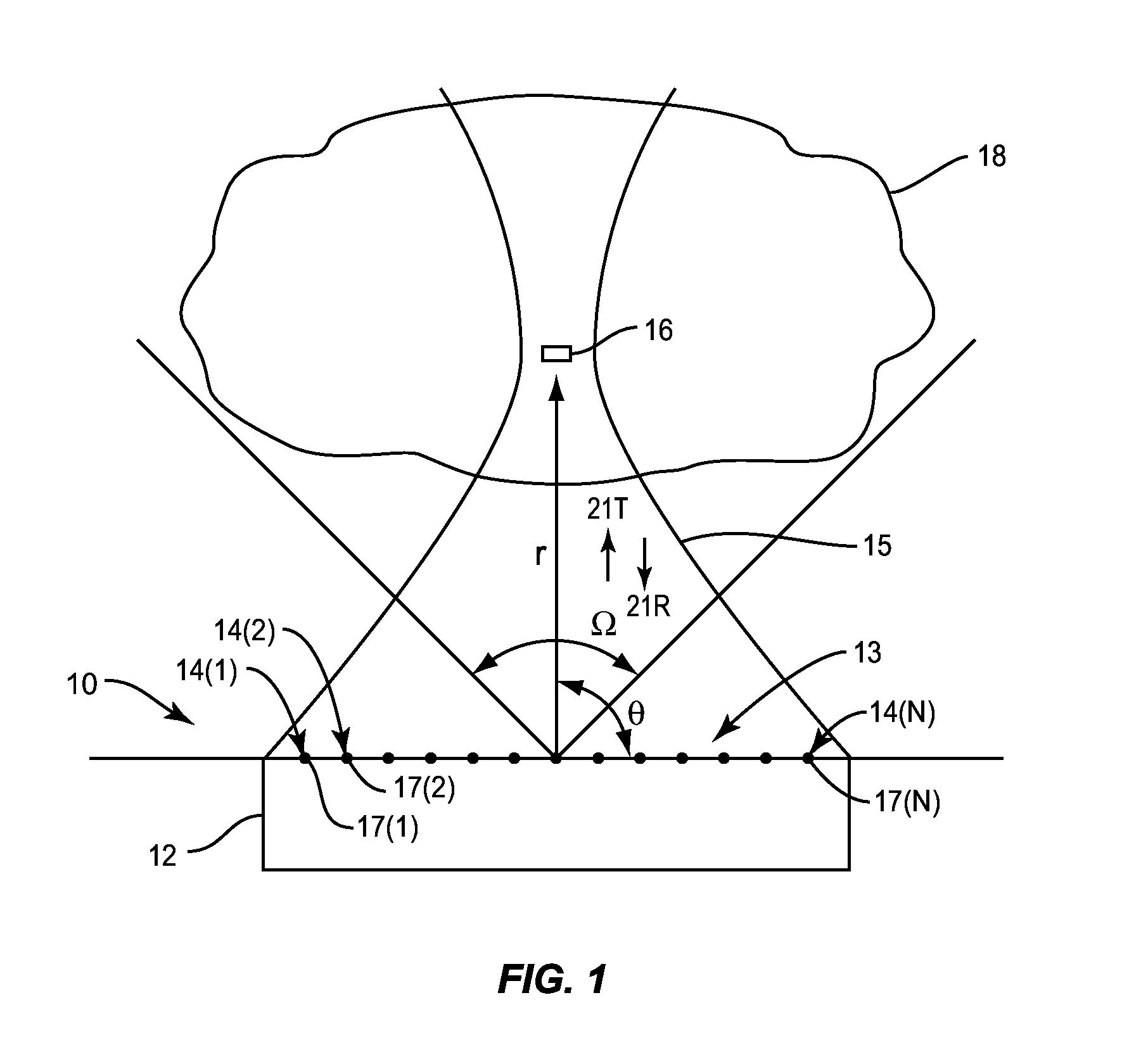
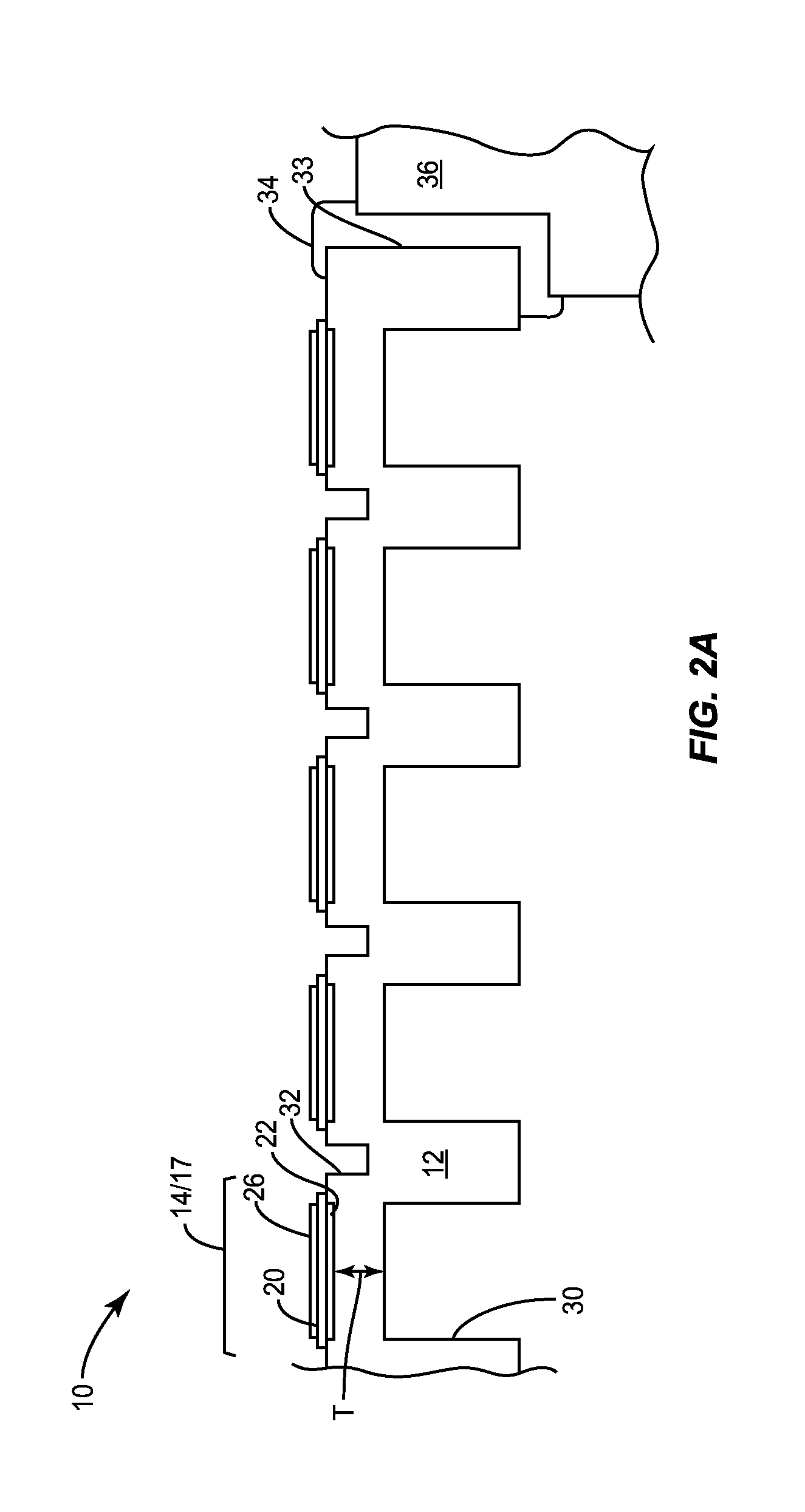
- Integration of MicroElectroMechanical Systems (MEMS) switches within the transducer array substrate, allowing for element-level addressing and reduced interconnects between the transducer and control circuitry, enabling 2D arrays with simplified multiplexing and reduced complexity in fabrication.


pMUT ARRAY FOR ULTRASONIC IMAGING, AND RELATED APPARATUSES, SYSTEMS, AND METHODS
PatentActiveUS20150265245A1
Innovation
- The use of Piezoelectric Micromachined Ultrasound Transducer (pMUT) arrays with predetermined geometry configured for fundamental mode vibration, allowing for smaller sizes and increased frequency capabilities, with each pMUT element being membrane-based and disposed directly on a substrate using MEMS techniques, eliminating the need for destructive dicing processes.

Manufacturing Complexity and Cost Analysis
The manufacturing complexity of pMUT arrays varies significantly between 1D and 2D configurations, directly impacting production costs and scalability for 3D beamforming applications. 1D pMUT arrays feature a linear arrangement of transducer elements, requiring relatively straightforward fabrication processes with conventional semiconductor manufacturing techniques. The simplified electrode routing and interconnection patterns in 1D arrays reduce the number of lithographic steps and minimize the risk of manufacturing defects.
In contrast, 2D pMUT arrays present substantially higher manufacturing complexity due to their matrix configuration requiring precise alignment of hundreds or thousands of individual elements. The fabrication process involves multiple layers of metallization, complex via structures, and sophisticated interconnection schemes to address each element independently. Advanced photolithography techniques and tight dimensional tolerances are essential to maintain uniform performance across the entire array, significantly increasing production time and equipment requirements.
Cost analysis reveals that 1D arrays benefit from lower material consumption and reduced processing steps, resulting in approximately 40-60% lower manufacturing costs compared to equivalent 2D arrays. The yield rates for 1D arrays typically exceed 85%, while 2D arrays often experience yields between 60-75% due to increased probability of defects across the larger number of active elements. Additionally, the testing and quality assurance procedures for 2D arrays require more sophisticated equipment and longer validation cycles.
However, the cost-per-performance ratio must consider the superior beamforming capabilities of 2D arrays. While initial manufacturing costs are higher, 2D arrays enable true volumetric imaging with enhanced spatial resolution and reduced side lobes, potentially justifying the increased investment for high-end applications. The economies of scale also favor 2D arrays in high-volume production scenarios, where the fixed costs of advanced manufacturing infrastructure can be amortized across larger production runs.
Manufacturing scalability presents different challenges for each configuration. 1D arrays can leverage existing production lines with minimal modifications, enabling rapid scaling and shorter time-to-market. Conversely, 2D arrays require specialized fabrication facilities and extensive process optimization, creating barriers to entry but offering greater differentiation potential in competitive markets.
In contrast, 2D pMUT arrays present substantially higher manufacturing complexity due to their matrix configuration requiring precise alignment of hundreds or thousands of individual elements. The fabrication process involves multiple layers of metallization, complex via structures, and sophisticated interconnection schemes to address each element independently. Advanced photolithography techniques and tight dimensional tolerances are essential to maintain uniform performance across the entire array, significantly increasing production time and equipment requirements.
Cost analysis reveals that 1D arrays benefit from lower material consumption and reduced processing steps, resulting in approximately 40-60% lower manufacturing costs compared to equivalent 2D arrays. The yield rates for 1D arrays typically exceed 85%, while 2D arrays often experience yields between 60-75% due to increased probability of defects across the larger number of active elements. Additionally, the testing and quality assurance procedures for 2D arrays require more sophisticated equipment and longer validation cycles.
However, the cost-per-performance ratio must consider the superior beamforming capabilities of 2D arrays. While initial manufacturing costs are higher, 2D arrays enable true volumetric imaging with enhanced spatial resolution and reduced side lobes, potentially justifying the increased investment for high-end applications. The economies of scale also favor 2D arrays in high-volume production scenarios, where the fixed costs of advanced manufacturing infrastructure can be amortized across larger production runs.
Manufacturing scalability presents different challenges for each configuration. 1D arrays can leverage existing production lines with minimal modifications, enabling rapid scaling and shorter time-to-market. Conversely, 2D arrays require specialized fabrication facilities and extensive process optimization, creating barriers to entry but offering greater differentiation potential in competitive markets.
Signal Processing Requirements for 3D Beamforming
The implementation of 3D beamforming with pMUT arrays demands sophisticated signal processing architectures that vary significantly between 1D and 2D configurations. For 1D pMUT arrays, the signal processing requirements focus primarily on temporal delay calculations and amplitude weighting along a single spatial dimension. The processing pipeline typically involves analog-to-digital conversion, time-delay compensation, and coherent summation algorithms that operate on relatively straightforward geometric relationships.
In contrast, 2D pMUT arrays introduce substantially more complex signal processing demands due to their ability to steer beams in both azimuth and elevation planes simultaneously. The computational requirements scale exponentially with the number of array elements, necessitating advanced parallel processing architectures and optimized algorithms for real-time operation. Each element in a 2D array requires independent phase and amplitude control, resulting in significantly higher data throughput requirements and more sophisticated beamforming calculations.
The digital signal processing chain for 2D arrays must accommodate multi-dimensional Fourier transforms, complex matrix operations for steering vector calculations, and adaptive algorithms for dynamic beam optimization. Memory bandwidth becomes a critical constraint as the system must store and process channel data from potentially hundreds of individual pMUT elements simultaneously. Advanced interpolation techniques are essential for achieving fine angular resolution in both spatial dimensions.
Real-time processing constraints impose stringent requirements on computational hardware selection. While 1D arrays can often utilize conventional digital signal processors, 2D implementations typically require field-programmable gate arrays or specialized application-specific integrated circuits to meet latency and throughput specifications. The signal processing architecture must also incorporate sophisticated calibration algorithms to compensate for element-to-element variations and maintain beam quality across the entire aperture.
Power consumption considerations become particularly critical for portable applications, as the increased computational complexity of 2D beamforming directly impacts battery life and thermal management requirements in compact ultrasound systems.
In contrast, 2D pMUT arrays introduce substantially more complex signal processing demands due to their ability to steer beams in both azimuth and elevation planes simultaneously. The computational requirements scale exponentially with the number of array elements, necessitating advanced parallel processing architectures and optimized algorithms for real-time operation. Each element in a 2D array requires independent phase and amplitude control, resulting in significantly higher data throughput requirements and more sophisticated beamforming calculations.
The digital signal processing chain for 2D arrays must accommodate multi-dimensional Fourier transforms, complex matrix operations for steering vector calculations, and adaptive algorithms for dynamic beam optimization. Memory bandwidth becomes a critical constraint as the system must store and process channel data from potentially hundreds of individual pMUT elements simultaneously. Advanced interpolation techniques are essential for achieving fine angular resolution in both spatial dimensions.
Real-time processing constraints impose stringent requirements on computational hardware selection. While 1D arrays can often utilize conventional digital signal processors, 2D implementations typically require field-programmable gate arrays or specialized application-specific integrated circuits to meet latency and throughput specifications. The signal processing architecture must also incorporate sophisticated calibration algorithms to compensate for element-to-element variations and maintain beam quality across the entire aperture.
Power consumption considerations become particularly critical for portable applications, as the increased computational complexity of 2D beamforming directly impacts battery life and thermal management requirements in compact ultrasound systems.
Unlock deeper insights with PatSnap Eureka Quick Research — get a full tech report to explore trends and direct your research. Try now!
Generate Your Research Report Instantly with AI Agent
Supercharge your innovation with PatSnap Eureka AI Agent Platform!