

Comparison of Lithography-Based and Ablation-Based Microtexturing
OCT 13, 20259 MIN READ
Generate Your Research Report Instantly with AI Agent
PatSnap Eureka helps you evaluate technical feasibility & market potential.
Microtexturing Technology Evolution and Objectives
Microtexturing technology has evolved significantly over the past several decades, transforming from rudimentary surface modification techniques to sophisticated precision engineering methods. The journey began in the 1970s with basic mechanical abrasion approaches, progressing through chemical etching in the 1980s, and eventually leading to the advanced lithography and laser ablation technologies that dominate today's landscape.
Lithography-based microtexturing emerged from semiconductor manufacturing processes in the 1990s, utilizing photoresist patterns and etching techniques to create precise surface features at the microscale. This approach revolutionized the field by enabling unprecedented control over surface topography with feature sizes reaching sub-micron dimensions. The early 2000s witnessed significant refinements in lithography techniques, including the development of nanoimprint lithography and interference lithography, which further expanded capabilities for creating complex surface patterns.
Concurrently, ablation-based microtexturing evolved from industrial laser cutting applications into a precise surface modification technology. The introduction of ultrafast lasers in the late 1990s marked a turning point, enabling cold ablation processes that minimized thermal damage while achieving micron-level precision. Subsequent advancements in beam control, pulse characteristics, and multi-axis positioning systems have continuously enhanced the capabilities of ablation-based approaches.
The primary objective of modern microtexturing research is to develop surface modification techniques that offer precise control over topographical features while maintaining cost-effectiveness and scalability for industrial applications. Researchers aim to achieve feature sizes below 100 nanometers with high aspect ratios, perfect reproducibility, and minimal substrate damage. Additionally, there is a growing focus on creating hierarchical structures that combine micro and nano-scale features to enhance functional properties.
Another critical objective is to reduce the environmental impact of microtexturing processes by minimizing chemical waste, energy consumption, and material usage. This aligns with broader sustainability goals across manufacturing sectors and responds to increasing regulatory pressures regarding industrial processes.
The field is now moving toward integrating microtexturing with smart manufacturing paradigms, incorporating real-time process monitoring, adaptive control systems, and predictive modeling to optimize surface properties for specific applications. This evolution reflects the growing recognition of microtextured surfaces as enabling technologies for advances in fields ranging from medical implants to renewable energy systems, optical devices, and tribological applications.
Lithography-based microtexturing emerged from semiconductor manufacturing processes in the 1990s, utilizing photoresist patterns and etching techniques to create precise surface features at the microscale. This approach revolutionized the field by enabling unprecedented control over surface topography with feature sizes reaching sub-micron dimensions. The early 2000s witnessed significant refinements in lithography techniques, including the development of nanoimprint lithography and interference lithography, which further expanded capabilities for creating complex surface patterns.
Concurrently, ablation-based microtexturing evolved from industrial laser cutting applications into a precise surface modification technology. The introduction of ultrafast lasers in the late 1990s marked a turning point, enabling cold ablation processes that minimized thermal damage while achieving micron-level precision. Subsequent advancements in beam control, pulse characteristics, and multi-axis positioning systems have continuously enhanced the capabilities of ablation-based approaches.
The primary objective of modern microtexturing research is to develop surface modification techniques that offer precise control over topographical features while maintaining cost-effectiveness and scalability for industrial applications. Researchers aim to achieve feature sizes below 100 nanometers with high aspect ratios, perfect reproducibility, and minimal substrate damage. Additionally, there is a growing focus on creating hierarchical structures that combine micro and nano-scale features to enhance functional properties.
Another critical objective is to reduce the environmental impact of microtexturing processes by minimizing chemical waste, energy consumption, and material usage. This aligns with broader sustainability goals across manufacturing sectors and responds to increasing regulatory pressures regarding industrial processes.
The field is now moving toward integrating microtexturing with smart manufacturing paradigms, incorporating real-time process monitoring, adaptive control systems, and predictive modeling to optimize surface properties for specific applications. This evolution reflects the growing recognition of microtextured surfaces as enabling technologies for advances in fields ranging from medical implants to renewable energy systems, optical devices, and tribological applications.
Market Applications and Demand Analysis
The market for microtexturing technologies has experienced significant growth in recent years, driven by increasing demands across multiple industries for enhanced surface functionalities. Both lithography-based and ablation-based microtexturing methods serve distinct market segments with varying requirements and applications.
In the semiconductor industry, lithography-based microtexturing dominates with a substantial market share due to its precision capabilities for creating intricate patterns essential for microchip production. Market research indicates that this segment continues to grow at approximately 7% annually, fueled by the ever-increasing demand for smaller, more powerful electronic devices and the expansion of IoT technologies.
Ablation-based techniques have found strong market traction in automotive and aerospace sectors, where surface texturing improves tribological properties, reducing friction and enhancing wear resistance. These industries value the ability to texture curved surfaces and process harder materials that lithography struggles with. The market for ablation technologies in these sectors has shown consistent growth rates exceeding 10% annually over the past five years.
Medical device manufacturing represents another significant market application, with both technologies competing for different niches. Lithography-based approaches are preferred for lab-on-chip devices and biosensors requiring precise channel dimensions, while ablation techniques have gained prominence for implantable devices where biocompatibility and specific surface roughness parameters are critical. This healthcare segment is projected to be one of the fastest-growing application areas for microtexturing technologies.
Consumer electronics manufacturers increasingly demand microtextured surfaces for both functional and aesthetic purposes. Water-repellent, anti-reflective, and tactile-enhancing surface treatments created through microtexturing have become key differentiators in premium product lines. This market segment shows strong regional variations, with Asian manufacturers leading adoption rates.
Renewable energy applications, particularly for solar panels and wind turbines, represent an emerging market with substantial growth potential. Self-cleaning surfaces created through specific microtexture patterns can significantly improve efficiency and reduce maintenance costs in these applications.
The geographical distribution of market demand shows concentration in regions with strong manufacturing bases. East Asia leads in lithography applications due to its semiconductor industry, while North America and Europe show balanced demand across both technologies with particular strength in medical and aerospace applications.
Customer requirements across these markets increasingly emphasize cost-effectiveness, scalability to large surface areas, and integration capabilities with existing manufacturing processes. This trend has accelerated research into hybrid approaches that combine the advantages of both lithography and ablation techniques to address broader market applications.
In the semiconductor industry, lithography-based microtexturing dominates with a substantial market share due to its precision capabilities for creating intricate patterns essential for microchip production. Market research indicates that this segment continues to grow at approximately 7% annually, fueled by the ever-increasing demand for smaller, more powerful electronic devices and the expansion of IoT technologies.
Ablation-based techniques have found strong market traction in automotive and aerospace sectors, where surface texturing improves tribological properties, reducing friction and enhancing wear resistance. These industries value the ability to texture curved surfaces and process harder materials that lithography struggles with. The market for ablation technologies in these sectors has shown consistent growth rates exceeding 10% annually over the past five years.
Medical device manufacturing represents another significant market application, with both technologies competing for different niches. Lithography-based approaches are preferred for lab-on-chip devices and biosensors requiring precise channel dimensions, while ablation techniques have gained prominence for implantable devices where biocompatibility and specific surface roughness parameters are critical. This healthcare segment is projected to be one of the fastest-growing application areas for microtexturing technologies.
Consumer electronics manufacturers increasingly demand microtextured surfaces for both functional and aesthetic purposes. Water-repellent, anti-reflective, and tactile-enhancing surface treatments created through microtexturing have become key differentiators in premium product lines. This market segment shows strong regional variations, with Asian manufacturers leading adoption rates.
Renewable energy applications, particularly for solar panels and wind turbines, represent an emerging market with substantial growth potential. Self-cleaning surfaces created through specific microtexture patterns can significantly improve efficiency and reduce maintenance costs in these applications.
The geographical distribution of market demand shows concentration in regions with strong manufacturing bases. East Asia leads in lithography applications due to its semiconductor industry, while North America and Europe show balanced demand across both technologies with particular strength in medical and aerospace applications.
Customer requirements across these markets increasingly emphasize cost-effectiveness, scalability to large surface areas, and integration capabilities with existing manufacturing processes. This trend has accelerated research into hybrid approaches that combine the advantages of both lithography and ablation techniques to address broader market applications.
Current Technological Landscape and Barriers
Microtexturing technologies have evolved significantly over the past decade, with lithography-based and ablation-based approaches emerging as the two dominant methodologies. Currently, lithography techniques such as photolithography, electron beam lithography, and nanoimprint lithography represent the most established processes for creating precise microstructures. These methods offer exceptional resolution capabilities, with advanced photolithography systems achieving feature sizes below 10 nm in industrial settings, while electron beam lithography can reach sub-5 nm resolution in research environments.
Ablation-based techniques, including laser ablation, focused ion beam milling, and plasma etching, have gained substantial traction due to their versatility and direct-write capabilities. Laser ablation systems now commonly achieve feature sizes of 1-10 μm with ultrafast lasers pushing boundaries to sub-micron precision. The global market for these microtexturing technologies exceeded $12 billion in 2022, with projected annual growth rates of 8-12% through 2028.
Despite these advancements, significant technical barriers persist. Lithography-based approaches face challenges related to throughput limitations, with complex patterns requiring multiple processing steps that increase production time and costs. The equipment investment remains prohibitively high, with advanced lithography systems costing between $20-200 million, creating substantial entry barriers for smaller manufacturers and research institutions.
Material compatibility represents another critical challenge, particularly for lithography techniques that often require specific photoresists and processing chemicals. This limitation restricts application across diverse substrate materials and creates environmental concerns regarding chemical waste management. Additionally, lithography typically requires flat surfaces, limiting its application for curved or complex three-dimensional structures.
Ablation-based methods face their own set of challenges, primarily concerning thermal effects that can create heat-affected zones and compromise precision. Material redeposition during ablation processes frequently leads to surface contamination and reduced feature quality. Control precision remains less consistent than lithography, with feature reproducibility varying by 5-15% compared to lithography's typical 1-3% variation.
Geographical distribution of these technologies shows concentration in East Asia (particularly Japan, South Korea, and Taiwan) for lithography equipment manufacturing, while Europe and North America lead in ablation system development. Recent research indicates growing interest in hybrid approaches that combine both methodologies to overcome their respective limitations, though integration complexities and cost considerations have limited widespread commercial adoption of these hybrid systems.
Ablation-based techniques, including laser ablation, focused ion beam milling, and plasma etching, have gained substantial traction due to their versatility and direct-write capabilities. Laser ablation systems now commonly achieve feature sizes of 1-10 μm with ultrafast lasers pushing boundaries to sub-micron precision. The global market for these microtexturing technologies exceeded $12 billion in 2022, with projected annual growth rates of 8-12% through 2028.
Despite these advancements, significant technical barriers persist. Lithography-based approaches face challenges related to throughput limitations, with complex patterns requiring multiple processing steps that increase production time and costs. The equipment investment remains prohibitively high, with advanced lithography systems costing between $20-200 million, creating substantial entry barriers for smaller manufacturers and research institutions.
Material compatibility represents another critical challenge, particularly for lithography techniques that often require specific photoresists and processing chemicals. This limitation restricts application across diverse substrate materials and creates environmental concerns regarding chemical waste management. Additionally, lithography typically requires flat surfaces, limiting its application for curved or complex three-dimensional structures.
Ablation-based methods face their own set of challenges, primarily concerning thermal effects that can create heat-affected zones and compromise precision. Material redeposition during ablation processes frequently leads to surface contamination and reduced feature quality. Control precision remains less consistent than lithography, with feature reproducibility varying by 5-15% compared to lithography's typical 1-3% variation.
Geographical distribution of these technologies shows concentration in East Asia (particularly Japan, South Korea, and Taiwan) for lithography equipment manufacturing, while Europe and North America lead in ablation system development. Recent research indicates growing interest in hybrid approaches that combine both methodologies to overcome their respective limitations, though integration complexities and cost considerations have limited widespread commercial adoption of these hybrid systems.
Comparative Analysis of Lithography vs Ablation Techniques
01 Lithography-based microtexturing for semiconductor applications
Lithography-based microtexturing techniques are widely used in semiconductor manufacturing to create precise microstructures. These techniques involve the use of light or other radiation sources to transfer patterns onto substrates coated with photosensitive materials. The process allows for the creation of intricate features at the micro and nano scale, essential for semiconductor devices. Advanced lithography methods enable the production of high-resolution patterns with controlled dimensions, which is crucial for modern integrated circuits and microelectronic components.- Lithography-based microtexturing for semiconductor applications: Lithography-based microtexturing techniques are widely used in semiconductor manufacturing to create precise micropatterns on various substrates. These techniques involve the use of light-sensitive materials (photoresists) that are exposed to specific patterns of light through masks, followed by development processes to create the desired microtextures. Advanced lithography methods enable the creation of increasingly smaller features, essential for modern semiconductor devices, integrated circuits, and microelectromechanical systems (MEMS).
- Laser ablation techniques for surface microtexturing: Laser ablation represents a direct-write approach to microtexturing where focused laser beams remove material from a substrate in a controlled manner. This non-contact process can create precise microstructures on various materials including metals, ceramics, polymers, and composites. The technique offers advantages in terms of flexibility, speed, and the ability to texture complex 3D surfaces. Parameters such as laser power, pulse duration, and beam characteristics can be adjusted to control the depth, width, and quality of the microtextures created.
- Hybrid and multi-step microtexturing processes: Hybrid approaches combine multiple microtexturing techniques to achieve complex surface structures that would be difficult to create using a single method. These processes often integrate lithography-based patterning with subsequent ablation steps, or combine different types of lithography techniques. Multi-step processes may involve initial pattern definition followed by etching, deposition, or other surface modification techniques. These hybrid approaches enable the creation of hierarchical structures with features at multiple scale levels, offering enhanced functionality for applications ranging from optics to biomedical devices.
- Microtexturing for optical and photonic applications: Microtexturing techniques are extensively used to create structures that manipulate light for various optical and photonic applications. These include anti-reflective surfaces, diffraction gratings, waveguides, and photonic crystals. Both lithography and ablation methods can create precisely controlled microstructures that affect how light is reflected, transmitted, or scattered. The ability to create sub-wavelength features enables the development of metamaterials with optical properties not found in nature. These microtextured surfaces find applications in solar cells, displays, sensors, and optical communication devices.
- Novel materials and innovations in microtexturing processes: Recent innovations in microtexturing focus on new materials, process improvements, and novel applications. These include the development of specialized photoresists and ablation-responsive materials, improvements in mask technology, and the integration of computational approaches for pattern optimization. Emerging techniques include direct laser writing for maskless lithography, two-photon polymerization for 3D microtexturing, and plasma-based texturing methods. These innovations are expanding the capabilities of microtexturing to create increasingly complex structures with enhanced precision and functionality across diverse fields including electronics, energy, healthcare, and advanced manufacturing.
02 Laser ablation techniques for surface microtexturing
Laser ablation is a prominent microtexturing technique that uses focused laser beams to remove material from a surface, creating precise microstructures. This non-contact process offers high precision and can be applied to various materials including metals, polymers, and ceramics. The technique allows for controlled material removal at the micro and nano scale, enabling the creation of specific surface textures with desired properties. Laser parameters such as wavelength, pulse duration, and energy density can be adjusted to achieve different texturing effects and feature sizes.Expand Specific Solutions03 Hybrid microtexturing approaches combining lithography and ablation
Hybrid approaches that combine lithography and ablation techniques offer enhanced capabilities for creating complex microtextures. These methods typically use lithography to define initial patterns, followed by ablation processes to further modify the surface structure. The combination allows for greater flexibility in texture design and can overcome limitations of individual techniques. Such hybrid approaches enable the creation of hierarchical structures with features at multiple scales, which can be beneficial for applications requiring specific surface properties like wettability, optical characteristics, or tribological performance.Expand Specific Solutions04 Microtexturing for functional surface properties
Microtexturing techniques are employed to create surfaces with specific functional properties. By precisely controlling surface topography at the micro and nano scale, properties such as hydrophobicity, light absorption, friction, and adhesion can be tailored for specific applications. Lithography-based methods provide precise control over pattern geometry, while ablation-based techniques offer versatility in material processing. These engineered surfaces find applications in various fields including optical devices, microfluidics, biomedical implants, and energy harvesting systems where specific surface interactions are crucial for performance.Expand Specific Solutions05 Equipment and process innovations for advanced microtexturing
Innovations in equipment and processes have significantly advanced microtexturing capabilities. These include developments in high-precision lithography systems, ultrafast laser technologies, and integrated processing platforms that combine multiple texturing methods. Advanced control systems enable precise manipulation of process parameters, resulting in improved texture quality and reproducibility. Automation and in-line monitoring technologies have enhanced manufacturing efficiency and quality control. These technological advancements have expanded the range of achievable surface textures and enabled industrial-scale production of microtextured components for various applications.Expand Specific Solutions
Leading Companies and Research Institutions
The microtexturing technology landscape is currently in a growth phase, with lithography-based and ablation-based approaches competing for market share in an estimated $3-5 billion specialized manufacturing segment. Lithography technologies, championed by industry leaders like ASML, Tokyo Electron, and Intel, offer higher precision but at greater cost, while ablation methods promoted by companies such as Picodeon, LPKF Laser, and Eastman Kodak provide more flexibility with moderate resolution. The competitive landscape features semiconductor giants (GLOBALFOUNDRIES, IBM) investing heavily in lithography, while specialized equipment manufacturers (Mark Andy, SUSS MicroTec) develop hybrid solutions. The technology maturity varies significantly, with traditional lithography being well-established but continuously evolving through innovations from research-focused entities like Semiconductor Energy Laboratory and academic institutions.
Tokyo Electron Ltd.
Technical Solution: Tokyo Electron (TEL) offers both lithography and plasma-based ablation technologies for microtexturing. Their lithography systems utilize advanced coating, exposure, and development processes to create precise micropatterns. TEL's plasma etching systems provide controlled ablation through reactive ion etching (RIE) and deep reactive ion etching (DRIE) technologies. These systems can create high aspect ratio features with vertical sidewalls and controlled undercuts. TEL's approach combines the precision of lithography with the material removal capabilities of plasma ablation, allowing for multi-step processes that optimize surface texturing for specific applications. Their systems enable the creation of complex hierarchical structures through sequential patterning and etching steps.
Strengths: Comprehensive technology portfolio spanning both lithography and ablation approaches, excellent process control, and ability to create complex hierarchical structures. Weaknesses: Requires multiple process steps increasing complexity and cost, plasma processes can cause surface damage in sensitive materials, and limited flexibility for rapid design iterations.
International Business Machines Corp.
Technical Solution: IBM has developed advanced microtexturing technologies using both lithography and ablation approaches. Their lithography-based techniques include directed self-assembly (DSA) that combines traditional lithography with block copolymer materials to achieve sub-10nm features. For ablation, IBM utilizes nanoimprint lithography (NIL) and reactive ion etching to create precise surface textures. IBM's research has focused on creating functional surfaces for microfluidics, optical applications, and semiconductor devices. Their approach often combines multiple techniques, using lithography to define initial patterns followed by selective ablation to create complex 3D structures. IBM has pioneered the use of computational modeling to predict and optimize surface texturing processes for specific functional outcomes.
Strengths: Industry-leading research combining multiple texturing approaches, sophisticated computational modeling capabilities, and focus on functional surface properties beyond mere pattern creation. Weaknesses: Many technologies remain in research phase rather than full production, complex multi-step processes increase manufacturing time and cost, and specialized expertise requirements limit widespread adoption.
Key Patents and Scientific Breakthroughs
Rapid prototyping of micro-structures using a cutting plotter
PatentInactiveUS20120247642A1
Innovation
- A micro knife plotter device with a knife head and motor control system that can cut microstructures into thin films with high precision, allowing for direct creation of microstructures without photolithography or expensive equipment, using a cutting plotter with a knife blade that can move laterally and pivot, enabling precise cutting and transfer of patterns to substrates.


Fully integrated miniaturized planar liquid sample handling and analysis device
PatentInactiveEP0708331B1
Innovation
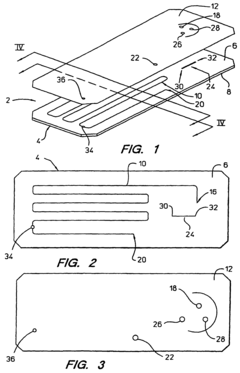
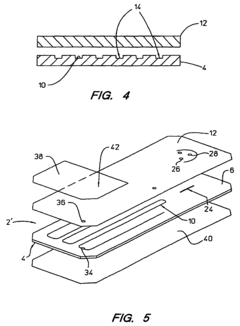
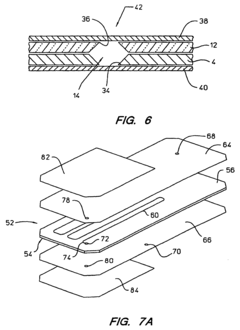
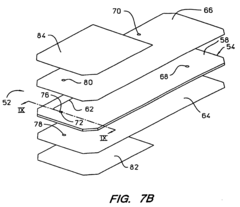
- A miniaturized planar column device using laser ablation techniques to form microstructures in polymeric and ceramic substrates, enabling enhanced detection path lengths and improved chemical stability, with integrated detection means and sample handling capabilities.
Material Compatibility and Limitations
Material compatibility represents a critical differentiating factor when comparing lithography-based and ablation-based microtexturing techniques. Lithography methods, particularly photolithography, demonstrate excellent compatibility with silicon and other semiconductor materials, making them the standard in microelectronics manufacturing. However, these techniques face significant limitations when applied to non-planar surfaces, flexible substrates, or materials with poor photoresist adhesion properties. The chemical processes involved in lithography also restrict its application on materials sensitive to etching chemicals or solvents.
In contrast, laser ablation techniques offer broader material compatibility, effectively processing metals, ceramics, polymers, and composites. This versatility stems from the physical nature of the material removal process, which relies on localized thermal or photochemical interactions rather than chemical reactions. Ultrafast laser ablation, utilizing femtosecond pulses, has further expanded this compatibility by minimizing heat-affected zones, enabling precise microtexturing on heat-sensitive materials like biological tissues and certain polymers that would otherwise deform under conventional laser processing.
Material thickness presents another significant limitation factor. Lithography techniques typically require thin material layers and become increasingly challenging with thicker substrates due to difficulties in achieving uniform photoresist coating and maintaining feature resolution throughout the depth. Ablation methods demonstrate greater flexibility regarding material thickness, though they may require multiple passes for deeper features, potentially compromising precision.
Surface properties also influence technique selection. Materials with high reflectivity can reduce ablation efficiency, requiring higher laser powers that may introduce thermal damage. Similarly, transparent materials present challenges for certain laser wavelengths, necessitating specialized approaches like two-photon absorption processes. For lithography, surface roughness and contamination can significantly impact pattern transfer quality and resolution.
The mechanical properties of materials further differentiate these techniques. Brittle materials may crack during ablation due to thermal stress, while highly ductile materials might experience deformation. Lithography processes generally impose fewer mechanical stresses but require materials that can withstand multiple processing steps including coating, exposure, development, and potentially etching or lift-off procedures.
Environmental considerations also factor into material limitations. Lithography typically requires controlled cleanroom environments and involves hazardous chemicals, restricting its application in certain contexts. Ablation techniques offer more flexibility in processing environments but may generate particulates requiring appropriate containment and filtration systems, particularly when processing toxic or hazardous materials.
In contrast, laser ablation techniques offer broader material compatibility, effectively processing metals, ceramics, polymers, and composites. This versatility stems from the physical nature of the material removal process, which relies on localized thermal or photochemical interactions rather than chemical reactions. Ultrafast laser ablation, utilizing femtosecond pulses, has further expanded this compatibility by minimizing heat-affected zones, enabling precise microtexturing on heat-sensitive materials like biological tissues and certain polymers that would otherwise deform under conventional laser processing.
Material thickness presents another significant limitation factor. Lithography techniques typically require thin material layers and become increasingly challenging with thicker substrates due to difficulties in achieving uniform photoresist coating and maintaining feature resolution throughout the depth. Ablation methods demonstrate greater flexibility regarding material thickness, though they may require multiple passes for deeper features, potentially compromising precision.
Surface properties also influence technique selection. Materials with high reflectivity can reduce ablation efficiency, requiring higher laser powers that may introduce thermal damage. Similarly, transparent materials present challenges for certain laser wavelengths, necessitating specialized approaches like two-photon absorption processes. For lithography, surface roughness and contamination can significantly impact pattern transfer quality and resolution.
The mechanical properties of materials further differentiate these techniques. Brittle materials may crack during ablation due to thermal stress, while highly ductile materials might experience deformation. Lithography processes generally impose fewer mechanical stresses but require materials that can withstand multiple processing steps including coating, exposure, development, and potentially etching or lift-off procedures.
Environmental considerations also factor into material limitations. Lithography typically requires controlled cleanroom environments and involves hazardous chemicals, restricting its application in certain contexts. Ablation techniques offer more flexibility in processing environments but may generate particulates requiring appropriate containment and filtration systems, particularly when processing toxic or hazardous materials.
Environmental Impact and Sustainability Considerations
The environmental impact of microtexturing processes represents a critical consideration in modern manufacturing, with significant differences between lithography-based and ablation-based approaches. Lithography processes typically involve photoresist chemicals, developers, and etching solutions that may contain hazardous substances such as heavy metals and organic solvents. These chemicals require specialized disposal protocols and can contribute to water pollution if improperly managed. Additionally, lithography often demands substantial water resources for cleaning and processing steps, creating a considerable water footprint.
In contrast, ablation-based microtexturing, particularly laser ablation, generally produces fewer chemical waste streams. However, these processes generate particulate matter and vapor emissions that require effective filtration systems to prevent air pollution and workplace exposure hazards. The energy consumption profile also differs significantly between these technologies, with lithography systems typically requiring controlled clean room environments with substantial HVAC demands, while laser ablation systems consume concentrated energy during the material removal process.
From a sustainability perspective, lithography offers advantages in material efficiency for high-volume production, as it enables parallel processing of multiple components simultaneously. Ablation approaches, while often more energy-intensive per unit area, provide benefits through reduced chemical usage and potentially simpler waste management systems. Recent advancements in green chemistry have introduced more environmentally friendly photoresists and developers for lithography, while improvements in laser technology have enhanced the energy efficiency of ablation systems.
Life cycle assessment studies indicate that the environmental impact of both technologies extends beyond the manufacturing phase to include raw material extraction, equipment production, and end-of-life considerations. The recyclability of processed materials varies depending on the specific microtexturing technique applied, with some surface modifications potentially complicating material recovery processes.
Regulatory frameworks increasingly influence technology selection, with stricter controls on certain chemicals used in lithography processes driving innovation toward more sustainable alternatives. Similarly, energy efficiency standards are pushing manufacturers to optimize ablation processes to reduce carbon footprints. Companies implementing microtexturing technologies must now balance performance requirements with environmental compliance and corporate sustainability goals.
Looking forward, hybrid approaches that combine the precision of lithography with the reduced chemical footprint of ablation techniques may offer promising pathways toward more sustainable microtexturing. Additionally, the development of closed-loop systems for chemical recovery in lithography and improved energy management in ablation processes represent important areas for continued environmental improvement in this field.
In contrast, ablation-based microtexturing, particularly laser ablation, generally produces fewer chemical waste streams. However, these processes generate particulate matter and vapor emissions that require effective filtration systems to prevent air pollution and workplace exposure hazards. The energy consumption profile also differs significantly between these technologies, with lithography systems typically requiring controlled clean room environments with substantial HVAC demands, while laser ablation systems consume concentrated energy during the material removal process.
From a sustainability perspective, lithography offers advantages in material efficiency for high-volume production, as it enables parallel processing of multiple components simultaneously. Ablation approaches, while often more energy-intensive per unit area, provide benefits through reduced chemical usage and potentially simpler waste management systems. Recent advancements in green chemistry have introduced more environmentally friendly photoresists and developers for lithography, while improvements in laser technology have enhanced the energy efficiency of ablation systems.
Life cycle assessment studies indicate that the environmental impact of both technologies extends beyond the manufacturing phase to include raw material extraction, equipment production, and end-of-life considerations. The recyclability of processed materials varies depending on the specific microtexturing technique applied, with some surface modifications potentially complicating material recovery processes.
Regulatory frameworks increasingly influence technology selection, with stricter controls on certain chemicals used in lithography processes driving innovation toward more sustainable alternatives. Similarly, energy efficiency standards are pushing manufacturers to optimize ablation processes to reduce carbon footprints. Companies implementing microtexturing technologies must now balance performance requirements with environmental compliance and corporate sustainability goals.
Looking forward, hybrid approaches that combine the precision of lithography with the reduced chemical footprint of ablation techniques may offer promising pathways toward more sustainable microtexturing. Additionally, the development of closed-loop systems for chemical recovery in lithography and improved energy management in ablation processes represent important areas for continued environmental improvement in this field.
Unlock deeper insights with PatSnap Eureka Quick Research — get a full tech report to explore trends and direct your research. Try now!
Generate Your Research Report Instantly with AI Agent
Supercharge your innovation with PatSnap Eureka AI Agent Platform!