

CXL 2.0 Vs CXL 3.0 Memory Modules: Implications For Developers
JUN 3, 20268 MIN READ
Generate Your Research Report Instantly with AI Agent
PatSnap Eureka helps you evaluate technical feasibility & market potential.
CXL Memory Technology Background and Developer Goals
Compute Express Link (CXL) technology emerged as a revolutionary interconnect standard designed to address the growing memory bandwidth and capacity limitations in modern computing systems. Initially developed by Intel and subsequently adopted by an industry consortium, CXL represents a paradigm shift in how processors communicate with memory and accelerator devices. The technology builds upon the proven PCIe infrastructure while introducing cache-coherent memory semantics, enabling unprecedented levels of system performance and flexibility.
The evolution from CXL 2.0 to CXL 3.0 marks a significant milestone in memory subsystem architecture, fundamentally transforming how developers approach system design and memory management. CXL 2.0, introduced in 2020, established the foundational framework for memory pooling and sharing across multiple processors, operating at speeds up to 32 GT/s. This generation enabled basic memory expansion and sharing capabilities, allowing systems to break free from traditional memory capacity constraints tied to individual processor sockets.
CXL 3.0, released in 2022, represents a quantum leap forward with enhanced bandwidth capabilities reaching 64 GT/s and introducing sophisticated memory management features. The newer specification incorporates advanced fabric switching capabilities, enabling complex multi-tier memory hierarchies and dynamic memory allocation across distributed computing resources. These enhancements fundamentally alter the memory landscape, providing developers with unprecedented flexibility in designing scalable, high-performance computing solutions.
The primary technical objectives driving CXL adoption center around solving critical memory bottlenecks that have plagued modern computing architectures. Traditional memory architectures suffer from capacity limitations, bandwidth constraints, and inefficient resource utilization across multi-socket systems. CXL technology aims to democratize memory access, enabling seamless memory sharing and pooling across heterogeneous computing environments while maintaining cache coherency and low-latency access patterns.
For developers, the transition from CXL 2.0 to 3.0 represents both an opportunity and a challenge. The enhanced capabilities demand new programming paradigms and system design methodologies, requiring developers to rethink traditional approaches to memory management, data locality, and system optimization. Understanding these technological shifts becomes crucial for leveraging the full potential of next-generation memory architectures in enterprise and high-performance computing applications.
The evolution from CXL 2.0 to CXL 3.0 marks a significant milestone in memory subsystem architecture, fundamentally transforming how developers approach system design and memory management. CXL 2.0, introduced in 2020, established the foundational framework for memory pooling and sharing across multiple processors, operating at speeds up to 32 GT/s. This generation enabled basic memory expansion and sharing capabilities, allowing systems to break free from traditional memory capacity constraints tied to individual processor sockets.
CXL 3.0, released in 2022, represents a quantum leap forward with enhanced bandwidth capabilities reaching 64 GT/s and introducing sophisticated memory management features. The newer specification incorporates advanced fabric switching capabilities, enabling complex multi-tier memory hierarchies and dynamic memory allocation across distributed computing resources. These enhancements fundamentally alter the memory landscape, providing developers with unprecedented flexibility in designing scalable, high-performance computing solutions.
The primary technical objectives driving CXL adoption center around solving critical memory bottlenecks that have plagued modern computing architectures. Traditional memory architectures suffer from capacity limitations, bandwidth constraints, and inefficient resource utilization across multi-socket systems. CXL technology aims to democratize memory access, enabling seamless memory sharing and pooling across heterogeneous computing environments while maintaining cache coherency and low-latency access patterns.
For developers, the transition from CXL 2.0 to 3.0 represents both an opportunity and a challenge. The enhanced capabilities demand new programming paradigms and system design methodologies, requiring developers to rethink traditional approaches to memory management, data locality, and system optimization. Understanding these technological shifts becomes crucial for leveraging the full potential of next-generation memory architectures in enterprise and high-performance computing applications.
Market Demand for CXL Memory Solutions
The enterprise memory market is experiencing unprecedented demand driven by the exponential growth of data-intensive applications, artificial intelligence workloads, and cloud computing infrastructure. Traditional memory architectures are struggling to keep pace with the bandwidth and capacity requirements of modern computing systems, creating a substantial market opportunity for innovative memory solutions like CXL-based modules.
Data centers and high-performance computing environments represent the primary demand drivers for CXL memory solutions. These facilities require memory systems that can deliver higher bandwidth, lower latency, and greater scalability than conventional DDR-based architectures. The proliferation of machine learning training, real-time analytics, and in-memory databases has intensified the need for memory solutions that can efficiently handle massive datasets while maintaining system performance.
Cloud service providers constitute a significant market segment actively seeking CXL memory technologies to optimize their infrastructure efficiency. The ability to disaggregate memory resources and dynamically allocate them across multiple processors offers compelling economic advantages, particularly in multi-tenant environments where resource utilization optimization directly impacts profitability.
The automotive and edge computing sectors are emerging as important growth areas for CXL memory adoption. Advanced driver assistance systems, autonomous vehicle platforms, and industrial IoT applications require memory solutions that combine high performance with reliability and power efficiency. These applications often demand real-time processing capabilities that benefit from the enhanced memory bandwidth and reduced latency offered by CXL architectures.
Enterprise software vendors developing memory-intensive applications are increasingly recognizing the potential of CXL memory solutions to unlock new performance capabilities. Database management systems, virtualization platforms, and analytics software can leverage CXL's memory pooling and sharing features to deliver improved performance and resource utilization.
The market demand is further amplified by the growing adoption of heterogeneous computing architectures that integrate CPUs, GPUs, and specialized accelerators. These systems require coherent memory access across different processing units, making CXL memory modules particularly attractive for maintaining performance consistency while simplifying system design complexity.
Data centers and high-performance computing environments represent the primary demand drivers for CXL memory solutions. These facilities require memory systems that can deliver higher bandwidth, lower latency, and greater scalability than conventional DDR-based architectures. The proliferation of machine learning training, real-time analytics, and in-memory databases has intensified the need for memory solutions that can efficiently handle massive datasets while maintaining system performance.
Cloud service providers constitute a significant market segment actively seeking CXL memory technologies to optimize their infrastructure efficiency. The ability to disaggregate memory resources and dynamically allocate them across multiple processors offers compelling economic advantages, particularly in multi-tenant environments where resource utilization optimization directly impacts profitability.
The automotive and edge computing sectors are emerging as important growth areas for CXL memory adoption. Advanced driver assistance systems, autonomous vehicle platforms, and industrial IoT applications require memory solutions that combine high performance with reliability and power efficiency. These applications often demand real-time processing capabilities that benefit from the enhanced memory bandwidth and reduced latency offered by CXL architectures.
Enterprise software vendors developing memory-intensive applications are increasingly recognizing the potential of CXL memory solutions to unlock new performance capabilities. Database management systems, virtualization platforms, and analytics software can leverage CXL's memory pooling and sharing features to deliver improved performance and resource utilization.
The market demand is further amplified by the growing adoption of heterogeneous computing architectures that integrate CPUs, GPUs, and specialized accelerators. These systems require coherent memory access across different processing units, making CXL memory modules particularly attractive for maintaining performance consistency while simplifying system design complexity.
Current CXL 2.0 vs 3.0 Development Challenges
The transition from CXL 2.0 to CXL 3.0 presents significant development challenges that developers must navigate carefully. CXL 2.0, operating at PCIe 5.0 speeds with 32 GT/s bandwidth, has established a foundation for memory expansion and pooling applications. However, developers face substantial constraints in memory latency optimization and bandwidth utilization efficiency, particularly when implementing large-scale memory disaggregation solutions.
Memory coherency management represents one of the most complex challenges in current CXL implementations. CXL 2.0's coherency protocols, while functional, introduce latency penalties that become pronounced in high-performance computing scenarios. Developers struggle with cache coherency overhead, especially when managing distributed memory pools across multiple CXL devices. The protocol's current implementation requires careful consideration of memory access patterns to avoid performance degradation.
CXL 3.0's introduction of enhanced features, including improved error correction and advanced memory management capabilities, creates a dual-challenge scenario for developers. While CXL 3.0 offers superior performance with PCIe 6.0 compatibility and enhanced bandwidth, the specification's complexity increases development overhead significantly. Developers must now account for backward compatibility requirements while leveraging new features, creating intricate design considerations.
Power management emerges as another critical challenge, particularly with CXL 3.0's increased performance capabilities. Memory modules operating at higher frequencies demand sophisticated power optimization strategies. Developers face difficulties in balancing performance gains with thermal constraints, especially in data center environments where power efficiency directly impacts operational costs.
Software stack compatibility issues compound these hardware challenges. Current CXL 2.0 implementations require extensive driver optimization and memory management framework modifications. The transition to CXL 3.0 necessitates additional software layer adaptations, creating potential compatibility gaps during the migration period. Developers must address these software challenges while maintaining system stability and performance consistency across different CXL generations.
Testing and validation methodologies for CXL implementations remain inadequately standardized, creating additional development hurdles. The complexity of verifying memory coherency, bandwidth utilization, and error handling across different CXL versions requires sophisticated testing frameworks that many development teams are still establishing.
Memory coherency management represents one of the most complex challenges in current CXL implementations. CXL 2.0's coherency protocols, while functional, introduce latency penalties that become pronounced in high-performance computing scenarios. Developers struggle with cache coherency overhead, especially when managing distributed memory pools across multiple CXL devices. The protocol's current implementation requires careful consideration of memory access patterns to avoid performance degradation.
CXL 3.0's introduction of enhanced features, including improved error correction and advanced memory management capabilities, creates a dual-challenge scenario for developers. While CXL 3.0 offers superior performance with PCIe 6.0 compatibility and enhanced bandwidth, the specification's complexity increases development overhead significantly. Developers must now account for backward compatibility requirements while leveraging new features, creating intricate design considerations.
Power management emerges as another critical challenge, particularly with CXL 3.0's increased performance capabilities. Memory modules operating at higher frequencies demand sophisticated power optimization strategies. Developers face difficulties in balancing performance gains with thermal constraints, especially in data center environments where power efficiency directly impacts operational costs.
Software stack compatibility issues compound these hardware challenges. Current CXL 2.0 implementations require extensive driver optimization and memory management framework modifications. The transition to CXL 3.0 necessitates additional software layer adaptations, creating potential compatibility gaps during the migration period. Developers must address these software challenges while maintaining system stability and performance consistency across different CXL generations.
Testing and validation methodologies for CXL implementations remain inadequately standardized, creating additional development hurdles. The complexity of verifying memory coherency, bandwidth utilization, and error handling across different CXL versions requires sophisticated testing frameworks that many development teams are still establishing.
Current CXL 2.0 and 3.0 Implementation Solutions
01 CXL memory controller optimization and performance enhancement
Advanced memory controller designs and optimization techniques are employed to enhance the performance of CXL memory modules. These approaches focus on improving data throughput, reducing latency, and optimizing memory access patterns. The controllers implement sophisticated algorithms for memory management, bandwidth allocation, and error correction to maximize overall system performance.- CXL memory controller optimization and performance enhancement: Advanced memory controller designs and optimization techniques are employed to enhance the performance of CXL memory modules. These approaches focus on improving data transfer rates, reducing latency, and optimizing memory access patterns. The controllers implement sophisticated algorithms for memory management, bandwidth allocation, and error correction to maximize overall system performance.
- Memory module architecture and interface design: Specialized architectural designs for CXL memory modules focus on optimizing the physical and logical interfaces between memory components and the host system. These designs incorporate advanced signaling techniques, improved power management, and enhanced data pathways to achieve superior performance characteristics compared to traditional memory solutions.
- Performance monitoring and adaptive optimization: Dynamic performance monitoring systems and adaptive optimization mechanisms are implemented to continuously assess and improve CXL memory module performance. These systems track various performance metrics, identify bottlenecks, and automatically adjust operational parameters to maintain optimal performance under varying workload conditions.
- Memory bandwidth and latency optimization techniques: Specialized techniques are employed to optimize memory bandwidth utilization and minimize access latency in CXL memory modules. These methods include advanced caching strategies, prefetching algorithms, and intelligent data placement schemes that significantly improve overall memory subsystem performance and reduce response times.
- Multi-module coordination and scalability solutions: Advanced coordination mechanisms and scalability solutions enable multiple CXL memory modules to work together efficiently in large-scale systems. These approaches address inter-module communication, load balancing, and resource allocation challenges to ensure consistent performance across distributed memory architectures while maintaining system coherency and reliability.
02 Memory interface and protocol optimization for CXL modules
Specialized interface designs and protocol optimizations are developed to improve the communication efficiency between CXL memory modules and host systems. These innovations focus on reducing protocol overhead, improving signal integrity, and enhancing data transfer rates through advanced signaling techniques and interface architectures.Expand Specific Solutions03 Power management and thermal optimization in CXL memory systems
Power management strategies and thermal optimization techniques are implemented to maintain optimal performance while managing energy consumption and heat dissipation in CXL memory modules. These approaches include dynamic power scaling, thermal throttling mechanisms, and efficient power delivery systems to ensure consistent performance under varying operational conditions.Expand Specific Solutions04 Memory pooling and resource allocation mechanisms
Advanced memory pooling architectures and resource allocation algorithms are developed to optimize the utilization of CXL memory resources across multiple compute nodes. These systems enable dynamic memory sharing, load balancing, and efficient resource distribution to maximize overall system performance and minimize memory access conflicts.Expand Specific Solutions05 Error detection and reliability enhancement for CXL memory
Comprehensive error detection, correction, and reliability enhancement mechanisms are integrated into CXL memory modules to ensure data integrity and system stability. These features include advanced error correction codes, fault tolerance mechanisms, and reliability monitoring systems that maintain consistent performance even in the presence of hardware faults or environmental stress.Expand Specific Solutions
Key Players in CXL Memory Ecosystem
The CXL memory module landscape represents a rapidly evolving competitive arena transitioning from early adoption to mainstream deployment. The industry is experiencing significant growth driven by AI and data center demands, with CXL 3.0 offering enhanced capabilities over 2.0 including improved bandwidth, memory pooling, and fabric switching. Technology maturity varies significantly among players: established memory giants like Samsung Electronics, SK Hynix, Micron Technology, and Intel lead with comprehensive CXL implementations, while specialized companies like Unifabrix and Panmnesia focus on innovative fabric solutions and switching technologies. Chinese players including Inspur, xFusion, and various research institutes are rapidly developing competitive offerings. The market shows strong momentum with companies like KIOXIA, Netlist, and emerging startups driving innovation in controller technologies and memory architectures, positioning CXL as a critical enabler for next-generation computing infrastructure.
Samsung Electronics Co., Ltd.
Technical Solution: Samsung has developed comprehensive CXL memory solutions spanning both CXL 2.0 and 3.0 specifications. Their CXL 2.0 memory modules provide cache coherent memory expansion with up to 512GB capacity per module, supporting Type 1, 2, and 3 protocols for CPU-memory coherency. For CXL 3.0, Samsung has enhanced their modules with improved memory pooling capabilities, supporting up to 1TB per module with advanced fabric switching and multi-level memory hierarchies. The transition from CXL 2.0 to 3.0 brings significant improvements in memory sharing efficiency, reduced latency through optimized cache coherency protocols, and enhanced scalability for data center applications. Samsung's implementation focuses on backward compatibility while leveraging new 3.0 features like improved memory semantic protocols and enhanced fabric management.
Strengths: Market leadership in memory technology, comprehensive product portfolio, strong manufacturing capabilities. Weaknesses: Higher cost compared to competitors, complex integration requirements for legacy systems.
Micron Technology, Inc.
Technical Solution: Micron provides advanced CXL memory modules supporting both 2.0 and 3.0 specifications with focus on high-density memory solutions. Their CXL 2.0 modules offer up to 256GB DDR5-based memory expansion with cache coherent access patterns, optimized for AI/ML workloads requiring large memory footprints. Micron's CXL 3.0 implementation introduces memory semantic enhancements with improved error correction, supporting up to 512GB per module with advanced RAS features. The evolution from CXL 2.0 to 3.0 provides developers with enhanced memory bandwidth utilization, improved multi-tenant memory sharing capabilities, and better power efficiency through dynamic memory management. Micron's solutions emphasize thermal management and reliability, crucial for enterprise deployments. Their memory modules support both volatile and persistent memory configurations, enabling flexible memory hierarchies that adapt to application requirements while maintaining compatibility across CXL generations.
Strengths: High-density memory solutions, excellent reliability and thermal management, competitive pricing. Weaknesses: Limited ecosystem partnerships, slower adoption of cutting-edge features.
Core CXL 3.0 Technical Innovations Analysis
Memory encryption engine interface in compute express link (CXL) attached memory controllers
PatentActiveUS20210311643A1
Innovation
- The implementation of a memory encryption engine (MEE) with a memory mapped I/O-based configuration and capability enumeration interface supports memory encryption and integrity for CXL devices, using cryptographic ciphers like AES-XTS and message authentication codes to ensure confidentiality and integrity, and a device security manager to lock down memory device configurations and verify their security.
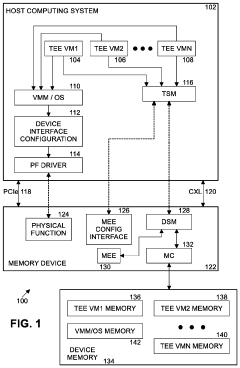
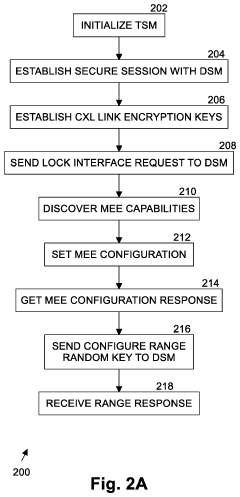
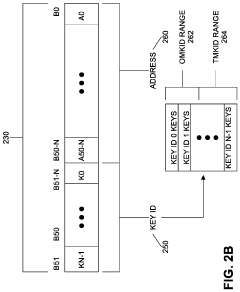
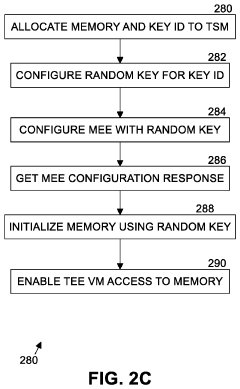
Memory system
PatentActiveUS20240319891A1
Innovation
- A memory system that employs a controller to dynamically manage interleave settings based on wear levels, using a copy-on-write process to distribute data across multiple memory modules, thereby reducing the need for extensive mapping tables and minimizing data movement costs.


Industry Standards and CXL Specification Compliance
The evolution from CXL 2.0 to CXL 3.0 represents a significant advancement in industry standardization, with both specifications maintaining strict compliance requirements that directly impact developer implementation strategies. CXL 2.0, ratified by the CXL Consortium in 2020, established foundational compliance frameworks including mandatory support for CXL.io, CXL.cache, and CXL.mem protocols, operating at PCIe 5.0 speeds up to 32 GT/s. The specification mandates specific electrical characteristics, protocol layer implementations, and interoperability testing procedures that memory module manufacturers must adhere to for certification.
CXL 3.0 specification, released in 2022, introduces enhanced compliance requirements while maintaining backward compatibility with CXL 2.0 devices. The updated standard incorporates stricter power management protocols, expanded error handling mechanisms, and refined memory coherency specifications. Key compliance additions include mandatory support for enhanced fabric management, improved security features, and standardized telemetry interfaces that enable better system monitoring and debugging capabilities.
Industry adoption patterns reveal varying compliance approaches across major semiconductor vendors. Intel's implementation focuses on tight integration with their processor architectures, while AMD emphasizes open ecosystem compatibility. Memory manufacturers like Samsung, Micron, and SK Hynix have developed distinct compliance strategies, with some prioritizing early CXL 3.0 adoption while others maintain focus on optimizing CXL 2.0 implementations for maximum market penetration.
Compliance verification processes have become increasingly sophisticated, requiring comprehensive testing across multiple domains including electrical validation, protocol conformance, and system-level interoperability. The CXL Consortium has established certification programs that mandate specific test suites, with CXL 3.0 introducing additional requirements for fabric-level testing and multi-device scenarios.
For developers, understanding these compliance frameworks is crucial for ensuring seamless integration and avoiding compatibility issues. The specification differences between CXL 2.0 and 3.0 create distinct development pathways, with compliance requirements directly influencing software architecture decisions, driver development approaches, and system optimization strategies that must align with certified hardware implementations.
CXL 3.0 specification, released in 2022, introduces enhanced compliance requirements while maintaining backward compatibility with CXL 2.0 devices. The updated standard incorporates stricter power management protocols, expanded error handling mechanisms, and refined memory coherency specifications. Key compliance additions include mandatory support for enhanced fabric management, improved security features, and standardized telemetry interfaces that enable better system monitoring and debugging capabilities.
Industry adoption patterns reveal varying compliance approaches across major semiconductor vendors. Intel's implementation focuses on tight integration with their processor architectures, while AMD emphasizes open ecosystem compatibility. Memory manufacturers like Samsung, Micron, and SK Hynix have developed distinct compliance strategies, with some prioritizing early CXL 3.0 adoption while others maintain focus on optimizing CXL 2.0 implementations for maximum market penetration.
Compliance verification processes have become increasingly sophisticated, requiring comprehensive testing across multiple domains including electrical validation, protocol conformance, and system-level interoperability. The CXL Consortium has established certification programs that mandate specific test suites, with CXL 3.0 introducing additional requirements for fabric-level testing and multi-device scenarios.
For developers, understanding these compliance frameworks is crucial for ensuring seamless integration and avoiding compatibility issues. The specification differences between CXL 2.0 and 3.0 create distinct development pathways, with compliance requirements directly influencing software architecture decisions, driver development approaches, and system optimization strategies that must align with certified hardware implementations.
Developer Migration Strategies from CXL 2.0 to 3.0
The transition from CXL 2.0 to CXL 3.0 represents a significant architectural evolution that requires careful planning and strategic implementation. Organizations must develop comprehensive migration strategies that balance performance gains with operational continuity while minimizing disruption to existing development workflows.
A phased migration approach proves most effective for enterprise environments. Initial phases should focus on non-critical workloads and development environments, allowing teams to gain familiarity with CXL 3.0's enhanced features before migrating production systems. This strategy enables developers to identify potential compatibility issues and optimize code paths for the new architecture without risking mission-critical operations.
Hardware compatibility assessment forms the foundation of any successful migration strategy. Organizations must evaluate existing server infrastructure to determine CXL 3.0 readiness, as the new specification requires updated PCIe 6.0 support and enhanced memory controllers. Legacy systems may require significant hardware upgrades or complete replacement, necessitating careful budget planning and timeline coordination.
Software stack modernization represents another critical migration component. Development teams must update drivers, firmware, and middleware components to support CXL 3.0's advanced features, including improved memory coherency protocols and enhanced bandwidth capabilities. This process often requires close collaboration with hardware vendors and software partners to ensure seamless integration.
Training and skill development initiatives should accompany technical migration efforts. Developers need comprehensive education on CXL 3.0's architectural differences, programming model changes, and optimization techniques. Establishing internal expertise through targeted training programs and vendor partnerships ensures teams can fully leverage the new specification's capabilities while maintaining development velocity.
Risk mitigation strategies must address potential performance regressions and compatibility issues during the transition period. Implementing robust testing frameworks, maintaining parallel development environments, and establishing clear rollback procedures help minimize migration risks. Organizations should also consider hybrid deployment models that allow gradual workload migration while maintaining CXL 2.0 systems for legacy applications requiring extended support timelines.
A phased migration approach proves most effective for enterprise environments. Initial phases should focus on non-critical workloads and development environments, allowing teams to gain familiarity with CXL 3.0's enhanced features before migrating production systems. This strategy enables developers to identify potential compatibility issues and optimize code paths for the new architecture without risking mission-critical operations.
Hardware compatibility assessment forms the foundation of any successful migration strategy. Organizations must evaluate existing server infrastructure to determine CXL 3.0 readiness, as the new specification requires updated PCIe 6.0 support and enhanced memory controllers. Legacy systems may require significant hardware upgrades or complete replacement, necessitating careful budget planning and timeline coordination.
Software stack modernization represents another critical migration component. Development teams must update drivers, firmware, and middleware components to support CXL 3.0's advanced features, including improved memory coherency protocols and enhanced bandwidth capabilities. This process often requires close collaboration with hardware vendors and software partners to ensure seamless integration.
Training and skill development initiatives should accompany technical migration efforts. Developers need comprehensive education on CXL 3.0's architectural differences, programming model changes, and optimization techniques. Establishing internal expertise through targeted training programs and vendor partnerships ensures teams can fully leverage the new specification's capabilities while maintaining development velocity.
Risk mitigation strategies must address potential performance regressions and compatibility issues during the transition period. Implementing robust testing frameworks, maintaining parallel development environments, and establishing clear rollback procedures help minimize migration risks. Organizations should also consider hybrid deployment models that allow gradual workload migration while maintaining CXL 2.0 systems for legacy applications requiring extended support timelines.
Unlock deeper insights with PatSnap Eureka Quick Research — get a full tech report to explore trends and direct your research. Try now!
Generate Your Research Report Instantly with AI Agent
Supercharge your innovation with PatSnap Eureka AI Agent Platform!