
Deploying Elastocaloric Cooling for Industrial Temperature Control
APR 24, 20269 MIN READ
Generate Your Research Report Instantly with AI Agent
Patsnap Eureka helps you evaluate technical feasibility & market potential.
Elastocaloric Cooling Technology Background and Industrial Goals
Elastocaloric cooling represents a revolutionary solid-state refrigeration technology that harnesses the elastocaloric effect observed in certain materials when subjected to mechanical stress. This phenomenon occurs when shape memory alloys and other elastocaloric materials undergo reversible phase transformations under applied stress, resulting in temperature changes that can be exploited for cooling applications. The technology emerged from fundamental research into caloric effects in the early 2000s, building upon decades of materials science advancement in shape memory alloys and thermodynamic cycle optimization.
The historical development of elastocaloric cooling traces back to the discovery of significant temperature changes in nickel-titanium alloys under mechanical loading. Initial research focused on understanding the underlying crystallographic mechanisms, where stress-induced martensitic transformations create entropy changes that manifest as measurable temperature variations. Early laboratory demonstrations achieved temperature spans of 10-20 Kelvin, establishing the foundation for practical cooling applications.
The evolution toward industrial applications has been driven by the urgent need for environmentally sustainable cooling solutions. Traditional vapor-compression systems rely heavily on hydrofluorocarbon refrigerants with high global warming potential, creating regulatory pressure and environmental concerns. Elastocaloric cooling offers a pathway to eliminate harmful refrigerants entirely while potentially achieving superior energy efficiency through optimized thermodynamic cycles.
Current technological objectives center on achieving industrial-scale temperature control systems capable of competing with conventional refrigeration in terms of cooling capacity, efficiency, and operational reliability. Primary goals include developing elastocaloric materials with enhanced fatigue resistance, optimizing mechanical actuation systems for continuous operation, and designing heat exchanger configurations that maximize heat transfer effectiveness while minimizing parasitic losses.
The industrial implementation targets span diverse sectors including data center cooling, food processing, pharmaceutical storage, and manufacturing process temperature control. These applications demand robust systems capable of maintaining precise temperature control across varying load conditions while delivering long-term operational stability. The technology aims to achieve coefficient of performance values exceeding 5.0, representing significant improvements over current industrial cooling systems.
Advanced material development focuses on compositional optimization of shape memory alloys, exploring copper-based and iron-based alternatives to nickel-titanium systems. Research priorities include extending operational temperature ranges, improving cyclic stability beyond one million cycles, and reducing material costs for commercial viability. System integration challenges involve developing efficient mechanical actuation mechanisms, implementing effective heat recovery strategies, and creating control algorithms that optimize performance across dynamic operating conditions.
The historical development of elastocaloric cooling traces back to the discovery of significant temperature changes in nickel-titanium alloys under mechanical loading. Initial research focused on understanding the underlying crystallographic mechanisms, where stress-induced martensitic transformations create entropy changes that manifest as measurable temperature variations. Early laboratory demonstrations achieved temperature spans of 10-20 Kelvin, establishing the foundation for practical cooling applications.
The evolution toward industrial applications has been driven by the urgent need for environmentally sustainable cooling solutions. Traditional vapor-compression systems rely heavily on hydrofluorocarbon refrigerants with high global warming potential, creating regulatory pressure and environmental concerns. Elastocaloric cooling offers a pathway to eliminate harmful refrigerants entirely while potentially achieving superior energy efficiency through optimized thermodynamic cycles.
Current technological objectives center on achieving industrial-scale temperature control systems capable of competing with conventional refrigeration in terms of cooling capacity, efficiency, and operational reliability. Primary goals include developing elastocaloric materials with enhanced fatigue resistance, optimizing mechanical actuation systems for continuous operation, and designing heat exchanger configurations that maximize heat transfer effectiveness while minimizing parasitic losses.
The industrial implementation targets span diverse sectors including data center cooling, food processing, pharmaceutical storage, and manufacturing process temperature control. These applications demand robust systems capable of maintaining precise temperature control across varying load conditions while delivering long-term operational stability. The technology aims to achieve coefficient of performance values exceeding 5.0, representing significant improvements over current industrial cooling systems.
Advanced material development focuses on compositional optimization of shape memory alloys, exploring copper-based and iron-based alternatives to nickel-titanium systems. Research priorities include extending operational temperature ranges, improving cyclic stability beyond one million cycles, and reducing material costs for commercial viability. System integration challenges involve developing efficient mechanical actuation mechanisms, implementing effective heat recovery strategies, and creating control algorithms that optimize performance across dynamic operating conditions.
Market Demand for Advanced Industrial Temperature Control Systems
The global industrial temperature control systems market is experiencing unprecedented growth driven by increasing automation across manufacturing sectors and stringent regulatory requirements for process optimization. Traditional cooling technologies, including vapor compression systems and thermoelectric coolers, face mounting pressure from environmental regulations and energy efficiency mandates, creating substantial opportunities for innovative cooling solutions.
Manufacturing industries, particularly semiconductor fabrication, pharmaceutical production, and precision machining, demand increasingly sophisticated temperature control capabilities. These sectors require precise thermal management with minimal temperature fluctuations, rapid response times, and reliable operation in harsh industrial environments. Current cooling technologies often struggle to meet these demanding specifications while maintaining energy efficiency and environmental compliance.
The automotive and aerospace industries represent emerging high-growth segments for advanced cooling technologies. Electric vehicle battery thermal management systems require precise temperature control to optimize performance and safety, while aerospace applications demand lightweight, reliable cooling solutions for avionics and propulsion systems. These applications present unique challenges that conventional cooling methods cannot adequately address.
Energy efficiency regulations and sustainability initiatives are reshaping market demand patterns. Industrial facilities face increasing pressure to reduce energy consumption and eliminate refrigerants with high global warming potential. This regulatory environment creates strong market pull for alternative cooling technologies that can deliver superior performance while meeting environmental standards.
Data centers and high-performance computing facilities represent another significant demand driver. These applications require precise temperature control with high cooling capacity and exceptional reliability. The exponential growth in computational requirements and server density intensifies the need for advanced cooling solutions that can handle increasing thermal loads efficiently.
Process industries, including chemical processing, food and beverage production, and biotechnology manufacturing, require specialized temperature control solutions for maintaining product quality and process stability. These applications often involve corrosive environments, strict hygiene requirements, and continuous operation demands that challenge conventional cooling technologies.
The market demonstrates strong preference for cooling solutions offering reduced maintenance requirements, improved reliability, and lower total cost of ownership. Industrial operators increasingly evaluate cooling technologies based on lifecycle performance rather than initial capital costs, creating opportunities for innovative solutions that deliver superior long-term value propositions.
Manufacturing industries, particularly semiconductor fabrication, pharmaceutical production, and precision machining, demand increasingly sophisticated temperature control capabilities. These sectors require precise thermal management with minimal temperature fluctuations, rapid response times, and reliable operation in harsh industrial environments. Current cooling technologies often struggle to meet these demanding specifications while maintaining energy efficiency and environmental compliance.
The automotive and aerospace industries represent emerging high-growth segments for advanced cooling technologies. Electric vehicle battery thermal management systems require precise temperature control to optimize performance and safety, while aerospace applications demand lightweight, reliable cooling solutions for avionics and propulsion systems. These applications present unique challenges that conventional cooling methods cannot adequately address.
Energy efficiency regulations and sustainability initiatives are reshaping market demand patterns. Industrial facilities face increasing pressure to reduce energy consumption and eliminate refrigerants with high global warming potential. This regulatory environment creates strong market pull for alternative cooling technologies that can deliver superior performance while meeting environmental standards.
Data centers and high-performance computing facilities represent another significant demand driver. These applications require precise temperature control with high cooling capacity and exceptional reliability. The exponential growth in computational requirements and server density intensifies the need for advanced cooling solutions that can handle increasing thermal loads efficiently.
Process industries, including chemical processing, food and beverage production, and biotechnology manufacturing, require specialized temperature control solutions for maintaining product quality and process stability. These applications often involve corrosive environments, strict hygiene requirements, and continuous operation demands that challenge conventional cooling technologies.
The market demonstrates strong preference for cooling solutions offering reduced maintenance requirements, improved reliability, and lower total cost of ownership. Industrial operators increasingly evaluate cooling technologies based on lifecycle performance rather than initial capital costs, creating opportunities for innovative solutions that deliver superior long-term value propositions.
Current State and Challenges of Elastocaloric Cooling Deployment
Elastocaloric cooling technology has emerged as a promising solid-state refrigeration alternative, leveraging the elastocaloric effect in shape memory alloys and other materials to achieve temperature changes through mechanical stress application. Currently, the technology remains predominantly in laboratory and pilot-scale development phases, with limited commercial deployment in industrial temperature control applications.
The global research landscape shows concentrated efforts in North America, Europe, and East Asia, particularly in the United States, Germany, and Japan. Leading research institutions have demonstrated prototype systems achieving cooling capacities ranging from 100W to several kilowatts, with coefficient of performance values between 2-8 under laboratory conditions. However, the transition from laboratory demonstrations to industrial-scale implementations faces significant scalability challenges.
Material durability represents the most critical technical constraint limiting widespread deployment. Current elastocaloric materials, including Ni-Ti alloys and natural rubber compounds, exhibit fatigue degradation after 10^4 to 10^6 mechanical cycles, far below the millions of cycles required for industrial applications. This limitation directly impacts system reliability and operational lifespan, making long-term industrial deployment economically unfeasible.
System integration complexity poses another substantial challenge. Industrial temperature control requires precise thermal management across varying load conditions, demanding sophisticated control algorithms and mechanical actuation systems. Current elastocaloric systems struggle with response time optimization, typically achieving cooling rates of 1-5K per second, which may be insufficient for rapid industrial process requirements.
Manufacturing scalability remains underdeveloped, with most elastocaloric materials produced through specialized laboratory processes unsuitable for mass production. The lack of standardized manufacturing protocols and quality control measures hinders consistent material properties across production batches, creating reliability concerns for industrial applications.
Economic viability presents additional deployment barriers. Current material costs exceed $50-100 per kilogram for high-performance elastocaloric alloys, significantly higher than conventional refrigerants. Combined with complex mechanical systems requiring precision engineering, initial capital investments remain prohibitively expensive compared to established vapor-compression technologies.
Regulatory frameworks for elastocaloric cooling systems are largely absent, creating uncertainty for industrial adoption. Unlike conventional refrigeration systems with established safety standards and certification processes, elastocaloric technologies lack comprehensive regulatory guidelines, potentially delaying commercial deployment timelines.
The global research landscape shows concentrated efforts in North America, Europe, and East Asia, particularly in the United States, Germany, and Japan. Leading research institutions have demonstrated prototype systems achieving cooling capacities ranging from 100W to several kilowatts, with coefficient of performance values between 2-8 under laboratory conditions. However, the transition from laboratory demonstrations to industrial-scale implementations faces significant scalability challenges.
Material durability represents the most critical technical constraint limiting widespread deployment. Current elastocaloric materials, including Ni-Ti alloys and natural rubber compounds, exhibit fatigue degradation after 10^4 to 10^6 mechanical cycles, far below the millions of cycles required for industrial applications. This limitation directly impacts system reliability and operational lifespan, making long-term industrial deployment economically unfeasible.
System integration complexity poses another substantial challenge. Industrial temperature control requires precise thermal management across varying load conditions, demanding sophisticated control algorithms and mechanical actuation systems. Current elastocaloric systems struggle with response time optimization, typically achieving cooling rates of 1-5K per second, which may be insufficient for rapid industrial process requirements.
Manufacturing scalability remains underdeveloped, with most elastocaloric materials produced through specialized laboratory processes unsuitable for mass production. The lack of standardized manufacturing protocols and quality control measures hinders consistent material properties across production batches, creating reliability concerns for industrial applications.
Economic viability presents additional deployment barriers. Current material costs exceed $50-100 per kilogram for high-performance elastocaloric alloys, significantly higher than conventional refrigerants. Combined with complex mechanical systems requiring precision engineering, initial capital investments remain prohibitively expensive compared to established vapor-compression technologies.
Regulatory frameworks for elastocaloric cooling systems are largely absent, creating uncertainty for industrial adoption. Unlike conventional refrigeration systems with established safety standards and certification processes, elastocaloric technologies lack comprehensive regulatory guidelines, potentially delaying commercial deployment timelines.
Existing Elastocaloric Cooling Implementation Solutions
01 Shape memory alloy materials for elastocaloric cooling systems
Shape memory alloys serve as the core materials in elastocaloric cooling systems, utilizing their unique property to undergo reversible phase transformations under mechanical stress. These materials can absorb and release heat during loading and unloading cycles, enabling efficient temperature control. The selection and optimization of specific alloy compositions are crucial for achieving desired cooling performance and operational temperature ranges.- Elastocaloric material composition and alloy development: Development of specialized elastocaloric materials and alloys that exhibit significant temperature changes when subjected to mechanical stress or strain. These materials are engineered to have optimal phase transformation properties and enhanced elastocaloric effects for efficient cooling applications. The composition and microstructure of these materials are critical for achieving desired temperature control performance.
- Mechanical actuation and stress application systems: Systems and mechanisms for applying controlled mechanical stress or strain to elastocaloric materials to induce temperature changes. These include various actuation methods, loading mechanisms, and stress distribution systems that enable precise control over the elastocaloric effect. The mechanical systems are designed to optimize the stress-strain cycles for maximum cooling efficiency.
- Heat transfer and thermal management integration: Integration of elastocaloric cooling systems with heat transfer mechanisms and thermal management components. This includes heat exchangers, thermal interfaces, and fluid circulation systems that effectively transfer the cooling effect from the elastocaloric material to the target application. The thermal management ensures efficient heat removal and temperature distribution.
- Control systems and temperature regulation methods: Advanced control algorithms and feedback systems for regulating temperature in elastocaloric cooling applications. These systems monitor temperature variations and automatically adjust the mechanical loading cycles to maintain desired temperature levels. The control methods include sensor integration, feedback loops, and automated actuation control for precise temperature management.
- Device architecture and cooling system design: Overall system architecture and design configurations for elastocaloric cooling devices and temperature control systems. This encompasses the structural design, component arrangement, and integration methods for creating practical cooling applications. The designs focus on optimizing space utilization, energy efficiency, and operational reliability in various cooling scenarios.
02 Mechanical actuation and stress control mechanisms
Precise control of mechanical stress application and release is essential for effective elastocaloric cooling operation. Various actuation systems including pneumatic, hydraulic, and electromagnetic mechanisms are employed to generate the required cyclic loading patterns. The timing, magnitude, and frequency of stress cycles directly influence the cooling efficiency and system performance.Expand Specific Solutions03 Heat transfer and thermal management systems
Effective heat transfer mechanisms are critical for removing heat from the elastocaloric material during the cooling cycle and dissipating it to the environment. This includes the design of heat exchangers, thermal interfaces, and fluid circulation systems that optimize heat transfer rates. Proper thermal management ensures consistent temperature control and prevents overheating of the elastocaloric elements.Expand Specific Solutions04 Control algorithms and feedback systems
Advanced control strategies are implemented to regulate the elastocaloric cooling process and maintain desired temperature setpoints. These systems incorporate temperature sensors, feedback loops, and adaptive algorithms that adjust operational parameters in real-time. The control systems optimize energy efficiency while ensuring stable temperature regulation across varying load conditions.Expand Specific Solutions05 System integration and application-specific designs
Elastocaloric cooling systems are integrated into various applications requiring precise temperature control, including electronics cooling, automotive climate control, and industrial process cooling. The integration involves mechanical packaging, electrical interfaces, and system-level optimization to meet specific performance requirements. Design considerations include size constraints, power consumption, and environmental operating conditions.Expand Specific Solutions
Key Players in Elastocaloric and Industrial Cooling Industry
The elastocaloric cooling technology for industrial temperature control represents an emerging sector in the early development stage, with significant growth potential driven by increasing demand for energy-efficient cooling solutions. The market remains relatively small but shows promising expansion opportunities as industries seek sustainable alternatives to traditional refrigeration systems. Technology maturity varies considerably across key players, with leading research institutions like Xi'an Jiaotong University, University of Maryland, and Technical Institute of Physics & Chemistry CAS advancing fundamental research, while industrial giants such as Siemens AG, Robert Bosch GmbH, and Volkswagen AG focus on practical applications and system integration. Companies like Baltimore Aircoil Co. and HOSHIZAKI Corp. bring specialized cooling expertise, whereas aerospace leaders Boeing and Airbus explore niche applications. The competitive landscape indicates a technology transition phase where academic breakthroughs are gradually being commercialized by established industrial players seeking next-generation thermal management solutions.
Volkswagen AG
Technical Solution: Volkswagen has invested in elastocaloric cooling research primarily for automotive applications but with potential industrial scaling opportunities. Their technology development focuses on solid-state cooling systems using nickel-titanium based elastocaloric materials for cabin climate control and battery thermal management. The system demonstrates cooling power outputs of 500W-2kW with compact packaging suitable for mobile and stationary applications. Volkswagen's approach emphasizes environmental sustainability and energy efficiency, targeting 25-30% reduction in cooling system energy consumption compared to conventional refrigeration. Their research includes material optimization for extended operational life and cost reduction strategies for mass production deployment in industrial temperature control systems.
Strengths: Strong automotive engineering capabilities, sustainability focus, mass production expertise. Weaknesses: Limited industrial cooling experience, technology primarily automotive-focused, early development stage for industrial applications.
Robert Bosch GmbH
Technical Solution: Bosch has developed advanced elastocaloric cooling systems utilizing shape memory alloys (SMAs) and nickel-titanium based materials for industrial temperature control applications. Their technology focuses on solid-state cooling mechanisms that achieve temperature differentials of 10-15K through mechanical stress-induced phase transitions. The system integrates sophisticated control algorithms to optimize the mechanical loading cycles, achieving cooling power densities of 200-500 W/kg. Bosch's approach emphasizes modular design architecture allowing scalable deployment across various industrial processes, with particular focus on automotive and manufacturing applications where precise temperature control is critical.
Strengths: Proven automotive industry expertise, robust mechanical engineering capabilities, established manufacturing infrastructure. Weaknesses: Limited experience with large-scale industrial cooling systems, higher initial capital costs compared to conventional cooling.
Core Patents in Elastocaloric Material and System Design
Elastocaloric cooling device
PatentWO2025152734A1
Innovation
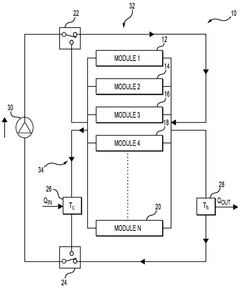
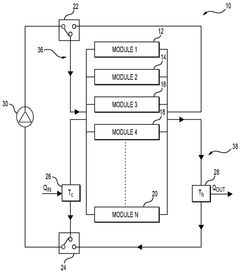
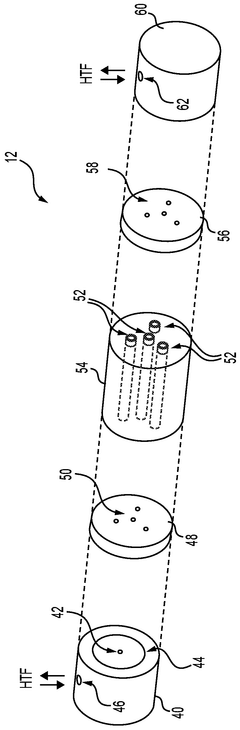
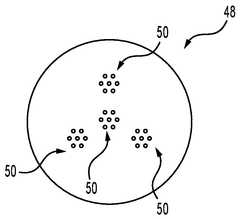
- An elastocaloric cooling device utilizing shape memory alloy tubes embedded in a retainer, driven by a pump with a cyclic alternating fluid flow, connected in parallel to enhance thermal energy conversion.
High-performance elastocaloric materials and methods for producing and using the same
PatentInactiveUS20220154310A1
Innovation
- Development of titanium-nickel based shape memory alloys with low hysteresis, comprising a mixture of transforming titanium-nickel alloy and non-transforming titanium-nickel intermetallic phase, produced using methods like laser-directed-energy deposition, which results in nanocomposite materials with reduced hysteresis and enhanced stability.


Energy Efficiency Standards for Industrial Cooling Systems
The deployment of elastocaloric cooling systems in industrial applications must align with increasingly stringent energy efficiency standards that govern industrial cooling operations. Current regulatory frameworks, including ISO 50001 energy management standards and regional directives such as the EU's Energy Efficiency Directive, establish baseline requirements for industrial cooling systems that elastocaloric technologies must meet or exceed to gain market acceptance.
Energy efficiency standards for industrial cooling systems typically mandate minimum Coefficient of Performance (COP) values ranging from 2.5 to 4.0, depending on the application and operating conditions. Elastocaloric cooling systems demonstrate significant potential to surpass these requirements, with theoretical COP values reaching 10-15 under optimal conditions. However, practical implementations must account for system losses, control mechanisms, and integration complexities that may reduce overall efficiency.
Compliance frameworks increasingly emphasize lifecycle energy consumption rather than peak performance metrics. This shift favors elastocaloric systems due to their solid-state nature, which eliminates refrigerant leakage concerns and reduces maintenance-related energy losses. The absence of working fluids also positions elastocaloric cooling favorably under emerging regulations targeting greenhouse gas emissions and ozone depletion potential.
Industrial cooling standards are evolving to incorporate smart grid integration requirements and demand response capabilities. Elastocaloric systems' rapid response characteristics and precise temperature control align well with these emerging standards, enabling better load management and grid stability contributions. The technology's inherent modularity supports scalable efficiency optimization across varying industrial loads.
Regional variations in energy efficiency standards create both opportunities and challenges for elastocaloric cooling deployment. While European standards emphasize environmental impact reduction, North American regulations focus more heavily on energy consumption metrics. Asian markets are developing hybrid approaches that balance efficiency with manufacturing cost considerations, creating diverse pathways for elastocaloric technology adoption.
Future standards development trends indicate increasing emphasis on system-level efficiency rather than component-level performance, favoring integrated elastocaloric solutions that can optimize entire industrial cooling processes rather than simply replacing individual components.
Energy efficiency standards for industrial cooling systems typically mandate minimum Coefficient of Performance (COP) values ranging from 2.5 to 4.0, depending on the application and operating conditions. Elastocaloric cooling systems demonstrate significant potential to surpass these requirements, with theoretical COP values reaching 10-15 under optimal conditions. However, practical implementations must account for system losses, control mechanisms, and integration complexities that may reduce overall efficiency.
Compliance frameworks increasingly emphasize lifecycle energy consumption rather than peak performance metrics. This shift favors elastocaloric systems due to their solid-state nature, which eliminates refrigerant leakage concerns and reduces maintenance-related energy losses. The absence of working fluids also positions elastocaloric cooling favorably under emerging regulations targeting greenhouse gas emissions and ozone depletion potential.
Industrial cooling standards are evolving to incorporate smart grid integration requirements and demand response capabilities. Elastocaloric systems' rapid response characteristics and precise temperature control align well with these emerging standards, enabling better load management and grid stability contributions. The technology's inherent modularity supports scalable efficiency optimization across varying industrial loads.
Regional variations in energy efficiency standards create both opportunities and challenges for elastocaloric cooling deployment. While European standards emphasize environmental impact reduction, North American regulations focus more heavily on energy consumption metrics. Asian markets are developing hybrid approaches that balance efficiency with manufacturing cost considerations, creating diverse pathways for elastocaloric technology adoption.
Future standards development trends indicate increasing emphasis on system-level efficiency rather than component-level performance, favoring integrated elastocaloric solutions that can optimize entire industrial cooling processes rather than simply replacing individual components.
Manufacturing Scalability of Elastocaloric Cooling Devices
The manufacturing scalability of elastocaloric cooling devices represents a critical bottleneck in transitioning from laboratory demonstrations to industrial-scale temperature control applications. Current production methods primarily rely on specialized material processing techniques that are inherently limited in throughput and cost-effectiveness. The fabrication of elastocaloric materials, particularly shape memory alloys and elastomeric polymers, requires precise control over microstructural properties, which traditionally involves batch processing methods unsuitable for mass production.
Material synthesis presents the first scalability challenge, as most elastocaloric materials require controlled thermal treatments, specific alloying processes, or polymer crosslinking procedures that are difficult to standardize across large production volumes. The uniformity of material properties becomes increasingly challenging to maintain as production scales increase, directly impacting the consistency of cooling performance across device populations.
Device assembly and integration pose additional manufacturing complexities. Elastocaloric cooling systems require precise mechanical actuation mechanisms, heat exchangers, and control systems that must be assembled with tight tolerances. Current assembly processes are largely manual or semi-automated, limiting production rates and introducing quality variability. The integration of multiple components into compact, reliable units suitable for industrial environments demands sophisticated manufacturing protocols that have yet to be fully developed.
Quality control and testing procedures represent another scalability constraint. Each elastocaloric device requires performance validation under various operating conditions, including fatigue testing, thermal cycling, and efficiency measurements. These testing protocols are time-intensive and require specialized equipment, creating bottlenecks in high-volume production scenarios.
Cost considerations significantly impact manufacturing scalability decisions. The current cost structure of elastocaloric devices remains prohibitively high for widespread industrial adoption, primarily due to expensive raw materials, complex processing requirements, and low production volumes. Achieving cost parity with conventional cooling technologies requires fundamental improvements in manufacturing efficiency and material utilization.
Automation potential offers promising pathways for addressing scalability challenges. Advanced manufacturing techniques such as additive manufacturing, automated assembly systems, and in-line quality monitoring could significantly enhance production capabilities. However, these solutions require substantial capital investment and process development efforts that may limit near-term scalability improvements.
Material synthesis presents the first scalability challenge, as most elastocaloric materials require controlled thermal treatments, specific alloying processes, or polymer crosslinking procedures that are difficult to standardize across large production volumes. The uniformity of material properties becomes increasingly challenging to maintain as production scales increase, directly impacting the consistency of cooling performance across device populations.
Device assembly and integration pose additional manufacturing complexities. Elastocaloric cooling systems require precise mechanical actuation mechanisms, heat exchangers, and control systems that must be assembled with tight tolerances. Current assembly processes are largely manual or semi-automated, limiting production rates and introducing quality variability. The integration of multiple components into compact, reliable units suitable for industrial environments demands sophisticated manufacturing protocols that have yet to be fully developed.
Quality control and testing procedures represent another scalability constraint. Each elastocaloric device requires performance validation under various operating conditions, including fatigue testing, thermal cycling, and efficiency measurements. These testing protocols are time-intensive and require specialized equipment, creating bottlenecks in high-volume production scenarios.
Cost considerations significantly impact manufacturing scalability decisions. The current cost structure of elastocaloric devices remains prohibitively high for widespread industrial adoption, primarily due to expensive raw materials, complex processing requirements, and low production volumes. Achieving cost parity with conventional cooling technologies requires fundamental improvements in manufacturing efficiency and material utilization.
Automation potential offers promising pathways for addressing scalability challenges. Advanced manufacturing techniques such as additive manufacturing, automated assembly systems, and in-line quality monitoring could significantly enhance production capabilities. However, these solutions require substantial capital investment and process development efforts that may limit near-term scalability improvements.
Unlock deeper insights with Patsnap Eureka Quick Research — get a full tech report to explore trends and direct your research. Try now!
Generate Your Research Report Instantly with AI Agent
Supercharge your innovation with Patsnap Eureka AI Agent Platform!