

Design Modifications in Monomode Fiber for Angular Diversity
MAR 11, 20269 MIN READ
Generate Your Research Report Instantly with AI Agent
PatSnap Eureka helps you evaluate technical feasibility & market potential.
Monomode Fiber Angular Diversity Background and Objectives
Monomode fiber technology has undergone significant evolution since its inception in the 1970s, fundamentally transforming optical communication systems. The development trajectory began with basic single-mode transmission capabilities and has progressively advanced toward sophisticated applications requiring enhanced spatial diversity and angular manipulation. This technological progression reflects the industry's continuous pursuit of higher data rates, improved signal quality, and more robust communication links.
The concept of angular diversity in monomode fibers emerged from the need to address fundamental limitations in traditional fiber optic systems. Conventional single-mode fibers, while excellent for point-to-point communication, face challenges in applications requiring spatial beam control, multiple input/multiple output configurations, and advanced sensing capabilities. These limitations became particularly evident as the telecommunications industry moved toward more complex network architectures and emerging applications in quantum communications, distributed sensing, and space-division multiplexing.
Current market demands are driving the exploration of design modifications that enable angular diversity functionality within monomode fiber structures. The telecommunications sector increasingly requires solutions that can support higher channel capacities while maintaining signal integrity across diverse propagation paths. Additionally, emerging applications in autonomous vehicles, aerospace communications, and industrial sensing systems demand fiber solutions capable of controlled angular beam steering and spatial mode manipulation.
The primary technical objective centers on developing fiber designs that maintain single-mode operation while enabling controlled angular diversity of the propagating light. This involves modifying core geometry, refractive index profiles, and potentially incorporating specialized structures that can influence the angular characteristics of the guided mode without compromising fundamental transmission properties.
Key performance targets include achieving angular steering capabilities across specified ranges while preserving low insertion loss, minimal modal dispersion, and compatibility with existing fiber infrastructure. The design modifications must also ensure long-term reliability and manufacturability at commercial scales, addressing both technical performance and economic viability considerations for widespread deployment in next-generation optical systems.
The concept of angular diversity in monomode fibers emerged from the need to address fundamental limitations in traditional fiber optic systems. Conventional single-mode fibers, while excellent for point-to-point communication, face challenges in applications requiring spatial beam control, multiple input/multiple output configurations, and advanced sensing capabilities. These limitations became particularly evident as the telecommunications industry moved toward more complex network architectures and emerging applications in quantum communications, distributed sensing, and space-division multiplexing.
Current market demands are driving the exploration of design modifications that enable angular diversity functionality within monomode fiber structures. The telecommunications sector increasingly requires solutions that can support higher channel capacities while maintaining signal integrity across diverse propagation paths. Additionally, emerging applications in autonomous vehicles, aerospace communications, and industrial sensing systems demand fiber solutions capable of controlled angular beam steering and spatial mode manipulation.
The primary technical objective centers on developing fiber designs that maintain single-mode operation while enabling controlled angular diversity of the propagating light. This involves modifying core geometry, refractive index profiles, and potentially incorporating specialized structures that can influence the angular characteristics of the guided mode without compromising fundamental transmission properties.
Key performance targets include achieving angular steering capabilities across specified ranges while preserving low insertion loss, minimal modal dispersion, and compatibility with existing fiber infrastructure. The design modifications must also ensure long-term reliability and manufacturability at commercial scales, addressing both technical performance and economic viability considerations for widespread deployment in next-generation optical systems.
Market Demand for Enhanced Fiber Optic Communication Systems
The global fiber optic communication market continues to experience robust growth driven by escalating bandwidth demands across multiple sectors. Data centers worldwide are expanding rapidly to accommodate cloud computing services, artificial intelligence applications, and big data analytics, creating substantial demand for high-performance optical communication systems. The proliferation of 5G networks requires extensive fiber infrastructure to support backhaul and fronthaul connections, while emerging technologies like autonomous vehicles and Internet of Things devices further amplify bandwidth requirements.
Telecommunications service providers face increasing pressure to upgrade their networks to handle exponentially growing data traffic. Traditional single-mode fibers, while effective, encounter limitations in capacity and signal quality over long distances. Angular diversity techniques in monomode fiber design present compelling solutions to address these constraints by improving signal-to-noise ratios and reducing modal dispersion effects.
Enterprise networks across industries including healthcare, finance, and manufacturing demand higher reliability and lower latency communications. Medical imaging systems require massive data transfers for high-resolution scans, while financial trading platforms depend on ultra-low latency connections for competitive advantage. These applications drive demand for advanced fiber optic solutions that can deliver superior performance characteristics.
The submarine cable market represents another significant growth area, with international data traffic increasing substantially due to global digitalization trends. Long-haul underwater communications require exceptional signal integrity and capacity, making angular diversity modifications particularly valuable for maintaining signal quality across vast oceanic distances.
Emerging applications in quantum communications and advanced sensing systems create new market segments for specialized fiber optic technologies. These applications often require precise control over light propagation characteristics, positioning angular diversity-enhanced fibers as enabling technologies for next-generation communication systems.
Market research indicates strong investment momentum in optical communication infrastructure, with both public and private sectors allocating substantial resources to network modernization initiatives. Government programs promoting digital infrastructure development and smart city projects further stimulate demand for enhanced fiber optic systems capable of supporting diverse communication requirements across multiple application domains.
Telecommunications service providers face increasing pressure to upgrade their networks to handle exponentially growing data traffic. Traditional single-mode fibers, while effective, encounter limitations in capacity and signal quality over long distances. Angular diversity techniques in monomode fiber design present compelling solutions to address these constraints by improving signal-to-noise ratios and reducing modal dispersion effects.
Enterprise networks across industries including healthcare, finance, and manufacturing demand higher reliability and lower latency communications. Medical imaging systems require massive data transfers for high-resolution scans, while financial trading platforms depend on ultra-low latency connections for competitive advantage. These applications drive demand for advanced fiber optic solutions that can deliver superior performance characteristics.
The submarine cable market represents another significant growth area, with international data traffic increasing substantially due to global digitalization trends. Long-haul underwater communications require exceptional signal integrity and capacity, making angular diversity modifications particularly valuable for maintaining signal quality across vast oceanic distances.
Emerging applications in quantum communications and advanced sensing systems create new market segments for specialized fiber optic technologies. These applications often require precise control over light propagation characteristics, positioning angular diversity-enhanced fibers as enabling technologies for next-generation communication systems.
Market research indicates strong investment momentum in optical communication infrastructure, with both public and private sectors allocating substantial resources to network modernization initiatives. Government programs promoting digital infrastructure development and smart city projects further stimulate demand for enhanced fiber optic systems capable of supporting diverse communication requirements across multiple application domains.
Current State and Challenges of Monomode Fiber Design
Monomode fiber technology has reached a mature state in conventional telecommunications applications, with standardized designs optimized for single-mode propagation at specific wavelengths. Current fiber architectures primarily focus on minimizing modal dispersion and maintaining signal integrity over long distances. However, the emergence of angular diversity applications has exposed significant limitations in existing monomode fiber designs, particularly in their ability to support controlled angular beam steering and spatial mode manipulation.
The fundamental challenge lies in the inherent design philosophy of traditional monomode fibers, which prioritizes mode confinement and suppression of higher-order modes. This approach conflicts with angular diversity requirements that demand precise control over light propagation angles and spatial beam characteristics. Current step-index and graded-index monomode fibers exhibit limited flexibility in manipulating the angular properties of transmitted light, constraining their effectiveness in applications requiring dynamic beam steering or spatial multiplexing.
Manufacturing precision represents another critical bottleneck in current monomode fiber production. Achieving the geometric tolerances necessary for angular diversity applications requires advanced fabrication techniques that exceed conventional fiber manufacturing capabilities. Core concentricity, refractive index profile accuracy, and dimensional uniformity must be maintained within extremely tight tolerances to enable reliable angular control. Current production methods struggle to consistently achieve these specifications at commercial scales.
Material limitations further compound the design challenges. Traditional silica-based fiber compositions offer limited refractive index contrast ranges, restricting the degree of angular manipulation achievable through core-cladding design modifications. The temperature sensitivity of existing dopant systems also introduces stability concerns in applications requiring precise angular control over varying environmental conditions.
Integration complexity poses additional obstacles in practical implementations. Current monomode fiber designs lack standardized interfaces for angular diversity systems, requiring custom coupling solutions that increase system complexity and cost. The absence of established design methodologies for angular diversity optimization forces developers to rely on iterative approaches, extending development timelines and increasing technical risks.
Measurement and characterization challenges represent a significant technical barrier. Existing fiber testing protocols are inadequate for evaluating angular diversity performance parameters. The lack of standardized measurement techniques for angular beam quality, steering accuracy, and spatial mode purity complicates the development and validation of modified fiber designs. This measurement gap hinders systematic optimization efforts and impedes the establishment of performance benchmarks for angular diversity applications.
The fundamental challenge lies in the inherent design philosophy of traditional monomode fibers, which prioritizes mode confinement and suppression of higher-order modes. This approach conflicts with angular diversity requirements that demand precise control over light propagation angles and spatial beam characteristics. Current step-index and graded-index monomode fibers exhibit limited flexibility in manipulating the angular properties of transmitted light, constraining their effectiveness in applications requiring dynamic beam steering or spatial multiplexing.
Manufacturing precision represents another critical bottleneck in current monomode fiber production. Achieving the geometric tolerances necessary for angular diversity applications requires advanced fabrication techniques that exceed conventional fiber manufacturing capabilities. Core concentricity, refractive index profile accuracy, and dimensional uniformity must be maintained within extremely tight tolerances to enable reliable angular control. Current production methods struggle to consistently achieve these specifications at commercial scales.
Material limitations further compound the design challenges. Traditional silica-based fiber compositions offer limited refractive index contrast ranges, restricting the degree of angular manipulation achievable through core-cladding design modifications. The temperature sensitivity of existing dopant systems also introduces stability concerns in applications requiring precise angular control over varying environmental conditions.
Integration complexity poses additional obstacles in practical implementations. Current monomode fiber designs lack standardized interfaces for angular diversity systems, requiring custom coupling solutions that increase system complexity and cost. The absence of established design methodologies for angular diversity optimization forces developers to rely on iterative approaches, extending development timelines and increasing technical risks.
Measurement and characterization challenges represent a significant technical barrier. Existing fiber testing protocols are inadequate for evaluating angular diversity performance parameters. The lack of standardized measurement techniques for angular beam quality, steering accuracy, and spatial mode purity complicates the development and validation of modified fiber designs. This measurement gap hinders systematic optimization efforts and impedes the establishment of performance benchmarks for angular diversity applications.
Existing Design Solutions for Angular Diversity Enhancement
01 Angular diversity techniques using mode coupling in single-mode fibers
Angular diversity can be achieved in monomode fiber systems by exploiting mode coupling effects. This involves intentionally introducing controlled perturbations or bends in the fiber to couple energy between different propagation modes or angular components. The technique helps improve signal reception by combining multiple angular paths of the optical signal, reducing fading and improving overall system performance in optical communication systems.- Angular diversity techniques using mode coupling in single-mode fibers: Angular diversity can be achieved in monomode fiber systems by exploiting mode coupling effects. This involves intentionally introducing controlled perturbations or bends in the fiber to couple energy between different propagation modes or angular components. The technique helps improve signal reception by combining signals from different angular paths, reducing fading effects and enhancing overall system performance in optical communication systems.
- Spatial diversity reception using multiple fiber inputs: Multiple single-mode fibers can be arranged to receive optical signals from different angular directions, creating a spatial diversity system. By positioning fiber ends at different angles or locations relative to the optical source, the system captures independent signal paths. These signals are then combined or processed to improve signal quality and reduce the impact of atmospheric turbulence or other interference sources in free-space optical communications.
- Fiber coupling with angular alignment mechanisms: Precise angular alignment systems are employed to optimize coupling efficiency between optical sources and single-mode fibers. These mechanisms include adjustable mounting structures, piezoelectric actuators, or micro-positioning stages that allow fine-tuning of the angular orientation. Such systems are critical for maintaining optimal coupling conditions and can be used to implement angular diversity by rapidly switching between different coupling angles or maintaining multiple simultaneous angular connections.
- Angular multiplexing in single-mode fiber systems: Angular multiplexing techniques enable multiple optical signals to be transmitted through a single-mode fiber by utilizing different angular components or orbital angular momentum states. This approach increases the information capacity of the fiber link by creating independent channels based on angular characteristics. The technique requires specialized coupling optics and detection systems capable of distinguishing between different angular modes at both transmitter and receiver ends.
- Beam steering and angular scanning for fiber coupling: Dynamic beam steering systems enable angular diversity by actively controlling the angle at which light couples into or out of single-mode fibers. These systems may employ optical phased arrays, MEMS mirrors, or other beam deflection technologies to scan across different angular positions. This capability is particularly useful in applications requiring adaptive coupling, tracking of moving sources, or implementation of angular diversity schemes to combat signal degradation in varying environmental conditions.
02 Spatial diversity reception using multiple fiber inputs
Multiple single-mode fibers can be arranged to receive optical signals from different angular directions, creating a spatial diversity system. Each fiber captures light from a slightly different angle, and the signals are then combined or processed to enhance reception quality. This approach is particularly useful in free-space optical communication systems where atmospheric turbulence or misalignment can cause signal degradation.Expand Specific Solutions03 Fiber coupling with angular offset compensation
Techniques for coupling light into single-mode fibers while compensating for angular misalignment involve specialized optical components and alignment mechanisms. These methods allow for efficient light coupling even when there is an angular deviation between the light source and the fiber axis. The compensation mechanisms may include adaptive optics, lens systems, or mechanical adjustment systems that dynamically correct for angular variations.Expand Specific Solutions04 Angular multiplexing in single-mode fiber systems
Angular multiplexing techniques enable multiple optical signals to be transmitted through a single-mode fiber by utilizing different angular components or propagation directions. This approach increases the information capacity of the fiber system by exploiting the angular domain as an additional degree of freedom. The signals can be separated at the receiver end using angular-selective components or processing algorithms.Expand Specific Solutions05 Angular alignment and positioning systems for fiber optics
Precision alignment systems are designed to control and optimize the angular positioning of single-mode fibers relative to optical sources or other fibers. These systems employ various mechanisms including piezoelectric actuators, micro-positioning stages, and feedback control loops to maintain optimal angular alignment. Such systems are critical in applications requiring high coupling efficiency and stable optical connections, particularly in sensing and communication applications.Expand Specific Solutions
Key Players in Fiber Optic and Telecom Industry
The monomode fiber angular diversity technology field represents a mature telecommunications sector experiencing steady evolution driven by increasing bandwidth demands and network infrastructure upgrades. The market demonstrates substantial scale with established global players including major fiber manufacturers like Corning, Fujikura, Sumitomo Electric, and Furukawa Electric alongside telecommunications giants such as NTT and Samsung Electronics. Technology maturity varies significantly across the competitive landscape, with traditional optical fiber companies like Draka Comteq and Yangtze Optical Fibre possessing deep manufacturing expertise, while research institutions including University of Michigan, CNRS, and Fraunhofer-Gesellschaft drive innovation in advanced fiber design modifications. Chinese manufacturers such as Hengtong Optic-Electric and specialized companies like OFS Fitel contribute to a diverse ecosystem where incremental improvements in angular diversity capabilities continue to enhance network performance and reliability.
Fujikura Ltd.
Technical Solution: Fujikura has developed sophisticated single-mode fiber designs featuring modified refractive index profiles and engineered core structures to improve angular diversity characteristics. Their approach incorporates advanced preform manufacturing techniques with precise control over dopant concentration gradients, enabling optimized numerical aperture properties. The company's fiber designs utilize specialized cladding configurations and innovative coating systems to enhance angular acceptance while preserving single-mode operation, particularly focusing on applications requiring improved coupling efficiency and reduced angular sensitivity in optical networks and sensing systems.
Strengths: Advanced preform technology and strong presence in Asian markets. Weaknesses: Limited global market penetration outside Asia.
Corning, Inc.
Technical Solution: Corning has developed advanced single-mode fiber designs incorporating specialized core and cladding structures to enhance angular diversity performance. Their approach focuses on optimizing the refractive index profile through precise dopant distribution, creating fibers with modified numerical aperture characteristics that support improved angular acceptance while maintaining single-mode operation. The company's proprietary manufacturing processes enable tight control over fiber geometry and optical properties, resulting in enhanced mode field diameter management and reduced angular sensitivity in optical communication systems.
Strengths: Industry-leading manufacturing capabilities and extensive R&D resources. Weaknesses: High production costs and complex manufacturing processes.
Core Innovations in Monomode Fiber Modification Patents
Photonic crystal fiber methods and devices
PatentInactiveUS20190331847A1
Innovation
- The development of annular core photonic crystal optical fibers with a specific geometry, featuring a central core surrounded by a ring of omitted holes or varying refractive index regions, which enhances non-linearity and supports a wide range of OAM and vector modes, allowing for robust transmission across various wavelengths.


Equalizing modal delay of high order modes in bend insensitive multimode fiber
PatentActiveUS7865050B1
Innovation
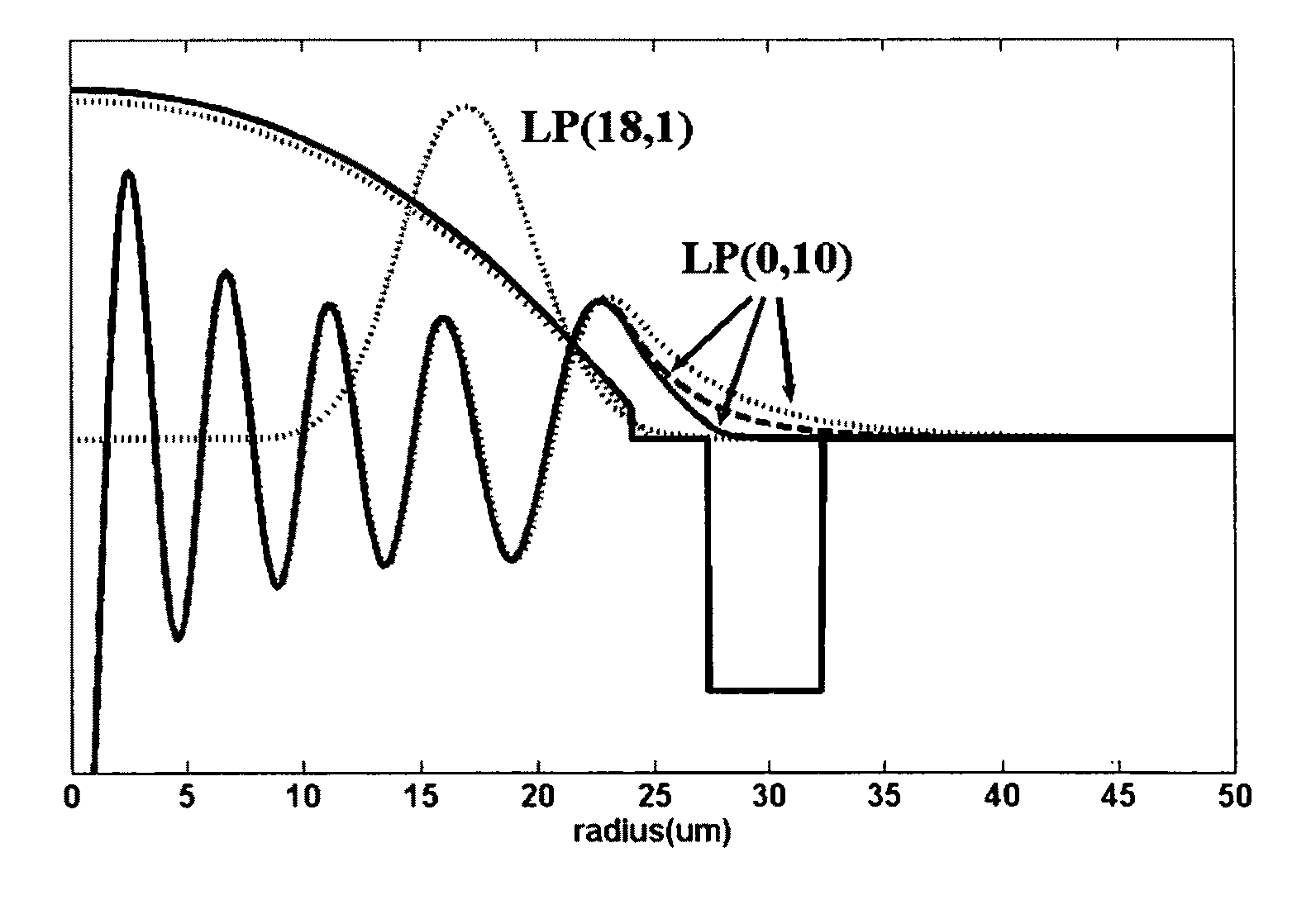
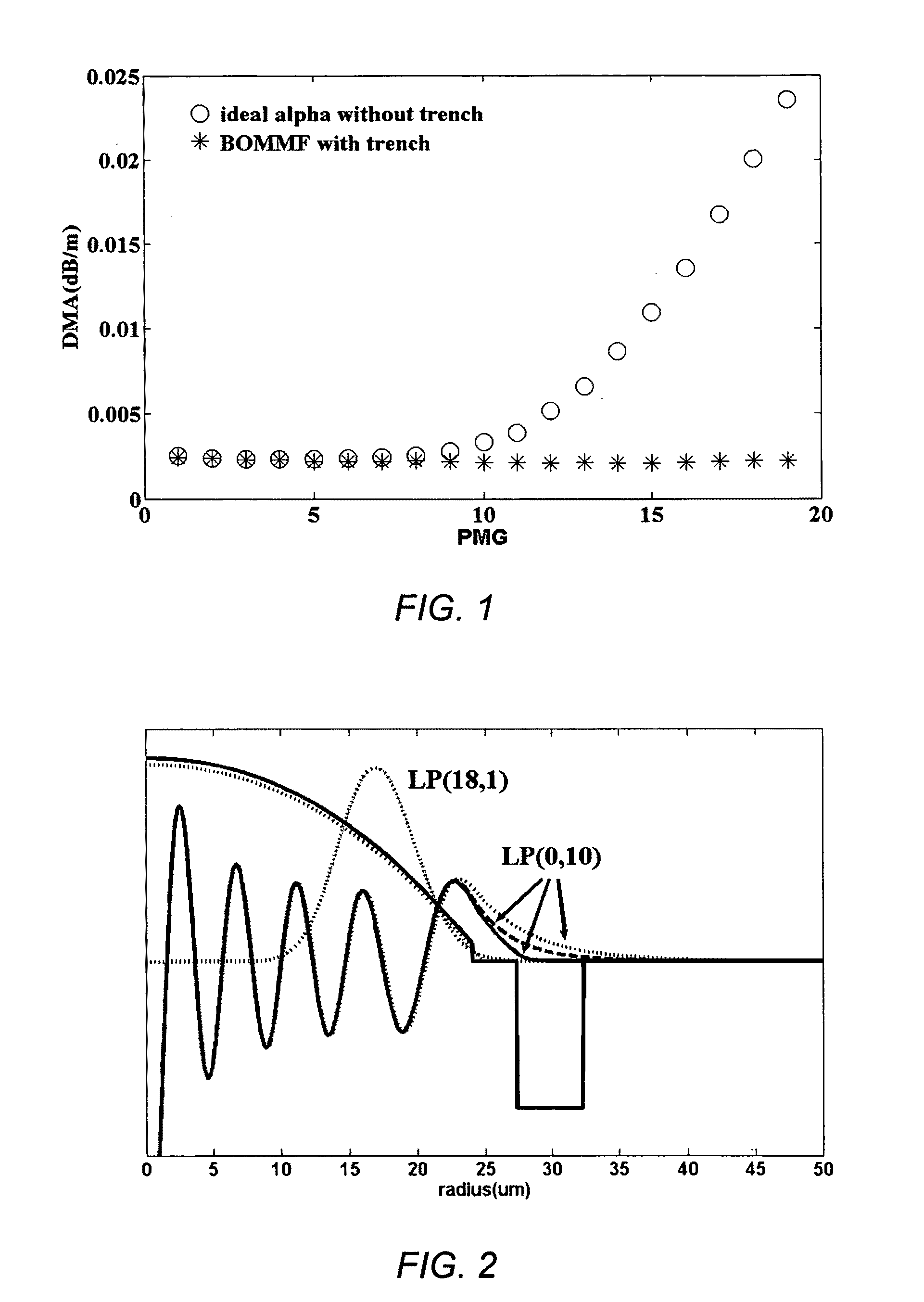
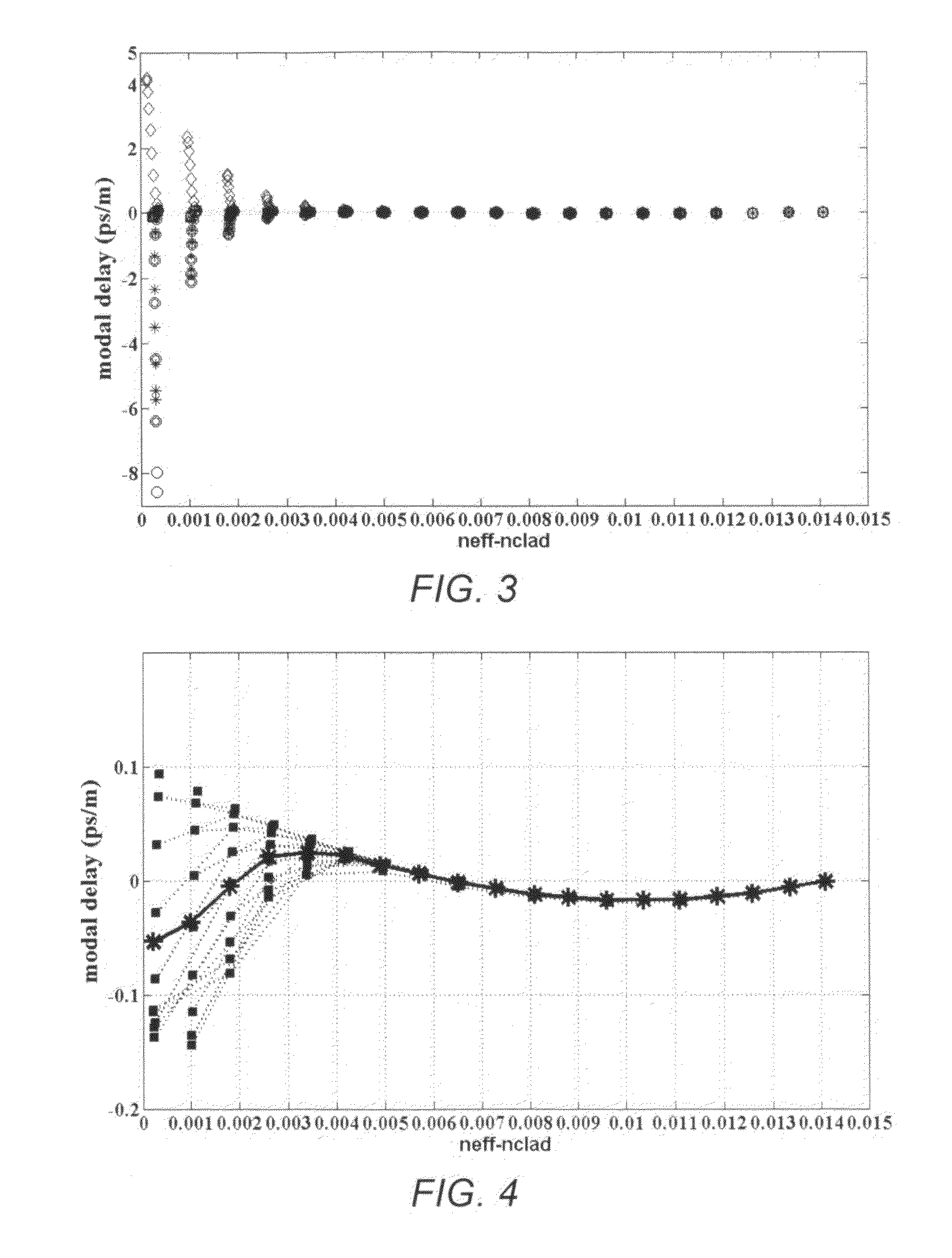
- The design incorporates a hybrid refractive index profile with a negative trench positioned at a specific radius relative to the core profile, combining a standard alpha profile with a step profile at the outer edge, which reduces differential mode delay and achieves low bend loss by equalizing modal delays across all modes.

Standardization Framework for Fiber Optic Communications
The standardization framework for fiber optic communications plays a crucial role in enabling angular diversity applications through monomode fiber design modifications. Current standardization efforts are primarily coordinated by the International Telecommunication Union (ITU-T), the Institute of Electrical and Electronics Engineers (IEEE), and the International Electrotechnical Commission (IEC), which collectively establish technical specifications for fiber optic systems incorporating advanced spatial diversity techniques.
The ITU-T G.652 and G.657 standards provide foundational specifications for single-mode optical fibers, but emerging angular diversity applications require extensions to accommodate modified core geometries and refractive index profiles. Recent standardization activities focus on defining measurement methodologies for angular-dependent transmission characteristics, including modal field diameter variations and bend-induced coupling coefficients that are essential for angular diversity implementations.
IEEE 802.3 working groups have initiated discussions on incorporating angular diversity-enabled fiber specifications into Ethernet standards, particularly for next-generation 400G and 800G applications. These efforts address the need for standardized testing procedures to evaluate fiber performance under various angular orientations and mechanical stress conditions that affect spatial mode coupling.
The standardization framework also encompasses safety and environmental considerations specific to modified fiber designs. IEC 60793 series standards are being updated to include thermal cycling tests and long-term reliability assessments for fibers with engineered angular sensitivity characteristics, ensuring consistent performance across different deployment scenarios.
Interoperability standards are particularly critical for angular diversity systems, as they must maintain backward compatibility with existing infrastructure while enabling enhanced spatial diversity capabilities. The framework establishes common interfaces and performance metrics that allow equipment from different manufacturers to work seamlessly in angular diversity-enabled networks.
Emerging standardization efforts also address the characterization of polarization-dependent effects in angular diversity fibers, establishing measurement protocols for cross-talk between spatial channels and defining acceptable performance thresholds for commercial deployment. These standards ensure that angular diversity modifications maintain signal integrity while providing the intended diversity benefits for improved system reliability and capacity.
The ITU-T G.652 and G.657 standards provide foundational specifications for single-mode optical fibers, but emerging angular diversity applications require extensions to accommodate modified core geometries and refractive index profiles. Recent standardization activities focus on defining measurement methodologies for angular-dependent transmission characteristics, including modal field diameter variations and bend-induced coupling coefficients that are essential for angular diversity implementations.
IEEE 802.3 working groups have initiated discussions on incorporating angular diversity-enabled fiber specifications into Ethernet standards, particularly for next-generation 400G and 800G applications. These efforts address the need for standardized testing procedures to evaluate fiber performance under various angular orientations and mechanical stress conditions that affect spatial mode coupling.
The standardization framework also encompasses safety and environmental considerations specific to modified fiber designs. IEC 60793 series standards are being updated to include thermal cycling tests and long-term reliability assessments for fibers with engineered angular sensitivity characteristics, ensuring consistent performance across different deployment scenarios.
Interoperability standards are particularly critical for angular diversity systems, as they must maintain backward compatibility with existing infrastructure while enabling enhanced spatial diversity capabilities. The framework establishes common interfaces and performance metrics that allow equipment from different manufacturers to work seamlessly in angular diversity-enabled networks.
Emerging standardization efforts also address the characterization of polarization-dependent effects in angular diversity fibers, establishing measurement protocols for cross-talk between spatial channels and defining acceptable performance thresholds for commercial deployment. These standards ensure that angular diversity modifications maintain signal integrity while providing the intended diversity benefits for improved system reliability and capacity.
Manufacturing Scalability for Modified Fiber Designs
Manufacturing scalability represents a critical bottleneck in the commercialization of modified monomode fiber designs for angular diversity applications. Traditional fiber manufacturing processes, optimized for standard single-mode fibers, require substantial modifications to accommodate the complex geometrical and material variations inherent in angular diversity designs. The precision requirements for maintaining consistent core asymmetries, specialized refractive index profiles, and micro-structured elements across kilometer-length productions present unprecedented challenges for existing manufacturing infrastructure.
Current fiber drawing processes face significant limitations when scaling modified designs from laboratory prototypes to commercial volumes. The preform fabrication stage becomes particularly complex, as angular diversity fibers often require non-circular core geometries, graded-index profiles with precise asymmetric distributions, or integrated micro-structures that deviate substantially from conventional cylindrical symmetry. These modifications demand enhanced process control systems capable of maintaining dimensional tolerances within nanometer ranges while operating at industrial production speeds.
Quality control and testing protocols represent another scalability challenge, as standard fiber characterization methods prove inadequate for angular diversity designs. Manufacturing facilities must implement specialized measurement systems capable of evaluating angular-dependent optical properties, mode coupling characteristics, and polarization behavior across multiple spatial orientations. The development of automated testing equipment that can rapidly assess these parameters without compromising production throughput remains a significant technical hurdle.
Economic considerations further complicate manufacturing scalability, as modified fiber designs typically require specialized materials, custom tooling, and extended process development cycles. The initial capital investment for retooling existing manufacturing lines or establishing dedicated production facilities can be substantial, particularly when considering the relatively niche market size for angular diversity applications compared to standard telecommunications fibers.
Supply chain integration poses additional challenges, as modified fiber designs may require specialized raw materials, custom preform components, or unique coating systems not readily available through established supplier networks. Manufacturers must develop new vendor relationships and potentially invest in upstream production capabilities to ensure consistent material quality and availability at commercial scales.
Current fiber drawing processes face significant limitations when scaling modified designs from laboratory prototypes to commercial volumes. The preform fabrication stage becomes particularly complex, as angular diversity fibers often require non-circular core geometries, graded-index profiles with precise asymmetric distributions, or integrated micro-structures that deviate substantially from conventional cylindrical symmetry. These modifications demand enhanced process control systems capable of maintaining dimensional tolerances within nanometer ranges while operating at industrial production speeds.
Quality control and testing protocols represent another scalability challenge, as standard fiber characterization methods prove inadequate for angular diversity designs. Manufacturing facilities must implement specialized measurement systems capable of evaluating angular-dependent optical properties, mode coupling characteristics, and polarization behavior across multiple spatial orientations. The development of automated testing equipment that can rapidly assess these parameters without compromising production throughput remains a significant technical hurdle.
Economic considerations further complicate manufacturing scalability, as modified fiber designs typically require specialized materials, custom tooling, and extended process development cycles. The initial capital investment for retooling existing manufacturing lines or establishing dedicated production facilities can be substantial, particularly when considering the relatively niche market size for angular diversity applications compared to standard telecommunications fibers.
Supply chain integration poses additional challenges, as modified fiber designs may require specialized raw materials, custom preform components, or unique coating systems not readily available through established supplier networks. Manufacturers must develop new vendor relationships and potentially invest in upstream production capabilities to ensure consistent material quality and availability at commercial scales.
Unlock deeper insights with PatSnap Eureka Quick Research — get a full tech report to explore trends and direct your research. Try now!
Generate Your Research Report Instantly with AI Agent
Supercharge your innovation with PatSnap Eureka AI Agent Platform!