

Develop Diamond Substrates to Boost Hydrophobic Coating Performance
MAY 14, 20269 MIN READ
Generate Your Research Report Instantly with AI Agent
Patsnap Eureka helps you evaluate technical feasibility & market potential.
Diamond Substrate Technology Background and Performance Goals
Diamond substrates represent a revolutionary advancement in surface engineering, leveraging the exceptional properties of synthetic diamond materials to enhance coating performance across multiple industrial applications. The unique crystalline structure of diamond provides an unprecedented combination of mechanical hardness, chemical inertness, and thermal conductivity that makes it an ideal foundation for advanced hydrophobic coatings. This technology has emerged from decades of research in chemical vapor deposition and diamond synthesis techniques, evolving from laboratory curiosities to commercially viable solutions.
The development trajectory of diamond substrate technology has been driven by the increasing demand for ultra-durable, high-performance surfaces in aerospace, automotive, marine, and electronic industries. Traditional substrate materials often fail to provide the necessary stability and longevity required for demanding hydrophobic applications, particularly under extreme environmental conditions. Diamond substrates address these limitations by offering superior adhesion properties, exceptional wear resistance, and remarkable chemical stability that significantly extends coating lifespan.
Current technological objectives focus on optimizing the surface morphology and crystallographic orientation of diamond substrates to maximize hydrophobic coating adhesion and performance. Key performance goals include achieving water contact angles exceeding 150 degrees with minimal hysteresis, maintaining coating integrity under mechanical stress exceeding 10 GPa, and ensuring operational stability across temperature ranges from -50°C to 300°C. Additionally, the technology aims to reduce surface energy to below 20 mN/m while preserving the substrate's inherent thermal management capabilities.
The strategic importance of this technology lies in its potential to revolutionize surface protection applications where conventional solutions prove inadequate. By combining diamond's intrinsic properties with advanced coating formulations, researchers are targeting breakthrough performance metrics that could enable new applications in harsh environments, including deep-sea exploration equipment, hypersonic vehicle surfaces, and next-generation electronic devices requiring both hydrophobic protection and efficient heat dissipation.
Emerging research directions emphasize the development of nanostructured diamond surfaces with controlled roughness parameters and the integration of functional dopants to enhance coating-substrate interactions. These advancements promise to unlock unprecedented levels of hydrophobic performance while maintaining the mechanical robustness essential for industrial applications.
The development trajectory of diamond substrate technology has been driven by the increasing demand for ultra-durable, high-performance surfaces in aerospace, automotive, marine, and electronic industries. Traditional substrate materials often fail to provide the necessary stability and longevity required for demanding hydrophobic applications, particularly under extreme environmental conditions. Diamond substrates address these limitations by offering superior adhesion properties, exceptional wear resistance, and remarkable chemical stability that significantly extends coating lifespan.
Current technological objectives focus on optimizing the surface morphology and crystallographic orientation of diamond substrates to maximize hydrophobic coating adhesion and performance. Key performance goals include achieving water contact angles exceeding 150 degrees with minimal hysteresis, maintaining coating integrity under mechanical stress exceeding 10 GPa, and ensuring operational stability across temperature ranges from -50°C to 300°C. Additionally, the technology aims to reduce surface energy to below 20 mN/m while preserving the substrate's inherent thermal management capabilities.
The strategic importance of this technology lies in its potential to revolutionize surface protection applications where conventional solutions prove inadequate. By combining diamond's intrinsic properties with advanced coating formulations, researchers are targeting breakthrough performance metrics that could enable new applications in harsh environments, including deep-sea exploration equipment, hypersonic vehicle surfaces, and next-generation electronic devices requiring both hydrophobic protection and efficient heat dissipation.
Emerging research directions emphasize the development of nanostructured diamond surfaces with controlled roughness parameters and the integration of functional dopants to enhance coating-substrate interactions. These advancements promise to unlock unprecedented levels of hydrophobic performance while maintaining the mechanical robustness essential for industrial applications.
Market Demand for Advanced Hydrophobic Coating Solutions
The global hydrophobic coating market is experiencing unprecedented growth driven by diverse industrial applications requiring superior water-repellent properties. Traditional hydrophobic coatings face significant limitations in durability, adhesion strength, and long-term performance under harsh environmental conditions. These challenges have created substantial demand for next-generation coating solutions that can maintain their hydrophobic properties over extended periods while withstanding mechanical stress, temperature fluctuations, and chemical exposure.
Automotive industries represent a major demand driver, seeking advanced hydrophobic coatings for windshields, exterior surfaces, and engine components to improve visibility, reduce maintenance costs, and enhance fuel efficiency through drag reduction. The aerospace sector requires ultra-durable hydrophobic solutions for aircraft surfaces to prevent ice formation, reduce weight from water accumulation, and maintain aerodynamic efficiency during flight operations.
Electronics manufacturing has emerged as a critical market segment demanding precision hydrophobic coatings for circuit boards, sensors, and display technologies. The miniaturization trend in electronics necessitates coatings that provide reliable moisture protection without compromising component functionality or adding significant thickness to device profiles.
Marine and offshore industries present substantial opportunities for advanced hydrophobic coating solutions. Ship hulls, offshore platforms, and underwater equipment require coatings that resist biofouling while maintaining hydrophobic properties in saltwater environments. The economic impact of improved coating performance includes reduced fuel consumption, decreased maintenance intervals, and extended equipment lifespan.
Building and construction sectors increasingly demand hydrophobic coatings for facades, windows, and roofing materials to reduce cleaning costs, prevent water damage, and improve energy efficiency. Smart building technologies integration requires coatings that maintain performance while supporting additional functionalities such as self-cleaning properties and pollution resistance.
Medical device manufacturing represents an emerging high-value market segment where hydrophobic coatings enable improved biocompatibility, reduced bacterial adhesion, and enhanced device performance in biological environments. Surgical instruments, implants, and diagnostic equipment benefit from advanced hydrophobic surface treatments that maintain sterility and functionality.
The convergence of these market demands creates compelling opportunities for diamond substrate-enhanced hydrophobic coatings that address current performance limitations while enabling new application possibilities across multiple industries.
Automotive industries represent a major demand driver, seeking advanced hydrophobic coatings for windshields, exterior surfaces, and engine components to improve visibility, reduce maintenance costs, and enhance fuel efficiency through drag reduction. The aerospace sector requires ultra-durable hydrophobic solutions for aircraft surfaces to prevent ice formation, reduce weight from water accumulation, and maintain aerodynamic efficiency during flight operations.
Electronics manufacturing has emerged as a critical market segment demanding precision hydrophobic coatings for circuit boards, sensors, and display technologies. The miniaturization trend in electronics necessitates coatings that provide reliable moisture protection without compromising component functionality or adding significant thickness to device profiles.
Marine and offshore industries present substantial opportunities for advanced hydrophobic coating solutions. Ship hulls, offshore platforms, and underwater equipment require coatings that resist biofouling while maintaining hydrophobic properties in saltwater environments. The economic impact of improved coating performance includes reduced fuel consumption, decreased maintenance intervals, and extended equipment lifespan.
Building and construction sectors increasingly demand hydrophobic coatings for facades, windows, and roofing materials to reduce cleaning costs, prevent water damage, and improve energy efficiency. Smart building technologies integration requires coatings that maintain performance while supporting additional functionalities such as self-cleaning properties and pollution resistance.
Medical device manufacturing represents an emerging high-value market segment where hydrophobic coatings enable improved biocompatibility, reduced bacterial adhesion, and enhanced device performance in biological environments. Surgical instruments, implants, and diagnostic equipment benefit from advanced hydrophobic surface treatments that maintain sterility and functionality.
The convergence of these market demands creates compelling opportunities for diamond substrate-enhanced hydrophobic coatings that address current performance limitations while enabling new application possibilities across multiple industries.
Current State and Challenges in Diamond Substrate Manufacturing
Diamond substrate manufacturing has achieved significant technological maturity over the past decades, with chemical vapor deposition (CVD) emerging as the dominant production method for synthetic diamond films. Current manufacturing capabilities enable the production of polycrystalline and single-crystal diamond substrates with varying degrees of surface quality and crystallographic orientation. The technology has progressed from laboratory-scale synthesis to industrial production, with substrate sizes now reaching several inches in diameter.
The manufacturing process typically involves high-temperature CVD reactors operating at temperatures between 800-1200°C, utilizing methane and hydrogen gas mixtures. Modern facilities can produce diamond substrates with surface roughness values ranging from nanometer to micrometer scales, depending on the intended application. Quality control systems have been established to monitor crystal structure, surface morphology, and defect density throughout the production process.
Despite technological advances, several critical challenges persist in diamond substrate manufacturing that directly impact hydrophobic coating performance. Surface roughness control remains a primary concern, as excessive roughness can compromise coating adhesion and uniformity. Achieving consistent surface topography across large substrate areas proves technically demanding, with variations often exceeding acceptable tolerances for high-performance coatings.
Crystal defect management presents another significant challenge. Grain boundaries, dislocations, and impurity incorporation during growth can create surface irregularities that negatively affect coating properties. These defects can serve as nucleation sites for coating failure or create non-uniform wetting characteristics that reduce hydrophobic performance.
Manufacturing cost represents a substantial barrier to widespread adoption. Current production methods require expensive equipment, high energy consumption, and lengthy processing times. The economic viability of diamond substrates for hydrophobic coating applications remains questionable compared to alternative substrate materials, limiting market penetration and scalability.
Substrate size limitations constrain manufacturing flexibility and application scope. While laboratory-scale substrates demonstrate excellent properties, scaling to larger dimensions while maintaining surface quality and crystal uniformity presents ongoing technical difficulties. This size constraint affects the economic feasibility of diamond substrates for large-area hydrophobic coating applications.
Quality standardization across different manufacturers lacks consistency, creating variability in substrate performance characteristics. The absence of universally accepted quality metrics and testing protocols complicates the selection and optimization of diamond substrates for specific hydrophobic coating requirements, hindering systematic performance improvements.
The manufacturing process typically involves high-temperature CVD reactors operating at temperatures between 800-1200°C, utilizing methane and hydrogen gas mixtures. Modern facilities can produce diamond substrates with surface roughness values ranging from nanometer to micrometer scales, depending on the intended application. Quality control systems have been established to monitor crystal structure, surface morphology, and defect density throughout the production process.
Despite technological advances, several critical challenges persist in diamond substrate manufacturing that directly impact hydrophobic coating performance. Surface roughness control remains a primary concern, as excessive roughness can compromise coating adhesion and uniformity. Achieving consistent surface topography across large substrate areas proves technically demanding, with variations often exceeding acceptable tolerances for high-performance coatings.
Crystal defect management presents another significant challenge. Grain boundaries, dislocations, and impurity incorporation during growth can create surface irregularities that negatively affect coating properties. These defects can serve as nucleation sites for coating failure or create non-uniform wetting characteristics that reduce hydrophobic performance.
Manufacturing cost represents a substantial barrier to widespread adoption. Current production methods require expensive equipment, high energy consumption, and lengthy processing times. The economic viability of diamond substrates for hydrophobic coating applications remains questionable compared to alternative substrate materials, limiting market penetration and scalability.
Substrate size limitations constrain manufacturing flexibility and application scope. While laboratory-scale substrates demonstrate excellent properties, scaling to larger dimensions while maintaining surface quality and crystal uniformity presents ongoing technical difficulties. This size constraint affects the economic feasibility of diamond substrates for large-area hydrophobic coating applications.
Quality standardization across different manufacturers lacks consistency, creating variability in substrate performance characteristics. The absence of universally accepted quality metrics and testing protocols complicates the selection and optimization of diamond substrates for specific hydrophobic coating requirements, hindering systematic performance improvements.
Existing Diamond Substrate Solutions for Hydrophobic Applications
01 Diamond substrate synthesis and growth methods
Various techniques for synthesizing and growing diamond substrates including chemical vapor deposition, plasma-enhanced methods, and controlled crystallization processes. These methods focus on achieving high-quality diamond films with specific crystal orientations and surface properties for enhanced performance in electronic and optical applications.- Diamond substrate synthesis and growth methods: Various techniques for synthesizing and growing diamond substrates including chemical vapor deposition, plasma-enhanced methods, and controlled crystallization processes. These methods focus on achieving high-quality diamond films with specific crystal orientations and surface properties for enhanced performance in electronic and optical applications.
- Surface treatment and modification techniques: Methods for treating and modifying diamond substrate surfaces to improve their performance characteristics. These include surface functionalization, etching processes, and coating applications that enhance adhesion, reduce surface roughness, and optimize electrical or thermal properties for specific applications.
- Thermal management and heat dissipation properties: Utilization of diamond substrates for thermal management applications due to their exceptional thermal conductivity. These implementations focus on heat sink designs, thermal interface materials, and substrate configurations that maximize heat dissipation in high-power electronic devices and systems.
- Electronic device integration and semiconductor applications: Integration of diamond substrates in semiconductor devices and electronic components to leverage their superior electrical properties. Applications include power electronics, high-frequency devices, and radiation-resistant components where diamond's wide bandgap and high breakdown voltage provide significant advantages.
- Mechanical properties and structural applications: Exploitation of diamond substrates' exceptional mechanical properties including hardness, wear resistance, and structural stability. These applications encompass cutting tools, wear-resistant coatings, and structural components where mechanical durability and dimensional stability are critical performance factors.
02 Surface treatment and modification techniques
Methods for treating and modifying diamond substrate surfaces to improve their performance characteristics. These include surface functionalization, etching processes, and coating applications that enhance adhesion, reduce surface roughness, and optimize electrical or thermal properties for specific applications.Expand Specific Solutions03 Electronic and semiconductor applications
Utilization of diamond substrates in electronic devices and semiconductor applications, focusing on their exceptional electrical properties, thermal conductivity, and radiation resistance. These applications leverage diamond's wide bandgap and high carrier mobility for high-performance electronic components.Expand Specific Solutions04 Thermal management and heat dissipation
Applications of diamond substrates for thermal management solutions, exploiting their superior thermal conductivity properties. These implementations focus on heat spreading, thermal interface materials, and cooling solutions for high-power electronic devices and systems requiring efficient heat dissipation.Expand Specific Solutions05 Optical and photonic device integration
Integration of diamond substrates in optical and photonic devices, utilizing their transparency, low optical loss, and unique photonic properties. These applications include quantum photonics, laser systems, and optical sensors where diamond's exceptional optical characteristics provide superior performance.Expand Specific Solutions
Key Players in Diamond Substrate and Coating Industry
The diamond substrate technology for hydrophobic coatings represents an emerging niche within the broader surface treatment industry, currently in its early development stage with significant growth potential. The market remains relatively small but is expanding rapidly, driven by applications in semiconductor manufacturing, precision optics, and advanced materials processing. Technology maturity varies significantly across players, with established industrial giants like BASF Corp., Hitachi Ltd., and Sumitomo Electric Industries Ltd. leveraging their extensive R&D capabilities and manufacturing expertise to advance diamond substrate applications. Research institutions including MIT, Fraunhofer-Gesellschaft, and Chinese Academy institutes are pioneering fundamental breakthroughs in diamond synthesis and surface modification techniques. Specialized companies such as Nanosys Inc., Wolfspeed Inc., and Hardide Plc are developing targeted solutions for specific applications, while traditional materials companies like Wacker Chemie AG and Saint-Gobain are integrating diamond substrates into their existing product portfolios to enhance coating performance and durability.
BASF Corp.
Technical Solution: BASF has developed advanced diamond-like carbon (DLC) and nanocrystalline diamond substrate technologies specifically designed to enhance hydrophobic coating performance. Their approach involves creating textured diamond surfaces with controlled micro and nano-scale features that promote superior coating adhesion while maintaining excellent water repellency. The company's proprietary chemical vapor deposition processes enable the production of diamond substrates with tailored surface chemistry and morphology, optimizing the interface between the substrate and hydrophobic coatings for improved durability and self-cleaning properties.
Strengths: Extensive chemical expertise and scalable manufacturing processes. Weaknesses: Limited specialization in pure diamond substrates compared to DLC alternatives.
Oerlikon Surface Solutions AG
Technical Solution: Oerlikon has developed diamond and diamond-like coating technologies that serve as both substrates and functional layers for hydrophobic applications. Their diamond substrate solutions utilize advanced PVD and CVD processes to create surfaces with controlled crystallinity and surface energy characteristics. The company's approach focuses on creating diamond substrates with specific surface textures and chemical properties that enhance the wetting behavior and adhesion of subsequently applied hydrophobic coatings. Their technology platform enables customization of substrate properties for specific application requirements in automotive, aerospace, and industrial sectors.
Strengths: Industrial-scale production capabilities and proven coating expertise. Weaknesses: Higher focus on traditional coatings rather than specialized diamond substrate development.
Core Innovations in Diamond-Enhanced Hydrophobic Coatings
Method for coating micromechanical components of a micromechanical system, in particular a watch and related micromechanical coated component
PatentInactiveUS20120141800A1
Innovation
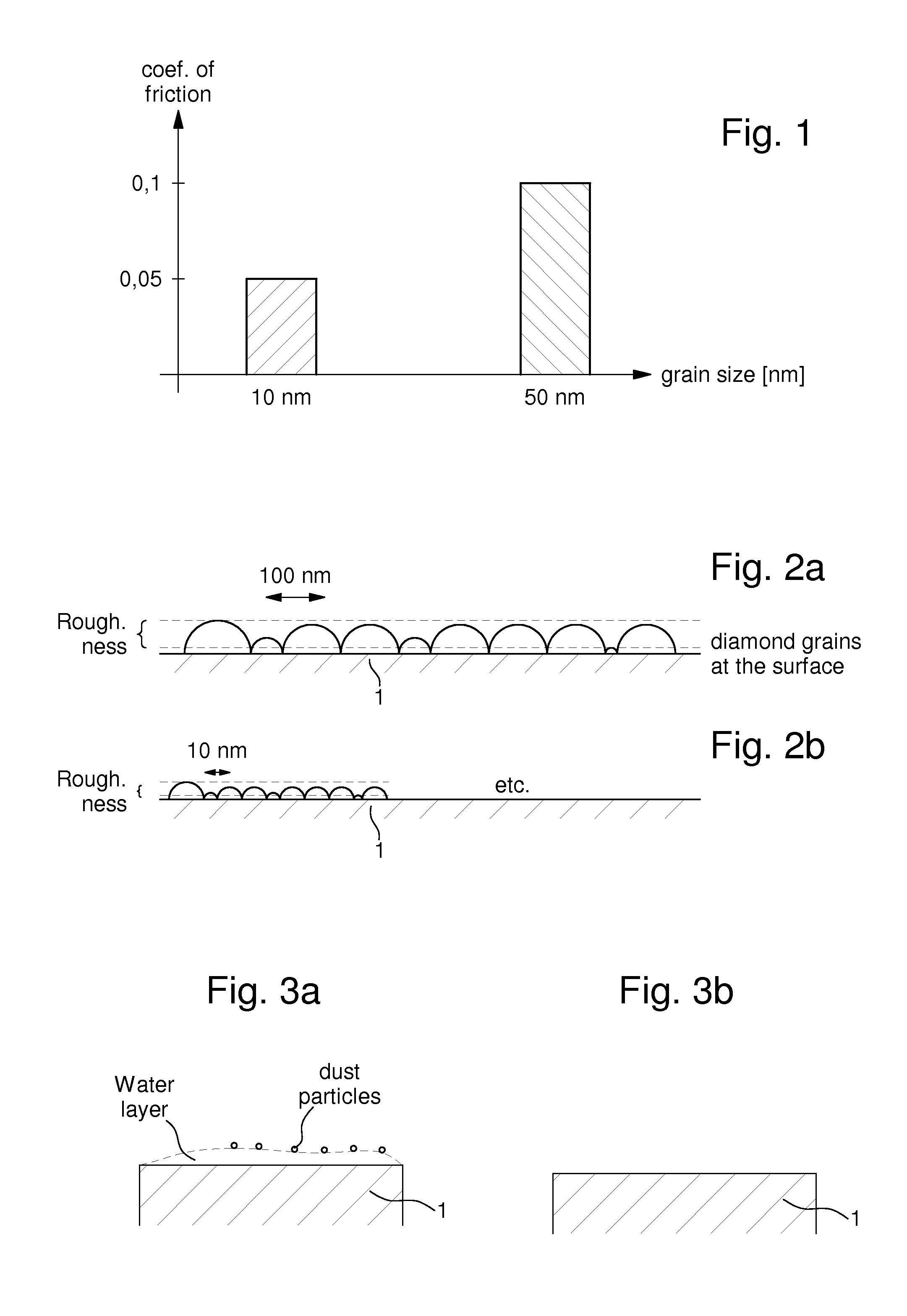
- Increasing the electrical conductivity of diamond coatings to reduce electrostatic charging and water film accumulation by doping with elements like boron or phosphorus, and terminating the surface with hydrophobic materials like fluorine to create a conductive, hydrophobic nanocrystalline diamond film with low friction and roughness.

Hydrophobical surface treated NANO diamond and method for manufacturing the same
PatentActiveKR1020130041573A
Innovation
- Nanodiamonds are treated with monounsaturated fatty acids and amine-based compounds through a two-step process involving mixing, milling, and filtering to impart hydrophobicity, ensuring stable dispersibility and storage stability in oil.


Environmental Impact and Sustainability of Diamond Substrates
The environmental implications of diamond substrate production present both challenges and opportunities in the context of hydrophobic coating applications. Traditional diamond synthesis methods, particularly high-pressure high-temperature (HPHT) processes, require substantial energy inputs and generate significant carbon footprints. However, the exceptional durability and longevity of diamond substrates can offset these initial environmental costs through extended service life and reduced replacement frequency.
Chemical vapor deposition (CVD) diamond production offers more environmentally favorable pathways compared to HPHT methods. CVD processes operate at lower pressures and can utilize renewable energy sources, reducing overall environmental impact. The ability to grow diamond films on various substrates also minimizes material waste and enables more efficient resource utilization in manufacturing processes.
The sustainability profile of diamond substrates becomes particularly compelling when considering their performance in hydrophobic coating applications. Diamond's superior thermal conductivity and chemical inertness enable coatings to maintain effectiveness for significantly longer periods compared to conventional substrates. This extended operational lifetime translates to reduced maintenance cycles, lower material consumption, and decreased waste generation throughout the product lifecycle.
Recycling and end-of-life considerations for diamond substrates present unique opportunities. Unlike many synthetic materials, diamond substrates can be reclaimed and reprocessed for alternative applications. The chemical stability of diamond ensures that substrate properties remain largely unchanged even after extended use, enabling circular economy approaches in specialized coating applications.
The water and chemical usage in diamond substrate manufacturing requires careful environmental management. CVD processes typically employ hydrogen and methane gases, necessitating proper emission controls and waste gas treatment systems. However, the closed-loop nature of many CVD systems allows for gas recycling and recovery, minimizing environmental release.
Life cycle assessments of diamond substrate applications consistently demonstrate favorable environmental profiles when evaluated over extended operational periods. The combination of reduced replacement frequency, enhanced coating performance, and potential for substrate reuse creates compelling sustainability arguments for diamond-based hydrophobic coating systems in critical applications where long-term performance justifies initial environmental investments.
Chemical vapor deposition (CVD) diamond production offers more environmentally favorable pathways compared to HPHT methods. CVD processes operate at lower pressures and can utilize renewable energy sources, reducing overall environmental impact. The ability to grow diamond films on various substrates also minimizes material waste and enables more efficient resource utilization in manufacturing processes.
The sustainability profile of diamond substrates becomes particularly compelling when considering their performance in hydrophobic coating applications. Diamond's superior thermal conductivity and chemical inertness enable coatings to maintain effectiveness for significantly longer periods compared to conventional substrates. This extended operational lifetime translates to reduced maintenance cycles, lower material consumption, and decreased waste generation throughout the product lifecycle.
Recycling and end-of-life considerations for diamond substrates present unique opportunities. Unlike many synthetic materials, diamond substrates can be reclaimed and reprocessed for alternative applications. The chemical stability of diamond ensures that substrate properties remain largely unchanged even after extended use, enabling circular economy approaches in specialized coating applications.
The water and chemical usage in diamond substrate manufacturing requires careful environmental management. CVD processes typically employ hydrogen and methane gases, necessitating proper emission controls and waste gas treatment systems. However, the closed-loop nature of many CVD systems allows for gas recycling and recovery, minimizing environmental release.
Life cycle assessments of diamond substrate applications consistently demonstrate favorable environmental profiles when evaluated over extended operational periods. The combination of reduced replacement frequency, enhanced coating performance, and potential for substrate reuse creates compelling sustainability arguments for diamond-based hydrophobic coating systems in critical applications where long-term performance justifies initial environmental investments.
Cost-Benefit Analysis of Diamond Substrate Implementation
The implementation of diamond substrates for hydrophobic coating applications presents a complex economic equation that requires careful evaluation of initial investments against long-term operational benefits. The primary cost drivers include substrate material procurement, specialized manufacturing equipment, and skilled workforce development, with diamond substrate costs ranging from $500 to $2,000 per square inch depending on quality and size specifications.
Manufacturing infrastructure represents the largest capital expenditure, requiring specialized chemical vapor deposition equipment, precision polishing systems, and controlled environment facilities. Initial setup costs typically range from $2-5 million for small-scale production facilities, with additional $500,000-1 million annually for maintenance and operational expenses. However, these investments enable production of substrates with exceptional durability and performance characteristics.
The economic benefits manifest through multiple channels, primarily through extended coating lifespan and reduced maintenance requirements. Diamond substrates can increase hydrophobic coating durability by 300-500% compared to conventional substrates, translating to significant lifecycle cost reductions. In aerospace applications, this translates to maintenance interval extensions from 6 months to 2-3 years, generating savings of $50,000-200,000 per aircraft annually.
Energy efficiency improvements provide additional economic value, particularly in industrial applications where reduced surface friction and improved fluid dynamics can decrease operational energy consumption by 15-25%. For large-scale industrial facilities, this represents annual savings of $100,000-500,000 depending on application scale and energy costs.
Market premium positioning enables revenue enhancement opportunities, with diamond substrate-based products commanding 40-80% price premiums over conventional alternatives. This premium pricing, combined with reduced warranty claims and enhanced customer satisfaction, creates sustainable competitive advantages that justify initial investment costs within 2-4 years for most commercial applications.
Risk mitigation benefits include reduced product liability exposure, decreased field service requirements, and enhanced brand reputation, contributing additional economic value that, while difficult to quantify precisely, significantly improves overall return on investment calculations for diamond substrate implementation strategies.
Manufacturing infrastructure represents the largest capital expenditure, requiring specialized chemical vapor deposition equipment, precision polishing systems, and controlled environment facilities. Initial setup costs typically range from $2-5 million for small-scale production facilities, with additional $500,000-1 million annually for maintenance and operational expenses. However, these investments enable production of substrates with exceptional durability and performance characteristics.
The economic benefits manifest through multiple channels, primarily through extended coating lifespan and reduced maintenance requirements. Diamond substrates can increase hydrophobic coating durability by 300-500% compared to conventional substrates, translating to significant lifecycle cost reductions. In aerospace applications, this translates to maintenance interval extensions from 6 months to 2-3 years, generating savings of $50,000-200,000 per aircraft annually.
Energy efficiency improvements provide additional economic value, particularly in industrial applications where reduced surface friction and improved fluid dynamics can decrease operational energy consumption by 15-25%. For large-scale industrial facilities, this represents annual savings of $100,000-500,000 depending on application scale and energy costs.
Market premium positioning enables revenue enhancement opportunities, with diamond substrate-based products commanding 40-80% price premiums over conventional alternatives. This premium pricing, combined with reduced warranty claims and enhanced customer satisfaction, creates sustainable competitive advantages that justify initial investment costs within 2-4 years for most commercial applications.
Risk mitigation benefits include reduced product liability exposure, decreased field service requirements, and enhanced brand reputation, contributing additional economic value that, while difficult to quantify precisely, significantly improves overall return on investment calculations for diamond substrate implementation strategies.
Unlock deeper insights with Patsnap Eureka Quick Research — get a full tech report to explore trends and direct your research. Try now!
Generate Your Research Report Instantly with AI Agent
Supercharge your innovation with Patsnap Eureka AI Agent Platform!