Digital Twin Simulation for Predictive Maintenance in Factories
MAR 11, 20269 MIN READ
Generate Your Research Report Instantly with AI Agent
PatSnap Eureka helps you evaluate technical feasibility & market potential.
Digital Twin Factory Maintenance Background and Objectives
Digital twin technology has emerged as a transformative paradigm in industrial manufacturing, representing a fundamental shift from reactive to predictive maintenance strategies. This technology creates virtual replicas of physical factory assets, enabling real-time monitoring, simulation, and analysis of equipment performance. The convergence of Internet of Things sensors, advanced analytics, artificial intelligence, and cloud computing has made comprehensive digital twin implementations increasingly viable for complex manufacturing environments.
The evolution of digital twin concepts traces back to NASA's Apollo program, where mirror systems were used for space missions. However, modern industrial applications have expanded far beyond these origins, incorporating sophisticated machine learning algorithms and edge computing capabilities. Manufacturing industries have recognized that traditional time-based maintenance schedules often result in unnecessary downtime and excessive costs, while reactive maintenance approaches lead to unexpected failures and production disruptions.
Contemporary factories face mounting pressure to optimize operational efficiency while minimizing maintenance costs and unplanned downtime. Digital twin simulation addresses these challenges by providing unprecedented visibility into equipment health, performance patterns, and failure prediction capabilities. The technology enables manufacturers to transition from calendar-based maintenance to condition-based and ultimately predictive maintenance strategies.
The primary objective of implementing digital twin simulation for predictive maintenance encompasses several critical goals. First, achieving significant reduction in unplanned equipment downtime through early detection of potential failures and performance degradation. Second, optimizing maintenance scheduling by accurately predicting when components will require attention, thereby extending asset lifecycles and reducing maintenance costs.
Third, enhancing overall equipment effectiveness by identifying performance bottlenecks and optimization opportunities that may not be apparent through traditional monitoring methods. Fourth, improving safety conditions by predicting potential hazardous situations before they occur, protecting both personnel and equipment from dangerous failures.
The strategic vision extends beyond immediate maintenance benefits to encompass broader operational transformation. Digital twin implementations aim to create self-optimizing factory environments where equipment performance continuously improves through machine learning algorithms that analyze historical and real-time data patterns. This approach enables manufacturers to achieve higher production quality, reduced energy consumption, and improved resource utilization while maintaining competitive advantages in increasingly demanding market conditions.
The evolution of digital twin concepts traces back to NASA's Apollo program, where mirror systems were used for space missions. However, modern industrial applications have expanded far beyond these origins, incorporating sophisticated machine learning algorithms and edge computing capabilities. Manufacturing industries have recognized that traditional time-based maintenance schedules often result in unnecessary downtime and excessive costs, while reactive maintenance approaches lead to unexpected failures and production disruptions.
Contemporary factories face mounting pressure to optimize operational efficiency while minimizing maintenance costs and unplanned downtime. Digital twin simulation addresses these challenges by providing unprecedented visibility into equipment health, performance patterns, and failure prediction capabilities. The technology enables manufacturers to transition from calendar-based maintenance to condition-based and ultimately predictive maintenance strategies.
The primary objective of implementing digital twin simulation for predictive maintenance encompasses several critical goals. First, achieving significant reduction in unplanned equipment downtime through early detection of potential failures and performance degradation. Second, optimizing maintenance scheduling by accurately predicting when components will require attention, thereby extending asset lifecycles and reducing maintenance costs.
Third, enhancing overall equipment effectiveness by identifying performance bottlenecks and optimization opportunities that may not be apparent through traditional monitoring methods. Fourth, improving safety conditions by predicting potential hazardous situations before they occur, protecting both personnel and equipment from dangerous failures.
The strategic vision extends beyond immediate maintenance benefits to encompass broader operational transformation. Digital twin implementations aim to create self-optimizing factory environments where equipment performance continuously improves through machine learning algorithms that analyze historical and real-time data patterns. This approach enables manufacturers to achieve higher production quality, reduced energy consumption, and improved resource utilization while maintaining competitive advantages in increasingly demanding market conditions.
Industrial Predictive Maintenance Market Demand Analysis
The industrial predictive maintenance market has experienced substantial growth driven by the increasing adoption of Industry 4.0 technologies and the critical need for operational efficiency. Manufacturing facilities worldwide are recognizing the strategic importance of transitioning from reactive and scheduled maintenance approaches to predictive methodologies that can significantly reduce unplanned downtime and maintenance costs.
Digital twin simulation technology has emerged as a cornerstone solution for predictive maintenance applications, addressing the growing demand for real-time asset monitoring and failure prediction capabilities. The convergence of IoT sensors, advanced analytics, and machine learning algorithms has created unprecedented opportunities for manufacturers to implement sophisticated predictive maintenance strategies that were previously technically or economically unfeasible.
Market demand is particularly strong in capital-intensive industries such as automotive manufacturing, aerospace, oil and gas, and heavy machinery production, where equipment failures can result in substantial financial losses and safety risks. These sectors are actively seeking comprehensive solutions that can provide accurate failure predictions, optimize maintenance schedules, and extend asset lifecycles through data-driven insights.
The automotive industry represents one of the most significant demand drivers, with manufacturers requiring continuous production line availability to meet just-in-time delivery requirements. Similarly, the aerospace sector demands extremely high reliability standards, making predictive maintenance solutions essential for maintaining operational safety and regulatory compliance.
Emerging markets in Asia-Pacific and Latin America are demonstrating accelerated adoption rates as manufacturing capabilities expand and digital transformation initiatives gain momentum. These regions present substantial growth opportunities for digital twin-based predictive maintenance solutions, particularly as local manufacturers seek to compete with established global players through operational excellence.
The market demand is further amplified by regulatory pressures and sustainability initiatives that require manufacturers to optimize resource utilization and minimize environmental impact. Digital twin simulation enables organizations to achieve these objectives while simultaneously improving operational performance and reducing total cost of ownership for critical manufacturing assets.
Digital twin simulation technology has emerged as a cornerstone solution for predictive maintenance applications, addressing the growing demand for real-time asset monitoring and failure prediction capabilities. The convergence of IoT sensors, advanced analytics, and machine learning algorithms has created unprecedented opportunities for manufacturers to implement sophisticated predictive maintenance strategies that were previously technically or economically unfeasible.
Market demand is particularly strong in capital-intensive industries such as automotive manufacturing, aerospace, oil and gas, and heavy machinery production, where equipment failures can result in substantial financial losses and safety risks. These sectors are actively seeking comprehensive solutions that can provide accurate failure predictions, optimize maintenance schedules, and extend asset lifecycles through data-driven insights.
The automotive industry represents one of the most significant demand drivers, with manufacturers requiring continuous production line availability to meet just-in-time delivery requirements. Similarly, the aerospace sector demands extremely high reliability standards, making predictive maintenance solutions essential for maintaining operational safety and regulatory compliance.
Emerging markets in Asia-Pacific and Latin America are demonstrating accelerated adoption rates as manufacturing capabilities expand and digital transformation initiatives gain momentum. These regions present substantial growth opportunities for digital twin-based predictive maintenance solutions, particularly as local manufacturers seek to compete with established global players through operational excellence.
The market demand is further amplified by regulatory pressures and sustainability initiatives that require manufacturers to optimize resource utilization and minimize environmental impact. Digital twin simulation enables organizations to achieve these objectives while simultaneously improving operational performance and reducing total cost of ownership for critical manufacturing assets.
Current Digital Twin Implementation Challenges in Manufacturing
Digital twin implementation in manufacturing environments faces significant technical and operational barriers that impede widespread adoption for predictive maintenance applications. The complexity of creating accurate virtual replicas of physical factory systems presents multifaceted challenges spanning data integration, computational requirements, and organizational readiness.
Data quality and integration represent the most fundamental obstacles in digital twin deployment. Manufacturing facilities typically operate with heterogeneous systems including legacy equipment, modern IoT sensors, and disparate data formats. Achieving seamless data flow from diverse sources while maintaining real-time synchronization proves technically demanding. Many existing manufacturing systems lack standardized communication protocols, creating data silos that prevent comprehensive digital representation of factory operations.
Computational infrastructure requirements pose another critical constraint. Real-time simulation of complex manufacturing processes demands substantial processing power and storage capacity. Many organizations struggle with the computational overhead required to maintain accurate digital twins while simultaneously running production operations. The challenge intensifies when attempting to simulate entire production lines or multi-facility operations, where computational demands can exceed available infrastructure capabilities.
Model accuracy and validation present ongoing technical hurdles. Creating digital twins that accurately reflect physical system behavior requires sophisticated modeling techniques and extensive calibration processes. Manufacturers often encounter difficulties in capturing the full complexity of production processes, including environmental variables, material variations, and equipment degradation patterns. Validation of digital twin accuracy against real-world performance remains resource-intensive and technically challenging.
Organizational and skill-related barriers significantly impact implementation success. The interdisciplinary nature of digital twin technology requires expertise spanning mechanical engineering, data science, software development, and domain-specific manufacturing knowledge. Many organizations lack personnel with the necessary skill combinations, creating implementation bottlenecks and increasing dependency on external consultants.
Cost considerations and return on investment uncertainties further complicate adoption decisions. Initial implementation costs for comprehensive digital twin systems can be substantial, encompassing hardware infrastructure, software licensing, system integration, and personnel training. Organizations often struggle to quantify expected benefits and establish clear ROI timelines, particularly for predictive maintenance applications where value realization may extend over multiple years.
Cybersecurity concerns add another layer of complexity to digital twin implementations. The increased connectivity and data sharing required for effective digital twins expand potential attack surfaces and create new vulnerabilities. Manufacturing organizations must balance operational transparency needed for accurate simulation with security requirements to protect intellectual property and operational continuity.
Data quality and integration represent the most fundamental obstacles in digital twin deployment. Manufacturing facilities typically operate with heterogeneous systems including legacy equipment, modern IoT sensors, and disparate data formats. Achieving seamless data flow from diverse sources while maintaining real-time synchronization proves technically demanding. Many existing manufacturing systems lack standardized communication protocols, creating data silos that prevent comprehensive digital representation of factory operations.
Computational infrastructure requirements pose another critical constraint. Real-time simulation of complex manufacturing processes demands substantial processing power and storage capacity. Many organizations struggle with the computational overhead required to maintain accurate digital twins while simultaneously running production operations. The challenge intensifies when attempting to simulate entire production lines or multi-facility operations, where computational demands can exceed available infrastructure capabilities.
Model accuracy and validation present ongoing technical hurdles. Creating digital twins that accurately reflect physical system behavior requires sophisticated modeling techniques and extensive calibration processes. Manufacturers often encounter difficulties in capturing the full complexity of production processes, including environmental variables, material variations, and equipment degradation patterns. Validation of digital twin accuracy against real-world performance remains resource-intensive and technically challenging.
Organizational and skill-related barriers significantly impact implementation success. The interdisciplinary nature of digital twin technology requires expertise spanning mechanical engineering, data science, software development, and domain-specific manufacturing knowledge. Many organizations lack personnel with the necessary skill combinations, creating implementation bottlenecks and increasing dependency on external consultants.
Cost considerations and return on investment uncertainties further complicate adoption decisions. Initial implementation costs for comprehensive digital twin systems can be substantial, encompassing hardware infrastructure, software licensing, system integration, and personnel training. Organizations often struggle to quantify expected benefits and establish clear ROI timelines, particularly for predictive maintenance applications where value realization may extend over multiple years.
Cybersecurity concerns add another layer of complexity to digital twin implementations. The increased connectivity and data sharing required for effective digital twins expand potential attack surfaces and create new vulnerabilities. Manufacturing organizations must balance operational transparency needed for accurate simulation with security requirements to protect intellectual property and operational continuity.
Existing Digital Twin Platforms for Factory Maintenance
01 Digital twin modeling and simulation for equipment monitoring
Digital twin technology creates virtual replicas of physical assets to enable real-time monitoring and simulation of equipment behavior. These virtual models integrate sensor data, operational parameters, and historical performance to accurately represent the current state of machinery. The simulation capabilities allow operators to visualize equipment conditions, test scenarios, and predict potential issues before they occur in the physical system.- Digital twin modeling and simulation for equipment monitoring: Digital twin technology creates virtual replicas of physical assets to enable real-time monitoring and simulation of equipment behavior. These virtual models integrate sensor data, operational parameters, and historical performance to accurately represent the current state of machinery. The simulation capabilities allow operators to visualize equipment conditions, test scenarios, and predict potential failures before they occur in the physical system.
- Predictive maintenance algorithms using machine learning: Advanced machine learning algorithms analyze data from digital twin simulations to predict equipment failures and maintenance needs. These algorithms process historical maintenance records, operational data, and real-time sensor inputs to identify patterns and anomalies that indicate potential issues. The predictive models can forecast remaining useful life, optimal maintenance schedules, and failure probabilities, enabling proactive maintenance strategies that reduce downtime and costs.
- Integration of IoT sensors with digital twin platforms: Internet of Things sensors are integrated with digital twin platforms to provide continuous data streams for predictive maintenance applications. These sensors monitor various parameters including temperature, vibration, pressure, and performance metrics in real-time. The collected data feeds into the digital twin model to update the virtual representation and enable accurate condition assessment and failure prediction.
- Cloud-based digital twin infrastructure for maintenance management: Cloud computing platforms provide scalable infrastructure for hosting digital twin applications and predictive maintenance systems. These cloud-based solutions enable centralized data storage, processing, and analysis across multiple assets and locations. The infrastructure supports collaborative maintenance planning, remote monitoring capabilities, and integration with enterprise asset management systems for comprehensive maintenance optimization.
- Visualization and decision support systems for maintenance operations: Interactive visualization tools and decision support systems present digital twin simulation results and predictive maintenance insights to operators and maintenance personnel. These systems provide dashboards, alerts, and recommendations that help prioritize maintenance activities based on criticality and resource availability. The visualization capabilities enable stakeholders to understand complex equipment conditions and make informed decisions about maintenance interventions.
02 Predictive maintenance algorithms using machine learning
Advanced machine learning algorithms analyze data from digital twin simulations to predict equipment failures and maintenance needs. These algorithms process historical maintenance records, operational data, and real-time sensor inputs to identify patterns and anomalies that indicate potential failures. The predictive models can forecast remaining useful life, optimal maintenance schedules, and failure probabilities, enabling proactive maintenance strategies that reduce downtime and costs.Expand Specific Solutions03 Real-time data integration and sensor fusion
Integration of multiple data sources and sensor types enables comprehensive monitoring of equipment health in digital twin systems. Sensor fusion techniques combine data from various monitoring devices, including vibration sensors, temperature monitors, and performance metrics, to create a holistic view of asset conditions. Real-time data streaming and processing capabilities ensure that the digital twin remains synchronized with the physical asset, providing up-to-date information for maintenance decision-making.Expand Specific Solutions04 Maintenance scheduling optimization and resource allocation
Digital twin-based predictive maintenance systems optimize maintenance schedules and resource allocation by analyzing equipment conditions and operational requirements. These systems consider factors such as production schedules, spare parts availability, technician resources, and predicted failure timelines to generate optimal maintenance plans. The optimization algorithms balance maintenance costs, equipment availability, and operational efficiency to maximize overall system performance.Expand Specific Solutions05 Failure mode analysis and diagnostic support
Digital twin simulations enable detailed failure mode analysis and provide diagnostic support for maintenance personnel. The virtual models can simulate various failure scenarios and their effects on system performance, helping to identify root causes of equipment degradation. Diagnostic tools integrated with digital twins offer guided troubleshooting procedures, recommend corrective actions, and provide visual representations of failure mechanisms to support maintenance decision-making and reduce repair times.Expand Specific Solutions
Major Players in Digital Twin and Industrial IoT Solutions
The digital twin simulation for predictive maintenance in factories represents a rapidly evolving market currently in its growth phase, driven by increasing Industry 4.0 adoption and IoT integration. The market demonstrates substantial expansion potential as manufacturers seek to minimize downtime and optimize operational efficiency. Technology maturity varies significantly across players, with established industrial giants like Siemens AG and IBM leading through comprehensive digital twin platforms and advanced analytics capabilities. Applied Materials and Lam Research contribute specialized semiconductor manufacturing expertise, while emerging players like Simacro LLC focus on AI-assisted digital twin solutions. Chinese companies including Shanghai Baosight Software and Suzhou Inspur provide regional market penetration with manufacturing execution systems integration. The competitive landscape shows a mix of mature enterprise solutions and innovative startups, indicating a market transitioning from early adoption to mainstream implementation across diverse industrial sectors.
International Business Machines Corp.
Technical Solution: IBM's digital twin solution leverages Watson AI and cloud computing infrastructure to create intelligent predictive maintenance systems for factory environments. Their approach combines cognitive computing with advanced analytics to process vast amounts of sensor data and historical maintenance records. The platform uses machine learning algorithms that continuously learn from equipment behavior patterns, achieving up to 25% reduction in unplanned downtime[2][4]. IBM's solution integrates seamlessly with existing enterprise systems and provides real-time visualization dashboards for maintenance teams. The technology incorporates natural language processing capabilities to analyze maintenance logs and technical documentation, enhancing the accuracy of failure predictions[6][8].
Strengths: Strong AI and cloud computing capabilities, extensive enterprise integration experience, robust data analytics platform. Weaknesses: Limited manufacturing domain expertise compared to industrial specialists, dependency on cloud connectivity.
Applied Materials, Inc.
Technical Solution: Applied Materials has developed specialized digital twin solutions focused on semiconductor manufacturing equipment and precision manufacturing processes. Their technology creates detailed virtual replicas of complex manufacturing tools, enabling predictive maintenance strategies that can reduce equipment downtime by up to 40%[1][9]. The solution incorporates advanced sensor networks and real-time data processing capabilities specifically designed for high-precision manufacturing environments. Their digital twin platform uses proprietary algorithms that account for the unique characteristics of semiconductor fabrication processes, including chamber conditioning, process drift, and component wear patterns. The system provides automated recommendations for maintenance scheduling and component replacement based on predictive analytics[3][11].
Strengths: Deep expertise in precision manufacturing, specialized knowledge of semiconductor processes, proven results in high-tech manufacturing. Weaknesses: Limited applicability outside semiconductor and precision manufacturing sectors, high specialization may restrict broader adoption.
Core Technologies in Predictive Analytics and Simulation
Digital replica based simulation to predict preventative measures and/or maintenance for an industrial location
PatentActiveUS20220100185A1
Innovation
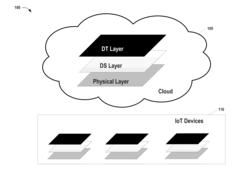
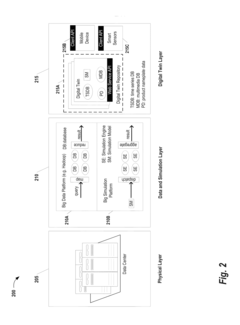
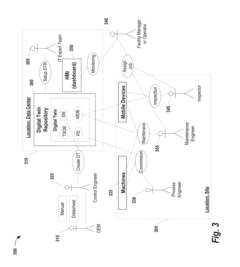
- A method utilizing digital twin simulations to generate predictions and determine mitigation procedures by obtaining digital replica models of equipment, receiving data feeds, simulating operations, and prioritizing preventive measures and maintenance activities based on predicted events.


Digital twins for energy efficient asset maintenance
PatentActiveUS20160247129A1
Innovation
- The implementation of digital twins (DTs) for energy-efficient asset maintenance, which create a digital representation of physical machines, integrating product nameplate data, simulation models, and real-time sensor data to facilitate predictive maintenance through a Bayesian filtering framework and multiprocessor computer systems.
Industrial Data Security and Privacy Regulations
The implementation of digital twin simulation for predictive maintenance in industrial environments necessitates comprehensive adherence to evolving data security and privacy regulations. Manufacturing facilities deploying these systems must navigate complex regulatory frameworks that govern the collection, processing, and storage of operational data from connected machinery and sensors.
The General Data Protection Regulation (GDPR) in Europe establishes stringent requirements for data handling, particularly when digital twin systems process information that could be linked to individual operators or maintenance personnel. Manufacturing companies must implement privacy-by-design principles, ensuring that personal data elements within operational datasets are properly anonymized or pseudonymized before integration into predictive models.
In the United States, sector-specific regulations such as the Cybersecurity and Infrastructure Security Agency (CISA) guidelines for critical manufacturing infrastructure impose additional security requirements. These regulations mandate robust encryption protocols for data transmission between physical assets and their digital counterparts, along with comprehensive audit trails for all data access and modification activities.
The Industrial Internet of Things (IIoT) Security Framework requires manufacturers to establish clear data governance policies that define retention periods, access controls, and cross-border data transfer protocols. Digital twin implementations must incorporate role-based access management systems that restrict sensitive operational data to authorized personnel while maintaining compliance with local privacy laws.
Emerging regulations in Asia-Pacific regions, including China's Cybersecurity Law and Japan's Personal Information Protection Act amendments, introduce additional compliance considerations for multinational manufacturing operations. These frameworks emphasize data localization requirements and mandate regular security assessments for systems processing industrial operational data.
The regulatory landscape continues evolving with proposed legislation addressing artificial intelligence governance and automated decision-making systems. Manufacturing organizations must establish flexible compliance frameworks that can adapt to changing regulatory requirements while maintaining the effectiveness of their predictive maintenance capabilities through digital twin technologies.
The General Data Protection Regulation (GDPR) in Europe establishes stringent requirements for data handling, particularly when digital twin systems process information that could be linked to individual operators or maintenance personnel. Manufacturing companies must implement privacy-by-design principles, ensuring that personal data elements within operational datasets are properly anonymized or pseudonymized before integration into predictive models.
In the United States, sector-specific regulations such as the Cybersecurity and Infrastructure Security Agency (CISA) guidelines for critical manufacturing infrastructure impose additional security requirements. These regulations mandate robust encryption protocols for data transmission between physical assets and their digital counterparts, along with comprehensive audit trails for all data access and modification activities.
The Industrial Internet of Things (IIoT) Security Framework requires manufacturers to establish clear data governance policies that define retention periods, access controls, and cross-border data transfer protocols. Digital twin implementations must incorporate role-based access management systems that restrict sensitive operational data to authorized personnel while maintaining compliance with local privacy laws.
Emerging regulations in Asia-Pacific regions, including China's Cybersecurity Law and Japan's Personal Information Protection Act amendments, introduce additional compliance considerations for multinational manufacturing operations. These frameworks emphasize data localization requirements and mandate regular security assessments for systems processing industrial operational data.
The regulatory landscape continues evolving with proposed legislation addressing artificial intelligence governance and automated decision-making systems. Manufacturing organizations must establish flexible compliance frameworks that can adapt to changing regulatory requirements while maintaining the effectiveness of their predictive maintenance capabilities through digital twin technologies.
ROI Assessment Framework for Digital Twin Implementation
Establishing a comprehensive ROI assessment framework for digital twin implementation in predictive maintenance requires a multi-dimensional evaluation approach that captures both quantitative and qualitative benefits. The framework must account for the complex interdependencies between operational improvements, cost reductions, and strategic advantages that digital twin technology delivers across manufacturing environments.
The primary cost components include initial technology investment, system integration expenses, data infrastructure development, and ongoing operational costs. Initial investments typically encompass hardware sensors, edge computing devices, cloud infrastructure, and software licensing fees. Integration costs involve connecting existing manufacturing execution systems, enterprise resource planning platforms, and operational technology networks with the digital twin environment.
Direct financial benefits manifest through reduced unplanned downtime, optimized maintenance scheduling, and extended equipment lifecycle. Quantifiable metrics include mean time between failures improvement, maintenance cost reduction percentages, and production efficiency gains. Studies indicate that predictive maintenance implementations can reduce maintenance costs by 20-25% while increasing equipment availability by 10-15%.
Indirect benefits require sophisticated measurement methodologies to capture their full value proposition. These include improved product quality through consistent equipment performance, enhanced safety outcomes from proactive maintenance interventions, and increased operational flexibility through better asset utilization planning. Energy efficiency improvements and reduced spare parts inventory also contribute significantly to the overall return calculation.
The assessment framework should incorporate risk-adjusted calculations that account for implementation uncertainties, technology maturation timelines, and potential scalability challenges. Monte Carlo simulations can model various scenarios to provide confidence intervals for ROI projections, while sensitivity analysis identifies critical success factors that most significantly impact financial outcomes.
Payback period calculations must consider the phased implementation approach typical in digital twin deployments, where initial pilot programs demonstrate value before enterprise-wide rollouts. The framework should establish milestone-based evaluation criteria that enable continuous ROI reassessment as the system matures and additional use cases emerge beyond predictive maintenance applications.
The primary cost components include initial technology investment, system integration expenses, data infrastructure development, and ongoing operational costs. Initial investments typically encompass hardware sensors, edge computing devices, cloud infrastructure, and software licensing fees. Integration costs involve connecting existing manufacturing execution systems, enterprise resource planning platforms, and operational technology networks with the digital twin environment.
Direct financial benefits manifest through reduced unplanned downtime, optimized maintenance scheduling, and extended equipment lifecycle. Quantifiable metrics include mean time between failures improvement, maintenance cost reduction percentages, and production efficiency gains. Studies indicate that predictive maintenance implementations can reduce maintenance costs by 20-25% while increasing equipment availability by 10-15%.
Indirect benefits require sophisticated measurement methodologies to capture their full value proposition. These include improved product quality through consistent equipment performance, enhanced safety outcomes from proactive maintenance interventions, and increased operational flexibility through better asset utilization planning. Energy efficiency improvements and reduced spare parts inventory also contribute significantly to the overall return calculation.
The assessment framework should incorporate risk-adjusted calculations that account for implementation uncertainties, technology maturation timelines, and potential scalability challenges. Monte Carlo simulations can model various scenarios to provide confidence intervals for ROI projections, while sensitivity analysis identifies critical success factors that most significantly impact financial outcomes.
Payback period calculations must consider the phased implementation approach typical in digital twin deployments, where initial pilot programs demonstrate value before enterprise-wide rollouts. The framework should establish milestone-based evaluation criteria that enable continuous ROI reassessment as the system matures and additional use cases emerge beyond predictive maintenance applications.
Unlock deeper insights with PatSnap Eureka Quick Research — get a full tech report to explore trends and direct your research. Try now!
Generate Your Research Report Instantly with AI Agent
Supercharge your innovation with PatSnap Eureka AI Agent Platform!