

Doubly Fed Induction Generator Rotor Position Estimation Without Encoder
JUL 17, 20269 MIN READ
Generate Your Research Report Instantly with AI Agent
Patsnap Eureka helps you evaluate technical feasibility & market potential.
DFIG Sensorless Control Background and Objectives
Doubly Fed Induction Generators have emerged as the dominant technology in variable-speed wind turbine applications since the late 1990s, primarily due to their ability to operate across a wide speed range while requiring only partial-scale power converters. Traditional DFIG control systems rely heavily on mechanical encoders or resolvers to provide precise rotor position and speed information, which is essential for field-oriented control and optimal power conversion. However, these position sensors introduce significant challenges in practical implementations, including increased system cost, reduced reliability due to additional failure points, and heightened maintenance requirements in harsh operating environments.
The evolution toward sensorless control strategies represents a critical technological advancement driven by multiple factors. Wind turbines typically operate in demanding conditions characterized by temperature extremes, humidity, vibration, and electromagnetic interference, all of which can compromise encoder performance and longevity. The elimination of position sensors not only reduces hardware costs but also simplifies mechanical installation and minimizes potential points of failure, thereby enhancing overall system reliability. This becomes particularly significant when considering the large-scale deployment of wind farms where maintenance accessibility and operational continuity are paramount concerns.
The primary objective of DFIG sensorless control research is to develop robust algorithms capable of accurately estimating rotor position and speed without mechanical sensors while maintaining control performance comparable to encoder-based systems. This encompasses achieving precise torque and power control across the entire operating range, from subsynchronous to supersynchronous speeds, and ensuring stable operation during grid disturbances and transient conditions. Additionally, the technology must demonstrate effectiveness at low speeds and standstill conditions, where back-EMF based estimation methods traditionally face limitations.
Beyond reliability improvements, sensorless control strategies aim to reduce total system cost and complexity, making wind energy more economically competitive. The research also targets enhanced fault tolerance capabilities, enabling continued operation even when certain feedback signals become unavailable or degraded. These objectives align with broader industry trends toward intelligent, self-diagnostic systems that can adapt to changing operational conditions while minimizing human intervention requirements in remote installations.
The evolution toward sensorless control strategies represents a critical technological advancement driven by multiple factors. Wind turbines typically operate in demanding conditions characterized by temperature extremes, humidity, vibration, and electromagnetic interference, all of which can compromise encoder performance and longevity. The elimination of position sensors not only reduces hardware costs but also simplifies mechanical installation and minimizes potential points of failure, thereby enhancing overall system reliability. This becomes particularly significant when considering the large-scale deployment of wind farms where maintenance accessibility and operational continuity are paramount concerns.
The primary objective of DFIG sensorless control research is to develop robust algorithms capable of accurately estimating rotor position and speed without mechanical sensors while maintaining control performance comparable to encoder-based systems. This encompasses achieving precise torque and power control across the entire operating range, from subsynchronous to supersynchronous speeds, and ensuring stable operation during grid disturbances and transient conditions. Additionally, the technology must demonstrate effectiveness at low speeds and standstill conditions, where back-EMF based estimation methods traditionally face limitations.
Beyond reliability improvements, sensorless control strategies aim to reduce total system cost and complexity, making wind energy more economically competitive. The research also targets enhanced fault tolerance capabilities, enabling continued operation even when certain feedback signals become unavailable or degraded. These objectives align with broader industry trends toward intelligent, self-diagnostic systems that can adapt to changing operational conditions while minimizing human intervention requirements in remote installations.
Market Demand for Encoder-Free Wind Turbine Systems
The global wind energy sector is experiencing accelerated growth driven by decarbonization commitments and renewable energy mandates across major economies. Within this expanding market, there is increasing demand for cost-effective and reliable wind turbine systems that can reduce capital expenditure while maintaining operational performance. Encoder-free doubly fed induction generator systems have emerged as a compelling solution to address these market requirements, particularly as wind farm operators seek to minimize maintenance costs and improve system reliability.
Traditional wind turbine control systems rely on mechanical encoders or resolvers to provide precise rotor position feedback for generator control. However, these sensors represent significant cost components in turbine manufacturing and are prone to failure in harsh environmental conditions typical of wind farm installations. The elimination of position sensors offers substantial economic advantages through reduced bill-of-materials costs, simplified installation procedures, and decreased maintenance requirements over the turbine lifecycle.
The offshore wind sector presents particularly strong demand for encoder-free solutions. Offshore installations face extreme environmental challenges including salt spray, humidity, and temperature variations that accelerate sensor degradation. Maintenance interventions in offshore environments incur substantially higher costs compared to onshore facilities due to accessibility constraints and weather-dependent service windows. Sensorless control technologies directly address these pain points by removing vulnerable components and reducing failure modes.
Emerging markets in Asia-Pacific and Latin America are driving demand for cost-optimized wind turbine designs as these regions rapidly expand renewable energy capacity. Price sensitivity in these markets creates strong incentives for manufacturers to adopt encoder-free architectures that reduce system costs without compromising performance standards. Additionally, the trend toward larger turbine ratings and longer blade designs amplifies the economic benefits of eliminating expensive high-resolution encoders required for precise control of multi-megawatt generators.
Grid code requirements for advanced power quality control and low-voltage ride-through capabilities necessitate sophisticated generator control algorithms. Modern sensorless estimation techniques have matured to meet these stringent performance requirements, making encoder-free systems viable alternatives to sensor-based architectures across diverse operating conditions and grid integration scenarios.
Traditional wind turbine control systems rely on mechanical encoders or resolvers to provide precise rotor position feedback for generator control. However, these sensors represent significant cost components in turbine manufacturing and are prone to failure in harsh environmental conditions typical of wind farm installations. The elimination of position sensors offers substantial economic advantages through reduced bill-of-materials costs, simplified installation procedures, and decreased maintenance requirements over the turbine lifecycle.
The offshore wind sector presents particularly strong demand for encoder-free solutions. Offshore installations face extreme environmental challenges including salt spray, humidity, and temperature variations that accelerate sensor degradation. Maintenance interventions in offshore environments incur substantially higher costs compared to onshore facilities due to accessibility constraints and weather-dependent service windows. Sensorless control technologies directly address these pain points by removing vulnerable components and reducing failure modes.
Emerging markets in Asia-Pacific and Latin America are driving demand for cost-optimized wind turbine designs as these regions rapidly expand renewable energy capacity. Price sensitivity in these markets creates strong incentives for manufacturers to adopt encoder-free architectures that reduce system costs without compromising performance standards. Additionally, the trend toward larger turbine ratings and longer blade designs amplifies the economic benefits of eliminating expensive high-resolution encoders required for precise control of multi-megawatt generators.
Grid code requirements for advanced power quality control and low-voltage ride-through capabilities necessitate sophisticated generator control algorithms. Modern sensorless estimation techniques have matured to meet these stringent performance requirements, making encoder-free systems viable alternatives to sensor-based architectures across diverse operating conditions and grid integration scenarios.
Current Status and Challenges in DFIG Rotor Position Estimation
Doubly Fed Induction Generators have become the dominant technology in wind power generation systems, primarily due to their ability to operate at variable speeds while maintaining grid synchronization through partial-scale power converters. Traditional DFIG control systems rely heavily on mechanical encoders or resolvers to obtain precise rotor position information, which is essential for field-oriented control and optimal power conversion. However, these position sensors introduce significant drawbacks including increased system cost, reduced reliability due to additional mechanical components, and heightened maintenance requirements in harsh operating environments typical of wind turbine installations.
The current landscape of encoder-less rotor position estimation presents a diverse array of technical approaches, each with distinct advantages and limitations. Model-based estimation methods, including open-loop integration techniques and closed-loop observers such as Model Reference Adaptive Systems and Extended Kalman Filters, have gained considerable attention. These approaches utilize machine electrical parameters and measured stator quantities to reconstruct rotor position information. While theoretically sound, their performance heavily depends on accurate machine parameter knowledge, which varies with operating conditions, temperature fluctuations, and magnetic saturation effects.
Signal injection methods represent another major category, where high-frequency voltage or current signals are deliberately introduced into the machine to extract position-dependent information from the resulting electromagnetic response. These techniques demonstrate robust performance at low speeds and standstill conditions where model-based methods typically struggle. However, they introduce additional harmonic distortion, increase acoustic noise, and require sophisticated signal processing algorithms to extract position information from noisy measurements.
A critical challenge facing all encoder-less estimation techniques is maintaining accuracy across the entire operating range of wind turbines, from startup and low-wind conditions to rated power operation. Parameter sensitivity remains a fundamental obstacle, as variations in rotor resistance, magnetizing inductance, and mutual inductance directly impact estimation accuracy. Additionally, the presence of grid voltage disturbances, unbalanced conditions, and harmonic pollution further complicates the estimation process. The computational burden of advanced estimation algorithms also poses implementation challenges for real-time control systems with limited processing capabilities.
Current research efforts are increasingly focused on hybrid estimation strategies that combine multiple techniques to leverage their complementary strengths, as well as adaptive algorithms that can self-tune parameters online to maintain robust performance under varying operating conditions.
The current landscape of encoder-less rotor position estimation presents a diverse array of technical approaches, each with distinct advantages and limitations. Model-based estimation methods, including open-loop integration techniques and closed-loop observers such as Model Reference Adaptive Systems and Extended Kalman Filters, have gained considerable attention. These approaches utilize machine electrical parameters and measured stator quantities to reconstruct rotor position information. While theoretically sound, their performance heavily depends on accurate machine parameter knowledge, which varies with operating conditions, temperature fluctuations, and magnetic saturation effects.
Signal injection methods represent another major category, where high-frequency voltage or current signals are deliberately introduced into the machine to extract position-dependent information from the resulting electromagnetic response. These techniques demonstrate robust performance at low speeds and standstill conditions where model-based methods typically struggle. However, they introduce additional harmonic distortion, increase acoustic noise, and require sophisticated signal processing algorithms to extract position information from noisy measurements.
A critical challenge facing all encoder-less estimation techniques is maintaining accuracy across the entire operating range of wind turbines, from startup and low-wind conditions to rated power operation. Parameter sensitivity remains a fundamental obstacle, as variations in rotor resistance, magnetizing inductance, and mutual inductance directly impact estimation accuracy. Additionally, the presence of grid voltage disturbances, unbalanced conditions, and harmonic pollution further complicates the estimation process. The computational burden of advanced estimation algorithms also poses implementation challenges for real-time control systems with limited processing capabilities.
Current research efforts are increasingly focused on hybrid estimation strategies that combine multiple techniques to leverage their complementary strengths, as well as adaptive algorithms that can self-tune parameters online to maintain robust performance under varying operating conditions.
Existing Sensorless Rotor Position Estimation Solutions
01 Sensorless rotor position estimation methods
Techniques for estimating the rotor position of doubly fed induction generators without using physical position sensors. These methods typically employ mathematical models, observer-based algorithms, or signal injection techniques to determine rotor angular position and speed. The sensorless approach reduces system cost and improves reliability by eliminating mechanical sensors while maintaining accurate control performance.- Sensorless rotor position estimation methods: Techniques for estimating the rotor position of doubly fed induction generators without using physical position sensors. These methods typically employ mathematical models, observer-based algorithms, or signal injection techniques to determine rotor angular position and speed. The sensorless approach reduces system cost and improves reliability by eliminating mechanical sensors while maintaining accurate control performance.
- Rotor position detection using voltage and current measurements: Methods that utilize measurements of stator and rotor voltages and currents to determine rotor position. These techniques analyze the electrical signals in the generator windings to extract position information through signal processing algorithms, coordinate transformations, and flux estimation. The approach enables precise position tracking during various operating conditions including grid-connected and standalone modes.
- Control systems with rotor position feedback: Control architectures that incorporate rotor position information for improved performance of doubly fed induction generators. These systems use position feedback to implement field-oriented control, direct torque control, or other advanced control strategies. The position data enables precise regulation of torque, power output, and grid synchronization in wind turbine and variable speed drive applications.
- Encoder-based rotor position sensing: Systems employing rotary encoders or resolvers mounted on the generator shaft to provide direct measurement of rotor angular position. These sensors generate digital or analog signals corresponding to shaft rotation, offering high accuracy and resolution. The encoder signals are processed by control electronics to determine instantaneous rotor position for precise generator control and monitoring.
- Rotor position synchronization for grid connection: Techniques for synchronizing the rotor position with grid voltage phase to enable smooth connection of doubly fed induction generators to the electrical network. These methods ensure proper phase alignment and minimize transient currents during grid connection events. The synchronization process involves monitoring both rotor position and grid voltage parameters to achieve seamless integration with the power system.
02 Rotor position detection using voltage and current measurements
Methods that utilize measurements of stator and rotor voltages and currents to determine rotor position. These techniques analyze the electrical signals in the generator windings to extract position information through signal processing algorithms, coordinate transformations, and flux estimation. The approach enables precise position tracking during various operating conditions including grid faults and transient events.Expand Specific Solutions03 Initial rotor position detection and alignment
Techniques for determining the initial rotor position when the generator is at standstill or during startup. These methods often involve injecting test signals, analyzing magnetic saturation effects, or using open-loop estimation to establish an initial position reference before transitioning to normal operation. Accurate initial position detection is critical for proper field-oriented control initialization.Expand Specific Solutions04 Rotor position control for grid synchronization
Control strategies that utilize rotor position information to achieve and maintain synchronization with the electrical grid. These methods coordinate the rotor-side converter control with position feedback to regulate active and reactive power flow, manage voltage and frequency variations, and ensure stable grid connection during normal operation and fault conditions.Expand Specific Solutions05 Enhanced rotor position tracking during fault conditions
Advanced position estimation and control techniques designed to maintain accurate rotor position information during grid faults, voltage dips, and other abnormal operating conditions. These methods incorporate robust algorithms, adaptive filters, and fault-tolerant control strategies to ensure continuous and reliable position tracking even when conventional methods may fail or produce erroneous results.Expand Specific Solutions
Key Players in DFIG and Wind Power Industry
The doubly fed induction generator (DFIG) rotor position estimation without encoder technology represents a mature yet evolving field within wind power and industrial drive systems. The competitive landscape is characterized by strong participation from established industrial automation giants like Siemens Gamesa, Vestas, ABB, and Bosch, who dominate commercial implementations in wind energy applications. The market shows significant growth potential driven by expanding renewable energy installations globally. Technology maturity varies across players, with leading Chinese research institutions including Nanjing University of Aeronautics & Astronautics, Huazhong University of Science & Technology, and China University of Mining & Technology advancing sensorless control algorithms, while industrial leaders like FANUC, Hitachi, and SEW-EURODRIVE focus on robust commercial solutions. The field demonstrates a hybrid development stage where academic innovation from institutions like McGill University and Northwestern Polytechnical University converges with industrial-scale deployment, particularly in wind turbine systems and heavy industrial applications, indicating both technological refinement and market expansion phases coexisting.
Nanjing University of Aeronautics & Astronautics
Technical Solution: NUAA research focuses on improved flux linkage observer combined with Luenberger observer structure for DFIG sensorless control. The approach utilizes stator and rotor voltage equations to estimate flux linkage components, from which rotor position is calculated through arctangent functions with quadrant correction. The system incorporates adaptive mechanisms to compensate for parameter mismatches including stator and rotor resistance variations with temperature and magnetic saturation effects. Pure integration problems in flux estimation are addressed through programmable low-pass filters with carefully designed cutoff frequencies. The research demonstrates position estimation maintaining accuracy within 2 electrical degrees across operating ranges from 20% to 120% synchronous speed in laboratory prototype testing with 7.5kW DFIG systems.
Strengths: Relatively simple implementation with lower computational requirements; good parameter adaptation capability for varying operating conditions. Weaknesses: Academic research stage with limited commercial deployment validation; performance degradation at very low speeds where voltage signals become weak and noise-sensitive.
Siemens Gamesa Renewable Energy AS
Technical Solution: Siemens Gamesa implements sensorless rotor position estimation for DFIG systems using model reference adaptive system (MRAS) combined with extended Kalman filter (EKF) techniques. The solution integrates stator flux linkage observation with rotor speed estimation algorithms, achieving position accuracy within ±0.5 electrical degrees during steady-state operation. The system employs dual estimation channels processing stator voltage and current measurements to reconstruct rotor position information, enabling reliable operation across the full wind speed range from cut-in to rated power. The technology incorporates adaptive gain scheduling to maintain estimation accuracy during grid voltage disturbances and transient conditions commonly encountered in wind power applications.
Strengths: Proven reliability in commercial wind turbine deployments with robust performance during grid faults; excellent accuracy across wide operating range. Weaknesses: Computational complexity requires high-performance processors; estimation accuracy degrades at very low rotor speeds near synchronous operation.
Core Algorithms for Encoder-Free DFIG Control
Method and system for controlling a doubly-fed induction machine
PatentInactiveUS8476871B2
Innovation
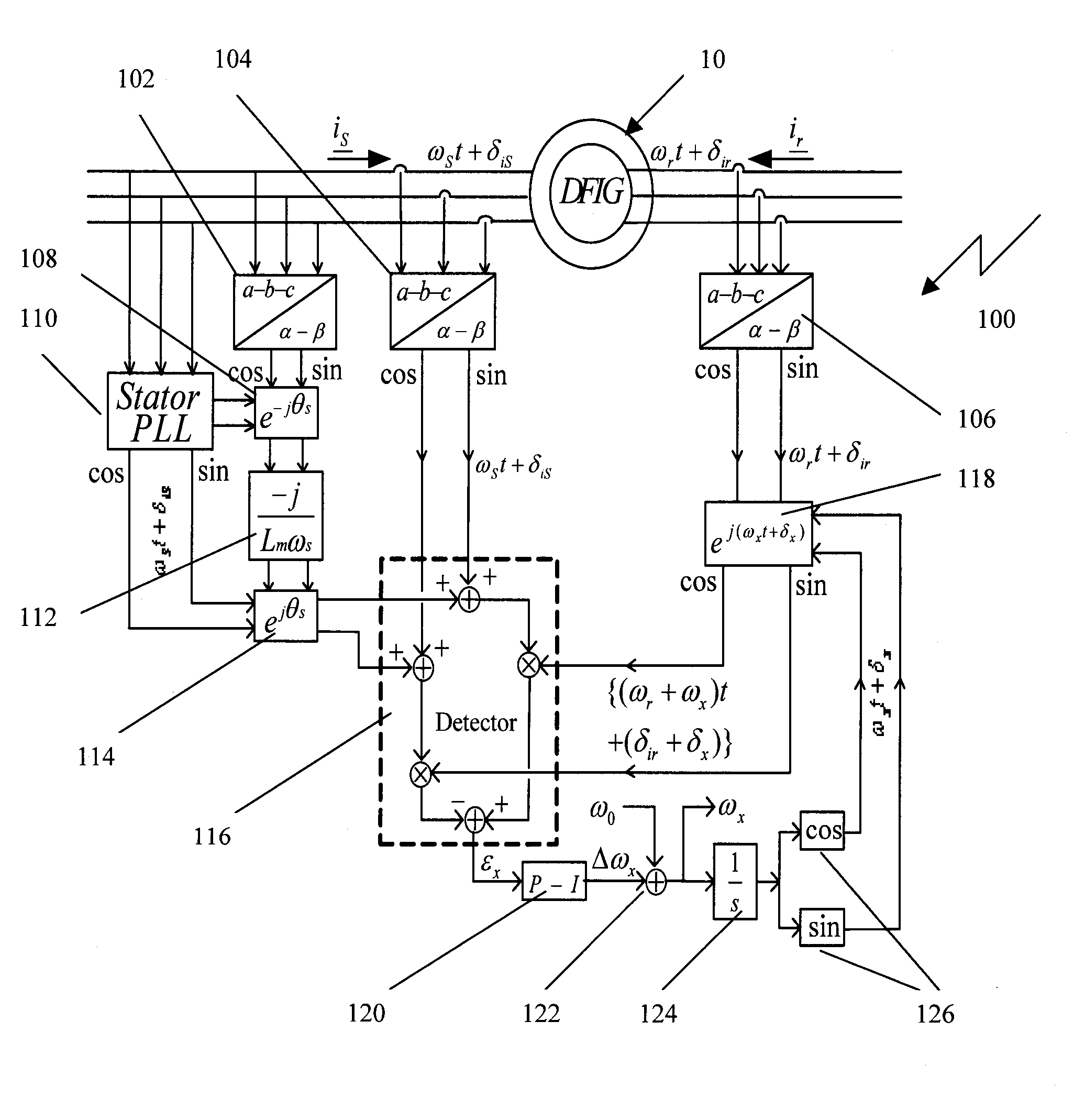
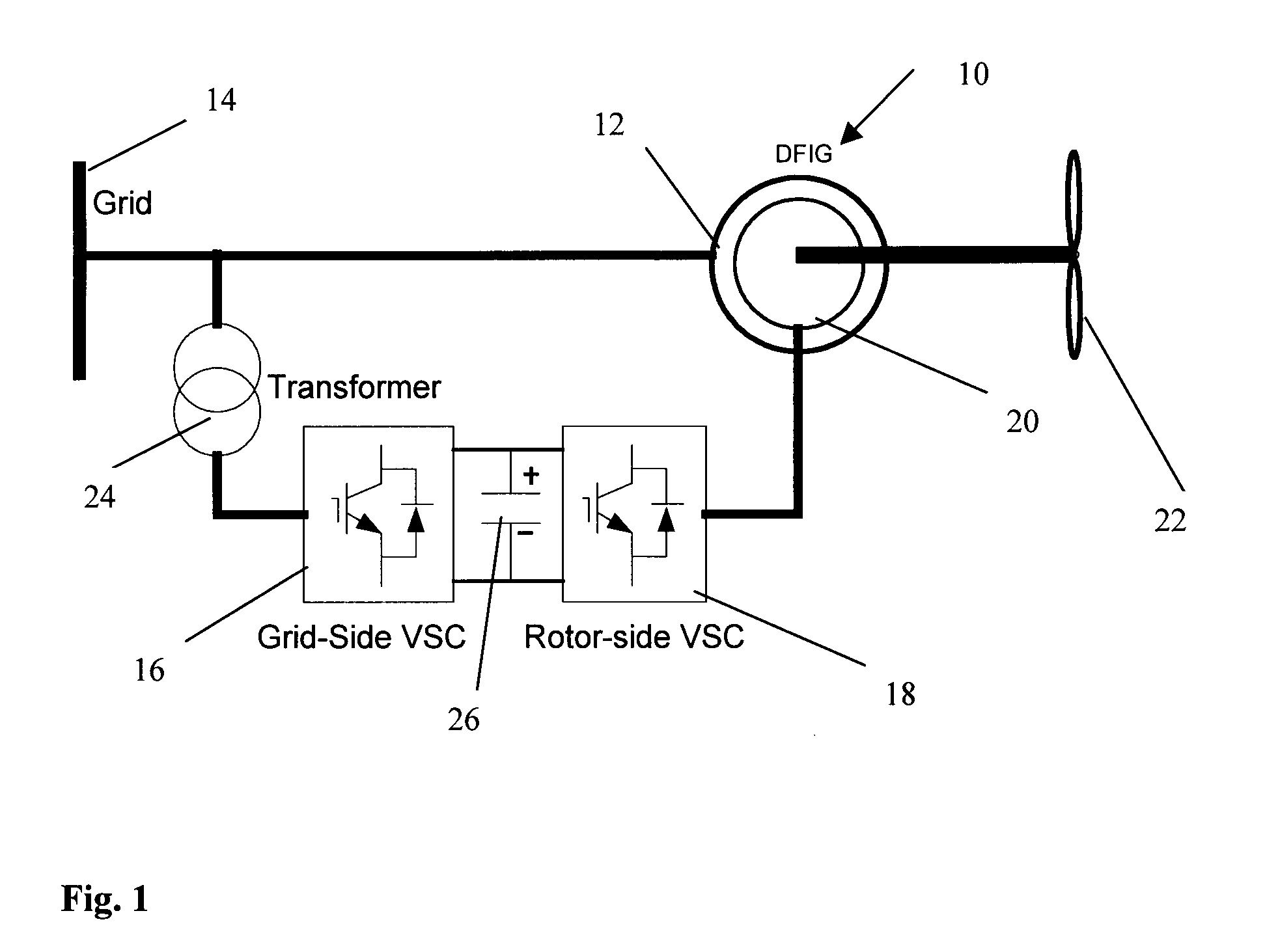
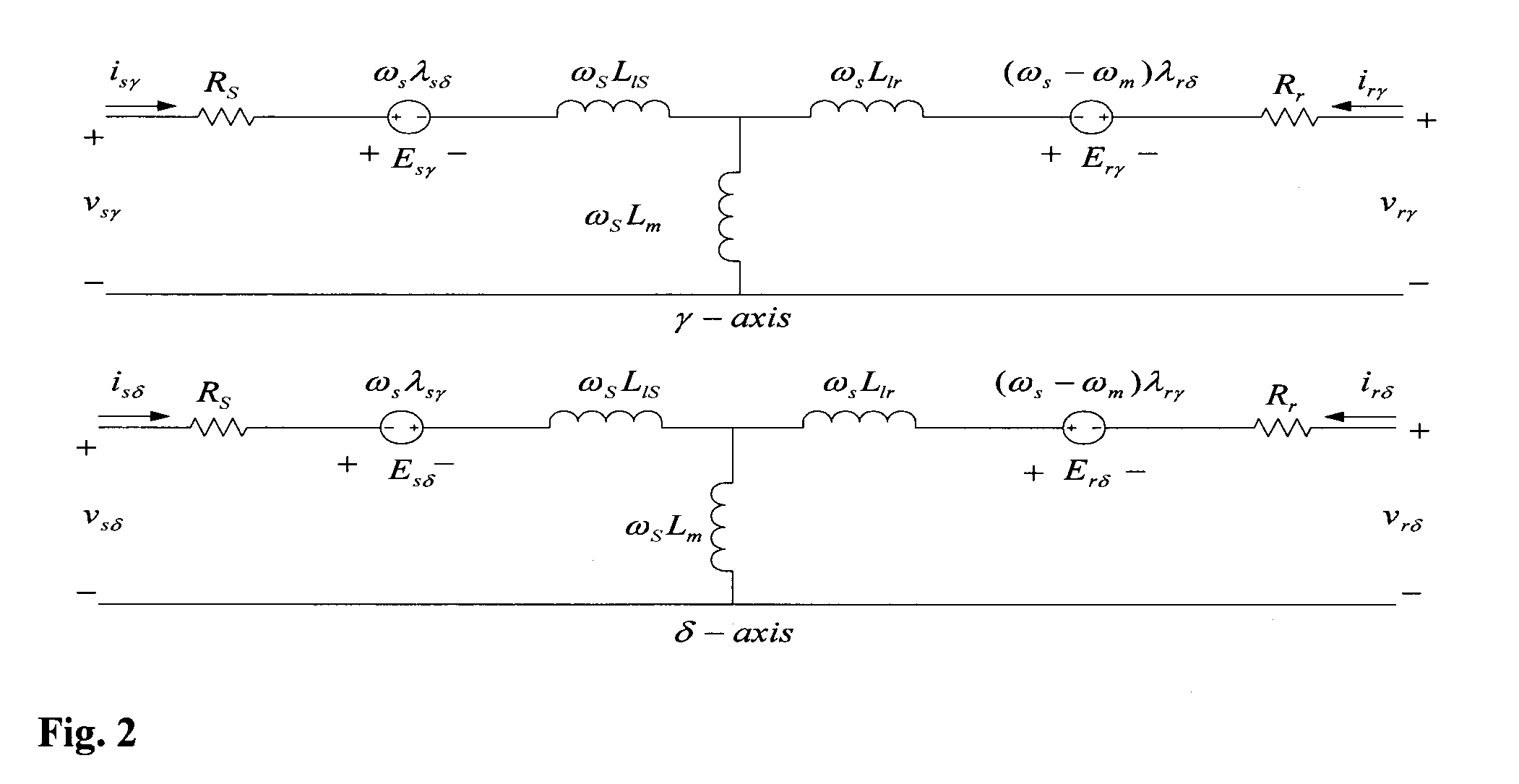
- A method and system for decoupled P-Q control that uses rotor position estimates derived from stator and rotor current signals, processed in specific coordinate frames, to independently control the doubly-fed induction machine without mechanical sensors, relying on magnetization reactance and rotor angular frequency estimation.

Method and system for controlling a doubly-fed induction machine
PatentWO2008064472A1
Innovation
- A method and system that uses rotor current and stator current signals to estimate rotor position and angular frequency independently of changing machine parameters, allowing for decoupled P-Q control without mechanical sensors by processing these signals in specific coordinate frames and using feedback loops to adjust control voltages.


Grid Code Compliance for Sensorless DFIG Systems
Grid code compliance represents a critical operational requirement for sensorless doubly fed induction generator systems integrated into modern power networks. As wind energy penetration increases globally, transmission system operators have established stringent technical standards governing fault ride-through capabilities, voltage support, frequency regulation, and power quality parameters. Sensorless DFIG configurations must demonstrate equivalent performance to encoder-based systems across all grid code specifications to achieve commercial viability and regulatory approval.
The absence of mechanical position sensors introduces specific challenges in meeting low voltage ride-through requirements during grid disturbances. Conventional DFIG systems rely on precise rotor position information to maintain synchronized control during voltage sags and asymmetrical faults. Sensorless estimation algorithms must maintain sufficient accuracy and response speed under transient conditions to enable proper reactive current injection and prevent converter overcurrent trips. Advanced estimation techniques incorporating voltage sequence separation and enhanced observer designs have emerged to address these dynamic scenarios.
Reactive power capability constitutes another essential grid code parameter affected by position estimation accuracy. Many jurisdictions mandate continuous reactive power provision across the operational wind speed range, requiring precise rotor current control referenced to grid voltage phase angle. Estimation errors directly impact the DFIG's ability to deliver specified reactive power levels, particularly during weak grid conditions where voltage phase angle variations occur. Robust estimation algorithms with adaptive compensation mechanisms have been developed to maintain compliance margins under varying grid strength conditions.
Frequency support functions, including synthetic inertia and primary frequency response, demand rapid torque adjustments coordinated with rotor-side converter control. Sensorless systems must achieve comparable dynamic performance to encoder-based configurations in detecting frequency deviations and executing appropriate power adjustments within mandated timeframes. Integration of grid frequency information into position estimation algorithms enhances system responsiveness while maintaining estimation stability during frequency events.
Harmonic emission limits and power quality standards present additional compliance considerations for sensorless DFIG implementations. Position estimation errors can introduce current harmonics through imperfect field orientation, potentially exceeding grid code thresholds. Validation testing under diverse operating conditions becomes essential to demonstrate consistent compliance across the full operational envelope, establishing sensorless technology as a reliable alternative for grid-connected wind generation applications.
The absence of mechanical position sensors introduces specific challenges in meeting low voltage ride-through requirements during grid disturbances. Conventional DFIG systems rely on precise rotor position information to maintain synchronized control during voltage sags and asymmetrical faults. Sensorless estimation algorithms must maintain sufficient accuracy and response speed under transient conditions to enable proper reactive current injection and prevent converter overcurrent trips. Advanced estimation techniques incorporating voltage sequence separation and enhanced observer designs have emerged to address these dynamic scenarios.
Reactive power capability constitutes another essential grid code parameter affected by position estimation accuracy. Many jurisdictions mandate continuous reactive power provision across the operational wind speed range, requiring precise rotor current control referenced to grid voltage phase angle. Estimation errors directly impact the DFIG's ability to deliver specified reactive power levels, particularly during weak grid conditions where voltage phase angle variations occur. Robust estimation algorithms with adaptive compensation mechanisms have been developed to maintain compliance margins under varying grid strength conditions.
Frequency support functions, including synthetic inertia and primary frequency response, demand rapid torque adjustments coordinated with rotor-side converter control. Sensorless systems must achieve comparable dynamic performance to encoder-based configurations in detecting frequency deviations and executing appropriate power adjustments within mandated timeframes. Integration of grid frequency information into position estimation algorithms enhances system responsiveness while maintaining estimation stability during frequency events.
Harmonic emission limits and power quality standards present additional compliance considerations for sensorless DFIG implementations. Position estimation errors can introduce current harmonics through imperfect field orientation, potentially exceeding grid code thresholds. Validation testing under diverse operating conditions becomes essential to demonstrate consistent compliance across the full operational envelope, establishing sensorless technology as a reliable alternative for grid-connected wind generation applications.
Reliability and Cost Benefits of Encoder Elimination
The elimination of mechanical encoders in doubly fed induction generator systems presents substantial reliability improvements that directly translate to enhanced operational performance and reduced lifecycle costs. Traditional encoder-based rotor position sensing introduces mechanical complexity and represents a critical failure point in wind turbine drivetrains. Encoders are susceptible to harsh environmental conditions including temperature extremes, moisture ingress, vibration, and electromagnetic interference commonly encountered in wind energy applications. By removing this vulnerable component, encoder-less systems inherently reduce maintenance requirements and extend mean time between failures, contributing to improved system availability particularly in offshore installations where accessibility is limited and maintenance costs are prohibitively high.
From a cost perspective, encoder elimination delivers multiple economic advantages throughout the system lifecycle. The direct hardware cost savings include not only the encoder unit itself but also associated cabling, connectors, and mounting hardware. Installation complexity is reduced as fewer components require precise alignment and calibration during commissioning. The simplified mechanical interface between generator and converter systems reduces assembly time and potential installation errors that could compromise system performance.
Operational cost benefits extend beyond initial capital expenditure. Encoder-less systems eliminate periodic encoder maintenance, recalibration procedures, and replacement costs associated with encoder degradation or failure. In large-scale wind farms comprising hundreds of turbines, these cumulative savings become substantial over the typical twenty to twenty-five year operational lifespan. Additionally, the reduced component count simplifies spare parts inventory management and decreases logistical complexity for maintenance operations.
The reliability enhancement achieved through encoder elimination also yields indirect economic benefits through improved energy capture and reduced downtime. System failures related to encoder malfunction often necessitate turbine shutdown until repairs are completed, resulting in lost revenue generation. Encoder-less control strategies mitigate this risk, contributing to higher capacity factors and more predictable energy production profiles that are increasingly valued in power purchase agreements and grid integration contracts.
From a cost perspective, encoder elimination delivers multiple economic advantages throughout the system lifecycle. The direct hardware cost savings include not only the encoder unit itself but also associated cabling, connectors, and mounting hardware. Installation complexity is reduced as fewer components require precise alignment and calibration during commissioning. The simplified mechanical interface between generator and converter systems reduces assembly time and potential installation errors that could compromise system performance.
Operational cost benefits extend beyond initial capital expenditure. Encoder-less systems eliminate periodic encoder maintenance, recalibration procedures, and replacement costs associated with encoder degradation or failure. In large-scale wind farms comprising hundreds of turbines, these cumulative savings become substantial over the typical twenty to twenty-five year operational lifespan. Additionally, the reduced component count simplifies spare parts inventory management and decreases logistical complexity for maintenance operations.
The reliability enhancement achieved through encoder elimination also yields indirect economic benefits through improved energy capture and reduced downtime. System failures related to encoder malfunction often necessitate turbine shutdown until repairs are completed, resulting in lost revenue generation. Encoder-less control strategies mitigate this risk, contributing to higher capacity factors and more predictable energy production profiles that are increasingly valued in power purchase agreements and grid integration contracts.
Unlock deeper insights with Patsnap Eureka Quick Research — get a full tech report to explore trends and direct your research. Try now!
Generate Your Research Report Instantly with AI Agent
Supercharge your innovation with Patsnap Eureka AI Agent Platform!