Dynamic Light Scattering in Colloidal Stability Measurement
SEP 5, 202510 MIN READ
Generate Your Research Report Instantly with AI Agent
Patsnap Eureka helps you evaluate technical feasibility & market potential.
DLS Technology Background and Objectives
Dynamic Light Scattering (DLS) has emerged as a pivotal analytical technique for measuring colloidal stability since its theoretical foundations were established in the early 20th century. The technology evolved significantly in the 1960s and 1970s with the advent of laser light sources, which provided the coherent illumination necessary for precise measurements. This evolution has transformed DLS from a purely academic research tool into an essential industrial quality control method across multiple sectors.
The fundamental principle of DLS relies on the Brownian motion of particles in suspension and the resulting fluctuations in scattered light intensity. These fluctuations contain valuable information about particle size distribution, which directly correlates with colloidal stability. As technology has progressed, DLS instrumentation has become increasingly sophisticated, incorporating advanced correlation techniques, multi-angle detection systems, and automated analysis algorithms.
Current technological trends in DLS focus on miniaturization, increased sensitivity, and integration with complementary techniques. The development of microfluidic DLS systems has enabled analysis of smaller sample volumes, critical for pharmaceutical and biological applications where sample quantities are often limited. Additionally, advancements in computational methods have improved data interpretation, allowing for more accurate characterization of complex, polydisperse systems.
The integration of artificial intelligence and machine learning algorithms represents the newest frontier in DLS technology, enabling more robust discrimination between different particle populations and improved analysis of multimodal distributions. These developments are particularly relevant for complex biological samples and nanomaterial characterization, where traditional analysis methods often struggle.
The primary technical objectives for DLS in colloidal stability measurement include enhancing measurement precision for highly concentrated samples, improving resolution for polydisperse systems, and developing standardized protocols for specific applications. There is also significant interest in extending the measurable size range, particularly toward smaller particles (below 1 nm) and larger aggregates (above 10 μm), which would broaden the applicability of the technique.
Another critical objective is the development of non-invasive, in-situ DLS methods that can monitor colloidal stability in real-time during manufacturing processes. This capability would revolutionize quality control in industries ranging from pharmaceuticals to food production, allowing for immediate corrective actions rather than post-production testing.
The convergence of DLS with other analytical techniques, such as Raman spectroscopy and small-angle X-ray scattering, represents a promising direction for obtaining more comprehensive characterization of colloidal systems, addressing the inherent limitations of single-technique approaches.
The fundamental principle of DLS relies on the Brownian motion of particles in suspension and the resulting fluctuations in scattered light intensity. These fluctuations contain valuable information about particle size distribution, which directly correlates with colloidal stability. As technology has progressed, DLS instrumentation has become increasingly sophisticated, incorporating advanced correlation techniques, multi-angle detection systems, and automated analysis algorithms.
Current technological trends in DLS focus on miniaturization, increased sensitivity, and integration with complementary techniques. The development of microfluidic DLS systems has enabled analysis of smaller sample volumes, critical for pharmaceutical and biological applications where sample quantities are often limited. Additionally, advancements in computational methods have improved data interpretation, allowing for more accurate characterization of complex, polydisperse systems.
The integration of artificial intelligence and machine learning algorithms represents the newest frontier in DLS technology, enabling more robust discrimination between different particle populations and improved analysis of multimodal distributions. These developments are particularly relevant for complex biological samples and nanomaterial characterization, where traditional analysis methods often struggle.
The primary technical objectives for DLS in colloidal stability measurement include enhancing measurement precision for highly concentrated samples, improving resolution for polydisperse systems, and developing standardized protocols for specific applications. There is also significant interest in extending the measurable size range, particularly toward smaller particles (below 1 nm) and larger aggregates (above 10 μm), which would broaden the applicability of the technique.
Another critical objective is the development of non-invasive, in-situ DLS methods that can monitor colloidal stability in real-time during manufacturing processes. This capability would revolutionize quality control in industries ranging from pharmaceuticals to food production, allowing for immediate corrective actions rather than post-production testing.
The convergence of DLS with other analytical techniques, such as Raman spectroscopy and small-angle X-ray scattering, represents a promising direction for obtaining more comprehensive characterization of colloidal systems, addressing the inherent limitations of single-technique approaches.
Market Applications for Colloidal Stability Analysis
The colloidal stability analysis market spans multiple industries with significant growth potential. Pharmaceuticals represent the largest application segment, where Dynamic Light Scattering (DLS) is essential for characterizing drug delivery systems, protein formulations, and vaccine stability. The pharmaceutical industry's increasing focus on biologics and nanomedicines has driven demand for precise colloidal stability measurements to ensure product efficacy and shelf-life.
In the food and beverage sector, colloidal stability analysis helps manufacturers optimize emulsion stability, improve texture, and extend product shelf-life. DLS techniques enable real-time monitoring of particle aggregation in dairy products, sauces, and beverages, allowing companies to develop more stable formulations with enhanced sensory properties and reduced use of artificial stabilizers.
The cosmetics and personal care industry utilizes colloidal stability measurements to develop stable formulations for creams, lotions, and sunscreens. DLS technology helps formulators understand how ingredients interact over time and under various environmental conditions, leading to products with improved texture, appearance, and durability.
Environmental monitoring represents a growing application area, where DLS assists in analyzing colloidal particles in natural water systems, wastewater treatment processes, and air quality monitoring. The technology enables detection of pollutants and assessment of treatment effectiveness through particle size and stability measurements.
The materials science sector employs colloidal stability analysis in developing advanced materials including ceramics, polymers, and composites. DLS measurements help optimize manufacturing processes by monitoring particle dispersion and agglomeration behavior during production.
Nanotechnology applications are expanding rapidly, with colloidal stability analysis critical for characterizing nanoparticle suspensions used in electronics, sensors, and catalysts. As nanomaterials become more prevalent in consumer and industrial products, demand for precise stability measurements continues to grow.
Academic and research institutions constitute another significant market segment, utilizing DLS for fundamental research in colloid science, biophysics, and materials development. These institutions often drive innovation in measurement techniques that later translate to industrial applications.
The electronics industry applies colloidal stability analysis in semiconductor manufacturing, where particle contamination control is crucial. DLS helps monitor cleaning solutions and polishing slurries used in chip fabrication processes.
Agricultural applications include the development and quality control of pesticide formulations, fertilizer suspensions, and seed coatings, where colloidal stability directly impacts product performance and environmental impact.
In the food and beverage sector, colloidal stability analysis helps manufacturers optimize emulsion stability, improve texture, and extend product shelf-life. DLS techniques enable real-time monitoring of particle aggregation in dairy products, sauces, and beverages, allowing companies to develop more stable formulations with enhanced sensory properties and reduced use of artificial stabilizers.
The cosmetics and personal care industry utilizes colloidal stability measurements to develop stable formulations for creams, lotions, and sunscreens. DLS technology helps formulators understand how ingredients interact over time and under various environmental conditions, leading to products with improved texture, appearance, and durability.
Environmental monitoring represents a growing application area, where DLS assists in analyzing colloidal particles in natural water systems, wastewater treatment processes, and air quality monitoring. The technology enables detection of pollutants and assessment of treatment effectiveness through particle size and stability measurements.
The materials science sector employs colloidal stability analysis in developing advanced materials including ceramics, polymers, and composites. DLS measurements help optimize manufacturing processes by monitoring particle dispersion and agglomeration behavior during production.
Nanotechnology applications are expanding rapidly, with colloidal stability analysis critical for characterizing nanoparticle suspensions used in electronics, sensors, and catalysts. As nanomaterials become more prevalent in consumer and industrial products, demand for precise stability measurements continues to grow.
Academic and research institutions constitute another significant market segment, utilizing DLS for fundamental research in colloid science, biophysics, and materials development. These institutions often drive innovation in measurement techniques that later translate to industrial applications.
The electronics industry applies colloidal stability analysis in semiconductor manufacturing, where particle contamination control is crucial. DLS helps monitor cleaning solutions and polishing slurries used in chip fabrication processes.
Agricultural applications include the development and quality control of pesticide formulations, fertilizer suspensions, and seed coatings, where colloidal stability directly impacts product performance and environmental impact.
Current Challenges in DLS Implementation
Despite the widespread adoption of Dynamic Light Scattering (DLS) in colloidal stability measurement, several significant challenges persist that limit its full potential. One primary obstacle is the technique's inherent sensitivity to dust particles and large aggregates, which can disproportionately influence measurement results due to the R^6 dependence of scattering intensity on particle radius. This often necessitates meticulous sample preparation protocols that are time-consuming and may introduce variability between laboratories.
The interpretation of polydisperse samples presents another substantial challenge. When multiple particle populations with different sizes coexist in a sample, DLS algorithms struggle to accurately resolve distinct peaks, particularly when size distributions overlap or when smaller particles are masked by larger ones. This limitation becomes especially problematic in complex biological samples, industrial formulations, or environmental specimens where heterogeneity is the norm rather than the exception.
Temperature control during measurement represents a critical technical hurdle. Even minor temperature fluctuations can significantly alter Brownian motion dynamics and solvent viscosity, leading to measurement inconsistencies. While modern instruments incorporate temperature regulation systems, achieving uniform temperature throughout the sample volume remains challenging, particularly for samples with high thermal conductivity variations.
Data analysis and interpretation complexities constitute another major challenge. The conversion of correlation functions to particle size distributions relies on mathematical models and assumptions that may not always reflect real-world conditions. The choice between different algorithms (CONTIN, NNLS, cumulants method) can yield substantially different results from the same raw data, creating uncertainty in comparative studies across different instrument platforms or research groups.
Concentration effects further complicate DLS measurements. At high concentrations, multiple scattering events and particle-particle interactions can distort results, while extremely dilute samples may not generate sufficient signal-to-noise ratios. Finding the optimal concentration window requires expertise and often preliminary experimentation, adding complexity to standardization efforts.
The measurement of non-spherical particles represents a fundamental limitation, as conventional DLS theory assumes spherical geometry. For rod-like, plate-like, or irregularly shaped particles common in many colloidal systems, DLS provides only an equivalent hydrodynamic diameter that may not meaningfully represent the actual particle dimensions or stability characteristics.
Finally, real-time monitoring of dynamic colloidal processes remains challenging with conventional DLS setups. The technique typically provides time-averaged measurements that may miss transient states or rapid changes in particle size distributions during processes like aggregation, dissolution, or phase transitions.
The interpretation of polydisperse samples presents another substantial challenge. When multiple particle populations with different sizes coexist in a sample, DLS algorithms struggle to accurately resolve distinct peaks, particularly when size distributions overlap or when smaller particles are masked by larger ones. This limitation becomes especially problematic in complex biological samples, industrial formulations, or environmental specimens where heterogeneity is the norm rather than the exception.
Temperature control during measurement represents a critical technical hurdle. Even minor temperature fluctuations can significantly alter Brownian motion dynamics and solvent viscosity, leading to measurement inconsistencies. While modern instruments incorporate temperature regulation systems, achieving uniform temperature throughout the sample volume remains challenging, particularly for samples with high thermal conductivity variations.
Data analysis and interpretation complexities constitute another major challenge. The conversion of correlation functions to particle size distributions relies on mathematical models and assumptions that may not always reflect real-world conditions. The choice between different algorithms (CONTIN, NNLS, cumulants method) can yield substantially different results from the same raw data, creating uncertainty in comparative studies across different instrument platforms or research groups.
Concentration effects further complicate DLS measurements. At high concentrations, multiple scattering events and particle-particle interactions can distort results, while extremely dilute samples may not generate sufficient signal-to-noise ratios. Finding the optimal concentration window requires expertise and often preliminary experimentation, adding complexity to standardization efforts.
The measurement of non-spherical particles represents a fundamental limitation, as conventional DLS theory assumes spherical geometry. For rod-like, plate-like, or irregularly shaped particles common in many colloidal systems, DLS provides only an equivalent hydrodynamic diameter that may not meaningfully represent the actual particle dimensions or stability characteristics.
Finally, real-time monitoring of dynamic colloidal processes remains challenging with conventional DLS setups. The technique typically provides time-averaged measurements that may miss transient states or rapid changes in particle size distributions during processes like aggregation, dissolution, or phase transitions.
Established DLS Methodologies for Colloid Assessment
01 DLS techniques for measuring colloidal stability
Dynamic Light Scattering (DLS) is used to measure the stability of colloidal systems by analyzing particle size distribution and Brownian motion. These techniques provide real-time monitoring of particle aggregation, sedimentation, and other stability parameters. Advanced DLS methods can detect subtle changes in colloidal systems, making them valuable for quality control and formulation development in various industries.- Dynamic light scattering techniques for measuring colloidal stability: Dynamic light scattering (DLS) is a powerful technique used to measure the size distribution and stability of colloidal particles in suspension. This method analyzes the temporal fluctuations in scattered light intensity caused by Brownian motion of particles to determine their hydrodynamic diameter and assess colloidal stability. The technique allows for real-time monitoring of aggregation processes and stability changes in colloidal systems under various environmental conditions.
- Instrumentation and apparatus for DLS measurements: Specialized instruments and apparatus have been developed for conducting dynamic light scattering measurements to assess colloidal stability. These systems typically include light sources (often lasers), detectors, correlators, and sample holders designed to minimize interference. Advanced systems may incorporate temperature control, multiple angle detection capabilities, and automated sample handling to improve measurement accuracy and reproducibility when evaluating colloidal stability.
- Applications of DLS in pharmaceutical and biomedical fields: Dynamic light scattering is widely applied in pharmaceutical and biomedical research to assess the stability of drug delivery systems, protein formulations, and nanoparticle-based therapeutics. The technique helps in determining optimal formulation conditions, predicting shelf-life, and ensuring batch-to-batch consistency of colloidal systems. It is particularly valuable for characterizing liposomes, polymeric nanoparticles, and protein aggregates in biological environments.
- Advanced DLS methods for complex colloidal systems: Advanced dynamic light scattering methodologies have been developed to address the challenges of measuring complex colloidal systems. These include multi-angle light scattering, depolarized dynamic light scattering, and cross-correlation techniques that can better characterize polydisperse samples, concentrated suspensions, and systems with multiple particle populations. These advanced methods provide more detailed information about colloidal stability and particle interactions in complex formulations.
- Integration of DLS with other analytical techniques: The integration of dynamic light scattering with complementary analytical techniques offers comprehensive characterization of colloidal stability. Combining DLS with zeta potential measurements, rheology, microscopy, or spectroscopic methods provides multidimensional insights into colloidal behavior. These integrated approaches enable researchers to correlate particle size distribution with surface properties, structural characteristics, and stability parameters for more complete understanding of colloidal systems.
02 Instrumentation and apparatus for DLS measurements
Specialized instruments and apparatus have been developed for conducting Dynamic Light Scattering measurements to assess colloidal stability. These systems typically include laser light sources, detectors, correlators, and temperature control mechanisms. Modern DLS instruments feature improved sensitivity, resolution, and automation capabilities, allowing for more accurate characterization of colloidal systems across various concentration ranges and environmental conditions.Expand Specific Solutions03 Applications of DLS in pharmaceutical and biomedical fields
Dynamic Light Scattering is widely applied in pharmaceutical and biomedical research to evaluate the stability of drug delivery systems, protein formulations, and nanoparticle-based therapeutics. The technique helps in understanding aggregation behavior, predicting shelf-life, and optimizing formulation parameters. DLS measurements provide critical information about the colloidal stability of biological samples under various physiological conditions, supporting drug development and quality assurance processes.Expand Specific Solutions04 Advanced data analysis methods for DLS
Sophisticated data analysis methods have been developed to interpret Dynamic Light Scattering measurements for colloidal stability assessment. These include correlation function analysis, cumulants method, CONTIN algorithm, and machine learning approaches. Advanced analytical techniques enable the extraction of detailed information about particle size distribution, zeta potential, and aggregation kinetics, providing comprehensive insights into colloidal system behavior and stability mechanisms.Expand Specific Solutions05 Environmental and industrial applications of DLS stability testing
Dynamic Light Scattering is employed in environmental monitoring and industrial processes to assess the stability of various colloidal systems. Applications include water treatment, food processing, cosmetics manufacturing, and nanomaterial characterization. DLS techniques help in optimizing process parameters, ensuring product quality, and developing stable formulations across different environmental conditions. The non-destructive nature of DLS makes it particularly valuable for continuous monitoring of colloidal stability in industrial settings.Expand Specific Solutions
Leading Manufacturers and Research Institutions
Dynamic Light Scattering (DLS) in colloidal stability measurement is currently in a growth phase, with the global market expanding at approximately 8-10% annually and expected to reach $1.2 billion by 2027. The technology has reached moderate maturity, with established applications in pharmaceuticals, nanomaterials, and biotechnology. Leading players include Wyatt Technology, which pioneered multi-angle light scattering systems, and LS Instruments AG, specializing in 3D cross-correlation technology for concentrated samples. FUJIFILM and Otsuka Electronics have developed proprietary DLS platforms for specialized applications, while academic institutions like Zhejiang University and Texas A&M contribute significant research advancements. Bruker AXS and Shimadzu offer integrated analytical solutions combining DLS with complementary techniques, enhancing the technology's application scope across diverse industrial sectors.
Otsuka Electronics Co., Ltd.
Technical Solution: Otsuka Electronics has developed the ELSZ series of dynamic light scattering instruments specifically optimized for colloidal stability measurement in pharmaceutical and biological applications. Their proprietary "Dual Light Source" technology combines a 532nm laser for standard DLS measurements with a 405nm source that provides enhanced resolution for smaller particles and improved sensitivity for low-concentration samples[7]. The system features a unique flow-cell design that minimizes sample aggregation during measurement and enables continuous monitoring of stability over time. Their advanced optical configuration allows measurements at multiple angles (173°, 90°, and 40°) with automatic optimization based on sample characteristics. Otsuka's CONTIN-based analysis software incorporates specialized algorithms for detecting early signs of aggregation and predicting long-term stability from short-term measurements. Recent innovations include automated dilution series capabilities for concentration-dependent studies and integration with their micro-rheology module for viscoelastic characterization of colloidal systems.
Strengths: Dual wavelength capability provides enhanced resolution across wider size range; specialized flow-cell design prevents measurement-induced aggregation; excellent sensitivity for early detection of instability. Weaknesses: More complex optical system requires regular calibration; proprietary software has steeper learning curve than some competitors; limited third-party integration options.
Wyatt Technology LLC
Technical Solution: Wyatt Technology has developed advanced multi-angle dynamic light scattering (MADLS) systems specifically designed for colloidal stability measurement. Their DAWN® and DynaPro® series instruments incorporate proprietary ASTRA® software that enables simultaneous measurement of particle size, molecular weight, and electrophoretic mobility. The technology employs temperature-controlled sample chambers (15-150°C) with precision of ±0.01°C to ensure accurate measurements across varying conditions[1]. Their patented approach combines traditional DLS with multi-angle light scattering (MALS) to provide comprehensive characterization of colloidal systems, allowing detection of particles from 0.5nm to 1μm. Wyatt's systems feature online filtering capabilities to remove dust and contaminants during measurement, significantly improving data quality and reproducibility[3]. Their latest innovations include automated batch measurements with minimal sample volumes (as low as 1.25μL) and non-invasive backscatter detection to handle higher concentration samples.
Strengths: Superior resolution for polydisperse samples through multi-angle detection; exceptional temperature control for stability studies; proprietary software provides comprehensive analysis. Weaknesses: Higher cost compared to single-angle DLS systems; requires more technical expertise to operate and interpret multi-angle data; larger footprint than some competing systems.
Key Patents and Innovations in DLS Technology
Bioassays using plasmonic scattering from noble metal nanostructures
PatentInactiveUS8101424B2
Innovation
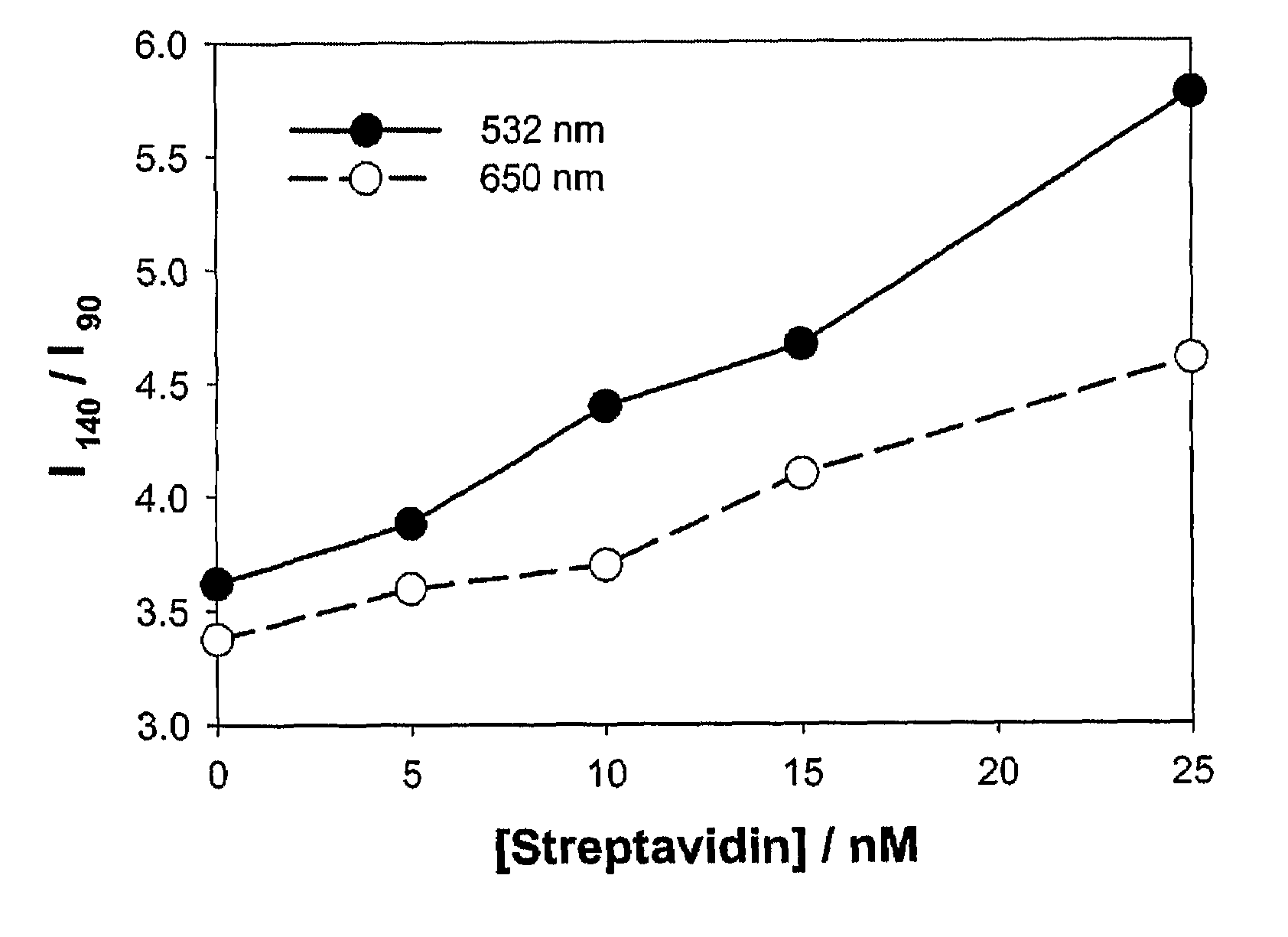
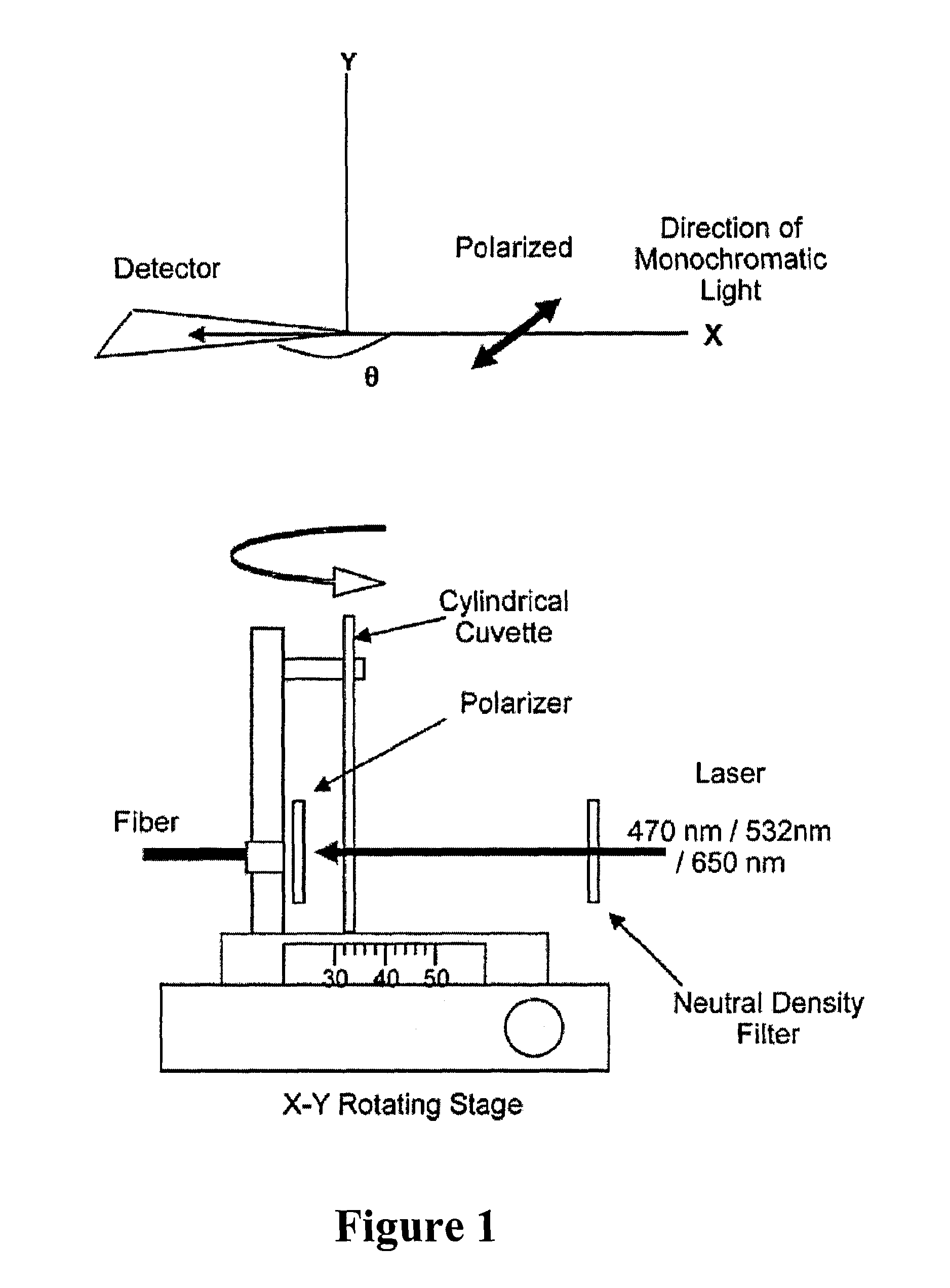
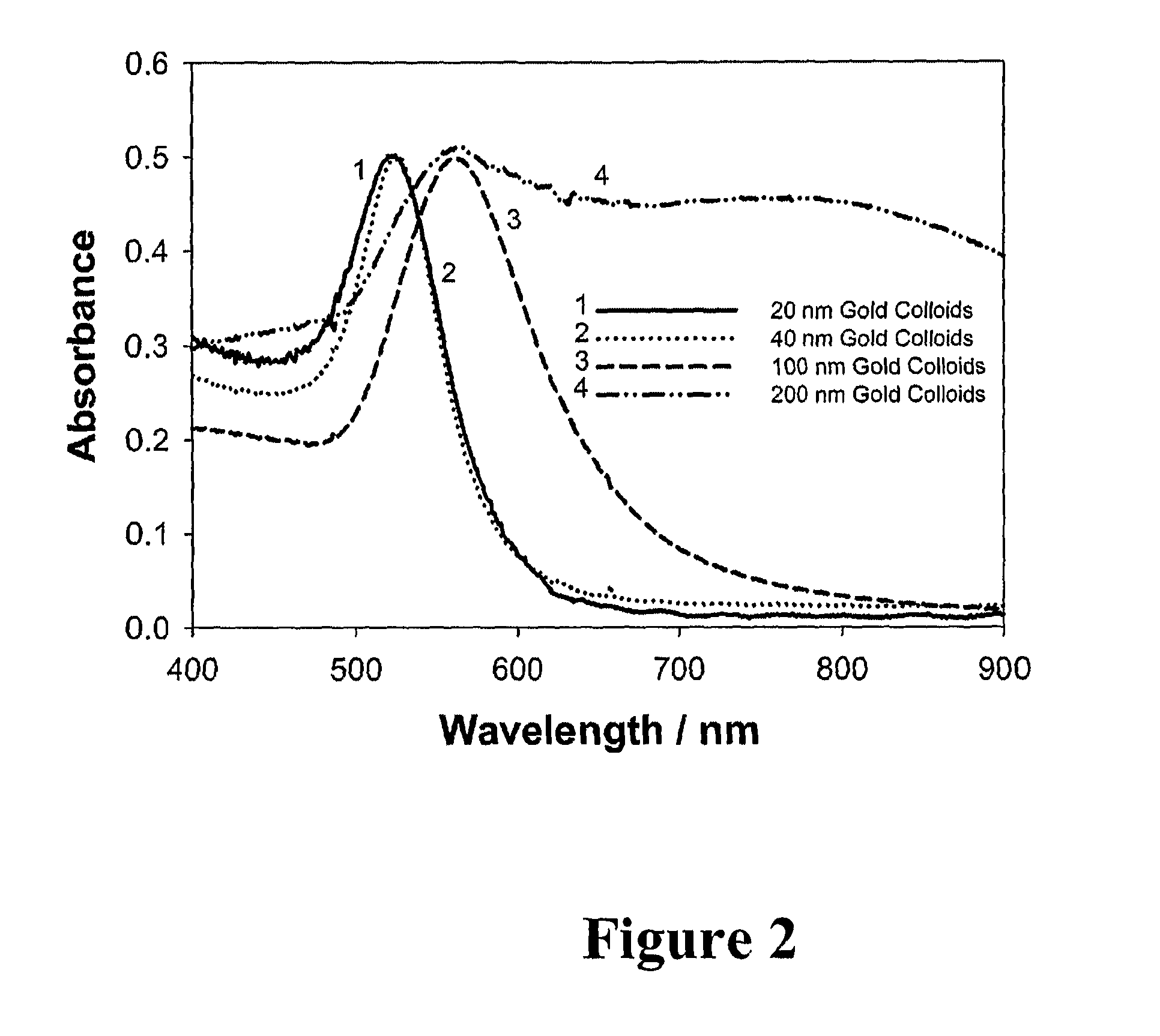
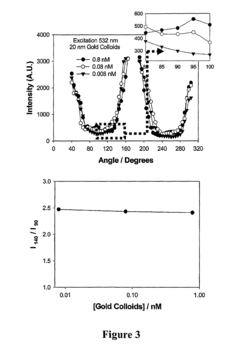
- The use of surface plasmons from metallic nanoparticles to measure scattering effects at different angles and wavelengths, allowing for the detection of analyte concentration through changes in light intensity and polarization, which is more stable and sensitive than traditional fluorescence methods.
Standardization and Quality Control Protocols
Standardization of Dynamic Light Scattering (DLS) protocols is essential for ensuring reliable and reproducible colloidal stability measurements across different laboratories and research settings. The establishment of comprehensive quality control protocols begins with instrument calibration using certified reference materials such as polystyrene latex beads or silica nanoparticles with known size distributions. These standards should be measured regularly to verify instrument performance and detect any drift in measurement accuracy over time.
Sample preparation procedures must be rigorously standardized to minimize variability. This includes protocols for sample dilution, filtration methods to remove dust particles, temperature equilibration times, and appropriate selection of cuvettes or measurement cells. Documentation of these procedures in standard operating protocols (SOPs) ensures consistency between operators and across different laboratory environments.
Data acquisition parameters significantly impact DLS measurement quality. Standardized protocols should specify optimal count rates, measurement duration, number of runs per measurement, and appropriate analysis algorithms. The angle of detection should be standardized based on the expected particle size range, with 90° being common for many colloidal systems, while backscatter detection (173°) may be preferred for concentrated samples.
Quality control metrics must be clearly defined and regularly monitored. These include the polydispersity index (PDI) thresholds for acceptable measurements, signal-to-noise ratios, and correlation function quality indicators. Statistical approaches for outlier detection and measurement repeatability assessment should be implemented as part of routine quality control procedures.
Interlaboratory comparison studies represent a critical component of standardization efforts. Participation in round-robin tests using identical samples measured across multiple facilities helps identify systematic errors and establish measurement uncertainty budgets. Results from these studies can inform the development of international standards through organizations such as ISO, ASTM, or NIST.
Environmental factors affecting DLS measurements require standardized control protocols. Temperature stability (±0.1°C), vibration isolation, and protection from ambient light fluctuations are essential for reproducible results. Automated system suitability tests should be performed at defined intervals to verify that environmental controls are functioning properly.
Documentation and reporting standards constitute the final element of quality control protocols. Reports should include complete information on sample history, preparation methods, measurement parameters, raw correlation data, and analysis algorithms used. This comprehensive documentation enables meaningful comparison of results across different studies and facilitates troubleshooting when discrepancies arise.
Sample preparation procedures must be rigorously standardized to minimize variability. This includes protocols for sample dilution, filtration methods to remove dust particles, temperature equilibration times, and appropriate selection of cuvettes or measurement cells. Documentation of these procedures in standard operating protocols (SOPs) ensures consistency between operators and across different laboratory environments.
Data acquisition parameters significantly impact DLS measurement quality. Standardized protocols should specify optimal count rates, measurement duration, number of runs per measurement, and appropriate analysis algorithms. The angle of detection should be standardized based on the expected particle size range, with 90° being common for many colloidal systems, while backscatter detection (173°) may be preferred for concentrated samples.
Quality control metrics must be clearly defined and regularly monitored. These include the polydispersity index (PDI) thresholds for acceptable measurements, signal-to-noise ratios, and correlation function quality indicators. Statistical approaches for outlier detection and measurement repeatability assessment should be implemented as part of routine quality control procedures.
Interlaboratory comparison studies represent a critical component of standardization efforts. Participation in round-robin tests using identical samples measured across multiple facilities helps identify systematic errors and establish measurement uncertainty budgets. Results from these studies can inform the development of international standards through organizations such as ISO, ASTM, or NIST.
Environmental factors affecting DLS measurements require standardized control protocols. Temperature stability (±0.1°C), vibration isolation, and protection from ambient light fluctuations are essential for reproducible results. Automated system suitability tests should be performed at defined intervals to verify that environmental controls are functioning properly.
Documentation and reporting standards constitute the final element of quality control protocols. Reports should include complete information on sample history, preparation methods, measurement parameters, raw correlation data, and analysis algorithms used. This comprehensive documentation enables meaningful comparison of results across different studies and facilitates troubleshooting when discrepancies arise.
Environmental Factors Affecting DLS Measurements
Dynamic Light Scattering (DLS) measurements in colloidal stability assessment are significantly influenced by various environmental factors that can alter the accuracy and reliability of results. Temperature stands as one of the most critical parameters affecting DLS measurements, as it directly impacts the Brownian motion of particles in suspension. Even minor temperature fluctuations can lead to substantial changes in diffusion coefficients, potentially resulting in misleading size distribution data. Most commercial DLS instruments incorporate temperature control systems with precision of ±0.1°C, but maintaining absolute temperature stability remains challenging in practical applications.
Solution viscosity represents another crucial environmental factor, as the Stokes-Einstein equation used in DLS calculations relies on accurate viscosity values. Temperature-induced viscosity changes must be accounted for, particularly when working with non-aqueous solvents or complex biological media. Research indicates that a 1°C temperature change can alter viscosity by approximately 2-3%, potentially introducing significant systematic errors in particle size determination.
The ionic strength of the dispersion medium substantially influences the electrical double layer surrounding colloidal particles, affecting their hydrodynamic diameter and consequently the DLS measurements. High salt concentrations can compress the electrical double layer, reducing the apparent hydrodynamic diameter, while extremely low ionic strength environments may lead to extended double layers and larger apparent sizes. This phenomenon becomes particularly relevant when studying the stability of charged colloidal systems under varying environmental conditions.
pH variations can dramatically alter surface charge properties of colloidal particles, potentially inducing aggregation or dispersion effects that complicate DLS interpretation. The isoelectric point, where particles exhibit minimal electrostatic repulsion, often corresponds to regions of maximum instability and measurement variability. Careful pH control and monitoring are essential, especially when working near the isoelectric point of the colloidal system.
Light-absorbing components or fluorescent species present in the sample can interfere with DLS measurements by reducing the signal-to-noise ratio or introducing secondary scattering phenomena. These optical interferences are particularly problematic in complex biological samples or when working with colored colloids. Advanced DLS instruments incorporate multiple-angle detection and sophisticated algorithms to mitigate these effects, but complete elimination remains challenging.
Dust contamination represents a persistent practical challenge in DLS measurements, as even microscopic dust particles can dominate the scattering signal due to their large size relative to the colloidal particles of interest. Rigorous sample preparation protocols, including filtration through appropriate membrane filters and measurement in dust-free environments, are essential for obtaining reliable data, particularly when characterizing nanoscale colloids.
Solution viscosity represents another crucial environmental factor, as the Stokes-Einstein equation used in DLS calculations relies on accurate viscosity values. Temperature-induced viscosity changes must be accounted for, particularly when working with non-aqueous solvents or complex biological media. Research indicates that a 1°C temperature change can alter viscosity by approximately 2-3%, potentially introducing significant systematic errors in particle size determination.
The ionic strength of the dispersion medium substantially influences the electrical double layer surrounding colloidal particles, affecting their hydrodynamic diameter and consequently the DLS measurements. High salt concentrations can compress the electrical double layer, reducing the apparent hydrodynamic diameter, while extremely low ionic strength environments may lead to extended double layers and larger apparent sizes. This phenomenon becomes particularly relevant when studying the stability of charged colloidal systems under varying environmental conditions.
pH variations can dramatically alter surface charge properties of colloidal particles, potentially inducing aggregation or dispersion effects that complicate DLS interpretation. The isoelectric point, where particles exhibit minimal electrostatic repulsion, often corresponds to regions of maximum instability and measurement variability. Careful pH control and monitoring are essential, especially when working near the isoelectric point of the colloidal system.
Light-absorbing components or fluorescent species present in the sample can interfere with DLS measurements by reducing the signal-to-noise ratio or introducing secondary scattering phenomena. These optical interferences are particularly problematic in complex biological samples or when working with colored colloids. Advanced DLS instruments incorporate multiple-angle detection and sophisticated algorithms to mitigate these effects, but complete elimination remains challenging.
Dust contamination represents a persistent practical challenge in DLS measurements, as even microscopic dust particles can dominate the scattering signal due to their large size relative to the colloidal particles of interest. Rigorous sample preparation protocols, including filtration through appropriate membrane filters and measurement in dust-free environments, are essential for obtaining reliable data, particularly when characterizing nanoscale colloids.
Unlock deeper insights with Patsnap Eureka Quick Research — get a full tech report to explore trends and direct your research. Try now!
Generate Your Research Report Instantly with AI Agent
Supercharge your innovation with Patsnap Eureka AI Agent Platform!