

EIS Interpretation vs Experimental Setup
MAR 26, 20269 MIN READ
Generate Your Research Report Instantly with AI Agent
PatSnap Eureka helps you evaluate technical feasibility & market potential.
EIS Technology Background and Research Objectives
Electrochemical Impedance Spectroscopy (EIS) has emerged as one of the most powerful and versatile analytical techniques in electrochemistry since its development in the 1960s. Originally conceived for studying electrode kinetics and double-layer phenomena, EIS has evolved into an indispensable tool for characterizing a wide range of electrochemical systems, from batteries and fuel cells to corrosion processes and biosensors.
The fundamental principle of EIS involves applying a small-amplitude sinusoidal voltage perturbation across a range of frequencies and measuring the corresponding current response. This frequency-domain analysis provides rich information about the electrochemical processes occurring at different time scales, enabling researchers to deconvolute complex interfacial phenomena that would be difficult to resolve using traditional time-domain techniques.
The evolution of EIS technology has been marked by significant advances in both instrumentation and data interpretation methodologies. Early impedance measurements were limited by analog frequency response analyzers and required extensive manual data collection. The advent of digital signal processing and computer-controlled instrumentation in the 1980s revolutionized the field, enabling automated frequency sweeps and real-time data acquisition across multiple decades of frequency.
Contemporary EIS systems integrate sophisticated hardware with advanced software algorithms, allowing for precise measurements spanning frequencies from microhertz to megahertz. Modern potentiostats incorporate features such as floating measurement capabilities, low-noise amplifiers, and temperature compensation, significantly improving measurement accuracy and reproducibility.
The primary objective of current EIS research focuses on bridging the gap between experimental data acquisition and meaningful physical interpretation. While hardware capabilities have advanced dramatically, the challenge of extracting quantitative information about electrochemical processes from complex impedance spectra remains a critical bottleneck. This interpretation challenge is compounded by the inherent coupling between experimental setup parameters and the resulting impedance response.
Key research objectives include developing standardized protocols for experimental design, establishing robust methodologies for equivalent circuit modeling, and creating automated tools for impedance data validation and interpretation. The ultimate goal is to transform EIS from an expert-dependent technique into a routine analytical method accessible to broader scientific and industrial communities.
The fundamental principle of EIS involves applying a small-amplitude sinusoidal voltage perturbation across a range of frequencies and measuring the corresponding current response. This frequency-domain analysis provides rich information about the electrochemical processes occurring at different time scales, enabling researchers to deconvolute complex interfacial phenomena that would be difficult to resolve using traditional time-domain techniques.
The evolution of EIS technology has been marked by significant advances in both instrumentation and data interpretation methodologies. Early impedance measurements were limited by analog frequency response analyzers and required extensive manual data collection. The advent of digital signal processing and computer-controlled instrumentation in the 1980s revolutionized the field, enabling automated frequency sweeps and real-time data acquisition across multiple decades of frequency.
Contemporary EIS systems integrate sophisticated hardware with advanced software algorithms, allowing for precise measurements spanning frequencies from microhertz to megahertz. Modern potentiostats incorporate features such as floating measurement capabilities, low-noise amplifiers, and temperature compensation, significantly improving measurement accuracy and reproducibility.
The primary objective of current EIS research focuses on bridging the gap between experimental data acquisition and meaningful physical interpretation. While hardware capabilities have advanced dramatically, the challenge of extracting quantitative information about electrochemical processes from complex impedance spectra remains a critical bottleneck. This interpretation challenge is compounded by the inherent coupling between experimental setup parameters and the resulting impedance response.
Key research objectives include developing standardized protocols for experimental design, establishing robust methodologies for equivalent circuit modeling, and creating automated tools for impedance data validation and interpretation. The ultimate goal is to transform EIS from an expert-dependent technique into a routine analytical method accessible to broader scientific and industrial communities.
Market Demand for Advanced EIS Analysis Solutions
The electrochemical impedance spectroscopy market is experiencing unprecedented growth driven by the increasing complexity of energy storage systems and the critical need for accurate battery diagnostics. Traditional EIS analysis methods are proving inadequate for modern applications, creating substantial demand for sophisticated interpretation solutions that can bridge the gap between experimental data and meaningful insights.
Battery manufacturers across automotive, consumer electronics, and grid storage sectors are facing mounting pressure to optimize performance while ensuring safety and longevity. Current EIS interpretation challenges directly impact product development timelines and quality assurance processes. The disconnect between experimental setup parameters and data interpretation capabilities has become a significant bottleneck in research and development workflows.
Research institutions and universities represent another major demand driver, requiring advanced EIS analysis tools for fundamental electrochemical research. The academic sector's need for standardized interpretation methodologies has intensified as collaborative research projects demand consistent and reproducible results across different experimental setups and measurement conditions.
Industrial quality control applications are increasingly adopting EIS-based testing protocols, particularly in pharmaceutical, chemical, and materials manufacturing sectors. These industries require robust interpretation frameworks that can accommodate varying experimental configurations while maintaining measurement accuracy and reliability standards.
The emergence of artificial intelligence and machine learning technologies has created new market opportunities for automated EIS interpretation solutions. Companies are actively seeking platforms that can reduce human error, accelerate data processing, and provide predictive insights from complex impedance datasets.
Regulatory compliance requirements in automotive and aerospace industries are driving demand for validated EIS analysis methodologies. Organizations need interpretation tools that can demonstrate traceability between experimental conditions and analytical conclusions, supporting certification processes and safety standards.
Small and medium enterprises entering the electrochemical testing market face particular challenges in developing internal EIS expertise. This segment represents significant growth potential for user-friendly interpretation solutions that can democratize advanced electrochemical analysis capabilities without requiring extensive specialized knowledge.
The integration of cloud-based data processing and collaborative analysis platforms is reshaping market expectations, with customers demanding scalable solutions that can handle large datasets while enabling remote access and team collaboration across different experimental facilities.
Battery manufacturers across automotive, consumer electronics, and grid storage sectors are facing mounting pressure to optimize performance while ensuring safety and longevity. Current EIS interpretation challenges directly impact product development timelines and quality assurance processes. The disconnect between experimental setup parameters and data interpretation capabilities has become a significant bottleneck in research and development workflows.
Research institutions and universities represent another major demand driver, requiring advanced EIS analysis tools for fundamental electrochemical research. The academic sector's need for standardized interpretation methodologies has intensified as collaborative research projects demand consistent and reproducible results across different experimental setups and measurement conditions.
Industrial quality control applications are increasingly adopting EIS-based testing protocols, particularly in pharmaceutical, chemical, and materials manufacturing sectors. These industries require robust interpretation frameworks that can accommodate varying experimental configurations while maintaining measurement accuracy and reliability standards.
The emergence of artificial intelligence and machine learning technologies has created new market opportunities for automated EIS interpretation solutions. Companies are actively seeking platforms that can reduce human error, accelerate data processing, and provide predictive insights from complex impedance datasets.
Regulatory compliance requirements in automotive and aerospace industries are driving demand for validated EIS analysis methodologies. Organizations need interpretation tools that can demonstrate traceability between experimental conditions and analytical conclusions, supporting certification processes and safety standards.
Small and medium enterprises entering the electrochemical testing market face particular challenges in developing internal EIS expertise. This segment represents significant growth potential for user-friendly interpretation solutions that can democratize advanced electrochemical analysis capabilities without requiring extensive specialized knowledge.
The integration of cloud-based data processing and collaborative analysis platforms is reshaping market expectations, with customers demanding scalable solutions that can handle large datasets while enabling remote access and team collaboration across different experimental facilities.
Current EIS Interpretation Challenges and Setup Limitations
Electrochemical Impedance Spectroscopy faces significant interpretation challenges that stem from the inherent complexity of electrochemical systems and the mathematical nature of impedance data analysis. The primary obstacle lies in the non-unique nature of equivalent circuit models, where multiple circuit configurations can produce nearly identical impedance responses. This ambiguity creates substantial uncertainty in parameter extraction and physical interpretation of electrochemical processes.
The frequency domain analysis presents additional complications, particularly in distinguishing between overlapping time constants of different electrochemical phenomena. When multiple processes occur within similar frequency ranges, their impedance signatures become convoluted, making it extremely difficult to deconvolute individual contributions from charge transfer, mass transport, and interfacial phenomena.
Experimental setup limitations significantly compound interpretation difficulties. Electrode geometry variations, particularly in three-dimensional porous structures, create non-uniform current and potential distributions that deviate from ideal theoretical models. These geometric complexities introduce transmission line effects and distributed impedance characteristics that are challenging to model accurately using conventional lumped-element equivalent circuits.
Temperature and environmental control represent critical setup constraints that directly impact data reliability. Thermal fluctuations during measurement can alter reaction kinetics and electrolyte conductivity, introducing systematic errors that are often difficult to distinguish from genuine electrochemical responses. Similarly, inadequate electromagnetic shielding can introduce parasitic impedances and noise artifacts that contaminate the measured spectra.
Reference electrode positioning and stability issues create additional interpretation challenges, particularly in systems with high ionic resistance or non-uniform electrolyte distribution. Poor reference electrode placement can introduce uncompensated resistance effects and potential measurement artifacts that skew the impedance response, leading to erroneous conclusions about system behavior.
The limited frequency range of conventional instrumentation constrains the ability to capture complete electrochemical processes. High-frequency limitations prevent accurate measurement of electrolyte resistance and double-layer capacitance, while low-frequency constraints may truncate diffusion-related impedance features, resulting in incomplete datasets for comprehensive analysis.
Data quality issues arising from measurement artifacts, including cable capacitance, instrument drift, and non-linear system behavior, further complicate interpretation efforts. These systematic errors often manifest as spurious impedance features that can be mistakenly attributed to electrochemical phenomena, leading to incorrect mechanistic conclusions and flawed model development.
The frequency domain analysis presents additional complications, particularly in distinguishing between overlapping time constants of different electrochemical phenomena. When multiple processes occur within similar frequency ranges, their impedance signatures become convoluted, making it extremely difficult to deconvolute individual contributions from charge transfer, mass transport, and interfacial phenomena.
Experimental setup limitations significantly compound interpretation difficulties. Electrode geometry variations, particularly in three-dimensional porous structures, create non-uniform current and potential distributions that deviate from ideal theoretical models. These geometric complexities introduce transmission line effects and distributed impedance characteristics that are challenging to model accurately using conventional lumped-element equivalent circuits.
Temperature and environmental control represent critical setup constraints that directly impact data reliability. Thermal fluctuations during measurement can alter reaction kinetics and electrolyte conductivity, introducing systematic errors that are often difficult to distinguish from genuine electrochemical responses. Similarly, inadequate electromagnetic shielding can introduce parasitic impedances and noise artifacts that contaminate the measured spectra.
Reference electrode positioning and stability issues create additional interpretation challenges, particularly in systems with high ionic resistance or non-uniform electrolyte distribution. Poor reference electrode placement can introduce uncompensated resistance effects and potential measurement artifacts that skew the impedance response, leading to erroneous conclusions about system behavior.
The limited frequency range of conventional instrumentation constrains the ability to capture complete electrochemical processes. High-frequency limitations prevent accurate measurement of electrolyte resistance and double-layer capacitance, while low-frequency constraints may truncate diffusion-related impedance features, resulting in incomplete datasets for comprehensive analysis.
Data quality issues arising from measurement artifacts, including cable capacitance, instrument drift, and non-linear system behavior, further complicate interpretation efforts. These systematic errors often manifest as spurious impedance features that can be mistakenly attributed to electrochemical phenomena, leading to incorrect mechanistic conclusions and flawed model development.
Existing EIS Data Interpretation and Setup Solutions
01 EIS for battery state monitoring and diagnosis
Electrochemical Impedance Spectroscopy is utilized to monitor and diagnose the state of batteries, including state of charge, state of health, and degradation mechanisms. The technique measures impedance across different frequencies to characterize battery performance and identify internal resistance changes, enabling predictive maintenance and optimization of battery management systems.- EIS for battery state monitoring and diagnostics: Electrochemical Impedance Spectroscopy is utilized to monitor and diagnose the state of health and state of charge of batteries. This technique measures the impedance characteristics across different frequencies to assess battery performance, degradation, and remaining useful life. The method enables real-time monitoring and predictive maintenance of battery systems by analyzing impedance spectra patterns.
- EIS apparatus and measurement system design: Development of specialized equipment and systems for performing electrochemical impedance measurements. These systems include hardware configurations with signal generators, potentiostats, and data acquisition components designed to apply AC signals and measure impedance responses. The apparatus may incorporate automated testing capabilities and multi-channel measurement functionalities for simultaneous testing of multiple samples.
- EIS for corrosion monitoring and material characterization: Application of impedance spectroscopy techniques to evaluate corrosion behavior and characterize material properties. The method involves analyzing the electrochemical interface between materials and their environment to determine corrosion rates, coating integrity, and protective layer effectiveness. This approach provides non-destructive assessment of material degradation and surface conditions.
- EIS data analysis and interpretation methods: Techniques for processing and analyzing impedance spectroscopy data to extract meaningful information. This includes equivalent circuit modeling, fitting algorithms, and pattern recognition methods to interpret complex impedance spectra. Advanced data processing approaches utilize machine learning and artificial intelligence to improve accuracy and automate the interpretation of impedance measurements.
- EIS for fuel cell and electrochemical device testing: Implementation of impedance spectroscopy for characterizing and testing fuel cells, electrolyzers, and other electrochemical devices. The technique evaluates electrode kinetics, mass transport limitations, and ohmic resistances within these systems. Measurements provide insights into device performance, efficiency losses, and operational characteristics under various conditions.
02 EIS apparatus and measurement systems
Specialized apparatus and systems are designed for performing electrochemical impedance spectroscopy measurements. These systems include signal generators, frequency response analyzers, and data acquisition components configured to apply AC signals and measure impedance responses. The equipment enables accurate characterization of electrochemical systems across wide frequency ranges with improved signal-to-noise ratios.Expand Specific Solutions03 EIS for fuel cell characterization
Electrochemical Impedance Spectroscopy is applied to characterize fuel cells and evaluate their performance parameters. The technique analyzes charge transfer resistance, mass transport limitations, and membrane properties to assess fuel cell efficiency and durability. This enables optimization of fuel cell design and operating conditions through detailed understanding of electrochemical processes.Expand Specific Solutions04 EIS data analysis and modeling methods
Advanced data analysis and modeling techniques are employed to interpret electrochemical impedance spectroscopy results. These methods include equivalent circuit modeling, complex nonlinear least squares fitting, and machine learning algorithms to extract meaningful parameters from impedance spectra. The analysis enables identification of electrochemical processes and quantification of system characteristics.Expand Specific Solutions05 EIS for corrosion and coating evaluation
Electrochemical Impedance Spectroscopy is utilized to evaluate corrosion behavior and protective coating performance on metal surfaces. The technique measures impedance changes that indicate coating degradation, corrosion initiation, and protective barrier properties. This enables non-destructive assessment of material durability and coating effectiveness in various environmental conditions.Expand Specific Solutions
Key Players in EIS Equipment and Software Industry
The EIS interpretation versus experimental setup field represents an emerging technology domain in the early growth stage, with significant market potential driven by increasing demand for advanced electrochemical analysis across energy storage, materials science, and biotechnology sectors. The competitive landscape features a diverse ecosystem spanning established technology giants like IBM, Samsung Electronics, and Intel Corp., alongside specialized players such as Ballard Power Systems and Cirrus Logic focusing on energy and signal processing applications. Leading research institutions including MIT, Caltech, UCLA, and international universities like Oxford University Innovation and Forschungszentrum Jülich are driving fundamental breakthroughs in EIS methodologies. The technology maturity varies significantly, with hardware components reaching commercial readiness while sophisticated interpretation algorithms and automated experimental design remain in development phases, creating opportunities for both incremental improvements and disruptive innovations in electrochemical impedance spectroscopy applications.
International Business Machines Corp.
Technical Solution: IBM has developed advanced EIS interpretation methodologies utilizing machine learning algorithms and cloud-based analytics platforms. Their approach integrates automated impedance spectrum analysis with experimental parameter optimization, enabling real-time correlation between EIS measurements and electrochemical system performance. The company's Watson AI platform is leveraged to identify complex impedance patterns and predict system behavior based on experimental conditions. IBM's solution includes comprehensive data preprocessing, noise reduction algorithms, and multi-frequency analysis capabilities that enhance the accuracy of EIS interpretation across various electrochemical applications including battery systems and fuel cells.
Strengths: Advanced AI-driven analysis capabilities, robust cloud infrastructure for large-scale data processing, comprehensive noise reduction algorithms. Weaknesses: High computational costs, requires extensive training data, may lack domain-specific electrochemical expertise.
Ballard Power Systems, Inc.
Technical Solution: Ballard Power Systems has developed specialized EIS interpretation methodologies focused on fuel cell technology applications. Their approach combines decades of fuel cell expertise with advanced impedance analysis techniques to optimize cell performance and diagnose operational issues. The company's methodology includes stack-level impedance mapping, individual cell monitoring capabilities, and correlation algorithms that link impedance characteristics with fuel cell degradation mechanisms. Ballard's EIS interpretation system incorporates experimental protocols specifically designed for fuel cell operating conditions, including humidity control, temperature management, and gas composition optimization to ensure accurate and reproducible impedance measurements for performance optimization and predictive maintenance.
Strengths: Deep fuel cell domain expertise, proven commercial applications, comprehensive understanding of fuel cell degradation mechanisms. Weaknesses: Limited to fuel cell applications, smaller scale compared to major technology companies, specialized market focus may limit broader applicability.
Core Innovations in EIS Measurement Optimization
Reduced stack voltage circuitry for energy storage system diagnostics
PatentWO2017015038A1
Innovation
- A reduced voltage circuitry is introduced to interface a DC power source with an AC signal diagnostic system, using a voltage-reduction circuit that reduces the DC component of the input voltage without affecting the AC component, allowing for efficient diagnostic measurements and improving high voltage to low voltage isolation, enabling the use of lower-cost signal processing electronics.
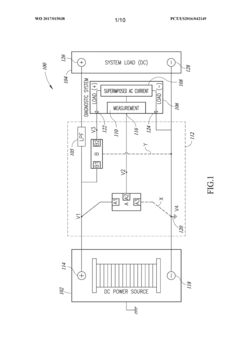
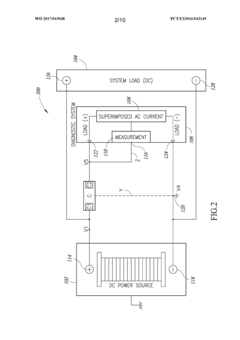
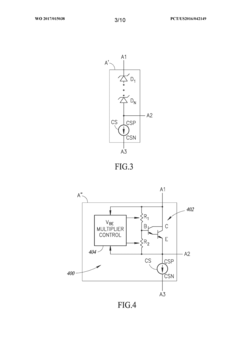
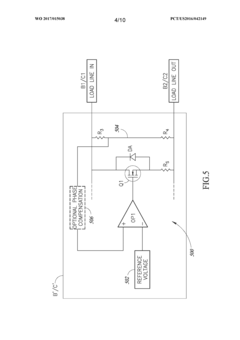
Electrochemical cell characterisation
PatentActiveUS20230408596A1
Innovation
- The development of adaptive circuitry that applies a stimulus to an electrochemical cell, measures the response, determines an estimated transfer function, and adjusts the stimulus or measurement circuitry based on a score to improve accuracy and efficiency, allowing for the determination of impedance across a broad frequency range.


Standardization Requirements for EIS Protocols
The standardization of Electrochemical Impedance Spectroscopy (EIS) protocols has become increasingly critical as the technique gains widespread adoption across diverse industries including energy storage, corrosion monitoring, and biomedical applications. The complexity of EIS measurements and the sensitivity of results to experimental conditions necessitate comprehensive standardization frameworks to ensure reproducibility and reliability across different laboratories and equipment platforms.
Current standardization efforts face significant challenges due to the inherent variability in experimental setups and measurement conditions. The frequency range selection, amplitude of the AC perturbation, and equilibration time before measurements can dramatically influence the impedance spectra obtained. Without standardized protocols, researchers often struggle to compare results across different studies, leading to inconsistencies in data interpretation and reduced confidence in EIS-based conclusions.
International standards organizations, including ASTM International and the International Electrotechnical Commission (IEC), have initiated efforts to establish unified protocols for EIS measurements. These standards address critical parameters such as cell configuration requirements, electrode preparation procedures, electrolyte specifications, and environmental control conditions. The standardization process must balance the need for consistency with the flexibility required for diverse application domains.
Key standardization requirements include the definition of minimum measurement parameters, quality assessment criteria for impedance data, and validation procedures for experimental setups. The protocols must specify acceptable ranges for measurement artifacts, noise levels, and system stability requirements. Additionally, standardized data formats and reporting guidelines are essential for facilitating data sharing and collaborative research efforts.
The implementation of standardized EIS protocols requires careful consideration of instrumentation capabilities and limitations. Different potentiostat manufacturers may have varying specifications for frequency ranges, current resolution, and impedance measurement accuracy. Standardization efforts must account for these hardware differences while establishing minimum performance requirements that ensure data quality and comparability across different experimental platforms.
Current standardization efforts face significant challenges due to the inherent variability in experimental setups and measurement conditions. The frequency range selection, amplitude of the AC perturbation, and equilibration time before measurements can dramatically influence the impedance spectra obtained. Without standardized protocols, researchers often struggle to compare results across different studies, leading to inconsistencies in data interpretation and reduced confidence in EIS-based conclusions.
International standards organizations, including ASTM International and the International Electrotechnical Commission (IEC), have initiated efforts to establish unified protocols for EIS measurements. These standards address critical parameters such as cell configuration requirements, electrode preparation procedures, electrolyte specifications, and environmental control conditions. The standardization process must balance the need for consistency with the flexibility required for diverse application domains.
Key standardization requirements include the definition of minimum measurement parameters, quality assessment criteria for impedance data, and validation procedures for experimental setups. The protocols must specify acceptable ranges for measurement artifacts, noise levels, and system stability requirements. Additionally, standardized data formats and reporting guidelines are essential for facilitating data sharing and collaborative research efforts.
The implementation of standardized EIS protocols requires careful consideration of instrumentation capabilities and limitations. Different potentiostat manufacturers may have varying specifications for frequency ranges, current resolution, and impedance measurement accuracy. Standardization efforts must account for these hardware differences while establishing minimum performance requirements that ensure data quality and comparability across different experimental platforms.
Quality Assurance in EIS Experimental Design
Quality assurance in electrochemical impedance spectroscopy experimental design represents a critical foundation for obtaining reliable and interpretable data. The inherent complexity of EIS measurements, combined with their sensitivity to environmental conditions and experimental parameters, necessitates rigorous quality control protocols throughout the entire measurement process.
Proper electrode preparation and surface conditioning constitute the first line of quality assurance. Surface contamination, oxide layers, or inadequate electrode pretreatment can introduce artifacts that manifest as spurious impedance features. Standardized cleaning procedures, controlled storage conditions, and systematic surface characterization protocols ensure consistent electrode states across measurements. The geometric accuracy of electrode areas and precise determination of active surface areas directly impact impedance normalization and subsequent quantitative analysis.
Instrumentation calibration and verification procedures form another essential component of quality assurance frameworks. Regular impedance standard measurements using precision resistors, capacitors, and RC networks validate instrument accuracy across the frequency spectrum. Systematic checks of potentiostat stability, current measurement precision, and phase accuracy help identify instrumental drift or malfunction before it compromises experimental data quality.
Environmental control measures significantly influence measurement reproducibility and data reliability. Temperature fluctuations, electromagnetic interference, and mechanical vibrations can introduce noise or systematic errors in impedance spectra. Faraday cage implementation, temperature regulation systems, and vibration isolation platforms minimize external disturbances that could compromise measurement integrity.
Data validation protocols provide systematic approaches for identifying problematic measurements or experimental artifacts. Kramers-Kronig transformation tests verify the fundamental causality and stability requirements of impedance data, while residual analysis helps detect systematic deviations from theoretical expectations. Statistical analysis of replicate measurements quantifies measurement uncertainty and establishes confidence intervals for impedance parameters.
Documentation and traceability systems ensure experimental reproducibility and enable systematic troubleshooting when anomalous results occur. Comprehensive recording of experimental conditions, sample preparation procedures, and instrument settings facilitates identification of variables that may influence measurement outcomes. Standardized data formats and metadata structures support long-term data integrity and enable comparative analysis across different experimental campaigns.
Proper electrode preparation and surface conditioning constitute the first line of quality assurance. Surface contamination, oxide layers, or inadequate electrode pretreatment can introduce artifacts that manifest as spurious impedance features. Standardized cleaning procedures, controlled storage conditions, and systematic surface characterization protocols ensure consistent electrode states across measurements. The geometric accuracy of electrode areas and precise determination of active surface areas directly impact impedance normalization and subsequent quantitative analysis.
Instrumentation calibration and verification procedures form another essential component of quality assurance frameworks. Regular impedance standard measurements using precision resistors, capacitors, and RC networks validate instrument accuracy across the frequency spectrum. Systematic checks of potentiostat stability, current measurement precision, and phase accuracy help identify instrumental drift or malfunction before it compromises experimental data quality.
Environmental control measures significantly influence measurement reproducibility and data reliability. Temperature fluctuations, electromagnetic interference, and mechanical vibrations can introduce noise or systematic errors in impedance spectra. Faraday cage implementation, temperature regulation systems, and vibration isolation platforms minimize external disturbances that could compromise measurement integrity.
Data validation protocols provide systematic approaches for identifying problematic measurements or experimental artifacts. Kramers-Kronig transformation tests verify the fundamental causality and stability requirements of impedance data, while residual analysis helps detect systematic deviations from theoretical expectations. Statistical analysis of replicate measurements quantifies measurement uncertainty and establishes confidence intervals for impedance parameters.
Documentation and traceability systems ensure experimental reproducibility and enable systematic troubleshooting when anomalous results occur. Comprehensive recording of experimental conditions, sample preparation procedures, and instrument settings facilitates identification of variables that may influence measurement outcomes. Standardized data formats and metadata structures support long-term data integrity and enable comparative analysis across different experimental campaigns.
Unlock deeper insights with PatSnap Eureka Quick Research — get a full tech report to explore trends and direct your research. Try now!
Generate Your Research Report Instantly with AI Agent
Supercharge your innovation with PatSnap Eureka AI Agent Platform!