

Electrochemical Compression's Role in Decarbonization Efforts
APR 24, 202610 MIN READ
Generate Your Research Report Instantly with AI Agent
PatSnap Eureka helps you evaluate technical feasibility & market potential.
Electrochemical Compression Background and Decarbonization Goals
Electrochemical compression represents a paradigm shift in gas compression technology, emerging from decades of research in electrochemical engineering and materials science. This innovative approach leverages electrochemical reactions to compress gases at the molecular level, fundamentally differing from traditional mechanical compression methods. The technology originated from fuel cell research in the 1960s and has evolved significantly with advances in membrane materials, catalyst development, and system integration capabilities.
The core principle involves using an electrochemical cell where gas molecules are ionized at one electrode, transported through an ion-conducting membrane, and recombined at the opposite electrode under higher pressure. This process eliminates the need for moving mechanical parts while achieving compression ratios comparable to conventional compressors. Early applications focused primarily on hydrogen compression for fuel cell systems, but the scope has expanded dramatically as decarbonization imperatives have intensified.
Global decarbonization efforts have established ambitious targets that directly align with electrochemical compression capabilities. The Paris Agreement's goal of limiting global temperature rise to 1.5°C requires unprecedented reductions in greenhouse gas emissions across all sectors. Hydrogen economy development, carbon capture and utilization, and renewable energy integration have emerged as critical pathways, each presenting specific compression requirements that electrochemical systems can uniquely address.
The technology's evolution has been driven by the need for efficient, clean compression solutions in emerging decarbonization applications. Unlike mechanical compressors that consume significant electrical energy and require maintenance-intensive moving parts, electrochemical compression offers inherently higher efficiency through direct electrochemical work. This efficiency advantage becomes particularly pronounced in applications requiring high-purity gas handling, such as hydrogen fuel production and carbon dioxide processing for utilization or storage.
Current decarbonization goals encompass multiple sectors where electrochemical compression demonstrates strategic value. In the hydrogen economy, the technology enables distributed compression at refueling stations and industrial facilities, supporting the transition from fossil fuel-based transportation and industrial processes. For carbon capture applications, electrochemical compression provides selective CO2 concentration and pressurization, facilitating both storage and conversion to valuable chemicals.
The integration of electrochemical compression with renewable energy systems represents another critical objective. As wind and solar power generation scales globally, the need for efficient energy storage and conversion technologies has intensified. Electrochemical compression enables power-to-gas applications where excess renewable electricity drives hydrogen production and compression simultaneously, creating a seamless pathway for long-term energy storage and grid stabilization.
Recent technological developments have focused on improving membrane durability, catalyst performance, and system scalability to meet industrial decarbonization requirements. Advanced polymer electrolyte membranes now demonstrate enhanced chemical stability and ionic conductivity, while novel catalyst formulations reduce precious metal requirements and improve operational longevity. These improvements directly support the economic viability of electrochemical compression in large-scale decarbonization applications.
The core principle involves using an electrochemical cell where gas molecules are ionized at one electrode, transported through an ion-conducting membrane, and recombined at the opposite electrode under higher pressure. This process eliminates the need for moving mechanical parts while achieving compression ratios comparable to conventional compressors. Early applications focused primarily on hydrogen compression for fuel cell systems, but the scope has expanded dramatically as decarbonization imperatives have intensified.
Global decarbonization efforts have established ambitious targets that directly align with electrochemical compression capabilities. The Paris Agreement's goal of limiting global temperature rise to 1.5°C requires unprecedented reductions in greenhouse gas emissions across all sectors. Hydrogen economy development, carbon capture and utilization, and renewable energy integration have emerged as critical pathways, each presenting specific compression requirements that electrochemical systems can uniquely address.
The technology's evolution has been driven by the need for efficient, clean compression solutions in emerging decarbonization applications. Unlike mechanical compressors that consume significant electrical energy and require maintenance-intensive moving parts, electrochemical compression offers inherently higher efficiency through direct electrochemical work. This efficiency advantage becomes particularly pronounced in applications requiring high-purity gas handling, such as hydrogen fuel production and carbon dioxide processing for utilization or storage.
Current decarbonization goals encompass multiple sectors where electrochemical compression demonstrates strategic value. In the hydrogen economy, the technology enables distributed compression at refueling stations and industrial facilities, supporting the transition from fossil fuel-based transportation and industrial processes. For carbon capture applications, electrochemical compression provides selective CO2 concentration and pressurization, facilitating both storage and conversion to valuable chemicals.
The integration of electrochemical compression with renewable energy systems represents another critical objective. As wind and solar power generation scales globally, the need for efficient energy storage and conversion technologies has intensified. Electrochemical compression enables power-to-gas applications where excess renewable electricity drives hydrogen production and compression simultaneously, creating a seamless pathway for long-term energy storage and grid stabilization.
Recent technological developments have focused on improving membrane durability, catalyst performance, and system scalability to meet industrial decarbonization requirements. Advanced polymer electrolyte membranes now demonstrate enhanced chemical stability and ionic conductivity, while novel catalyst formulations reduce precious metal requirements and improve operational longevity. These improvements directly support the economic viability of electrochemical compression in large-scale decarbonization applications.
Market Demand for Clean Hydrogen Compression Solutions
The global hydrogen economy is experiencing unprecedented growth momentum, driven by ambitious decarbonization commitments from governments and corporations worldwide. Clean hydrogen has emerged as a critical enabler for achieving net-zero emissions across multiple sectors, including steel production, chemical manufacturing, transportation, and power generation. This transition has created substantial demand for efficient, reliable, and cost-effective hydrogen compression technologies that can support the entire hydrogen value chain from production to end-use applications.
Traditional mechanical compression systems face significant limitations in meeting the evolving requirements of clean hydrogen applications. These conventional technologies often suffer from high maintenance costs, limited efficiency at varying load conditions, and challenges in handling the unique properties of hydrogen gas. The growing emphasis on system reliability and operational flexibility in hydrogen infrastructure has highlighted the inadequacy of existing compression solutions, particularly for applications requiring high-purity hydrogen or variable compression ratios.
The industrial sector represents the largest near-term market opportunity for clean hydrogen compression solutions. Steel manufacturers are increasingly adopting hydrogen-based direct reduction processes to replace carbon-intensive blast furnaces, requiring large-scale compression systems capable of handling substantial hydrogen volumes. Similarly, ammonia production facilities are transitioning toward green hydrogen feedstock, necessitating compression technologies that can integrate seamlessly with renewable energy sources and accommodate intermittent operation patterns.
Transportation applications are driving demand for specialized compression solutions that can support hydrogen refueling infrastructure. The expansion of fuel cell vehicle adoption requires compression systems capable of achieving high-pressure ratios while maintaining rapid refueling capabilities. These applications demand compression technologies that can operate efficiently across wide pressure ranges and provide consistent performance under varying ambient conditions.
Energy storage and power generation applications are creating additional market segments for hydrogen compression technologies. As renewable energy penetration increases, hydrogen-based energy storage systems require compression solutions that can efficiently handle the cyclical nature of charge-discharge operations. These applications prioritize energy efficiency and system longevity, creating opportunities for advanced compression technologies that can deliver superior performance compared to conventional mechanical systems.
The market demand is further amplified by stringent environmental regulations and carbon pricing mechanisms that favor low-emission technologies. Electrochemical compression solutions are particularly well-positioned to address these market requirements due to their inherent efficiency advantages, reduced maintenance requirements, and ability to integrate with renewable energy systems.
Traditional mechanical compression systems face significant limitations in meeting the evolving requirements of clean hydrogen applications. These conventional technologies often suffer from high maintenance costs, limited efficiency at varying load conditions, and challenges in handling the unique properties of hydrogen gas. The growing emphasis on system reliability and operational flexibility in hydrogen infrastructure has highlighted the inadequacy of existing compression solutions, particularly for applications requiring high-purity hydrogen or variable compression ratios.
The industrial sector represents the largest near-term market opportunity for clean hydrogen compression solutions. Steel manufacturers are increasingly adopting hydrogen-based direct reduction processes to replace carbon-intensive blast furnaces, requiring large-scale compression systems capable of handling substantial hydrogen volumes. Similarly, ammonia production facilities are transitioning toward green hydrogen feedstock, necessitating compression technologies that can integrate seamlessly with renewable energy sources and accommodate intermittent operation patterns.
Transportation applications are driving demand for specialized compression solutions that can support hydrogen refueling infrastructure. The expansion of fuel cell vehicle adoption requires compression systems capable of achieving high-pressure ratios while maintaining rapid refueling capabilities. These applications demand compression technologies that can operate efficiently across wide pressure ranges and provide consistent performance under varying ambient conditions.
Energy storage and power generation applications are creating additional market segments for hydrogen compression technologies. As renewable energy penetration increases, hydrogen-based energy storage systems require compression solutions that can efficiently handle the cyclical nature of charge-discharge operations. These applications prioritize energy efficiency and system longevity, creating opportunities for advanced compression technologies that can deliver superior performance compared to conventional mechanical systems.
The market demand is further amplified by stringent environmental regulations and carbon pricing mechanisms that favor low-emission technologies. Electrochemical compression solutions are particularly well-positioned to address these market requirements due to their inherent efficiency advantages, reduced maintenance requirements, and ability to integrate with renewable energy systems.
Current State and Challenges of Electrochemical Compression
Electrochemical compression technology has emerged as a promising solution for hydrogen handling and storage, yet its current development stage reveals significant disparities across global markets. Leading nations including the United States, Germany, Japan, and South Korea have established substantial research programs and pilot projects, while developing economies lag considerably in both technological capabilities and infrastructure deployment. The technology demonstrates particular strength in applications requiring high-purity hydrogen compression, such as fuel cell systems and industrial processes.
Current electrochemical compression systems achieve compression ratios of 100:1 to 1000:1 in single-stage operations, significantly outperforming traditional mechanical compressors that typically require multiple stages for similar performance. Commercial systems operate at current densities ranging from 0.5 to 2.0 A/cm², with energy consumption between 2.5 to 4.5 kWh per kilogram of hydrogen compressed. These performance metrics position electrochemical compression as technically viable for specific applications, though broader market penetration remains limited.
The primary technical challenges constraining widespread adoption center on membrane durability and cost optimization. Proton exchange membranes, the core component of electrochemical compressors, suffer from degradation under high differential pressures and elevated temperatures. Current membrane lifespans typically range from 5,000 to 15,000 operating hours, substantially shorter than the 40,000+ hour targets required for commercial viability. Membrane replacement costs can represent 30-40% of total system operating expenses.
Manufacturing scalability presents another critical constraint. Current production volumes remain at prototype and small-scale demonstration levels, resulting in prohibitively high capital costs exceeding $10,000 per kilowatt of compression capacity. This cost structure limits deployment to specialized applications where performance advantages justify premium pricing, such as aerospace and high-end industrial processes.
System integration challenges further complicate market adoption. Electrochemical compressors require sophisticated control systems to manage pressure differentials, temperature variations, and electrical load balancing. Integration with existing hydrogen infrastructure often necessitates custom engineering solutions, increasing project complexity and costs. Additionally, the technology's sensitivity to hydrogen purity levels demands upstream purification systems in many applications.
Geographic distribution of technological capabilities remains highly concentrated. North American and European companies dominate intellectual property portfolios and manufacturing capabilities, while Asian markets focus primarily on integration and application development. This concentration creates supply chain vulnerabilities and limits technology transfer to emerging markets where decarbonization needs are most acute.
Despite these challenges, recent technological advances demonstrate promising trajectories. Advanced membrane materials incorporating reinforced structures and improved chemical stability show potential for extending operational lifespans beyond 20,000 hours. Modular system designs are reducing manufacturing complexity and enabling standardized production approaches that could significantly lower costs as volumes increase.
Current electrochemical compression systems achieve compression ratios of 100:1 to 1000:1 in single-stage operations, significantly outperforming traditional mechanical compressors that typically require multiple stages for similar performance. Commercial systems operate at current densities ranging from 0.5 to 2.0 A/cm², with energy consumption between 2.5 to 4.5 kWh per kilogram of hydrogen compressed. These performance metrics position electrochemical compression as technically viable for specific applications, though broader market penetration remains limited.
The primary technical challenges constraining widespread adoption center on membrane durability and cost optimization. Proton exchange membranes, the core component of electrochemical compressors, suffer from degradation under high differential pressures and elevated temperatures. Current membrane lifespans typically range from 5,000 to 15,000 operating hours, substantially shorter than the 40,000+ hour targets required for commercial viability. Membrane replacement costs can represent 30-40% of total system operating expenses.
Manufacturing scalability presents another critical constraint. Current production volumes remain at prototype and small-scale demonstration levels, resulting in prohibitively high capital costs exceeding $10,000 per kilowatt of compression capacity. This cost structure limits deployment to specialized applications where performance advantages justify premium pricing, such as aerospace and high-end industrial processes.
System integration challenges further complicate market adoption. Electrochemical compressors require sophisticated control systems to manage pressure differentials, temperature variations, and electrical load balancing. Integration with existing hydrogen infrastructure often necessitates custom engineering solutions, increasing project complexity and costs. Additionally, the technology's sensitivity to hydrogen purity levels demands upstream purification systems in many applications.
Geographic distribution of technological capabilities remains highly concentrated. North American and European companies dominate intellectual property portfolios and manufacturing capabilities, while Asian markets focus primarily on integration and application development. This concentration creates supply chain vulnerabilities and limits technology transfer to emerging markets where decarbonization needs are most acute.
Despite these challenges, recent technological advances demonstrate promising trajectories. Advanced membrane materials incorporating reinforced structures and improved chemical stability show potential for extending operational lifespans beyond 20,000 hours. Modular system designs are reducing manufacturing complexity and enabling standardized production approaches that could significantly lower costs as volumes increase.
Existing Electrochemical Compression Solutions
01 Electrochemical CO2 capture and conversion systems
Advanced electrochemical systems designed to capture carbon dioxide from various sources and convert it into useful products through electrochemical processes. These systems utilize specialized electrodes and electrolytes to facilitate the reduction of CO2 into valuable chemicals, fuels, or other carbon-containing compounds, effectively removing CO2 from the atmosphere or industrial emissions.- Electrochemical CO2 capture and conversion systems: Advanced electrochemical systems designed to capture carbon dioxide from various sources and convert it into useful products through electrochemical processes. These systems utilize specialized electrodes and electrolytes to facilitate the reduction of CO2 into valuable chemicals or fuels, providing an effective approach to carbon utilization and emission reduction.
- Compression-integrated electrochemical reactors: Innovative reactor designs that combine mechanical compression with electrochemical processes to enhance decarbonization efficiency. These systems optimize pressure conditions to improve mass transfer and reaction kinetics, enabling more effective carbon dioxide processing and conversion rates in industrial applications.
- Electrode materials and catalyst systems: Specialized electrode materials and catalytic systems optimized for electrochemical decarbonization processes. These materials enhance the selectivity and efficiency of carbon dioxide reduction reactions, featuring novel compositions and structures that promote electron transfer and minimize energy consumption during the conversion process.
- Process control and optimization methods: Advanced control strategies and optimization techniques for managing electrochemical compression decarbonization systems. These methods involve sophisticated monitoring and adjustment of operational parameters such as current density, temperature, and pressure to maximize carbon conversion efficiency and system performance.
- Industrial scale implementation and equipment design: Large-scale industrial equipment and system designs for implementing electrochemical compression decarbonization in commercial applications. These solutions address scalability challenges, energy integration, and process economics to enable practical deployment in various industrial sectors for effective carbon emission reduction.
02 Compression-integrated electrochemical reactors
Innovative reactor designs that combine mechanical compression with electrochemical processes for enhanced decarbonization efficiency. These systems optimize the pressure and electrochemical conditions to improve CO2 solubility and reaction kinetics, leading to more effective carbon capture and conversion rates while reducing energy consumption.Expand Specific Solutions03 Electrode materials and catalysts for CO2 reduction
Specialized electrode materials and catalytic systems optimized for electrochemical carbon dioxide reduction reactions. These materials enhance the selectivity and efficiency of CO2 conversion processes, enabling the production of specific target products while minimizing energy requirements and improving overall system performance.Expand Specific Solutions04 Electrolyte systems for enhanced CO2 processing
Advanced electrolyte formulations and ionic liquid systems designed to improve CO2 solubility and electrochemical conversion efficiency. These electrolyte systems provide optimal ionic conductivity and chemical stability while facilitating the transport of CO2 and reaction intermediates, leading to improved decarbonization performance.Expand Specific Solutions05 Process optimization and system integration
Comprehensive approaches for optimizing electrochemical decarbonization processes through advanced control systems, heat integration, and process intensification techniques. These methods focus on maximizing energy efficiency, improving product selectivity, and integrating multiple unit operations to create economically viable and environmentally sustainable decarbonization solutions.Expand Specific Solutions
Key Players in Electrochemical Compression Industry
The electrochemical compression technology for decarbonization is in an emerging growth stage, characterized by significant research momentum from leading institutions like MIT, Rutgers University, and CEA, alongside industrial players spanning automotive (BMW, Toyota Industries), energy (BP, CNOOC), and specialized technology companies (Dioxycle, Nuvera Fuel Cells). The market shows substantial potential driven by global decarbonization mandates, though precise market sizing remains fluid due to the technology's nascent commercial deployment. Technology maturity varies considerably across applications, with companies like Panasonic and 3M advancing materials science foundations, while automotive manufacturers integrate compression systems into fuel cell vehicles, and energy companies explore industrial-scale carbon capture applications. The competitive landscape reflects a convergence of established industrial giants leveraging existing capabilities with innovative startups like Dioxycle pioneering novel electrochemical approaches, indicating the technology is transitioning from laboratory research toward commercial viability across multiple decarbonization pathways.
Massachusetts Institute of Technology
Technical Solution: MIT researchers have developed novel electrochemical compression concepts focusing on advanced materials and system architectures for next-generation clean energy applications. Their research encompasses innovative electrode materials including non-platinum group metal catalysts and novel membrane designs that reduce the cost and environmental impact of electrochemical compression systems. MIT's approach includes the development of solid-state electrochemical compression using ceramic ion conductors that can operate at elevated temperatures (200-400°C) and achieve higher compression ratios with improved thermodynamic efficiency. Their research has demonstrated prototype systems achieving compression ratios exceeding 200:1 with energy consumption 25-30% lower than conventional mechanical compression. The technology focuses on integration with renewable energy systems and grid-scale energy storage applications, supporting broader decarbonization efforts through improved energy system flexibility and efficiency. MIT's work also explores electrochemical compression of other gases including CO2 and ammonia for industrial decarbonization applications.
Strengths: Cutting-edge research capabilities, innovative materials development, strong focus on cost reduction and sustainability, extensive collaboration networks with industry partners. Weaknesses: Early-stage technology development with limited commercial deployment experience, potential scalability challenges for laboratory-developed materials, longer timeline for technology commercialization.
FFI Ionix IP Inc
Technical Solution: FFI Ionix specializes in advanced electrochemical compression technology for hydrogen applications, developing proprietary membrane electrode assemblies (MEAs) and stack designs that enable efficient hydrogen compression without mechanical moving parts. Their technology utilizes proton exchange membranes to electrochemically compress hydrogen from low pressure (1-10 bar) to high pressure (up to 1000 bar) with energy efficiency improvements of 15-20% compared to mechanical compressors. The system operates through electrochemical pumping, where hydrogen molecules are split into protons and electrons at the anode, with protons migrating through the membrane and recombining at the cathode under higher pressure. This approach significantly reduces maintenance requirements and operational noise while providing precise pressure control for hydrogen storage and fuel cell applications in decarbonization efforts.
Strengths: High energy efficiency, minimal maintenance due to no moving parts, precise pressure control, compact design suitable for distributed hydrogen infrastructure. Weaknesses: Higher initial capital costs compared to mechanical compressors, limited operational temperature range, potential membrane degradation over extended operation cycles.
Core Patents in Electrochemical Compression Innovation
Electrochemical hydrogen compressor
PatentInactiveUS20040211679A1
Innovation
- An electrochemical hydrogen compression apparatus and process using a membrane electrolyte cell assembly with a proton-conducting electrolyte membrane, anode, and cathode, along with planar gas distribution and support plates, connected in series to achieve high-pressure differentials up to 12,000 psi, leveraging electrochemical reactions to oxidize and reduce hydrogen across the membrane.
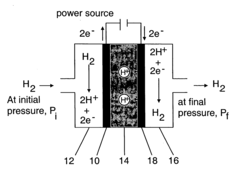
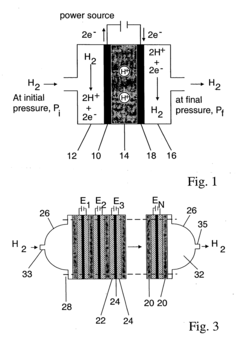
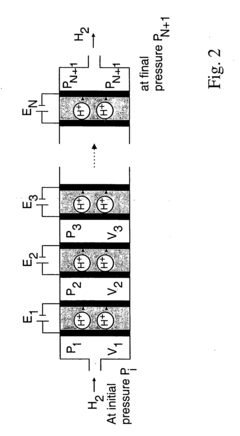
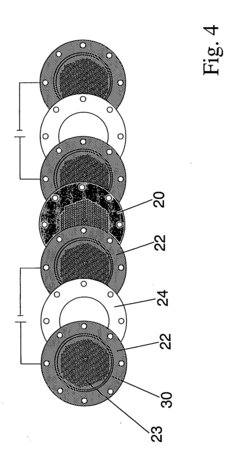
Method and device for the electrochemical compression of gaseous hydrogen
PatentPendingEP3773991A1
Innovation
- Implements a polarity reversal mechanism in electrochemical hydrogen compression, enabling alternating oxidation-reduction cycles that prevent water accumulation and maintain efficient hydrogen transport through membrane-electrode assemblies.
- Utilizes an intermediate redox vector (A/B couple) in the electrolyte system to facilitate hydrogen compression from low pressure (1-30 bar) to high pressure (700-900 bar) through controlled electrochemical reactions.
- Integrates series-connected membrane-electrode assemblies with electrical isolation to achieve high compression ratios while solving water management issues that typically plague electrochemical compressors.


Carbon Policy Impact on Compression Technology Adoption
Carbon pricing mechanisms have emerged as the primary policy driver accelerating electrochemical compression technology adoption across industrial sectors. The implementation of carbon taxes and cap-and-trade systems creates direct economic incentives for organizations to transition from conventional mechanical compression systems to more energy-efficient electrochemical alternatives. Countries with aggressive carbon pricing, such as those in the European Union with carbon prices exceeding $80 per ton CO2, demonstrate significantly higher adoption rates of advanced compression technologies compared to regions with minimal carbon policy frameworks.
Regulatory mandates for industrial decarbonization are reshaping compression technology selection criteria within energy-intensive sectors. Government-imposed emission reduction targets, particularly in hydrogen production and gas processing industries, are compelling companies to evaluate electrochemical compression as a viable pathway to meet compliance requirements. These mandates often include specific timelines for emission reductions, creating urgency in technology deployment decisions and accelerating market penetration of innovative compression solutions.
Financial incentive structures, including tax credits, grants, and subsidized financing programs, are reducing the economic barriers traditionally associated with electrochemical compression technology adoption. Government-backed funding mechanisms specifically targeting clean energy infrastructure development have lowered the total cost of ownership for electrochemical compression systems, making them increasingly competitive against conventional alternatives. These incentives often prioritize technologies demonstrating measurable carbon reduction potential, positioning electrochemical compression favorably within policy frameworks.
International climate commitments and national decarbonization strategies are establishing long-term market signals that influence corporate investment decisions in compression technology. The alignment of electrochemical compression capabilities with net-zero emission goals creates strategic advantages for early adopters, as regulatory environments continue evolving toward stricter emission standards. Policy certainty regarding future carbon regulations enables companies to justify higher upfront investments in electrochemical compression systems based on anticipated regulatory compliance costs and operational advantages in carbon-constrained markets.
Regulatory mandates for industrial decarbonization are reshaping compression technology selection criteria within energy-intensive sectors. Government-imposed emission reduction targets, particularly in hydrogen production and gas processing industries, are compelling companies to evaluate electrochemical compression as a viable pathway to meet compliance requirements. These mandates often include specific timelines for emission reductions, creating urgency in technology deployment decisions and accelerating market penetration of innovative compression solutions.
Financial incentive structures, including tax credits, grants, and subsidized financing programs, are reducing the economic barriers traditionally associated with electrochemical compression technology adoption. Government-backed funding mechanisms specifically targeting clean energy infrastructure development have lowered the total cost of ownership for electrochemical compression systems, making them increasingly competitive against conventional alternatives. These incentives often prioritize technologies demonstrating measurable carbon reduction potential, positioning electrochemical compression favorably within policy frameworks.
International climate commitments and national decarbonization strategies are establishing long-term market signals that influence corporate investment decisions in compression technology. The alignment of electrochemical compression capabilities with net-zero emission goals creates strategic advantages for early adopters, as regulatory environments continue evolving toward stricter emission standards. Policy certainty regarding future carbon regulations enables companies to justify higher upfront investments in electrochemical compression systems based on anticipated regulatory compliance costs and operational advantages in carbon-constrained markets.
Environmental Benefits Assessment of Electrochemical Methods
Electrochemical compression technologies demonstrate substantial environmental advantages compared to conventional mechanical compression systems, particularly in their contribution to global decarbonization initiatives. The primary environmental benefit stems from the elimination of moving mechanical parts, which significantly reduces energy consumption and associated carbon emissions. Traditional mechanical compressors typically operate at 60-70% efficiency, while electrochemical compression systems can achieve efficiencies exceeding 85%, resulting in a 15-25% reduction in overall energy requirements.
The carbon footprint reduction potential of electrochemical compression becomes particularly pronounced when integrated with renewable energy sources. Unlike mechanical systems that require consistent power delivery, electrochemical compressors can operate effectively with intermittent renewable energy inputs, enabling direct coupling with solar and wind power systems. This compatibility eliminates the need for energy storage intermediates, reducing system complexity and associated environmental impacts from battery manufacturing and disposal.
Life cycle assessment studies indicate that electrochemical compression systems generate approximately 40% fewer greenhouse gas emissions over their operational lifetime compared to conventional alternatives. This reduction encompasses both direct operational emissions and indirect emissions from manufacturing and maintenance activities. The absence of lubricants, seals, and frequently replaced mechanical components further minimizes environmental impact through reduced material consumption and waste generation.
Water resource conservation represents another significant environmental benefit, as electrochemical systems eliminate the need for cooling water typically required in mechanical compression applications. This advantage is particularly valuable in water-stressed regions where industrial water consumption faces increasing regulatory constraints. Additionally, the modular nature of electrochemical systems enables distributed deployment, reducing transportation-related emissions and infrastructure requirements.
The technology's contribution to air quality improvement extends beyond carbon emission reductions. Electrochemical compression systems operate without generating particulate matter or volatile organic compounds associated with mechanical system maintenance and lubrication. This characteristic makes them particularly suitable for deployment in urban environments and sensitive ecological areas where air quality standards are stringent.
The carbon footprint reduction potential of electrochemical compression becomes particularly pronounced when integrated with renewable energy sources. Unlike mechanical systems that require consistent power delivery, electrochemical compressors can operate effectively with intermittent renewable energy inputs, enabling direct coupling with solar and wind power systems. This compatibility eliminates the need for energy storage intermediates, reducing system complexity and associated environmental impacts from battery manufacturing and disposal.
Life cycle assessment studies indicate that electrochemical compression systems generate approximately 40% fewer greenhouse gas emissions over their operational lifetime compared to conventional alternatives. This reduction encompasses both direct operational emissions and indirect emissions from manufacturing and maintenance activities. The absence of lubricants, seals, and frequently replaced mechanical components further minimizes environmental impact through reduced material consumption and waste generation.
Water resource conservation represents another significant environmental benefit, as electrochemical systems eliminate the need for cooling water typically required in mechanical compression applications. This advantage is particularly valuable in water-stressed regions where industrial water consumption faces increasing regulatory constraints. Additionally, the modular nature of electrochemical systems enables distributed deployment, reducing transportation-related emissions and infrastructure requirements.
The technology's contribution to air quality improvement extends beyond carbon emission reductions. Electrochemical compression systems operate without generating particulate matter or volatile organic compounds associated with mechanical system maintenance and lubrication. This characteristic makes them particularly suitable for deployment in urban environments and sensitive ecological areas where air quality standards are stringent.
Unlock deeper insights with PatSnap Eureka Quick Research — get a full tech report to explore trends and direct your research. Try now!
Generate Your Research Report Instantly with AI Agent
Supercharge your innovation with PatSnap Eureka AI Agent Platform!