

Enhance Battery Management System Performance: Best Practices
MAR 20, 20269 MIN READ
Generate Your Research Report Instantly with AI Agent
PatSnap Eureka helps you evaluate technical feasibility & market potential.
Battery Management System Performance Enhancement Background
Battery Management Systems have evolved from simple voltage monitoring circuits in early electric vehicles to sophisticated, multi-layered control systems that serve as the critical interface between battery cells and vehicle operations. The historical development of BMS technology traces back to the 1990s when electric vehicle manufacturers first recognized the need for active battery protection and monitoring systems to ensure safe operation of lithium-ion battery packs.
The evolution of BMS technology has been driven by the exponential growth in electric vehicle adoption, renewable energy storage systems, and portable electronic devices. Early systems focused primarily on basic safety functions such as overvoltage and undervoltage protection, while modern BMS implementations incorporate advanced algorithms for state estimation, thermal management, and predictive maintenance capabilities.
Contemporary BMS architectures have progressed through several distinct phases, beginning with centralized systems where a single control unit managed entire battery packs, evolving to distributed architectures that enable cell-level monitoring and control. The current trend toward modular and scalable BMS designs reflects the industry's need for flexible solutions that can accommodate varying battery chemistries, pack configurations, and application requirements.
The technological trajectory of battery management systems demonstrates a clear shift from reactive protection mechanisms to proactive optimization strategies. Modern systems integrate machine learning algorithms, cloud connectivity, and advanced sensor technologies to enable real-time performance optimization, predictive failure analysis, and adaptive charging protocols that extend battery lifespan while maximizing energy efficiency.
The primary objectives driving current BMS performance enhancement initiatives center on achieving higher accuracy in state-of-charge and state-of-health estimation, reducing power consumption of the management system itself, improving thermal management effectiveness, and enabling faster charging capabilities without compromising battery safety or longevity. These goals align with broader industry demands for increased vehicle range, reduced charging times, and enhanced overall system reliability.
Future development targets for BMS technology include the integration of artificial intelligence for autonomous battery optimization, implementation of wireless communication protocols for simplified system architecture, and the development of standardized interfaces that enable interoperability across different battery technologies and vehicle platforms.
The evolution of BMS technology has been driven by the exponential growth in electric vehicle adoption, renewable energy storage systems, and portable electronic devices. Early systems focused primarily on basic safety functions such as overvoltage and undervoltage protection, while modern BMS implementations incorporate advanced algorithms for state estimation, thermal management, and predictive maintenance capabilities.
Contemporary BMS architectures have progressed through several distinct phases, beginning with centralized systems where a single control unit managed entire battery packs, evolving to distributed architectures that enable cell-level monitoring and control. The current trend toward modular and scalable BMS designs reflects the industry's need for flexible solutions that can accommodate varying battery chemistries, pack configurations, and application requirements.
The technological trajectory of battery management systems demonstrates a clear shift from reactive protection mechanisms to proactive optimization strategies. Modern systems integrate machine learning algorithms, cloud connectivity, and advanced sensor technologies to enable real-time performance optimization, predictive failure analysis, and adaptive charging protocols that extend battery lifespan while maximizing energy efficiency.
The primary objectives driving current BMS performance enhancement initiatives center on achieving higher accuracy in state-of-charge and state-of-health estimation, reducing power consumption of the management system itself, improving thermal management effectiveness, and enabling faster charging capabilities without compromising battery safety or longevity. These goals align with broader industry demands for increased vehicle range, reduced charging times, and enhanced overall system reliability.
Future development targets for BMS technology include the integration of artificial intelligence for autonomous battery optimization, implementation of wireless communication protocols for simplified system architecture, and the development of standardized interfaces that enable interoperability across different battery technologies and vehicle platforms.
Market Demand for Advanced BMS Solutions
The global battery management system market is experiencing unprecedented growth driven by the rapid expansion of electric vehicles, renewable energy storage systems, and portable electronic devices. Electric vehicle adoption serves as the primary catalyst, with automotive manufacturers increasingly demanding sophisticated BMS solutions that can optimize battery performance, extend lifespan, and ensure safety compliance across diverse operating conditions.
Energy storage applications represent another significant demand driver, particularly as grid-scale battery installations proliferate to support renewable energy integration. Utility companies and commercial energy storage operators require advanced BMS capabilities to manage large-scale battery arrays, optimize charge-discharge cycles, and maintain system reliability over extended operational periods.
The consumer electronics sector continues to fuel steady demand for compact, efficient BMS solutions. Smartphones, laptops, tablets, and wearable devices require increasingly sophisticated battery management to support longer usage times, faster charging capabilities, and enhanced safety features while maintaining compact form factors.
Industrial applications, including material handling equipment, backup power systems, and medical devices, are driving demand for specialized BMS solutions that can operate reliably in harsh environments while providing precise monitoring and control capabilities. These applications often require custom BMS configurations tailored to specific operational requirements and regulatory standards.
Emerging market segments such as electric aviation, marine propulsion systems, and stationary energy storage for residential applications are creating new demand categories. These applications require BMS solutions capable of handling unique operational profiles, environmental conditions, and performance requirements that differ significantly from traditional automotive or consumer electronics applications.
Regulatory pressures and safety standards are intensifying market demand for advanced BMS features. Stricter safety regulations, environmental compliance requirements, and performance standards are compelling manufacturers to invest in more sophisticated BMS technologies that can provide comprehensive monitoring, predictive maintenance capabilities, and enhanced safety protection mechanisms.
The shift toward higher energy density battery chemistries and multi-cell configurations is creating demand for more intelligent BMS solutions capable of managing complex battery architectures while optimizing performance across individual cells and battery packs.
Energy storage applications represent another significant demand driver, particularly as grid-scale battery installations proliferate to support renewable energy integration. Utility companies and commercial energy storage operators require advanced BMS capabilities to manage large-scale battery arrays, optimize charge-discharge cycles, and maintain system reliability over extended operational periods.
The consumer electronics sector continues to fuel steady demand for compact, efficient BMS solutions. Smartphones, laptops, tablets, and wearable devices require increasingly sophisticated battery management to support longer usage times, faster charging capabilities, and enhanced safety features while maintaining compact form factors.
Industrial applications, including material handling equipment, backup power systems, and medical devices, are driving demand for specialized BMS solutions that can operate reliably in harsh environments while providing precise monitoring and control capabilities. These applications often require custom BMS configurations tailored to specific operational requirements and regulatory standards.
Emerging market segments such as electric aviation, marine propulsion systems, and stationary energy storage for residential applications are creating new demand categories. These applications require BMS solutions capable of handling unique operational profiles, environmental conditions, and performance requirements that differ significantly from traditional automotive or consumer electronics applications.
Regulatory pressures and safety standards are intensifying market demand for advanced BMS features. Stricter safety regulations, environmental compliance requirements, and performance standards are compelling manufacturers to invest in more sophisticated BMS technologies that can provide comprehensive monitoring, predictive maintenance capabilities, and enhanced safety protection mechanisms.
The shift toward higher energy density battery chemistries and multi-cell configurations is creating demand for more intelligent BMS solutions capable of managing complex battery architectures while optimizing performance across individual cells and battery packs.
Current BMS Performance Challenges and Limitations
Battery Management Systems face significant performance challenges that limit their effectiveness in modern energy storage applications. Thermal management represents one of the most critical limitations, as BMS units struggle to maintain optimal operating temperatures across diverse environmental conditions. Excessive heat generation during high-current operations can lead to component degradation and reduced system reliability, while inadequate cooling mechanisms result in thermal runaway risks and shortened battery lifespan.
State-of-charge estimation accuracy remains a persistent challenge, particularly in dynamic load conditions. Current BMS architectures often rely on simplified algorithms that fail to account for battery aging, temperature variations, and complex electrochemical behaviors. This limitation leads to inaccurate capacity predictions, suboptimal charging strategies, and premature battery replacement decisions that increase operational costs.
Cell balancing inefficiencies constitute another major performance bottleneck. Existing passive balancing methods waste significant energy through resistive dissipation, while active balancing systems suffer from complex control algorithms and higher component costs. The inability to maintain uniform cell voltages across large battery packs results in capacity losses and accelerated degradation of weaker cells.
Communication latency and data processing limitations hinder real-time monitoring capabilities. Traditional BMS architectures struggle with high-frequency data acquisition and processing requirements, leading to delayed fault detection and suboptimal control responses. This challenge becomes more pronounced in large-scale applications where thousands of cells require simultaneous monitoring.
Safety monitoring and fault detection mechanisms often lack sophistication to identify early warning signs of battery failures. Current systems primarily rely on threshold-based alerts that may miss gradual degradation patterns or emerging failure modes. The absence of predictive analytics capabilities limits proactive maintenance strategies and increases the risk of catastrophic failures.
Power consumption of BMS components themselves presents an ongoing challenge, particularly in applications requiring extended standby periods. High quiescent current draw from monitoring circuits, communication modules, and control processors can significantly impact overall system efficiency and reduce available battery capacity for primary applications.
State-of-charge estimation accuracy remains a persistent challenge, particularly in dynamic load conditions. Current BMS architectures often rely on simplified algorithms that fail to account for battery aging, temperature variations, and complex electrochemical behaviors. This limitation leads to inaccurate capacity predictions, suboptimal charging strategies, and premature battery replacement decisions that increase operational costs.
Cell balancing inefficiencies constitute another major performance bottleneck. Existing passive balancing methods waste significant energy through resistive dissipation, while active balancing systems suffer from complex control algorithms and higher component costs. The inability to maintain uniform cell voltages across large battery packs results in capacity losses and accelerated degradation of weaker cells.
Communication latency and data processing limitations hinder real-time monitoring capabilities. Traditional BMS architectures struggle with high-frequency data acquisition and processing requirements, leading to delayed fault detection and suboptimal control responses. This challenge becomes more pronounced in large-scale applications where thousands of cells require simultaneous monitoring.
Safety monitoring and fault detection mechanisms often lack sophistication to identify early warning signs of battery failures. Current systems primarily rely on threshold-based alerts that may miss gradual degradation patterns or emerging failure modes. The absence of predictive analytics capabilities limits proactive maintenance strategies and increases the risk of catastrophic failures.
Power consumption of BMS components themselves presents an ongoing challenge, particularly in applications requiring extended standby periods. High quiescent current draw from monitoring circuits, communication modules, and control processors can significantly impact overall system efficiency and reduce available battery capacity for primary applications.
Existing BMS Performance Optimization Solutions
01 State of Charge (SOC) and State of Health (SOH) estimation methods
Battery management systems employ various algorithms and techniques to accurately estimate the state of charge and state of health of battery cells. These estimation methods utilize voltage, current, and temperature measurements combined with mathematical models to predict remaining capacity and battery degradation. Advanced estimation techniques include Kalman filtering, neural networks, and coulomb counting methods to improve accuracy and reliability of battery performance monitoring.- State of Charge (SOC) and State of Health (SOH) estimation methods: Battery management systems employ various algorithms and techniques to accurately estimate the state of charge and state of health of battery cells. These estimation methods utilize voltage, current, and temperature measurements combined with mathematical models to predict remaining capacity and battery degradation. Advanced estimation techniques include Kalman filtering, neural networks, and coulomb counting methods to improve accuracy and reliability of battery performance monitoring.
- Cell balancing and equalization techniques: Battery management systems implement cell balancing strategies to ensure uniform charge distribution across all cells in a battery pack. These techniques include passive balancing using resistive dissipation and active balancing using energy transfer methods. Proper cell balancing extends battery life, improves overall pack performance, and prevents individual cell degradation due to overcharging or undercharging conditions.
- Thermal management and temperature monitoring: Effective thermal management is critical for battery performance and safety. Battery management systems incorporate temperature sensors and control algorithms to monitor and regulate battery temperature within optimal operating ranges. These systems may include active cooling or heating mechanisms, thermal modeling, and predictive algorithms to prevent thermal runaway and maintain consistent performance across varying environmental conditions.
- Communication protocols and data management: Modern battery management systems utilize standardized communication protocols to interface with vehicle control units and external systems. These protocols enable real-time data transmission of battery parameters, diagnostic information, and performance metrics. The systems incorporate data logging, cloud connectivity, and advanced analytics capabilities to support predictive maintenance and performance optimization over the battery lifecycle.
- Safety monitoring and fault detection: Battery management systems implement comprehensive safety features including overvoltage, undervoltage, overcurrent, and short circuit protection. Advanced fault detection algorithms continuously monitor battery parameters to identify abnormal conditions and trigger protective actions. These systems include isolation monitoring, insulation resistance testing, and emergency shutdown mechanisms to prevent hazardous situations and ensure safe operation under all conditions.
02 Cell balancing and equalization techniques
Battery management systems implement cell balancing strategies to ensure uniform charge distribution across all cells in a battery pack. These techniques include passive balancing using resistive dissipation and active balancing using energy transfer methods. Proper cell balancing extends battery life, improves overall pack performance, and prevents individual cell degradation due to overcharging or undercharging conditions.Expand Specific Solutions03 Thermal management and temperature monitoring
Effective thermal management is critical for battery management system performance, involving continuous temperature monitoring and control strategies. Systems incorporate temperature sensors at multiple locations within the battery pack and implement cooling or heating mechanisms to maintain optimal operating temperatures. Advanced thermal management prevents thermal runaway, reduces degradation rates, and ensures safe operation under various environmental conditions.Expand Specific Solutions04 Communication protocols and data management
Battery management systems utilize various communication protocols to exchange data with vehicle control units and external systems. These protocols enable real-time monitoring, diagnostics, and control of battery parameters. Data management includes logging historical performance data, implementing secure communication channels, and providing interfaces for system integration and remote monitoring capabilities.Expand Specific Solutions05 Safety monitoring and fault detection
Battery management systems incorporate comprehensive safety monitoring features to detect abnormal conditions such as overvoltage, undervoltage, overcurrent, and short circuits. Fault detection algorithms continuously analyze battery parameters and trigger protective actions when thresholds are exceeded. These safety mechanisms include disconnection switches, warning systems, and emergency shutdown procedures to prevent hazardous situations and protect both the battery and connected systems.Expand Specific Solutions
Key Players in BMS and Battery Technology Industry
The battery management system (BMS) market is experiencing rapid growth driven by the electric vehicle boom and energy storage demands, with the industry transitioning from early adoption to mainstream deployment. Market expansion is fueled by automotive giants like Toyota Motor Corp., Peugeot SA, and Guangzhou Automobile Group integrating advanced BMS solutions into their electric vehicle platforms. Technology maturity varies significantly across players, with established battery manufacturers like LG Energy Solution Ltd., Samsung SDI Co. Ltd., and Contemporary Amperex Technology Co. Ltd. leading in proven BMS technologies, while specialized firms like Zitara Technologies Inc. and Sensata Technologies Denmark A/S focus on AI-driven optimization and safety systems. Traditional tech companies including Samsung Electronics, Intel Corp., and IBM are leveraging their semiconductor and software expertise to develop next-generation BMS solutions, creating a competitive landscape where hardware manufacturers, automotive OEMs, and technology innovators are converging to enhance battery performance, safety, and longevity across diverse applications.
LG Energy Solution Ltd.
Technical Solution: LG Energy Solution implements advanced Battery Management Systems featuring multi-layered safety architecture with real-time cell monitoring, predictive analytics for state-of-charge and state-of-health estimation, and thermal management optimization. Their BMS utilizes machine learning algorithms for battery degradation prediction and incorporates wireless communication protocols for seamless integration with vehicle systems. The company's NCM (Nickel Cobalt Manganese) battery technology combined with sophisticated BMS delivers enhanced energy density up to 300Wh/kg while maintaining safety standards through comprehensive fault detection and isolation mechanisms.
Strengths: Industry-leading energy density, robust safety systems, advanced predictive analytics. Weaknesses: Higher cost compared to competitors, complex integration requirements.
Samsung SDI Co., Ltd.
Technical Solution: Samsung SDI's Battery Management System incorporates proprietary solid-state battery technology with advanced cell balancing algorithms and integrated safety monitoring. Their BMS features real-time impedance tracking, temperature gradient management across battery packs, and AI-driven performance optimization. The system includes modular architecture supporting scalable battery configurations from 50kWh to 200kWh for various applications. Samsung's BMS utilizes advanced semiconductor technology for precise voltage and current control, enabling fast charging capabilities up to 350kW while maintaining battery longevity through intelligent thermal regulation and cell-level monitoring with microsecond response times.
Strengths: Cutting-edge solid-state technology, excellent thermal management, fast charging capabilities. Weaknesses: Limited commercial availability, higher manufacturing complexity.
Core Innovations in Advanced BMS Algorithms
Method and apparatus for optimizing battery management system
PatentActiveUS12012014B2
Innovation
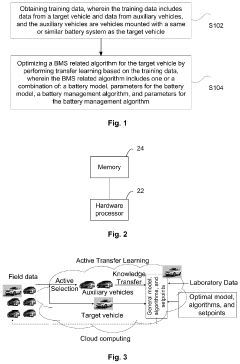
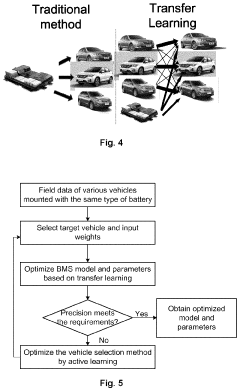
- The method employs transfer learning using training data from target and auxiliary vehicles with similar battery systems, optimizing algorithms through cloud computing and connected vehicle technology to adapt to individual driving and charging patterns, enabling the battery management system to learn from past usage and adapt to novel situations.
Battery management system and method for operating a battery management system
PatentPendingDE102021207048A1
Innovation
- A battery management system utilizing an AI-optimized computing device equipped with a trained neural network to analyze electrical and physical variables from battery cells and modules, enabling precise estimation of cell and battery states, including state of charge, health, and potential faults, and allowing for proactive control strategies.


Safety Standards and Regulations for BMS
Battery Management System safety standards and regulations form a comprehensive framework that governs the design, manufacturing, testing, and deployment of BMS technologies across various applications. These regulatory requirements have evolved significantly as battery technologies have advanced and their applications have expanded from traditional automotive uses to energy storage systems, consumer electronics, and industrial applications.
The International Electrotechnical Commission (IEC) provides foundational standards through IEC 62619 for lithium-ion batteries in industrial applications and IEC 62133 for portable sealed secondary cells. These standards establish fundamental safety requirements including protection against overcharge, over-discharge, short circuits, and thermal runaway conditions. The IEC 61508 functional safety standard also applies to BMS design, requiring systematic approaches to achieve safety integrity levels appropriate for the application's risk profile.
Automotive applications are governed by ISO 26262, which mandates functional safety requirements throughout the vehicle lifecycle. This standard requires BMS designers to implement redundant safety mechanisms, fail-safe operating modes, and comprehensive diagnostic capabilities. The standard categorizes safety requirements based on Automotive Safety Integrity Levels (ASIL), with battery systems typically requiring ASIL C or D compliance depending on their criticality to vehicle operation.
Regional regulatory frameworks add additional compliance layers. The European Union's Battery Regulation (EU) 2023/1542 establishes comprehensive requirements for battery lifecycle management, including sustainability, labeling, and end-of-life considerations. In North America, UL 2580 provides safety standards for electric vehicle battery systems, while UL 1973 covers stationary energy storage applications. These standards mandate specific testing protocols for thermal, electrical, and mechanical safety validation.
Emerging regulations increasingly focus on cybersecurity aspects of BMS design. The ISO/SAE 21434 standard addresses automotive cybersecurity engineering, requiring BMS manufacturers to implement secure communication protocols, authentication mechanisms, and intrusion detection capabilities. This reflects growing concerns about the vulnerability of connected battery systems to cyber threats.
Compliance with these evolving standards requires continuous monitoring of regulatory developments and proactive adaptation of BMS architectures to meet emerging requirements while maintaining performance optimization objectives.
The International Electrotechnical Commission (IEC) provides foundational standards through IEC 62619 for lithium-ion batteries in industrial applications and IEC 62133 for portable sealed secondary cells. These standards establish fundamental safety requirements including protection against overcharge, over-discharge, short circuits, and thermal runaway conditions. The IEC 61508 functional safety standard also applies to BMS design, requiring systematic approaches to achieve safety integrity levels appropriate for the application's risk profile.
Automotive applications are governed by ISO 26262, which mandates functional safety requirements throughout the vehicle lifecycle. This standard requires BMS designers to implement redundant safety mechanisms, fail-safe operating modes, and comprehensive diagnostic capabilities. The standard categorizes safety requirements based on Automotive Safety Integrity Levels (ASIL), with battery systems typically requiring ASIL C or D compliance depending on their criticality to vehicle operation.
Regional regulatory frameworks add additional compliance layers. The European Union's Battery Regulation (EU) 2023/1542 establishes comprehensive requirements for battery lifecycle management, including sustainability, labeling, and end-of-life considerations. In North America, UL 2580 provides safety standards for electric vehicle battery systems, while UL 1973 covers stationary energy storage applications. These standards mandate specific testing protocols for thermal, electrical, and mechanical safety validation.
Emerging regulations increasingly focus on cybersecurity aspects of BMS design. The ISO/SAE 21434 standard addresses automotive cybersecurity engineering, requiring BMS manufacturers to implement secure communication protocols, authentication mechanisms, and intrusion detection capabilities. This reflects growing concerns about the vulnerability of connected battery systems to cyber threats.
Compliance with these evolving standards requires continuous monitoring of regulatory developments and proactive adaptation of BMS architectures to meet emerging requirements while maintaining performance optimization objectives.
Environmental Impact of BMS Performance Optimization
The optimization of Battery Management System performance carries significant environmental implications that extend beyond immediate operational benefits. Enhanced BMS efficiency directly correlates with reduced energy consumption throughout the battery lifecycle, contributing to lower carbon footprint and decreased environmental burden. When BMS algorithms operate at peak efficiency, they minimize energy losses during charging and discharging cycles, resulting in reduced electricity demand from the grid and consequently lower greenhouse gas emissions from power generation.
Improved BMS performance optimization leads to substantial reductions in electronic waste generation. By extending battery lifespan through precise monitoring and control algorithms, optimized systems can increase operational life by 20-30%, effectively reducing the frequency of battery replacements. This extension translates to fewer batteries entering waste streams and decreased demand for raw material extraction, including lithium, cobalt, and rare earth elements that pose significant environmental challenges during mining operations.
The manufacturing impact of BMS optimization presents a complex environmental equation. While advanced BMS components may require more sophisticated manufacturing processes initially, the long-term environmental benefits significantly outweigh these costs. Optimized systems reduce the overall number of battery units needed across applications, leading to decreased manufacturing energy consumption and reduced industrial emissions over the product lifecycle.
Resource conservation represents another critical environmental dimension of BMS performance optimization. Enhanced thermal management and state-of-charge accuracy reduce stress on battery cells, minimizing degradation rates and preserving the chemical integrity of battery materials. This preservation effect reduces the need for frequent battery cycling and replacement, conserving valuable materials and reducing the environmental impact associated with battery production and disposal.
The integration of renewable energy sources benefits substantially from optimized BMS performance. Enhanced systems provide better grid stability and energy storage efficiency, facilitating higher penetration of solar and wind power into energy networks. This improved integration capability accelerates the transition away from fossil fuel dependence, creating cascading environmental benefits across multiple sectors and contributing to global climate change mitigation efforts.
Improved BMS performance optimization leads to substantial reductions in electronic waste generation. By extending battery lifespan through precise monitoring and control algorithms, optimized systems can increase operational life by 20-30%, effectively reducing the frequency of battery replacements. This extension translates to fewer batteries entering waste streams and decreased demand for raw material extraction, including lithium, cobalt, and rare earth elements that pose significant environmental challenges during mining operations.
The manufacturing impact of BMS optimization presents a complex environmental equation. While advanced BMS components may require more sophisticated manufacturing processes initially, the long-term environmental benefits significantly outweigh these costs. Optimized systems reduce the overall number of battery units needed across applications, leading to decreased manufacturing energy consumption and reduced industrial emissions over the product lifecycle.
Resource conservation represents another critical environmental dimension of BMS performance optimization. Enhanced thermal management and state-of-charge accuracy reduce stress on battery cells, minimizing degradation rates and preserving the chemical integrity of battery materials. This preservation effect reduces the need for frequent battery cycling and replacement, conserving valuable materials and reducing the environmental impact associated with battery production and disposal.
The integration of renewable energy sources benefits substantially from optimized BMS performance. Enhanced systems provide better grid stability and energy storage efficiency, facilitating higher penetration of solar and wind power into energy networks. This improved integration capability accelerates the transition away from fossil fuel dependence, creating cascading environmental benefits across multiple sectors and contributing to global climate change mitigation efforts.
Unlock deeper insights with PatSnap Eureka Quick Research — get a full tech report to explore trends and direct your research. Try now!
Generate Your Research Report Instantly with AI Agent
Supercharge your innovation with PatSnap Eureka AI Agent Platform!