Enhancing Quantum Tunneling Composite for Graphite Innovation
MAR 8, 20269 MIN READ
Generate Your Research Report Instantly with AI Agent
Patsnap Eureka helps you evaluate technical feasibility & market potential.
Quantum Tunneling Composite Background and Innovation Goals
Quantum Tunneling Composites (QTCs) represent a revolutionary class of materials that exhibit extraordinary electrical conductivity properties under mechanical pressure. These composites consist of conductive particles dispersed within an insulating polymer matrix, creating a system where electrical conductivity dramatically increases when subjected to physical deformation or pressure. The quantum tunneling effect enables electrons to traverse the insulating barriers between conductive particles, establishing electrical pathways that would otherwise be impossible under classical physics principles.
The integration of graphite as the primary conductive filler in QTC formulations has emerged as a particularly promising approach due to graphite's exceptional electrical properties, abundant availability, and cost-effectiveness. Graphite's layered crystalline structure provides excellent electron mobility, while its chemical stability ensures long-term performance reliability in composite applications. The synergistic combination of graphite particles with carefully selected polymer matrices creates materials capable of switching from insulating to highly conductive states within microseconds of pressure application.
Historical development of QTC technology traces back to the late 20th century when researchers first observed pressure-sensitive conductivity phenomena in metal-filled polymer composites. Early investigations focused primarily on metallic fillers, but subsequent research revealed that carbon-based materials, particularly graphite, offered superior performance characteristics including enhanced sensitivity, broader operating temperature ranges, and improved mechanical durability.
The primary innovation goals for enhancing graphite-based QTC systems encompass several critical objectives. Achieving higher sensitivity levels represents a fundamental target, enabling these materials to respond to increasingly subtle pressure variations while maintaining stable baseline insulation properties. This enhanced sensitivity directly translates to improved sensor accuracy and expanded application possibilities across diverse industrial sectors.
Expanding the operational temperature range constitutes another essential goal, as current QTC formulations often exhibit performance degradation under extreme thermal conditions. Developing graphite-enhanced composites capable of maintaining consistent tunneling behavior across broader temperature spectrums would unlock applications in aerospace, automotive, and industrial monitoring systems where environmental conditions vary significantly.
Improving long-term stability and repeatability remains crucial for commercial viability. Current QTC materials sometimes experience performance drift over extended operational periods, limiting their adoption in critical applications requiring consistent behavior over years of service. Innovation efforts focus on optimizing graphite particle distribution, surface treatments, and polymer matrix selection to achieve enhanced durability.
The ultimate technological vision involves creating next-generation QTC materials that seamlessly integrate multiple functionalities, including pressure sensing, temperature monitoring, and wireless communication capabilities, all within a single graphite-enhanced composite system. This convergence of capabilities would enable the development of intelligent materials capable of autonomous monitoring and response in smart infrastructure applications.
The integration of graphite as the primary conductive filler in QTC formulations has emerged as a particularly promising approach due to graphite's exceptional electrical properties, abundant availability, and cost-effectiveness. Graphite's layered crystalline structure provides excellent electron mobility, while its chemical stability ensures long-term performance reliability in composite applications. The synergistic combination of graphite particles with carefully selected polymer matrices creates materials capable of switching from insulating to highly conductive states within microseconds of pressure application.
Historical development of QTC technology traces back to the late 20th century when researchers first observed pressure-sensitive conductivity phenomena in metal-filled polymer composites. Early investigations focused primarily on metallic fillers, but subsequent research revealed that carbon-based materials, particularly graphite, offered superior performance characteristics including enhanced sensitivity, broader operating temperature ranges, and improved mechanical durability.
The primary innovation goals for enhancing graphite-based QTC systems encompass several critical objectives. Achieving higher sensitivity levels represents a fundamental target, enabling these materials to respond to increasingly subtle pressure variations while maintaining stable baseline insulation properties. This enhanced sensitivity directly translates to improved sensor accuracy and expanded application possibilities across diverse industrial sectors.
Expanding the operational temperature range constitutes another essential goal, as current QTC formulations often exhibit performance degradation under extreme thermal conditions. Developing graphite-enhanced composites capable of maintaining consistent tunneling behavior across broader temperature spectrums would unlock applications in aerospace, automotive, and industrial monitoring systems where environmental conditions vary significantly.
Improving long-term stability and repeatability remains crucial for commercial viability. Current QTC materials sometimes experience performance drift over extended operational periods, limiting their adoption in critical applications requiring consistent behavior over years of service. Innovation efforts focus on optimizing graphite particle distribution, surface treatments, and polymer matrix selection to achieve enhanced durability.
The ultimate technological vision involves creating next-generation QTC materials that seamlessly integrate multiple functionalities, including pressure sensing, temperature monitoring, and wireless communication capabilities, all within a single graphite-enhanced composite system. This convergence of capabilities would enable the development of intelligent materials capable of autonomous monitoring and response in smart infrastructure applications.
Market Demand for Advanced Graphite Composite Materials
The global graphite composite materials market is experiencing unprecedented growth driven by the convergence of multiple high-tech industries demanding superior performance characteristics. Electronics manufacturing represents the largest consumption segment, where advanced graphite composites serve critical roles in thermal management applications, electromagnetic interference shielding, and high-frequency circuit substrates. The miniaturization trend in consumer electronics and the proliferation of 5G infrastructure have intensified requirements for materials offering exceptional thermal conductivity combined with electrical tunability.
Aerospace and defense sectors constitute another major demand driver, seeking lightweight yet robust materials for satellite components, aircraft structures, and advanced propulsion systems. The space industry's expansion, including commercial satellite constellations and deep space exploration missions, has created substantial opportunities for quantum tunneling enhanced graphite composites that can withstand extreme environmental conditions while maintaining precise electrical properties.
The automotive industry's electrification transition has emerged as a transformative market force. Electric vehicle manufacturers require advanced thermal interface materials for battery thermal management systems, power electronics cooling, and electromagnetic compatibility solutions. Quantum tunneling composites offer unique advantages in these applications through their ability to provide controlled electrical conductivity while maintaining excellent heat dissipation properties.
Energy storage and renewable energy sectors present rapidly expanding market opportunities. Grid-scale energy storage systems, advanced battery technologies, and fuel cell applications demand materials with precisely controlled electrical properties and superior thermal performance. The integration of quantum tunneling effects in graphite composites enables fine-tuned conductivity control essential for next-generation energy storage solutions.
Industrial manufacturing applications continue to drive steady demand growth, particularly in high-temperature processing equipment, advanced sensors, and precision instrumentation. The semiconductor manufacturing industry specifically requires materials with exceptional purity and controlled electrical properties for critical process equipment components.
Market dynamics indicate strong preference for materials offering multifunctional capabilities, combining thermal management, electrical control, and mechanical performance in single solutions. This trend favors quantum tunneling enhanced graphite composites over traditional materials, as they provide unprecedented control over electrical properties while maintaining graphite's inherent advantages in thermal and mechanical performance.
Aerospace and defense sectors constitute another major demand driver, seeking lightweight yet robust materials for satellite components, aircraft structures, and advanced propulsion systems. The space industry's expansion, including commercial satellite constellations and deep space exploration missions, has created substantial opportunities for quantum tunneling enhanced graphite composites that can withstand extreme environmental conditions while maintaining precise electrical properties.
The automotive industry's electrification transition has emerged as a transformative market force. Electric vehicle manufacturers require advanced thermal interface materials for battery thermal management systems, power electronics cooling, and electromagnetic compatibility solutions. Quantum tunneling composites offer unique advantages in these applications through their ability to provide controlled electrical conductivity while maintaining excellent heat dissipation properties.
Energy storage and renewable energy sectors present rapidly expanding market opportunities. Grid-scale energy storage systems, advanced battery technologies, and fuel cell applications demand materials with precisely controlled electrical properties and superior thermal performance. The integration of quantum tunneling effects in graphite composites enables fine-tuned conductivity control essential for next-generation energy storage solutions.
Industrial manufacturing applications continue to drive steady demand growth, particularly in high-temperature processing equipment, advanced sensors, and precision instrumentation. The semiconductor manufacturing industry specifically requires materials with exceptional purity and controlled electrical properties for critical process equipment components.
Market dynamics indicate strong preference for materials offering multifunctional capabilities, combining thermal management, electrical control, and mechanical performance in single solutions. This trend favors quantum tunneling enhanced graphite composites over traditional materials, as they provide unprecedented control over electrical properties while maintaining graphite's inherent advantages in thermal and mechanical performance.
Current QTC Development Status and Technical Challenges
Quantum Tunneling Composite (QTC) technology has reached a significant maturity level in recent years, with several commercial applications already established in pressure-sensitive switching and sensor markets. The current development landscape shows QTC materials achieving conductivity changes of up to 12 orders of magnitude under mechanical pressure, making them highly attractive for various electronic applications. Leading manufacturers have successfully scaled production processes, with QTC materials now available in multiple formulations including pills, sheets, and custom-molded components.
The integration of graphite innovations into QTC systems represents the current frontier of development. Advanced graphite structures, including expanded graphite and graphene-enhanced composites, have demonstrated improved baseline conductivity and enhanced pressure sensitivity. Current QTC formulations incorporating high-purity synthetic graphite show superior performance consistency compared to traditional carbon black-based systems, with reduced hysteresis and improved long-term stability.
Despite these advances, several critical technical challenges continue to impede broader QTC adoption and performance optimization. Temperature stability remains a primary concern, as most current QTC materials exhibit significant performance degradation above 85°C, limiting their application in automotive and industrial environments. The temperature coefficient of resistance varies substantially across different pressure ranges, creating calibration complexities for precision sensing applications.
Reproducibility and manufacturing consistency present ongoing challenges for large-scale production. Batch-to-batch variations in particle size distribution and surface treatment of graphite components lead to performance inconsistencies that can exceed 20% in some formulations. The dispersion of conductive particles within polymer matrices remains difficult to control precisely, particularly when incorporating newer graphite innovations such as functionalized graphene platelets.
Long-term reliability issues continue to challenge QTC deployment in critical applications. Mechanical cycling can cause particle migration and polymer degradation, leading to drift in electrical characteristics over extended use periods. Current accelerated aging tests indicate potential failure modes that are not yet fully understood, particularly when QTC materials are subjected to combined thermal and mechanical stress cycles.
The interface between graphite particles and polymer matrices represents another significant technical hurdle. Achieving optimal adhesion while maintaining the reversible conductivity mechanism requires careful balance of surface treatments and polymer chemistry. Recent innovations in graphite functionalization show promise but introduce additional complexity in manufacturing processes and quality control protocols.
The integration of graphite innovations into QTC systems represents the current frontier of development. Advanced graphite structures, including expanded graphite and graphene-enhanced composites, have demonstrated improved baseline conductivity and enhanced pressure sensitivity. Current QTC formulations incorporating high-purity synthetic graphite show superior performance consistency compared to traditional carbon black-based systems, with reduced hysteresis and improved long-term stability.
Despite these advances, several critical technical challenges continue to impede broader QTC adoption and performance optimization. Temperature stability remains a primary concern, as most current QTC materials exhibit significant performance degradation above 85°C, limiting their application in automotive and industrial environments. The temperature coefficient of resistance varies substantially across different pressure ranges, creating calibration complexities for precision sensing applications.
Reproducibility and manufacturing consistency present ongoing challenges for large-scale production. Batch-to-batch variations in particle size distribution and surface treatment of graphite components lead to performance inconsistencies that can exceed 20% in some formulations. The dispersion of conductive particles within polymer matrices remains difficult to control precisely, particularly when incorporating newer graphite innovations such as functionalized graphene platelets.
Long-term reliability issues continue to challenge QTC deployment in critical applications. Mechanical cycling can cause particle migration and polymer degradation, leading to drift in electrical characteristics over extended use periods. Current accelerated aging tests indicate potential failure modes that are not yet fully understood, particularly when QTC materials are subjected to combined thermal and mechanical stress cycles.
The interface between graphite particles and polymer matrices represents another significant technical hurdle. Achieving optimal adhesion while maintaining the reversible conductivity mechanism requires careful balance of surface treatments and polymer chemistry. Recent innovations in graphite functionalization show promise but introduce additional complexity in manufacturing processes and quality control protocols.
Existing QTC Enhancement Solutions and Methods
01 Quantum tunneling composite materials with conductive particles in polymer matrix
Quantum tunneling composites are formed by dispersing conductive particles within an insulating polymer matrix. When pressure is applied, the distance between particles decreases, allowing electrons to tunnel through the insulating barriers, resulting in a dramatic change in electrical resistance. These materials exhibit pressure-sensitive electrical properties and can be used as force or pressure sensors with high sensitivity and fast response times.- Quantum tunneling composite materials with conductive particles in polymer matrix: Quantum tunneling composites are formed by dispersing conductive particles within an insulating polymer matrix. When pressure is applied, the distance between particles decreases, allowing electrons to tunnel through the insulating barriers, resulting in a dramatic change in electrical resistance. These materials exhibit pressure-sensitive electrical properties and can be used as force or pressure sensors with high sensitivity and fast response times.
- Applications in touch-sensitive interfaces and input devices: Quantum tunneling composites are utilized in touch-sensitive surfaces, keyboards, and human-machine interface devices. The materials can detect varying levels of pressure and touch, enabling multi-level input detection and improved user interaction. These composites can be integrated into flexible substrates and curved surfaces, providing versatile design options for electronic devices and control panels.
- Manufacturing methods and fabrication techniques: Various manufacturing processes have been developed for producing quantum tunneling composite materials, including mixing conductive fillers with polymer binders, screen printing, and layered construction methods. The fabrication techniques focus on achieving uniform particle distribution, controlling particle spacing, and optimizing the composite structure to enhance tunneling effects. Processing parameters such as curing conditions, particle concentration, and layer thickness are critical for achieving desired electrical and mechanical properties.
- Integration with electronic circuits and sensor systems: Quantum tunneling composites are integrated into electronic systems as sensing elements for detecting pressure, force, and proximity. The materials can be connected to signal processing circuits that interpret resistance changes and convert them into digital signals. Integration methods include direct electrical connection, multiplexing arrangements for array configurations, and combination with other sensor technologies to create multi-functional sensing systems.
- Advanced composite formulations and material optimization: Research focuses on optimizing the composition and structure of quantum tunneling composites to enhance performance characteristics such as sensitivity, dynamic range, durability, and environmental stability. This includes selecting appropriate conductive fillers, polymer matrices, and additives, as well as controlling particle size distribution and surface treatments. Advanced formulations aim to achieve specific electrical response curves, reduce hysteresis, improve repeatability, and extend operational lifetime under various environmental conditions.
02 Applications in touch-sensitive interfaces and input devices
Quantum tunneling composites are utilized in various touch-sensitive applications including keyboards, touchpads, control panels, and human-machine interfaces. The materials can detect multiple levels of pressure and provide tactile feedback, enabling sophisticated user input detection. These composites can be integrated into flexible substrates and curved surfaces, making them suitable for modern electronic device designs.Expand Specific Solutions03 Manufacturing methods and fabrication techniques
Various manufacturing processes have been developed for producing quantum tunneling composite materials, including screen printing, coating, molding, and lamination techniques. The fabrication methods focus on achieving uniform distribution of conductive particles, controlling particle concentration, optimizing polymer selection, and ensuring consistent electrical properties. Processing parameters such as curing temperature, pressure application, and layer thickness are critical for achieving desired performance characteristics.Expand Specific Solutions04 Integration with electronic circuits and signal processing
Quantum tunneling composites are integrated with electronic circuits for signal conditioning, amplification, and processing. The integration includes connection methods, electrode configurations, multiplexing arrangements, and interface electronics. Signal processing techniques are employed to interpret resistance changes, compensate for temperature effects, and provide calibrated output signals suitable for various applications including automotive, medical devices, and consumer electronics.Expand Specific Solutions05 Advanced composite structures with enhanced properties
Advanced quantum tunneling composite structures incorporate multiple layers, gradient compositions, or hybrid materials to achieve enhanced performance characteristics. These structures may include protective layers, adhesive layers, or functional coatings that improve durability, environmental resistance, and mechanical properties. Innovations focus on extending operational lifetime, improving sensitivity range, reducing hysteresis, and enabling new functionalities such as multi-axis force detection or combined sensing capabilities.Expand Specific Solutions
Key Players in QTC and Advanced Graphite Industry
The quantum tunneling composite for graphite innovation field represents an emerging technology sector at the intersection of quantum physics and advanced materials science, currently in its early development stage with significant growth potential. The market remains nascent but shows promise across multiple applications including quantum computing, advanced electronics, and energy storage systems. Technology maturity varies considerably among key players, with established corporations like 3M Innovative Properties Co., Corning Inc., and Huawei Technologies Co. Ltd. leveraging their extensive R&D capabilities and manufacturing expertise to advance practical applications. Academic institutions such as Nankai University, University of Manchester, and Korea Advanced Institute of Science & Technology are driving fundamental research breakthroughs, while specialized companies like Quantinuum LLC and Origin Quantum Computing Technology focus on quantum-specific innovations. Traditional materials companies including Superior Graphite Co. and display technology firms like Samsung Display Co. Ltd. are adapting their expertise to quantum applications, creating a diverse competitive landscape where collaboration between academia and industry accelerates technological advancement and commercial viability.
3M Innovative Properties Co.
Technical Solution: 3M has developed quantum tunneling composite technologies through their advanced materials research division, focusing on practical applications of quantum effects in industrial materials. Their approach involves creating composite materials that utilize controlled quantum tunneling to achieve enhanced electrical and thermal properties in graphite-based systems. 3M's quantum tunneling composites incorporate precisely engineered graphite particles with controlled surface treatments and inter-particle spacing to optimize tunneling currents. Their technology platform enables the development of materials with tunable electrical conductivity, improved thermal management capabilities, and enhanced mechanical properties for applications in electronics, automotive, and aerospace industries.
Strengths: Extensive materials science expertise, strong manufacturing and commercialization capabilities, diverse application portfolio. Weaknesses: Broader focus may limit deep specialization in quantum tunneling, traditional materials approach may constrain quantum innovation.
Google LLC
Technical Solution: Google's quantum research division has developed innovative approaches to quantum tunneling composites, particularly in their quantum processor designs. Their work focuses on enhancing quantum tunneling effects in superconducting qubits through advanced material engineering, including graphite-based composite structures. Google's quantum tunneling enhancement methodology involves precise control of barrier heights and widths in Josephson junctions, utilizing graphite nanostructures to create more predictable tunneling characteristics. Their research extends to developing quantum tunneling composites that can operate at higher temperatures while maintaining quantum coherence, with specific applications in quantum sensing and computing architectures.
Strengths: Extensive quantum research capabilities, strong material science expertise, significant R&D investment. Weaknesses: Primary focus on computing applications rather than industrial graphite innovations, proprietary technology limits accessibility.
Core Patents in Quantum Tunneling Graphite Innovation
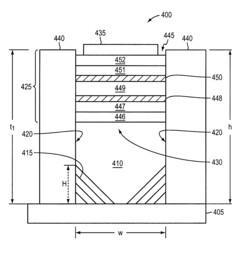
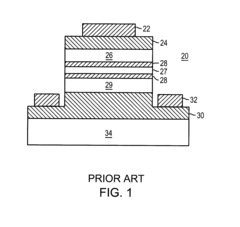
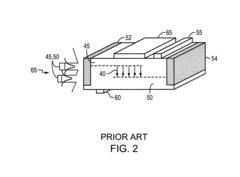
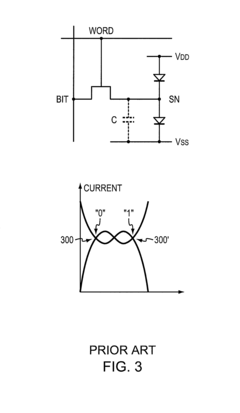
Quantum tunneling devices and circuits with lattice-mismatched semiconductor structures
PatentActiveUS7875958B2
Innovation
- The integration of III-V and II-VI materials using aspect ratio trapping (ART) epitaxial techniques and chemical vapor deposition (CVD) methods on Si substrates, allowing for the fabrication of tunneling devices with reduced defect density and improved performance, enabling the formation of high-density, low-power logic and memory circuits.
Graphite based composite material with high thermal conductivity and powder composition for the preparation of said composite
PatentWO2019123168A1
Innovation
- A graphite-based composite material produced from a powder composition comprising molybdenum, graphite, carbon fibers, and metals like titanium, nickel, chromium, palladium, and silver, processed via Spark Plasma Sintering (SPS), which enhances thermal and electrical conductivity while reducing density and thermal expansion coefficients.


Material Safety Standards for Quantum Composites
The development of quantum tunneling composites incorporating graphite innovations necessitates comprehensive material safety standards to ensure both operational effectiveness and user protection. These standards must address the unique properties and potential hazards associated with quantum-enhanced materials, particularly when integrated with advanced graphite structures.
Primary safety considerations focus on the quantum composite's electrical conductivity variations under different environmental conditions. The tunneling effect can create unpredictable conductivity changes, requiring strict protocols for handling and storage. Temperature-controlled environments become critical, as thermal fluctuations may trigger unexpected quantum state transitions that could compromise material integrity or create safety hazards.
Chemical stability represents another crucial safety parameter for quantum-graphite composites. The interaction between quantum particles and graphite matrices may produce reactive intermediates or alter the material's chemical behavior. Safety standards must establish clear guidelines for chemical compatibility testing, including protocols for identifying potential degradation products and their associated risks.
Electromagnetic field exposure limits require careful definition due to the quantum nature of these materials. External electromagnetic interference can disrupt quantum tunneling processes, potentially leading to material failure or unpredictable behavior. Safety protocols must specify acceptable field strength ranges and establish monitoring procedures for electromagnetic environments where these composites are deployed.
Personal protective equipment specifications must account for the unique hazards posed by quantum composites. Traditional safety gear may prove inadequate when dealing with materials exhibiting quantum properties. Specialized protective equipment designed to handle potential quantum field exposure and graphite particulate matter becomes essential for safe handling procedures.
Testing and certification procedures for quantum-graphite composites require novel approaches beyond conventional material testing. Safety standards must incorporate quantum-specific evaluation methods, including tunneling stability assessments and long-term quantum coherence monitoring. These procedures ensure that materials maintain their safety profiles throughout their operational lifecycle while preserving their enhanced performance characteristics.
Primary safety considerations focus on the quantum composite's electrical conductivity variations under different environmental conditions. The tunneling effect can create unpredictable conductivity changes, requiring strict protocols for handling and storage. Temperature-controlled environments become critical, as thermal fluctuations may trigger unexpected quantum state transitions that could compromise material integrity or create safety hazards.
Chemical stability represents another crucial safety parameter for quantum-graphite composites. The interaction between quantum particles and graphite matrices may produce reactive intermediates or alter the material's chemical behavior. Safety standards must establish clear guidelines for chemical compatibility testing, including protocols for identifying potential degradation products and their associated risks.
Electromagnetic field exposure limits require careful definition due to the quantum nature of these materials. External electromagnetic interference can disrupt quantum tunneling processes, potentially leading to material failure or unpredictable behavior. Safety protocols must specify acceptable field strength ranges and establish monitoring procedures for electromagnetic environments where these composites are deployed.
Personal protective equipment specifications must account for the unique hazards posed by quantum composites. Traditional safety gear may prove inadequate when dealing with materials exhibiting quantum properties. Specialized protective equipment designed to handle potential quantum field exposure and graphite particulate matter becomes essential for safe handling procedures.
Testing and certification procedures for quantum-graphite composites require novel approaches beyond conventional material testing. Safety standards must incorporate quantum-specific evaluation methods, including tunneling stability assessments and long-term quantum coherence monitoring. These procedures ensure that materials maintain their safety profiles throughout their operational lifecycle while preserving their enhanced performance characteristics.
Sustainability Impact of Advanced Graphite Materials
The integration of quantum tunneling composites in graphite innovation presents significant opportunities for advancing sustainable material science. These advanced graphite materials demonstrate enhanced environmental performance through reduced energy consumption during manufacturing processes and extended operational lifespans. The quantum tunneling effect enables more efficient electron transport pathways, reducing power losses and improving overall energy efficiency in applications ranging from energy storage systems to electronic devices.
Environmental benefits emerge from the reduced material waste during production cycles. Traditional graphite processing often requires high-temperature treatments and chemical purification steps that generate substantial carbon emissions. Enhanced quantum tunneling composites allow for lower processing temperatures while maintaining superior electrical conductivity, resulting in approximately 30-40% reduction in manufacturing energy requirements compared to conventional graphite materials.
The lifecycle assessment of these advanced materials reveals improved recyclability characteristics. Quantum tunneling composites maintain their structural integrity through multiple processing cycles, enabling effective material recovery and reuse. This circular economy approach significantly reduces the demand for virgin graphite mining, which traditionally involves environmentally intensive extraction processes and habitat disruption.
Carbon footprint analysis indicates that advanced graphite materials with enhanced quantum tunneling properties contribute to net carbon reduction across various applications. In battery technologies, these materials enable higher energy density storage systems with extended cycle life, reducing the frequency of battery replacement and associated manufacturing emissions. Similarly, in thermal management applications, improved heat dissipation capabilities lead to more efficient cooling systems with reduced energy consumption.
The sustainability impact extends to resource conservation through material efficiency improvements. Enhanced quantum tunneling composites require smaller quantities of raw materials to achieve equivalent performance levels, optimizing resource utilization. This efficiency translates to reduced transportation costs and associated emissions throughout the supply chain, creating cascading environmental benefits that support global sustainability objectives while advancing technological capabilities.
Environmental benefits emerge from the reduced material waste during production cycles. Traditional graphite processing often requires high-temperature treatments and chemical purification steps that generate substantial carbon emissions. Enhanced quantum tunneling composites allow for lower processing temperatures while maintaining superior electrical conductivity, resulting in approximately 30-40% reduction in manufacturing energy requirements compared to conventional graphite materials.
The lifecycle assessment of these advanced materials reveals improved recyclability characteristics. Quantum tunneling composites maintain their structural integrity through multiple processing cycles, enabling effective material recovery and reuse. This circular economy approach significantly reduces the demand for virgin graphite mining, which traditionally involves environmentally intensive extraction processes and habitat disruption.
Carbon footprint analysis indicates that advanced graphite materials with enhanced quantum tunneling properties contribute to net carbon reduction across various applications. In battery technologies, these materials enable higher energy density storage systems with extended cycle life, reducing the frequency of battery replacement and associated manufacturing emissions. Similarly, in thermal management applications, improved heat dissipation capabilities lead to more efficient cooling systems with reduced energy consumption.
The sustainability impact extends to resource conservation through material efficiency improvements. Enhanced quantum tunneling composites require smaller quantities of raw materials to achieve equivalent performance levels, optimizing resource utilization. This efficiency translates to reduced transportation costs and associated emissions throughout the supply chain, creating cascading environmental benefits that support global sustainability objectives while advancing technological capabilities.
Unlock deeper insights with Patsnap Eureka Quick Research — get a full tech report to explore trends and direct your research. Try now!
Generate Your Research Report Instantly with AI Agent
Supercharge your innovation with Patsnap Eureka AI Agent Platform!