

Entanglement in Quantum Encryption: Enhanced Security
APR 28, 20269 MIN READ
Generate Your Research Report Instantly with AI Agent
PatSnap Eureka helps you evaluate technical feasibility & market potential.
Quantum Entanglement Encryption Background and Objectives
Quantum entanglement represents one of the most profound phenomena in quantum mechanics, where particles become intrinsically correlated in ways that classical physics cannot explain. When two or more particles are entangled, measuring one particle instantaneously affects the state of its partner, regardless of the distance separating them. This "spooky action at a distance," as Einstein famously described it, has evolved from a theoretical curiosity into a cornerstone technology for next-generation cryptographic systems.
The historical development of quantum entanglement encryption traces back to the 1970s when Stephen Wiesner first proposed quantum money concepts, followed by Charles Bennett and Gilles Brassard's groundbreaking BB84 protocol in 1984. However, the integration of entanglement into practical encryption systems gained momentum in the 1990s with Artur Ekert's E91 protocol, which demonstrated how entangled particles could enable unconditionally secure key distribution.
Traditional cryptographic methods rely on computational complexity, making them vulnerable to advances in computing power, particularly the looming threat of quantum computers capable of breaking RSA and elliptic curve cryptography. Quantum entanglement encryption addresses this fundamental vulnerability by leveraging the laws of physics rather than mathematical assumptions, offering information-theoretic security that remains unbreakable even against quantum adversaries.
The primary objective of quantum entanglement encryption is to establish provably secure communication channels that detect any eavesdropping attempts through quantum mechanical principles. When an unauthorized party intercepts entangled photons, the measurement process inevitably disturbs the quantum states, creating detectable anomalies in the correlation patterns between communicating parties.
Current technological evolution aims to overcome practical limitations including photon loss, decoherence, and transmission distance constraints. Advanced objectives encompass developing satellite-based quantum networks, room-temperature quantum devices, and integration with existing telecommunications infrastructure. The ultimate goal involves creating a global quantum internet where entanglement-based encryption becomes the standard for securing critical communications across government, financial, and healthcare sectors.
These developments position quantum entanglement encryption as a transformative technology capable of revolutionizing cybersecurity paradigms, ensuring long-term protection against both classical and quantum computational threats while establishing the foundation for future quantum communication networks.
The historical development of quantum entanglement encryption traces back to the 1970s when Stephen Wiesner first proposed quantum money concepts, followed by Charles Bennett and Gilles Brassard's groundbreaking BB84 protocol in 1984. However, the integration of entanglement into practical encryption systems gained momentum in the 1990s with Artur Ekert's E91 protocol, which demonstrated how entangled particles could enable unconditionally secure key distribution.
Traditional cryptographic methods rely on computational complexity, making them vulnerable to advances in computing power, particularly the looming threat of quantum computers capable of breaking RSA and elliptic curve cryptography. Quantum entanglement encryption addresses this fundamental vulnerability by leveraging the laws of physics rather than mathematical assumptions, offering information-theoretic security that remains unbreakable even against quantum adversaries.
The primary objective of quantum entanglement encryption is to establish provably secure communication channels that detect any eavesdropping attempts through quantum mechanical principles. When an unauthorized party intercepts entangled photons, the measurement process inevitably disturbs the quantum states, creating detectable anomalies in the correlation patterns between communicating parties.
Current technological evolution aims to overcome practical limitations including photon loss, decoherence, and transmission distance constraints. Advanced objectives encompass developing satellite-based quantum networks, room-temperature quantum devices, and integration with existing telecommunications infrastructure. The ultimate goal involves creating a global quantum internet where entanglement-based encryption becomes the standard for securing critical communications across government, financial, and healthcare sectors.
These developments position quantum entanglement encryption as a transformative technology capable of revolutionizing cybersecurity paradigms, ensuring long-term protection against both classical and quantum computational threats while establishing the foundation for future quantum communication networks.
Market Demand for Quantum-Enhanced Security Solutions
The global cybersecurity market is experiencing unprecedented demand for quantum-enhanced security solutions, driven by the escalating sophistication of cyber threats and the looming quantum computing threat to classical encryption methods. Organizations across critical infrastructure sectors, including financial services, healthcare, government, and telecommunications, are actively seeking advanced security technologies that can withstand both current and future attack vectors.
Financial institutions represent the largest segment of early adopters, as they handle sensitive transaction data and face regulatory requirements for robust data protection. Major banks and payment processors are investing heavily in quantum-resistant security infrastructure to protect against potential quantum computer attacks that could compromise RSA and elliptic curve cryptography within the next decade.
Government and defense sectors constitute another significant market segment, with national security agencies recognizing quantum encryption as essential for protecting classified communications and critical infrastructure. The increasing geopolitical tensions and state-sponsored cyber warfare activities have accelerated government procurement of quantum-enhanced security solutions.
The healthcare industry is emerging as a rapidly growing market segment, particularly following increased digitization and telemedicine adoption. Medical institutions require quantum-level security to protect patient data, research information, and medical device communications from sophisticated attacks that could compromise patient safety and privacy.
Telecommunications companies are driving demand for quantum key distribution networks and quantum-secured communication channels. As 5G and future 6G networks expand, telecom operators need quantum-enhanced security to protect network infrastructure and customer communications from advanced persistent threats.
Enterprise demand is expanding beyond traditional high-security sectors, with manufacturing, energy, and technology companies recognizing the strategic importance of quantum-resistant security. Supply chain vulnerabilities and industrial espionage concerns are motivating broader adoption across various industries.
The market demand is further amplified by regulatory pressures and compliance requirements. Government agencies worldwide are developing quantum-readiness standards and mandating quantum-resistant cryptography adoption timelines, creating a compliance-driven market pull that extends beyond voluntary security upgrades.
Financial institutions represent the largest segment of early adopters, as they handle sensitive transaction data and face regulatory requirements for robust data protection. Major banks and payment processors are investing heavily in quantum-resistant security infrastructure to protect against potential quantum computer attacks that could compromise RSA and elliptic curve cryptography within the next decade.
Government and defense sectors constitute another significant market segment, with national security agencies recognizing quantum encryption as essential for protecting classified communications and critical infrastructure. The increasing geopolitical tensions and state-sponsored cyber warfare activities have accelerated government procurement of quantum-enhanced security solutions.
The healthcare industry is emerging as a rapidly growing market segment, particularly following increased digitization and telemedicine adoption. Medical institutions require quantum-level security to protect patient data, research information, and medical device communications from sophisticated attacks that could compromise patient safety and privacy.
Telecommunications companies are driving demand for quantum key distribution networks and quantum-secured communication channels. As 5G and future 6G networks expand, telecom operators need quantum-enhanced security to protect network infrastructure and customer communications from advanced persistent threats.
Enterprise demand is expanding beyond traditional high-security sectors, with manufacturing, energy, and technology companies recognizing the strategic importance of quantum-resistant security. Supply chain vulnerabilities and industrial espionage concerns are motivating broader adoption across various industries.
The market demand is further amplified by regulatory pressures and compliance requirements. Government agencies worldwide are developing quantum-readiness standards and mandating quantum-resistant cryptography adoption timelines, creating a compliance-driven market pull that extends beyond voluntary security upgrades.
Current State and Challenges of Quantum Encryption
Quantum encryption technology has reached a pivotal stage where theoretical foundations are increasingly being translated into practical implementations. Current quantum key distribution (QKD) systems primarily rely on protocols such as BB84, SARG04, and continuous-variable approaches, with commercial systems achieving transmission distances of up to 500 kilometers through optical fibers. Major telecommunications companies and research institutions have deployed QKD networks in metropolitan areas across China, Europe, and North America, demonstrating the technology's growing maturity.
The integration of quantum entanglement into encryption systems represents the cutting edge of current development efforts. Entanglement-based QKD protocols, including E91 and BBM92, offer theoretical advantages in security verification and eavesdropping detection compared to prepare-and-measure schemes. However, the practical implementation of entangled photon sources remains technically demanding, requiring sophisticated equipment for photon pair generation, distribution, and measurement.
Contemporary quantum encryption systems face significant technical barriers that limit widespread adoption. Photon loss during transmission severely constrains communication range, with typical systems experiencing exponential signal degradation over distance. Environmental factors such as temperature fluctuations, vibrations, and electromagnetic interference introduce noise that compromises key generation rates and system stability. Current entanglement sources suffer from low generation efficiency and limited coherence times, making real-time encryption applications challenging.
The scalability challenge represents another critical limitation in current quantum encryption deployment. Existing point-to-point QKD systems struggle to support multi-user networks efficiently, as quantum signals cannot be amplified or copied without destroying their quantum properties. Network topology constraints require complex trusted node architectures that potentially introduce security vulnerabilities and increase system complexity.
Cost barriers significantly impede commercial adoption of quantum encryption technologies. Current systems require expensive specialized hardware including single-photon detectors, laser sources, and precision optical components that operate under controlled environmental conditions. The need for dedicated fiber infrastructure or free-space optical links adds substantial deployment costs compared to classical encryption methods.
Security gaps between theoretical quantum encryption protocols and practical implementations create additional challenges. Real-world systems exhibit imperfections in photon sources, detectors, and measurement devices that can be exploited by sophisticated adversaries. Side-channel attacks targeting classical components of quantum systems have demonstrated vulnerabilities that compromise the theoretical security guarantees of quantum protocols.
Despite these challenges, recent technological advances show promising directions for overcoming current limitations. Developments in quantum repeaters, satellite-based quantum communication, and integrated photonic devices are addressing range and scalability issues. Improved entanglement sources based on quantum dots and nonlinear crystals are enhancing generation efficiency and stability, bringing entanglement-enhanced quantum encryption closer to practical viability.
The integration of quantum entanglement into encryption systems represents the cutting edge of current development efforts. Entanglement-based QKD protocols, including E91 and BBM92, offer theoretical advantages in security verification and eavesdropping detection compared to prepare-and-measure schemes. However, the practical implementation of entangled photon sources remains technically demanding, requiring sophisticated equipment for photon pair generation, distribution, and measurement.
Contemporary quantum encryption systems face significant technical barriers that limit widespread adoption. Photon loss during transmission severely constrains communication range, with typical systems experiencing exponential signal degradation over distance. Environmental factors such as temperature fluctuations, vibrations, and electromagnetic interference introduce noise that compromises key generation rates and system stability. Current entanglement sources suffer from low generation efficiency and limited coherence times, making real-time encryption applications challenging.
The scalability challenge represents another critical limitation in current quantum encryption deployment. Existing point-to-point QKD systems struggle to support multi-user networks efficiently, as quantum signals cannot be amplified or copied without destroying their quantum properties. Network topology constraints require complex trusted node architectures that potentially introduce security vulnerabilities and increase system complexity.
Cost barriers significantly impede commercial adoption of quantum encryption technologies. Current systems require expensive specialized hardware including single-photon detectors, laser sources, and precision optical components that operate under controlled environmental conditions. The need for dedicated fiber infrastructure or free-space optical links adds substantial deployment costs compared to classical encryption methods.
Security gaps between theoretical quantum encryption protocols and practical implementations create additional challenges. Real-world systems exhibit imperfections in photon sources, detectors, and measurement devices that can be exploited by sophisticated adversaries. Side-channel attacks targeting classical components of quantum systems have demonstrated vulnerabilities that compromise the theoretical security guarantees of quantum protocols.
Despite these challenges, recent technological advances show promising directions for overcoming current limitations. Developments in quantum repeaters, satellite-based quantum communication, and integrated photonic devices are addressing range and scalability issues. Improved entanglement sources based on quantum dots and nonlinear crystals are enhancing generation efficiency and stability, bringing entanglement-enhanced quantum encryption closer to practical viability.
Existing Quantum Entanglement Encryption Solutions
01 Quantum key distribution protocols and methods
Advanced protocols for secure quantum key distribution that enable parties to establish cryptographic keys with information-theoretic security. These methods utilize quantum mechanical properties to detect eavesdropping attempts and ensure the integrity of key exchange processes in quantum communication systems.- Quantum key distribution protocols and methods: Advanced protocols for secure quantum key distribution that enable parties to establish cryptographic keys with information-theoretic security. These methods utilize quantum mechanical properties to detect eavesdropping attempts and ensure the integrity of key exchange processes through various quantum communication channels.
- Quantum-resistant cryptographic algorithms: Development of cryptographic algorithms designed to withstand attacks from quantum computers. These post-quantum cryptographic methods include lattice-based, hash-based, and multivariate cryptographic schemes that maintain security even when adversaries have access to quantum computing capabilities.
- Quantum random number generation for encryption: Systems and methods for generating truly random numbers using quantum phenomena to enhance cryptographic security. These quantum random number generators exploit quantum uncertainty principles to produce unpredictable sequences that serve as the foundation for secure encryption keys and cryptographic operations.
- Quantum authentication and digital signature schemes: Quantum-based authentication protocols and digital signature mechanisms that provide unforgeable verification of identity and message integrity. These schemes leverage quantum properties to create authentication tokens and signatures that cannot be duplicated or forged using classical or quantum computational methods.
- Hybrid quantum-classical security frameworks: Integrated security architectures that combine quantum cryptographic techniques with classical encryption methods to provide comprehensive protection. These hybrid approaches offer practical implementations that bridge current classical systems with emerging quantum technologies while maintaining backward compatibility and enhanced security levels.
02 Quantum-resistant cryptographic algorithms
Development of cryptographic algorithms designed to withstand attacks from quantum computers. These post-quantum cryptographic methods provide security against both classical and quantum computational threats, ensuring long-term protection of encrypted data and communications.Expand Specific Solutions03 Quantum random number generation for encryption
Systems and methods for generating truly random numbers using quantum phenomena to enhance cryptographic security. These quantum-based random number generators provide high-quality entropy sources essential for secure key generation and cryptographic operations.Expand Specific Solutions04 Quantum authentication and digital signatures
Quantum-based authentication mechanisms and digital signature schemes that leverage quantum properties to provide unforgeable authentication. These systems ensure message integrity and sender verification with quantum-enhanced security guarantees.Expand Specific Solutions05 Quantum network security infrastructure
Infrastructure and protocols for securing quantum communication networks, including quantum repeaters, network topology optimization, and multi-party quantum communication systems. These solutions address the practical implementation challenges of large-scale quantum secure communication networks.Expand Specific Solutions
Key Players in Quantum Encryption Industry
The quantum encryption entanglement technology sector is experiencing rapid evolution, transitioning from experimental research to practical implementation phases. The market demonstrates significant growth potential, driven by increasing cybersecurity demands and government investments in quantum infrastructure. Technology maturity varies considerably across players, with established telecommunications giants like AT&T, Deutsche Telekom, and China Telecom leading commercial deployment efforts, while specialized quantum companies such as IQM Finland and levelQuantum focus on advanced hardware and security solutions. Academic institutions including Technische Universität München, Beijing University of Posts & Telecommunications, and Stevens Institute of Technology contribute foundational research, creating a robust innovation pipeline. Technology companies like Huawei, Sony, and Baidu are integrating quantum capabilities into broader portfolios, while financial institutions such as Bank of America and Wells Fargo explore quantum-secured transaction systems, indicating strong cross-industry adoption momentum.
Huawei Technologies Canada Co. Ltd.
Technical Solution: Huawei has developed comprehensive quantum encryption solutions leveraging quantum entanglement for enhanced security protocols. Their approach focuses on quantum key distribution (QKD) systems that utilize entangled photon pairs to establish unconditionally secure communication channels. The company has implemented entanglement-based protocols that can detect any eavesdropping attempts through quantum state collapse, ensuring information-theoretic security. Their quantum encryption framework integrates with existing telecommunications infrastructure, enabling practical deployment of quantum-secured networks across metropolitan and long-distance communications.
Strengths: Strong integration with telecom infrastructure, practical deployment capabilities, extensive R&D resources. Weaknesses: Limited by current quantum hardware constraints, high implementation costs for widespread adoption.
China Telecom Corp. Ltd.
Technical Solution: China Telecom has pioneered large-scale quantum communication networks utilizing entanglement-based encryption for national security applications. Their quantum backbone network employs entangled photon distribution across fiber optic infrastructure, creating secure communication channels between major cities. The company's approach combines satellite-based quantum entanglement distribution with terrestrial fiber networks, enabling quantum-secured communications over thousands of kilometers. Their system implements continuous variable quantum key distribution protocols that leverage the non-local correlations of entangled states to guarantee detection of any interception attempts.
Strengths: Large-scale network deployment experience, government backing for quantum initiatives, extensive fiber infrastructure. Weaknesses: Technology primarily focused on domestic applications, limited international collaboration opportunities.
Core Innovations in Entanglement-Based Security
The One-Qubit Pad (OQP) for entanglement encryption of quantum information
PatentInactiveUS20210058244A1
Innovation
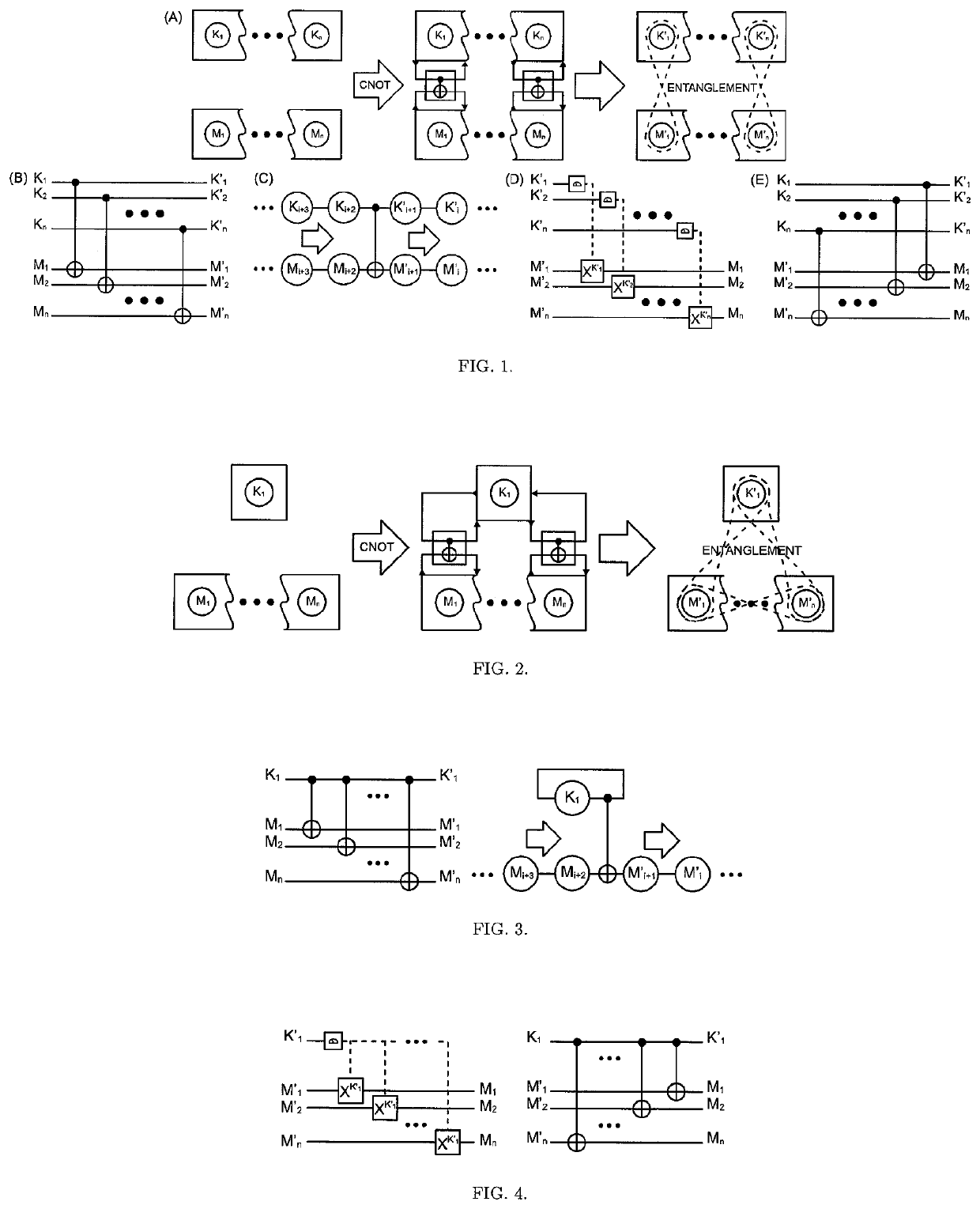
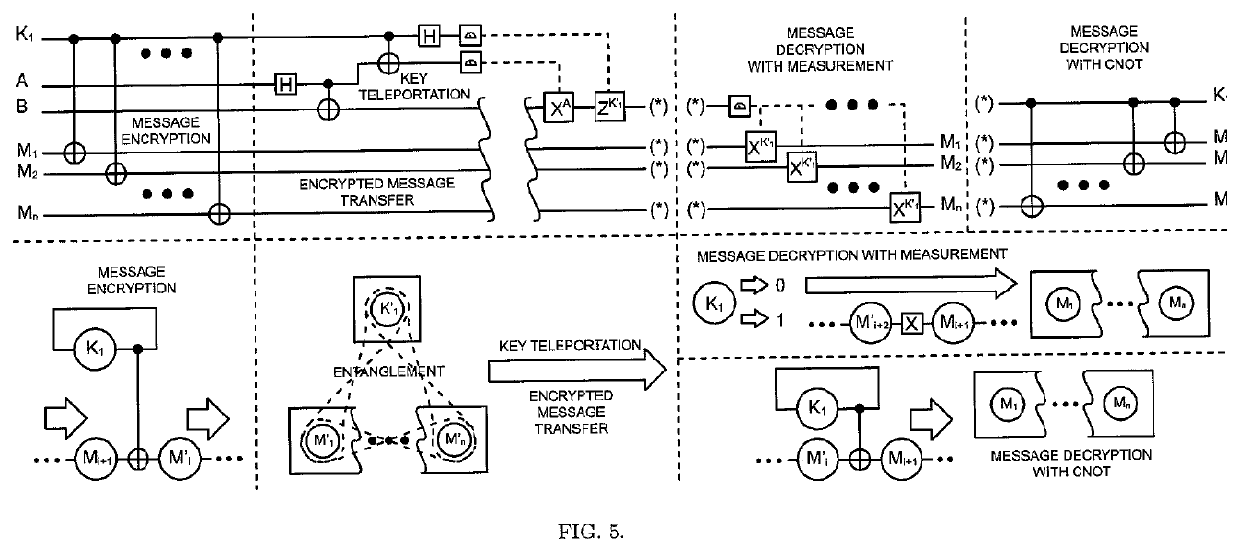
- The One-Qubit Pad (OQP) protocol uses a single qubit key in unknown quantum superposition, employing multi-qubit entanglement through iterative CNOT operations to encrypt n qubits of quantum information, ensuring that without the key qubit, the original information cannot be extracted, leveraging the no-cloning theorem for absolute security.
Method for remote generation of two arbitrary-length identical random cryptographic keys with the device-independent security using entangled multiphoton sources of quantum light
PatentActiveUS20250112766A1
Innovation
- A method for generating a shared cryptographic key using two quantum sources of light with device-independent security, employing multiphoton entanglement and additional coherent light beams for fine-tuning and compensating for phase fluctuations, allowing for robust key generation even in high-loss environments.


Quantum Technology Regulatory Framework
The regulatory landscape for quantum encryption technologies utilizing entanglement presents a complex framework that spans multiple jurisdictions and technical domains. Current regulatory approaches primarily focus on export controls, national security implications, and standardization efforts rather than comprehensive governance structures specifically designed for quantum entanglement applications.
Export control regulations represent the most established regulatory mechanism affecting quantum encryption development. The United States maintains strict controls through the Export Administration Regulations, classifying quantum cryptographic systems as dual-use technologies. Similar restrictions exist in European Union member states and other developed nations, creating a patchwork of compliance requirements that significantly impact international collaboration and technology transfer in entanglement-based security systems.
National security frameworks increasingly recognize quantum encryption as critical infrastructure requiring protection and oversight. The U.S. National Quantum Initiative Act and similar legislation in China, Canada, and the European Union establish governmental oversight mechanisms for quantum technology development. These frameworks often include provisions for research funding, security clearance requirements, and mandatory disclosure of certain quantum encryption capabilities to relevant authorities.
Standardization bodies play a crucial role in establishing technical and operational guidelines for quantum encryption systems. The International Organization for Standardization and the National Institute of Standards and Technology are developing standards for quantum key distribution protocols, including those utilizing entanglement. These standards address technical specifications, security requirements, and interoperability guidelines that effectively function as regulatory requirements for commercial implementations.
Privacy and data protection regulations present additional compliance challenges for entanglement-based encryption systems. The General Data Protection Regulation and similar frameworks require specific technical and organizational measures for data protection, which quantum encryption systems must accommodate while maintaining their quantum mechanical properties.
The regulatory environment continues evolving rapidly as governments recognize both the transformative potential and security implications of quantum encryption technologies. Future regulatory developments will likely address certification processes, operational security requirements, and international cooperation frameworks specifically tailored to quantum entanglement applications in cryptographic systems.
Export control regulations represent the most established regulatory mechanism affecting quantum encryption development. The United States maintains strict controls through the Export Administration Regulations, classifying quantum cryptographic systems as dual-use technologies. Similar restrictions exist in European Union member states and other developed nations, creating a patchwork of compliance requirements that significantly impact international collaboration and technology transfer in entanglement-based security systems.
National security frameworks increasingly recognize quantum encryption as critical infrastructure requiring protection and oversight. The U.S. National Quantum Initiative Act and similar legislation in China, Canada, and the European Union establish governmental oversight mechanisms for quantum technology development. These frameworks often include provisions for research funding, security clearance requirements, and mandatory disclosure of certain quantum encryption capabilities to relevant authorities.
Standardization bodies play a crucial role in establishing technical and operational guidelines for quantum encryption systems. The International Organization for Standardization and the National Institute of Standards and Technology are developing standards for quantum key distribution protocols, including those utilizing entanglement. These standards address technical specifications, security requirements, and interoperability guidelines that effectively function as regulatory requirements for commercial implementations.
Privacy and data protection regulations present additional compliance challenges for entanglement-based encryption systems. The General Data Protection Regulation and similar frameworks require specific technical and organizational measures for data protection, which quantum encryption systems must accommodate while maintaining their quantum mechanical properties.
The regulatory environment continues evolving rapidly as governments recognize both the transformative potential and security implications of quantum encryption technologies. Future regulatory developments will likely address certification processes, operational security requirements, and international cooperation frameworks specifically tailored to quantum entanglement applications in cryptographic systems.
National Security Implications of Quantum Encryption
Quantum encryption technologies, particularly those leveraging quantum entanglement, represent a paradigm shift in national security infrastructure that demands comprehensive strategic evaluation. The deployment of entanglement-based quantum key distribution systems creates unprecedented implications for governmental communications, intelligence operations, and critical infrastructure protection across multiple security domains.
The strategic advantage of quantum entanglement in encryption lies in its fundamental ability to detect any interception attempts, providing governments with theoretically unbreachable communication channels. This capability transforms diplomatic communications, military command structures, and intelligence sharing protocols by establishing communication networks that can guarantee message integrity and confidentiality at the quantum level.
National defense applications of entanglement-based quantum encryption extend beyond traditional communication security to encompass critical infrastructure protection. Power grids, financial networks, transportation systems, and healthcare databases protected by quantum encryption become virtually immune to conventional cyber warfare tactics, fundamentally altering the landscape of national vulnerability assessment and defense planning.
The geopolitical implications of quantum encryption deployment create new dimensions of international competition and cooperation. Nations achieving quantum encryption superiority gain significant intelligence advantages while simultaneously becoming targets for quantum computing development aimed at breaking traditional encryption methods. This technological race influences diplomatic relationships, trade agreements, and international security partnerships.
Intelligence agencies face transformative operational changes as quantum encryption adoption spreads globally. Traditional signals intelligence methods become obsolete against quantum-protected communications, necessitating entirely new approaches to information gathering and analysis. Simultaneously, these agencies must protect their own communications using quantum technologies to maintain operational security.
Economic security considerations encompass both protective and competitive aspects of quantum encryption implementation. While quantum-secured financial systems and trade communications enhance economic stability, the substantial investment required for quantum infrastructure development affects national budget allocations and technological competitiveness in global markets.
The regulatory and policy framework surrounding quantum encryption deployment requires careful balance between security enhancement and international cooperation. Export controls, technology sharing agreements, and standardization efforts must address both national security interests and the collaborative nature of advancing quantum technologies for broader societal benefit.
The strategic advantage of quantum entanglement in encryption lies in its fundamental ability to detect any interception attempts, providing governments with theoretically unbreachable communication channels. This capability transforms diplomatic communications, military command structures, and intelligence sharing protocols by establishing communication networks that can guarantee message integrity and confidentiality at the quantum level.
National defense applications of entanglement-based quantum encryption extend beyond traditional communication security to encompass critical infrastructure protection. Power grids, financial networks, transportation systems, and healthcare databases protected by quantum encryption become virtually immune to conventional cyber warfare tactics, fundamentally altering the landscape of national vulnerability assessment and defense planning.
The geopolitical implications of quantum encryption deployment create new dimensions of international competition and cooperation. Nations achieving quantum encryption superiority gain significant intelligence advantages while simultaneously becoming targets for quantum computing development aimed at breaking traditional encryption methods. This technological race influences diplomatic relationships, trade agreements, and international security partnerships.
Intelligence agencies face transformative operational changes as quantum encryption adoption spreads globally. Traditional signals intelligence methods become obsolete against quantum-protected communications, necessitating entirely new approaches to information gathering and analysis. Simultaneously, these agencies must protect their own communications using quantum technologies to maintain operational security.
Economic security considerations encompass both protective and competitive aspects of quantum encryption implementation. While quantum-secured financial systems and trade communications enhance economic stability, the substantial investment required for quantum infrastructure development affects national budget allocations and technological competitiveness in global markets.
The regulatory and policy framework surrounding quantum encryption deployment requires careful balance between security enhancement and international cooperation. Export controls, technology sharing agreements, and standardization efforts must address both national security interests and the collaborative nature of advancing quantum technologies for broader societal benefit.
Unlock deeper insights with PatSnap Eureka Quick Research — get a full tech report to explore trends and direct your research. Try now!
Generate Your Research Report Instantly with AI Agent
Supercharge your innovation with PatSnap Eureka AI Agent Platform!