

Evaluate Fluoroelastomer Purity Using FTIR Spectroscopy
MAR 5, 20269 MIN READ
Generate Your Research Report Instantly with AI Agent
Patsnap Eureka helps you evaluate technical feasibility & market potential.
Fluoroelastomer FTIR Analysis Background and Objectives
Fluoroelastomers represent a critical class of synthetic rubber materials that have gained significant importance across multiple high-performance industrial applications since their commercial introduction in the 1950s. These specialized polymers, characterized by their exceptional resistance to extreme temperatures, aggressive chemicals, and harsh environmental conditions, have become indispensable in aerospace, automotive, chemical processing, and semiconductor industries. The evolution of fluoroelastomer technology has been driven by increasingly stringent performance requirements and the need for materials that can withstand operating conditions where conventional elastomers fail.
The purity assessment of fluoroelastomers has emerged as a fundamental quality control challenge that directly impacts material performance and application reliability. Traditional analytical methods for polymer characterization often prove inadequate for fluoroelastomers due to their unique chemical structure and resistance to conventional solvents. This limitation has created a significant gap in quality assurance protocols, particularly as applications demand higher purity levels and more precise material specifications.
Fourier Transform Infrared (FTIR) spectroscopy has evolved as a promising analytical technique for fluoroelastomer characterization, offering non-destructive analysis capabilities with high sensitivity to molecular structure variations. The technique's ability to identify specific functional groups and detect trace impurities makes it particularly suitable for fluoroelastomer purity evaluation. Recent advances in FTIR instrumentation and data processing algorithms have enhanced detection limits and improved spectral resolution, making quantitative purity assessment increasingly feasible.
The primary objective of implementing FTIR spectroscopy for fluoroelastomer purity evaluation centers on developing a reliable, rapid, and cost-effective analytical method that can replace or complement existing characterization techniques. This approach aims to establish standardized protocols for identifying and quantifying common impurities, including unreacted monomers, processing aids, and degradation products that can significantly impact material performance.
Secondary objectives include creating comprehensive spectral databases for different fluoroelastomer grades and establishing correlation models between spectral features and purity levels. The ultimate goal involves integrating FTIR-based purity assessment into manufacturing quality control systems, enabling real-time monitoring and ensuring consistent product quality while reducing analysis time and costs compared to traditional methods.
The purity assessment of fluoroelastomers has emerged as a fundamental quality control challenge that directly impacts material performance and application reliability. Traditional analytical methods for polymer characterization often prove inadequate for fluoroelastomers due to their unique chemical structure and resistance to conventional solvents. This limitation has created a significant gap in quality assurance protocols, particularly as applications demand higher purity levels and more precise material specifications.
Fourier Transform Infrared (FTIR) spectroscopy has evolved as a promising analytical technique for fluoroelastomer characterization, offering non-destructive analysis capabilities with high sensitivity to molecular structure variations. The technique's ability to identify specific functional groups and detect trace impurities makes it particularly suitable for fluoroelastomer purity evaluation. Recent advances in FTIR instrumentation and data processing algorithms have enhanced detection limits and improved spectral resolution, making quantitative purity assessment increasingly feasible.
The primary objective of implementing FTIR spectroscopy for fluoroelastomer purity evaluation centers on developing a reliable, rapid, and cost-effective analytical method that can replace or complement existing characterization techniques. This approach aims to establish standardized protocols for identifying and quantifying common impurities, including unreacted monomers, processing aids, and degradation products that can significantly impact material performance.
Secondary objectives include creating comprehensive spectral databases for different fluoroelastomer grades and establishing correlation models between spectral features and purity levels. The ultimate goal involves integrating FTIR-based purity assessment into manufacturing quality control systems, enabling real-time monitoring and ensuring consistent product quality while reducing analysis time and costs compared to traditional methods.
Market Demand for High-Purity Fluoroelastomer Materials
The global fluoroelastomer market has experienced substantial growth driven by increasing demands for high-performance materials in critical applications. Industries requiring exceptional chemical resistance, thermal stability, and mechanical durability have become primary consumers of high-purity fluoroelastomer materials. The aerospace sector represents one of the most demanding markets, where fluoroelastomers serve in fuel systems, hydraulic seals, and engine components that must withstand extreme temperatures and aggressive chemical environments.
Automotive applications constitute another significant demand driver, particularly in electric vehicle development where fluoroelastomers provide essential sealing solutions for battery systems and high-voltage components. The stringent purity requirements in these applications necessitate precise material characterization, making FTIR spectroscopy evaluation increasingly valuable for quality assurance and material certification processes.
The semiconductor manufacturing industry has emerged as a rapidly growing market segment for ultra-high-purity fluoroelastomers. Clean room environments and chemical processing equipment require materials with minimal extractable contaminants and consistent chemical composition. These applications demand fluoroelastomers with purity levels exceeding traditional industrial standards, creating premium market opportunities for suppliers capable of delivering and verifying such quality levels.
Chemical processing facilities represent a substantial market where fluoroelastomers encounter harsh operating conditions including concentrated acids, bases, and organic solvents. The reliability of sealing systems in these environments directly correlates with material purity, as impurities can compromise chemical resistance and lead to premature failure. This correlation drives demand for advanced analytical techniques like FTIR spectroscopy to ensure material specifications meet application requirements.
Pharmaceutical and biotechnology sectors increasingly rely on high-purity fluoroelastomers for critical fluid handling systems where product contamination risks must be minimized. Regulatory compliance requirements in these industries mandate comprehensive material characterization, supporting the adoption of spectroscopic evaluation methods. The growing biopharmaceutical manufacturing sector particularly values materials with documented purity profiles and traceability.
Market trends indicate increasing emphasis on material certification and quality documentation across all application sectors. End users are demanding more sophisticated analytical data to support material selection decisions and regulatory compliance requirements. This trend creates opportunities for fluoroelastomer suppliers who can provide comprehensive material characterization including FTIR spectroscopic analysis as part of their quality assurance programs.
Automotive applications constitute another significant demand driver, particularly in electric vehicle development where fluoroelastomers provide essential sealing solutions for battery systems and high-voltage components. The stringent purity requirements in these applications necessitate precise material characterization, making FTIR spectroscopy evaluation increasingly valuable for quality assurance and material certification processes.
The semiconductor manufacturing industry has emerged as a rapidly growing market segment for ultra-high-purity fluoroelastomers. Clean room environments and chemical processing equipment require materials with minimal extractable contaminants and consistent chemical composition. These applications demand fluoroelastomers with purity levels exceeding traditional industrial standards, creating premium market opportunities for suppliers capable of delivering and verifying such quality levels.
Chemical processing facilities represent a substantial market where fluoroelastomers encounter harsh operating conditions including concentrated acids, bases, and organic solvents. The reliability of sealing systems in these environments directly correlates with material purity, as impurities can compromise chemical resistance and lead to premature failure. This correlation drives demand for advanced analytical techniques like FTIR spectroscopy to ensure material specifications meet application requirements.
Pharmaceutical and biotechnology sectors increasingly rely on high-purity fluoroelastomers for critical fluid handling systems where product contamination risks must be minimized. Regulatory compliance requirements in these industries mandate comprehensive material characterization, supporting the adoption of spectroscopic evaluation methods. The growing biopharmaceutical manufacturing sector particularly values materials with documented purity profiles and traceability.
Market trends indicate increasing emphasis on material certification and quality documentation across all application sectors. End users are demanding more sophisticated analytical data to support material selection decisions and regulatory compliance requirements. This trend creates opportunities for fluoroelastomer suppliers who can provide comprehensive material characterization including FTIR spectroscopic analysis as part of their quality assurance programs.
Current FTIR Spectroscopy Limitations in Fluoroelastomer Analysis
FTIR spectroscopy faces several inherent limitations when applied to fluoroelastomer purity evaluation, primarily stemming from the unique molecular characteristics of fluorinated polymers. The strong electronegativity of fluorine atoms creates intense C-F stretching vibrations that often dominate the spectral region between 1000-1400 cm⁻¹, potentially masking weaker absorption bands from trace impurities or additives that are critical for accurate purity assessment.
Spectral overlap represents a significant challenge in fluoroelastomer analysis, as different fluorinated compounds frequently exhibit similar absorption patterns. The broad, intense peaks characteristic of C-F bonds can obscure subtle spectral differences between various fluoroelastomer grades or mask the presence of low-concentration contaminants. This overlap becomes particularly problematic when attempting to distinguish between structurally similar fluorinated species or when quantifying specific impurity levels below 1-2 weight percent.
Sample preparation difficulties further complicate FTIR analysis of fluoroelastomers. The chemical inertness and low solubility of these materials in common solvents limit the effectiveness of solution-based transmission measurements. Additionally, the tendency of fluoroelastomers to exhibit poor adhesion to traditional sampling accessories can result in inconsistent sample contact and irreproducible spectral quality, particularly when using ATR techniques.
Quantitative analysis limitations pose another significant constraint. The non-linear relationship between peak intensity and concentration for highly absorbing C-F bonds can lead to deviations from Beer's law, making accurate quantification challenging. Matrix effects and variations in sample thickness or density can further compromise the reliability of quantitative measurements, particularly when attempting to establish precise purity specifications.
Environmental interference and instrumental limitations also impact measurement accuracy. Atmospheric moisture and CO₂ can interfere with specific spectral regions, while the limited resolution of standard FTIR instruments may be insufficient to resolve closely spaced peaks that could indicate the presence of specific impurities or structural variations in complex fluoroelastomer formulations.
Temperature-dependent spectral variations present additional complications, as fluoroelastomer spectra can exhibit significant changes with thermal conditions. This temperature sensitivity can mask or enhance certain absorption features, making it difficult to establish standardized measurement protocols that ensure consistent and reliable purity evaluation across different operating conditions and laboratory environments.
Spectral overlap represents a significant challenge in fluoroelastomer analysis, as different fluorinated compounds frequently exhibit similar absorption patterns. The broad, intense peaks characteristic of C-F bonds can obscure subtle spectral differences between various fluoroelastomer grades or mask the presence of low-concentration contaminants. This overlap becomes particularly problematic when attempting to distinguish between structurally similar fluorinated species or when quantifying specific impurity levels below 1-2 weight percent.
Sample preparation difficulties further complicate FTIR analysis of fluoroelastomers. The chemical inertness and low solubility of these materials in common solvents limit the effectiveness of solution-based transmission measurements. Additionally, the tendency of fluoroelastomers to exhibit poor adhesion to traditional sampling accessories can result in inconsistent sample contact and irreproducible spectral quality, particularly when using ATR techniques.
Quantitative analysis limitations pose another significant constraint. The non-linear relationship between peak intensity and concentration for highly absorbing C-F bonds can lead to deviations from Beer's law, making accurate quantification challenging. Matrix effects and variations in sample thickness or density can further compromise the reliability of quantitative measurements, particularly when attempting to establish precise purity specifications.
Environmental interference and instrumental limitations also impact measurement accuracy. Atmospheric moisture and CO₂ can interfere with specific spectral regions, while the limited resolution of standard FTIR instruments may be insufficient to resolve closely spaced peaks that could indicate the presence of specific impurities or structural variations in complex fluoroelastomer formulations.
Temperature-dependent spectral variations present additional complications, as fluoroelastomer spectra can exhibit significant changes with thermal conditions. This temperature sensitivity can mask or enhance certain absorption features, making it difficult to establish standardized measurement protocols that ensure consistent and reliable purity evaluation across different operating conditions and laboratory environments.
Existing FTIR Methods for Fluoroelastomer Purity Assessment
01 Purification methods for fluoroelastomer production
Various purification techniques are employed during fluoroelastomer manufacturing to remove impurities and unreacted monomers. These methods include washing, extraction, and filtration processes that help achieve desired purity levels. The purification steps are critical for ensuring the final product meets quality specifications and performance requirements.- Purification methods for fluoroelastomer production: Various purification techniques are employed during fluoroelastomer manufacturing to remove impurities and unreacted monomers. These methods include washing, extraction, and filtration processes that help achieve desired purity levels. The purification steps are critical for ensuring the final product meets quality specifications and performance requirements.
- Post-polymerization treatment and cleaning: After polymerization, fluoroelastomers undergo various treatment processes to enhance purity. These include coagulation, drying, and solvent-based cleaning methods that remove residual catalysts, surfactants, and other contaminants. The treatment processes are designed to improve the physical and chemical properties of the final fluoroelastomer product.
- Control of residual monomers and oligomers: Maintaining low levels of residual monomers and oligomers is essential for fluoroelastomer purity. Techniques such as steam stripping, vacuum treatment, and thermal processing are used to reduce these volatile components. Proper control of these residuals ensures better processing characteristics and end-use performance.
- Analytical methods for purity assessment: Various analytical techniques are employed to measure and verify fluoroelastomer purity. These include spectroscopic methods, chromatography, and thermal analysis to quantify impurities and characterize the polymer composition. Accurate purity assessment is crucial for quality control and meeting industry standards.
- Removal of ionic and metallic impurities: Specialized processes are used to eliminate ionic contaminants and metallic residues from fluoroelastomers. These purification steps may involve ion exchange, acid or base washing, and chelating treatments. Reducing these impurities is important for preventing degradation and ensuring long-term stability of the fluoroelastomer material.
02 Post-polymerization treatment and cleaning
After polymerization, fluoroelastomers undergo various treatment processes to enhance purity. These include coagulation, drying, and solvent-based cleaning methods that remove residual catalysts, surfactants, and other contaminants. The treatment processes are designed to improve the physical and chemical properties of the final elastomer product.Expand Specific Solutions03 Control of ionic and metallic impurities
Maintaining low levels of ionic and metallic impurities is essential for fluoroelastomer purity. Specialized techniques are used to minimize contamination from metal ions, salts, and other ionic species that can affect curing behavior and material properties. These control methods ensure consistent quality and performance in demanding applications.Expand Specific Solutions04 Monomer purity and feedstock quality control
The purity of fluorinated monomers used as starting materials significantly impacts the final fluoroelastomer quality. Rigorous quality control measures are implemented to ensure monomer feedstocks meet stringent purity specifications. This includes removal of trace impurities, stabilizers, and inhibitors that could interfere with polymerization or degrade final product properties.Expand Specific Solutions05 Analytical methods for purity assessment
Various analytical techniques are employed to measure and verify fluoroelastomer purity. These methods include spectroscopic analysis, chromatography, and thermal analysis to detect and quantify impurities, residual monomers, and degradation products. Comprehensive testing protocols ensure that materials meet industry standards and application-specific requirements.Expand Specific Solutions
Key Players in Fluoroelastomer and FTIR Equipment Industry
The fluoroelastomer purity evaluation using FTIR spectroscopy represents a mature analytical technology operating within a specialized but growing market segment. The industry is in an advanced development stage, driven by increasing demand for high-performance materials across aerospace, automotive, and chemical processing sectors. Market growth is supported by stringent quality requirements and regulatory compliance needs. Technology maturity is evidenced by established players including major chemical manufacturers like Wacker Chemie AG, Dow Global Technologies LLC, and Borealis GmbH, alongside energy sector leaders such as Saudi Arabian Oil Co., Halliburton Energy Services, and China Petroleum & Chemical Corp. Research institutions including École Polytechnique Fédérale de Lausanne, University of Strathclyde, and Centre National de la Recherche Scientifique contribute to ongoing technological refinements. The competitive landscape features both multinational corporations and specialized analytical equipment providers like Thermo Electron Scientific Instruments LLC, indicating a well-established market with continued innovation potential.
Halliburton Energy Services, Inc.
Technical Solution: Halliburton has implemented FTIR spectroscopy for evaluating fluoroelastomer purity in downhole sealing applications and drilling equipment. Their analytical approach focuses on assessing fluoroelastomer degradation and contamination under extreme oilfield conditions, utilizing both laboratory and field-portable FTIR systems. The company's methodology emphasizes detection of chemical changes in fluoroelastomer seals exposed to high temperatures, corrosive fluids, and hydrocarbon environments. Halliburton's FTIR protocols include analysis of C-F bond integrity, identification of thermal degradation products, and quantification of absorbed contaminants such as crude oil components and drilling fluid additives. Their quality assurance procedures incorporate spectral comparison techniques against pristine fluoroelastomer standards to determine material fitness for service and predict seal performance in harsh downhole environments.
Strengths: Specialized expertise in harsh environment applications, practical field experience with fluoroelastomer performance under extreme conditions. Weaknesses: Focus primarily on oilfield applications may limit broader fluoroelastomer purity assessment capabilities, less emphasis on manufacturing quality control.
Dow Global Technologies LLC
Technical Solution: Dow has developed comprehensive FTIR-based quality control methodologies for fluoroelastomer production and purity verification. Their approach combines transmission and ATR-FTIR techniques to analyze fluoroelastomer samples at different processing stages. The company utilizes specific spectral markers including C-F stretching frequencies, carbonyl impurity detection around 1750 cm⁻¹, and moisture content assessment through O-H stretching bands. Dow's proprietary calibration models correlate FTIR spectral data with chemical composition and purity levels, enabling rapid in-line quality assessment. Their methodology includes advanced chemometric techniques such as partial least squares regression for quantitative purity determination and principal component analysis for identifying contamination sources and processing variations in fluoroelastomer materials.
Strengths: Extensive experience in fluoropolymer manufacturing with proven analytical methods, strong integration of FTIR with production processes. Weaknesses: Methods may be proprietary and not widely accessible, focus primarily on their own product lines.
Core FTIR Innovations for Fluoroelastomer Characterization
FTIR System and Method for Compositional Analysis of Matter
PatentInactiveUS20170059411A1
Innovation
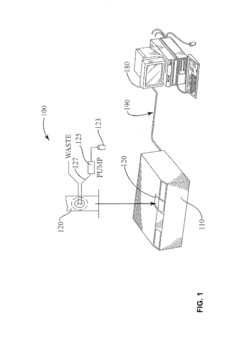
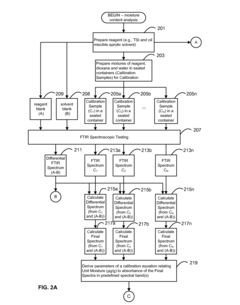
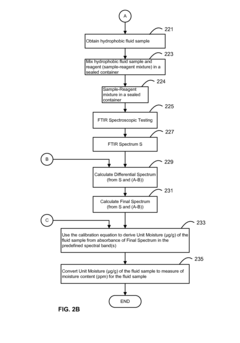
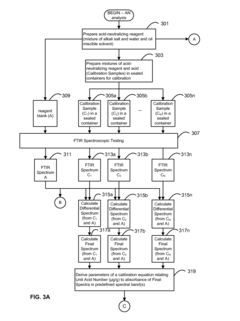
- A system and method using FTIR spectroscopy that involves preparing reagents reacting with the sample to produce carbon dioxide gas, allowing for calibration equations to be derived from standard mixtures, enabling precise measurement of moisture, acidity, or basicity by analyzing absorbance in specific spectral bands, which can be applied to various hydrophobic fluids and solid matrices.
Fourier transform infrared spectrometer
PatentActiveUS12372460B2
Innovation
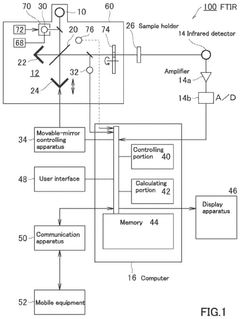
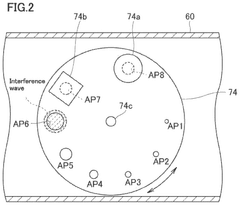
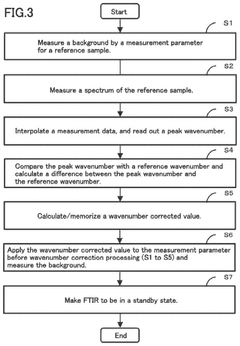
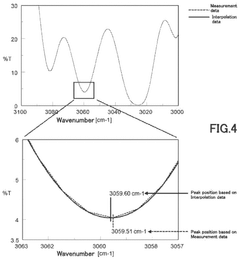
- A Fourier transform infrared spectrometer utilizing a solid reference sample, such as a polystyrene film, with a computer program for interpolating and correcting the wavenumber by adjusting the semiconductor laser's wavelength through temperature control or applied current, ensuring precise wavenumber correction even in nitrogen-purged or vacuumed states.
Environmental Regulations for Fluorinated Polymer Testing
The regulatory landscape for fluorinated polymer testing has evolved significantly in response to growing environmental concerns about per- and polyfluoroalkyl substances (PFAS). The European Union's REACH regulation has established stringent requirements for fluoroelastomer characterization, mandating comprehensive purity assessment protocols that directly impact FTIR spectroscopy applications. These regulations require manufacturers to demonstrate precise compositional analysis, making spectroscopic purity evaluation not merely a quality control measure but a regulatory compliance necessity.
The Stockholm Convention on Persistent Organic Pollutants has classified several fluorinated compounds as substances of very high concern, creating cascading effects on testing methodologies. Regulatory bodies now require detection limits that push FTIR spectroscopy to its analytical boundaries, particularly for identifying trace fluorinated impurities that may indicate the presence of restricted substances. This has driven the development of enhanced spectroscopic techniques and more sophisticated data interpretation protocols.
The United States Environmental Protection Agency has implemented the PFAS Action Plan, which establishes specific testing requirements for fluorinated materials used in industrial applications. These regulations mandate that purity assessments must be capable of detecting and quantifying fluorinated impurities at parts-per-million levels, challenging traditional FTIR approaches and necessitating method optimization for regulatory compliance.
International standards organizations, including ISO and ASTM, have responded by developing standardized protocols for fluoroelastomer purity evaluation using FTIR spectroscopy. These standards define specific spectral regions of interest, baseline correction procedures, and quantification methodologies that ensure reproducible results across different laboratories and regulatory jurisdictions.
The regulatory framework also addresses waste management and disposal requirements for fluorinated polymers, creating additional testing obligations throughout the product lifecycle. Environmental monitoring regulations now require periodic purity verification of fluoroelastomers in service, particularly in applications where material degradation could release regulated fluorinated compounds into the environment.
Emerging regulations in Asia-Pacific regions are adopting similar approaches, creating a global convergence toward standardized fluoroelastomer purity assessment protocols. This regulatory harmonization is driving technological advancement in FTIR spectroscopy applications, as manufacturers seek cost-effective solutions that meet multiple jurisdictional requirements simultaneously.
The Stockholm Convention on Persistent Organic Pollutants has classified several fluorinated compounds as substances of very high concern, creating cascading effects on testing methodologies. Regulatory bodies now require detection limits that push FTIR spectroscopy to its analytical boundaries, particularly for identifying trace fluorinated impurities that may indicate the presence of restricted substances. This has driven the development of enhanced spectroscopic techniques and more sophisticated data interpretation protocols.
The United States Environmental Protection Agency has implemented the PFAS Action Plan, which establishes specific testing requirements for fluorinated materials used in industrial applications. These regulations mandate that purity assessments must be capable of detecting and quantifying fluorinated impurities at parts-per-million levels, challenging traditional FTIR approaches and necessitating method optimization for regulatory compliance.
International standards organizations, including ISO and ASTM, have responded by developing standardized protocols for fluoroelastomer purity evaluation using FTIR spectroscopy. These standards define specific spectral regions of interest, baseline correction procedures, and quantification methodologies that ensure reproducible results across different laboratories and regulatory jurisdictions.
The regulatory framework also addresses waste management and disposal requirements for fluorinated polymers, creating additional testing obligations throughout the product lifecycle. Environmental monitoring regulations now require periodic purity verification of fluoroelastomers in service, particularly in applications where material degradation could release regulated fluorinated compounds into the environment.
Emerging regulations in Asia-Pacific regions are adopting similar approaches, creating a global convergence toward standardized fluoroelastomer purity assessment protocols. This regulatory harmonization is driving technological advancement in FTIR spectroscopy applications, as manufacturers seek cost-effective solutions that meet multiple jurisdictional requirements simultaneously.
Quality Standards for Fluoroelastomer Purity Validation
The establishment of comprehensive quality standards for fluoroelastomer purity validation represents a critical foundation for ensuring consistent and reliable material performance across industrial applications. Current industry practices rely on a combination of international standards, proprietary specifications, and application-specific requirements that collectively define acceptable purity thresholds for different fluoroelastomer grades.
International standards organizations, including ASTM International and ISO, have developed fundamental testing protocols that serve as baseline references for fluoroelastomer characterization. ASTM D1418 provides classification systems for rubber materials, while ASTM D2000 establishes performance-based specifications that indirectly address purity requirements through mechanical and thermal property criteria. These standards form the regulatory backbone for quality assessment but often lack specific guidance for advanced analytical techniques like FTIR spectroscopy.
Industry-specific quality frameworks have emerged to address the unique requirements of critical applications such as aerospace, automotive, and chemical processing. The aerospace sector, governed by specifications like AMS-R-83485 and Boeing BMS standards, demands exceptionally high purity levels with stringent limits on volatile extractables, ionic impurities, and residual cure agents. These specifications typically require purity levels exceeding 98% with detailed analytical validation protocols.
Pharmaceutical and food-grade applications operate under FDA regulations and USP standards that emphasize biocompatibility and extractable compound limits. These frameworks mandate comprehensive analytical validation including FTIR fingerprinting, extractables testing, and trace metal analysis. The validation protocols require statistical process control with defined confidence intervals and measurement uncertainty calculations.
Contemporary quality standards increasingly incorporate spectroscopic validation requirements, recognizing FTIR as a primary analytical tool for purity assessment. Modern specifications define acceptable spectral characteristics including peak intensity ratios, baseline stability criteria, and spectral resolution requirements. These standards establish quantitative metrics for impurity detection limits, typically ranging from 0.1% to 1% depending on the specific contaminant type and application criticality.
The evolution toward digitalized quality systems has introduced requirements for spectral database management, automated analysis protocols, and real-time monitoring capabilities. These advanced standards emphasize traceability, data integrity, and statistical validation of analytical results, reflecting the industry's movement toward Industry 4.0 principles and enhanced quality assurance methodologies.
International standards organizations, including ASTM International and ISO, have developed fundamental testing protocols that serve as baseline references for fluoroelastomer characterization. ASTM D1418 provides classification systems for rubber materials, while ASTM D2000 establishes performance-based specifications that indirectly address purity requirements through mechanical and thermal property criteria. These standards form the regulatory backbone for quality assessment but often lack specific guidance for advanced analytical techniques like FTIR spectroscopy.
Industry-specific quality frameworks have emerged to address the unique requirements of critical applications such as aerospace, automotive, and chemical processing. The aerospace sector, governed by specifications like AMS-R-83485 and Boeing BMS standards, demands exceptionally high purity levels with stringent limits on volatile extractables, ionic impurities, and residual cure agents. These specifications typically require purity levels exceeding 98% with detailed analytical validation protocols.
Pharmaceutical and food-grade applications operate under FDA regulations and USP standards that emphasize biocompatibility and extractable compound limits. These frameworks mandate comprehensive analytical validation including FTIR fingerprinting, extractables testing, and trace metal analysis. The validation protocols require statistical process control with defined confidence intervals and measurement uncertainty calculations.
Contemporary quality standards increasingly incorporate spectroscopic validation requirements, recognizing FTIR as a primary analytical tool for purity assessment. Modern specifications define acceptable spectral characteristics including peak intensity ratios, baseline stability criteria, and spectral resolution requirements. These standards establish quantitative metrics for impurity detection limits, typically ranging from 0.1% to 1% depending on the specific contaminant type and application criticality.
The evolution toward digitalized quality systems has introduced requirements for spectral database management, automated analysis protocols, and real-time monitoring capabilities. These advanced standards emphasize traceability, data integrity, and statistical validation of analytical results, reflecting the industry's movement toward Industry 4.0 principles and enhanced quality assurance methodologies.
Unlock deeper insights with Patsnap Eureka Quick Research — get a full tech report to explore trends and direct your research. Try now!
Generate Your Research Report Instantly with AI Agent
Supercharge your innovation with Patsnap Eureka AI Agent Platform!