

Evaluating Neuromorphic Vision's Role in Predictive Maintenance
APR 14, 20269 MIN READ
Generate Your Research Report Instantly with AI Agent
PatSnap Eureka helps you evaluate technical feasibility & market potential.
Neuromorphic Vision Background and Predictive Maintenance Goals
Neuromorphic vision represents a paradigm shift in computational imaging, drawing inspiration from the biological neural networks found in the human visual system. This technology emerged from decades of research into brain-inspired computing architectures, beginning with early work in the 1980s on artificial neural networks and evolving through advances in spike-based processing and event-driven sensors. The field gained significant momentum in the 2000s with the development of silicon retinas and neuromorphic chips that could process visual information with unprecedented efficiency and speed.
The fundamental principle underlying neuromorphic vision systems lies in their ability to process visual data asynchronously, mimicking the way biological neurons communicate through discrete spikes rather than continuous signals. This approach enables real-time processing of dynamic visual scenes with minimal power consumption, making it particularly suitable for applications requiring continuous monitoring and rapid response capabilities. Unlike traditional frame-based cameras that capture images at fixed intervals, neuromorphic vision sensors respond only to changes in the visual field, generating sparse data streams that contain temporal information about moving objects and changing conditions.
Predictive maintenance has evolved as a critical strategy for modern industrial operations, aiming to prevent equipment failures before they occur through continuous monitoring and data analysis. Traditional predictive maintenance approaches rely heavily on sensor data such as vibration, temperature, and acoustic measurements, combined with machine learning algorithms to identify patterns indicative of impending failures. However, these methods often struggle with complex visual indicators of equipment degradation, such as surface wear, corrosion, alignment issues, or fluid leaks that require sophisticated image analysis capabilities.
The integration of neuromorphic vision into predictive maintenance systems represents a convergence of two rapidly advancing technological domains. The primary goal is to leverage the unique advantages of neuromorphic processing to enhance the detection and prediction of equipment failures through visual monitoring. This includes achieving real-time analysis of high-speed machinery, detecting subtle changes in equipment appearance over extended periods, and providing continuous surveillance capabilities with minimal computational overhead.
Key objectives for neuromorphic vision in predictive maintenance encompass developing robust algorithms for anomaly detection in industrial environments, creating adaptive systems that can learn normal operational patterns and identify deviations, and establishing frameworks for integrating visual data with other sensor modalities. The technology aims to address current limitations in maintenance scheduling by providing more accurate failure predictions, reducing false alarms, and enabling condition-based maintenance strategies that optimize equipment uptime while minimizing maintenance costs.
The fundamental principle underlying neuromorphic vision systems lies in their ability to process visual data asynchronously, mimicking the way biological neurons communicate through discrete spikes rather than continuous signals. This approach enables real-time processing of dynamic visual scenes with minimal power consumption, making it particularly suitable for applications requiring continuous monitoring and rapid response capabilities. Unlike traditional frame-based cameras that capture images at fixed intervals, neuromorphic vision sensors respond only to changes in the visual field, generating sparse data streams that contain temporal information about moving objects and changing conditions.
Predictive maintenance has evolved as a critical strategy for modern industrial operations, aiming to prevent equipment failures before they occur through continuous monitoring and data analysis. Traditional predictive maintenance approaches rely heavily on sensor data such as vibration, temperature, and acoustic measurements, combined with machine learning algorithms to identify patterns indicative of impending failures. However, these methods often struggle with complex visual indicators of equipment degradation, such as surface wear, corrosion, alignment issues, or fluid leaks that require sophisticated image analysis capabilities.
The integration of neuromorphic vision into predictive maintenance systems represents a convergence of two rapidly advancing technological domains. The primary goal is to leverage the unique advantages of neuromorphic processing to enhance the detection and prediction of equipment failures through visual monitoring. This includes achieving real-time analysis of high-speed machinery, detecting subtle changes in equipment appearance over extended periods, and providing continuous surveillance capabilities with minimal computational overhead.
Key objectives for neuromorphic vision in predictive maintenance encompass developing robust algorithms for anomaly detection in industrial environments, creating adaptive systems that can learn normal operational patterns and identify deviations, and establishing frameworks for integrating visual data with other sensor modalities. The technology aims to address current limitations in maintenance scheduling by providing more accurate failure predictions, reducing false alarms, and enabling condition-based maintenance strategies that optimize equipment uptime while minimizing maintenance costs.
Market Demand for Advanced Predictive Maintenance Solutions
The global predictive maintenance market is experiencing unprecedented growth driven by the convergence of Industrial Internet of Things technologies, artificial intelligence, and advanced sensor systems. Manufacturing industries are increasingly recognizing the critical importance of transitioning from reactive and scheduled maintenance approaches to intelligent, condition-based maintenance strategies that can significantly reduce operational costs and minimize unplanned downtime.
Traditional maintenance approaches are proving inadequate for modern industrial environments where equipment complexity continues to escalate. Organizations across sectors including automotive manufacturing, aerospace, energy production, and heavy machinery operations are actively seeking sophisticated solutions that can provide real-time equipment health monitoring and accurate failure prediction capabilities. The demand is particularly acute in industries where equipment failure can result in substantial financial losses or safety hazards.
Current market drivers include the rising costs of equipment downtime, increasing complexity of industrial machinery, and growing emphasis on operational efficiency optimization. Companies are recognizing that advanced predictive maintenance solutions can deliver substantial return on investment through reduced maintenance costs, extended equipment lifespan, and improved production reliability. The integration of machine learning algorithms with sensor data analytics has created new possibilities for detecting subtle equipment degradation patterns that were previously undetectable.
The emergence of neuromorphic vision technologies represents a significant opportunity within this expanding market landscape. Unlike conventional computer vision systems, neuromorphic approaches offer unique advantages for continuous monitoring applications, including ultra-low power consumption, real-time processing capabilities, and enhanced sensitivity to temporal changes in visual patterns. These characteristics align perfectly with industrial requirements for persistent equipment monitoring without substantial energy overhead.
Market demand is particularly strong for solutions that can operate effectively in challenging industrial environments characterized by variable lighting conditions, electromagnetic interference, and harsh operating temperatures. Neuromorphic vision systems demonstrate superior performance in these conditions compared to traditional imaging technologies, making them increasingly attractive for industrial applications.
The competitive landscape reveals growing investment in advanced predictive maintenance technologies, with organizations seeking differentiated solutions that can provide competitive advantages through superior accuracy, reduced implementation complexity, and lower total cost of ownership. This market dynamic creates substantial opportunities for innovative approaches like neuromorphic vision that can address current technological limitations while delivering enhanced performance characteristics.
Traditional maintenance approaches are proving inadequate for modern industrial environments where equipment complexity continues to escalate. Organizations across sectors including automotive manufacturing, aerospace, energy production, and heavy machinery operations are actively seeking sophisticated solutions that can provide real-time equipment health monitoring and accurate failure prediction capabilities. The demand is particularly acute in industries where equipment failure can result in substantial financial losses or safety hazards.
Current market drivers include the rising costs of equipment downtime, increasing complexity of industrial machinery, and growing emphasis on operational efficiency optimization. Companies are recognizing that advanced predictive maintenance solutions can deliver substantial return on investment through reduced maintenance costs, extended equipment lifespan, and improved production reliability. The integration of machine learning algorithms with sensor data analytics has created new possibilities for detecting subtle equipment degradation patterns that were previously undetectable.
The emergence of neuromorphic vision technologies represents a significant opportunity within this expanding market landscape. Unlike conventional computer vision systems, neuromorphic approaches offer unique advantages for continuous monitoring applications, including ultra-low power consumption, real-time processing capabilities, and enhanced sensitivity to temporal changes in visual patterns. These characteristics align perfectly with industrial requirements for persistent equipment monitoring without substantial energy overhead.
Market demand is particularly strong for solutions that can operate effectively in challenging industrial environments characterized by variable lighting conditions, electromagnetic interference, and harsh operating temperatures. Neuromorphic vision systems demonstrate superior performance in these conditions compared to traditional imaging technologies, making them increasingly attractive for industrial applications.
The competitive landscape reveals growing investment in advanced predictive maintenance technologies, with organizations seeking differentiated solutions that can provide competitive advantages through superior accuracy, reduced implementation complexity, and lower total cost of ownership. This market dynamic creates substantial opportunities for innovative approaches like neuromorphic vision that can address current technological limitations while delivering enhanced performance characteristics.
Current State and Challenges of Neuromorphic Vision Technology
Neuromorphic vision technology has emerged as a promising paradigm that mimics the biological visual processing mechanisms of the human brain. Currently, the field is experiencing rapid advancement with several commercial and research implementations demonstrating practical applications. Leading semiconductor companies have developed neuromorphic vision chips capable of processing visual information with ultra-low power consumption, typically operating in the milliwatt range compared to traditional computer vision systems requiring watts of power.
The technology leverages event-driven processing, where pixels independently detect changes in light intensity and generate asynchronous events rather than capturing full frames at fixed intervals. This approach enables microsecond-level temporal resolution and eliminates motion blur, making it particularly suitable for dynamic monitoring scenarios. Current implementations achieve pixel array resolutions ranging from 128x128 to 1280x720, with temporal resolution exceeding 1 million events per second.
Despite these advances, significant technical challenges persist in the neuromorphic vision domain. Hardware limitations remain a primary constraint, as current sensor technologies struggle with noise sensitivity under varying lighting conditions and limited dynamic range compared to conventional cameras. The event-based data format requires specialized processing algorithms that differ fundamentally from traditional frame-based computer vision approaches, creating a steep learning curve for developers.
Software ecosystem maturity presents another substantial challenge. The lack of standardized development frameworks and limited availability of pre-trained models hinder widespread adoption. Most existing machine learning libraries are optimized for frame-based processing, necessitating custom algorithm development for neuromorphic data streams. This creates significant barriers for organizations seeking to implement neuromorphic vision solutions without extensive specialized expertise.
Integration complexity with existing industrial systems poses additional obstacles. Current predictive maintenance infrastructures are predominantly designed around conventional sensing modalities, requiring substantial modifications to accommodate neuromorphic vision inputs. The asynchronous nature of event-based data streams demands real-time processing capabilities that may exceed the computational resources of legacy maintenance systems.
Geographically, neuromorphic vision development is concentrated in advanced technology regions, with significant research activities in North America, Europe, and East Asia. However, the technology transfer to industrial applications remains limited, with most implementations confined to research laboratories and pilot projects rather than full-scale commercial deployments in predictive maintenance scenarios.
The technology leverages event-driven processing, where pixels independently detect changes in light intensity and generate asynchronous events rather than capturing full frames at fixed intervals. This approach enables microsecond-level temporal resolution and eliminates motion blur, making it particularly suitable for dynamic monitoring scenarios. Current implementations achieve pixel array resolutions ranging from 128x128 to 1280x720, with temporal resolution exceeding 1 million events per second.
Despite these advances, significant technical challenges persist in the neuromorphic vision domain. Hardware limitations remain a primary constraint, as current sensor technologies struggle with noise sensitivity under varying lighting conditions and limited dynamic range compared to conventional cameras. The event-based data format requires specialized processing algorithms that differ fundamentally from traditional frame-based computer vision approaches, creating a steep learning curve for developers.
Software ecosystem maturity presents another substantial challenge. The lack of standardized development frameworks and limited availability of pre-trained models hinder widespread adoption. Most existing machine learning libraries are optimized for frame-based processing, necessitating custom algorithm development for neuromorphic data streams. This creates significant barriers for organizations seeking to implement neuromorphic vision solutions without extensive specialized expertise.
Integration complexity with existing industrial systems poses additional obstacles. Current predictive maintenance infrastructures are predominantly designed around conventional sensing modalities, requiring substantial modifications to accommodate neuromorphic vision inputs. The asynchronous nature of event-based data streams demands real-time processing capabilities that may exceed the computational resources of legacy maintenance systems.
Geographically, neuromorphic vision development is concentrated in advanced technology regions, with significant research activities in North America, Europe, and East Asia. However, the technology transfer to industrial applications remains limited, with most implementations confined to research laboratories and pilot projects rather than full-scale commercial deployments in predictive maintenance scenarios.
Existing Neuromorphic Vision Solutions for Equipment Monitoring
01 Event-based vision sensors and neuromorphic cameras
Neuromorphic vision systems utilize event-based sensors that detect changes in pixel intensity asynchronously, mimicking biological vision. These sensors generate sparse event streams rather than traditional frame-based images, enabling high temporal resolution and low latency processing. The technology captures visual information only when changes occur in the scene, significantly reducing data redundancy and power consumption compared to conventional cameras.- Event-based vision sensors and neuromorphic cameras: Neuromorphic vision systems utilize event-based sensors that asynchronously detect changes in pixel intensity rather than capturing frames at fixed intervals. These sensors mimic biological retinas by generating sparse, temporal events only when visual changes occur, resulting in high temporal resolution, low latency, and reduced power consumption. The event-driven approach enables real-time processing of dynamic scenes with minimal data redundancy.
- Spiking neural networks for visual processing: Spiking neural networks are employed in neuromorphic vision systems to process visual information using biologically-inspired spike-based computation. These networks operate on temporal spike patterns rather than continuous values, enabling efficient processing of event-based sensor data. The spike-timing-dependent plasticity and temporal coding mechanisms allow for adaptive learning and energy-efficient computation in visual recognition and classification tasks.
- Hardware architectures for neuromorphic vision processing: Specialized hardware architectures are designed to implement neuromorphic vision systems, including custom integrated circuits, memristive devices, and parallel processing units. These architectures support massively parallel computation, low-power operation, and real-time processing capabilities. The hardware implementations enable efficient execution of spike-based algorithms and event-driven processing with minimal energy consumption compared to traditional von Neumann architectures.
- Motion detection and tracking using neuromorphic vision: Neuromorphic vision systems excel at motion detection and object tracking by leveraging the temporal precision of event-based sensors. The asynchronous nature of event generation enables detection of fast-moving objects and subtle motion patterns that conventional frame-based cameras might miss. Applications include robotics navigation, autonomous vehicles, and surveillance systems where real-time motion analysis is critical.
- Integration with artificial intelligence and machine learning: Neuromorphic vision systems are integrated with machine learning frameworks to enable intelligent visual perception and decision-making. The combination of event-based sensing with deep learning algorithms allows for efficient feature extraction, pattern recognition, and scene understanding. Hybrid approaches leverage both neuromorphic computing principles and conventional AI techniques to achieve robust performance in complex visual tasks while maintaining energy efficiency.
02 Spiking neural networks for visual processing
Neuromorphic vision systems employ spiking neural networks that process visual information using spike-based computation, similar to biological neurons. These networks operate on event-driven data from neuromorphic sensors, enabling efficient real-time processing with minimal power requirements. The spike-based approach allows for temporal coding of visual information and supports learning algorithms that adapt to dynamic visual environments.Expand Specific Solutions03 Hardware architectures for neuromorphic vision processing
Specialized hardware architectures are designed to implement neuromorphic vision systems, including custom integrated circuits and neuromorphic processors. These architectures feature parallel processing capabilities, event-driven computation, and memory structures that co-locate processing and storage. The hardware implementations enable energy-efficient execution of vision algorithms while maintaining high-speed processing of asynchronous event streams.Expand Specific Solutions04 Object recognition and tracking using neuromorphic vision
Neuromorphic vision systems are applied to object recognition and tracking tasks, leveraging the high temporal resolution of event-based sensors. These systems can detect and track fast-moving objects with low latency, performing feature extraction and classification directly on event streams. The approach enables robust performance in challenging conditions such as high-speed motion, varying lighting, and occlusions.Expand Specific Solutions05 Neuromorphic vision for robotics and autonomous systems
Neuromorphic vision technology is integrated into robotics and autonomous systems for real-time perception and navigation. The low-latency, event-driven processing enables rapid response to environmental changes, supporting applications in autonomous vehicles, drones, and mobile robots. These systems benefit from reduced power consumption and improved performance in dynamic environments, enabling continuous operation with minimal computational overhead.Expand Specific Solutions
Key Players in Neuromorphic Vision and Industrial IoT
The neuromorphic vision technology for predictive maintenance represents an emerging market in early development stages, characterized by significant growth potential but limited commercial deployment. The market remains relatively small with most applications still in research and pilot phases, though industrial automation and healthcare sectors show promising adoption trajectories. Technology maturity varies considerably across key players, with established technology giants like IBM, Siemens, Huawei, and Hitachi leading advanced research initiatives and prototype development. These companies leverage their existing AI and industrial IoT capabilities to integrate neuromorphic vision solutions. Meanwhile, specialized firms like Cymer and automotive suppliers including Ford Global Technologies and HL Mando are exploring niche applications. Academic institutions such as Beihang University and Shanghai University contribute foundational research, while companies like Caterpillar and Liugong represent potential end-users in heavy machinery sectors, indicating broad industrial interest despite current technological and implementation challenges.
International Business Machines Corp.
Technical Solution: IBM has developed neuromorphic computing solutions through its TrueNorth chip architecture, which mimics brain-like processing for real-time sensor data analysis in predictive maintenance applications. Their approach integrates event-driven neuromorphic vision sensors with machine learning algorithms to detect anomalies in industrial equipment. The system processes visual data with ultra-low power consumption, enabling continuous monitoring of machinery conditions. IBM's neuromorphic platform can identify subtle changes in equipment behavior patterns, vibrations, and thermal signatures that traditional vision systems might miss. Their solution provides real-time processing capabilities with minimal latency, making it suitable for critical industrial applications where immediate response is essential for preventing equipment failures and optimizing maintenance schedules.
Strengths: Pioneering neuromorphic chip technology with proven industrial applications, low power consumption, real-time processing capabilities. Weaknesses: High initial development costs, limited ecosystem compared to traditional AI solutions, requires specialized expertise for implementation.
Siemens AG
Technical Solution: Siemens has integrated neuromorphic vision technologies into their MindSphere IoT platform for advanced predictive maintenance solutions. Their approach combines event-based vision sensors with digital twin technology to create comprehensive monitoring systems for industrial equipment. The neuromorphic vision components can detect micro-movements, surface changes, and operational anomalies in real-time with significantly reduced data processing requirements compared to traditional frame-based cameras. Siemens leverages the sparse, event-driven nature of neuromorphic sensors to minimize bandwidth usage while maintaining high sensitivity to relevant changes in equipment status. Their solution enables continuous 24/7 monitoring with edge computing capabilities, processing visual data locally to provide immediate alerts and maintenance recommendations. The system integrates seamlessly with existing industrial automation infrastructure and provides predictive analytics based on visual pattern recognition.
Strengths: Strong industrial automation expertise, comprehensive IoT platform integration, proven track record in predictive maintenance. Weaknesses: Relatively new to neuromorphic technology, dependency on third-party neuromorphic sensor suppliers, complex integration requirements.
Core Patents in Event-Based Vision for Fault Detection
Neuromorphic Analog Signal Processor for Predictive Maintenance of Machines
PatentPendingUS20230081715A1
Innovation
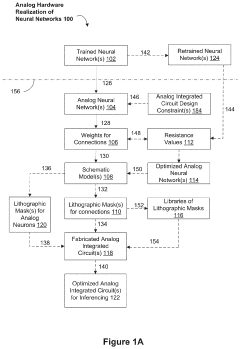
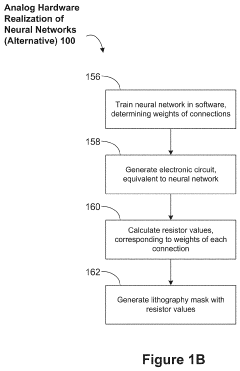
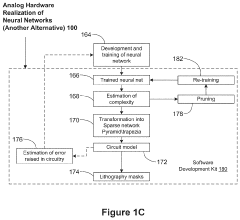
- Analog neuromorphic circuits that model trained neural networks, using operational amplifiers and resistors to create hardware implementations that are more power-efficient, scalable, and less sensitive to noise and temperature changes, allowing for mass production and reduced manufacturing costs.
Industrial Safety Standards for AI-Based Maintenance Systems
The integration of neuromorphic vision systems into predictive maintenance applications necessitates adherence to comprehensive industrial safety standards specifically designed for AI-based maintenance systems. These standards establish critical frameworks that ensure the reliable and safe deployment of artificial intelligence technologies in industrial environments where equipment failures can result in significant safety hazards, operational disruptions, and financial losses.
Current industrial safety standards for AI-based maintenance systems primarily focus on functional safety requirements outlined in IEC 61508 and its sector-specific derivatives such as IEC 61511 for process industries. These standards mandate systematic approaches to hazard analysis, risk assessment, and safety integrity level determination. For neuromorphic vision applications, additional considerations include ISO/IEC 23053 for AI system trustworthiness and IEEE 2857 for privacy engineering in AI systems.
The certification process for AI-based maintenance systems requires extensive validation and verification procedures. Neuromorphic vision systems must demonstrate consistent performance across varying environmental conditions, including temperature fluctuations, vibration, electromagnetic interference, and lighting variations. Safety standards mandate comprehensive testing protocols that evaluate system behavior under both normal operating conditions and foreseeable fault scenarios.
Data integrity and cybersecurity represent critical components of industrial safety standards for AI maintenance systems. Standards such as IEC 62443 provide cybersecurity frameworks specifically addressing industrial automation and control systems. Neuromorphic vision systems must implement robust data encryption, secure communication protocols, and intrusion detection mechanisms to prevent unauthorized access and potential system compromises.
Regulatory compliance frameworks vary across different industrial sectors and geographical regions. In the European Union, the proposed AI Act introduces specific requirements for high-risk AI applications, including those used in critical infrastructure maintenance. Similarly, OSHA guidelines in the United States emphasize the importance of maintaining human oversight and establishing clear accountability chains when implementing AI-based safety systems.
The emerging ISO/IEC 23894 standard specifically addresses AI risk management, providing structured methodologies for identifying, assessing, and mitigating risks associated with AI system deployment. This standard emphasizes the importance of continuous monitoring, regular performance assessments, and adaptive risk management strategies throughout the system lifecycle, which are particularly relevant for neuromorphic vision applications in dynamic industrial environments.
Current industrial safety standards for AI-based maintenance systems primarily focus on functional safety requirements outlined in IEC 61508 and its sector-specific derivatives such as IEC 61511 for process industries. These standards mandate systematic approaches to hazard analysis, risk assessment, and safety integrity level determination. For neuromorphic vision applications, additional considerations include ISO/IEC 23053 for AI system trustworthiness and IEEE 2857 for privacy engineering in AI systems.
The certification process for AI-based maintenance systems requires extensive validation and verification procedures. Neuromorphic vision systems must demonstrate consistent performance across varying environmental conditions, including temperature fluctuations, vibration, electromagnetic interference, and lighting variations. Safety standards mandate comprehensive testing protocols that evaluate system behavior under both normal operating conditions and foreseeable fault scenarios.
Data integrity and cybersecurity represent critical components of industrial safety standards for AI maintenance systems. Standards such as IEC 62443 provide cybersecurity frameworks specifically addressing industrial automation and control systems. Neuromorphic vision systems must implement robust data encryption, secure communication protocols, and intrusion detection mechanisms to prevent unauthorized access and potential system compromises.
Regulatory compliance frameworks vary across different industrial sectors and geographical regions. In the European Union, the proposed AI Act introduces specific requirements for high-risk AI applications, including those used in critical infrastructure maintenance. Similarly, OSHA guidelines in the United States emphasize the importance of maintaining human oversight and establishing clear accountability chains when implementing AI-based safety systems.
The emerging ISO/IEC 23894 standard specifically addresses AI risk management, providing structured methodologies for identifying, assessing, and mitigating risks associated with AI system deployment. This standard emphasizes the importance of continuous monitoring, regular performance assessments, and adaptive risk management strategies throughout the system lifecycle, which are particularly relevant for neuromorphic vision applications in dynamic industrial environments.
Energy Efficiency Benefits of Neuromorphic Vision Deployment
Neuromorphic vision systems demonstrate remarkable energy efficiency advantages over traditional computer vision architectures in predictive maintenance applications. These bio-inspired processors consume significantly less power by processing visual information in an event-driven manner, activating only when pixel-level changes occur rather than continuously processing entire frames. This fundamental difference results in power consumption reductions of up to 90% compared to conventional CMOS sensors and digital signal processors.
The energy efficiency gains become particularly pronounced in industrial monitoring scenarios where equipment operates in relatively stable visual environments. Traditional vision systems continuously capture and process high-resolution images at fixed frame rates, consuming substantial power even when monitoring static machinery. Neuromorphic vision sensors, conversely, remain largely dormant during periods of visual stability, dramatically reducing baseline power consumption while maintaining full sensitivity to relevant changes indicating potential equipment anomalies.
Edge deployment scenarios benefit significantly from neuromorphic vision's low power requirements. Industrial facilities can deploy extensive sensor networks without requiring substantial electrical infrastructure upgrades or frequent battery replacements. The reduced power consumption enables wireless sensor nodes to operate for months or years on single battery charges, substantially lowering maintenance costs and improving system reliability in remote or hazardous monitoring locations.
Real-time processing capabilities of neuromorphic systems eliminate the need for power-intensive data transmission to centralized processing units. Local event processing reduces network bandwidth requirements and associated energy costs while enabling immediate anomaly detection responses. This distributed processing approach proves particularly valuable in large-scale industrial facilities where centralized processing would require extensive communication infrastructure and introduce latency issues.
The asynchronous nature of neuromorphic processing aligns naturally with the temporal dynamics of mechanical failures, which often manifest as gradual changes in vibration patterns, thermal signatures, or visual anomalies. This temporal matching enables more efficient detection algorithms that consume minimal computational resources while maintaining high sensitivity to failure precursors, further enhancing overall system energy efficiency.
The energy efficiency gains become particularly pronounced in industrial monitoring scenarios where equipment operates in relatively stable visual environments. Traditional vision systems continuously capture and process high-resolution images at fixed frame rates, consuming substantial power even when monitoring static machinery. Neuromorphic vision sensors, conversely, remain largely dormant during periods of visual stability, dramatically reducing baseline power consumption while maintaining full sensitivity to relevant changes indicating potential equipment anomalies.
Edge deployment scenarios benefit significantly from neuromorphic vision's low power requirements. Industrial facilities can deploy extensive sensor networks without requiring substantial electrical infrastructure upgrades or frequent battery replacements. The reduced power consumption enables wireless sensor nodes to operate for months or years on single battery charges, substantially lowering maintenance costs and improving system reliability in remote or hazardous monitoring locations.
Real-time processing capabilities of neuromorphic systems eliminate the need for power-intensive data transmission to centralized processing units. Local event processing reduces network bandwidth requirements and associated energy costs while enabling immediate anomaly detection responses. This distributed processing approach proves particularly valuable in large-scale industrial facilities where centralized processing would require extensive communication infrastructure and introduce latency issues.
The asynchronous nature of neuromorphic processing aligns naturally with the temporal dynamics of mechanical failures, which often manifest as gradual changes in vibration patterns, thermal signatures, or visual anomalies. This temporal matching enables more efficient detection algorithms that consume minimal computational resources while maintaining high sensitivity to failure precursors, further enhancing overall system energy efficiency.
Unlock deeper insights with PatSnap Eureka Quick Research — get a full tech report to explore trends and direct your research. Try now!
Generate Your Research Report Instantly with AI Agent
Supercharge your innovation with PatSnap Eureka AI Agent Platform!