

Exploring Conductive Polymer Composites in Emerging Markets
OCT 23, 202510 MIN READ
Generate Your Research Report Instantly with AI Agent
PatSnap Eureka helps you evaluate technical feasibility & market potential.
Conductive Polymer Evolution and Research Objectives
Conductive polymers have evolved significantly since their initial discovery in the 1970s when Alan Heeger, Alan MacDiarmid, and Hideki Shirakawa demonstrated that polyacetylene could conduct electricity when doped with iodine. This groundbreaking work, which earned them the Nobel Prize in Chemistry in 2000, opened a new frontier in materials science that bridges the traditionally separate domains of polymers and electronic conductors.
The evolution of conductive polymers has progressed through several distinct phases. The first generation focused primarily on polyacetylene, polypyrrole, and polyaniline, establishing fundamental understanding of their conductive mechanisms. The second generation, emerging in the 1990s, expanded to include polythiophenes and their derivatives, particularly poly(3,4-ethylenedioxythiophene) or PEDOT, which offered improved stability and processability.
The third generation, beginning in the early 2000s, shifted toward composite materials that combine conductive polymers with nanofillers such as carbon nanotubes, graphene, and metal nanoparticles. This approach has dramatically enhanced electrical, mechanical, and thermal properties while maintaining the inherent advantages of polymeric materials.
Current research objectives in conductive polymer composites (CPCs) are multifaceted and interdisciplinary. A primary goal is to achieve precise control over electrical conductivity across multiple orders of magnitude, enabling applications ranging from antistatic coatings to highly conductive alternatives to metals. Researchers are particularly focused on understanding and manipulating the percolation threshold—the critical concentration at which conductive networks form within the polymer matrix.
Another crucial objective is enhancing the mechanical flexibility and durability of CPCs while maintaining their electrical properties. This is essential for emerging applications in wearable electronics, flexible displays, and stretchable sensors that must withstand repeated deformation cycles without performance degradation.
Process optimization represents another significant research direction, with emphasis on developing scalable, environmentally friendly manufacturing techniques. This includes water-based processing methods, solvent-free approaches, and additive manufacturing technologies that can produce complex CPC structures with tailored properties.
In emerging markets, research objectives extend to developing cost-effective formulations that can compete with traditional materials while offering unique advantages. This includes exploring locally available raw materials and adapting processing technologies to suit the infrastructure constraints of developing economies.
The integration of CPCs with other emerging technologies, particularly Internet of Things (IoT) devices, renewable energy systems, and biomedical applications, constitutes another frontier. Researchers are investigating how these materials can enable new functionalities in resource-constrained environments, such as self-powered sensors for agricultural monitoring or affordable medical diagnostics.
The evolution of conductive polymers has progressed through several distinct phases. The first generation focused primarily on polyacetylene, polypyrrole, and polyaniline, establishing fundamental understanding of their conductive mechanisms. The second generation, emerging in the 1990s, expanded to include polythiophenes and their derivatives, particularly poly(3,4-ethylenedioxythiophene) or PEDOT, which offered improved stability and processability.
The third generation, beginning in the early 2000s, shifted toward composite materials that combine conductive polymers with nanofillers such as carbon nanotubes, graphene, and metal nanoparticles. This approach has dramatically enhanced electrical, mechanical, and thermal properties while maintaining the inherent advantages of polymeric materials.
Current research objectives in conductive polymer composites (CPCs) are multifaceted and interdisciplinary. A primary goal is to achieve precise control over electrical conductivity across multiple orders of magnitude, enabling applications ranging from antistatic coatings to highly conductive alternatives to metals. Researchers are particularly focused on understanding and manipulating the percolation threshold—the critical concentration at which conductive networks form within the polymer matrix.
Another crucial objective is enhancing the mechanical flexibility and durability of CPCs while maintaining their electrical properties. This is essential for emerging applications in wearable electronics, flexible displays, and stretchable sensors that must withstand repeated deformation cycles without performance degradation.
Process optimization represents another significant research direction, with emphasis on developing scalable, environmentally friendly manufacturing techniques. This includes water-based processing methods, solvent-free approaches, and additive manufacturing technologies that can produce complex CPC structures with tailored properties.
In emerging markets, research objectives extend to developing cost-effective formulations that can compete with traditional materials while offering unique advantages. This includes exploring locally available raw materials and adapting processing technologies to suit the infrastructure constraints of developing economies.
The integration of CPCs with other emerging technologies, particularly Internet of Things (IoT) devices, renewable energy systems, and biomedical applications, constitutes another frontier. Researchers are investigating how these materials can enable new functionalities in resource-constrained environments, such as self-powered sensors for agricultural monitoring or affordable medical diagnostics.
Market Demand Analysis for Conductive Polymer Composites
The global market for conductive polymer composites (CPCs) has witnessed substantial growth in recent years, driven primarily by increasing demand for lightweight, flexible, and cost-effective alternatives to traditional metal conductors. Current market valuations indicate that the CPC market reached approximately 3.5 billion USD in 2022, with projections suggesting a compound annual growth rate of 8.2% through 2028, potentially reaching 5.6 billion USD by the end of the forecast period.
The demand for CPCs is particularly robust in emerging markets across Asia-Pacific, Latin America, and parts of Africa, where rapid industrialization and technological adoption are creating new application opportunities. China, India, and Brazil represent the most significant growth territories, with domestic manufacturing capabilities expanding to meet both local and export demands.
Consumer electronics remains the dominant application sector, accounting for nearly 40% of the total market share. The miniaturization trend in electronic devices, coupled with the need for components that can withstand mechanical stress while maintaining electrical performance, has positioned CPCs as ideal materials for next-generation flexible displays, wearable technology, and IoT devices.
The automotive industry represents another substantial market segment, particularly with the accelerating transition toward electric vehicles. CPCs are increasingly utilized in battery systems, electromagnetic interference (EMI) shielding, and sensor applications. Market research indicates that automotive applications of CPCs are growing at 10.3% annually, outpacing the overall market growth rate.
Healthcare applications present an emerging high-value market, with CPCs finding applications in biosensors, drug delivery systems, and medical implants. The biocompatibility of certain polymer composites, combined with their electrical properties, makes them particularly valuable in this sector, which is expected to grow at 12.7% annually over the next five years.
Environmental sustainability concerns are also driving market demand, as manufacturers seek alternatives to toxic materials and heavy metals. CPCs offer reduced environmental impact compared to traditional conductive materials, aligning with increasingly stringent regulatory frameworks in both developed and emerging markets.
Supply chain challenges represent a significant factor influencing market dynamics. The dependency on specific raw materials, some of which are sourced from regions with geopolitical instability, has led to price volatility. Consequently, there is growing interest in developing CPCs using locally available and sustainable resources, particularly in emerging economies seeking to reduce import dependencies.
Price sensitivity remains a critical factor in emerging markets, where cost considerations often outweigh performance parameters. This has spurred innovation in manufacturing processes to reduce production costs while maintaining essential electrical and mechanical properties of CPCs.
The demand for CPCs is particularly robust in emerging markets across Asia-Pacific, Latin America, and parts of Africa, where rapid industrialization and technological adoption are creating new application opportunities. China, India, and Brazil represent the most significant growth territories, with domestic manufacturing capabilities expanding to meet both local and export demands.
Consumer electronics remains the dominant application sector, accounting for nearly 40% of the total market share. The miniaturization trend in electronic devices, coupled with the need for components that can withstand mechanical stress while maintaining electrical performance, has positioned CPCs as ideal materials for next-generation flexible displays, wearable technology, and IoT devices.
The automotive industry represents another substantial market segment, particularly with the accelerating transition toward electric vehicles. CPCs are increasingly utilized in battery systems, electromagnetic interference (EMI) shielding, and sensor applications. Market research indicates that automotive applications of CPCs are growing at 10.3% annually, outpacing the overall market growth rate.
Healthcare applications present an emerging high-value market, with CPCs finding applications in biosensors, drug delivery systems, and medical implants. The biocompatibility of certain polymer composites, combined with their electrical properties, makes them particularly valuable in this sector, which is expected to grow at 12.7% annually over the next five years.
Environmental sustainability concerns are also driving market demand, as manufacturers seek alternatives to toxic materials and heavy metals. CPCs offer reduced environmental impact compared to traditional conductive materials, aligning with increasingly stringent regulatory frameworks in both developed and emerging markets.
Supply chain challenges represent a significant factor influencing market dynamics. The dependency on specific raw materials, some of which are sourced from regions with geopolitical instability, has led to price volatility. Consequently, there is growing interest in developing CPCs using locally available and sustainable resources, particularly in emerging economies seeking to reduce import dependencies.
Price sensitivity remains a critical factor in emerging markets, where cost considerations often outweigh performance parameters. This has spurred innovation in manufacturing processes to reduce production costs while maintaining essential electrical and mechanical properties of CPCs.
Global Development Status and Technical Barriers
Conductive polymer composites (CPCs) have emerged as a significant technological advancement across global markets, with development trajectories varying considerably between regions. In North America and Europe, research institutions and corporations have established mature ecosystems for CPC development, focusing primarily on high-performance applications in aerospace, automotive, and medical sectors. These regions maintain technological leadership through substantial R&D investments and strong intellectual property portfolios, with particular emphasis on enhancing conductivity while maintaining mechanical properties.
Asia-Pacific, especially China, Japan, and South Korea, has demonstrated remarkable growth in CPC development, leveraging manufacturing capabilities and cost advantages. These countries have rapidly closed the technological gap through strategic government initiatives and industry collaborations, particularly in consumer electronics and energy storage applications. Their approach often emphasizes scalable production methods and cost optimization rather than fundamental innovation.
Emerging markets in Latin America, Africa, and parts of Southeast Asia represent the new frontier for CPC technology adoption. These regions are increasingly implementing localized applications that address specific regional challenges, such as affordable energy solutions and infrastructure development, though often relying on imported technology rather than indigenous innovation.
Despite global progress, significant technical barriers persist in CPC development. The fundamental challenge of achieving consistent electrical conductivity while maintaining desirable mechanical properties remains unresolved. The percolation threshold—the minimum conductive filler content required for electrical conductivity—often necessitates high filler loadings that compromise flexibility, processability, and durability.
Manufacturing scalability presents another critical barrier, as laboratory-scale successes frequently encounter difficulties in translation to industrial production. Processes that work effectively for small batches often face issues with dispersion uniformity, agglomeration, and interfacial compatibility when scaled up, resulting in performance inconsistencies and increased production costs.
Environmental stability represents a persistent challenge, with many CPCs exhibiting performance degradation under humidity, temperature fluctuations, UV exposure, and mechanical stress. This limitation particularly affects outdoor applications and devices requiring long-term reliability.
Standardization gaps further complicate global development, as the absence of unified testing protocols and performance metrics creates market fragmentation and impedes technology transfer. Different regions employ varying standards for electrical conductivity measurement, mechanical testing, and environmental resistance evaluation, complicating cross-market comparisons and international collaboration.
Cost factors remain a significant barrier to widespread adoption, especially in price-sensitive emerging markets. The premium pricing of high-performance conductive fillers such as carbon nanotubes and graphene derivatives limits commercial viability for many potential applications, creating a persistent tension between performance requirements and economic feasibility.
Asia-Pacific, especially China, Japan, and South Korea, has demonstrated remarkable growth in CPC development, leveraging manufacturing capabilities and cost advantages. These countries have rapidly closed the technological gap through strategic government initiatives and industry collaborations, particularly in consumer electronics and energy storage applications. Their approach often emphasizes scalable production methods and cost optimization rather than fundamental innovation.
Emerging markets in Latin America, Africa, and parts of Southeast Asia represent the new frontier for CPC technology adoption. These regions are increasingly implementing localized applications that address specific regional challenges, such as affordable energy solutions and infrastructure development, though often relying on imported technology rather than indigenous innovation.
Despite global progress, significant technical barriers persist in CPC development. The fundamental challenge of achieving consistent electrical conductivity while maintaining desirable mechanical properties remains unresolved. The percolation threshold—the minimum conductive filler content required for electrical conductivity—often necessitates high filler loadings that compromise flexibility, processability, and durability.
Manufacturing scalability presents another critical barrier, as laboratory-scale successes frequently encounter difficulties in translation to industrial production. Processes that work effectively for small batches often face issues with dispersion uniformity, agglomeration, and interfacial compatibility when scaled up, resulting in performance inconsistencies and increased production costs.
Environmental stability represents a persistent challenge, with many CPCs exhibiting performance degradation under humidity, temperature fluctuations, UV exposure, and mechanical stress. This limitation particularly affects outdoor applications and devices requiring long-term reliability.
Standardization gaps further complicate global development, as the absence of unified testing protocols and performance metrics creates market fragmentation and impedes technology transfer. Different regions employ varying standards for electrical conductivity measurement, mechanical testing, and environmental resistance evaluation, complicating cross-market comparisons and international collaboration.
Cost factors remain a significant barrier to widespread adoption, especially in price-sensitive emerging markets. The premium pricing of high-performance conductive fillers such as carbon nanotubes and graphene derivatives limits commercial viability for many potential applications, creating a persistent tension between performance requirements and economic feasibility.
Current Technical Solutions and Implementation Methods
01 Carbon-based conductive polymer composites
Carbon-based materials such as carbon nanotubes, graphene, and carbon black are incorporated into polymer matrices to create conductive composites. These fillers provide excellent electrical conductivity while maintaining the mechanical properties of the polymer. The resulting composites can be used in various applications including electromagnetic shielding, antistatic materials, and flexible electronics. The dispersion method and filler concentration significantly affect the final conductivity of the composite.- Carbon-based conductive polymer composites: Carbon-based materials such as carbon nanotubes, graphene, and carbon black are incorporated into polymer matrices to create conductive composites. These fillers provide excellent electrical conductivity while maintaining the mechanical properties of the polymer. The resulting composites can be used in various applications including electromagnetic shielding, antistatic materials, and flexible electronics. The dispersion method and concentration of carbon materials significantly affect the conductivity and performance of the final composite.
- Metal-polymer conductive composites: Metal particles or nanowires are incorporated into polymer matrices to create conductive composites with enhanced electrical properties. Common metals used include silver, copper, and nickel. These metal-polymer composites offer advantages such as high conductivity, processability, and in some cases, transparency. Applications include printed electronics, sensors, and electromagnetic interference shielding. The size, shape, and distribution of metal particles within the polymer matrix significantly influence the electrical and mechanical properties of the composite.
- Intrinsically conductive polymers in composites: Intrinsically conductive polymers such as polyaniline, polypyrrole, and PEDOT:PSS are used either as the main component or in combination with conventional polymers to create conductive composites. These materials offer unique properties including tunable conductivity, optical properties, and environmental responsiveness. The composites find applications in batteries, supercapacitors, sensors, and organic electronics. Various dopants and processing methods are employed to enhance the conductivity and stability of these polymer-based composites.
- Conductive polymer composites for energy storage applications: Specialized conductive polymer composites are developed for energy storage applications such as batteries, supercapacitors, and fuel cells. These composites often combine conductive polymers with other functional materials to enhance energy density, power density, and cycling stability. The synergistic effects between the polymer matrix and conductive fillers result in improved electrochemical performance. Various fabrication techniques are employed to optimize the interface between components and enhance the overall performance of the energy storage devices.
- Processing and manufacturing methods for conductive polymer composites: Various processing and manufacturing methods are developed to produce conductive polymer composites with controlled properties. These include solution blending, melt processing, in-situ polymerization, and additive manufacturing techniques. The processing conditions significantly affect the dispersion of conductive fillers, interfacial interactions, and ultimately the electrical and mechanical properties of the composites. Novel approaches such as layer-by-layer assembly, freeze-drying, and template-assisted methods are employed to create composites with hierarchical structures and enhanced functionalities.
02 Metal-polymer conductive composites
Metal particles or nanowires are incorporated into polymer matrices to create conductive composites with enhanced electrical properties. Common metals used include silver, copper, and nickel. These composites offer advantages such as high conductivity, processability, and in some cases, self-healing properties. Applications include printed electronics, sensors, and electromagnetic interference shielding. The interface between the metal particles and polymer matrix plays a crucial role in determining the overall performance of the composite.Expand Specific Solutions03 Intrinsically conductive polymer composites
Intrinsically conductive polymers such as polyaniline, polypyrrole, and PEDOT:PSS are combined with other materials to form composites with enhanced electrical, mechanical, and thermal properties. These composites maintain their conductivity without requiring additional conductive fillers. The synthesis method, dopant type, and processing conditions significantly influence the conductivity and stability of these materials. Applications include batteries, supercapacitors, and organic electronics.Expand Specific Solutions04 Thermal management in conductive polymer composites
Conductive polymer composites are designed with enhanced thermal conductivity for heat dissipation applications. These materials incorporate fillers such as boron nitride, aluminum oxide, or graphite to improve thermal conductivity while maintaining electrical insulation properties when required. The orientation and distribution of fillers, interface engineering, and hybrid filler systems are key factors in optimizing thermal management performance. Applications include LED heat sinks, electronic packaging, and thermal interface materials.Expand Specific Solutions05 Processing techniques for conductive polymer composites
Various processing techniques are employed to manufacture conductive polymer composites with optimized properties. These include solution blending, melt mixing, in-situ polymerization, and additive manufacturing. Surface functionalization of fillers improves dispersion and interfacial adhesion with the polymer matrix. Post-processing treatments such as annealing or stretching can enhance the alignment of conductive fillers and improve overall conductivity. The processing method significantly impacts the final structure and properties of the composite.Expand Specific Solutions
Key Industry Players and Competitive Landscape
The conductive polymer composites market is currently in a growth phase, characterized by increasing adoption across emerging markets. The global market size is expanding rapidly, driven by applications in electronics, automotive, and healthcare sectors. Technologically, the field is advancing from early-stage development to commercial maturity, with key players demonstrating varying levels of innovation. Academic institutions like Sichuan University, Rutgers, and Georgia Tech Research Corp. are pioneering fundamental research, while commercial entities such as DuPont, SABIC, and SK Innovation are focusing on application development and commercialization. Asian companies, particularly from South Korea and China, are emerging as significant competitors alongside established Western corporations. The industry is witnessing increased collaboration between academic institutions and industrial partners to accelerate technology transfer and market penetration.
SK INNOVATION CO LTD
Technical Solution: SK Innovation has developed advanced conductive polymer composites focusing on energy storage and automotive applications for emerging markets. Their technology centers on a proprietary blend of polyolefin matrices (primarily polypropylene and polyethylene) with precisely controlled carbon nanostructures including carbon nanotubes and graphene nanoplatelets. SK's innovation includes a patented melt-compounding process that achieves uniform dispersion of conductive fillers at loadings as low as 2-5 wt%, significantly below conventional percolation thresholds. Their composites demonstrate volume resistivities ranging from 10^1 to 10^9 ohm-cm while maintaining over 85% of the base polymer's mechanical properties. SK Innovation has specifically targeted electric vehicle applications in emerging markets with their lightweight conductive composites for battery components, achieving weight reductions of 25-40% compared to metal alternatives while providing comparable EMI shielding (>40dB attenuation) and thermal management capabilities. Their materials incorporate stabilization packages specifically designed for the environmental conditions prevalent in Southeast Asian and South American markets.
Strengths: Strong vertical integration with petrochemical operations providing cost advantages, established presence in multiple Asian emerging markets, and specialized expertise in energy storage applications. Weaknesses: More limited experience in non-automotive applications compared to competitors, and relatively narrower polymer chemistry portfolio requiring partnerships for certain specialty applications.
SABIC Global Technologies BV
Technical Solution: SABIC has pioneered a range of conductive polymer composites based on their LEXAN™ polycarbonate, NORYL™ PPE, and ULTEM™ polyetherimide platforms. Their technology focuses on creating materials with precisely controlled electrical properties while maintaining exceptional mechanical performance and processability. SABIC's approach involves proprietary compounding techniques that achieve uniform dispersion of conductive fillers including carbon nanotubes, carbon fibers, and metallic particles. Their LNP™ STAT-KON™ compounds achieve volume resistivities ranging from 10^2 to 10^12 ohm-cm with minimal impact on mechanical properties. For emerging markets, SABIC has developed cost-effective formulations that utilize locally available carbon black variants combined with their proprietary compatibilizers, reducing material costs by approximately 15-30% compared to premium alternatives. SABIC's technology also includes injection-moldable EMI shielding composites that eliminate secondary operations, reducing manufacturing complexity and capital requirements for producers in developing economies.
Strengths: Extensive global manufacturing footprint including facilities in emerging markets, strong technical service capabilities, and broad portfolio of base polymers suitable for different applications. Weaknesses: Higher material costs compared to local alternatives in some markets, and relatively complex supply chain that can impact availability in certain regions.
Core Patents and Innovations in Polymer Conductivity
Highly conductive carbon/inherently conductive polymer composites
PatentInactiveUS20040232390A1
Innovation
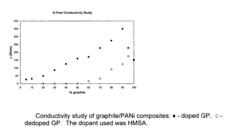
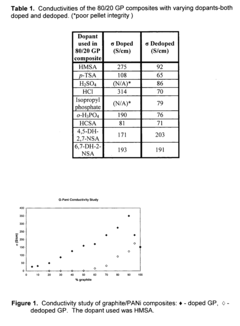
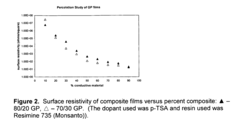
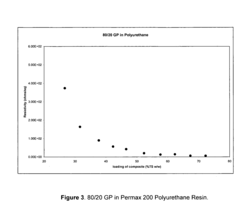
- The development of composites comprising graphite and doped polyaniline, polypyrrole, polythiophene, or polyethylenedioxythiophene with graphite, synthesized by oxidative polymerization in the presence of an acid dopant, resulting in higher conductivity and improved dispersibility in various solvents and resins.
Polymer composites and methods for producing the same
PatentInactiveUS20100190924A1
Innovation
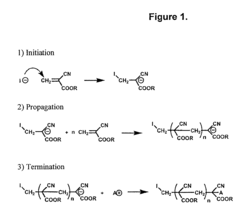
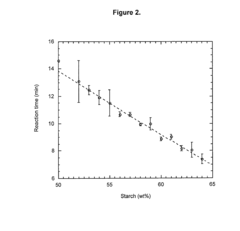
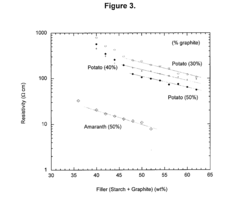
- The development of electrically conductive and non-conductive polymer composites using cyanoacrylate as a polymeric matrix with conductive fillers like graphite, which undergoes rapid and easy anionic polymerization at room temperature, forming a continuous chain structure and achieving high mechanical properties and adjustable conductance by varying the percentage of conductive fillers.
Sustainability and Environmental Impact Assessment
The environmental impact of conductive polymer composites (CPCs) represents a critical dimension in their market adoption and long-term viability. These materials offer significant sustainability advantages compared to traditional metal-based conductors, primarily through reduced energy consumption during manufacturing. The production of CPCs typically requires 30-45% less energy than comparable metallic conductors, resulting in a substantially lower carbon footprint across the product lifecycle.
Waste management considerations for CPCs present both challenges and opportunities. While some polymer matrices are inherently recyclable, the addition of conductive fillers can complicate end-of-life processing. Recent innovations in biodegradable conductive polymers, particularly those incorporating cellulose nanofibers and lignin-based carbon, demonstrate promising decomposition rates with minimal environmental persistence. These advancements address growing concerns about electronic waste accumulation in emerging markets where formal recycling infrastructure may be limited.
Life cycle assessment (LCA) studies indicate that CPCs can reduce environmental impact by 25-40% compared to conventional alternatives when considering extraction, manufacturing, use, and disposal phases. This advantage becomes particularly significant in applications requiring frequent replacement or maintenance, where the durability of CPCs translates to fewer replacement cycles and consequently reduced resource consumption.
Water usage represents another critical environmental metric. CPC manufacturing processes typically consume 50-70% less water than traditional metal conductor production, an especially important consideration for implementation in water-stressed regions common in many emerging markets. Additionally, the absence of toxic heavy metals in most CPC formulations eliminates risks associated with groundwater contamination during both production and disposal phases.
Regulatory frameworks governing environmental standards for electronic materials vary significantly across emerging markets. Countries like India and Brazil have recently implemented stricter regulations on electronic waste and material toxicity, creating market advantages for CPCs that meet these enhanced environmental criteria. Manufacturers developing CPCs with comprehensive environmental compliance documentation gain competitive advantages in these increasingly regulated markets.
Carbon footprint reduction potential through CPC adoption extends beyond manufacturing to include transportation efficiencies. The lightweight nature of these composites (typically 40-60% lighter than metal equivalents) translates to reduced fuel consumption during distribution, particularly relevant for remote regions in emerging markets where transportation infrastructure challenges amplify the environmental impact of heavy materials.
Waste management considerations for CPCs present both challenges and opportunities. While some polymer matrices are inherently recyclable, the addition of conductive fillers can complicate end-of-life processing. Recent innovations in biodegradable conductive polymers, particularly those incorporating cellulose nanofibers and lignin-based carbon, demonstrate promising decomposition rates with minimal environmental persistence. These advancements address growing concerns about electronic waste accumulation in emerging markets where formal recycling infrastructure may be limited.
Life cycle assessment (LCA) studies indicate that CPCs can reduce environmental impact by 25-40% compared to conventional alternatives when considering extraction, manufacturing, use, and disposal phases. This advantage becomes particularly significant in applications requiring frequent replacement or maintenance, where the durability of CPCs translates to fewer replacement cycles and consequently reduced resource consumption.
Water usage represents another critical environmental metric. CPC manufacturing processes typically consume 50-70% less water than traditional metal conductor production, an especially important consideration for implementation in water-stressed regions common in many emerging markets. Additionally, the absence of toxic heavy metals in most CPC formulations eliminates risks associated with groundwater contamination during both production and disposal phases.
Regulatory frameworks governing environmental standards for electronic materials vary significantly across emerging markets. Countries like India and Brazil have recently implemented stricter regulations on electronic waste and material toxicity, creating market advantages for CPCs that meet these enhanced environmental criteria. Manufacturers developing CPCs with comprehensive environmental compliance documentation gain competitive advantages in these increasingly regulated markets.
Carbon footprint reduction potential through CPC adoption extends beyond manufacturing to include transportation efficiencies. The lightweight nature of these composites (typically 40-60% lighter than metal equivalents) translates to reduced fuel consumption during distribution, particularly relevant for remote regions in emerging markets where transportation infrastructure challenges amplify the environmental impact of heavy materials.
Emerging Market Entry Strategies and Challenges
Entering emerging markets with conductive polymer composite technologies requires strategic planning and careful consideration of unique regional challenges. Developing economies in Asia, Africa, and Latin America present significant opportunities due to their rapid industrialization, growing middle classes, and increasing infrastructure investments. However, these markets exhibit distinct characteristics that demand tailored approaches.
Market entry strategies must begin with comprehensive localization efforts. This involves adapting product specifications to meet regional requirements, such as different electrical standards, climate conditions, and price sensitivities. Companies must also navigate complex regulatory environments that vary significantly across emerging economies, with some requiring extensive certification processes or imposing import restrictions on advanced materials.
Partnership models represent a critical success factor for market penetration. Joint ventures with local manufacturers can provide immediate market access while addressing nationalist procurement policies. Technology licensing agreements offer another pathway, allowing companies to monetize intellectual property while enabling local partners to handle production and distribution. Strategic alliances with regional research institutions can further enhance product adaptation and foster innovation ecosystems.
Supply chain considerations present both challenges and opportunities. Establishing regional manufacturing hubs can reduce logistics costs and import duties while demonstrating commitment to local economic development. However, companies must carefully evaluate raw material availability, quality control capabilities, and intellectual property protection measures in potential manufacturing locations.
Cultural and business practice differences significantly impact market entry success. Relationship-building often takes precedence over transactional approaches in many emerging markets. Decision-making processes may follow different hierarchical structures, and negotiation styles can vary dramatically from Western norms. Companies must invest in developing cultural intelligence and adapting their communication strategies accordingly.
Pricing strategies require particular attention, as emerging markets typically demonstrate higher price sensitivity but also contain premium segments willing to pay for advanced technologies. Tiered pricing models, feature-adjusted products, and innovative financing options can help address these diverse market needs while maintaining profitability.
Risk management frameworks must account for currency volatility, political instability, and infrastructure limitations common in emerging economies. Companies should develop contingency plans for supply chain disruptions, establish diverse banking relationships, and consider political risk insurance where appropriate. Despite these challenges, first-mover advantages in emerging markets can establish brand dominance and create significant barriers to later entrants.
Market entry strategies must begin with comprehensive localization efforts. This involves adapting product specifications to meet regional requirements, such as different electrical standards, climate conditions, and price sensitivities. Companies must also navigate complex regulatory environments that vary significantly across emerging economies, with some requiring extensive certification processes or imposing import restrictions on advanced materials.
Partnership models represent a critical success factor for market penetration. Joint ventures with local manufacturers can provide immediate market access while addressing nationalist procurement policies. Technology licensing agreements offer another pathway, allowing companies to monetize intellectual property while enabling local partners to handle production and distribution. Strategic alliances with regional research institutions can further enhance product adaptation and foster innovation ecosystems.
Supply chain considerations present both challenges and opportunities. Establishing regional manufacturing hubs can reduce logistics costs and import duties while demonstrating commitment to local economic development. However, companies must carefully evaluate raw material availability, quality control capabilities, and intellectual property protection measures in potential manufacturing locations.
Cultural and business practice differences significantly impact market entry success. Relationship-building often takes precedence over transactional approaches in many emerging markets. Decision-making processes may follow different hierarchical structures, and negotiation styles can vary dramatically from Western norms. Companies must invest in developing cultural intelligence and adapting their communication strategies accordingly.
Pricing strategies require particular attention, as emerging markets typically demonstrate higher price sensitivity but also contain premium segments willing to pay for advanced technologies. Tiered pricing models, feature-adjusted products, and innovative financing options can help address these diverse market needs while maintaining profitability.
Risk management frameworks must account for currency volatility, political instability, and infrastructure limitations common in emerging economies. Companies should develop contingency plans for supply chain disruptions, establish diverse banking relationships, and consider political risk insurance where appropriate. Despite these challenges, first-mover advantages in emerging markets can establish brand dominance and create significant barriers to later entrants.
Unlock deeper insights with PatSnap Eureka Quick Research — get a full tech report to explore trends and direct your research. Try now!
Generate Your Research Report Instantly with AI Agent
Supercharge your innovation with PatSnap Eureka AI Agent Platform!