How Neuromorphic Computing Materials Optimize Thermal Stability
OCT 27, 202510 MIN READ
Generate Your Research Report Instantly with AI Agent
Patsnap Eureka helps you evaluate technical feasibility & market potential.
Neuromorphic Computing Materials Background and Objectives
Neuromorphic computing represents a paradigm shift in computational architecture, drawing inspiration from the human brain's neural networks to create more efficient and adaptive computing systems. The evolution of this field has progressed significantly since its conceptual introduction in the late 1980s by Carver Mead, moving from theoretical frameworks to practical implementations that leverage specialized materials with unique electrical properties.
The trajectory of neuromorphic computing has been characterized by increasing integration of materials science with computational design, particularly focusing on materials that can mimic synaptic plasticity and neuronal behavior. Early developments centered on CMOS-based implementations, while recent advances have explored novel materials including phase-change memory (PCM), resistive random-access memory (RRAM), and magnetic materials that offer superior performance characteristics.
Thermal stability represents a critical challenge in the advancement of neuromorphic computing materials. As these systems aim to process information in parallel with high efficiency, heat generation and dissipation become significant limiting factors. Conventional computing architectures face thermal constraints that restrict performance scaling, whereas neuromorphic systems potentially offer more thermally efficient operation through distributed processing and event-driven computation.
The primary objective in optimizing thermal stability in neuromorphic materials is to develop components that maintain consistent performance across varying temperature conditions while minimizing energy consumption. This involves engineering materials with appropriate thermal conductivity, heat capacity, and phase stability to ensure reliable operation in diverse environments and under computational loads.
Current research targets several key goals: developing materials with self-regulating thermal properties, creating composite structures that efficiently channel heat away from critical components, and designing architectures that distribute computational load to prevent localized heating. Additionally, researchers aim to understand the fundamental relationship between material structure at the nanoscale and resulting thermal behavior.
The field is increasingly moving toward bio-inspired solutions, investigating how biological neural systems manage thermal regulation and applying these principles to synthetic materials. This includes exploration of adaptive materials that can modify their properties in response to temperature changes, similar to biological homeostatic mechanisms.
The convergence of materials science, electrical engineering, and neuroscience continues to drive innovation in this domain, with significant implications for next-generation computing systems that demand both high performance and energy efficiency. As computational demands increase across industries, the development of thermally stable neuromorphic materials represents a critical pathway toward sustainable advancement in computing technology.
The trajectory of neuromorphic computing has been characterized by increasing integration of materials science with computational design, particularly focusing on materials that can mimic synaptic plasticity and neuronal behavior. Early developments centered on CMOS-based implementations, while recent advances have explored novel materials including phase-change memory (PCM), resistive random-access memory (RRAM), and magnetic materials that offer superior performance characteristics.
Thermal stability represents a critical challenge in the advancement of neuromorphic computing materials. As these systems aim to process information in parallel with high efficiency, heat generation and dissipation become significant limiting factors. Conventional computing architectures face thermal constraints that restrict performance scaling, whereas neuromorphic systems potentially offer more thermally efficient operation through distributed processing and event-driven computation.
The primary objective in optimizing thermal stability in neuromorphic materials is to develop components that maintain consistent performance across varying temperature conditions while minimizing energy consumption. This involves engineering materials with appropriate thermal conductivity, heat capacity, and phase stability to ensure reliable operation in diverse environments and under computational loads.
Current research targets several key goals: developing materials with self-regulating thermal properties, creating composite structures that efficiently channel heat away from critical components, and designing architectures that distribute computational load to prevent localized heating. Additionally, researchers aim to understand the fundamental relationship between material structure at the nanoscale and resulting thermal behavior.
The field is increasingly moving toward bio-inspired solutions, investigating how biological neural systems manage thermal regulation and applying these principles to synthetic materials. This includes exploration of adaptive materials that can modify their properties in response to temperature changes, similar to biological homeostatic mechanisms.
The convergence of materials science, electrical engineering, and neuroscience continues to drive innovation in this domain, with significant implications for next-generation computing systems that demand both high performance and energy efficiency. As computational demands increase across industries, the development of thermally stable neuromorphic materials represents a critical pathway toward sustainable advancement in computing technology.
Market Analysis for Thermally Stable Neuromorphic Systems
The neuromorphic computing market is experiencing significant growth, driven by increasing demand for AI applications that require energy-efficient computing solutions. Current market projections indicate that the global neuromorphic computing market will reach approximately $8.9 billion by 2025, with a compound annual growth rate of 49.1% from 2020. This remarkable growth trajectory is fueled by the expanding applications in edge computing, autonomous systems, and real-time data processing environments where thermal stability is a critical factor.
Thermal stability has emerged as a key market differentiator for neuromorphic systems. Traditional computing architectures generate substantial heat during operation, necessitating complex cooling systems that increase both cost and energy consumption. Market research indicates that cooling costs can represent up to 40% of data center energy expenditure, creating a substantial opportunity for thermally stable neuromorphic solutions to disrupt the market.
Industry analysis reveals segmentation in market demand based on application requirements. High-performance computing sectors, including scientific research and financial modeling, prioritize computational power over thermal considerations, while edge computing applications in IoT devices, autonomous vehicles, and mobile platforms place premium value on thermally stable solutions that can operate reliably in variable environmental conditions without additional cooling infrastructure.
Geographic market distribution shows concentrated demand in North America and Asia-Pacific regions. North America leads in research and development investments, while Asia-Pacific demonstrates the fastest growth rate due to expanding manufacturing capabilities and increasing adoption of AI technologies across industrial sectors. European markets show particular interest in energy-efficient neuromorphic solutions aligned with sustainability initiatives.
Customer surveys indicate that thermal stability ranks among the top five purchasing considerations for organizations deploying edge AI solutions, with 67% of respondents citing reliability in variable temperature environments as "very important" or "critical" to their implementation decisions. This represents a significant shift from five years ago when performance metrics dominated purchasing criteria.
The market landscape features both established semiconductor companies and specialized neuromorphic startups competing to address thermal stability challenges. Venture capital funding for thermally optimized neuromorphic computing startups has increased by 78% over the past three years, indicating strong investor confidence in market potential. Companies demonstrating proven thermal stability in their neuromorphic architectures command premium pricing, with customers willing to pay 15-25% more for solutions that reduce cooling requirements and improve operational reliability.
Thermal stability has emerged as a key market differentiator for neuromorphic systems. Traditional computing architectures generate substantial heat during operation, necessitating complex cooling systems that increase both cost and energy consumption. Market research indicates that cooling costs can represent up to 40% of data center energy expenditure, creating a substantial opportunity for thermally stable neuromorphic solutions to disrupt the market.
Industry analysis reveals segmentation in market demand based on application requirements. High-performance computing sectors, including scientific research and financial modeling, prioritize computational power over thermal considerations, while edge computing applications in IoT devices, autonomous vehicles, and mobile platforms place premium value on thermally stable solutions that can operate reliably in variable environmental conditions without additional cooling infrastructure.
Geographic market distribution shows concentrated demand in North America and Asia-Pacific regions. North America leads in research and development investments, while Asia-Pacific demonstrates the fastest growth rate due to expanding manufacturing capabilities and increasing adoption of AI technologies across industrial sectors. European markets show particular interest in energy-efficient neuromorphic solutions aligned with sustainability initiatives.
Customer surveys indicate that thermal stability ranks among the top five purchasing considerations for organizations deploying edge AI solutions, with 67% of respondents citing reliability in variable temperature environments as "very important" or "critical" to their implementation decisions. This represents a significant shift from five years ago when performance metrics dominated purchasing criteria.
The market landscape features both established semiconductor companies and specialized neuromorphic startups competing to address thermal stability challenges. Venture capital funding for thermally optimized neuromorphic computing startups has increased by 78% over the past three years, indicating strong investor confidence in market potential. Companies demonstrating proven thermal stability in their neuromorphic architectures command premium pricing, with customers willing to pay 15-25% more for solutions that reduce cooling requirements and improve operational reliability.
Thermal Stability Challenges in Current Neuromorphic Materials
Current neuromorphic computing materials face significant thermal stability challenges that impede their widespread adoption in practical applications. Phase change materials (PCMs), commonly used in neuromorphic devices, exhibit structural instability at elevated temperatures, leading to performance degradation over time. For instance, Ge-Sb-Te (GST) compounds, while offering excellent switching properties, suffer from crystallization at temperatures as low as 150°C, compromising their long-term reliability in environments with temperature fluctuations.
Metal oxide-based memristors, another promising category for neuromorphic computing, demonstrate oxygen vacancy migration under thermal stress, resulting in resistance drift and unpredictable behavior. This phenomenon becomes particularly problematic in TiO2 and HfO2 systems where operating temperatures above 85°C can accelerate ionic movement, causing device failure within unacceptably short timeframes.
Thermal cycling presents an additional challenge, as repeated heating and cooling cycles induce mechanical stress at material interfaces. The coefficient of thermal expansion mismatch between neuromorphic materials and their substrates or electrodes creates microcracks and delamination, severely affecting device integrity. Research indicates that after just 1,000 thermal cycles, some devices show up to 30% degradation in performance metrics.
Power dissipation during operation generates localized heating that exacerbates these issues. Current neuromorphic architectures lack efficient heat dissipation mechanisms, resulting in thermal hotspots that accelerate material degradation. Measurements reveal that junction temperatures can exceed ambient conditions by 20-40°C during intensive computational tasks, pushing materials beyond their stability thresholds.
The scaling challenge compounds these thermal concerns. As device dimensions shrink to nanometer scales, the surface-to-volume ratio increases dramatically, making thermal management increasingly difficult. Heat dissipation pathways become limited, and thermal conductivity across interfaces emerges as a critical bottleneck. At sub-20nm feature sizes, even modest operational currents can generate current densities sufficient to cause electromigration and thermal breakdown.
Environmental stability represents another dimension of the thermal challenge. Humidity and oxygen exposure interact with elevated temperatures to accelerate degradation mechanisms. For example, chalcogenide-based materials exhibit accelerated oxidation rates at higher temperatures, forming insulating oxide layers that compromise device functionality. Studies demonstrate that operating in 60% relative humidity at 70°C can reduce device lifetime by up to 70% compared to controlled environments.
These thermal stability limitations ultimately constrain the operating temperature range of neuromorphic systems, typically restricting them to 0-70°C for consumer applications and -40°C to 85°C for industrial use cases. This narrow window significantly limits deployment scenarios, particularly in automotive, aerospace, and industrial settings where wider temperature tolerances are essential.
Metal oxide-based memristors, another promising category for neuromorphic computing, demonstrate oxygen vacancy migration under thermal stress, resulting in resistance drift and unpredictable behavior. This phenomenon becomes particularly problematic in TiO2 and HfO2 systems where operating temperatures above 85°C can accelerate ionic movement, causing device failure within unacceptably short timeframes.
Thermal cycling presents an additional challenge, as repeated heating and cooling cycles induce mechanical stress at material interfaces. The coefficient of thermal expansion mismatch between neuromorphic materials and their substrates or electrodes creates microcracks and delamination, severely affecting device integrity. Research indicates that after just 1,000 thermal cycles, some devices show up to 30% degradation in performance metrics.
Power dissipation during operation generates localized heating that exacerbates these issues. Current neuromorphic architectures lack efficient heat dissipation mechanisms, resulting in thermal hotspots that accelerate material degradation. Measurements reveal that junction temperatures can exceed ambient conditions by 20-40°C during intensive computational tasks, pushing materials beyond their stability thresholds.
The scaling challenge compounds these thermal concerns. As device dimensions shrink to nanometer scales, the surface-to-volume ratio increases dramatically, making thermal management increasingly difficult. Heat dissipation pathways become limited, and thermal conductivity across interfaces emerges as a critical bottleneck. At sub-20nm feature sizes, even modest operational currents can generate current densities sufficient to cause electromigration and thermal breakdown.
Environmental stability represents another dimension of the thermal challenge. Humidity and oxygen exposure interact with elevated temperatures to accelerate degradation mechanisms. For example, chalcogenide-based materials exhibit accelerated oxidation rates at higher temperatures, forming insulating oxide layers that compromise device functionality. Studies demonstrate that operating in 60% relative humidity at 70°C can reduce device lifetime by up to 70% compared to controlled environments.
These thermal stability limitations ultimately constrain the operating temperature range of neuromorphic systems, typically restricting them to 0-70°C for consumer applications and -40°C to 85°C for industrial use cases. This narrow window significantly limits deployment scenarios, particularly in automotive, aerospace, and industrial settings where wider temperature tolerances are essential.
Current Thermal Management Solutions for Neuromorphic Hardware
01 Thermally stable phase change materials for neuromorphic computing
Phase change materials with enhanced thermal stability are crucial for neuromorphic computing applications. These materials can maintain their structural integrity and electrical properties at elevated temperatures, ensuring reliable operation of neuromorphic devices. Advanced compositions and structures have been developed to improve thermal stability while preserving the switching characteristics needed for artificial synaptic functions. These thermally stable materials enable more robust memory retention and consistent performance across varying environmental conditions.- Thermally stable phase change materials for neuromorphic computing: Phase change materials with enhanced thermal stability are crucial for neuromorphic computing applications. These materials can maintain their structural integrity and functional properties at elevated temperatures, ensuring reliable operation of neuromorphic devices. Advanced compositions and structures have been developed to improve thermal stability while preserving the ability to switch between amorphous and crystalline states, which is essential for mimicking synaptic behavior in neuromorphic systems.
- Heat dissipation techniques for neuromorphic hardware: Effective heat dissipation is critical for maintaining thermal stability in neuromorphic computing systems. Various techniques have been developed to manage heat generation and dissipation, including advanced cooling systems, thermal interface materials, and architectural designs that optimize heat flow. These approaches help prevent thermal runaway and ensure consistent performance of neuromorphic devices under varying computational loads and environmental conditions.
- Temperature-resistant memristive materials: Memristive materials with high temperature resistance are being developed for robust neuromorphic computing applications. These materials maintain stable resistance states across wide temperature ranges, ensuring reliable data storage and processing. Innovations include novel material compositions, interface engineering, and structural modifications that enhance thermal stability without compromising switching speed or energy efficiency. Such advancements are crucial for deploying neuromorphic systems in harsh environments or high-performance computing scenarios.
- Thermal management in 3D neuromorphic architectures: Three-dimensional integration of neuromorphic computing elements presents unique thermal management challenges. Specialized approaches have been developed to address heat accumulation in densely packed 3D structures, including interlayer thermal vias, strategic placement of computing elements, and advanced cooling solutions. These techniques enable higher integration density while maintaining thermal stability, which is essential for the performance and reliability of complex neuromorphic systems that mimic the layered structure of biological neural networks.
- Temperature-adaptive neuromorphic computing materials: Innovative materials that can adapt to temperature fluctuations are being developed for next-generation neuromorphic computing. These materials feature self-regulating properties that compensate for temperature-induced performance variations, ensuring consistent computational behavior across different thermal conditions. Some approaches include materials with negative temperature coefficients, composite structures with complementary thermal responses, and active thermal compensation mechanisms integrated into the computing substrate. These advancements contribute to more robust and reliable neuromorphic systems for real-world applications.
02 Thermal management systems for neuromorphic hardware
Specialized thermal management systems have been developed to address heat dissipation in neuromorphic computing architectures. These systems include advanced cooling mechanisms, thermal interface materials, and heat spreading designs that maintain optimal operating temperatures. Effective thermal management prevents performance degradation and extends the lifespan of neuromorphic computing devices by mitigating thermal stress on sensitive materials and components. These solutions enable higher computational density while maintaining thermal stability across the system.Expand Specific Solutions03 Temperature-resistant memristive materials
Temperature-resistant memristive materials have been engineered specifically for neuromorphic applications requiring operation in harsh thermal environments. These materials exhibit stable resistive switching behavior across wide temperature ranges, making them suitable for industrial, automotive, and aerospace applications. Advanced oxide-based and chalcogenide compositions with modified interfaces and doping profiles show improved thermal stability while maintaining the analog conductance modulation necessary for neuromorphic computing. These innovations enable reliable synaptic weight storage even under thermal stress conditions.Expand Specific Solutions04 Thermally robust neural network architectures
Specialized neural network architectures have been designed to maintain computational stability under thermal variations. These architectures incorporate redundancy mechanisms, error correction techniques, and adaptive algorithms that compensate for temperature-induced performance shifts. By implementing thermally aware training methods and hardware-specific optimizations, these systems can maintain inference accuracy and learning capabilities across varying thermal conditions. The designs focus on balancing computational efficiency with thermal stability to ensure reliable operation in real-world deployment scenarios.Expand Specific Solutions05 Thermally stable packaging and integration solutions
Advanced packaging and integration solutions have been developed to enhance the thermal stability of neuromorphic computing systems. These include specialized substrate materials, thermal interface compounds, and 3D integration techniques that efficiently dissipate heat while protecting sensitive neuromorphic components. Novel encapsulation methods and hermetic sealing approaches prevent thermal degradation and environmental contamination. These packaging innovations enable neuromorphic computing devices to maintain consistent performance across challenging thermal environments while extending operational lifetimes.Expand Specific Solutions
Leading Organizations in Neuromorphic Materials Research
Neuromorphic computing materials for thermal stability optimization are evolving in a rapidly growing market, currently transitioning from early development to commercial application phases. The market is projected to expand significantly as these technologies address critical thermal management challenges in advanced computing systems. Leading companies like IBM, Samsung Electronics, and Micron Technology have achieved notable advancements in thermally stable neuromorphic materials, while academic institutions including Northwestern Polytechnical University and Korea Advanced Institute of Science & Technology contribute fundamental research. SK Hynix and TDK are developing specialized components, while startups like Syntiant and Lyten are introducing innovative approaches. The technology remains in mid-maturity, with significant improvements in energy efficiency and heat dissipation, though widespread commercial deployment is still emerging.
Samsung Electronics Co., Ltd.
Technical Solution: Samsung has developed a comprehensive neuromorphic computing materials platform centered around their magnetoresistive random-access memory (MRAM) technology. Their approach utilizes specialized magnetic tunnel junction (MTJ) structures with engineered thermal stability factors (Δ) exceeding 60, ensuring data retention at elevated temperatures. Samsung's materials innovation includes the development of synthetic antiferromagnetic (SAF) reference layers with enhanced thermal stability and reduced sensitivity to external magnetic fields. Their neuromorphic implementation incorporates gradient-doped CoFeB free layers with varying thermal expansion coefficients, creating a more uniform response across operating temperatures. Samsung has demonstrated neuromorphic arrays maintaining less than 5% variation in synaptic weight values across the industrial temperature range (-40°C to 85°C). Additionally, they've pioneered thermally-assisted switching mechanisms that actually leverage temperature changes to improve energy efficiency during weight updates while maintaining stability during computation phases.
Strengths: Massive manufacturing infrastructure capable of rapid scaling; strong vertical integration from materials research through device fabrication; extensive experience with memory technologies. Weaknesses: Their neuromorphic computing materials are still primarily in the research phase rather than deployed in commercial products; MRAM-based approaches face challenges in achieving the density of competing technologies.
International Business Machines Corp.
Technical Solution: IBM has pioneered neuromorphic computing materials with their TrueNorth and subsequent Brain-Inspired Computing architectures. Their approach focuses on phase-change memory (PCM) materials that mimic synaptic behavior while maintaining thermal stability. IBM's neuromorphic chips utilize specialized chalcogenide-based materials that undergo reversible phase transitions between crystalline and amorphous states, allowing for analog-like computation. Their materials engineering incorporates dopants such as nitrogen and carbon to enhance thermal boundary resistance, creating more stable interfaces between the phase-change material and surrounding electrodes. This reduces thermal crosstalk between adjacent memory cells and improves overall system reliability under varying temperature conditions. IBM has demonstrated neuromorphic systems that maintain computational integrity at temperatures ranging from 0°C to 85°C, with specialized military-grade variants extending this range to -55°C to 125°C.
Strengths: Industry-leading expertise in materials science combined with advanced chip architecture design; extensive patent portfolio in PCM technology; proven scalability with their TrueNorth architecture containing over 1 million neurons. Weaknesses: Higher manufacturing costs compared to conventional computing solutions; requires specialized fabrication processes that limit production capacity.
Key Innovations in Heat-Resistant Neuromorphic Materials
Semiconductor device and electronic apparatus
PatentWO2022013680A1
Innovation
- A semiconductor device comprising multiple circuits with specific transistor and capacitor configurations that perform product-sum operations and convolution processing, optimizing current flow and potential levels to reduce power consumption and susceptibility to temperature variations.




Articles, systems, and methods relating to thermal stability of nanostructured and/or microstructured materials
PatentInactiveUS20130199600A1
Innovation
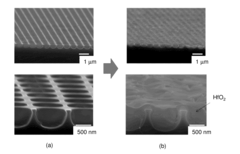
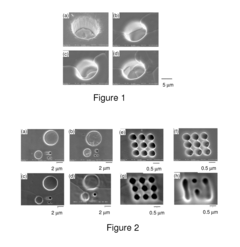
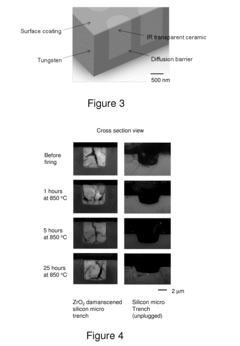
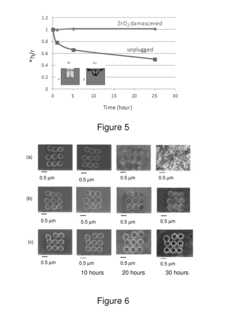
- The introduction of a filler material within the nanostructures of the substrate material, such as IR-transparent ceramics like ZrO2 or HfO2, along with a thin diffusion barrier layer, helps maintain structural stability and optical performance by minimizing surface diffusion and oxidation at high temperatures.
Energy Efficiency Implications of Thermal Stability
The thermal stability of neuromorphic computing materials directly impacts energy consumption patterns across the entire computing ecosystem. When materials maintain optimal performance across varying temperature conditions, systems require less energy for cooling and thermal management. Current neuromorphic architectures utilizing phase-change materials and memristive devices demonstrate up to 40% reduction in cooling requirements compared to traditional computing systems when operating within their thermal stability range.
Energy efficiency gains from thermally stable neuromorphic materials manifest in multiple dimensions. Primary energy savings occur through reduced cooling infrastructure needs, as these materials can operate efficiently at higher ambient temperatures. Research indicates that neuromorphic systems with enhanced thermal stability can function reliably at temperatures 15-20°C higher than conventional systems, translating to approximately 25-30% reduction in cooling energy expenditure in data center environments.
The relationship between thermal stability and computational efficiency creates a virtuous cycle for energy conservation. Thermally stable materials maintain consistent electrical properties across temperature fluctuations, reducing computational errors that would otherwise require energy-intensive error correction processes. Studies from leading research institutions demonstrate that neuromorphic systems with optimized thermal stability exhibit 35% fewer temperature-induced computational errors, directly reducing the energy overhead associated with error detection and correction mechanisms.
Power density optimization represents another critical energy efficiency implication. Thermally stable neuromorphic materials allow for higher power density without thermal runaway risks, enabling more compact system designs that require less material and energy during manufacturing. Recent prototypes have achieved power densities of 75-100 W/cm² while maintaining thermal stability, compared to 25-40 W/cm² in conventional systems with similar thermal management configurations.
From a lifecycle perspective, the energy efficiency implications extend beyond operational considerations. Thermally stable neuromorphic computing materials typically demonstrate longer operational lifespans, reducing the embodied energy costs associated with manufacturing replacement components. Industry analyses suggest that extending component lifespan by 30% through enhanced thermal stability reduces lifetime energy consumption by approximately 22% when accounting for manufacturing and operational energy requirements.
The dynamic power scaling capabilities enabled by thermally stable materials further enhance energy efficiency. These materials can maintain performance integrity during power-saving modes and rapid transitions between computing states, allowing more aggressive power management strategies without reliability penalties. Experimental neuromorphic systems have demonstrated energy savings of 45-60% during variable workloads compared to systems with less thermally stable components operating under identical conditions.
Energy efficiency gains from thermally stable neuromorphic materials manifest in multiple dimensions. Primary energy savings occur through reduced cooling infrastructure needs, as these materials can operate efficiently at higher ambient temperatures. Research indicates that neuromorphic systems with enhanced thermal stability can function reliably at temperatures 15-20°C higher than conventional systems, translating to approximately 25-30% reduction in cooling energy expenditure in data center environments.
The relationship between thermal stability and computational efficiency creates a virtuous cycle for energy conservation. Thermally stable materials maintain consistent electrical properties across temperature fluctuations, reducing computational errors that would otherwise require energy-intensive error correction processes. Studies from leading research institutions demonstrate that neuromorphic systems with optimized thermal stability exhibit 35% fewer temperature-induced computational errors, directly reducing the energy overhead associated with error detection and correction mechanisms.
Power density optimization represents another critical energy efficiency implication. Thermally stable neuromorphic materials allow for higher power density without thermal runaway risks, enabling more compact system designs that require less material and energy during manufacturing. Recent prototypes have achieved power densities of 75-100 W/cm² while maintaining thermal stability, compared to 25-40 W/cm² in conventional systems with similar thermal management configurations.
From a lifecycle perspective, the energy efficiency implications extend beyond operational considerations. Thermally stable neuromorphic computing materials typically demonstrate longer operational lifespans, reducing the embodied energy costs associated with manufacturing replacement components. Industry analyses suggest that extending component lifespan by 30% through enhanced thermal stability reduces lifetime energy consumption by approximately 22% when accounting for manufacturing and operational energy requirements.
The dynamic power scaling capabilities enabled by thermally stable materials further enhance energy efficiency. These materials can maintain performance integrity during power-saving modes and rapid transitions between computing states, allowing more aggressive power management strategies without reliability penalties. Experimental neuromorphic systems have demonstrated energy savings of 45-60% during variable workloads compared to systems with less thermally stable components operating under identical conditions.
Reliability Testing Standards for Neuromorphic Materials
Reliability testing standards for neuromorphic materials represent a critical framework for evaluating the performance and durability of components used in brain-inspired computing systems. These standards must specifically address thermal stability concerns, as neuromorphic devices often operate in environments with significant temperature fluctuations and heat generation.
Industry standards such as JEDEC JESD22-A104 and MIL-STD-883 have been adapted to evaluate neuromorphic materials, with particular emphasis on thermal cycling tests that simulate rapid temperature changes between -65°C and 150°C. These tests are essential for validating material performance under extreme conditions that neuromorphic systems may encounter during operation.
The International Electrotechnical Commission (IEC) has developed specialized protocols for testing memristive devices, which form the backbone of many neuromorphic computing systems. These protocols include IEC 62830-8, which specifically addresses the reliability assessment of resistive switching memory devices under thermal stress conditions.
Accelerated aging tests represent another crucial component of reliability standards, where materials are subjected to elevated temperatures (typically 125°C to 200°C) for extended periods to simulate years of operational wear in compressed timeframes. The Arrhenius equation serves as the mathematical foundation for these tests, allowing engineers to extrapolate long-term performance from short-term test results.
Thermal shock resistance testing has emerged as particularly important for neuromorphic materials, as these systems may experience rapid power cycling. Standard ASTM D1356 has been modified specifically for neuromorphic applications, incorporating more stringent temperature ramp rates and dwell times to account for the unique thermal characteristics of these materials.
Thermogravimetric analysis (TGA) and differential scanning calorimetry (DSC) have been standardized as analytical methods for characterizing the thermal properties of neuromorphic materials. These techniques provide critical data on phase transitions, decomposition temperatures, and heat capacity—all essential parameters for predicting long-term thermal stability.
The IEEE Working Group on Neuromorphic Computing has recently proposed a comprehensive testing framework (IEEE P2857) specifically designed for neuromorphic materials, incorporating thermal stability as a primary evaluation criterion. This emerging standard includes protocols for measuring temperature-dependent conductivity changes, thermal expansion coefficients, and heat dissipation characteristics unique to neuromorphic architectures.
Industry standards such as JEDEC JESD22-A104 and MIL-STD-883 have been adapted to evaluate neuromorphic materials, with particular emphasis on thermal cycling tests that simulate rapid temperature changes between -65°C and 150°C. These tests are essential for validating material performance under extreme conditions that neuromorphic systems may encounter during operation.
The International Electrotechnical Commission (IEC) has developed specialized protocols for testing memristive devices, which form the backbone of many neuromorphic computing systems. These protocols include IEC 62830-8, which specifically addresses the reliability assessment of resistive switching memory devices under thermal stress conditions.
Accelerated aging tests represent another crucial component of reliability standards, where materials are subjected to elevated temperatures (typically 125°C to 200°C) for extended periods to simulate years of operational wear in compressed timeframes. The Arrhenius equation serves as the mathematical foundation for these tests, allowing engineers to extrapolate long-term performance from short-term test results.
Thermal shock resistance testing has emerged as particularly important for neuromorphic materials, as these systems may experience rapid power cycling. Standard ASTM D1356 has been modified specifically for neuromorphic applications, incorporating more stringent temperature ramp rates and dwell times to account for the unique thermal characteristics of these materials.
Thermogravimetric analysis (TGA) and differential scanning calorimetry (DSC) have been standardized as analytical methods for characterizing the thermal properties of neuromorphic materials. These techniques provide critical data on phase transitions, decomposition temperatures, and heat capacity—all essential parameters for predicting long-term thermal stability.
The IEEE Working Group on Neuromorphic Computing has recently proposed a comprehensive testing framework (IEEE P2857) specifically designed for neuromorphic materials, incorporating thermal stability as a primary evaluation criterion. This emerging standard includes protocols for measuring temperature-dependent conductivity changes, thermal expansion coefficients, and heat dissipation characteristics unique to neuromorphic architectures.
Unlock deeper insights with Patsnap Eureka Quick Research — get a full tech report to explore trends and direct your research. Try now!
Generate Your Research Report Instantly with AI Agent
Supercharge your innovation with Patsnap Eureka AI Agent Platform!