
How Separator Coatings Stabilize Interfaces in Solid-State Batteries
MAY 22, 20269 MIN READ
Generate Your Research Report Instantly with AI Agent
Patsnap Eureka helps you evaluate technical feasibility & market potential.
Solid-State Battery Interface Challenges and Goals
Solid-state batteries represent a paradigm shift in energy storage technology, addressing critical limitations of conventional lithium-ion batteries through the elimination of liquid electrolytes. The fundamental challenge lies in achieving stable, efficient interfaces between solid components while maintaining high ionic conductivity and mechanical integrity throughout battery operation cycles.
The primary technical objective centers on developing separator coatings that can effectively mediate the complex interfacial interactions between solid electrolytes, electrodes, and protective layers. These coatings must simultaneously address multiple interface-related phenomena including ionic transport barriers, mechanical stress accommodation, and electrochemical stability maintenance across varying operating conditions.
Interface stabilization in solid-state systems requires overcoming inherent challenges related to solid-solid contact limitations, where traditional liquid electrolyte wetting mechanisms are absent. The separator coating technology aims to create artificial interface layers that can replicate and enhance the beneficial aspects of liquid-solid interfaces while maintaining the safety and performance advantages of all-solid configurations.
Key technical goals include achieving ionic conductivities comparable to liquid electrolyte systems, typically targeting values above 10^-3 S/cm at room temperature. Additionally, the coatings must demonstrate mechanical flexibility to accommodate volume changes during charge-discharge cycles while preventing dendrite formation and maintaining electrochemical windows exceeding 4V versus lithium.
The evolution of solid-state battery technology has progressed through distinct phases, beginning with early ceramic electrolyte systems in the 1970s, advancing through polymer-based approaches in the 1990s, and currently focusing on hybrid and composite solutions. Each developmental stage has contributed critical insights into interface engineering requirements and coating material selection criteria.
Contemporary research emphasizes the development of multifunctional separator coatings that can address thermal stability requirements, typically operating effectively across temperature ranges from -20°C to 60°C, while maintaining structural integrity under mechanical stress conditions exceeding 10 MPa. These specifications reflect the demanding operational environments expected in automotive and grid-scale energy storage applications.
The ultimate technological vision encompasses separator coatings that enable solid-state batteries to achieve energy densities exceeding 400 Wh/kg while delivering cycle lives surpassing 10,000 charge-discharge cycles, representing significant improvements over current lithium-ion technology limitations and establishing solid-state systems as viable next-generation energy storage solutions.
The primary technical objective centers on developing separator coatings that can effectively mediate the complex interfacial interactions between solid electrolytes, electrodes, and protective layers. These coatings must simultaneously address multiple interface-related phenomena including ionic transport barriers, mechanical stress accommodation, and electrochemical stability maintenance across varying operating conditions.
Interface stabilization in solid-state systems requires overcoming inherent challenges related to solid-solid contact limitations, where traditional liquid electrolyte wetting mechanisms are absent. The separator coating technology aims to create artificial interface layers that can replicate and enhance the beneficial aspects of liquid-solid interfaces while maintaining the safety and performance advantages of all-solid configurations.
Key technical goals include achieving ionic conductivities comparable to liquid electrolyte systems, typically targeting values above 10^-3 S/cm at room temperature. Additionally, the coatings must demonstrate mechanical flexibility to accommodate volume changes during charge-discharge cycles while preventing dendrite formation and maintaining electrochemical windows exceeding 4V versus lithium.
The evolution of solid-state battery technology has progressed through distinct phases, beginning with early ceramic electrolyte systems in the 1970s, advancing through polymer-based approaches in the 1990s, and currently focusing on hybrid and composite solutions. Each developmental stage has contributed critical insights into interface engineering requirements and coating material selection criteria.
Contemporary research emphasizes the development of multifunctional separator coatings that can address thermal stability requirements, typically operating effectively across temperature ranges from -20°C to 60°C, while maintaining structural integrity under mechanical stress conditions exceeding 10 MPa. These specifications reflect the demanding operational environments expected in automotive and grid-scale energy storage applications.
The ultimate technological vision encompasses separator coatings that enable solid-state batteries to achieve energy densities exceeding 400 Wh/kg while delivering cycle lives surpassing 10,000 charge-discharge cycles, representing significant improvements over current lithium-ion technology limitations and establishing solid-state systems as viable next-generation energy storage solutions.
Market Demand for Advanced Solid-State Battery Solutions
The global solid-state battery market is experiencing unprecedented growth momentum, driven by the urgent need for safer, more energy-dense, and longer-lasting energy storage solutions. Electric vehicle manufacturers are increasingly demanding battery technologies that can overcome the limitations of conventional lithium-ion batteries, particularly regarding thermal runaway risks, limited energy density, and degradation issues that plague current systems.
Consumer electronics manufacturers represent another significant demand driver, seeking compact power solutions that can support increasingly sophisticated devices while maintaining safety standards. The miniaturization trend in smartphones, wearables, and IoT devices requires batteries with higher volumetric energy density, making solid-state technology particularly attractive for these applications.
Grid-scale energy storage applications are emerging as a substantial market opportunity, where the enhanced safety profile and potential for longer cycle life of solid-state batteries address critical infrastructure requirements. Utility companies and renewable energy developers are actively seeking storage solutions that can operate reliably over extended periods without the fire hazards associated with liquid electrolyte systems.
The aerospace and defense sectors demonstrate strong interest in solid-state battery technology due to stringent safety requirements and performance demands in extreme environments. These applications often justify premium pricing for advanced battery solutions, creating favorable market conditions for early commercialization of solid-state technologies.
Market research indicates that separator coating technologies specifically address several critical performance barriers that have historically limited solid-state battery adoption. Interface stability issues between solid electrolytes and electrodes have been identified as primary technical obstacles preventing widespread commercialization, creating substantial demand for innovative coating solutions.
Manufacturing scalability concerns are driving demand for separator coating approaches that can be integrated into existing battery production infrastructure. Companies are actively seeking solutions that enable gradual transition from liquid to solid-state systems without requiring complete manufacturing line overhauls, making coating-based approaches particularly attractive from a commercial perspective.
The convergence of regulatory pressures for safer battery technologies, performance requirements for next-generation applications, and manufacturing feasibility considerations has created a robust market environment for advanced solid-state battery solutions incorporating sophisticated separator coating technologies.
Consumer electronics manufacturers represent another significant demand driver, seeking compact power solutions that can support increasingly sophisticated devices while maintaining safety standards. The miniaturization trend in smartphones, wearables, and IoT devices requires batteries with higher volumetric energy density, making solid-state technology particularly attractive for these applications.
Grid-scale energy storage applications are emerging as a substantial market opportunity, where the enhanced safety profile and potential for longer cycle life of solid-state batteries address critical infrastructure requirements. Utility companies and renewable energy developers are actively seeking storage solutions that can operate reliably over extended periods without the fire hazards associated with liquid electrolyte systems.
The aerospace and defense sectors demonstrate strong interest in solid-state battery technology due to stringent safety requirements and performance demands in extreme environments. These applications often justify premium pricing for advanced battery solutions, creating favorable market conditions for early commercialization of solid-state technologies.
Market research indicates that separator coating technologies specifically address several critical performance barriers that have historically limited solid-state battery adoption. Interface stability issues between solid electrolytes and electrodes have been identified as primary technical obstacles preventing widespread commercialization, creating substantial demand for innovative coating solutions.
Manufacturing scalability concerns are driving demand for separator coating approaches that can be integrated into existing battery production infrastructure. Companies are actively seeking solutions that enable gradual transition from liquid to solid-state systems without requiring complete manufacturing line overhauls, making coating-based approaches particularly attractive from a commercial perspective.
The convergence of regulatory pressures for safer battery technologies, performance requirements for next-generation applications, and manufacturing feasibility considerations has created a robust market environment for advanced solid-state battery solutions incorporating sophisticated separator coating technologies.
Current Interface Stability Issues in Solid-State Batteries
Solid-state batteries face significant interface stability challenges that fundamentally limit their commercial viability and performance characteristics. The primary issue stems from the inherent incompatibility between solid electrolytes and electrode materials, creating unstable interfaces that degrade over time and compromise battery functionality.
Chemical reactivity at electrode-electrolyte interfaces represents one of the most critical stability concerns. Solid electrolytes, particularly sulfide-based materials like Li₆PS₅Cl and Li₁₀GeP₂S₁₂, exhibit thermodynamic instability when in direct contact with high-voltage cathode materials such as LiCoO₂ and LiNi₀.₈Mn₀.₁Co₀.₁O₂. This instability leads to interfacial reactions that form resistive interphases, consuming active lithium and creating impedance barriers that reduce ionic conductivity.
Mechanical stress accumulation during charge-discharge cycles poses another substantial challenge. Volume changes in electrode materials during lithiation and delithiation create mechanical strain at rigid solid-solid interfaces. Unlike liquid electrolytes that can accommodate these dimensional changes, solid electrolytes cannot easily deform, leading to contact loss, crack formation, and progressive interface degradation.
Electrochemical decomposition of solid electrolytes occurs when their electrochemical stability windows are exceeded by electrode operating potentials. Oxide electrolytes like Li₇La₃Zr₂O₁₂ demonstrate better chemical stability but suffer from narrow electrochemical windows, while sulfide electrolytes offer superior ionic conductivity but are prone to oxidation at high voltages and reduction at low potentials.
Space charge layer formation at interfaces creates additional impedance due to charge redistribution and band alignment mismatches between different solid phases. These layers can extend several nanometers into the materials, significantly impacting lithium-ion transport kinetics and overall battery performance.
Interfacial resistance growth over cycling represents a cumulative effect of these stability issues. As interfaces degrade through chemical reactions, mechanical failure, and electrochemical decomposition, the overall cell resistance increases exponentially, leading to capacity fade, voltage hysteresis, and eventual battery failure. Current solid-state battery prototypes typically exhibit interface resistances orders of magnitude higher than their liquid electrolyte counterparts, highlighting the critical nature of these stability challenges.
Chemical reactivity at electrode-electrolyte interfaces represents one of the most critical stability concerns. Solid electrolytes, particularly sulfide-based materials like Li₆PS₅Cl and Li₁₀GeP₂S₁₂, exhibit thermodynamic instability when in direct contact with high-voltage cathode materials such as LiCoO₂ and LiNi₀.₈Mn₀.₁Co₀.₁O₂. This instability leads to interfacial reactions that form resistive interphases, consuming active lithium and creating impedance barriers that reduce ionic conductivity.
Mechanical stress accumulation during charge-discharge cycles poses another substantial challenge. Volume changes in electrode materials during lithiation and delithiation create mechanical strain at rigid solid-solid interfaces. Unlike liquid electrolytes that can accommodate these dimensional changes, solid electrolytes cannot easily deform, leading to contact loss, crack formation, and progressive interface degradation.
Electrochemical decomposition of solid electrolytes occurs when their electrochemical stability windows are exceeded by electrode operating potentials. Oxide electrolytes like Li₇La₃Zr₂O₁₂ demonstrate better chemical stability but suffer from narrow electrochemical windows, while sulfide electrolytes offer superior ionic conductivity but are prone to oxidation at high voltages and reduction at low potentials.
Space charge layer formation at interfaces creates additional impedance due to charge redistribution and band alignment mismatches between different solid phases. These layers can extend several nanometers into the materials, significantly impacting lithium-ion transport kinetics and overall battery performance.
Interfacial resistance growth over cycling represents a cumulative effect of these stability issues. As interfaces degrade through chemical reactions, mechanical failure, and electrochemical decomposition, the overall cell resistance increases exponentially, leading to capacity fade, voltage hysteresis, and eventual battery failure. Current solid-state battery prototypes typically exhibit interface resistances orders of magnitude higher than their liquid electrolyte counterparts, highlighting the critical nature of these stability challenges.
Existing Separator Coating Solutions for Interface Stability
01 Coating material composition and adhesion enhancement
Various coating materials and additives are used to improve the adhesion between separator layers and enhance interface stability. These materials include specialized polymers, adhesion promoters, and surface treatment agents that create stronger bonds between different layers of the separator structure. The composition is optimized to maintain long-term stability under operating conditions.- Coating material composition and adhesion enhancement: Development of specialized coating materials with enhanced adhesion properties to improve interface stability between separators and adjacent components. These compositions focus on optimizing chemical bonding and mechanical interlocking at the interface to prevent delamination and maintain long-term stability under various operating conditions.
- Surface treatment and preparation methods: Techniques for preparing separator surfaces prior to coating application to enhance interface stability. These methods include surface modification, cleaning procedures, and pre-treatment processes that improve coating adhesion and create more stable interfaces between the separator and coating layers.
- Multi-layer coating systems and interface design: Implementation of multi-layer coating architectures designed to optimize interface stability through graduated property transitions. These systems utilize intermediate layers and engineered interfaces to reduce stress concentrations and improve overall coating-separator adhesion performance.
- Mechanical stability and stress management: Design approaches focused on managing mechanical stresses at coating-separator interfaces to prevent failure modes such as cracking, peeling, or delamination. These solutions address thermal expansion mismatches, mechanical loading, and cyclic stress conditions that can compromise interface integrity.
- Interface characterization and quality control: Methods and systems for evaluating and monitoring coating-separator interface stability through various testing and measurement techniques. These approaches enable quality assessment, failure prediction, and optimization of coating processes to ensure reliable interface performance throughout the product lifecycle.
02 Surface modification and treatment techniques
Surface modification methods are employed to improve the interface characteristics of separator coatings. These techniques involve physical or chemical treatments that alter the surface properties to enhance compatibility and bonding between layers. The modifications help reduce delamination and improve overall structural integrity of the separator system.Expand Specific Solutions03 Mechanical stability and structural design
The mechanical design of separator structures focuses on optimizing the physical configuration to maintain interface stability under stress conditions. This includes considerations for layer thickness, structural reinforcement, and mechanical interlocking mechanisms that prevent separation failure during operation and thermal cycling.Expand Specific Solutions04 Thermal stability and temperature resistance
Thermal management approaches are implemented to ensure separator coating interfaces remain stable across operating temperature ranges. These solutions address thermal expansion mismatches, heat dissipation, and temperature-induced stress that could compromise interface integrity. Special attention is given to materials that maintain properties under thermal cycling.Expand Specific Solutions05 Interface monitoring and quality control
Methods for monitoring and controlling interface quality during manufacturing and operation are developed to ensure consistent separator performance. These approaches include testing procedures, quality assessment techniques, and process control measures that verify interface stability and detect potential failure modes before they affect system performance.Expand Specific Solutions
Key Players in Solid-State Battery and Coating Industry
The solid-state battery separator coating technology represents an emerging sector within the rapidly expanding solid-state battery market, currently valued at approximately $1.2 billion and projected to reach $8.7 billion by 2030. The industry is in its early commercialization phase, transitioning from R&D to pilot production. Technology maturity varies significantly among key players: established battery manufacturers like LG Energy Solution, Samsung SDI, and BYD are advancing coating technologies for next-generation batteries, while specialized companies such as Solid Power and separator manufacturers like Shenzhen Senior Technology Material focus on interface stabilization solutions. Automotive leaders including Toyota, Nissan, and Honda are driving demand through EV applications, while research institutions like Fraunhofer-Gesellschaft contribute fundamental innovations. The competitive landscape shows Asian companies dominating manufacturing capabilities, with emerging Chinese players like CALB Group and EVE Energy rapidly scaling production, indicating a technology sector poised for significant growth as solid-state batteries approach commercial viability.
LG Energy Solution Ltd.
Technical Solution: LG Energy Solution has developed proprietary separator coating formulations utilizing lithium-ion conducting polymers combined with inorganic fillers to stabilize solid-state battery interfaces. Their technology focuses on creating gradient coating layers that provide smooth ionic transport pathways while maintaining mechanical flexibility. The coating incorporates nano-sized ceramic particles dispersed in polymer matrices that enhance ionic conductivity and provide structural support. This approach addresses interface instability issues by creating buffer zones that accommodate stress from volume expansion and contraction during charge-discharge cycles, while maintaining low interfacial resistance.
Strengths: Large-scale manufacturing capabilities and established supply chain networks. Weaknesses: Limited solid-state battery commercialization experience compared to liquid electrolyte systems.
Samsung SDI Co., Ltd.
Technical Solution: Samsung SDI has developed multi-functional separator coatings that incorporate lithium-conducting ceramic nanoparticles within polymer matrices to enhance interface stability in solid-state batteries. Their coating technology utilizes sol-gel processing to create uniform thin films that provide both ionic conductivity and mechanical protection. The coatings feature engineered surface chemistry that promotes better wetting and adhesion between solid electrolyte and electrode materials. Additionally, their approach includes thermal management properties within the coating to prevent hot spot formation that could compromise interface integrity during high-rate charging and discharging operations.
Strengths: Advanced materials science expertise and integrated manufacturing capabilities. Weaknesses: High development costs and challenges in achieving uniform coating thickness at industrial scale.
Core Innovations in Interface Stabilization Coatings
Stabilization coatings for solid state batteries
PatentActiveUS10854930B2
Innovation
- Applying metal oxide coatings to stabilize the interfaces between active materials, conductive additives, solid electrolytes, and current collectors in composite solid-state battery electrodes, thereby controlling chemical reactions during high-temperature processing to achieve balanced electrochemical properties.


Interface protection for all-solid-state batteries
PatentPendingUS20230113915A1
Innovation
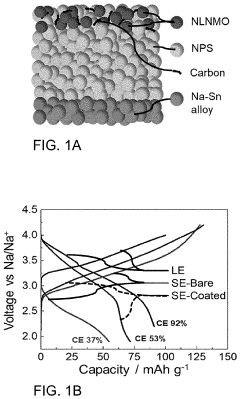
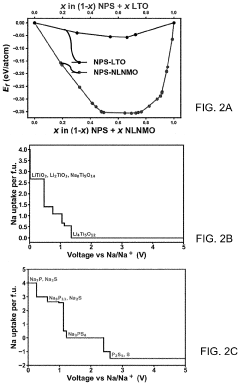
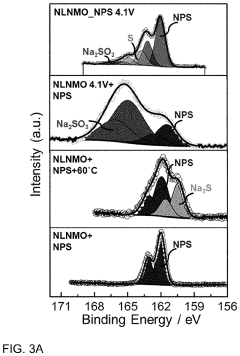
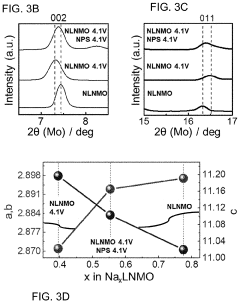
- The application of a Li4Ti5O12 (LTO) coating at the solid-state electrolyte-cathode interface in sodium all-solid-state batteries, which is electronically insulative but ionically conductive, prevents unwanted interfacial reactions and cation inter-diffusion, enabling high voltage operation and long cycle life.
Safety Standards for Solid-State Battery Manufacturing
The development of comprehensive safety standards for solid-state battery manufacturing has become increasingly critical as the technology transitions from laboratory research to commercial production. Current regulatory frameworks primarily address conventional lithium-ion batteries, creating significant gaps in addressing the unique safety considerations associated with solid-state battery production processes, particularly those involving separator coatings and interface stabilization techniques.
International standardization organizations, including IEC, ISO, and UL, are actively developing new protocols specifically tailored to solid-state battery manufacturing. These emerging standards focus heavily on the handling and processing of solid electrolyte materials, coating application procedures, and interface formation processes. The standards emphasize the need for controlled atmospheric conditions during separator coating applications, as moisture and oxygen exposure can compromise interface stability and create safety hazards during subsequent manufacturing steps.
Manufacturing facility requirements under these evolving standards mandate specialized environmental controls, including ultra-low humidity processing areas and inert gas handling systems. Personnel safety protocols require enhanced training programs covering the unique risks associated with solid electrolyte materials and coating chemicals. Equipment certification standards now include specific requirements for coating application machinery, thermal processing equipment, and interface characterization tools used in solid-state battery production lines.
Quality control standards establish mandatory testing protocols for separator coating integrity, interface adhesion strength, and electrochemical stability under various operating conditions. These standards require comprehensive documentation of coating thickness uniformity, chemical composition verification, and long-term stability assessments. Traceability requirements ensure that all materials and processes affecting interface stability can be tracked throughout the manufacturing chain.
Emergency response protocols specifically address potential failure modes unique to solid-state batteries, including thermal runaway scenarios involving coated separators and interface degradation events. These standards mandate specialized fire suppression systems compatible with solid electrolyte materials and establish procedures for handling manufacturing defects that could compromise interface stability. Regular safety audits and compliance verification processes ensure continuous adherence to these evolving standards as solid-state battery manufacturing scales toward commercial production volumes.
International standardization organizations, including IEC, ISO, and UL, are actively developing new protocols specifically tailored to solid-state battery manufacturing. These emerging standards focus heavily on the handling and processing of solid electrolyte materials, coating application procedures, and interface formation processes. The standards emphasize the need for controlled atmospheric conditions during separator coating applications, as moisture and oxygen exposure can compromise interface stability and create safety hazards during subsequent manufacturing steps.
Manufacturing facility requirements under these evolving standards mandate specialized environmental controls, including ultra-low humidity processing areas and inert gas handling systems. Personnel safety protocols require enhanced training programs covering the unique risks associated with solid electrolyte materials and coating chemicals. Equipment certification standards now include specific requirements for coating application machinery, thermal processing equipment, and interface characterization tools used in solid-state battery production lines.
Quality control standards establish mandatory testing protocols for separator coating integrity, interface adhesion strength, and electrochemical stability under various operating conditions. These standards require comprehensive documentation of coating thickness uniformity, chemical composition verification, and long-term stability assessments. Traceability requirements ensure that all materials and processes affecting interface stability can be tracked throughout the manufacturing chain.
Emergency response protocols specifically address potential failure modes unique to solid-state batteries, including thermal runaway scenarios involving coated separators and interface degradation events. These standards mandate specialized fire suppression systems compatible with solid electrolyte materials and establish procedures for handling manufacturing defects that could compromise interface stability. Regular safety audits and compliance verification processes ensure continuous adherence to these evolving standards as solid-state battery manufacturing scales toward commercial production volumes.
Environmental Impact of Separator Coating Materials
The environmental implications of separator coating materials in solid-state batteries represent a critical consideration as the technology transitions from laboratory development to commercial deployment. Traditional separator coatings often rely on fluorinated polymers, ceramic nanoparticles, and various organic solvents during manufacturing processes, each presenting distinct environmental challenges throughout their lifecycle.
Fluorinated polymer coatings, while offering excellent electrochemical stability and thermal resistance, pose significant environmental concerns due to their persistence in natural systems. These materials exhibit extremely long degradation times and potential bioaccumulation properties, raising questions about end-of-life disposal and recycling strategies. The manufacturing processes for such coatings typically involve perfluorinated compounds that have been linked to environmental contamination issues.
Ceramic-based coating materials, including aluminum oxide and silicon dioxide nanoparticles, present a more environmentally favorable profile in terms of chemical stability and non-toxicity. However, the energy-intensive production methods required for high-purity ceramic materials contribute to significant carbon footprints. The mining and processing of raw materials for ceramic coatings also raise concerns about resource depletion and ecosystem disruption.
Emerging bio-based and biodegradable coating alternatives are gaining attention as sustainable solutions. Cellulose-derived coatings and other natural polymer systems offer promising environmental benefits, including renewable sourcing and enhanced biodegradability. However, these materials often require chemical modifications to achieve the necessary electrochemical performance, potentially introducing new environmental considerations.
The solvent systems used in coating application processes represent another significant environmental factor. Traditional organic solvents contribute to volatile organic compound emissions and require specialized waste treatment protocols. Water-based coating formulations and solvent-free application methods are being developed to minimize environmental impact while maintaining coating quality and uniformity.
Lifecycle assessment studies indicate that the environmental impact of separator coatings extends beyond material composition to include manufacturing energy consumption, transportation requirements, and end-of-life management strategies. The development of closed-loop recycling processes for coated separators remains a critical challenge for achieving truly sustainable solid-state battery technologies.
Fluorinated polymer coatings, while offering excellent electrochemical stability and thermal resistance, pose significant environmental concerns due to their persistence in natural systems. These materials exhibit extremely long degradation times and potential bioaccumulation properties, raising questions about end-of-life disposal and recycling strategies. The manufacturing processes for such coatings typically involve perfluorinated compounds that have been linked to environmental contamination issues.
Ceramic-based coating materials, including aluminum oxide and silicon dioxide nanoparticles, present a more environmentally favorable profile in terms of chemical stability and non-toxicity. However, the energy-intensive production methods required for high-purity ceramic materials contribute to significant carbon footprints. The mining and processing of raw materials for ceramic coatings also raise concerns about resource depletion and ecosystem disruption.
Emerging bio-based and biodegradable coating alternatives are gaining attention as sustainable solutions. Cellulose-derived coatings and other natural polymer systems offer promising environmental benefits, including renewable sourcing and enhanced biodegradability. However, these materials often require chemical modifications to achieve the necessary electrochemical performance, potentially introducing new environmental considerations.
The solvent systems used in coating application processes represent another significant environmental factor. Traditional organic solvents contribute to volatile organic compound emissions and require specialized waste treatment protocols. Water-based coating formulations and solvent-free application methods are being developed to minimize environmental impact while maintaining coating quality and uniformity.
Lifecycle assessment studies indicate that the environmental impact of separator coatings extends beyond material composition to include manufacturing energy consumption, transportation requirements, and end-of-life management strategies. The development of closed-loop recycling processes for coated separators remains a critical challenge for achieving truly sustainable solid-state battery technologies.
Unlock deeper insights with Patsnap Eureka Quick Research — get a full tech report to explore trends and direct your research. Try now!
Generate Your Research Report Instantly with AI Agent
Supercharge your innovation with Patsnap Eureka AI Agent Platform!