

How to Compare PRO vs RED For salinity range break-even point
MAY 9, 20269 MIN READ
Generate Your Research Report Instantly with AI Agent
PatSnap Eureka helps you evaluate technical feasibility & market potential.
PRO vs RED Salinity Technology Background and Goals
Pressure Retarded Osmosis (PRO) and Reverse Electrodialysis (RED) represent two distinct approaches to harvesting salinity gradient energy, commonly known as blue energy or osmotic power. Both technologies exploit the chemical potential difference between solutions of varying salt concentrations to generate renewable energy, positioning them as promising alternatives in the global transition toward sustainable energy systems.
PRO technology operates on the principle of osmotic pressure differential across semi-permeable membranes. When freshwater and seawater are separated by a selective membrane, water molecules naturally migrate from the low-salinity side to the high-salinity side, creating hydraulic pressure that can drive turbines for electricity generation. This process mimics natural osmotic phenomena while harnessing the energy potential inherent in salinity gradients.
RED technology employs a fundamentally different mechanism based on ion-selective membranes arranged in alternating patterns. The system utilizes the electrochemical potential difference between high and low salinity solutions, where ions migrate through selective membranes to generate electrical current directly. This electrochemical approach eliminates the need for mechanical energy conversion stages present in PRO systems.
The evolution of both technologies stems from decades of membrane science advancement and growing recognition of salinity gradient energy potential. Early research in the 1970s established theoretical foundations, while recent developments have focused on membrane optimization, system integration, and economic viability enhancement. Current technological trajectories emphasize improving power density, reducing membrane costs, and extending operational lifespans.
The primary objective driving comparative analysis between PRO and RED centers on identifying optimal salinity range applications for each technology. Understanding break-even points across different salinity gradients enables strategic technology selection based on available water sources, whether utilizing seawater-freshwater interfaces, hypersaline industrial brines, or engineered salinity solutions. This comparative framework supports informed decision-making for blue energy deployment strategies and guides future research priorities toward maximizing energy extraction efficiency within specific salinity operating windows.
PRO technology operates on the principle of osmotic pressure differential across semi-permeable membranes. When freshwater and seawater are separated by a selective membrane, water molecules naturally migrate from the low-salinity side to the high-salinity side, creating hydraulic pressure that can drive turbines for electricity generation. This process mimics natural osmotic phenomena while harnessing the energy potential inherent in salinity gradients.
RED technology employs a fundamentally different mechanism based on ion-selective membranes arranged in alternating patterns. The system utilizes the electrochemical potential difference between high and low salinity solutions, where ions migrate through selective membranes to generate electrical current directly. This electrochemical approach eliminates the need for mechanical energy conversion stages present in PRO systems.
The evolution of both technologies stems from decades of membrane science advancement and growing recognition of salinity gradient energy potential. Early research in the 1970s established theoretical foundations, while recent developments have focused on membrane optimization, system integration, and economic viability enhancement. Current technological trajectories emphasize improving power density, reducing membrane costs, and extending operational lifespans.
The primary objective driving comparative analysis between PRO and RED centers on identifying optimal salinity range applications for each technology. Understanding break-even points across different salinity gradients enables strategic technology selection based on available water sources, whether utilizing seawater-freshwater interfaces, hypersaline industrial brines, or engineered salinity solutions. This comparative framework supports informed decision-making for blue energy deployment strategies and guides future research priorities toward maximizing energy extraction efficiency within specific salinity operating windows.
Market Demand for Salinity-Based Energy Recovery Systems
The global market for salinity-based energy recovery systems is experiencing significant growth driven by increasing energy security concerns and the urgent need for sustainable power generation solutions. Pressure Retarded Osmosis (PRO) and Reverse Electrodialysis (RED) technologies represent two primary approaches for harvesting energy from salinity gradients, with market demand varying based on specific application requirements and operational conditions.
Industrial sectors with high water treatment demands are emerging as primary market drivers for these technologies. Desalination plants, wastewater treatment facilities, and industrial process water systems are increasingly seeking integrated solutions that can recover energy while managing salinity variations. The break-even point comparison between PRO and RED systems directly influences procurement decisions in these sectors.
Coastal regions with abundant seawater resources and inland areas with high-salinity industrial discharge present substantial market opportunities. The demand pattern shows distinct geographical clustering, with Mediterranean countries, Middle Eastern nations, and water-stressed regions in Asia demonstrating heightened interest in salinity gradient energy recovery systems.
The renewable energy sector's expansion has created additional market pull for these technologies. Grid operators and energy developers are evaluating salinity-based systems as complementary solutions to solar and wind power, particularly for applications requiring consistent baseload generation. The comparative analysis of PRO versus RED performance across different salinity ranges directly impacts technology selection and market penetration strategies.
Market demand is also influenced by regulatory frameworks promoting clean energy adoption and water resource management efficiency. Government incentives for innovative energy recovery technologies are accelerating commercial deployment, while environmental regulations are pushing industries toward integrated water-energy solutions.
Economic factors play a crucial role in shaping market demand patterns. The total cost of ownership, including capital expenditure, operational costs, and maintenance requirements, varies significantly between PRO and RED systems depending on the salinity range and operational scale. Market participants are increasingly focused on identifying optimal salinity break-even points to maximize return on investment.
The industrial water treatment market represents the most immediate commercial opportunity, with facilities seeking to offset energy costs while meeting discharge requirements. Municipal water authorities are also emerging as significant demand drivers, particularly in regions facing water scarcity challenges where energy recovery can improve overall system economics.
Industrial sectors with high water treatment demands are emerging as primary market drivers for these technologies. Desalination plants, wastewater treatment facilities, and industrial process water systems are increasingly seeking integrated solutions that can recover energy while managing salinity variations. The break-even point comparison between PRO and RED systems directly influences procurement decisions in these sectors.
Coastal regions with abundant seawater resources and inland areas with high-salinity industrial discharge present substantial market opportunities. The demand pattern shows distinct geographical clustering, with Mediterranean countries, Middle Eastern nations, and water-stressed regions in Asia demonstrating heightened interest in salinity gradient energy recovery systems.
The renewable energy sector's expansion has created additional market pull for these technologies. Grid operators and energy developers are evaluating salinity-based systems as complementary solutions to solar and wind power, particularly for applications requiring consistent baseload generation. The comparative analysis of PRO versus RED performance across different salinity ranges directly impacts technology selection and market penetration strategies.
Market demand is also influenced by regulatory frameworks promoting clean energy adoption and water resource management efficiency. Government incentives for innovative energy recovery technologies are accelerating commercial deployment, while environmental regulations are pushing industries toward integrated water-energy solutions.
Economic factors play a crucial role in shaping market demand patterns. The total cost of ownership, including capital expenditure, operational costs, and maintenance requirements, varies significantly between PRO and RED systems depending on the salinity range and operational scale. Market participants are increasingly focused on identifying optimal salinity break-even points to maximize return on investment.
The industrial water treatment market represents the most immediate commercial opportunity, with facilities seeking to offset energy costs while meeting discharge requirements. Municipal water authorities are also emerging as significant demand drivers, particularly in regions facing water scarcity challenges where energy recovery can improve overall system economics.
Current State of PRO and RED Technologies and Challenges
Pressure Retarded Osmosis (PRO) technology has achieved significant progress in membrane development and system optimization over the past decade. Current PRO systems utilize thin-film composite membranes with enhanced water permeability and reduced structural parameter values. Leading membrane manufacturers have developed specialized hollow fiber and flat sheet configurations optimized for high-pressure operations. Commercial-scale PRO installations demonstrate power densities ranging from 2-5 W/m², with laboratory achievements reaching up to 15 W/m² under controlled conditions.
Reverse Electrodialysis (RED) technology has similarly advanced through improved ion-exchange membrane materials and stack design optimization. Modern RED systems employ monovalent selective membranes that enhance selectivity and reduce fouling susceptibility. Current commercial RED installations achieve power densities of 1-3 W/m², with research prototypes demonstrating potential for 5-7 W/m² under optimal salinity gradient conditions.
Both technologies face substantial technical challenges that impact their salinity range break-even analysis. PRO systems encounter membrane fouling issues, particularly with natural water sources containing organic matter and suspended solids. The high operating pressures required for optimal performance create mechanical stress on membrane materials, leading to reduced lifespan and increased replacement costs. Additionally, concentration polarization effects limit actual performance compared to theoretical predictions.
RED technology confronts challenges related to membrane scaling and biofouling, which significantly reduce ion transport efficiency over time. The electrical resistance of membrane stacks increases with operation duration, directly impacting power generation capacity. Parasitic energy consumption from pumping systems and pretreatment requirements further reduces net energy output, particularly affecting economic viability at lower salinity differentials.
Temperature sensitivity affects both technologies differently across various salinity ranges. PRO performance generally improves with higher temperatures due to increased water permeability, while RED systems show complex temperature dependencies related to membrane conductivity and solution viscosity. These thermal effects create varying optimal operating windows that influence break-even point calculations.
Current research efforts focus on addressing membrane durability and fouling resistance for both technologies. Advanced surface modification techniques and novel membrane materials show promise for extending operational lifespans. However, the commercial scalability of these innovations remains under evaluation, creating uncertainty in long-term performance projections for salinity range optimization studies.
Reverse Electrodialysis (RED) technology has similarly advanced through improved ion-exchange membrane materials and stack design optimization. Modern RED systems employ monovalent selective membranes that enhance selectivity and reduce fouling susceptibility. Current commercial RED installations achieve power densities of 1-3 W/m², with research prototypes demonstrating potential for 5-7 W/m² under optimal salinity gradient conditions.
Both technologies face substantial technical challenges that impact their salinity range break-even analysis. PRO systems encounter membrane fouling issues, particularly with natural water sources containing organic matter and suspended solids. The high operating pressures required for optimal performance create mechanical stress on membrane materials, leading to reduced lifespan and increased replacement costs. Additionally, concentration polarization effects limit actual performance compared to theoretical predictions.
RED technology confronts challenges related to membrane scaling and biofouling, which significantly reduce ion transport efficiency over time. The electrical resistance of membrane stacks increases with operation duration, directly impacting power generation capacity. Parasitic energy consumption from pumping systems and pretreatment requirements further reduces net energy output, particularly affecting economic viability at lower salinity differentials.
Temperature sensitivity affects both technologies differently across various salinity ranges. PRO performance generally improves with higher temperatures due to increased water permeability, while RED systems show complex temperature dependencies related to membrane conductivity and solution viscosity. These thermal effects create varying optimal operating windows that influence break-even point calculations.
Current research efforts focus on addressing membrane durability and fouling resistance for both technologies. Advanced surface modification techniques and novel membrane materials show promise for extending operational lifespans. However, the commercial scalability of these innovations remains under evaluation, creating uncertainty in long-term performance projections for salinity range optimization studies.
Existing Solutions for Salinity Gradient Power Generation
01 Pressure Retarded Osmosis (PRO) membrane technology optimization
PRO technology utilizes osmotic pressure differences between high and low salinity water streams to generate power. The technology requires specific membrane configurations and operating conditions to achieve optimal performance across different salinity ranges. Key factors include membrane selectivity, water permeability, and pressure resistance to maximize energy extraction efficiency.- Pressure Retarded Osmosis (PRO) membrane technology optimization: PRO technology utilizes osmotic pressure differences between high and low salinity water streams to generate power. The technology requires specific membrane configurations and operating conditions to achieve optimal performance across different salinity ranges. Key factors include membrane selectivity, water permeability, and pressure resistance to maximize energy extraction efficiency.
- Reverse Electrodialysis (RED) system design and performance: RED technology converts salinity gradient energy into electrical energy through ion-selective membranes. The system performance is highly dependent on salinity concentration differences, membrane properties, and stack configuration. Optimization involves balancing membrane resistance, ion transport efficiency, and power density to achieve economic viability at specific salinity ranges.
- Salinity gradient power generation efficiency analysis: The efficiency of salinity gradient power generation technologies varies significantly with input water salinity levels. Critical parameters include the salinity ratio between concentrated and diluted streams, temperature effects, and flow rate optimization. Performance analysis involves determining the optimal operating conditions where energy output exceeds system operational costs.
- Economic break-even point determination for salinity-based technologies: The economic viability of PRO versus RED technologies depends on capital costs, operational expenses, and energy output at different salinity ranges. Break-even analysis considers factors such as membrane replacement costs, pumping energy requirements, and maintenance expenses. The crossover point where one technology becomes more economical than the other varies with local conditions and water salinity availability.
- Hybrid systems and process integration strategies: Advanced approaches combine PRO and RED technologies or integrate them with other water treatment processes to optimize performance across varying salinity conditions. These hybrid systems can adapt to different input water qualities and maximize energy recovery. Integration strategies include coupling with desalination plants, wastewater treatment facilities, and renewable energy systems to improve overall economic feasibility.
02 Reverse Electrodialysis (RED) system design and performance
RED technology converts salinity gradient energy into electrical energy through ion-selective membranes. The system performance depends on membrane stack design, electrode configuration, and electrolyte management. Critical parameters include ion exchange capacity, electrical resistance, and membrane fouling resistance to maintain stable power generation across varying salinity conditions.Expand Specific Solutions03 Salinity gradient power generation efficiency analysis
The efficiency of salinity gradient power systems varies significantly with feed water salinity concentrations. Performance optimization requires careful analysis of thermodynamic limits, mass transfer rates, and energy conversion efficiency. System design must account for varying salinity ratios to determine the most economically viable operating range for each technology.Expand Specific Solutions04 Economic break-even analysis for salinity gradient technologies
The economic viability of PRO versus RED technologies depends on capital costs, operating expenses, and power generation capacity at different salinity ranges. Break-even analysis considers membrane replacement costs, system maintenance, and energy output to determine the optimal salinity range for each technology. Cost-effectiveness varies with local conditions and available salinity sources.Expand Specific Solutions05 Hybrid systems and process integration strategies
Advanced approaches combine PRO and RED technologies or integrate them with other processes to optimize performance across broader salinity ranges. Hybrid configurations can leverage the strengths of each technology while mitigating individual limitations. Process integration includes pretreatment systems, brine management, and energy recovery mechanisms to improve overall system economics and expand viable operating conditions.Expand Specific Solutions
Key Players in PRO and RED Technology Development
The salinity range break-even point comparison between PRO (Pressure Retarded Osmosis) and RED (Reverse Electrodialysis) technologies represents an emerging sector within the broader water treatment and energy recovery industry. The market is currently in its early commercialization phase, with significant growth potential driven by increasing water scarcity and renewable energy demands. Technology maturity varies considerably among key players, with established companies like 3M Innovative Properties Co., ExxonMobil Chemical Patents Inc., and H.B. Fuller Co. leveraging their materials expertise for membrane development, while research institutions including Nanyang Technological University, King Abdullah University of Science & Technology, and University of Florida advance fundamental research. Specialized firms such as Desolenator BV focus on integrated solar-powered desalination solutions, while healthcare companies like Fresenius Kabi Deutschland GmbH contribute biocompatible materials knowledge. The competitive landscape shows a convergence of chemical manufacturers, academic researchers, and technology developers working to optimize salinity gradient power generation efficiency and cost-effectiveness.
Nanyang Technological University
Technical Solution: NTU has developed innovative membrane technologies and system designs for both PRO and RED applications. Their research focuses on creating high-performance membranes optimized for different salinity ranges and developing comparative analysis frameworks for technology selection. The university has established testing protocols for evaluating PRO and RED performance across various salinity gradients, including development of cost-benefit analysis tools that consider membrane lifespan, energy output, and maintenance requirements. Their work includes collaboration with industry partners for technology validation and commercialization pathways.
Strengths: Advanced membrane technology development, strong industry collaborations, comprehensive testing facilities. Weaknesses: Geographic limitations for certain applications, scaling challenges for commercial deployment.
Desolenator BV
Technical Solution: Desolenator has developed solar-powered desalination technology that operates effectively across varying salinity ranges. Their system uses concentrated solar power to drive thermal desalination processes, with modular designs that can be optimized for different feed water salinities. The company's technology incorporates advanced heat recovery systems and can process brackish water (1,000-10,000 ppm) to seawater (35,000+ ppm) with energy efficiency optimization based on salinity levels. Their break-even analysis considers solar irradiance, water salinity, and local water pricing to determine optimal deployment scenarios.
Strengths: Solar-powered operation reduces operational costs, modular design allows scalability. Weaknesses: Weather-dependent performance, higher initial capital investment compared to conventional methods.
Core Innovations in PRO vs RED Performance Optimization
Reverse Electrodialysis or Pressure-Retarded Osmosis Cell and Methods of Use Thereof
PatentActiveUS20240162468A1
Innovation
- A salt gradient heat engine system incorporating selectively permeable membranes, a thermal optimization system, and various regeneration methods like membrane distillation, salt decomposition, and electrodialysis to maintain and regenerate salinity gradients, allowing for closed-loop operation and improved energy efficiency.


Hybridization of Humidification-Dehumidification and Pressure-Retarded Osmosis
PatentActiveUS20160229714A1
Innovation
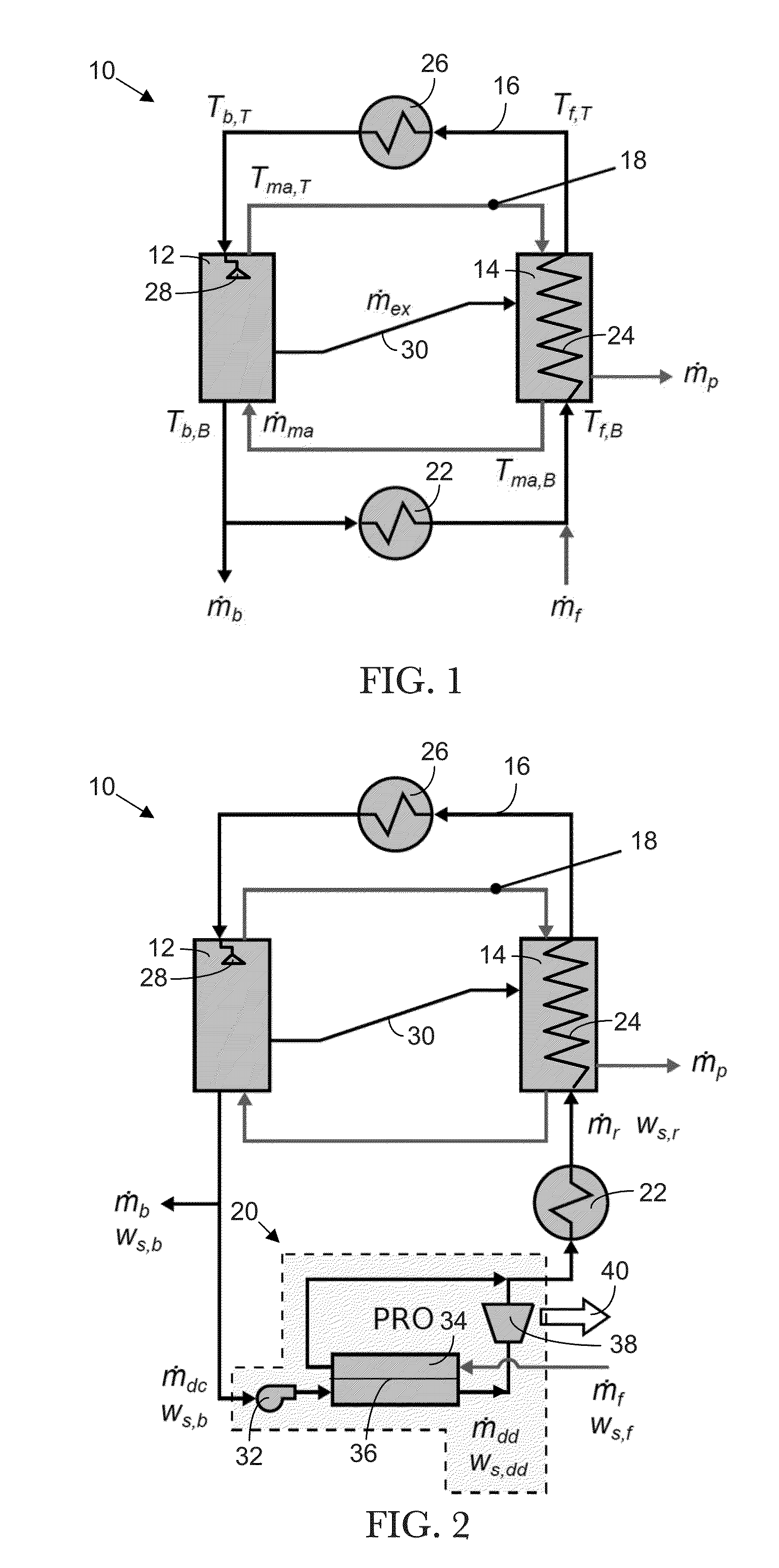
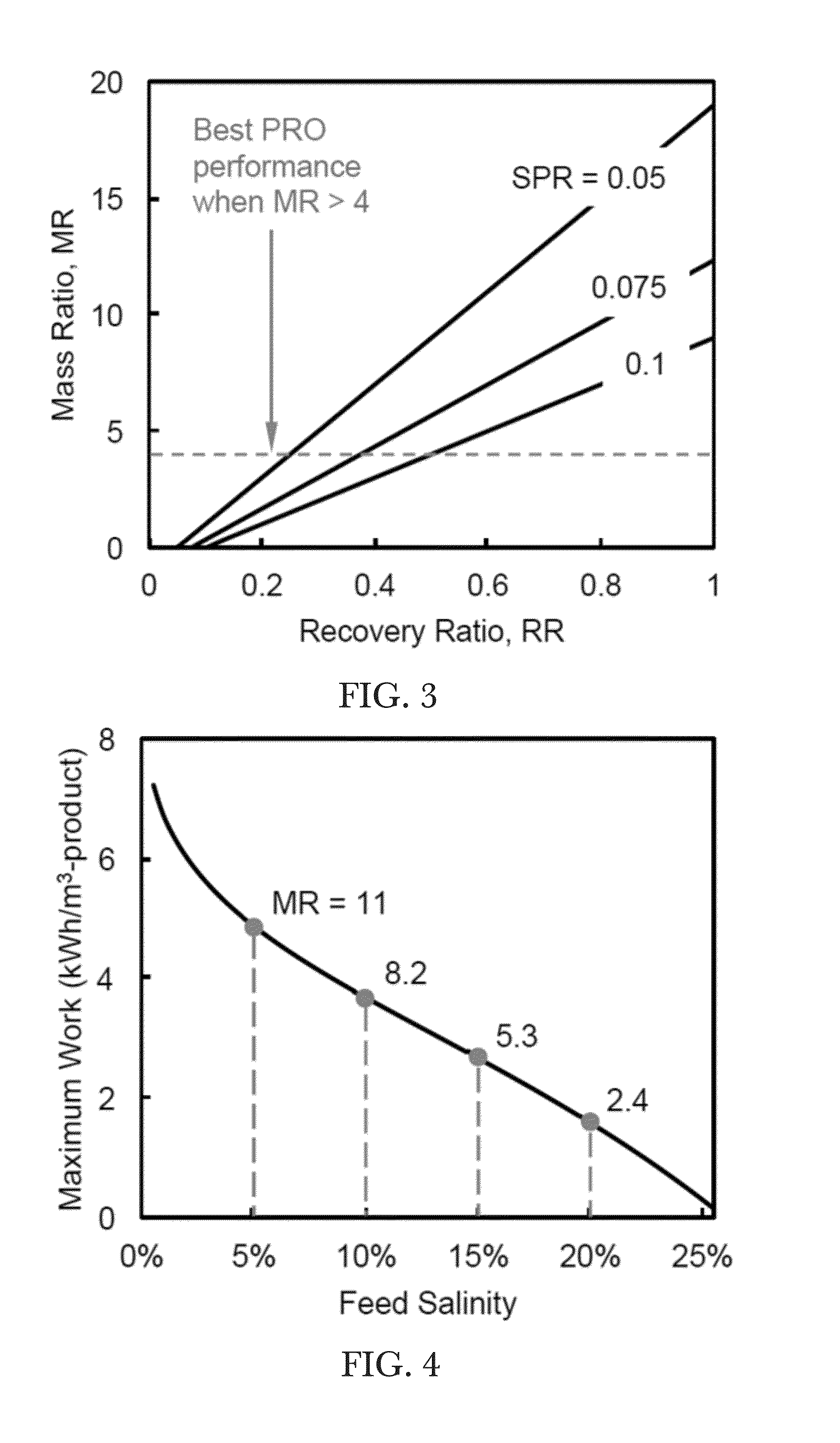
- A hybrid system combining HDH with pressure-retarded osmosis (PRO) recirculates concentrated brine to generate electrical power by exploiting osmotic pressure differences across a semi-permeable membrane, using the power to drive auxiliary equipment and eliminate onsite power generation in off-grid areas.


Environmental Impact Assessment of Salinity Energy Systems
The environmental implications of Pressure Retarded Osmosis (PRO) and Reverse Electrodialysis (RED) technologies present distinct profiles that significantly influence their salinity range break-even points. Both technologies harness salinity gradients for energy generation but exhibit markedly different environmental footprints across various operational parameters.
PRO systems demonstrate relatively lower environmental impact in terms of chemical discharge, as they primarily rely on semi-permeable membranes without requiring extensive chemical additives during operation. The technology's environmental burden primarily stems from membrane manufacturing processes and periodic replacement cycles. However, PRO systems show sensitivity to feed water quality, potentially requiring pre-treatment processes that may introduce additional environmental considerations.
RED technology presents a more complex environmental profile due to its reliance on ion-exchange membranes and electrode systems. The manufacturing of specialized membranes involves fluorinated polymers and other materials with higher environmental impact during production. Additionally, RED systems may require periodic cleaning with chemical solutions, contributing to operational environmental burden.
Water consumption patterns differ significantly between the two technologies. PRO systems typically require higher water volumes due to dilution effects, potentially impacting local water resources. RED systems demonstrate more efficient water utilization but may generate concentrated brine streams requiring careful disposal management.
The carbon footprint analysis reveals that PRO systems generally exhibit lower lifecycle emissions when operating within optimal salinity ranges, particularly in seawater-freshwater applications. RED systems show competitive environmental performance in hypersaline applications where their efficiency advantages offset manufacturing impacts.
Ecosystem impact assessments indicate that both technologies pose minimal direct environmental risks during operation, with primary concerns centered on intake and discharge effects on marine environments. The break-even analysis must incorporate these environmental costs, as regulatory compliance and environmental mitigation measures significantly influence operational economics across different salinity ranges.
PRO systems demonstrate relatively lower environmental impact in terms of chemical discharge, as they primarily rely on semi-permeable membranes without requiring extensive chemical additives during operation. The technology's environmental burden primarily stems from membrane manufacturing processes and periodic replacement cycles. However, PRO systems show sensitivity to feed water quality, potentially requiring pre-treatment processes that may introduce additional environmental considerations.
RED technology presents a more complex environmental profile due to its reliance on ion-exchange membranes and electrode systems. The manufacturing of specialized membranes involves fluorinated polymers and other materials with higher environmental impact during production. Additionally, RED systems may require periodic cleaning with chemical solutions, contributing to operational environmental burden.
Water consumption patterns differ significantly between the two technologies. PRO systems typically require higher water volumes due to dilution effects, potentially impacting local water resources. RED systems demonstrate more efficient water utilization but may generate concentrated brine streams requiring careful disposal management.
The carbon footprint analysis reveals that PRO systems generally exhibit lower lifecycle emissions when operating within optimal salinity ranges, particularly in seawater-freshwater applications. RED systems show competitive environmental performance in hypersaline applications where their efficiency advantages offset manufacturing impacts.
Ecosystem impact assessments indicate that both technologies pose minimal direct environmental risks during operation, with primary concerns centered on intake and discharge effects on marine environments. The break-even analysis must incorporate these environmental costs, as regulatory compliance and environmental mitigation measures significantly influence operational economics across different salinity ranges.
Economic Feasibility Models for PRO vs RED Implementation
Economic feasibility models for PRO and RED implementation require comprehensive financial frameworks that account for capital expenditures, operational costs, and revenue generation potential across different salinity ranges. The break-even analysis must incorporate technology-specific cost structures, where PRO systems typically demonstrate higher capital intensity due to specialized membrane requirements and high-pressure infrastructure, while RED systems involve lower pressure operations but require larger membrane areas for equivalent power output.
Net Present Value (NPV) calculations form the cornerstone of comparative economic assessment, integrating discounted cash flows over projected system lifespans of 20-25 years. The models must account for membrane replacement cycles, with PRO membranes requiring replacement every 3-5 years and RED membranes lasting 5-7 years, significantly impacting long-term operational economics. Energy conversion efficiency directly correlates with revenue potential, where PRO systems achieve 2-5 W/m² power density compared to RED's 1-3 W/m², creating distinct economic profiles across varying salinity gradients.
Levelized Cost of Energy (LCOE) modeling provides standardized comparison metrics, incorporating capacity factors that vary significantly between technologies based on salinity availability. PRO systems demonstrate optimal performance with high-salinity sources exceeding 35 g/L, while RED systems maintain consistent efficiency across broader salinity ranges from 10-35 g/L, affecting capacity utilization and revenue streams.
Sensitivity analysis within economic models must evaluate critical variables including membrane costs, energy prices, maintenance requirements, and salinity source availability. Monte Carlo simulations can quantify risk factors and uncertainty ranges, particularly important given the emerging nature of both technologies and fluctuating material costs.
The economic models should incorporate scenario-based projections reflecting different deployment scales, from pilot installations to commercial-scale facilities exceeding 10 MW capacity. Economies of scale significantly impact unit costs, with larger installations demonstrating 30-40% cost reductions compared to smaller deployments. Additionally, the models must consider regional economic factors, including electricity market prices, environmental regulations, and potential carbon credit revenues that can substantially influence overall project economics and break-even thresholds across different salinity operating ranges.
Net Present Value (NPV) calculations form the cornerstone of comparative economic assessment, integrating discounted cash flows over projected system lifespans of 20-25 years. The models must account for membrane replacement cycles, with PRO membranes requiring replacement every 3-5 years and RED membranes lasting 5-7 years, significantly impacting long-term operational economics. Energy conversion efficiency directly correlates with revenue potential, where PRO systems achieve 2-5 W/m² power density compared to RED's 1-3 W/m², creating distinct economic profiles across varying salinity gradients.
Levelized Cost of Energy (LCOE) modeling provides standardized comparison metrics, incorporating capacity factors that vary significantly between technologies based on salinity availability. PRO systems demonstrate optimal performance with high-salinity sources exceeding 35 g/L, while RED systems maintain consistent efficiency across broader salinity ranges from 10-35 g/L, affecting capacity utilization and revenue streams.
Sensitivity analysis within economic models must evaluate critical variables including membrane costs, energy prices, maintenance requirements, and salinity source availability. Monte Carlo simulations can quantify risk factors and uncertainty ranges, particularly important given the emerging nature of both technologies and fluctuating material costs.
The economic models should incorporate scenario-based projections reflecting different deployment scales, from pilot installations to commercial-scale facilities exceeding 10 MW capacity. Economies of scale significantly impact unit costs, with larger installations demonstrating 30-40% cost reductions compared to smaller deployments. Additionally, the models must consider regional economic factors, including electricity market prices, environmental regulations, and potential carbon credit revenues that can substantially influence overall project economics and break-even thresholds across different salinity operating ranges.
Unlock deeper insights with PatSnap Eureka Quick Research — get a full tech report to explore trends and direct your research. Try now!
Generate Your Research Report Instantly with AI Agent
Supercharge your innovation with PatSnap Eureka AI Agent Platform!