
How to Control Rubber Surface Tack in Assembly
OCT 9, 20269 MIN READ
Generate Your Research Report Instantly with AI Agent
Patsnap Eureka helps you evaluate technical feasibility & market potential.
Rubber Surface Tack Control Background and Objectives
Rubber surface tack, defined as the adhesive or sticky property of uncured or partially cured rubber surfaces, has emerged as a critical challenge in modern manufacturing and assembly operations. This phenomenon occurs due to the migration of low molecular weight compounds, plasticizers, and uncured polymer chains to the rubber surface, creating an inherently tacky interface. While this property can be beneficial in certain applications such as pressure-sensitive adhesives, it poses significant obstacles in assembly processes where precise handling, positioning, and component integration are required.
The historical development of rubber manufacturing has consistently grappled with surface tack issues. Early rubber products relied heavily on natural rubber formulations that exhibited pronounced tackiness, complicating both production workflows and end-user applications. As synthetic rubber compounds evolved throughout the mid-20th century, the industry gained greater control over material properties, yet surface tack remained a persistent concern, particularly in automotive sealing systems, consumer electronics gaskets, and industrial vibration dampers.
Contemporary manufacturing environments demand increasingly stringent quality standards and automation capabilities. Excessive rubber surface tack interferes with automated handling systems, causes contamination through dust and particle adhesion, leads to component misalignment during assembly, and results in aesthetic defects on finished products. These challenges have intensified as production speeds increase and tolerance requirements tighten across industries ranging from automotive to medical device manufacturing.
The primary objective of controlling rubber surface tack in assembly operations encompasses multiple dimensions. First, achieving optimal surface characteristics that enable smooth automated handling without compromising the rubber's functional properties such as sealing performance, flexibility, and durability. Second, developing cost-effective and environmentally sustainable treatment methods that can be seamlessly integrated into existing production lines. Third, establishing reliable quality control metrics and testing protocols to ensure consistent surface properties across production batches.
Furthermore, the technical goals extend to understanding the fundamental mechanisms governing tack formation and persistence, enabling predictive control rather than reactive treatment. This includes investigating the relationship between rubber formulation parameters, curing conditions, environmental factors, and resulting surface properties. Ultimately, successful tack control solutions must balance manufacturing efficiency, product performance requirements, regulatory compliance, and economic viability while supporting the industry's transition toward more sustainable and automated production paradigms.
The historical development of rubber manufacturing has consistently grappled with surface tack issues. Early rubber products relied heavily on natural rubber formulations that exhibited pronounced tackiness, complicating both production workflows and end-user applications. As synthetic rubber compounds evolved throughout the mid-20th century, the industry gained greater control over material properties, yet surface tack remained a persistent concern, particularly in automotive sealing systems, consumer electronics gaskets, and industrial vibration dampers.
Contemporary manufacturing environments demand increasingly stringent quality standards and automation capabilities. Excessive rubber surface tack interferes with automated handling systems, causes contamination through dust and particle adhesion, leads to component misalignment during assembly, and results in aesthetic defects on finished products. These challenges have intensified as production speeds increase and tolerance requirements tighten across industries ranging from automotive to medical device manufacturing.
The primary objective of controlling rubber surface tack in assembly operations encompasses multiple dimensions. First, achieving optimal surface characteristics that enable smooth automated handling without compromising the rubber's functional properties such as sealing performance, flexibility, and durability. Second, developing cost-effective and environmentally sustainable treatment methods that can be seamlessly integrated into existing production lines. Third, establishing reliable quality control metrics and testing protocols to ensure consistent surface properties across production batches.
Furthermore, the technical goals extend to understanding the fundamental mechanisms governing tack formation and persistence, enabling predictive control rather than reactive treatment. This includes investigating the relationship between rubber formulation parameters, curing conditions, environmental factors, and resulting surface properties. Ultimately, successful tack control solutions must balance manufacturing efficiency, product performance requirements, regulatory compliance, and economic viability while supporting the industry's transition toward more sustainable and automated production paradigms.
Market Demand for Low-Tack Rubber Assembly Solutions
The global rubber manufacturing industry is experiencing a significant shift in assembly process requirements, driven by evolving quality standards and operational efficiency demands. Traditional rubber components often exhibit excessive surface tackiness during assembly operations, leading to premature adhesion, contamination issues, and compromised production throughput. This challenge has created substantial market demand for controlled-tack rubber solutions that maintain necessary handling properties while preventing unwanted adhesion during manufacturing and assembly stages.
Automotive sector represents a primary demand driver for low-tack rubber assembly solutions, particularly in weatherstripping, gaskets, and vibration dampening components. Vehicle manufacturers increasingly require rubber parts that can be efficiently handled by automated assembly systems without surface contamination or positioning errors caused by premature sticking. The trend toward higher production volumes and reduced cycle times has intensified the need for rubber materials with precisely controlled surface characteristics that facilitate smooth assembly workflows.
Consumer electronics and appliance industries constitute another significant market segment demanding low-tack rubber solutions. Products such as smartphone gaskets, tablet seals, and appliance door seals require rubber components that can be rapidly assembled without leaving residues or causing alignment issues. The miniaturization trend in electronics has further elevated requirements for dimensional precision during assembly, making surface tack control increasingly critical.
Industrial manufacturing sectors, including HVAC systems, fluid handling equipment, and machinery production, demonstrate growing demand for rubber components with controlled surface properties. These applications often involve complex assembly sequences where rubber parts must be positioned accurately before final bonding or mechanical fastening. Excessive surface tack in these scenarios leads to increased labor costs, higher defect rates, and reduced production efficiency.
The medical device and pharmaceutical industries present emerging demand for low-tack rubber solutions, particularly in sterile packaging seals and equipment gaskets. These sectors require rubber materials that maintain cleanliness standards while enabling efficient assembly in controlled environments. Surface tack control directly impacts contamination prevention and assembly precision in these regulated applications.
Market demand is further amplified by sustainability initiatives and waste reduction goals across manufacturing sectors. Controlled-tack rubber solutions reduce assembly defects and rework requirements, contributing to material efficiency and environmental objectives. This alignment with corporate sustainability targets has elevated the strategic importance of surface tack control technologies in procurement decisions.
Automotive sector represents a primary demand driver for low-tack rubber assembly solutions, particularly in weatherstripping, gaskets, and vibration dampening components. Vehicle manufacturers increasingly require rubber parts that can be efficiently handled by automated assembly systems without surface contamination or positioning errors caused by premature sticking. The trend toward higher production volumes and reduced cycle times has intensified the need for rubber materials with precisely controlled surface characteristics that facilitate smooth assembly workflows.
Consumer electronics and appliance industries constitute another significant market segment demanding low-tack rubber solutions. Products such as smartphone gaskets, tablet seals, and appliance door seals require rubber components that can be rapidly assembled without leaving residues or causing alignment issues. The miniaturization trend in electronics has further elevated requirements for dimensional precision during assembly, making surface tack control increasingly critical.
Industrial manufacturing sectors, including HVAC systems, fluid handling equipment, and machinery production, demonstrate growing demand for rubber components with controlled surface properties. These applications often involve complex assembly sequences where rubber parts must be positioned accurately before final bonding or mechanical fastening. Excessive surface tack in these scenarios leads to increased labor costs, higher defect rates, and reduced production efficiency.
The medical device and pharmaceutical industries present emerging demand for low-tack rubber solutions, particularly in sterile packaging seals and equipment gaskets. These sectors require rubber materials that maintain cleanliness standards while enabling efficient assembly in controlled environments. Surface tack control directly impacts contamination prevention and assembly precision in these regulated applications.
Market demand is further amplified by sustainability initiatives and waste reduction goals across manufacturing sectors. Controlled-tack rubber solutions reduce assembly defects and rework requirements, contributing to material efficiency and environmental objectives. This alignment with corporate sustainability targets has elevated the strategic importance of surface tack control technologies in procurement decisions.
Current Challenges in Rubber Surface Tack Management
Rubber surface tack management in assembly operations faces multiple interconnected challenges that significantly impact manufacturing efficiency and product quality. The primary difficulty stems from the inherent variability of rubber compounds, where surface tackiness fluctuates based on formulation differences, curing conditions, and environmental exposure. This variability creates inconsistencies during handling and assembly, leading to unpredictable adhesion behaviors that complicate process control and quality assurance.
Temperature and humidity sensitivity represents another critical challenge. Rubber surfaces exhibit dramatically different tack levels under varying environmental conditions, with elevated temperatures typically increasing surface stickiness while low humidity can cause surface hardening. Manufacturing facilities often struggle to maintain consistent environmental parameters across production lines, resulting in batch-to-batch variations that require constant process adjustments and increase rejection rates.
The time-dependent nature of rubber surface properties poses significant operational constraints. Freshly molded or processed rubber components often display excessive tack immediately after production, necessitating waiting periods before assembly. Conversely, prolonged storage can lead to surface contamination, oxidation, or bloom formation that alters tack characteristics unpredictably. This temporal instability complicates inventory management and production scheduling, forcing manufacturers to balance just-in-time assembly requirements against material aging effects.
Contamination control emerges as a persistent technical barrier. Rubber surfaces readily attract dust, oils, and other airborne particles that modify surface energy and adhesion properties. Even minimal contamination can cause assembly defects, component misalignment, or premature bonding failures. Traditional cleaning methods often prove inadequate or may introduce additional complications by altering the rubber surface chemistry or leaving residues that affect subsequent processing steps.
Measurement and standardization difficulties further compound these challenges. Current industry practices lack universally accepted quantitative methods for assessing rubber surface tack in production environments. Existing test methods are often laboratory-based, time-consuming, and poorly correlated with actual assembly performance. This measurement gap prevents effective process monitoring and makes it difficult to establish reliable acceptance criteria or implement closed-loop control strategies that could optimize tack levels for specific assembly requirements.
Temperature and humidity sensitivity represents another critical challenge. Rubber surfaces exhibit dramatically different tack levels under varying environmental conditions, with elevated temperatures typically increasing surface stickiness while low humidity can cause surface hardening. Manufacturing facilities often struggle to maintain consistent environmental parameters across production lines, resulting in batch-to-batch variations that require constant process adjustments and increase rejection rates.
The time-dependent nature of rubber surface properties poses significant operational constraints. Freshly molded or processed rubber components often display excessive tack immediately after production, necessitating waiting periods before assembly. Conversely, prolonged storage can lead to surface contamination, oxidation, or bloom formation that alters tack characteristics unpredictably. This temporal instability complicates inventory management and production scheduling, forcing manufacturers to balance just-in-time assembly requirements against material aging effects.
Contamination control emerges as a persistent technical barrier. Rubber surfaces readily attract dust, oils, and other airborne particles that modify surface energy and adhesion properties. Even minimal contamination can cause assembly defects, component misalignment, or premature bonding failures. Traditional cleaning methods often prove inadequate or may introduce additional complications by altering the rubber surface chemistry or leaving residues that affect subsequent processing steps.
Measurement and standardization difficulties further compound these challenges. Current industry practices lack universally accepted quantitative methods for assessing rubber surface tack in production environments. Existing test methods are often laboratory-based, time-consuming, and poorly correlated with actual assembly performance. This measurement gap prevents effective process monitoring and makes it difficult to establish reliable acceptance criteria or implement closed-loop control strategies that could optimize tack levels for specific assembly requirements.
Existing Tack Control Solutions in Rubber Assembly
01 Enhancing building tack in rubber compositions
Rubber mixtures and formulations can be modified using specific additives, polymers, or chemical treatments to improve surface tackiness. Enhancing raw or unvulcanized rubber building tack is critical for improving adhesion during manufacturing processes such as tire building and component assembly.- Enhancing building tack in rubber compositions: Rubber formulations and additives can be designed to increase or retain surface tackiness, which is critical for the assembly and cohesion of unvulcanized rubber components during manufacturing processes such as tire building.
- Surface treatment techniques for reducing elastomer tack: Chemical treatments, coatings, or modified surface processing methods applied directly to finished or molded rubber and elastomeric surfaces effectively reduce unwanted tackiness, sticky feel, or surface adhesion without altering the bulk mechanical properties.
- Use of anti-tack agent compositions for rubber processing: Formulating specialized anti-tack agent compositions, coatings, or aqueous dispersions prevents raw, unvulcanized rubber sheets or products from sticking to each other or to processing machinery during storage and handling.
- Chemical formulation adjustments to lower rubber tackiness: Directly modifying the rubber compound batch by incorporating specific additives, crosslinking agents, or tailored polymer blends reduces the inherent surface tack and improves processing behavior of vulcanized or unvulcanized rubber mixtures.
- Methods for controlling surface tack of organopolysiloxanes and gels: Process steps and formulations targeted at silicone rubbers, gels, or organopolysiloxane greases reduce surface stickiness while maintaining their desired structural, elastomeric, or protective qualities.
02 Surface treatment methods for tack reduction
External surface treatments and chemical processes are applied to cured rubber and elastomer products to reduce unwanted surface tackiness. These treatments modify the surface properties to provide tack reduction while maintaining or improving water, oil, and weather resistance.Expand Specific Solutions03 Anti-tack agent compositions and dispersions
Compositions and aqueous dispersions containing anti-tack agents are applied to unvulcanized or processed rubber to prevent unwanted adhesion during storage or handling. These agents form protective coatings that eliminate surface stickiness without compromising subsequent rubber processing.Expand Specific Solutions04 Formulation of rubber tackifying adhesives and coatings
Rubber-based tack agents, coatings, and solvent formulations are developed to serve as adhesives, tack coats, or specialized rubber paints. These formulations utilize depolymerized polymers or specific resin systems to control tackiness and ensure desirable tactile and weather-resistant surface properties.Expand Specific Solutions05 Methods for adjusting and controlling rubber tack
Specific processing methods, chemical modifications, and additives are used to adjust, retain, or reduce the tack levels of unvulcanized rubber members and specific synthetic elastomers such as acrylic or EPDM rubbers to suit required manufacturing parameters.Expand Specific Solutions
Key Players in Rubber Processing and Assembly Industry
The rubber surface tack control in assembly represents a mature technical challenge within the broader rubber manufacturing and processing industry, currently in a consolidation phase dominated by established players. The market spans multiple sectors including automotive, industrial equipment, and specialty manufacturing, with significant scale driven by tire manufacturers like Bridgestone Corp., Goodyear Tire & Rubber Co., Sumitomo Rubber Industries, and The Yokohama Rubber Co. Technology maturity varies across applications, with companies like Ashland LLC and Kraton Chemical LLC advancing chemical modifier solutions, while equipment manufacturers including Mitsubishi Heavy Industries Machinery Technology Corp. and Dongguan Kesheng Intelligent Equipment Technology focus on processing innovations. Chinese entities such as Zhuzhou Times New Materials Technology and Tianjin Rubber Industry Research Institute contribute specialized material developments. The competitive landscape reflects both vertical integration by major tire producers and horizontal specialization by chemical suppliers and equipment makers, indicating a technologically mature but continuously evolving market addressing assembly efficiency and product quality requirements.
Sumitomo Rubber Industries, Ltd.
Technical Solution: Sumitomo Rubber has developed an integrated tack management system that combines compound design with surface treatment technologies. Their approach utilizes modified rubber formulations incorporating specific anti-tack additives such as fatty acid derivatives and wax blends that migrate to the surface during processing, creating a natural release layer. The company employs precision coating technologies to apply water-based or solvent-based anti-tack solutions that provide temporary surface modification without affecting vulcanization. Sumitomo's manufacturing process includes controlled cooling stages after mixing and calendering operations to optimize surface characteristics. They have implemented sensor-based tack measurement systems that provide feedback for process adjustments. The company also utilizes UV treatment and corona discharge methods for selective surface energy modification, allowing precise control of adhesion properties in different zones of rubber components during assembly operations.
Strengths: Integration of tack control into compound formulation reduces need for post-treatments, advanced sensor technologies enable real-time process optimization. Weaknesses: Formulation modifications may affect other rubber properties, requires sophisticated process control equipment.
Goodyear Tire & Rubber Co.
Technical Solution: Goodyear implements a multi-faceted approach to rubber surface tack control combining chemical and physical methods. Their technology includes formulation optimization using specific ratios of natural and synthetic rubbers with controlled molecular weight distributions to achieve desired tack levels. The company employs surface dusting with inert powders such as talc, mica, or proprietary polymer microspheres to create a physical barrier that reduces tack while maintaining component compatibility. Goodyear has developed automated application systems for anti-tack agents that ensure uniform coverage and precise dosing. Their process control includes real-time monitoring of compound viscosity and tack measurements using specialized instrumentation. Additionally, they utilize controlled aging protocols where rubber components are stored under specific conditions to allow surface oxidation that naturally reduces tack before assembly operations commence.
Strengths: Comprehensive quality control systems, automated application technologies, strong material science expertise. Weaknesses: Requires careful balance between reducing tack and maintaining adequate inter-component adhesion, additional processing steps increase production time.
Core Technologies for Rubber Surface Modification
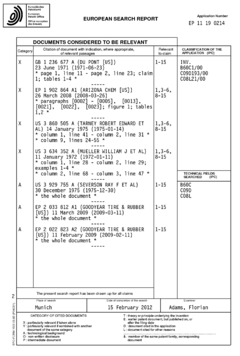
Rubber composition with moisture exposed surface containing combination of silica and specialized tackifying resin and tire with component thereof
PatentInactiveBRPI1002293A2
Innovation
- Incorporating a specialized tackifying resin, such as a vinyl monomer modified reaction product of t-butyl phenol and formaldehyde, or a reaction product of t-butyl phenol and formaldehyde, into the silica-containing uncured rubber composition to maintain and enhance surface building tack, particularly in the presence of moisture.
Promoting uncured tack and cured adhesion for tire component rubber compositions including a tread strip
PatentInactiveEP2457741A1
Innovation
- A composition comprising rosin ester or hydrogenated rosin ester, combined with uncured sulfur curable rubber, sulfur-based curatives, reinforcing fillers, and high boiling hydrocarbon solvents is applied to the surfaces of uncured rubber components to enhance building tack and cured adhesion, eliminating the need for volatile organic solvents and petroleum-based oils.
Environmental Regulations for Rubber Surface Treatments
The regulatory landscape governing rubber surface treatments has evolved significantly in response to growing environmental and health concerns. International frameworks such as REACH (Registration, Evaluation, Authorization and Restriction of Chemicals) in the European Union impose stringent requirements on chemical substances used in rubber processing, including surface treatment agents and tack control additives. These regulations mandate comprehensive safety assessments and restrict the use of hazardous substances, compelling manufacturers to reformulate traditional surface treatment solutions that may contain volatile organic compounds or toxic components.
In North America, the Environmental Protection Agency enforces regulations under the Toxic Substances Control Act and Clean Air Act, which directly impact the selection of surface treatment chemicals and application methods. Specific attention is directed toward VOC emissions from rubber processing facilities, with increasingly stringent emission limits requiring adoption of low-VOC or water-based surface treatment formulations. California's Proposition 65 further restricts substances known to cause cancer or reproductive harm, affecting the availability of certain traditional tack control agents in the market.
Asian markets, particularly China, Japan, and South Korea, have implemented parallel regulatory frameworks that align with international standards while addressing region-specific environmental priorities. China's GB standards and environmental protection laws now require detailed disclosure of chemical compositions in rubber surface treatments, with regular compliance audits becoming standard practice. These regulations have accelerated the transition toward environmentally friendly alternatives such as bio-based release agents and water-soluble surface modifiers.
The regulatory trend emphasizes lifecycle assessment and sustainability metrics, pushing the industry toward circular economy principles. Manufacturers must now consider not only the immediate environmental impact of surface treatment processes but also the end-of-life disposal and recyclability of treated rubber components. This regulatory pressure has catalyzed innovation in green chemistry approaches, including plasma treatment technologies and enzyme-based surface modification methods that eliminate chemical residues entirely. Compliance documentation and traceability requirements have also intensified, necessitating robust quality management systems that track chemical usage throughout the assembly process.
In North America, the Environmental Protection Agency enforces regulations under the Toxic Substances Control Act and Clean Air Act, which directly impact the selection of surface treatment chemicals and application methods. Specific attention is directed toward VOC emissions from rubber processing facilities, with increasingly stringent emission limits requiring adoption of low-VOC or water-based surface treatment formulations. California's Proposition 65 further restricts substances known to cause cancer or reproductive harm, affecting the availability of certain traditional tack control agents in the market.
Asian markets, particularly China, Japan, and South Korea, have implemented parallel regulatory frameworks that align with international standards while addressing region-specific environmental priorities. China's GB standards and environmental protection laws now require detailed disclosure of chemical compositions in rubber surface treatments, with regular compliance audits becoming standard practice. These regulations have accelerated the transition toward environmentally friendly alternatives such as bio-based release agents and water-soluble surface modifiers.
The regulatory trend emphasizes lifecycle assessment and sustainability metrics, pushing the industry toward circular economy principles. Manufacturers must now consider not only the immediate environmental impact of surface treatment processes but also the end-of-life disposal and recyclability of treated rubber components. This regulatory pressure has catalyzed innovation in green chemistry approaches, including plasma treatment technologies and enzyme-based surface modification methods that eliminate chemical residues entirely. Compliance documentation and traceability requirements have also intensified, necessitating robust quality management systems that track chemical usage throughout the assembly process.
Cost-Benefit Analysis of Tack Control Implementation
Implementing tack control solutions in rubber assembly operations requires careful evaluation of financial implications against operational benefits. Initial capital investments typically encompass surface treatment equipment, chemical additives, environmental control systems, and quality monitoring instruments. These upfront costs vary significantly depending on the chosen approach, ranging from relatively modest investments in dusting agents to substantial expenditures for plasma treatment or automated coating systems. Additionally, organizations must account for installation expenses, employee training programs, and potential production line modifications to accommodate new processes.
Operational costs constitute another critical consideration in the economic assessment. Consumable materials such as release agents, anti-tack powders, or coating compounds generate recurring expenses that accumulate over the product lifecycle. Energy consumption for heating, cooling, or plasma generation systems contributes to ongoing operational budgets. Maintenance requirements for specialized equipment and periodic calibration of monitoring systems add further financial obligations. Labor costs may increase initially during the learning curve but often stabilize or decrease as workers become proficient with new procedures.
The benefit side of the equation reveals substantial value creation opportunities. Reduced defect rates directly translate to lower scrap costs and decreased rework requirements, improving overall material utilization efficiency. Enhanced assembly line productivity emerges from minimized component sticking and smoother handling operations, potentially increasing throughput by fifteen to thirty percent in optimized implementations. Quality improvements strengthen customer satisfaction and reduce warranty claims, protecting brand reputation and market position. Extended product shelf life and improved storage stability decrease inventory losses and expand distribution flexibility.
Strategic advantages extend beyond immediate financial metrics. Consistent tack control enables tighter process tolerances and supports advanced manufacturing techniques such as automated assembly and robotic handling. This capability positions organizations to pursue higher-value market segments and differentiate their offerings from competitors relying on conventional methods. Environmental compliance benefits may reduce regulatory risks and align with sustainability initiatives increasingly valued by customers and stakeholders.
Return on investment calculations typically demonstrate payback periods ranging from eighteen months to three years, depending on production volumes and specific implementation approaches. High-volume operations generally achieve faster returns due to economies of scale, while specialized applications may justify longer payback horizons based on quality imperatives and competitive positioning requirements.
Operational costs constitute another critical consideration in the economic assessment. Consumable materials such as release agents, anti-tack powders, or coating compounds generate recurring expenses that accumulate over the product lifecycle. Energy consumption for heating, cooling, or plasma generation systems contributes to ongoing operational budgets. Maintenance requirements for specialized equipment and periodic calibration of monitoring systems add further financial obligations. Labor costs may increase initially during the learning curve but often stabilize or decrease as workers become proficient with new procedures.
The benefit side of the equation reveals substantial value creation opportunities. Reduced defect rates directly translate to lower scrap costs and decreased rework requirements, improving overall material utilization efficiency. Enhanced assembly line productivity emerges from minimized component sticking and smoother handling operations, potentially increasing throughput by fifteen to thirty percent in optimized implementations. Quality improvements strengthen customer satisfaction and reduce warranty claims, protecting brand reputation and market position. Extended product shelf life and improved storage stability decrease inventory losses and expand distribution flexibility.
Strategic advantages extend beyond immediate financial metrics. Consistent tack control enables tighter process tolerances and supports advanced manufacturing techniques such as automated assembly and robotic handling. This capability positions organizations to pursue higher-value market segments and differentiate their offerings from competitors relying on conventional methods. Environmental compliance benefits may reduce regulatory risks and align with sustainability initiatives increasingly valued by customers and stakeholders.
Return on investment calculations typically demonstrate payback periods ranging from eighteen months to three years, depending on production volumes and specific implementation approaches. High-volume operations generally achieve faster returns due to economies of scale, while specialized applications may justify longer payback horizons based on quality imperatives and competitive positioning requirements.
Unlock deeper insights with Patsnap Eureka Quick Research — get a full tech report to explore trends and direct your research. Try now!
Generate Your Research Report Instantly with AI Agent
Supercharge your innovation with Patsnap Eureka AI Agent Platform!