
How to Decrease Bioplastics Opacity for Clear Applications
MAR 31, 20269 MIN READ
Generate Your Research Report Instantly with AI Agent
Patsnap Eureka helps you evaluate technical feasibility & market potential.
Bioplastics Transparency Development Background and Objectives
The development of transparent bioplastics represents a critical frontier in sustainable materials science, driven by the urgent need to replace conventional petroleum-based transparent plastics with environmentally friendly alternatives. Traditional transparent applications, including food packaging, medical devices, optical components, and consumer goods, have long relied on fossil fuel-derived polymers such as polystyrene, polycarbonate, and various polyolefins. However, mounting environmental concerns and regulatory pressures have intensified the search for bio-based substitutes that can match the optical clarity of conventional plastics.
Bioplastics, derived from renewable biomass sources such as corn starch, sugarcane, cellulose, and various plant oils, offer promising sustainability benefits including reduced carbon footprint, biodegradability, and decreased dependence on finite fossil resources. Despite these advantages, most commercially available bioplastics suffer from inherent opacity issues that significantly limit their application in transparent product segments. This opacity primarily stems from crystalline structures, phase separation, and light scattering phenomena that occur during polymer processing and solidification.
The technical challenge of achieving transparency in bioplastics involves complex polymer chemistry and processing considerations. Unlike their petroleum-based counterparts, bio-derived polymers often exhibit different molecular architectures, thermal properties, and crystallization behaviors that directly impact optical performance. The presence of natural impurities, varying molecular weight distributions, and incompatible polymer blends further contribute to light scattering and reduced transparency.
Current market demands for transparent packaging solutions, particularly in food and beverage industries, represent a substantial opportunity for transparent bioplastics. The global transparent plastics market, valued at several billion dollars annually, continues to grow driven by consumer preferences for product visibility and premium packaging aesthetics. Successfully developing transparent bioplastic alternatives could capture significant market share while addressing sustainability mandates.
The primary objective of transparency development in bioplastics focuses on achieving optical clarity comparable to conventional transparent plastics while maintaining mechanical properties, processability, and cost-effectiveness. This involves systematic approaches to molecular design, processing optimization, and additive technologies that can minimize light scattering mechanisms. Secondary objectives include ensuring that transparency improvements do not compromise the inherent sustainability benefits of bioplastics, including biodegradability and renewable content. Additionally, scalable manufacturing processes must be developed to enable commercial viability and widespread adoption across various transparent application segments.
Bioplastics, derived from renewable biomass sources such as corn starch, sugarcane, cellulose, and various plant oils, offer promising sustainability benefits including reduced carbon footprint, biodegradability, and decreased dependence on finite fossil resources. Despite these advantages, most commercially available bioplastics suffer from inherent opacity issues that significantly limit their application in transparent product segments. This opacity primarily stems from crystalline structures, phase separation, and light scattering phenomena that occur during polymer processing and solidification.
The technical challenge of achieving transparency in bioplastics involves complex polymer chemistry and processing considerations. Unlike their petroleum-based counterparts, bio-derived polymers often exhibit different molecular architectures, thermal properties, and crystallization behaviors that directly impact optical performance. The presence of natural impurities, varying molecular weight distributions, and incompatible polymer blends further contribute to light scattering and reduced transparency.
Current market demands for transparent packaging solutions, particularly in food and beverage industries, represent a substantial opportunity for transparent bioplastics. The global transparent plastics market, valued at several billion dollars annually, continues to grow driven by consumer preferences for product visibility and premium packaging aesthetics. Successfully developing transparent bioplastic alternatives could capture significant market share while addressing sustainability mandates.
The primary objective of transparency development in bioplastics focuses on achieving optical clarity comparable to conventional transparent plastics while maintaining mechanical properties, processability, and cost-effectiveness. This involves systematic approaches to molecular design, processing optimization, and additive technologies that can minimize light scattering mechanisms. Secondary objectives include ensuring that transparency improvements do not compromise the inherent sustainability benefits of bioplastics, including biodegradability and renewable content. Additionally, scalable manufacturing processes must be developed to enable commercial viability and widespread adoption across various transparent application segments.
Market Demand for Clear Bioplastic Applications
The global packaging industry is experiencing unprecedented demand for sustainable alternatives to conventional petroleum-based plastics, with clear bioplastic applications representing one of the fastest-growing market segments. Food and beverage packaging constitutes the largest application area, where transparency is essential for product visibility and consumer appeal. Clear bioplastic containers, bottles, and films are increasingly sought after by brands seeking to meet sustainability commitments while maintaining product presentation standards.
Consumer goods packaging represents another significant demand driver, particularly in cosmetics, personal care, and household products where package aesthetics directly influence purchasing decisions. The shift toward sustainable packaging has intensified as consumers become more environmentally conscious, creating substantial market pressure for transparent bioplastic solutions that can match the optical clarity of traditional plastics.
The electronics and automotive industries are emerging as notable demand sources for clear bioplastic components. Electronic device housings, display covers, and automotive interior elements require high optical clarity combined with durability. These sectors are actively seeking bioplastic alternatives that can meet stringent transparency requirements while supporting corporate sustainability initiatives.
Medical and pharmaceutical applications present specialized but growing demand for clear bioplastics. Medical device packaging, pharmaceutical containers, and disposable medical components require exceptional clarity for content inspection and regulatory compliance. The biocompatibility advantages of certain bioplastics make this segment particularly attractive for future development.
Regional demand patterns show strong growth in Europe and North America, driven by regulatory frameworks promoting sustainable packaging and circular economy principles. Asia-Pacific markets are rapidly expanding due to increasing environmental awareness and government initiatives supporting bioplastic adoption. The food service industry, particularly in developed markets, is transitioning toward clear bioplastic alternatives for disposable cups, containers, and utensils.
Market demand is further amplified by corporate sustainability commitments from major brands across multiple industries. These commitments create consistent, long-term demand for clear bioplastic solutions, providing market stability for technology development investments and encouraging innovation in opacity reduction techniques.
Consumer goods packaging represents another significant demand driver, particularly in cosmetics, personal care, and household products where package aesthetics directly influence purchasing decisions. The shift toward sustainable packaging has intensified as consumers become more environmentally conscious, creating substantial market pressure for transparent bioplastic solutions that can match the optical clarity of traditional plastics.
The electronics and automotive industries are emerging as notable demand sources for clear bioplastic components. Electronic device housings, display covers, and automotive interior elements require high optical clarity combined with durability. These sectors are actively seeking bioplastic alternatives that can meet stringent transparency requirements while supporting corporate sustainability initiatives.
Medical and pharmaceutical applications present specialized but growing demand for clear bioplastics. Medical device packaging, pharmaceutical containers, and disposable medical components require exceptional clarity for content inspection and regulatory compliance. The biocompatibility advantages of certain bioplastics make this segment particularly attractive for future development.
Regional demand patterns show strong growth in Europe and North America, driven by regulatory frameworks promoting sustainable packaging and circular economy principles. Asia-Pacific markets are rapidly expanding due to increasing environmental awareness and government initiatives supporting bioplastic adoption. The food service industry, particularly in developed markets, is transitioning toward clear bioplastic alternatives for disposable cups, containers, and utensils.
Market demand is further amplified by corporate sustainability commitments from major brands across multiple industries. These commitments create consistent, long-term demand for clear bioplastic solutions, providing market stability for technology development investments and encouraging innovation in opacity reduction techniques.
Current Opacity Issues and Technical Barriers in Bioplastics
Bioplastics face significant opacity challenges that fundamentally stem from their molecular structure and processing characteristics. Unlike conventional petroleum-based plastics, bioplastics often exhibit inherent light scattering properties due to crystalline regions, phase separation, and molecular weight distribution variations. These structural irregularities create refractive index mismatches that scatter incident light, resulting in the characteristic hazy or opaque appearance that limits their application in transparent products.
The crystallization behavior of bioplastics represents a primary technical barrier to achieving optical clarity. Materials such as polylactic acid (PLA) and polyhydroxyalkanoates (PHAs) tend to form spherulitic structures during cooling, creating microscopic domains with different optical densities. These crystalline formations act as light-scattering centers, significantly reducing transparency even when the material thickness is minimal. The crystallization rate and morphology are highly sensitive to processing conditions, making consistent optical properties difficult to achieve.
Processing-induced defects constitute another major obstacle in bioplastic transparency. During extrusion, injection molding, or film formation, bioplastics are susceptible to thermal degradation, moisture absorption, and shear-induced molecular orientation. These processing artifacts create internal stress patterns, micro-voids, and density variations that contribute to optical haze. The relatively narrow processing windows of many bioplastics compared to conventional plastics exacerbate these challenges.
Additive compatibility issues further complicate transparency optimization. Many bioplastics require plasticizers, stabilizers, or processing aids to achieve desired mechanical properties, but these additives often create phase separation or chemical incompatibilities that increase opacity. The limited selection of bio-compatible additives that maintain both transparency and biodegradability constrains formulation options.
Molecular weight control presents an additional technical hurdle. Bioplastics with insufficient molecular weight exhibit poor film-forming properties and mechanical strength, while high molecular weight variants often display increased crystallinity and processing difficulties. Achieving the optimal molecular weight distribution for transparency while maintaining other performance requirements requires precise polymerization control and often involves trade-offs in material properties.
Surface quality and thickness uniformity challenges also impact optical performance. Bioplastic films and sheets frequently exhibit surface roughness, thickness variations, and edge effects that scatter light and reduce clarity. These manufacturing inconsistencies are often more pronounced in bioplastics due to their processing sensitivity and the relative immaturity of specialized production equipment designed for these materials.
The crystallization behavior of bioplastics represents a primary technical barrier to achieving optical clarity. Materials such as polylactic acid (PLA) and polyhydroxyalkanoates (PHAs) tend to form spherulitic structures during cooling, creating microscopic domains with different optical densities. These crystalline formations act as light-scattering centers, significantly reducing transparency even when the material thickness is minimal. The crystallization rate and morphology are highly sensitive to processing conditions, making consistent optical properties difficult to achieve.
Processing-induced defects constitute another major obstacle in bioplastic transparency. During extrusion, injection molding, or film formation, bioplastics are susceptible to thermal degradation, moisture absorption, and shear-induced molecular orientation. These processing artifacts create internal stress patterns, micro-voids, and density variations that contribute to optical haze. The relatively narrow processing windows of many bioplastics compared to conventional plastics exacerbate these challenges.
Additive compatibility issues further complicate transparency optimization. Many bioplastics require plasticizers, stabilizers, or processing aids to achieve desired mechanical properties, but these additives often create phase separation or chemical incompatibilities that increase opacity. The limited selection of bio-compatible additives that maintain both transparency and biodegradability constrains formulation options.
Molecular weight control presents an additional technical hurdle. Bioplastics with insufficient molecular weight exhibit poor film-forming properties and mechanical strength, while high molecular weight variants often display increased crystallinity and processing difficulties. Achieving the optimal molecular weight distribution for transparency while maintaining other performance requirements requires precise polymerization control and often involves trade-offs in material properties.
Surface quality and thickness uniformity challenges also impact optical performance. Bioplastic films and sheets frequently exhibit surface roughness, thickness variations, and edge effects that scatter light and reduce clarity. These manufacturing inconsistencies are often more pronounced in bioplastics due to their processing sensitivity and the relative immaturity of specialized production equipment designed for these materials.
Existing Solutions for Bioplastic Clarity Improvement
01 Use of opacifying agents in bioplastic compositions
Opacifying agents such as titanium dioxide, calcium carbonate, or other mineral fillers can be incorporated into bioplastic formulations to increase opacity and reduce light transmission. These agents are dispersed throughout the bioplastic matrix to achieve desired opacity levels while maintaining biodegradability and mechanical properties of the material.- Use of mineral fillers to control opacity in bioplastics: Mineral fillers such as calcium carbonate, titanium dioxide, and talc can be incorporated into bioplastic formulations to increase opacity. These fillers scatter light and reduce transparency, making the bioplastic more opaque. The particle size, concentration, and dispersion of these fillers significantly affect the final opacity level of the bioplastic material.
- Incorporation of opacifying agents in biodegradable polymer matrices: Opacifying agents can be added to biodegradable polymer matrices to enhance opacity while maintaining biodegradability. These agents work by creating light-scattering centers within the polymer structure. The selection and concentration of opacifying agents must be balanced to achieve desired opacity without compromising the mechanical properties and biodegradability of the final product.
- Multi-layer bioplastic structures for opacity control: Multi-layer structures can be designed to control opacity in bioplastic products. By combining layers with different optical properties, manufacturers can achieve specific opacity levels while optimizing other properties such as barrier performance and mechanical strength. The layer composition, thickness, and arrangement can be adjusted to meet specific opacity requirements for different applications.
- Surface treatment methods to modify bioplastic opacity: Surface treatment techniques can be applied to modify the opacity of bioplastic materials. These methods include coating, embossing, or chemical treatment of the bioplastic surface to alter its light transmission properties. Surface modifications can provide controlled opacity without significantly changing the bulk properties of the bioplastic material.
- Blending of different biopolymers to achieve desired opacity: Blending different types of biopolymers with varying optical properties can be used to control opacity in bioplastic products. The compatibility, ratio, and processing conditions of the polymer blend affect the final opacity. This approach allows for customization of opacity while maintaining biodegradability and can also improve other properties such as flexibility and strength.
02 Incorporation of natural fibers and cellulosic materials
Natural fibers, cellulose derivatives, and plant-based fillers can be added to bioplastic formulations to enhance opacity. These materials provide light-scattering properties that reduce transparency while improving the renewable content and sustainability profile of the bioplastic product. The fiber content and distribution affect the final opacity characteristics.Expand Specific Solutions03 Multi-layer bioplastic structures with opacity control
Multi-layer bioplastic films and sheets can be designed with specific layers dedicated to opacity control. These structures may include opaque core layers sandwiched between functional outer layers, or gradient opacity designs. The layered approach allows for optimization of both optical properties and barrier performance in bioplastic packaging applications.Expand Specific Solutions04 Surface treatment and coating methods for opacity enhancement
Surface modification techniques including coating, printing, or chemical treatment can be applied to bioplastic substrates to increase opacity. These methods allow for controlled opacity adjustment without significantly altering the bulk properties of the bioplastic material. Various coating compositions and application methods can be employed to achieve desired opacity levels.Expand Specific Solutions05 Polymer blend systems for opacity modification
Blending different biopolymers or combining biopolymers with compatible synthetic polymers can create systems with enhanced opacity. The immiscibility or partial miscibility of blend components creates light-scattering interfaces that increase opacity. Blend composition ratios and processing conditions can be optimized to achieve target opacity while maintaining biodegradability requirements.Expand Specific Solutions
Key Players in Transparent Bioplastics Industry
The bioplastics transparency enhancement sector represents an emerging market within the broader sustainable materials industry, currently in its early development stage with significant growth potential driven by increasing demand for eco-friendly packaging solutions. Market size remains relatively modest but expanding rapidly as regulatory pressures and consumer preferences shift toward sustainable alternatives. Technology maturity varies considerably across key players, with established chemical giants like 3M Innovative Properties Co., FUJIFILM Corp., and Shin-Etsu Chemical Co. leading advanced polymer modification techniques, while specialized firms such as Priplak SASU and Trinseo Europe GmbH focus on targeted transparency solutions. Academic institutions including Guangdong University of Technology, Beijing University of Chemical Technology, and Southeast University contribute fundamental research in optical property enhancement. The competitive landscape shows a mix of mature multinational corporations leveraging existing polymer expertise and emerging specialists developing novel clarity-enhancing formulations, indicating a technology transition phase with substantial innovation opportunities.
ROEHM GMBH
Technical Solution: ROEHM has developed transparent bioplastic formulations using advanced acrylic-based polymer chemistry combined with bio-derived monomers. Their technology involves molecular-level design of polymer chains to minimize light scattering centers and optimize optical transmission. The company employs specialized polymerization techniques that control molecular weight distribution and reduce crystallinity, resulting in amorphous structures with enhanced transparency. Their approach includes the use of optical brightening agents and refractive index modifiers specifically designed for bioplastic applications, achieving transparency levels exceeding 90% in thin film applications.
Strengths: Deep expertise in acrylic chemistry, proven optical material technologies, strong patent portfolio. Weaknesses: Limited to specific polymer types, higher material costs compared to conventional options, processing complexity.
3M Innovative Properties Co.
Technical Solution: 3M has developed advanced optical film technologies and surface modification techniques to reduce bioplastic opacity. Their approach involves incorporating specialized optical additives and nanoparticle dispersions that minimize light scattering while maintaining mechanical properties. The company utilizes multilayer coextrusion processes combined with precision optical design to create transparent bioplastic films. Their technology focuses on controlling crystalline structure formation during processing and employing refractive index matching between polymer matrix and additives to achieve optical clarity comparable to conventional plastics.
Strengths: Extensive experience in optical materials, strong R&D capabilities, established manufacturing infrastructure. Weaknesses: High development costs, complex processing requirements, potential scalability challenges for specialized additives.
Core Patents in Bioplastic Transparency Technologies
Compound or film containing thermoplastic starch and a thermoplastic polymer
PatentPendingUS20220064411A1
Innovation
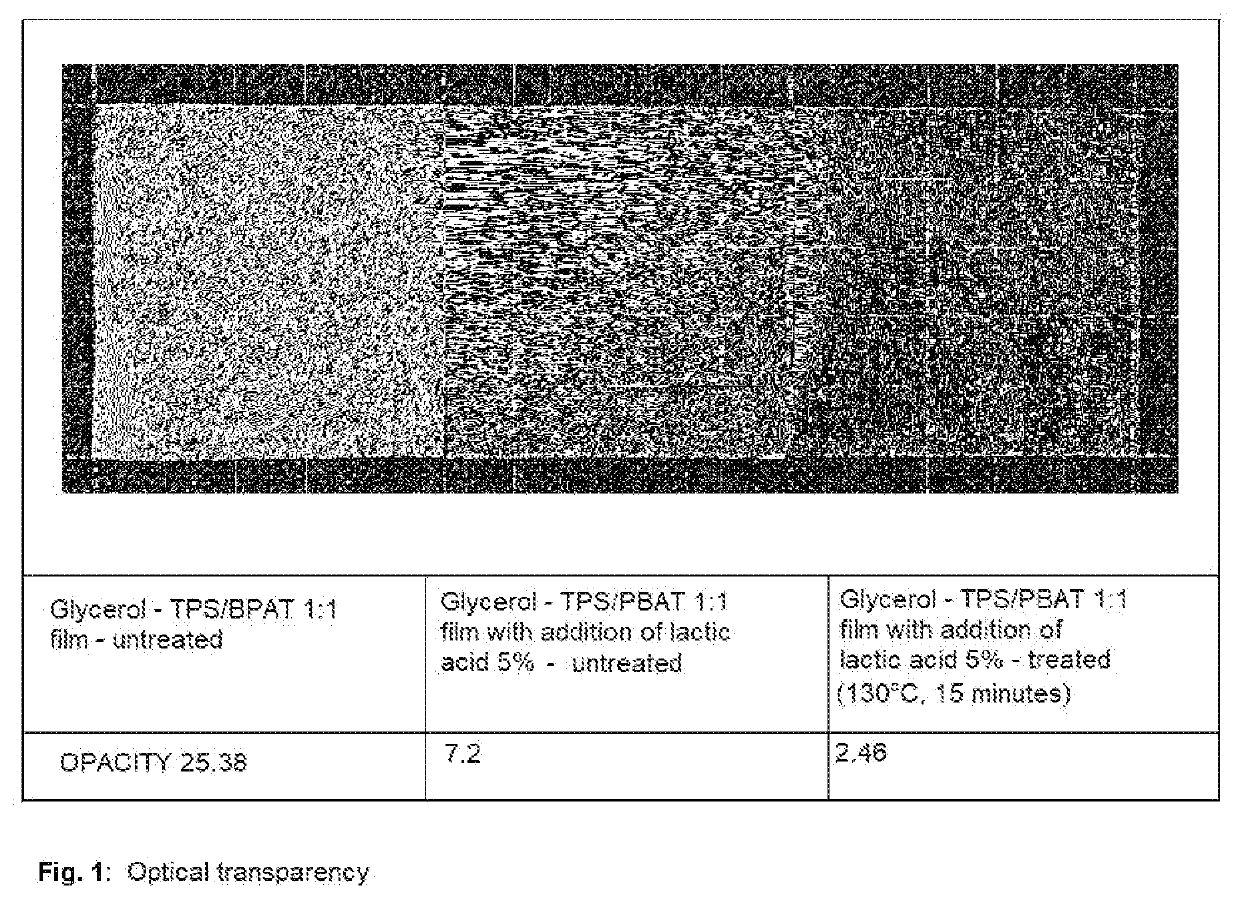
- A method involving the use of an alpha-hydroxycarboxylic acid, such as lactic acid, in combination with thermoplastic starch and a thermoplastic polymer, followed by an additional heating step to 100-140°C, allows for the production of transparent films by enhancing compatibility and reducing opacity, enabling up to 65% TPS content in the compound.
Films and articles with reversible opacity change upon stretching, and methods of making and using same
PatentInactiveUS7943219B2
Innovation
- A film comprising a blend of an elastomeric polymer and a polymer with crystalline or semicrystalline properties, where the crystalline regions are formed within the elastomeric polymer, allowing for a reversible non-linear reduction in opacity as the film is stretched between 1.5 to 2 times its original length, achieved by specific ratios of ethylene octene copolymer and polypropylene, and optionally including an olefin elastomer and a skin layer.


Environmental Regulations for Biodegradable Clear Plastics
The regulatory landscape for biodegradable clear plastics is rapidly evolving as governments worldwide recognize the urgent need to address plastic pollution while maintaining material performance standards. The European Union leads this regulatory transformation through its Single-Use Plastics Directive and the Circular Economy Action Plan, which establish comprehensive frameworks for biodegradable plastic certification and end-of-life management. These regulations specifically address transparency requirements for food packaging applications, mandating that biodegradable clear plastics maintain optical clarity standards comparable to conventional plastics while demonstrating complete biodegradation within specified timeframes.
In the United States, the Federal Trade Commission's Green Guides provide stringent guidelines for biodegradability claims, requiring clear documentation of degradation rates and environmental conditions. State-level regulations, particularly in California and New York, impose additional requirements for compostability certification through ASTM D6400 and D6868 standards. These standards directly impact the development of clear bioplastics by establishing minimum transparency thresholds and requiring comprehensive lifecycle assessments that demonstrate environmental benefits without compromising optical performance.
Asian markets, led by Japan and South Korea, have implemented progressive regulations that incentivize the development of high-performance biodegradable materials. Japan's Plastic Resource Circulation Strategy specifically promotes clear biodegradable alternatives for packaging applications, offering regulatory fast-tracks for materials that meet both transparency and biodegradation criteria. These regulations create market pull for advanced bioplastic formulations that can achieve conventional plastic-like clarity while maintaining certified biodegradability.
Emerging regulatory trends indicate increasing harmonization of international standards, with ISO 17088 and EN 13432 becoming globally recognized benchmarks. Future regulations are expected to introduce more stringent transparency requirements, potentially establishing quantitative haze and light transmission standards specifically for biodegradable clear plastics. This regulatory evolution drives innovation in polymer chemistry and processing technologies, compelling manufacturers to develop novel approaches for achieving optical clarity in biodegradable formulations while ensuring compliance with increasingly demanding environmental performance criteria.
In the United States, the Federal Trade Commission's Green Guides provide stringent guidelines for biodegradability claims, requiring clear documentation of degradation rates and environmental conditions. State-level regulations, particularly in California and New York, impose additional requirements for compostability certification through ASTM D6400 and D6868 standards. These standards directly impact the development of clear bioplastics by establishing minimum transparency thresholds and requiring comprehensive lifecycle assessments that demonstrate environmental benefits without compromising optical performance.
Asian markets, led by Japan and South Korea, have implemented progressive regulations that incentivize the development of high-performance biodegradable materials. Japan's Plastic Resource Circulation Strategy specifically promotes clear biodegradable alternatives for packaging applications, offering regulatory fast-tracks for materials that meet both transparency and biodegradation criteria. These regulations create market pull for advanced bioplastic formulations that can achieve conventional plastic-like clarity while maintaining certified biodegradability.
Emerging regulatory trends indicate increasing harmonization of international standards, with ISO 17088 and EN 13432 becoming globally recognized benchmarks. Future regulations are expected to introduce more stringent transparency requirements, potentially establishing quantitative haze and light transmission standards specifically for biodegradable clear plastics. This regulatory evolution drives innovation in polymer chemistry and processing technologies, compelling manufacturers to develop novel approaches for achieving optical clarity in biodegradable formulations while ensuring compliance with increasingly demanding environmental performance criteria.
Sustainability Assessment of Transparent Bioplastic Solutions
The sustainability assessment of transparent bioplastic solutions requires a comprehensive evaluation framework that encompasses environmental, economic, and social dimensions throughout the entire product lifecycle. This assessment becomes particularly critical when addressing opacity reduction challenges, as the modifications needed to achieve transparency can significantly impact the overall sustainability profile of bioplastic materials.
Life cycle assessment (LCA) methodologies serve as the foundation for evaluating transparent bioplastics, examining impacts from raw material extraction through end-of-life disposal. The carbon footprint analysis reveals that transparency-enhancing additives and processing modifications can increase energy consumption during manufacturing by 15-25% compared to standard bioplastic production. However, the extended product lifespan and enhanced recyclability of clear bioplastics often offset these initial environmental costs.
Resource efficiency metrics demonstrate mixed results for transparent bioplastic solutions. While advanced purification processes required for clarity improvement consume additional water and energy resources, the resulting materials typically exhibit superior mechanical properties and durability. This enhanced performance translates to reduced material usage in final applications, with packaging thickness reductions of 20-30% commonly achieved without compromising functionality.
Biodegradability assessments indicate that transparency modifications can influence decomposition rates and pathways. Certain clarifying agents and processing aids may extend biodegradation timelines by 10-40%, depending on environmental conditions and specific additive compositions. However, the maintained biodegradability advantage over conventional plastics remains substantial, with complete decomposition typically occurring within 6-24 months under industrial composting conditions.
Economic sustainability analysis reveals favorable long-term prospects despite higher initial production costs. The premium pricing potential for transparent bioplastics in high-value applications such as food packaging and consumer electronics creates positive economic incentives for continued development. Market penetration studies suggest that cost parity with conventional transparent plastics could be achieved within 5-7 years through economies of scale and process optimization.
Social sustainability considerations encompass supply chain impacts, worker safety, and community benefits. The shift toward bio-based feedstocks for transparent applications supports rural agricultural communities while reducing dependence on fossil fuel resources. Additionally, improved workplace safety profiles associated with bio-based processing chemicals contribute to enhanced social sustainability outcomes compared to traditional plastic manufacturing processes.
Life cycle assessment (LCA) methodologies serve as the foundation for evaluating transparent bioplastics, examining impacts from raw material extraction through end-of-life disposal. The carbon footprint analysis reveals that transparency-enhancing additives and processing modifications can increase energy consumption during manufacturing by 15-25% compared to standard bioplastic production. However, the extended product lifespan and enhanced recyclability of clear bioplastics often offset these initial environmental costs.
Resource efficiency metrics demonstrate mixed results for transparent bioplastic solutions. While advanced purification processes required for clarity improvement consume additional water and energy resources, the resulting materials typically exhibit superior mechanical properties and durability. This enhanced performance translates to reduced material usage in final applications, with packaging thickness reductions of 20-30% commonly achieved without compromising functionality.
Biodegradability assessments indicate that transparency modifications can influence decomposition rates and pathways. Certain clarifying agents and processing aids may extend biodegradation timelines by 10-40%, depending on environmental conditions and specific additive compositions. However, the maintained biodegradability advantage over conventional plastics remains substantial, with complete decomposition typically occurring within 6-24 months under industrial composting conditions.
Economic sustainability analysis reveals favorable long-term prospects despite higher initial production costs. The premium pricing potential for transparent bioplastics in high-value applications such as food packaging and consumer electronics creates positive economic incentives for continued development. Market penetration studies suggest that cost parity with conventional transparent plastics could be achieved within 5-7 years through economies of scale and process optimization.
Social sustainability considerations encompass supply chain impacts, worker safety, and community benefits. The shift toward bio-based feedstocks for transparent applications supports rural agricultural communities while reducing dependence on fossil fuel resources. Additionally, improved workplace safety profiles associated with bio-based processing chemicals contribute to enhanced social sustainability outcomes compared to traditional plastic manufacturing processes.
Unlock deeper insights with Patsnap Eureka Quick Research — get a full tech report to explore trends and direct your research. Try now!
Generate Your Research Report Instantly with AI Agent
Supercharge your innovation with Patsnap Eureka AI Agent Platform!