

How to Develop AI-Driven Battery Management Systems
MAR 20, 20269 MIN READ
Generate Your Research Report Instantly with AI Agent
PatSnap Eureka helps you evaluate technical feasibility & market potential.
AI-Driven BMS Development Background and Objectives
The evolution of battery management systems has undergone significant transformation since the early adoption of rechargeable batteries in consumer electronics and electric vehicles. Traditional BMS architectures relied on rule-based algorithms and simple threshold monitoring, which proved inadequate for optimizing complex electrochemical processes and predicting battery degradation patterns. The integration of artificial intelligence represents a paradigm shift from reactive to predictive battery management, enabling systems to learn from operational data and adapt to varying usage conditions.
Modern battery applications demand unprecedented levels of performance, safety, and longevity across diverse sectors including electric vehicles, grid-scale energy storage, and portable electronics. The complexity of lithium-ion battery chemistry, coupled with the need for real-time optimization under dynamic operating conditions, has exposed the limitations of conventional BMS approaches. These challenges have catalyzed the development of AI-driven solutions that can process vast amounts of sensor data and extract meaningful patterns for enhanced decision-making.
The technological landscape has witnessed remarkable advances in machine learning algorithms, edge computing capabilities, and sensor technologies, creating an opportune environment for AI-BMS integration. Deep learning models have demonstrated superior performance in battery state estimation, while reinforcement learning algorithms show promise for optimal charging strategies. The convergence of these technologies with improved computational hardware has made real-time AI processing feasible within the constraints of embedded battery management systems.
The primary objective of AI-driven BMS development centers on achieving autonomous battery optimization through intelligent state estimation, predictive maintenance, and adaptive control strategies. This encompasses accurate prediction of state-of-charge, state-of-health, and remaining useful life while simultaneously optimizing charging protocols to maximize battery lifespan. Advanced AI algorithms aim to enable self-learning capabilities that continuously improve performance based on operational experience.
Safety enhancement represents another critical objective, where AI systems must detect anomalous conditions and predict potential failure modes before they manifest as safety hazards. The integration of explainable AI techniques ensures that critical safety decisions remain transparent and auditable, addressing regulatory requirements in safety-critical applications.
Furthermore, the development targets seamless integration with existing battery systems while maintaining computational efficiency suitable for resource-constrained embedded environments. The ultimate goal involves creating intelligent BMS solutions that not only match but significantly exceed the performance of traditional systems across all key metrics including accuracy, reliability, and operational efficiency.
Modern battery applications demand unprecedented levels of performance, safety, and longevity across diverse sectors including electric vehicles, grid-scale energy storage, and portable electronics. The complexity of lithium-ion battery chemistry, coupled with the need for real-time optimization under dynamic operating conditions, has exposed the limitations of conventional BMS approaches. These challenges have catalyzed the development of AI-driven solutions that can process vast amounts of sensor data and extract meaningful patterns for enhanced decision-making.
The technological landscape has witnessed remarkable advances in machine learning algorithms, edge computing capabilities, and sensor technologies, creating an opportune environment for AI-BMS integration. Deep learning models have demonstrated superior performance in battery state estimation, while reinforcement learning algorithms show promise for optimal charging strategies. The convergence of these technologies with improved computational hardware has made real-time AI processing feasible within the constraints of embedded battery management systems.
The primary objective of AI-driven BMS development centers on achieving autonomous battery optimization through intelligent state estimation, predictive maintenance, and adaptive control strategies. This encompasses accurate prediction of state-of-charge, state-of-health, and remaining useful life while simultaneously optimizing charging protocols to maximize battery lifespan. Advanced AI algorithms aim to enable self-learning capabilities that continuously improve performance based on operational experience.
Safety enhancement represents another critical objective, where AI systems must detect anomalous conditions and predict potential failure modes before they manifest as safety hazards. The integration of explainable AI techniques ensures that critical safety decisions remain transparent and auditable, addressing regulatory requirements in safety-critical applications.
Furthermore, the development targets seamless integration with existing battery systems while maintaining computational efficiency suitable for resource-constrained embedded environments. The ultimate goal involves creating intelligent BMS solutions that not only match but significantly exceed the performance of traditional systems across all key metrics including accuracy, reliability, and operational efficiency.
Market Demand for Intelligent Battery Management Solutions
The global battery management systems market is experiencing unprecedented growth driven by the rapid expansion of electric vehicles, renewable energy storage systems, and portable electronic devices. Traditional battery management approaches are increasingly inadequate for meeting the sophisticated requirements of modern applications, creating substantial demand for intelligent solutions that can optimize performance, extend battery life, and ensure safety across diverse operating conditions.
Electric vehicle manufacturers represent the largest and most rapidly expanding market segment for intelligent battery management solutions. As automotive companies transition toward electrification, they require advanced systems capable of real-time monitoring, predictive maintenance, and adaptive charging strategies. The complexity of modern EV battery packs, often containing thousands of individual cells, necessitates AI-driven approaches that can process vast amounts of data and make instantaneous decisions to optimize performance and prevent failures.
The renewable energy sector presents another significant growth opportunity, particularly in grid-scale energy storage applications. Solar and wind installations increasingly rely on large battery arrays to store excess energy and provide grid stability services. These systems demand sophisticated management capabilities that can predict energy demand patterns, optimize charging and discharging cycles, and coordinate with grid operators to maximize economic returns while maintaining system reliability.
Consumer electronics manufacturers are also driving demand for intelligent battery management solutions as devices become more powerful and energy-intensive. Smartphones, laptops, and wearable devices require systems that can learn user behavior patterns, adapt charging strategies accordingly, and provide accurate battery life predictions. The proliferation of Internet of Things devices further expands this market segment, as these applications often operate in remote or challenging environments where battery optimization is critical.
Industrial applications, including backup power systems, telecommunications infrastructure, and medical devices, represent additional market opportunities. These sectors require highly reliable battery management solutions that can operate autonomously for extended periods while providing detailed monitoring and diagnostic capabilities. The increasing adoption of predictive maintenance strategies across industries is driving demand for AI-powered systems that can anticipate battery failures before they occur.
Market demand is further accelerated by regulatory pressures and sustainability initiatives. Governments worldwide are implementing stricter environmental regulations and promoting circular economy principles, creating incentives for battery management solutions that can extend battery lifecycles and improve recycling efficiency. Corporate sustainability commitments are also driving adoption of intelligent battery management systems as companies seek to reduce their environmental footprint and improve operational efficiency.
Electric vehicle manufacturers represent the largest and most rapidly expanding market segment for intelligent battery management solutions. As automotive companies transition toward electrification, they require advanced systems capable of real-time monitoring, predictive maintenance, and adaptive charging strategies. The complexity of modern EV battery packs, often containing thousands of individual cells, necessitates AI-driven approaches that can process vast amounts of data and make instantaneous decisions to optimize performance and prevent failures.
The renewable energy sector presents another significant growth opportunity, particularly in grid-scale energy storage applications. Solar and wind installations increasingly rely on large battery arrays to store excess energy and provide grid stability services. These systems demand sophisticated management capabilities that can predict energy demand patterns, optimize charging and discharging cycles, and coordinate with grid operators to maximize economic returns while maintaining system reliability.
Consumer electronics manufacturers are also driving demand for intelligent battery management solutions as devices become more powerful and energy-intensive. Smartphones, laptops, and wearable devices require systems that can learn user behavior patterns, adapt charging strategies accordingly, and provide accurate battery life predictions. The proliferation of Internet of Things devices further expands this market segment, as these applications often operate in remote or challenging environments where battery optimization is critical.
Industrial applications, including backup power systems, telecommunications infrastructure, and medical devices, represent additional market opportunities. These sectors require highly reliable battery management solutions that can operate autonomously for extended periods while providing detailed monitoring and diagnostic capabilities. The increasing adoption of predictive maintenance strategies across industries is driving demand for AI-powered systems that can anticipate battery failures before they occur.
Market demand is further accelerated by regulatory pressures and sustainability initiatives. Governments worldwide are implementing stricter environmental regulations and promoting circular economy principles, creating incentives for battery management solutions that can extend battery lifecycles and improve recycling efficiency. Corporate sustainability commitments are also driving adoption of intelligent battery management systems as companies seek to reduce their environmental footprint and improve operational efficiency.
Current AI-BMS Technology Status and Technical Challenges
AI-driven Battery Management Systems represent a rapidly evolving technological domain that combines traditional battery monitoring capabilities with advanced artificial intelligence algorithms. Current implementations primarily focus on integrating machine learning models for state estimation, predictive analytics, and adaptive control strategies. The technology has progressed from basic rule-based systems to sophisticated neural networks capable of real-time decision making and continuous learning from operational data.
The present landscape of AI-BMS technology demonstrates significant variations in maturity levels across different application sectors. Automotive applications, particularly in electric vehicles, have achieved the most advanced implementations with deep learning algorithms for state-of-charge estimation and thermal management. Industrial energy storage systems utilize AI for grid integration and load balancing, while consumer electronics applications remain relatively conservative due to cost and complexity constraints.
Major technical challenges persist in several critical areas that limit widespread adoption and optimal performance. Data quality and availability represent fundamental obstacles, as AI algorithms require extensive, high-quality datasets for training and validation. Battery behavior exhibits complex nonlinear characteristics influenced by temperature, aging, and usage patterns, making accurate modeling extremely challenging. Real-time processing requirements conflict with the computational intensity of advanced AI algorithms, creating trade-offs between accuracy and response time.
Algorithm robustness and reliability constitute another significant challenge category. AI models must maintain performance across diverse operating conditions, battery chemistries, and aging states. The black-box nature of many machine learning approaches raises concerns about interpretability and safety validation, particularly in critical applications. Model generalization across different battery types and manufacturers remains problematic, often requiring extensive retraining and customization.
Hardware integration challenges further complicate AI-BMS development. Limited computational resources in embedded systems restrict algorithm complexity and model size. Power consumption of AI processing units must be minimized to avoid parasitic losses. Sensor accuracy and calibration directly impact AI model performance, while cost constraints limit the sophistication of sensing infrastructure.
Safety and regulatory compliance present additional technical hurdles. AI-driven systems must demonstrate predictable behavior under fault conditions and maintain fail-safe operation modes. Regulatory frameworks for AI-enabled safety-critical systems remain underdeveloped, creating uncertainty for manufacturers and system integrators.
The present landscape of AI-BMS technology demonstrates significant variations in maturity levels across different application sectors. Automotive applications, particularly in electric vehicles, have achieved the most advanced implementations with deep learning algorithms for state-of-charge estimation and thermal management. Industrial energy storage systems utilize AI for grid integration and load balancing, while consumer electronics applications remain relatively conservative due to cost and complexity constraints.
Major technical challenges persist in several critical areas that limit widespread adoption and optimal performance. Data quality and availability represent fundamental obstacles, as AI algorithms require extensive, high-quality datasets for training and validation. Battery behavior exhibits complex nonlinear characteristics influenced by temperature, aging, and usage patterns, making accurate modeling extremely challenging. Real-time processing requirements conflict with the computational intensity of advanced AI algorithms, creating trade-offs between accuracy and response time.
Algorithm robustness and reliability constitute another significant challenge category. AI models must maintain performance across diverse operating conditions, battery chemistries, and aging states. The black-box nature of many machine learning approaches raises concerns about interpretability and safety validation, particularly in critical applications. Model generalization across different battery types and manufacturers remains problematic, often requiring extensive retraining and customization.
Hardware integration challenges further complicate AI-BMS development. Limited computational resources in embedded systems restrict algorithm complexity and model size. Power consumption of AI processing units must be minimized to avoid parasitic losses. Sensor accuracy and calibration directly impact AI model performance, while cost constraints limit the sophistication of sensing infrastructure.
Safety and regulatory compliance present additional technical hurdles. AI-driven systems must demonstrate predictable behavior under fault conditions and maintain fail-safe operation modes. Regulatory frameworks for AI-enabled safety-critical systems remain underdeveloped, creating uncertainty for manufacturers and system integrators.
Existing AI-Driven Battery Management Solutions
01 AI-based state of charge and state of health estimation
Artificial intelligence algorithms, including machine learning and neural networks, are employed to accurately estimate battery state of charge (SOC) and state of health (SOH). These AI models analyze historical data, voltage, current, and temperature patterns to predict battery performance and remaining capacity. The systems continuously learn from operational data to improve estimation accuracy over time, enabling more reliable battery management and extending battery lifespan through optimized charging and discharging strategies.- AI-based state of charge and state of health estimation: Artificial intelligence algorithms, including machine learning and neural networks, are employed to accurately estimate battery state of charge (SOC) and state of health (SOH). These AI models analyze historical data, voltage, current, and temperature patterns to predict battery performance and remaining capacity. The systems continuously learn from operational data to improve estimation accuracy over time, enabling more reliable battery management and extending battery lifespan.
- Predictive maintenance and fault diagnosis using AI: AI-driven systems implement predictive maintenance strategies by analyzing battery operational patterns to detect anomalies and predict potential failures before they occur. Machine learning algorithms identify degradation patterns, thermal issues, and abnormal behavior in battery cells. These systems provide early warnings for maintenance needs, reducing downtime and preventing catastrophic failures through proactive intervention based on predictive analytics.
- Intelligent charging optimization and control: AI algorithms optimize charging strategies by considering multiple factors including battery chemistry, temperature, usage patterns, and grid conditions. The systems dynamically adjust charging rates, voltages, and currents to maximize charging efficiency while minimizing degradation. Adaptive learning enables the system to personalize charging profiles based on user behavior and environmental conditions, balancing fast charging needs with long-term battery health preservation.
- Thermal management through AI-based control: AI-driven thermal management systems monitor and control battery temperature using intelligent algorithms that predict thermal behavior under various operating conditions. The systems optimize cooling and heating strategies based on real-time data analysis, preventing thermal runaway and maintaining optimal temperature ranges. Machine learning models predict heat generation patterns and adjust thermal management parameters proactively to ensure safe and efficient battery operation.
- Cloud-based battery management and data analytics: Cloud-connected battery management systems leverage AI for large-scale data processing and fleet-level analytics. These systems aggregate data from multiple battery packs to identify trends, optimize performance across vehicle fleets, and enable remote monitoring and diagnostics. Advanced analytics provide insights for battery design improvements, warranty management, and second-life applications through comprehensive data analysis and pattern recognition across distributed battery systems.
02 Predictive maintenance and fault diagnosis using AI
AI-driven systems implement predictive maintenance capabilities by analyzing battery performance data to identify potential failures before they occur. Machine learning algorithms detect anomalies, degradation patterns, and fault conditions in real-time. These systems can predict battery failures, thermal runaway risks, and performance degradation, allowing for proactive maintenance scheduling and preventing catastrophic failures. The AI models are trained on extensive datasets to recognize early warning signs of battery issues.Expand Specific Solutions03 Intelligent charging optimization and control
AI algorithms optimize battery charging processes by dynamically adjusting charging parameters based on battery condition, environmental factors, and usage patterns. The systems employ reinforcement learning and optimization techniques to determine optimal charging rates, voltage levels, and charging schedules. This intelligent control maximizes charging efficiency, minimizes charging time, and reduces battery degradation. The AI-driven approach adapts to different battery chemistries and operating conditions to achieve optimal performance.Expand Specific Solutions04 Thermal management and safety monitoring with AI
AI-powered thermal management systems monitor and control battery temperature to ensure safe operation and optimal performance. Machine learning models predict thermal behavior, detect hotspots, and prevent overheating conditions. The systems integrate multiple sensor inputs and use predictive algorithms to adjust cooling strategies in real-time. AI-based safety monitoring continuously assesses risk factors and implements protective measures to prevent thermal runaway and other safety hazards.Expand Specific Solutions05 Cloud-connected and distributed AI battery management
Advanced battery management systems leverage cloud computing and distributed AI architectures to enable large-scale data analysis and fleet-level optimization. These systems collect data from multiple battery packs, perform centralized analysis, and distribute optimized control strategies back to individual units. Cloud-based AI models can be continuously updated and improved using aggregated data from numerous sources. The distributed approach enables coordinated management of battery systems in electric vehicles, energy storage installations, and other applications.Expand Specific Solutions
Major Players in AI-BMS and Smart Battery Industry
The AI-driven battery management systems market is experiencing rapid growth, currently in an expansion phase driven by the electric vehicle boom and renewable energy storage demands. The market, valued at several billion dollars globally, shows strong momentum with projected compound annual growth rates exceeding 20%. Technology maturity varies significantly across players, with established giants like Samsung Electronics, LG Energy Solution, and Toshiba leading in advanced BMS integration and AI capabilities. Automotive leaders Volkswagen and Bosch demonstrate mature implementations in electric vehicles, while specialized firms like Element Energy and EVE Energy focus on innovative battery optimization technologies. Chinese companies including Shanghai Mek Sheng and Guangzhou Zhiguang represent emerging players developing competitive AI-enhanced solutions. The competitive landscape spans from semiconductor providers like NXP to system integrators like Microsoft, indicating a diverse ecosystem where traditional battery manufacturers, tech companies, and automotive suppliers converge to develop intelligent battery management solutions.
Toshiba Corp.
Technical Solution: Toshiba has developed an AI-driven battery management system specifically designed for grid-scale energy storage applications, incorporating their expertise in power electronics and industrial systems. Their solution uses machine learning algorithms to optimize battery operation across large-scale installations, managing thousands of battery cells simultaneously. The system employs predictive maintenance algorithms that analyze historical performance data to identify potential failure modes before they occur, reducing maintenance costs by up to 30%. Toshiba's BMS includes advanced grid integration capabilities, using AI to optimize charge and discharge cycles based on electricity market prices and grid demand patterns. Their platform features sophisticated thermal management systems that use AI to predict and prevent thermal events in large battery installations. The solution also includes comprehensive monitoring and reporting capabilities for regulatory compliance and performance optimization.
Strengths: Extensive experience in industrial and grid-scale applications with proven reliability in mission-critical environments and strong grid integration capabilities. Weaknesses: Limited focus on automotive applications and higher system complexity that may require specialized installation and maintenance expertise.
Microsoft Technology Licensing LLC
Technical Solution: Microsoft has developed cloud-based AI platforms and software frameworks that enable the development of intelligent battery management systems through Azure IoT and machine learning services. Their solution provides scalable cloud infrastructure for processing large volumes of battery telemetry data and running complex AI models for predictive analytics. The platform includes pre-built machine learning models for common BMS applications such as SOC estimation, fault detection, and remaining useful life prediction. Microsoft's offering features integration with digital twin technology, allowing virtual modeling and simulation of battery behavior under various conditions. Their solution supports real-time data streaming and edge computing capabilities for low-latency battery control applications. The platform also includes comprehensive data visualization and reporting tools for fleet management and performance optimization across distributed battery installations.
Strengths: Robust cloud infrastructure with global scalability and comprehensive AI/ML tools that accelerate development cycles for BMS applications. Weaknesses: Lacks hardware integration capabilities and requires partnerships with battery manufacturers for complete solution deployment, plus ongoing cloud service costs.
Core AI Algorithms and Machine Learning Innovations
System and method of estimating state of charge of battery using coulomb counting estimation with periodic calibration using artificial intelligence based estimation
PatentActiveEP4166958A1
Innovation
- A system and method combining coulomb counting (CC) estimation with periodic artificial intelligence (AI) calibration, where AI estimation is used to minimize SOC errors by calibrating each battery cell periodically, and CC estimation is used to track SOC in between calibrations, reducing computational load while maintaining accuracy.


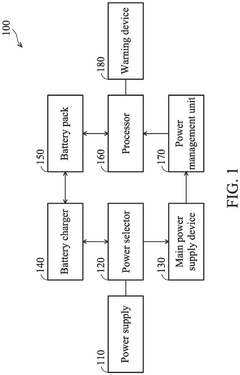
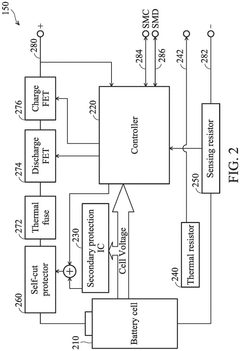
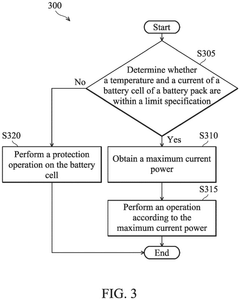
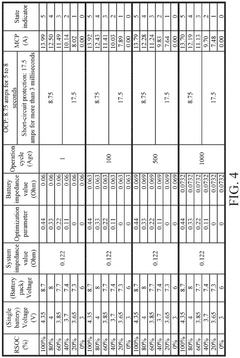
Method and device for artificial intelligence monitoring and protecting battery performance
PatentPendingEP4560875A1
Innovation
- A method and device utilizing artificial intelligence to monitor and protect battery performance by determining maximum current power based on relative state of charge, voltage, system impedance, optimization parameters, and battery impedance, optimizing energy efficiency and extending battery life.
Safety Standards and Regulations for AI-BMS Systems
The development of AI-driven Battery Management Systems operates within a complex regulatory landscape that encompasses multiple safety standards and certification requirements. These frameworks are essential for ensuring the reliability, safety, and market acceptance of AI-BMS technologies across various applications, from electric vehicles to grid-scale energy storage systems.
International safety standards form the foundation of AI-BMS regulation, with IEC 62619 and IEC 62133 establishing fundamental safety requirements for lithium-ion battery systems. These standards address thermal management, electrical safety, and mechanical integrity, which are critical considerations when integrating AI algorithms into battery control systems. The ISO 26262 functional safety standard becomes particularly relevant for automotive applications, requiring systematic hazard analysis and risk assessment for AI-driven safety functions.
Automotive sector regulations present the most stringent requirements for AI-BMS systems. The UN ECE R100 regulation governs electric vehicle battery safety, mandating specific testing protocols for thermal runaway prevention and electrical isolation. Additionally, emerging regulations like the EU's General Safety Regulation (GSR) are beginning to address AI system transparency and explainability requirements, which directly impact AI-BMS certification processes.
Grid-scale energy storage applications must comply with IEEE 1547 standards for distributed energy resources, along with UL 9540 safety standards for energy storage systems. These regulations emphasize fire safety, emergency response protocols, and grid integration requirements that AI-BMS systems must accommodate through appropriate safety algorithms and fail-safe mechanisms.
The regulatory landscape is rapidly evolving to address AI-specific challenges, including algorithmic transparency, data privacy, and cybersecurity. The EU AI Act introduces risk-based classifications that may affect AI-BMS systems used in critical infrastructure applications. Similarly, emerging cybersecurity standards like IEC 62443 are becoming increasingly relevant as AI-BMS systems incorporate cloud connectivity and remote monitoring capabilities.
Certification processes for AI-BMS systems typically require extensive documentation of AI model validation, safety case development, and continuous monitoring capabilities. Regulatory bodies are developing new assessment methodologies that address the unique challenges of AI systems, including model drift detection, adversarial robustness, and performance degradation over time.
International safety standards form the foundation of AI-BMS regulation, with IEC 62619 and IEC 62133 establishing fundamental safety requirements for lithium-ion battery systems. These standards address thermal management, electrical safety, and mechanical integrity, which are critical considerations when integrating AI algorithms into battery control systems. The ISO 26262 functional safety standard becomes particularly relevant for automotive applications, requiring systematic hazard analysis and risk assessment for AI-driven safety functions.
Automotive sector regulations present the most stringent requirements for AI-BMS systems. The UN ECE R100 regulation governs electric vehicle battery safety, mandating specific testing protocols for thermal runaway prevention and electrical isolation. Additionally, emerging regulations like the EU's General Safety Regulation (GSR) are beginning to address AI system transparency and explainability requirements, which directly impact AI-BMS certification processes.
Grid-scale energy storage applications must comply with IEEE 1547 standards for distributed energy resources, along with UL 9540 safety standards for energy storage systems. These regulations emphasize fire safety, emergency response protocols, and grid integration requirements that AI-BMS systems must accommodate through appropriate safety algorithms and fail-safe mechanisms.
The regulatory landscape is rapidly evolving to address AI-specific challenges, including algorithmic transparency, data privacy, and cybersecurity. The EU AI Act introduces risk-based classifications that may affect AI-BMS systems used in critical infrastructure applications. Similarly, emerging cybersecurity standards like IEC 62443 are becoming increasingly relevant as AI-BMS systems incorporate cloud connectivity and remote monitoring capabilities.
Certification processes for AI-BMS systems typically require extensive documentation of AI model validation, safety case development, and continuous monitoring capabilities. Regulatory bodies are developing new assessment methodologies that address the unique challenges of AI systems, including model drift detection, adversarial robustness, and performance degradation over time.
Data Privacy and Security in Connected Battery Systems
The integration of AI-driven battery management systems with connected networks introduces significant data privacy and security challenges that require comprehensive protection strategies. Connected battery systems continuously collect and transmit sensitive operational data, including charging patterns, usage behaviors, location information, and performance metrics, creating potential vulnerabilities for unauthorized access and data breaches.
Data encryption represents the fundamental security layer for connected battery systems. Advanced encryption protocols such as AES-256 and elliptic curve cryptography must be implemented for both data at rest and data in transit. End-to-end encryption ensures that sensitive battery performance data, user behavior patterns, and system diagnostics remain protected throughout the entire communication chain from sensors to cloud platforms.
Authentication and access control mechanisms form critical security barriers in AI-driven battery networks. Multi-factor authentication protocols, digital certificates, and role-based access controls prevent unauthorized system access. Secure boot processes and hardware security modules embedded within battery management units provide additional protection against tampering and malicious code injection.
Privacy-preserving AI techniques enable intelligent battery management while protecting user data. Federated learning approaches allow AI models to train on distributed battery data without centralizing sensitive information. Differential privacy methods add statistical noise to datasets, enabling valuable insights while maintaining individual user anonymity. Homomorphic encryption permits AI computations on encrypted data without requiring decryption.
Network security protocols specifically designed for IoT battery systems address unique connectivity challenges. Secure communication standards like TLS 1.3 and MQTT with security extensions protect data transmission channels. Network segmentation isolates battery management systems from other connected devices, reducing attack surfaces and containing potential security breaches.
Regulatory compliance frameworks such as GDPR, CCPA, and emerging IoT security standards establish mandatory data protection requirements for connected battery systems. These regulations mandate explicit user consent for data collection, data minimization principles, and the right to data deletion, directly impacting AI model development and deployment strategies in battery management applications.
Data encryption represents the fundamental security layer for connected battery systems. Advanced encryption protocols such as AES-256 and elliptic curve cryptography must be implemented for both data at rest and data in transit. End-to-end encryption ensures that sensitive battery performance data, user behavior patterns, and system diagnostics remain protected throughout the entire communication chain from sensors to cloud platforms.
Authentication and access control mechanisms form critical security barriers in AI-driven battery networks. Multi-factor authentication protocols, digital certificates, and role-based access controls prevent unauthorized system access. Secure boot processes and hardware security modules embedded within battery management units provide additional protection against tampering and malicious code injection.
Privacy-preserving AI techniques enable intelligent battery management while protecting user data. Federated learning approaches allow AI models to train on distributed battery data without centralizing sensitive information. Differential privacy methods add statistical noise to datasets, enabling valuable insights while maintaining individual user anonymity. Homomorphic encryption permits AI computations on encrypted data without requiring decryption.
Network security protocols specifically designed for IoT battery systems address unique connectivity challenges. Secure communication standards like TLS 1.3 and MQTT with security extensions protect data transmission channels. Network segmentation isolates battery management systems from other connected devices, reducing attack surfaces and containing potential security breaches.
Regulatory compliance frameworks such as GDPR, CCPA, and emerging IoT security standards establish mandatory data protection requirements for connected battery systems. These regulations mandate explicit user consent for data collection, data minimization principles, and the right to data deletion, directly impacting AI model development and deployment strategies in battery management applications.
Unlock deeper insights with PatSnap Eureka Quick Research — get a full tech report to explore trends and direct your research. Try now!
Generate Your Research Report Instantly with AI Agent
Supercharge your innovation with PatSnap Eureka AI Agent Platform!