

How to Develop VRLA Battery Algorithms for Predictive Maintenance
MAR 20, 20269 MIN READ
Generate Your Research Report Instantly with AI Agent
PatSnap Eureka helps you evaluate technical feasibility & market potential.
VRLA Battery Technology Background and Predictive Goals
Valve Regulated Lead Acid (VRLA) batteries have been a cornerstone of energy storage technology since their commercial introduction in the 1970s. These sealed, maintenance-free batteries evolved from traditional flooded lead-acid designs to address the growing demand for reliable, low-maintenance power solutions in telecommunications, uninterruptible power supplies, and emergency backup systems. The technology's development trajectory has consistently focused on improving energy density, cycle life, and operational reliability while reducing maintenance requirements.
The fundamental architecture of VRLA batteries incorporates an oxygen recombination cycle that eliminates the need for water addition during normal operation. This sealed design, combined with absorbed glass mat (AGM) or gel electrolyte technologies, has positioned VRLA batteries as preferred solutions for critical applications where reliability and minimal maintenance are paramount. However, the sealed nature that provides operational advantages also creates challenges in monitoring internal battery conditions and predicting performance degradation.
Traditional battery management approaches have relied primarily on voltage and current measurements, supplemented by periodic capacity testing. While these methods provide basic operational insights, they often fail to detect early-stage degradation patterns or predict imminent failures with sufficient accuracy. The reactive nature of conventional monitoring frequently results in unexpected battery failures, leading to costly downtime and emergency replacements in critical applications.
The evolution toward predictive maintenance represents a paradigm shift from reactive to proactive battery management strategies. Modern VRLA battery systems generate vast amounts of operational data through continuous monitoring of electrical parameters, environmental conditions, and usage patterns. Advanced algorithms can analyze these data streams to identify subtle degradation signatures that precede catastrophic failures, enabling maintenance teams to schedule replacements during planned outages rather than responding to emergency situations.
The primary technical objectives for VRLA battery predictive maintenance algorithms encompass several critical capabilities. Accurate state-of-health estimation requires algorithms that can correlate multiple measurable parameters with internal battery conditions, accounting for the complex electrochemical processes that influence performance degradation. Remaining useful life prediction demands sophisticated modeling approaches that consider historical usage patterns, environmental stresses, and aging mechanisms to forecast when batteries will reach end-of-life criteria.
Early fault detection represents another crucial goal, requiring algorithms capable of identifying anomalous behavior patterns that indicate developing problems such as thermal runaway, electrolyte stratification, or grid corrosion. These predictive capabilities must operate reliably across diverse operating conditions while minimizing false positive alerts that could undermine user confidence in the system.
The integration of machine learning techniques with traditional electrochemical modeling approaches offers promising pathways for achieving these predictive maintenance objectives, enabling more accurate and reliable battery management strategies that optimize both performance and operational costs.
The fundamental architecture of VRLA batteries incorporates an oxygen recombination cycle that eliminates the need for water addition during normal operation. This sealed design, combined with absorbed glass mat (AGM) or gel electrolyte technologies, has positioned VRLA batteries as preferred solutions for critical applications where reliability and minimal maintenance are paramount. However, the sealed nature that provides operational advantages also creates challenges in monitoring internal battery conditions and predicting performance degradation.
Traditional battery management approaches have relied primarily on voltage and current measurements, supplemented by periodic capacity testing. While these methods provide basic operational insights, they often fail to detect early-stage degradation patterns or predict imminent failures with sufficient accuracy. The reactive nature of conventional monitoring frequently results in unexpected battery failures, leading to costly downtime and emergency replacements in critical applications.
The evolution toward predictive maintenance represents a paradigm shift from reactive to proactive battery management strategies. Modern VRLA battery systems generate vast amounts of operational data through continuous monitoring of electrical parameters, environmental conditions, and usage patterns. Advanced algorithms can analyze these data streams to identify subtle degradation signatures that precede catastrophic failures, enabling maintenance teams to schedule replacements during planned outages rather than responding to emergency situations.
The primary technical objectives for VRLA battery predictive maintenance algorithms encompass several critical capabilities. Accurate state-of-health estimation requires algorithms that can correlate multiple measurable parameters with internal battery conditions, accounting for the complex electrochemical processes that influence performance degradation. Remaining useful life prediction demands sophisticated modeling approaches that consider historical usage patterns, environmental stresses, and aging mechanisms to forecast when batteries will reach end-of-life criteria.
Early fault detection represents another crucial goal, requiring algorithms capable of identifying anomalous behavior patterns that indicate developing problems such as thermal runaway, electrolyte stratification, or grid corrosion. These predictive capabilities must operate reliably across diverse operating conditions while minimizing false positive alerts that could undermine user confidence in the system.
The integration of machine learning techniques with traditional electrochemical modeling approaches offers promising pathways for achieving these predictive maintenance objectives, enabling more accurate and reliable battery management strategies that optimize both performance and operational costs.
Market Demand for VRLA Battery Predictive Maintenance
The global VRLA battery market is experiencing unprecedented growth driven by the increasing adoption of uninterruptible power supply systems, telecommunications infrastructure expansion, and renewable energy storage applications. Data centers, telecommunications facilities, and critical infrastructure operators are recognizing that battery failures represent one of the most significant risks to operational continuity, creating substantial demand for predictive maintenance solutions.
Traditional reactive maintenance approaches have proven inadequate for modern operational requirements. Organizations are shifting from scheduled maintenance to condition-based strategies that can prevent unexpected failures while optimizing battery lifecycle costs. This transition is particularly pronounced in sectors where downtime costs are exceptionally high, including financial services, healthcare facilities, and manufacturing operations.
The telecommunications industry represents a particularly robust market segment for VRLA battery predictive maintenance solutions. Network operators managing thousands of remote sites require automated monitoring capabilities to reduce site visits and maintenance costs while ensuring service reliability. Similarly, the data center industry's rapid expansion has created demand for sophisticated battery management systems that can predict failures before they impact critical operations.
Regulatory compliance requirements are further driving market demand. Industries subject to strict uptime requirements, such as healthcare and financial services, are increasingly mandating predictive maintenance capabilities for backup power systems. These regulations are creating a compliance-driven market segment that prioritizes reliability over cost considerations.
The emergence of Internet of Things technologies and cloud-based analytics platforms has made predictive maintenance solutions more accessible and cost-effective for smaller organizations. This technological democratization is expanding the addressable market beyond large enterprises to include mid-market customers who previously could not justify the investment in sophisticated monitoring systems.
Market research indicates strong growth potential across multiple geographic regions, with particular strength in North America and Asia-Pacific markets. The increasing frequency of power grid instabilities and extreme weather events is driving organizations to invest more heavily in backup power reliability, creating sustained demand for predictive maintenance technologies that can ensure these systems perform when needed most.
Traditional reactive maintenance approaches have proven inadequate for modern operational requirements. Organizations are shifting from scheduled maintenance to condition-based strategies that can prevent unexpected failures while optimizing battery lifecycle costs. This transition is particularly pronounced in sectors where downtime costs are exceptionally high, including financial services, healthcare facilities, and manufacturing operations.
The telecommunications industry represents a particularly robust market segment for VRLA battery predictive maintenance solutions. Network operators managing thousands of remote sites require automated monitoring capabilities to reduce site visits and maintenance costs while ensuring service reliability. Similarly, the data center industry's rapid expansion has created demand for sophisticated battery management systems that can predict failures before they impact critical operations.
Regulatory compliance requirements are further driving market demand. Industries subject to strict uptime requirements, such as healthcare and financial services, are increasingly mandating predictive maintenance capabilities for backup power systems. These regulations are creating a compliance-driven market segment that prioritizes reliability over cost considerations.
The emergence of Internet of Things technologies and cloud-based analytics platforms has made predictive maintenance solutions more accessible and cost-effective for smaller organizations. This technological democratization is expanding the addressable market beyond large enterprises to include mid-market customers who previously could not justify the investment in sophisticated monitoring systems.
Market research indicates strong growth potential across multiple geographic regions, with particular strength in North America and Asia-Pacific markets. The increasing frequency of power grid instabilities and extreme weather events is driving organizations to invest more heavily in backup power reliability, creating sustained demand for predictive maintenance technologies that can ensure these systems perform when needed most.
Current VRLA Algorithm Challenges and Technical Barriers
VRLA battery predictive maintenance algorithms face significant technical barriers that limit their effectiveness in real-world applications. The primary challenge stems from the complex electrochemical processes within sealed lead-acid batteries, where multiple degradation mechanisms occur simultaneously and interact in non-linear ways. Traditional algorithms struggle to accurately model these interdependent processes, including sulfation, grid corrosion, electrolyte stratification, and thermal runaway conditions.
Data acquisition represents another critical barrier, as VRLA batteries typically provide limited measurable parameters compared to other battery technologies. Most systems rely solely on voltage, current, and temperature measurements, which provide insufficient information to comprehensively assess internal battery health. The lack of direct access to electrolyte specific gravity, a key indicator in flooded lead-acid batteries, forces algorithms to infer critical state information from indirect measurements, reducing accuracy significantly.
Algorithm robustness across diverse operating conditions poses substantial challenges. VRLA batteries operate in varying temperature ranges, discharge profiles, and float charging conditions, each affecting degradation patterns differently. Current algorithms often fail to maintain accuracy when deployed across different applications, from telecommunications backup power to renewable energy storage systems, due to insufficient adaptability to environmental and operational variations.
State-of-charge estimation accuracy remains problematic, particularly in partial state-of-charge cycling applications common in renewable energy systems. The voltage-based methods traditionally used for VRLA batteries suffer from significant errors during dynamic loading conditions and temperature fluctuations. Coulomb counting approaches accumulate errors over time due to measurement uncertainties and varying charge efficiency rates.
Computational complexity versus accuracy trade-offs create implementation barriers for embedded systems. Advanced algorithms requiring extensive computational resources are often impractical for deployment in cost-sensitive applications where VRLA batteries are commonly used. Simplified models sacrifice accuracy for computational efficiency, limiting their predictive capabilities.
Data quality and standardization issues further complicate algorithm development. Inconsistent measurement protocols, varying sensor accuracies, and lack of standardized degradation datasets hinder the development of universally applicable algorithms. The absence of comprehensive failure mode databases limits machine learning approaches that require extensive training data to achieve reliable performance across diverse operational scenarios.
Data acquisition represents another critical barrier, as VRLA batteries typically provide limited measurable parameters compared to other battery technologies. Most systems rely solely on voltage, current, and temperature measurements, which provide insufficient information to comprehensively assess internal battery health. The lack of direct access to electrolyte specific gravity, a key indicator in flooded lead-acid batteries, forces algorithms to infer critical state information from indirect measurements, reducing accuracy significantly.
Algorithm robustness across diverse operating conditions poses substantial challenges. VRLA batteries operate in varying temperature ranges, discharge profiles, and float charging conditions, each affecting degradation patterns differently. Current algorithms often fail to maintain accuracy when deployed across different applications, from telecommunications backup power to renewable energy storage systems, due to insufficient adaptability to environmental and operational variations.
State-of-charge estimation accuracy remains problematic, particularly in partial state-of-charge cycling applications common in renewable energy systems. The voltage-based methods traditionally used for VRLA batteries suffer from significant errors during dynamic loading conditions and temperature fluctuations. Coulomb counting approaches accumulate errors over time due to measurement uncertainties and varying charge efficiency rates.
Computational complexity versus accuracy trade-offs create implementation barriers for embedded systems. Advanced algorithms requiring extensive computational resources are often impractical for deployment in cost-sensitive applications where VRLA batteries are commonly used. Simplified models sacrifice accuracy for computational efficiency, limiting their predictive capabilities.
Data quality and standardization issues further complicate algorithm development. Inconsistent measurement protocols, varying sensor accuracies, and lack of standardized degradation datasets hinder the development of universally applicable algorithms. The absence of comprehensive failure mode databases limits machine learning approaches that require extensive training data to achieve reliable performance across diverse operational scenarios.
Existing VRLA Predictive Maintenance Solutions
01 Battery state monitoring and parameter measurement algorithms
Predictive maintenance systems utilize algorithms to continuously monitor and measure key battery parameters such as voltage, current, temperature, and internal resistance. These measurements are collected through sensors and processed to assess the current state of health and performance of VRLA batteries. Advanced signal processing techniques are employed to filter noise and extract meaningful data patterns that indicate battery degradation or potential failure modes.- Machine learning algorithms for battery state prediction: Advanced machine learning and artificial intelligence algorithms are employed to predict the state of health and remaining useful life of VRLA batteries. These algorithms analyze historical data patterns, voltage characteristics, and discharge cycles to forecast battery degradation and potential failures. The predictive models enable proactive maintenance scheduling by identifying anomalies and trends before critical failures occur.
- Real-time monitoring and data acquisition systems: Comprehensive monitoring systems continuously collect operational parameters including voltage, current, temperature, and internal resistance of VRLA batteries. These systems utilize sensors and data acquisition hardware to capture real-time performance metrics, which are then processed to assess battery condition. The collected data forms the foundation for predictive analytics and enables early detection of performance degradation.
- Impedance and internal resistance analysis: Predictive maintenance techniques incorporate impedance spectroscopy and internal resistance measurements to evaluate battery health. By analyzing the electrical characteristics and resistance changes over time, these methods can identify cell degradation, sulfation, and electrolyte stratification. This approach provides accurate indicators of battery aging and helps determine optimal replacement timing.
- Cloud-based predictive maintenance platforms: Cloud computing infrastructure enables centralized battery management and predictive analytics across distributed battery installations. These platforms aggregate data from multiple battery systems, apply sophisticated algorithms for pattern recognition, and provide remote monitoring capabilities. The cloud-based approach facilitates scalable maintenance management and enables comparison of performance across different battery populations.
- Thermal management and temperature-based prediction: Temperature monitoring and thermal analysis play a critical role in predicting VRLA battery failures and optimizing maintenance schedules. Predictive algorithms incorporate thermal profiles and ambient temperature effects to assess battery stress conditions and accelerated aging. Temperature-compensated models improve prediction accuracy by accounting for environmental factors that influence battery performance and lifespan.
02 Machine learning and AI-based predictive models
Artificial intelligence and machine learning algorithms are implemented to analyze historical battery data and predict future performance trends. These models can identify patterns and correlations that indicate impending battery failures before they occur. The algorithms are trained on large datasets to recognize anomalies and degradation signatures, enabling proactive maintenance scheduling and reducing unexpected downtime.Expand Specific Solutions03 Remaining useful life estimation algorithms
Specialized algorithms are developed to estimate the remaining useful life of VRLA batteries based on current operating conditions and historical degradation patterns. These estimation methods combine electrochemical models with statistical approaches to provide accurate predictions of when batteries will reach end-of-life criteria. The algorithms account for various factors including charge-discharge cycles, operating temperature, and aging mechanisms to generate reliable lifetime forecasts.Expand Specific Solutions04 Fault detection and diagnostic algorithms
Diagnostic algorithms are employed to detect and classify various fault conditions in VRLA batteries such as sulfation, dry-out, thermal runaway, and cell imbalance. These algorithms analyze multiple parameters simultaneously to identify specific failure modes and their root causes. Early fault detection enables timely intervention and prevents catastrophic failures, extending battery service life and improving system reliability.Expand Specific Solutions05 Cloud-based data analytics and remote monitoring systems
Cloud computing platforms are integrated with predictive maintenance algorithms to enable remote monitoring and centralized data analytics for distributed VRLA battery installations. These systems collect data from multiple battery sites, perform advanced analytics in the cloud, and provide real-time alerts and maintenance recommendations. The cloud-based approach facilitates scalable deployment, continuous algorithm updates, and comprehensive fleet management capabilities.Expand Specific Solutions
Key Players in VRLA Battery Algorithm Development
The VRLA battery predictive maintenance algorithm market represents a rapidly evolving sector within the broader energy storage and power management industry. Currently in its growth phase, the market is experiencing significant expansion driven by increasing demand for reliable backup power systems and grid modernization initiatives. The market size is substantial, particularly in regions with extensive industrial infrastructure and renewable energy deployment. Technology maturity varies considerably across market participants, with established players like Huawei Technologies, Robert Bosch, and LG Energy Solution demonstrating advanced algorithmic capabilities and comprehensive battery management systems. State Grid Corporation of China and its subsidiaries, along with Eaton Intelligent Power, represent mature utility-scale implementations. Meanwhile, specialized companies such as Hangzhou Gold Electronic Equipment and emerging players like Shenzhen Yinwang Intelligent Technology are developing innovative solutions. Academic institutions including Zhejiang University and Huazhong University of Science & Technology contribute fundamental research, indicating strong R&D foundations supporting continued technological advancement in predictive maintenance algorithms.
Eaton Intelligent Power Ltd.
Technical Solution: Eaton has developed sophisticated predictive maintenance algorithms for VRLA batteries used in UPS systems and critical power applications. Their approach leverages decades of power management expertise to create algorithms that monitor battery impedance, float current, and temperature variations to predict maintenance needs. The system employs time-series analysis and statistical modeling to identify degradation patterns and predict end-of-life scenarios. Their algorithms can detect early signs of battery sulfation, thermal runaway risks, and capacity loss with prediction accuracies above 80%. The solution includes automated reporting capabilities and integration with facility management systems for proactive maintenance scheduling.
Strengths: Deep domain expertise in power systems and established customer base for validation. Weaknesses: Traditional approach may lag behind newer AI-driven methodologies and limited scalability for large deployments.
Huawei Technologies Co., Ltd.
Technical Solution: Huawei has developed AI-powered predictive maintenance algorithms specifically designed for VRLA batteries in telecommunications and data center applications. Their solution combines edge computing capabilities with advanced analytics to monitor battery health parameters in real-time. The system uses ensemble learning methods incorporating decision trees, support vector machines, and deep learning models to predict battery failures with lead times of 30-90 days. Their algorithms analyze voltage fluctuations, capacity degradation trends, and environmental factors to generate predictive insights. The platform supports automated alert generation and maintenance scheduling integration, reducing unplanned downtime by up to 40% in deployed systems.
Strengths: Strong AI capabilities and extensive telecom infrastructure experience providing rich training datasets. Weaknesses: Limited focus on non-telecom applications and complex integration requirements.
Core Algorithm Innovations for VRLA Health Monitoring
Battery float management
PatentActiveUS20070080668A1
Innovation
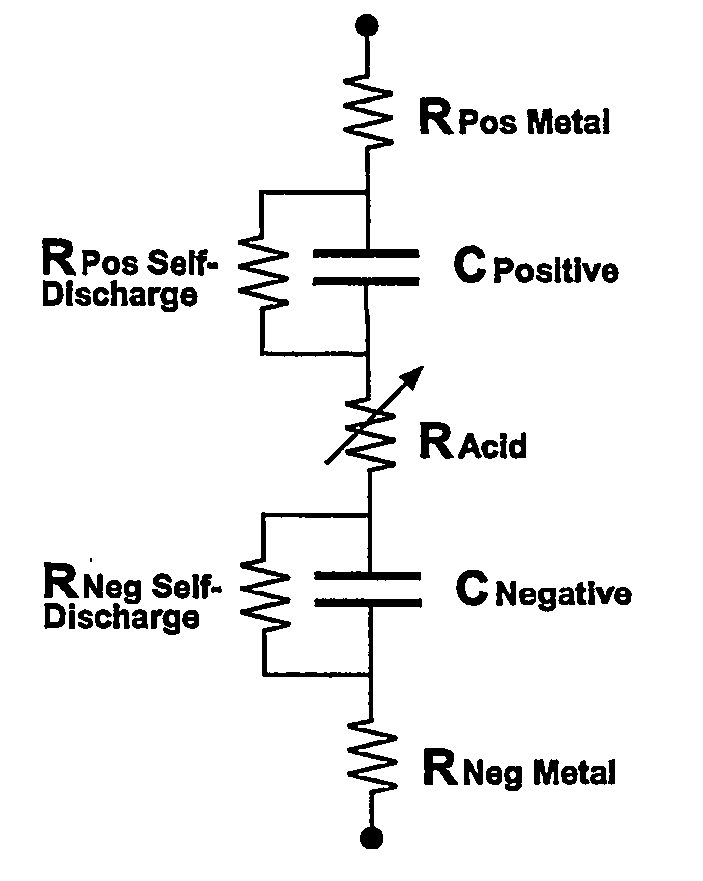
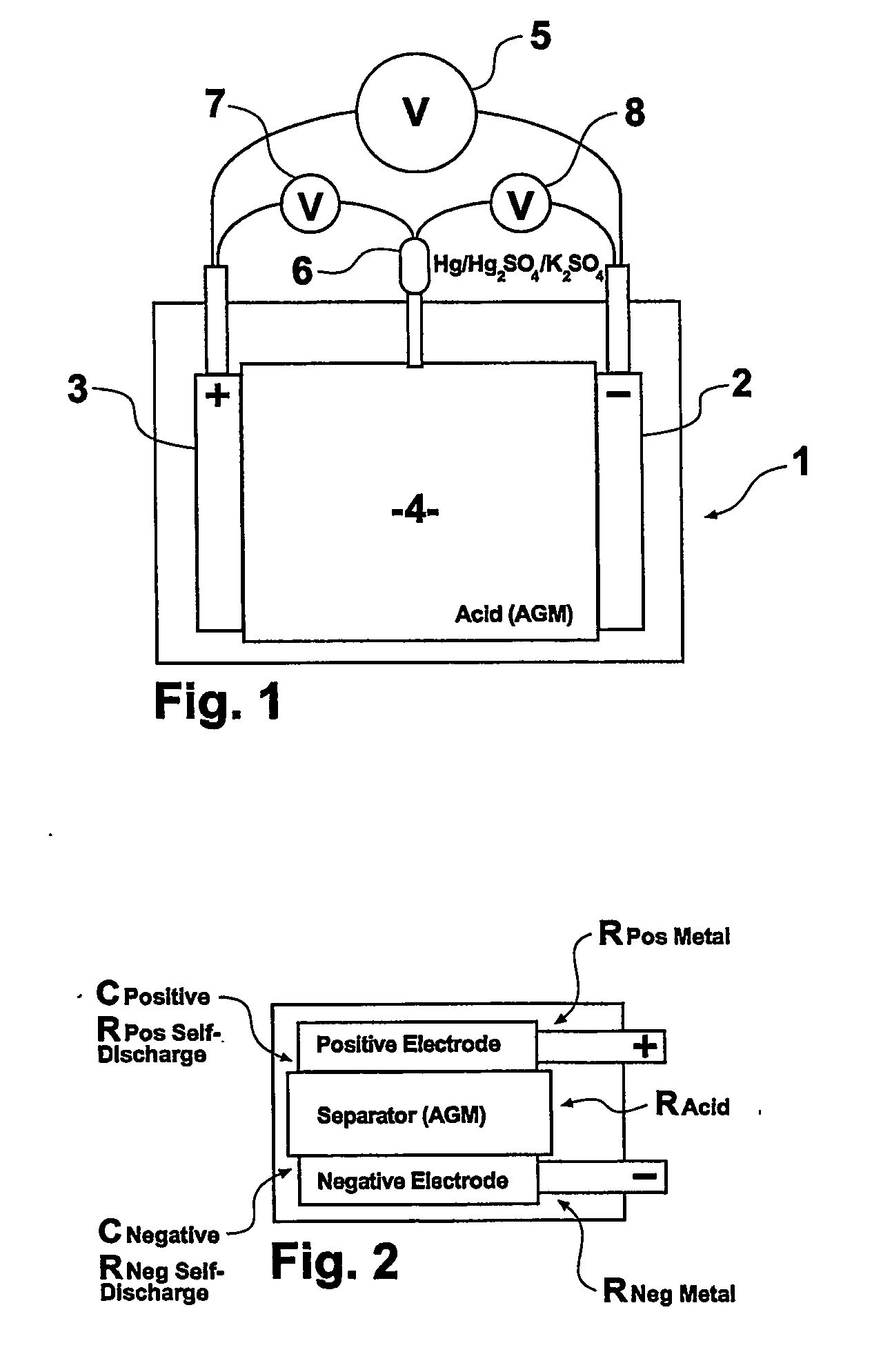
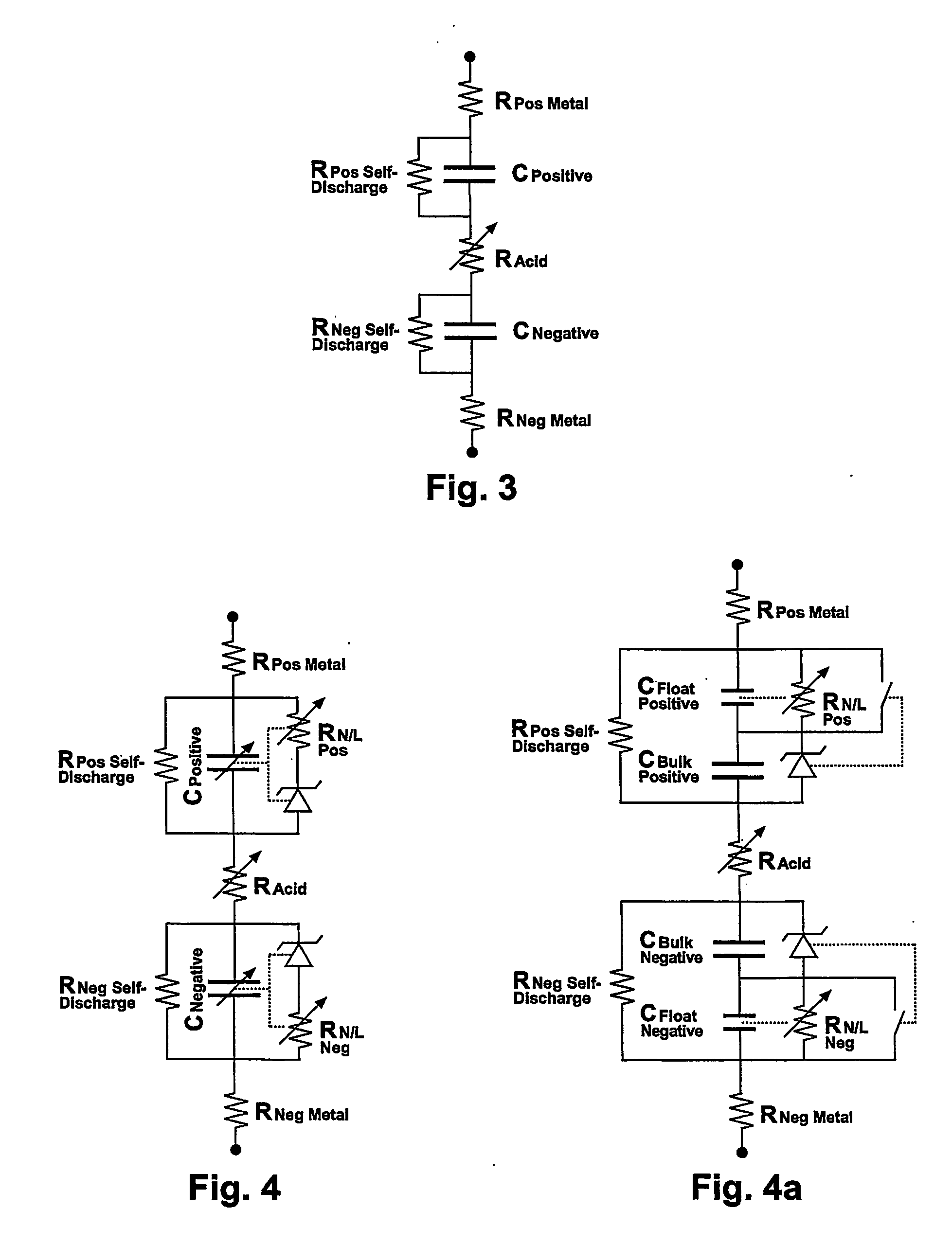
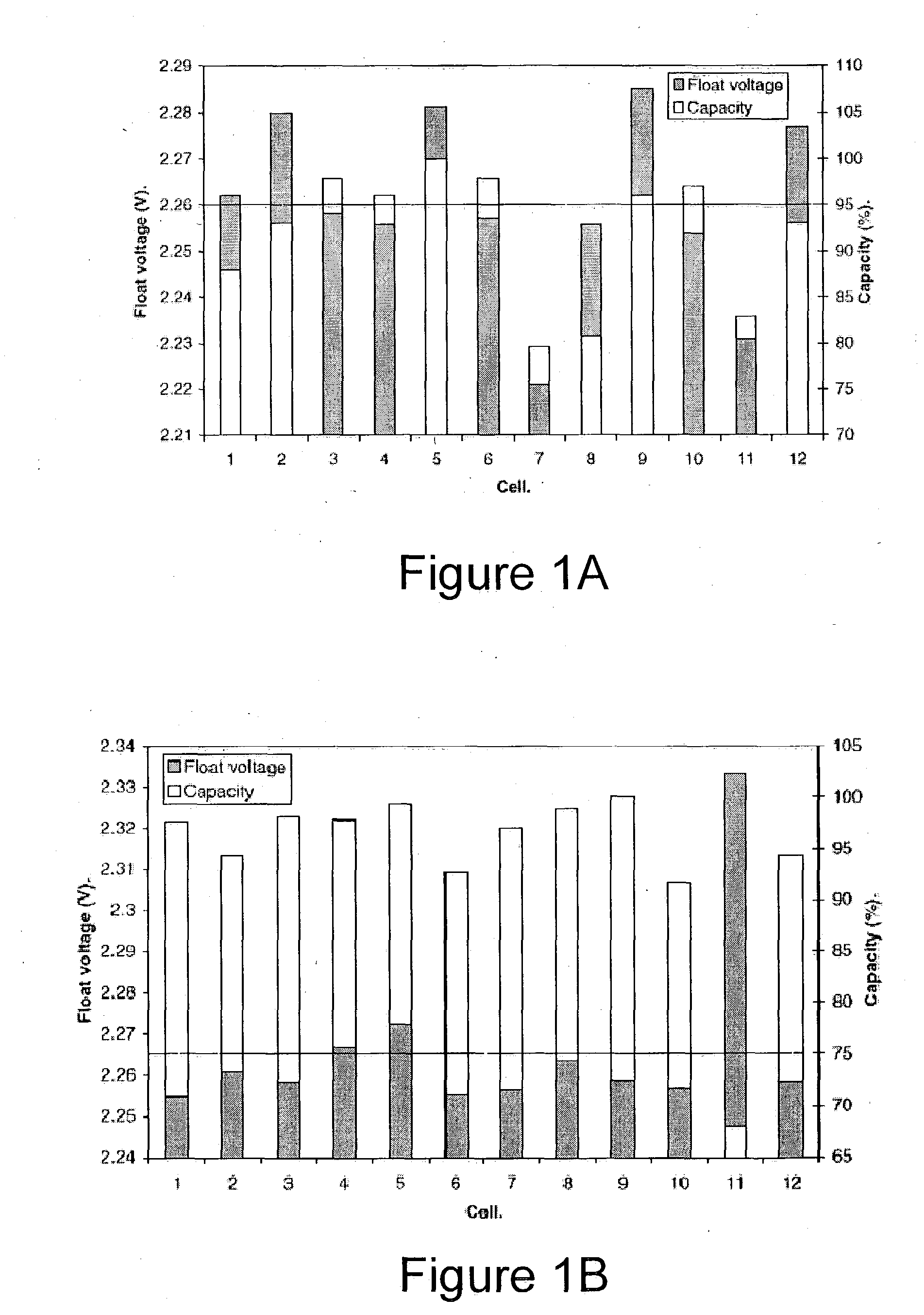
- A method to determine and manage electrode polarization in VRLA batteries by monitoring voltage changes during discharge, allowing for tailored float charge application and modeling of dual-value capacitances to simulate both bulk charge and float regions, enabling balanced charge distribution without the need for additional hardware or reference electrodes.

Apparatus, methods and computer program products for estimation of battery reserve life using adaptively modified state of health indicator-based reserve life models
PatentInactiveUS20050001627A1
Innovation
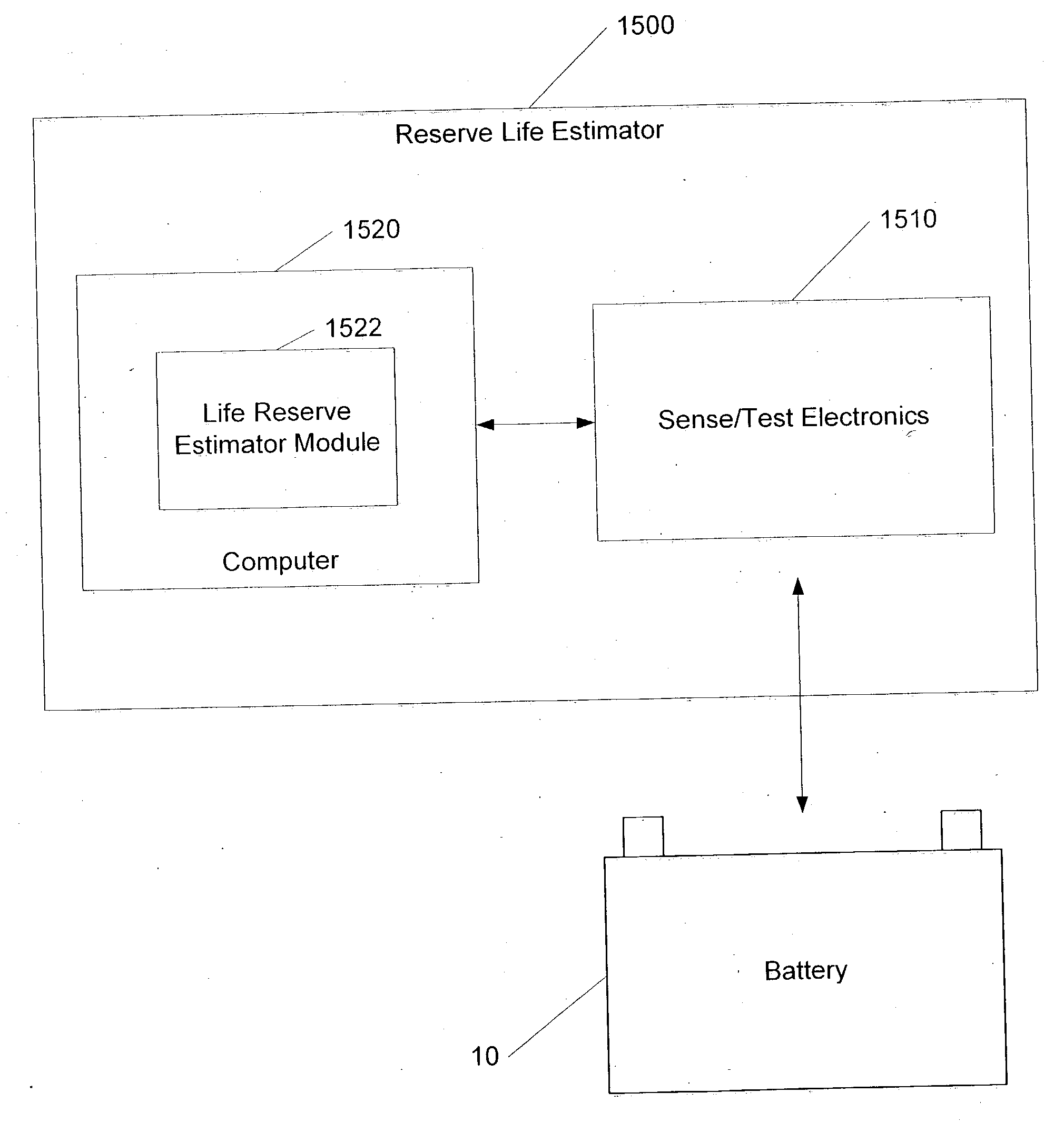
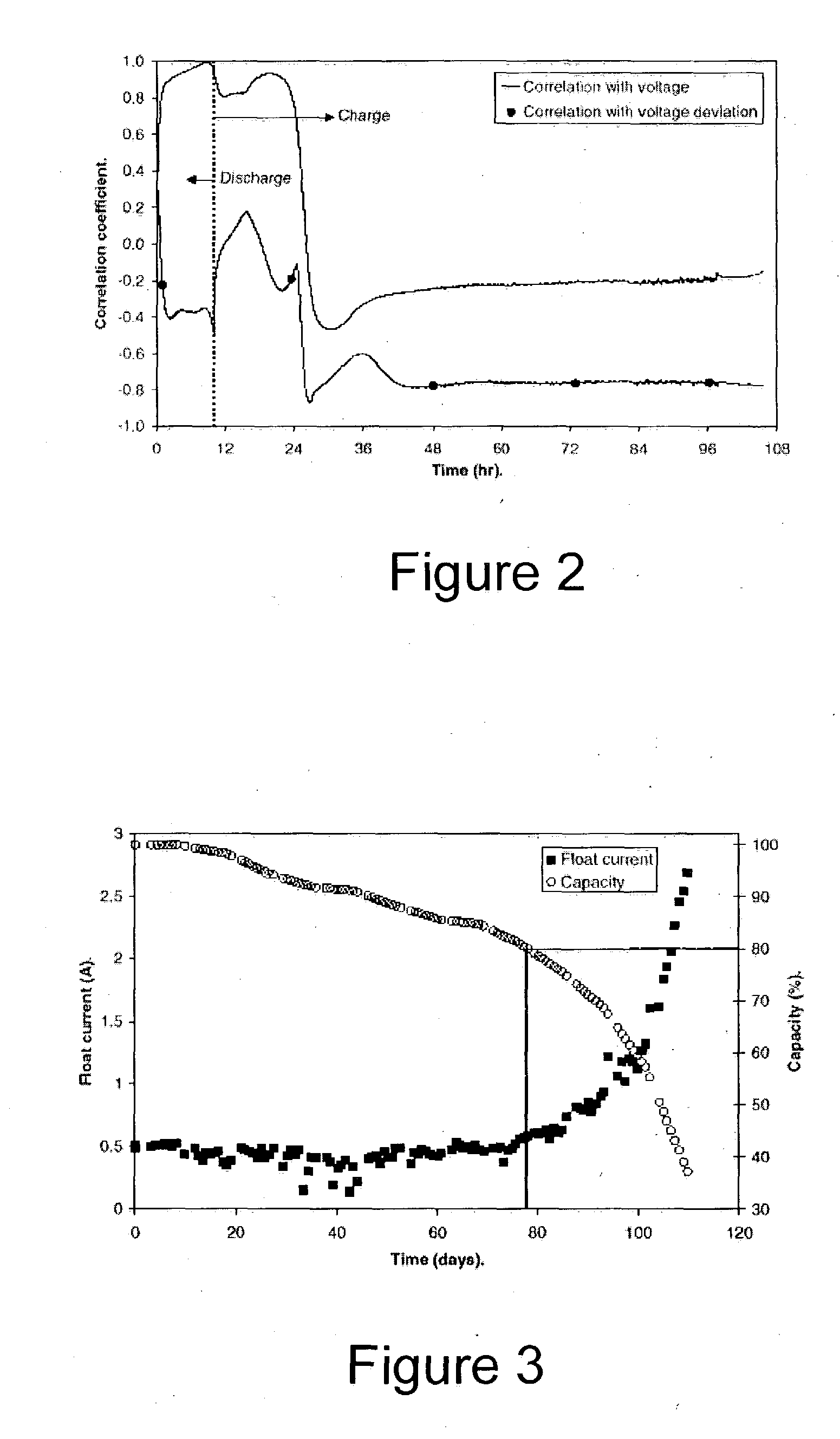
- A model that adaptively modifies battery reserve life estimates based on State of Health (SOH) indicators, using intermittent capacity tests, float voltage, float current, temperature, charge/discharge cycling, impedance, conductance, and coup de fouet parameters to provide accurate reserve life predictions.

Safety Standards for VRLA Battery Management Systems
Safety standards for VRLA battery management systems represent a critical framework that governs the development and implementation of predictive maintenance algorithms. These standards establish fundamental requirements for system design, operational parameters, and risk mitigation strategies that directly influence algorithmic development approaches.
The International Electrotechnical Commission (IEC) 62485 series provides comprehensive guidelines for VRLA battery safety in stationary applications, defining essential parameters such as voltage thresholds, temperature limits, and gas emission monitoring requirements. These specifications create boundary conditions that predictive algorithms must respect during operation. Additionally, IEEE 1188 standards establish maintenance practices that serve as benchmarks for algorithmic performance validation.
Functional safety requirements under IEC 61508 mandate that battery management systems incorporate fail-safe mechanisms and redundant monitoring capabilities. This necessitates that predictive maintenance algorithms include built-in safety checks, emergency shutdown protocols, and continuous system integrity verification. The Safety Integrity Level (SIL) classifications directly impact the complexity and reliability requirements of algorithmic implementations.
Thermal management safety standards impose strict temperature monitoring and control requirements, as thermal runaway represents one of the most significant risks in VRLA systems. Algorithms must incorporate multi-point temperature sensing, gradient analysis, and predictive thermal modeling to comply with NFPA 855 energy storage system safety codes. These requirements influence data collection strategies and computational complexity of predictive models.
Electrical safety standards, including UL 1973 and UL 9540, establish protocols for voltage monitoring, insulation resistance testing, and arc fault detection. Predictive algorithms must integrate these safety parameters as primary inputs while maintaining compliance with electromagnetic compatibility requirements under IEC 61000 series standards.
Certification processes require comprehensive documentation of algorithmic decision-making processes, validation methodologies, and failure mode analysis. This regulatory framework shapes the development lifecycle, requiring extensive testing protocols and performance verification against established safety benchmarks before deployment in critical applications.
The International Electrotechnical Commission (IEC) 62485 series provides comprehensive guidelines for VRLA battery safety in stationary applications, defining essential parameters such as voltage thresholds, temperature limits, and gas emission monitoring requirements. These specifications create boundary conditions that predictive algorithms must respect during operation. Additionally, IEEE 1188 standards establish maintenance practices that serve as benchmarks for algorithmic performance validation.
Functional safety requirements under IEC 61508 mandate that battery management systems incorporate fail-safe mechanisms and redundant monitoring capabilities. This necessitates that predictive maintenance algorithms include built-in safety checks, emergency shutdown protocols, and continuous system integrity verification. The Safety Integrity Level (SIL) classifications directly impact the complexity and reliability requirements of algorithmic implementations.
Thermal management safety standards impose strict temperature monitoring and control requirements, as thermal runaway represents one of the most significant risks in VRLA systems. Algorithms must incorporate multi-point temperature sensing, gradient analysis, and predictive thermal modeling to comply with NFPA 855 energy storage system safety codes. These requirements influence data collection strategies and computational complexity of predictive models.
Electrical safety standards, including UL 1973 and UL 9540, establish protocols for voltage monitoring, insulation resistance testing, and arc fault detection. Predictive algorithms must integrate these safety parameters as primary inputs while maintaining compliance with electromagnetic compatibility requirements under IEC 61000 series standards.
Certification processes require comprehensive documentation of algorithmic decision-making processes, validation methodologies, and failure mode analysis. This regulatory framework shapes the development lifecycle, requiring extensive testing protocols and performance verification against established safety benchmarks before deployment in critical applications.
Data Privacy in Battery Monitoring Applications
Data privacy represents a critical consideration in VRLA battery monitoring applications, particularly as predictive maintenance algorithms require extensive data collection and processing. The sensitive nature of operational data, including battery performance metrics, usage patterns, and facility information, necessitates robust privacy protection mechanisms throughout the entire data lifecycle.
Battery monitoring systems typically collect granular data including voltage readings, temperature measurements, charge-discharge cycles, and environmental conditions. This information can reveal operational patterns, energy consumption behaviors, and infrastructure vulnerabilities that organizations consider proprietary or sensitive. The aggregation of such data across multiple battery installations creates comprehensive profiles that could be exploited if inadequately protected.
Regulatory compliance frameworks significantly impact data handling practices in battery monitoring applications. The General Data Protection Regulation (GDPR) in Europe and various national data protection laws establish strict requirements for data collection, processing, and storage. Organizations must implement privacy-by-design principles, ensuring that data protection measures are integrated into monitoring systems from the initial development stages rather than added as afterthoughts.
Technical privacy protection mechanisms include data anonymization, pseudonymization, and differential privacy techniques. Edge computing architectures enable local data processing, reducing the need to transmit sensitive information to centralized servers. Federated learning approaches allow predictive maintenance algorithms to be trained across distributed battery installations without exposing individual facility data.
Encryption protocols protect data both in transit and at rest, while access control mechanisms ensure that only authorized personnel can view sensitive battery performance information. Multi-party computation techniques enable collaborative analysis of battery data across organizations without revealing proprietary information to competitors.
The challenge lies in balancing data utility with privacy protection. Excessive anonymization can reduce the effectiveness of predictive maintenance algorithms, while insufficient protection exposes organizations to regulatory penalties and competitive disadvantages. Organizations must establish clear data governance policies that define collection purposes, retention periods, and sharing protocols while maintaining the data quality necessary for accurate predictive analytics.
Battery monitoring systems typically collect granular data including voltage readings, temperature measurements, charge-discharge cycles, and environmental conditions. This information can reveal operational patterns, energy consumption behaviors, and infrastructure vulnerabilities that organizations consider proprietary or sensitive. The aggregation of such data across multiple battery installations creates comprehensive profiles that could be exploited if inadequately protected.
Regulatory compliance frameworks significantly impact data handling practices in battery monitoring applications. The General Data Protection Regulation (GDPR) in Europe and various national data protection laws establish strict requirements for data collection, processing, and storage. Organizations must implement privacy-by-design principles, ensuring that data protection measures are integrated into monitoring systems from the initial development stages rather than added as afterthoughts.
Technical privacy protection mechanisms include data anonymization, pseudonymization, and differential privacy techniques. Edge computing architectures enable local data processing, reducing the need to transmit sensitive information to centralized servers. Federated learning approaches allow predictive maintenance algorithms to be trained across distributed battery installations without exposing individual facility data.
Encryption protocols protect data both in transit and at rest, while access control mechanisms ensure that only authorized personnel can view sensitive battery performance information. Multi-party computation techniques enable collaborative analysis of battery data across organizations without revealing proprietary information to competitors.
The challenge lies in balancing data utility with privacy protection. Excessive anonymization can reduce the effectiveness of predictive maintenance algorithms, while insufficient protection exposes organizations to regulatory penalties and competitive disadvantages. Organizations must establish clear data governance policies that define collection purposes, retention periods, and sharing protocols while maintaining the data quality necessary for accurate predictive analytics.
Unlock deeper insights with PatSnap Eureka Quick Research — get a full tech report to explore trends and direct your research. Try now!
Generate Your Research Report Instantly with AI Agent
Supercharge your innovation with PatSnap Eureka AI Agent Platform!