
How to Evaluate Tricalcium Phosphate Purity Using FTIR
MAR 20, 20269 MIN READ
Generate Your Research Report Instantly with AI Agent
Patsnap Eureka helps you evaluate technical feasibility & market potential.
FTIR-Based TCP Purity Analysis Background and Objectives
Tricalcium phosphate (TCP) represents a critical biomaterial extensively utilized in medical applications, particularly in bone tissue engineering, dental implants, and orthopedic reconstructive procedures. The material's biocompatibility, osteoconductivity, and biodegradability properties make it an essential component in modern regenerative medicine. However, the therapeutic efficacy and safety of TCP-based products are fundamentally dependent on material purity, necessitating robust analytical methodologies for quality assessment.
The evolution of TCP purity analysis has progressed from traditional wet chemical methods to sophisticated instrumental techniques. Early approaches relied primarily on gravimetric analysis and titration methods, which, while providing basic compositional information, lacked the precision and specificity required for comprehensive impurity characterization. The introduction of X-ray diffraction (XRD) marked a significant advancement, enabling crystalline phase identification and quantification of TCP polymorphs.
Fourier Transform Infrared (FTIR) spectroscopy has emerged as a transformative analytical tool in TCP purity evaluation, offering unique advantages in molecular-level characterization. The technique's ability to identify functional groups, detect trace impurities, and provide quantitative analysis through spectral deconvolution has positioned it as an indispensable method in pharmaceutical and biomedical material quality control.
Contemporary challenges in TCP purity assessment stem from the material's complex synthesis pathways and potential contamination sources. Common impurities include calcium carbonate, calcium oxide, hydroxyapatite, and various phosphate phases, each presenting distinct spectroscopic signatures. The presence of organic residues from synthesis processes, moisture content variations, and crystalline defects further complicate purity determination.
The primary objective of developing FTIR-based TCP purity analysis methodologies centers on establishing standardized protocols that can reliably detect and quantify impurities at clinically relevant concentrations. This involves creating comprehensive spectral libraries, developing mathematical models for quantitative analysis, and validating methods against established reference standards.
Advanced FTIR techniques, including attenuated total reflectance (ATR) and diffuse reflectance infrared Fourier transform spectroscopy (DRIFTS), offer enhanced sensitivity and reduced sample preparation requirements. These methodologies aim to achieve detection limits below 1% for major impurities while maintaining analytical precision suitable for regulatory compliance in pharmaceutical and medical device manufacturing.
The evolution of TCP purity analysis has progressed from traditional wet chemical methods to sophisticated instrumental techniques. Early approaches relied primarily on gravimetric analysis and titration methods, which, while providing basic compositional information, lacked the precision and specificity required for comprehensive impurity characterization. The introduction of X-ray diffraction (XRD) marked a significant advancement, enabling crystalline phase identification and quantification of TCP polymorphs.
Fourier Transform Infrared (FTIR) spectroscopy has emerged as a transformative analytical tool in TCP purity evaluation, offering unique advantages in molecular-level characterization. The technique's ability to identify functional groups, detect trace impurities, and provide quantitative analysis through spectral deconvolution has positioned it as an indispensable method in pharmaceutical and biomedical material quality control.
Contemporary challenges in TCP purity assessment stem from the material's complex synthesis pathways and potential contamination sources. Common impurities include calcium carbonate, calcium oxide, hydroxyapatite, and various phosphate phases, each presenting distinct spectroscopic signatures. The presence of organic residues from synthesis processes, moisture content variations, and crystalline defects further complicate purity determination.
The primary objective of developing FTIR-based TCP purity analysis methodologies centers on establishing standardized protocols that can reliably detect and quantify impurities at clinically relevant concentrations. This involves creating comprehensive spectral libraries, developing mathematical models for quantitative analysis, and validating methods against established reference standards.
Advanced FTIR techniques, including attenuated total reflectance (ATR) and diffuse reflectance infrared Fourier transform spectroscopy (DRIFTS), offer enhanced sensitivity and reduced sample preparation requirements. These methodologies aim to achieve detection limits below 1% for major impurities while maintaining analytical precision suitable for regulatory compliance in pharmaceutical and medical device manufacturing.
Market Demand for High-Purity Tricalcium Phosphate
The global market for high-purity tricalcium phosphate demonstrates robust growth driven by expanding applications across multiple industries, with biomedical and pharmaceutical sectors representing the most significant demand drivers. The increasing prevalence of orthopedic procedures, dental implants, and bone grafting surgeries has created substantial market opportunities for ultra-pure tricalcium phosphate materials that meet stringent biocompatibility requirements.
Pharmaceutical applications constitute another major demand segment, where high-purity tricalcium phosphate serves as an essential excipient in tablet formulations and drug delivery systems. The growing emphasis on pharmaceutical quality standards and regulatory compliance has intensified the need for precise purity evaluation methods, making FTIR-based assessment techniques increasingly valuable for manufacturers seeking to ensure product consistency and regulatory approval.
The food and dietary supplement industry represents an emerging market segment with significant growth potential. High-purity tricalcium phosphate functions as a calcium fortification agent and anti-caking additive in various food products. Consumer awareness regarding nutritional supplementation and bone health has driven demand for premium-grade calcium phosphate materials that require rigorous purity verification protocols.
Industrial applications in ceramics, catalysts, and specialty chemical manufacturing continue to expand, particularly in regions with growing manufacturing capabilities. These applications often demand specific purity levels and crystalline phases, necessitating reliable analytical methods for quality control and process optimization.
Market trends indicate increasing consolidation among suppliers, with leading manufacturers investing heavily in advanced analytical capabilities to differentiate their products. The ability to provide comprehensive purity characterization using techniques like FTIR spectroscopy has become a competitive advantage, enabling suppliers to command premium pricing for certified high-purity materials.
Regional demand patterns show strong growth in Asia-Pacific markets, driven by expanding healthcare infrastructure and pharmaceutical manufacturing capabilities. North American and European markets maintain steady demand, primarily focused on high-value biomedical applications where purity requirements are most stringent and analytical verification is critical for market acceptance.
Pharmaceutical applications constitute another major demand segment, where high-purity tricalcium phosphate serves as an essential excipient in tablet formulations and drug delivery systems. The growing emphasis on pharmaceutical quality standards and regulatory compliance has intensified the need for precise purity evaluation methods, making FTIR-based assessment techniques increasingly valuable for manufacturers seeking to ensure product consistency and regulatory approval.
The food and dietary supplement industry represents an emerging market segment with significant growth potential. High-purity tricalcium phosphate functions as a calcium fortification agent and anti-caking additive in various food products. Consumer awareness regarding nutritional supplementation and bone health has driven demand for premium-grade calcium phosphate materials that require rigorous purity verification protocols.
Industrial applications in ceramics, catalysts, and specialty chemical manufacturing continue to expand, particularly in regions with growing manufacturing capabilities. These applications often demand specific purity levels and crystalline phases, necessitating reliable analytical methods for quality control and process optimization.
Market trends indicate increasing consolidation among suppliers, with leading manufacturers investing heavily in advanced analytical capabilities to differentiate their products. The ability to provide comprehensive purity characterization using techniques like FTIR spectroscopy has become a competitive advantage, enabling suppliers to command premium pricing for certified high-purity materials.
Regional demand patterns show strong growth in Asia-Pacific markets, driven by expanding healthcare infrastructure and pharmaceutical manufacturing capabilities. North American and European markets maintain steady demand, primarily focused on high-value biomedical applications where purity requirements are most stringent and analytical verification is critical for market acceptance.
Current FTIR Analysis Challenges for TCP Purity
FTIR spectroscopy faces several significant challenges when applied to tricalcium phosphate purity evaluation, primarily stemming from the complex nature of calcium phosphate systems and inherent limitations of infrared analysis techniques. These challenges directly impact the accuracy and reliability of purity assessments in both research and industrial applications.
Spectral overlap represents one of the most critical obstacles in TCP purity analysis. Tricalcium phosphate exhibits characteristic phosphate absorption bands in the 900-1200 cm⁻¹ region, but these frequencies often coincide with those of other calcium phosphate phases such as hydroxyapatite, dicalcium phosphate, and amorphous calcium phosphate. The overlapping nature of these bands makes it extremely difficult to distinguish between different phases and accurately quantify TCP content, particularly when impurities are present at low concentrations.
Sample preparation inconsistencies pose another major challenge affecting reproducibility and accuracy. TCP samples require careful handling to avoid moisture absorption and phase transformation during preparation. Traditional KBr pellet methods can introduce artifacts due to pressure-induced phase changes or incomplete mixing, while ATR techniques may suffer from poor contact between the sample and crystal surface, leading to inconsistent spectral quality and baseline variations.
Matrix effects significantly complicate quantitative analysis of TCP purity. The presence of organic additives, residual precursors, or other inorganic impurities can alter the intensity ratios of characteristic peaks, making it challenging to establish reliable calibration curves. These matrix interferences can mask or enhance specific absorption bands, leading to systematic errors in purity calculations.
Baseline correction and spectral preprocessing present ongoing technical difficulties. TCP samples often exhibit sloping baselines due to scattering effects, particularly when particle size distribution is not uniform. Determining appropriate baseline correction methods and preprocessing parameters requires extensive expertise and can introduce subjective bias into the analysis process.
Quantitative limitations of FTIR further constrain its application for precise purity determination. While FTIR excels at qualitative identification, establishing linear relationships between peak intensities and concentration requires careful selection of reference standards and validation across different concentration ranges. The technique's sensitivity limitations may prevent detection of trace impurities that could significantly impact material performance.
Environmental sensitivity during measurement adds another layer of complexity. TCP samples can undergo hydration or carbonation when exposed to atmospheric moisture and CO₂, potentially altering spectral characteristics during analysis. Temperature fluctuations and instrument drift can also affect spectral reproducibility, requiring stringent environmental controls and frequent calibration procedures.
Spectral overlap represents one of the most critical obstacles in TCP purity analysis. Tricalcium phosphate exhibits characteristic phosphate absorption bands in the 900-1200 cm⁻¹ region, but these frequencies often coincide with those of other calcium phosphate phases such as hydroxyapatite, dicalcium phosphate, and amorphous calcium phosphate. The overlapping nature of these bands makes it extremely difficult to distinguish between different phases and accurately quantify TCP content, particularly when impurities are present at low concentrations.
Sample preparation inconsistencies pose another major challenge affecting reproducibility and accuracy. TCP samples require careful handling to avoid moisture absorption and phase transformation during preparation. Traditional KBr pellet methods can introduce artifacts due to pressure-induced phase changes or incomplete mixing, while ATR techniques may suffer from poor contact between the sample and crystal surface, leading to inconsistent spectral quality and baseline variations.
Matrix effects significantly complicate quantitative analysis of TCP purity. The presence of organic additives, residual precursors, or other inorganic impurities can alter the intensity ratios of characteristic peaks, making it challenging to establish reliable calibration curves. These matrix interferences can mask or enhance specific absorption bands, leading to systematic errors in purity calculations.
Baseline correction and spectral preprocessing present ongoing technical difficulties. TCP samples often exhibit sloping baselines due to scattering effects, particularly when particle size distribution is not uniform. Determining appropriate baseline correction methods and preprocessing parameters requires extensive expertise and can introduce subjective bias into the analysis process.
Quantitative limitations of FTIR further constrain its application for precise purity determination. While FTIR excels at qualitative identification, establishing linear relationships between peak intensities and concentration requires careful selection of reference standards and validation across different concentration ranges. The technique's sensitivity limitations may prevent detection of trace impurities that could significantly impact material performance.
Environmental sensitivity during measurement adds another layer of complexity. TCP samples can undergo hydration or carbonation when exposed to atmospheric moisture and CO₂, potentially altering spectral characteristics during analysis. Temperature fluctuations and instrument drift can also affect spectral reproducibility, requiring stringent environmental controls and frequent calibration procedures.
Existing FTIR Methods for TCP Purity Assessment
01 Purification methods using precipitation and crystallization
High purity tricalcium phosphate can be obtained through controlled precipitation and crystallization processes. These methods involve adjusting pH, temperature, and reactant concentrations to precipitate tricalcium phosphate from solution, followed by washing and drying steps to remove impurities. The crystallization process can be optimized to achieve desired particle size and morphology while maintaining high purity levels.- Purification methods using precipitation and crystallization: High purity tricalcium phosphate can be obtained through controlled precipitation and crystallization processes. These methods involve adjusting pH, temperature, and reactant concentrations to selectively precipitate tricalcium phosphate while removing impurities. The crystallization process can be optimized to achieve desired particle size and morphology while maintaining high purity levels. Multiple washing and recrystallization steps may be employed to further enhance purity.
- Removal of heavy metal impurities: Various techniques can be employed to remove heavy metal contaminants from tricalcium phosphate products. These methods include chemical treatment, ion exchange, and selective adsorption processes. The removal of heavy metals is critical for applications in food, pharmaceutical, and biomedical fields where purity standards are stringent. Advanced purification protocols can reduce heavy metal content to trace levels meeting regulatory requirements.
- Control of calcium to phosphate molar ratio: Maintaining precise stoichiometric ratios during synthesis is essential for producing high purity tricalcium phosphate. Careful control of reactant ratios, reaction conditions, and monitoring of intermediate products ensures the formation of the desired calcium phosphate phase without secondary phases or impurities. Analytical techniques are used to verify the correct molar ratio and phase composition throughout the production process.
- Thermal treatment and calcination processes: High temperature treatment and calcination are employed to improve the purity and crystallinity of tricalcium phosphate. These thermal processes can eliminate organic impurities, remove residual moisture, and convert precursor materials into the desired crystalline phase. The calcination temperature and duration are optimized to achieve maximum purity while controlling particle characteristics. Post-calcination processing may include grinding and classification to obtain the final product specifications.
- Quality control and purity analysis methods: Comprehensive analytical methods are essential for verifying tricalcium phosphate purity. These include chemical analysis for elemental composition, X-ray diffraction for phase identification, spectroscopic techniques for impurity detection, and particle size analysis. Standard testing protocols ensure products meet specifications for various applications. Advanced characterization techniques can detect trace impurities and verify crystalline structure to guarantee product quality and consistency.
02 Chemical synthesis routes for high-purity production
Various chemical synthesis methods can be employed to produce high-purity tricalcium phosphate, including wet chemical processes and solid-state reactions. These routes typically involve the reaction of calcium sources with phosphate sources under controlled conditions. The selection of high-purity starting materials and optimization of reaction parameters are critical for achieving the desired purity level in the final product.Expand Specific Solutions03 Purification through thermal treatment and calcination
Thermal treatment and calcination processes can be used to enhance the purity of tricalcium phosphate by removing volatile impurities and organic contaminants. High-temperature processing can also improve crystallinity and phase purity. The calcination temperature and duration are carefully controlled to prevent decomposition while achieving optimal purity and desired physical properties.Expand Specific Solutions04 Impurity removal through washing and filtration techniques
Multiple washing and filtration steps are employed to remove soluble impurities and residual reactants from tricalcium phosphate. These techniques may include water washing, acid or base treatment, and multi-stage filtration processes. The washing conditions such as temperature, pH, and number of cycles are optimized to maximize impurity removal while minimizing product loss.Expand Specific Solutions05 Quality control and purity analysis methods
Various analytical techniques are utilized to assess and ensure the purity of tricalcium phosphate products. These methods include chemical analysis for elemental composition, X-ray diffraction for phase identification, and spectroscopic techniques for detecting trace impurities. Standardized testing protocols are established to verify that the product meets specified purity requirements for different applications.Expand Specific Solutions
Key Players in FTIR Equipment and TCP Manufacturing
The tricalcium phosphate purity evaluation using FTIR technology represents a mature analytical field within the broader biomaterials and pharmaceutical industries. The market demonstrates steady growth driven by increasing demand for quality control in medical implants, food additives, and pharmaceutical applications. The competitive landscape spans established chemical giants like Merck Patent GmbH, Wacker Chemie AG, and Rohm & Haas Co., alongside specialized materials companies such as Maruo Calcium Co. and Hubei Xingfa Chemicals Group. Academic institutions including Shanghai Jiao Tong University, Southeast University, and Heriot-Watt University contribute significant research advancement. Technology maturity is high, with FTIR spectroscopy being well-established for phosphate analysis, though innovation continues in automated systems and enhanced sensitivity methods. The sector benefits from strong industrial infrastructure and regulatory requirements driving consistent demand for reliable purity assessment methodologies.
Heriot-Watt University
Technical Solution: Heriot-Watt University has developed innovative FTIR microscopy techniques for tricalcium phosphate purity assessment, combining spatial resolution capabilities with spectroscopic analysis. Their approach utilizes attenuated total reflectance (ATR) mapping and transmission microscopy to identify heterogeneous impurity distributions within calcium phosphate samples. The university's methodology includes development of novel sample preparation techniques and spectral preprocessing algorithms to enhance detection sensitivity for trace impurities. Their research emphasizes correlation between microstructural properties and spectroscopic signatures, providing comprehensive characterization protocols for biomedical and industrial applications of tricalcium phosphate materials.
Strengths: Innovative microscopy integration, spatial analysis capabilities, comprehensive characterization approach. Weaknesses: Complex methodology requiring specialized expertise, higher analysis time requirements.
Merck Patent GmbH
Technical Solution: Merck has developed comprehensive FTIR analytical methods for tricalcium phosphate purity evaluation, utilizing advanced spectroscopic techniques to identify characteristic phosphate peaks at 1040-1100 cm⁻¹ and 560-600 cm⁻¹ regions. Their approach incorporates quantitative analysis using internal standards and baseline correction algorithms to determine impurity levels including calcium carbonate, hydroxyapatite, and organic contaminants. The company's methodology includes sample preparation protocols involving KBr pellet formation and ATR-FTIR techniques for direct powder analysis, enabling detection of impurities down to 0.5% concentration levels.
Strengths: Established pharmaceutical-grade analytical standards, comprehensive impurity detection capabilities. Weaknesses: Higher cost methodology, requires specialized equipment maintenance.
Core FTIR Techniques for TCP Characterization
Fourier transform infrared spectroscopy for quantification of mixtures
PatentWO2026052636A1
Innovation
- A method using a transmission flow-through cell with FTIR spectroscopy and classical least squares (CLS) analysis allows simultaneous quantification of multiple components in a single automated measurement, eliminating the need for complex statistical models and reducing setup time by comparing measured spectra with reference extinction coefficients.


FTIR System and Method for Compositional Analysis of Matter
PatentInactiveUS20170059411A1
Innovation
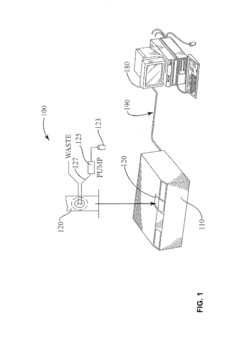
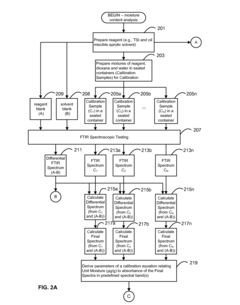
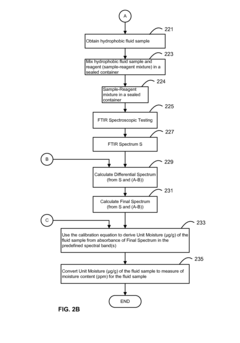
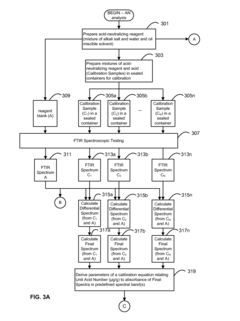
- A system and method using FTIR spectroscopy that involves preparing reagents reacting with the sample to produce carbon dioxide gas, allowing for calibration equations to be derived from standard mixtures, enabling precise measurement of moisture, acidity, or basicity by analyzing absorbance in specific spectral bands, which can be applied to various hydrophobic fluids and solid matrices.
Quality Standards and Regulations for TCP Purity
The quality standards and regulations governing tricalcium phosphate (TCP) purity are established by multiple international and national regulatory bodies, each addressing specific application domains. The pharmaceutical industry primarily follows United States Pharmacopeia (USP), European Pharmacopoeia (Ph.Eur.), and Japanese Pharmacopoeia (JP) standards, which define stringent purity requirements typically exceeding 98% for pharmaceutical-grade TCP. These pharmacopeial standards specify acceptable limits for heavy metals, arsenic, lead, and other impurities, with detailed analytical procedures for verification.
Food and dietary supplement applications are governed by the Food and Drug Administration (FDA) in the United States, which classifies TCP as Generally Recognized as Safe (GRAS) under specific purity criteria. The European Food Safety Authority (EFSA) maintains similar regulations under EU food additive legislation, requiring compliance with E341 specifications for calcium phosphates used in food products.
Industrial and biomedical applications follow ISO 13779 series standards for calcium phosphate materials, particularly relevant for bone substitute and dental applications. These standards establish minimum purity thresholds of 95-99% depending on the intended use, with specific requirements for crystalline phase composition and particle size distribution.
The regulatory framework increasingly emphasizes analytical method validation, requiring laboratories to demonstrate method accuracy, precision, and reproducibility. FTIR spectroscopy, while not always the primary analytical technique specified in traditional pharmacopeial methods, is gaining recognition as a complementary analytical tool when properly validated against established reference methods.
Recent regulatory trends indicate growing acceptance of advanced spectroscopic techniques, including FTIR, provided they meet International Conference on Harmonisation (ICH) guidelines for analytical procedure validation. Regulatory bodies are also implementing stricter controls on manufacturing processes, requiring comprehensive quality management systems that incorporate multiple analytical techniques for comprehensive purity assessment and batch-to-batch consistency verification.
Food and dietary supplement applications are governed by the Food and Drug Administration (FDA) in the United States, which classifies TCP as Generally Recognized as Safe (GRAS) under specific purity criteria. The European Food Safety Authority (EFSA) maintains similar regulations under EU food additive legislation, requiring compliance with E341 specifications for calcium phosphates used in food products.
Industrial and biomedical applications follow ISO 13779 series standards for calcium phosphate materials, particularly relevant for bone substitute and dental applications. These standards establish minimum purity thresholds of 95-99% depending on the intended use, with specific requirements for crystalline phase composition and particle size distribution.
The regulatory framework increasingly emphasizes analytical method validation, requiring laboratories to demonstrate method accuracy, precision, and reproducibility. FTIR spectroscopy, while not always the primary analytical technique specified in traditional pharmacopeial methods, is gaining recognition as a complementary analytical tool when properly validated against established reference methods.
Recent regulatory trends indicate growing acceptance of advanced spectroscopic techniques, including FTIR, provided they meet International Conference on Harmonisation (ICH) guidelines for analytical procedure validation. Regulatory bodies are also implementing stricter controls on manufacturing processes, requiring comprehensive quality management systems that incorporate multiple analytical techniques for comprehensive purity assessment and batch-to-batch consistency verification.
Validation Protocols for FTIR-Based TCP Testing
Establishing robust validation protocols for FTIR-based TCP testing requires a systematic approach that ensures measurement accuracy, reproducibility, and regulatory compliance. The validation framework must address both analytical performance characteristics and operational parameters to guarantee reliable purity assessment results across different laboratory environments and testing conditions.
Method validation begins with defining acceptance criteria for key analytical parameters including accuracy, precision, linearity, range, detection limits, and specificity. For TCP purity analysis, accuracy should be validated against certified reference materials with known purity levels, typically requiring recovery rates within 98-102% of the theoretical values. Precision validation encompasses both repeatability and intermediate precision, with relative standard deviation values generally not exceeding 2% for replicate measurements under identical conditions.
Linearity validation involves establishing the relationship between FTIR spectral response and TCP concentration across the expected purity range. This typically requires preparing calibration standards spanning 85-100% purity levels, with correlation coefficients exceeding 0.995 to demonstrate acceptable linear response. The working range should encompass all expected sample concentrations while maintaining adequate analytical performance throughout the specified range.
Specificity validation focuses on demonstrating the method's ability to distinguish TCP from potential interferents and impurities commonly found in calcium phosphate materials. This includes testing against other calcium phosphate phases such as hydroxyapatite, dicalcium phosphate, and amorphous calcium phosphate, ensuring minimal cross-reactivity and false positive results.
System suitability testing establishes routine performance checks to ensure consistent instrument performance before sample analysis. These tests include baseline stability verification, wavelength accuracy confirmation using polystyrene standards, and photometric accuracy assessment using neutral density filters. Acceptance criteria should be established for each parameter with appropriate control limits.
Documentation protocols must encompass complete traceability from sample preparation through final results reporting. This includes detailed standard operating procedures, calibration records, maintenance logs, analyst qualification records, and change control documentation. Regular revalidation schedules should be established to maintain method validity over time, typically requiring annual performance verification and full revalidation following significant procedural modifications or equipment changes.
Method validation begins with defining acceptance criteria for key analytical parameters including accuracy, precision, linearity, range, detection limits, and specificity. For TCP purity analysis, accuracy should be validated against certified reference materials with known purity levels, typically requiring recovery rates within 98-102% of the theoretical values. Precision validation encompasses both repeatability and intermediate precision, with relative standard deviation values generally not exceeding 2% for replicate measurements under identical conditions.
Linearity validation involves establishing the relationship between FTIR spectral response and TCP concentration across the expected purity range. This typically requires preparing calibration standards spanning 85-100% purity levels, with correlation coefficients exceeding 0.995 to demonstrate acceptable linear response. The working range should encompass all expected sample concentrations while maintaining adequate analytical performance throughout the specified range.
Specificity validation focuses on demonstrating the method's ability to distinguish TCP from potential interferents and impurities commonly found in calcium phosphate materials. This includes testing against other calcium phosphate phases such as hydroxyapatite, dicalcium phosphate, and amorphous calcium phosphate, ensuring minimal cross-reactivity and false positive results.
System suitability testing establishes routine performance checks to ensure consistent instrument performance before sample analysis. These tests include baseline stability verification, wavelength accuracy confirmation using polystyrene standards, and photometric accuracy assessment using neutral density filters. Acceptance criteria should be established for each parameter with appropriate control limits.
Documentation protocols must encompass complete traceability from sample preparation through final results reporting. This includes detailed standard operating procedures, calibration records, maintenance logs, analyst qualification records, and change control documentation. Regular revalidation schedules should be established to maintain method validity over time, typically requiring annual performance verification and full revalidation following significant procedural modifications or equipment changes.
Unlock deeper insights with Patsnap Eureka Quick Research — get a full tech report to explore trends and direct your research. Try now!
Generate Your Research Report Instantly with AI Agent
Supercharge your innovation with Patsnap Eureka AI Agent Platform!